

|
시장보고서
상품코드
2065591
상업용 IT 하드웨어 플릿 조달 시장 : 시장 점유율 분석, 업계 동향 및 통계, 성장 예측(2026-2031년)Commercial IT Hardware Fleet Procurement - Market Share Analysis, Industry Trends & Statistics, Growth Forecasts (2026 - 2031) |
||||||
 Mordor Intelligence
Mordor Intelligence에 의하면, 상업용 IT 하드웨어 플릿 조달 시장은 2026년 253억 7,000만 달러로 추정되고, 2031년까지 368억 2,000만 달러로 확대될 전망이며, 동기 사이 CAGR은 7.73%를 나타낼 것으로 예측됩니다.
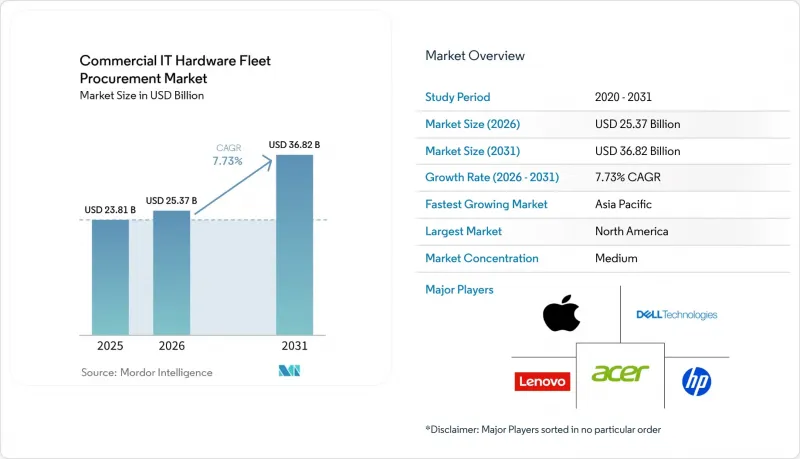
본 보고서는 하드웨어 카테고리별(노트북, 데스크톱 등), 조달 모델별(일괄 구매, 리스, Device-As-A-Service 등), 최종 사용자 산업 분야별(은행, 금융서비스 및 보험(BFSI), 의료, IT 및 통신, 정부, 교육 등), 조직 규모별(대기업, 중소기업) 및 지역별로 분류되어 있습니다. 시장 전망은 금액(달러) 기준으로 제시되어 있습니다.
세계의 상업용 IT 하드웨어 플릿 조달 시장 동향 및 인사이트
하이브리드 근무 방식에 따른 하드웨어 교체 주기의 가속화
팬데믹 이후 정착된 하이브리드 근무 방식으로 인해, 기업들이 급히 조달한 소비자용 기기를 하드웨어 기반 인증 기능이 탑재된 상용 등급의 엔드포인트로 교체하는 움직임이 가속화되면서, 동기화된 업데이트 프로그램이 추진되고 있습니다. 마이크로소프트가 2025년 10월에 Windows 10 지원을 종료함에 따라, 2억 4,000만 대의 PC가 업데이트 대상이 되며, 그 영향이 2026년까지 이어질 것으로 예상되는 가운데, 클라우드에서 엣지로 추론 처리를 오프로드하는 신경망 처리 장치(NPU)를 탑재한 AI 지원 하드웨어가 주목받고 있습니다. 이를 통해 협업 플랫폼의 지연 시간을 대폭 줄이는 동시에 데이터 전송 비용도 절감하고 있습니다. 델 테크놀로지스는 2025년 기업용 RFP(제안 요청서)의 68%에 AI PC 관련 요구 사항이 명시되어 있었습니다고 밝히며, 단순한 기기 교체에서 기능 중심의 조달로 전환되고 있음을 보여주고 있습니다.
‘디바이스 애즈 어 서비스(DaaS)’ 계약의 보급 확대
Device-as-a-Service(DaaS)는 하드웨어 지출을 구독형 지출로 전환하고 잔존 가치에 대한 위험을 공급업체로 이전함으로써, 대차대조표 최적화를 목표로 하는 CFO의 목표에 부합하는 것입니다. HP Inc.는 2025년에 DaaS 번들 서비스를 확대하여 탄소 중립 배송과 기기의 수명을 2년 연장하는 모듈식 부품 교체를 포함시켰습니다. 레노버의 ‘TruScale’은 사용량에 따른 과금 체계를 확대하고, 고장이 발생하기 전에 선제적으로 교체를 실시하는 시스템을 도입했습니다. 이를 통해 금융 서비스 업계 고객을 대상으로 한 시범 도입에서 예상치 못한 가동 중단 시간을 3분의 1로 줄였습니다. DaaS는 장비 교체에 따르는 번거로움을 줄여주지만, 조달 팀은 잠재적인 락인 현상에 대한 경계를 늦추지 않고 있으며, 규제상 의무를 이행하기 위해 데이터 삭제 조항을 계약에 포함시킬 것을 강력히 요구하고 있습니다.
전 세계 반도체 공급 부족의 지속
반도체 제조 시설에 막대한 투자를 했음에도 불구하고, 구세대 노드의 부족 현상은 여전히 계속되고 있습니다. TSMC의 2025년 설비 투자는 최첨단 노드 개발에 중점을 두고 있어, 중요한 28나노미터 생산 라인에 배정되는 생산 능력은 제한적입니다. 이러한 제약으로 인해 리드타임이 최대 18주까지 길어지면서, 노트북 생산 지연과 공급망에 차질이 발생하고 있습니다. 또한, 데이터센터 재고 보충에 따른 수요 증가를 배경으로, DDR5 모듈 가격은 2024년 4분기부터 2025년 2분기에 걸쳐 50% 상승했습니다. 이러한 가격 급등으로 인해 OEM(주문자 상표 제조업체)은 비용 증가분을 기업 고객에게 전가할 수밖에 없게 되어, 예산 부담이 더욱 커지고 있습니다. 이러한 과제에 대응하기 위해 조달팀은 2차 정보의 선택지를 확대함으로써 위험을 줄여왔습니다. 그러나 이러한 접근 방식은 재고 비용 증가와 품질 관리 위험의 증대를 초래하여, 공급망 관리를 더욱 복잡하게 만들고 있습니다.
부문별 분석
모바일 핸드헬드 기기는 2025년 기준 매출 비중이 낮았으나, 연평균 성장률(CAGR) 8.93%로 확대될 것으로 예상되며, 이는 상업용 IT 하드웨어 대량 조달 시장에서 가장 높은 성장률에 해당합니다. 유틸리티, 광업, 물류 기업에서는 자산 점검 및 계량 검침의 디지털화를 추진하기 위해 견고하고 본질안전형 태블릿을 도입하고 있습니다. Getac Technology는 예측 유지보수 용도과 결합된 5G 지원 모델의 호조에 힘입어, 2025년 러기드 태블릿 출하량이 42% 급증했습니다. Zebra Technologies는 성수기 수요 급증에 직면한 창고를 위해 6인치 디스플레이와 핫스왑 지원 배터리를 탑재한 핸드헬드 스캐너 라인업을 확대했습니다.
2025년, 노트북은 상업용 IT 하드웨어 조달 시장에서 46.32%의 점유율을 유지했으나, 가상 데스크톱 인프라(VDI)의 보급으로 인해 지식 근로자의 컴퓨팅 수요가 억제되면서 성장세가 둔화되고 있습니다. 데스크톱 PC는 정해진 자리에서 작업하는 것이 주를 이루는 콜센터나 교육 현장에서 여전히 사용되고 있으며, 워크스테이션은 별도의 GPU가 필요한 엔지니어링 및 미디어 관련 업무에서 여전히 없어서는 안 될 존재로 남아 있습니다. 각 제조업체들이 로컬 연산 처리를 확대함에 따라 엣지 환경에 최적화된 서버 시장이 성장하고 있으며, Supermicro는 2025년에 전년 대비 38%의 성장률을 기록했습니다. 컴퓨터 주변기기는 엔드포인트의 보급 확대에 발맞추어 성장하고 있지만, USB-C의 표준화로 인해 차별화 요소가 줄어들면서 상품화 현상에 직면해 있습니다.
디바이스-어즈-어-서비스(DaaS) 계약은 연평균 성장률(CAGR) 8.73%로 확대될 것으로 예상되며, 2025년에는 51.13%의 시장 점유율을 차지한 것으로 평가된, 일괄 구매 방식의 우위를 점차 약화시킬 것으로 보입니다. HP는 DaaS 수주액이 전년 대비 29%라는 큰 폭 증가를 기록했으며, 계약 기간은 최장 4년에 달할 전망입니다. 이러한 계약에는 하드웨어, 지원 서비스, 지속가능성 기능 등의 번들 서비스가 포함되는 경우가 많아, 기업에게 매력적인 선택지가 되고 있습니다. 리스는 그 유연성 덕분에 중견 기업들 사이에서 여전히 인기 있는 선택지이지만, DaaS가 제공하는 통합적인 리프레시 자동화 기능을 갖추고 있지 않아, IT 운영 효율화를 목표로 하는 조직에게 있어 이는 점점 더 중요한 요소가 되고 있습니다.
인증 리퍼비시 시장도 성장세를 보이고 있으며, Dell 등 기업들은 2025년에 리퍼비시 프로그램을 통해 약 120만 대를 처리한 것으로 평가되었습니다. 이러한 프로그램에서는 완전한 보증을 유지하면서 리퍼브 제품을 30-40% 할인된 가격에 제공하고 있어, 예산을 중시하는 구매자에게 비용 대비 효과가 높은 선택지가 되고 있습니다. 그러나 데이터 주권에 관한 요건이 엄격한 업계에서는 여전히 완전 소유 모델이 선호되고 있습니다. 그럼에도 불구하고, 기업들이 IT 전략에서 유연성과 비용 효율성을 점점 더 중요시하게 되면서, 운영 비용(OpEx)이 클라우드 지출 동향과 일치함에 따라 DaaS와 같은 구독형 모델로 점차 균형이 이동하고 있습니다.
지역별 분석
2025년 조달 지출 중 북미가 38.21%를 차지했습니다. 이는 제로 트러스트 요건의 도입과 엔드포인트에서의 AI 기술 조기 도입이 주도한 결과입니다. 특히 미국에서는 ‘지속적 진단 및 완화(CDM)’ 등의 연방 프로그램을 통해 막대한 투자가 이루어졌습니다. 이 프로그램에 따라 하드웨어 기반의 인증 정보 저장이 의무화되었으며, 다양한 정부 기관에서 업그레이드가 진행되었습니다. 또한, 캐나다와 멕시코에서는 제조 활동이 아시아에서 북미로 이동하는 ‘니어쇼어링’ 추세의 혜택을 받아, 지역 내 IT 인프라 및 관련 기술에 대한 투자가 더욱 확대되었습니다.
아시아태평양은 예측 기간 동안 8.36%라는 지역별 최고 연평균 성장률(CAGR)을 달성할 것으로 전망됩니다. 인도의 ‘디지털 인디아 2.0’ 이니셔티브에서는 2025년에 IT 인프라 강화를 위해 12억 달러가 배정되었으며, 학교 및 전자정부 센터용 기기 50만 대 조달 등이 포함되어 있어, 이것이 해당 지역의 성장을 견인하고 있습니다. 한편, 중국의 ‘이중 순환’ 정책은 기업들이 화웨이(Huawei)나 인스파(Inspur) 등 국내 제조업체의 서버를 도입하도록 장려함으로써 지정학적 위험을 완화하는 데 기여하고 있습니다. 또한 일본도 클라우드 기반 솔루션을 도입하는 중소기업(SME)을 대상으로 하드웨어 비용의 50%를 지원하는 디지털 전환(DX) 보조금을 확대함으로써 해당 지역의 성장에 기여하고 있습니다.
유럽에서는 엄격한 환경·사회·지배구조(ESG) 규제와 재정 긴축 정책 간의 균형을 모색하고 있습니다. GDPR(EU 개인정보보호규정) 시행과 사이버 보안 지침으로 인해 엔드포인트 단말기 수요는 유지되고 있지만, 공공 부문의 예산 동결로 인해 해당 지역의 전반적인 성장세는 둔화되고 있습니다. 남미에서는 가격에 대한 민감도가 여전히 중요한 요인으로 작용하고 있으며, 많은 기업들이 비용 관리를 위해 재생 제품이나 장기 결제 조건을 선택하고 있습니다. 중동 및 아프리카에서는 수요의 양극화 현상이 나타나고 있으며, 걸프 연안 국가들은 스마트 시티 인프라 프로젝트에 막대한 투자를 하고 있는 반면, 많은 아프리카 시장에서는 유선 광대역 인프라의 한계를 극복하기 위해 ‘모바일 우선’ 조달 전략을 우선시하고 있습니다.
기타 혜택 :
- 엑셀 형식 시장 예측(ME) 시트
- 3개월간의 애널리스트 지원
자주 묻는 질문
목차
제1장 서론
제2장 조사 방법
제3장 주요 요약
제4장 시장 구도
제5장 시장 규모 및 성장 예측
제6장 경쟁 구도
제7장 시장 기회 및 향후 전망
LSH 26.06.24According to Mordor Intelligence, the commercial IT hardware fleet procurement market is projected to expand from USD 25.37 billion in 2026 to USD 36.82 billion by 2031, registering a CAGR of 7.73% over the same period.
This report is Segmented by Hardware Category (Laptops and Notebooks, Desktops, and More), Procurement Model (Outright Purchase, Leasing, Device-As-A-Service, and More), End-User Industry (BFSI, Healthcare, IT and Telecom, Government, Education, and More ), Organization Size (Large Enterprises, and SMEs), and Geography. The Market Forecasts are Provided in Terms of Value (USD).
Global Commercial IT Hardware Fleet Procurement Market Trends and Insights
Accelerated Hybrid-Work Hardware Refresh Cycles
Hybrid work, entrenched since the pandemic, is driving synchronized refresh programs as enterprises replace hastily procured consumer devices with commercial-grade endpoints that embed hardware-based attestation. Microsoft's October 2025 end-of-support for Windows 10 pushed 240 million PCs into refresh queues, and the spillover into 2026 is emphasizing AI-ready hardware equipped with neural processing units that offload inference from the cloud to the edge, slashing latency for collaboration platforms while curbing egress expenses. Dell Technologies disclosed that 68% of enterprise RFPs in 2025 specified AI PC requirements, underscoring the pivot from generic replacement to capability-centric procurement
Rising Adoption of Device-as-a-Service Contracts
Device-as-a-service (DaaS) converts hardware spending into subscription outlays and shifts residual-value risk to vendors, aligning with CFO goals for balance-sheet optimization. HP Inc. broadened its DaaS bundle in 2025 to include carbon-neutral shipping and modular component swaps that lengthen device life by two years. Lenovo's TruScale expanded usage-based billing that triggers proactive swaps before failure, cutting unplanned downtime by one-third in pilot deployments for financial-services clients. While DaaS mitigates refresh headaches, procurement teams remain alert to potential lock-in and insist on data-sanitization clauses to satisfy regulatory obligations.
Persistent Global Semiconductor Supply Gaps
Despite significant investments in semiconductor fabrication facilities, shortages of legacy nodes continue to persist. TSMC's capital expenditure for 2025 has been heavily focused on advancing cutting-edge nodes, leaving limited capacity for critical 28-nanometer production lines. This constraint has led to extended lead times of up to 18 weeks, causing delays in laptop production and impacting supply chains. Additionally, DDR5 module prices increased by 50% between Q4 2024 and Q2 2025, driven by heightened demand from data center restocking. This price surge has forced original equipment manufacturers (OEMs) to transfer the increased costs to enterprise buyers, further straining budgets. In response to these challenges, procurement teams have sought to mitigate risks by expanding secondary sourcing options. However, this approach has led to higher inventory costs and increased quality-control risks, adding complexity to supply chain management.
Other drivers and restraints analyzed in the detailed report include:
- ESG-Linked Procurement Mandates from Enterprises
- Chipset Road-Map Alignment Reducing Total Lifecycle Cost
- Budget Freezes in Public Sector IT Spending
For complete list of drivers and restraints, kindly check the Table Of Contents.
Segment Analysis
Mobile handheld devices contributed a smaller revenue base in 2025 but are forecast to advance at an 8.93% CAGR, the fastest within the commercial IT hardware fleet procurement market. Utilities, mining, and logistics firms are rolling out rugged, intrinsically safe tablets to digitize asset inspections and meter readings. Getac Technology saw rugged tablet shipments jump 42% in 2025, driven by 5G-enabled models paired with predictive-maintenance applications. Zebra Technologies supplemented its handheld scanner line with six-inch displays and hot-swappable batteries for warehouses grappling with peak-season surges.
Laptops and notebooks retained 46.32% of the commercial IT hardware fleet procurement market share in 2025, yet growth tapers as virtual desktop infrastructure tempers compute needs for knowledge workers. Desktops persist in call centers and education, where stationary workflows prevail, and workstations remain indispensable for engineering and media workloads that require discrete GPUs. Edge-optimized servers are growing as manufacturers deploy localized compute; Supermicro logged 38% year-over-year growth in 2025. Computer peripherals track endpoint proliferation but face commoditization as USB-C standardization narrows differentiation.
Device-as-a-service (DaaS) contracts are expected to grow at a compound annual growth rate (CAGR) of 8.73%, gradually reducing the dominance of outright purchases, which are projected to hold a 51.13% share in 2025. HP has reported a significant 29% year-over-year increase in its DaaS bookings, with contract durations extending up to four years. These contracts often include bundled offerings such as hardware, support services, and sustainability features, making them an attractive option for businesses. While leasing remains a popular choice among mid-sized firms due to its flexibility, it lacks the integrated refresh automation that DaaS provides, which is increasingly becoming a critical factor for organizations aiming to streamline their IT operations.
The certified refurbishment market is also gaining momentum, with companies like Dell processing approximately 1.2 million units in 2025 through their refurbishment programs. These programs offer refurbished devices at 30-40% off while still providing full warranties, making them a cost-effective alternative for budget-conscious buyers. However, outright ownership remains the preferred model for industries with stringent data sovereignty requirements. Despite this, the alignment of operational expenditure (OpEx) with cloud spending trends is gradually shifting the balance in favor of subscription-based models like DaaS, as businesses increasingly prioritize flexibility and cost efficiency in their IT strategies.
Geography Analysis
North America accounted for 38.21% of procurement outlays in 2025, driven by the implementation of zero-trust mandates and the early adoption of AI technologies at endpoints. The United States, in particular, saw significant investments through federal programs such as Continuous Diagnostics and Mitigation, which mandated hardware-rooted credential storage, prompting upgrades across various agencies. Additionally, Canada and Mexico benefited from nearshoring trends as manufacturing activities shifted from Asia to North America, further boosting investments in regional IT infrastructure and related technologies.
Asia-Pacific is projected to achieve the highest regional CAGR at 8.36% during the forecast period. India's Digital India 2.0 initiative allocated USD 1.2 billion in 2025 to enhance IT infrastructure, including the procurement of 500,000 devices for schools and e-governance centers, thereby driving growth in the region. Meanwhile, China's dual-circulation policy encouraged enterprises to adopt domestic servers from companies like Huawei and Inspur, helping mitigate geopolitical risks. Japan is also contributing to the region's growth by extending digital transformation subsidies that covered 50% of hardware costs for small and medium-sized enterprises (SMEs) adopting cloud-based solutions.
Europe continues to balance strong environmental, social, and governance (ESG) regulations with fiscal austerity measures. While GDPR enforcement and cybersecurity directives sustain demand for endpoint devices, public-sector budget freezes have slowed overall growth in the region. In South America, price sensitivity remains a key factor, with many organizations opting for refurbished equipment and long payment terms to manage costs. The Middle East and Africa exhibit a bifurcated demand pattern, with Gulf states investing heavily in smart-city infrastructure projects, while many African markets prioritize mobile-first procurement strategies to overcome the limitations of wired broadband infrastructure.
- Dell Technologies Inc.
- HP Inc.
- Lenovo Group Limited
- Apple Inc.
- Acer Inc.
- ASUSTeK Computer Inc.
- Samsung Electronics Co., Ltd.
- Fujitsu Limited
- Toshiba Corporation
- Panasonic Holdings Corporation
- Dynabook Inc.
- Microsoft Corporation
- Huawei Technologies Co., Ltd.
- Cisco Systems, Inc.
- Getac Technology Corporation
- Micro-Star International Co., Ltd.
- LG Electronics Inc.
- Zebra Technologies Corporation
- Honeywell International Inc.
- Super Micro Computer, Inc.
Additional Benefits:
- The market estimate (ME) sheet in Excel format
- 3 months of analyst support
TABLE OF CONTENTS
1 INTRODUCTION
- 1.1 Study Assumptions and Market Definition
- 1.2 Scope of the Study
2 RESEARCH METHODOLOGY
3 EXECUTIVE SUMMARY
4 MARKET LANDSCAPE
- 4.1 Market Overview
- 4.2 Market Drivers
- 4.2.1 Accelerated Hybrid-Work Hardware Refresh Cycles
- 4.2.2 Rising Adoption of Device-as-a-Service Contracts
- 4.2.3 ESG-Linked Procurement Mandates from Enterprises
- 4.2.4 Chipset Road-Map Alignment Reducing Total Lifecycle Cost
- 4.2.5 Zero-Trust Security Standards Driving Endpoint Upgrades
- 4.2.6 Surge in Edge-Computing Server Deployments
- 4.3 Market Restraints
- 4.3.1 Persistent Global Semiconductor Supply Gaps
- 4.3.2 Budget Freezes in Public Sector IT Spending
- 4.3.3 Lengthening Hardware Replacement Cycles via Cloud Migration
- 4.3.4 Rising E-Waste Compliance Costs for Procurers
- 4.4 Impact of Macroeconomic Factors on the Market
- 4.5 Industry Value Chain Analysis
- 4.6 Regulatory Landscape
- 4.7 Technological Outlook
- 4.8 Porter's Five Forces Analysis
- 4.8.1 Bargaining Power of Suppliers
- 4.8.2 Bargaining Power of Buyers
- 4.8.3 Threat of New Entrants
- 4.8.4 Threat of Substitutes
- 4.8.5 Intensity of Competitive Rivalry
5 MARKET SIZE AND GROWTH FORECASTS (VALUE)
- 5.1 By Hardware Category
- 5.1.1 Laptops and Notebooks
- 5.1.2 Desktops
- 5.1.3 Workstations
- 5.1.4 Servers
- 5.1.5 Mobile Handheld Devices
- 5.1.6 Computer Peripherals
- 5.2 By Procurement Model
- 5.2.1 Outright Purchase
- 5.2.2 Leasing
- 5.2.3 Device-as-a-Service (DaaS)
- 5.2.4 Subscription-Based Procurement
- 5.2.5 Buyback and Refurbished Programs
- 5.3 By End-User Industry
- 5.3.1 BFSI
- 5.3.2 Healthcare
- 5.3.3 IT and Telecom
- 5.3.4 Government and Public Sector
- 5.3.5 Education
- 5.3.6 Manufacturing
- 5.3.7 Retail and E-Commerce
- 5.3.8 Energy and Utilities
- 5.4 By Organization Size
- 5.4.1 Large Enterprises
- 5.4.2 Small and Medium Enterprises (SMEs)
- 5.5 By Geography
- 5.5.1 North America
- 5.5.1.1 United States
- 5.5.1.2 Canada
- 5.5.1.3 Mexico
- 5.5.2 South America
- 5.5.2.1 Brazil
- 5.5.2.2 Argentina
- 5.5.2.3 Rest of South America
- 5.5.3 Europe
- 5.5.3.1 United Kingdom
- 5.5.3.2 Germany
- 5.5.3.3 France
- 5.5.3.4 Italy
- 5.5.3.5 Spain
- 5.5.3.6 Rest of Europe
- 5.5.4 Asia-Pacific
- 5.5.4.1 China
- 5.5.4.2 Japan
- 5.5.4.3 India
- 5.5.4.4 South Korea
- 5.5.4.5 Rest of Asia-Pacific
- 5.5.5 Middle East and Africa
- 5.5.5.1 Middle East
- 5.5.5.1.1 United Arab Emirates
- 5.5.5.1.2 Saudi Arabia
- 5.5.5.1.3 Rest of Middle East
- 5.5.5.2 Africa
- 5.5.5.2.1 South Africa
- 5.5.5.2.2 Egypt
- 5.5.5.2.3 Rest of Africa
- 5.5.5.1 Middle East
- 5.5.1 North America
6 COMPETITIVE LANDSCAPE
- 6.1 Market Concentration
- 6.2 Strategic Moves
- 6.3 Market Share Analysis
- 6.4 Company Profiles (includes Global Level Overview, Market Level Overview, Core Segments, Financials as available, Strategic Information, Market Rank/Share, Products and Services, Recent Developments)
- 6.4.1 Dell Technologies Inc.
- 6.4.2 HP Inc.
- 6.4.3 Lenovo Group Limited
- 6.4.4 Apple Inc.
- 6.4.5 Acer Inc.
- 6.4.6 ASUSTeK Computer Inc.
- 6.4.7 Samsung Electronics Co., Ltd.
- 6.4.8 Fujitsu Limited
- 6.4.9 Toshiba Corporation
- 6.4.10 Panasonic Holdings Corporation
- 6.4.11 Dynabook Inc.
- 6.4.12 Microsoft Corporation
- 6.4.13 Huawei Technologies Co., Ltd.
- 6.4.14 Cisco Systems, Inc.
- 6.4.15 Getac Technology Corporation
- 6.4.16 Micro-Star International Co., Ltd.
- 6.4.17 LG Electronics Inc.
- 6.4.18 Zebra Technologies Corporation
- 6.4.19 Honeywell International Inc.
- 6.4.20 Super Micro Computer, Inc.
7 MARKET OPPORTUNITIES AND FUTURE OUTLOOK
- 7.1 White-Space and Unmet-Need Assessment

(주말 및 공휴일 제외)


