|
시장보고서
상품코드
2065616
비안정 멀티바이브레이터 시장 : 점유율 분석, 업계 동향과 통계, 성장 예측(2026-2031년)Astable Multivibrator - Market Share Analysis, Industry Trends & Statistics, Growth Forecasts (2026 - 2031) |
||||||
 Mordor Intelligence
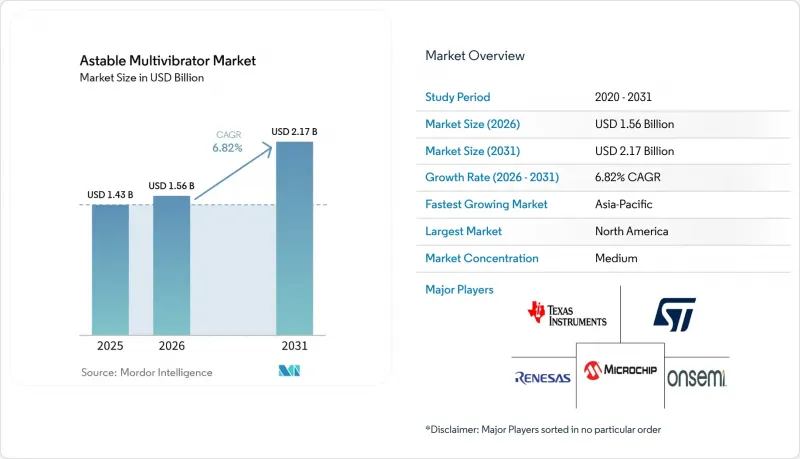
Mordor Intelligence에 의하면, 비안정 멀티바이브레이터 시장 규모는 2025년 14억 3,000만 달러에서 2026년에는 15억 6,000만 달러로 확대되어 2026년부터 2031년까지 CAGR 6.82%로 성장을 지속하여, 2031년에는 21억 7,000만 달러에 이를 것으로 예측됩니다.
본 보고서는 구성 유형(이미터 결합형 비안정 멀티바이브레이터 등), 회로 구현(IC 기반 비안정 멀티바이브레이터 등), 용도(클럭 및 발진기 기능, 발진기 기능 등), 최종 사용 산업(가정용 전자기기, 산업용 자동화 및 제어 등), 그리고 지역별로 분류되어 있습니다. 시장 전망은 금액(달러) 기준으로 제시되어 있습니다.
세계 비안정 멀티바이브레이터 시장 동향 및 인사이트
가정용 및 산업용 전자기기에서 임베디드 타이밍 기능에 대한 수요 증가
저비용 전자 조립 분야에서는 시퀀싱 제어 및 제어를 위해 여전히 간단한 발진기 기능이 필요하기 때문에 내장형 타이밍 기능에 대한 수요는 비안정 멀티바이브레이터 시장에 있어 가장 강력한 버팀목으로 남아 있습니다. 이는 스마트 플러그, 백색 가전, 전동 공구, 교육용 키트, 그리고 기존의 타이머 IC 아키텍처에 계속 의존하고 있는 경공업용 시스템 등 폭넓은 분야에 적용됩니다. 555 패밀리 CMOS 타이머의 방대한 도입 실적은 지속적인 교체 수요와 폭넓은 설계 참조 기반을 창출하고 있으며, 이는 성숙한 제품 카테고리에서 비안정 멀티바이브레이터 시장이 계속해서 중요한 위치를 차지하는 한 가지 요인이 되고 있습니다. 또한, CMOS 구현은 바이폴라형에 비해 공급 전류를 대폭 낮출 수 있기 때문에 배터리 보조형 설계에서도 우위를 유지하고 있으며, 단순성과 낮은 대기 전력 소모를 중시하는 제품에서 비안정 멀티바이브레이터 시장의 경쟁력을 뒷받침하고 있습니다. 주요 공급업체들의 지속적인 제품 지원은 각 OEM 업체들이 여전히 3.3V 및 5V 미만의 시스템 레일용 이러한 유형의 타이밍 디바이스에 투자하고 있음을 보여주며, 기존 설계와 새로운 저전압 설계 모두에서 비안정 멀티바이브레이터 시장을 뒷받침하고 있습니다.
산업용 자동화 및 저비용 PWM의 도입
산업 자동화 분야에서는 저비용 펄스 폭 변조(PWM), 시퀀싱 제어, 센서 폴링 및 액추에이터 타이밍이 여전히 많은 공장 시스템에서 기판 수준에서 처리되고 있기 때문에 비안정 멀티바이브레이터 시장을 지속적으로 지탱하고 있습니다. 이러한 기능은 컨베이어 제어, 모터의 소프트 스타트 회로 및 로컬 신호 조정 블록에서 찾아볼 수 있지만, 이러한 경우에는 프로그래밍 가능한 대체품보다 전용으로 설계된 타이머가 검증 및 유지보수가 더 용이한 경우가 있습니다. 2025년에 발표된 조사에 따르면, 로직 게이트 발진기 구조를 갖춘 CMOS 카운터 기반의 고정밀 시간 간격 발생기는 산업용 IoT 환경에서 1 kHz에서 ±3µ s의 펄스 편차를 실현하고 있어, 가혹한 환경 하에서 단순한 발진기 방식의 신뢰성을 입증하고 있습니다. 이러한 불안정한 멀티 바이브레이터 시장에서도 장기적인 공급 보장은 중요한 요소입니다. 플랜트 운영자나 시스템 통합사업자는 제품의 수명 주기 전반에 걸쳐 장기간 구할 수 있는 부품을 선호하기 때문입니다. 따라서 소프트웨어 유지보수가 필요 없고, 변경 관리 비용이 높은 상황에서는 저비용 타이머 IC 및 관련 발진 회로가 매력적인 선택지가 됩니다.
MCU, SoC 및 프로그래머블 클럭 기반 대체 제품과의 경쟁
비안정 멀티바이브레이터 시장에 가해지는 가장 두드러진 압박 요인은 마이크로컨트롤러, SoC 및 프로그래머블 클럭 디바이스의 기능 향상에서 비롯됩니다. 이들 장치는 현재, 과거에는 독립된 발진 회로가 담당하던 기능을 처리할 수 있게 되었습니다. 마이크로칩사의 PIC12LF1571/2 시리즈는 3개의 16비트 PWM 출력, 워치독 타이머, 저주파 모드에서 매우 낮은 전류로 동작하면서도 ±1%로 보정된 고정밀 내부 발진기를 결합하고 있어, 많은 소규모 노드 설계에서 별도의 타이머가 필요하지 않습니다. 타이밍 기능이 펌웨어로 이전되면 채널을 추가하는 비용이 대폭 감소하므로, 다기능 설계에서 전용 비안정 발진단의 가치는 떨어집니다. 인접한 타이밍 시장에서의 통합 또한 이러한 압박을 더욱 가중시키고 있습니다. SiTime사가 르네사스의 타이밍 관련 자산을 인수한다고 발표한 것은 프로그래머블 및 MEMS 기반 타이밍 제품군이 클럭 및 발진기와 관련된 더 많은 응용 분야를 아우르는 방향으로 확대되고 있음을 보여줍니다. 따라서 비안정 멀티바이브레이터 시장공급업체들은 시스템 수준에서 단순성, 비프로그래밍식 작동, 펌웨어에 대한 의존성이 없습니다는 점이 여전히 중요한 이용 사례를 철저히 지켜나가야 합니다.
부문별 분석
2025년, 이미터 결합 회로는 비안정 멀티바이브레이터 시장 점유율의 54.12%를 차지하며, 구성 유형 중 1위를 차지했습니다. 이러한 1위 순위는 회로의 최소한의 단순성보다는 발진 주파수, 스위칭 속도, 파형의 대칭성이 더 중요한 응용 분야에서 뚜렷한 성능상의 우위를 반영하고 있습니다. 그 주된 이유는 이미터 결합 설계에서는 트랜지스터의 포화를 피할 수 있으므로, 저장 시간의 영향을 줄이고 더 깨끗한 스위칭 전이를 실현할 수 있다는 점에 있습니다. 이를 통해 보다 안정적인 국부 발진 동작이 요구되는 통신, 자동차용 전자기기 및 정밀 계측 기기의 설계 분야에서 비안정 멀티바이브레이터 시장에 대한 적합성이 한층 더 높아집니다. 한편, 콜렉터 결합 회로는 구성이 간편하고 지도하기 쉬우며, 저비용 실험 및 학습 환경에 적용하기에도 용이하기 때문에 여전히 중요한 역할을 하고 있습니다.
또한, 이미터 결합 회로는 2026년부터 2031년까지 연평균 성장률(CAGR) 7.22%를 기록하며 가장 빠르게 성장하는 구성 요소가 될 것으로 전망됩니다. 이는 비안정 멀티바이브레이터 시장에서 고부가가치 용도의 성장세가 가속화되고 있음을 보여줍니다. 수요를 견인하고 있는 것은 아날로그 RF 신호 생성뿐만 아니라, PWM 구동 조명 및 액추에이터 모듈에서 보다 예측 가능한 스위칭 에지를 선호하는 자동차 설계자들입니다. 이러한 양극화로 인해, 비안정 멀티바이브레이터 업계에는 두 가지 흐름이 나타나고 있습니다. 비용 중심의 설계에서는 기존과 같은 포화 모드 방식이 계속 채택되는 반면, 고성능 틈새 시장에서는 능동 영역 스위칭으로의 전환이 진행되고 있습니다. 2026년 시점에서도 계속 업데이트되고 있는 ABLIC의 자동차용 컴포트 타이머 제품군은 전문 아날로그 부품 공급업체들이 이러한 높은 신뢰성 요건을 충족하는 자동차 등급 타이밍 제품에 대한 투자를 지속하고 있음을 보여줍니다.
2025년, IC 기반 비안정 멀티바이브레이터는 회로?? 부문에서 67.39%의 점유율을 차지하며, 디스크리트 방식을 확실히 앞질렀습니다. 이러한 위상은 555 계열 타이머 및 CMOS 후속 제품을 둘러싼 수십 년에 걸친 표준화의 결과이며, 이 제품들은 컴팩트한 실적, 예측 가능한 타이밍, 폭넓은 입수성, 그리고 익숙한 설계 기법을 제공합니다. 비안정 멀티바이브레이터 시장은 이러한 도입 실적을 통해 혜택을 보고 있습니다. 이는 가정용, 산업용, 교육용 용도 엔지니어들이 이미 이러한 부품을 활용한 설계 방법을 잘 알고 있기 때문입니다. NE555, LMC555, TS556, ICM7555 등 각 제품군에 대한 지원 덕분에 이 카테고리는 활발한 상태를 유지하고 있으며, 널리 상호 참조되고 있어, 이는 지역을 불문하고 교체 수요의 지속에 기여하고 있습니다. ST마이크로일렉트로닉스의 2025년 TS556 업데이트 역시, 공급업체가 현재의 설계 요구 사항을 충족하기 위해 저전력 듀얼 CMOS 타이머 제품 라인을 지속적으로 제공하고 있음을 보여줍니다.
디스크리트 부품 부문은 2026년부터 2031년까지 연평균 성장률(CAGR) 7.62%를 나타낼 것으로 예측되며, 비안정 멀티바이브레이터 시장에서 가장 빠르게 성장하는 회로 구현 그룹이 될 전망입니다. 이러한 성장은 표준 IC의 핀 배치가 기판의 제약이나 전압 조건에 부합하지 않는 용도에서 트랜지스터 기반, 로직 게이트, 슈미트 트리거 및 연산 증폭기 기반 설계가 지닌 유연성을 반영한 것입니다. 슈미트 트리거 인버터와 같은 로직 패밀리는 기존의 555 타이머가 적합하지 않은 제한된 공간에서도 발진기 기능을 지원할 수 있기 때문에 소형 저전압 시스템에서 그 중요성이 점점 더 커지고 있습니다. 2025년 『Electronics』지에 게재된 연구에 따르면, 인버터 기반 수정 발진기 구조와 카운터를 결합함으로써 ±50 ppm의 안정성을 달성한 것으로 나타났으며, 이는 분산형 IoT 시스템에서 로직 게이트를 이용한 타이밍 기법의 설계적 중요성이 여전히 높다는 점을 뒷받침하고 있습니다.
지역별 분석
2025년, 북미는 비안정 멀티바이브레이터 시장 점유율의 36.16%를 차지하며, 지역별로는 가장 큰 기여를 한 지역이 되었습니다. 이 지역은 탄탄한 산업 자동화 기반, 성숙한 항공우주 및 방위용 전자 생태계, 그리고 차세대 플랫폼을 위한 타이머 IC 제품군의 인증을 지속적으로 획득하고 있는 반도체 설계 센터와 같은 강점을 활용하고 있습니다. 이러한 장기적인 설계 도입 주기는 비안정 멀티바이브레이터 시장을 지탱하고 있습니다. 왜냐하면 타이머 회로가 산업용 제어, 배전 또는 빌딩 시스템에 통합될 경우, 그 교체 주기가 여러 제품 세대에 걸쳐 있을 가능성이 있기 때문입니다. 아시아태평양은 2026년부터 2031년까지 연평균 성장률(CAGR) 7.74%를 나타낼 것으로 예측되며, 비안정 멀티바이브레이터 시장에서 가장 두드러진 성장을 보일 것으로 전망됩니다.
중국, 일본, 한국, 인도는 배터리 구동형 IoT 기기, 가전제품, 가정용 전자기기 및 자동차용 ECU의 대규모 생산을 통해 이 지역의 성장을 주도하고 있습니다. 이러한 제조 거점의 집중으로 인해, 저비용 임베디드 노드 및 제어 모듈에서 타이밍 회로가 반복적으로 사용됨에 따라, 비안정 멀티바이브레이터 시장에는 견고한 판매량 기반이 구축되어 있습니다. 유럽의 상황은 다르며, 독일과 프랑스가 자동차 공급망 및 수명이 긴 타이머 IC 제품군을 지정하는 산업용 기기 제조업체를 통해 수요를 뒷받침하고 있습니다. 자동차 및 공장용 전자기기의 안전성 및 인증 요건이 강화됨에 따라, 유럽 전역의 프로젝트에서 신뢰성이 더 높은 타이머 및 발진기 장치에 대한 수요가 증가하고 있습니다. 남미는 가정용 전자기기 조립 및 농업용 자동화 장비 수요에 힘입어, 비안정 멀티바이브레이터 시장에서 소폭이지만 안정적인 입지를 유지하고 있습니다.
아프리카와 중동은 여전히 초기 단계 시장이지만, 통신 인프라 구축과 전자제품의 보급 확대에 따라 저비용 타이밍 회로의 도입 대수가 증가하고 있습니다. 일본에서는 부품 조달에 있어 제품의 지속적인 공급과 검증된 품질이 매우 중요하게 여겨지기 때문에 수요의 특성은 더욱 복잡해지고 있습니다. ROHM의 CR 제어 타이머 IC 제품군은 자동차, 산업용, 가정 용도 분야에서 10년에서 15년에 걸친 공급 보장을 명시하고 있으며, 이는 장수명 제조 프로그램 내의 비안정 멀티바이브레이터 시장을 뒷받침하고 있습니다. 르네사스와 ABLIC 역시 긴 인증 주기와 신뢰성이 높은 자동차용 타이밍 부품 공급에 대한 이 지역의 선호도를 뒷받침하고 있습니다.
기타 혜택:
- 엑셀 형식 시장 예측(ME) 시트
- 3개월간의 애널리스트 지원
자주 묻는 질문
목차
제1장 서론
제2장 조사 방법
제3장 주요 요약
제4장 시장 구도
제5장 시장 규모와 성장 예측
제6장 경쟁 구도
제7장 시장 기회와 향후 전망
JHS 26.06.29According to Mordor Intelligence, the astable multivibrator market size is expected to grow from USD 1.43 billion in 2025 to USD 1.56 billion in 2026 and is forecast to reach USD 2.17 billion by 2031 at 6.82% CAGR over 2026-2031.
This report is Segmented by Configuration Type (Emitter-Coupled Astable Multivibrators, and More), Circuit Implementation (IC-Based Astable Multivibrators, and More), Application (Clock and Oscillator Functions, Oscillator Functions, and More), End-User Industry (Consumer Electronics, Industrial Automation and Control, and More), and Geography. The Market Forecasts are Provided in Terms of Value (USD).
Global Astable Multivibrator Market Trends and Insights
Rising Embedded Timing Demand in Consumer and Industrial Electronics
Embedded timing demand remains the strongest support for the astable multivibrator market, as low-cost electronic assemblies still require simple oscillator functions for sequencing and control. This applies across smart plugs, white goods, power tools, educational kits, and light industrial systems that continue to rely on familiar timer IC architectures. The large installed base of 555-family CMOS timers has created durable replacement demand and a wide design reference base, helping the astable multivibrator market remain relevant across mature product categories. CMOS implementations also retain an advantage in battery-assisted designs because supply current can be far lower than in bipolar equivalents, keeping the astable multivibrator market competitive in products that value simplicity and low standby draw. Continued product support from major suppliers indicates that OEMs still invest in this class of timing devices for 3.3 V and sub-5 V system rails, supporting the astable multivibrator market in both legacy and new low-voltage designs.
Industrial Automation and Low-Cost PWM Adoption
Industrial automation continues to support the astable multivibrator market because low-cost pulse width modulation, sequence control, sensor polling, and actuator timing are still handled at the board level in many factory systems. These functions appear in conveyor controls, motor soft-start circuits, and local signal conditioning blocks, where a purpose-built timer can be easier to validate and maintain than a programmable alternative. Published research in 2025 showed that CMOS counter-based precision time interval generators with logic-gate oscillator structures delivered pulse deviations of +-3 µs at 1 kHz in industrial IoT settings, supporting the reliability case for simple oscillator approaches in demanding environments. Long supply commitments also matter in this part of the astable multivibrator market, as plant operators and integrators prefer components that remain available for long product life cycles. That makes low-cost timer ICs and related oscillator circuits attractive where software maintenance is unnecessary, and change management costs remain high.
Competition from MCU-, SoC-, and Programmable Clock-Based Alternatives
The clearest pressure on the astable multivibrator market comes from the growing capabilities of microcontrollers, SoCs, and programmable clock devices, which now handle functions once handled by standalone oscillator circuits. Microchip's PIC12LF1571/2 series combines three 16-bit PWM outputs, watchdog timing, and a precision internal oscillator calibrated to +-1% while operating at very low current in low-frequency mode, making a separate timer unnecessary in many small-node designs. Once a timing function moves into firmware, the cost of adding more channels falls sharply, thereby reducing the value of a dedicated astable stage in multifunction designs. Consolidation in adjacent timing markets is adding to that pressure, as SiTime's announced acquisition of Renesas timing assets showed how programmable and MEMS-based timing portfolios are scaling to cover more applications around clocks and oscillators. Suppliers in the astable multivibrator market, therefore, need to defend use cases where simplicity, non-programmable operation, and no firmware dependency still matter at the system level.
Other drivers and restraints analyzed in the detailed report include:
- Automotive Electronics Content Growth in Lighting, Alarms, and Control Modules
- Telecom and Edge Device Demand for Low-Cost Clocking and Pulse Shaping
- Miniaturization and High-Frequency Integration Limits for Discrete Astable Designs
For complete list of drivers and restraints, kindly check the Table Of Contents.
Segment Analysis
Emitter-coupled circuits held 54.12% of the astable multivibrator market share in 2025, which gave them the leading position within the configuration type. That leadership reflects a clear performance advantage in applications where oscillation frequency, switching speed, and waveform symmetry matter more than minimum circuit simplicity. The main reason is that emitter-coupled designs avoid transistor saturation, thereby reducing storage-time effects and enabling cleaner switching transitions. This provides a stronger fit for the astable multivibrator market in telecommunications, automotive electronics, and precision instrumentation designs that require more stable local oscillation behavior. Collector-coupled circuits still retained a meaningful role because they remain easy to build, easy to teach, and easy to adapt in low-cost experiments and learning environments.
Emitter-coupled circuits are also projected to be the fastest-growing configuration, with a 7.22% CAGR during 2026-2031, indicating that higher-value uses are gaining traction in the astable multivibrator market. Demand is being helped by analog RF signal generation and by automotive designers who prefer more predictable switching edges in PWM-driven lighting and actuator modules. This split creates a two-track structure in the astable multivibrator industry, where cost-focused designs continue to use familiar saturated-mode approaches while higher-performance niches move toward active-region switching. ABLIC's automotive convenience timer portfolio, which was still being updated in 2026, shows that specialized analog suppliers continue to invest in automotive-grade timing products that align with these higher-reliability requirements.
IC-based astable multivibrators commanded a 67.39% share of the circuit implementation segment in 2025, which kept them firmly ahead of discrete approaches. That position came from decades of standardization around 555-family timers and CMOS successors that offer compact footprints, predictable timing, broad availability, and familiar design practices. The astable multivibrator market has benefited from this installed base because engineers across consumer, industrial, and educational applications already know how to design around these parts. Support across the NE555, LMC555, TS556, and ICM7555 families has kept the category active and widely cross-referenced, which helps sustain replacement demand across regions. STMicroelectronics' 2025 TS556 update also showed that suppliers continue to offer low-power dual CMOS timer lines to meet current design needs.
The discrete component segment is projected to grow at a 7.62% CAGR during 2026-2031, making it the fastest-growing circuit implementation group in the astable multivibrator market. That growth reflects the flexibility of transistor-based, logic-gate, Schmitt-trigger, and op-amp-based designs in applications where standard IC pinouts do not fit board constraints or voltage conditions. Logic families such as Schmitt-trigger inverters are becoming more relevant in compact low-voltage systems because they can support oscillator functions in spaces where classic 555 timers are less suitable. Research published in Electronics in 2025 showed that inverter-based crystal oscillator structures combined with counters achieved +-50 ppm stability, which supports the continued design relevance of logic-gate timing approaches in distributed IoT systems.
Geography Analysis
North America held 36.16% of the astable multivibrator market share in 2025, which made it the largest regional contributor. The region benefits from a dense industrial automation base, a mature aerospace and defense electronics ecosystem, and semiconductor design centers that continue to qualify timer IC families for new platform generations. These long design-in cycles support the astable multivibrator market because once timer circuits are embedded in industrial control, power distribution, or building systems, replacement cycles can extend across multiple product generations. Asia-Pacific is projected to grow at a 7.74% CAGR during 2026-2031, which makes it the fastest-growing region for the astable multivibrator market.
China, Japan, South Korea, and India are driving that regional growth through large-scale production of battery-powered IoT devices, home appliances, consumer electronics, and automotive ECUs. This manufacturing concentration gives the astable multivibrator market a strong volume base, as timing circuits are used repeatedly across low-cost embedded nodes and control modules. Europe has a different profile, with Germany and France anchoring demand through automotive supply chains and industrial equipment makers that specify long-lifecycle timer IC families. Higher safety and qualification expectations in vehicle and factory electronics also support demand for more reliable timer and oscillator devices across European programs. South America maintained a modest but stable position in the astable multivibrator market, driven by consumer electronics assembly and agricultural automation equipment demand.
The Middle East and Africa remained early-stage markets, but telecom buildout and broader electronics penetration are expanding the installed base of low-cost timing circuits. Japan adds a more sophisticated demand profile because component sourcing there strongly favors product continuity and proven quality. ROHM's CR control timer IC portfolio documents 10-year to 15-year supply commitments across automotive, industrial, and consumer applications, which supports the astable multivibrator market in long-life manufacturing programs. Renesas and ABLIC also reinforce this regional preference for long qualification cycles and dependable automotive timing supply.
- Texas Instruments Incorporated
- STMicroelectronics N.V.
- Semiconductor Components Industries, LLC
- Microchip Technology Incorporated
- Renesas Electronics Corporation
- Analog Devices, Inc.
- Nexperia B.V.
- NXP Semiconductors N.V.
- Diodes Incorporated
- ROHM Co., Ltd.
- Toshiba Electronic Devices & Storage Corporation
- ABLIC Inc.
- Seiko Epson Corporation
- Murata Manufacturing Co., Ltd.
- KYOCERA AVX Components Corporation
- Vishay Intertechnology, Inc.
- Abracon LLC
- ECS Inc. International
- SiTime Corp.
- Micro Crystal AG
Additional Benefits:
- The market estimate (ME) sheet in Excel format
- 3 months of analyst support
TABLE OF CONTENTS
1 INTRODUCTION
- 1.1 Study Assumptions and Market Definition
- 1.2 Scope of the Study
2 RESEARCH METHODOLOGY
3 EXECUTIVE SUMMARY
4 MARKET LANDSCAPE
- 4.1 Market Overview
- 4.2 Market Drivers
- 4.2.1 Rising Embedded Timing Demand in Consumer and Industrial Electronics
- 4.2.2 Industrial Automation and Low-Cost PWM Adoption
- 4.2.3 Automotive Electronics Content Growth in Lighting, Alarms, and Control Modules
- 4.2.4 Telecom and Edge Device Demand for Low-Cost Clocking and Pulse Shaping
- 4.2.5 Shift Toward Ultra-Low-Power CMOS Timer Architectures in Battery Designs
- 4.2.6 Wider Use of Schmitt-Trigger Inverter Topologies in Compact Low-Voltage Designs
- 4.3 Market Restraints
- 4.3.1 Competition From MCU-, SoC-, and Programmable Clock-Based Alternatives
- 4.3.2 Miniaturization and High-Frequency Integration Limits for Discrete Astable Designs
- 4.3.3 Sticky Design-In Cycles Once Timing Functions Are Embedded in ASICs and Controllers
- 4.3.4 EMI, Jitter, and Thermal Qualification Requirements in Automotive and Industrial Systems
- 4.4 Industry Value Chain Analysis
- 4.5 Regulatory Landscape
- 4.6 Impact of Macroeconomic Factors on the Market
- 4.7 Technological Outlook
- 4.8 Porter's Five Forces Analysis
- 4.8.1 Bargaining Power of Buyers
- 4.8.2 Bargaining Power of Suppliers
- 4.8.3 Threat of New Entrants
- 4.8.4 Threat of Substitutes
- 4.8.5 Intensity of Competitive Rivalry
5 MARKET SIZE AND GROWTH FORECASTS (VALUE)
- 5.1 By Configuration Type
- 5.1.1 Collector-Coupled Astable Multivibrators
- 5.1.2 Emitter-Coupled Astable Multivibrators
- 5.2 By Circuit Implementation
- 5.2.1 IC-Based Astable Multivibrators
- 5.2.2 Transistor-Based Astable Multivibrators
- 5.2.3 Logic Gate and Schmitt-Trigger-Based Astable Multivibrators
- 5.2.4 Op-Amp-Based Astable Multivibrators
- 5.3 By Application
- 5.3.1 Clock and Oscillator Functions
- 5.3.2 Timing and Delay Circuits
- 5.3.3 Pulse Width Modulation and Signal Conditioning
- 5.3.4 LED Flashing and Tone Generation
- 5.3.5 Communication and Modulation Circuits
- 5.3.6 Experimental and Educational Circuits
- 5.4 By End-User Industry
- 5.4.1 Consumer Electronics
- 5.4.2 Industrial Automation and Control
- 5.4.3 Automotive Electronics
- 5.4.4 Telecommunications
- 5.4.5 Aerospace and Defense
- 5.4.6 Medical Devices and Instrumentation
- 5.4.7 Education and Research
- 5.5 By Geography
- 5.5.1 North America
- 5.5.1.1 United States
- 5.5.1.2 Canada
- 5.5.1.3 Mexico
- 5.5.2 South America
- 5.5.2.1 Brazil
- 5.5.2.2 Argentina
- 5.5.2.3 Rest of South America
- 5.5.3 Europe
- 5.5.3.1 Germany
- 5.5.3.2 United Kingdom
- 5.5.3.3 France
- 5.5.3.4 Italy
- 5.5.3.5 Spain
- 5.5.3.6 Rest of Europe
- 5.5.4 Asia-Pacific
- 5.5.4.1 China
- 5.5.4.2 Japan
- 5.5.4.3 India
- 5.5.4.4 South Korea
- 5.5.4.5 Rest of Asia-Pacific
- 5.5.5 Middle East
- 5.5.5.1 Saudi Arabia
- 5.5.5.2 United Arab Emirates
- 5.5.5.3 Rest of Middle East
- 5.5.6 Africa
- 5.5.6.1 South Africa
- 5.5.6.2 Nigeria
- 5.5.6.3 Rest of Africa
- 5.5.1 North America
6 COMPETITIVE LANDSCAPE
- 6.1 Market Concentration
- 6.2 Strategic Moves
- 6.3 Market Share Analysis
- 6.4 Company Profiles (includes Global Level Overview, Market Level Overview, Core Segments, Financials as available, Strategic Information, Market Rank/Share, Products and Services, Recent Developments)
- 6.4.1 Texas Instruments Incorporated
- 6.4.2 STMicroelectronics N.V.
- 6.4.3 Semiconductor Components Industries, LLC
- 6.4.4 Microchip Technology Incorporated
- 6.4.5 Renesas Electronics Corporation
- 6.4.6 Analog Devices, Inc.
- 6.4.7 Nexperia B.V.
- 6.4.8 NXP Semiconductors N.V.
- 6.4.9 Diodes Incorporated
- 6.4.10 ROHM Co., Ltd.
- 6.4.11 Toshiba Electronic Devices & Storage Corporation
- 6.4.12 ABLIC Inc.
- 6.4.13 Seiko Epson Corporation
- 6.4.14 Murata Manufacturing Co., Ltd.
- 6.4.15 KYOCERA AVX Components Corporation
- 6.4.16 Vishay Intertechnology, Inc.
- 6.4.17 Abracon LLC
- 6.4.18 ECS Inc. International
- 6.4.19 SiTime Corp.
- 6.4.20 Micro Crystal AG
7 MARKET OPPORTUNITIES AND FUTURE OUTLOOK
- 7.1 White-Space and Unmet-Need Assessment