

|
시장보고서
상품코드
2066379
지르코늄 시장 : 점유율 분석, 업계 동향과 통계, 성장 예측(2026-2031년)Zirconium - Market Share Analysis, Industry Trends & Statistics, Growth Forecasts (2026 - 2031) |
||||||
 Mordor Intelligence
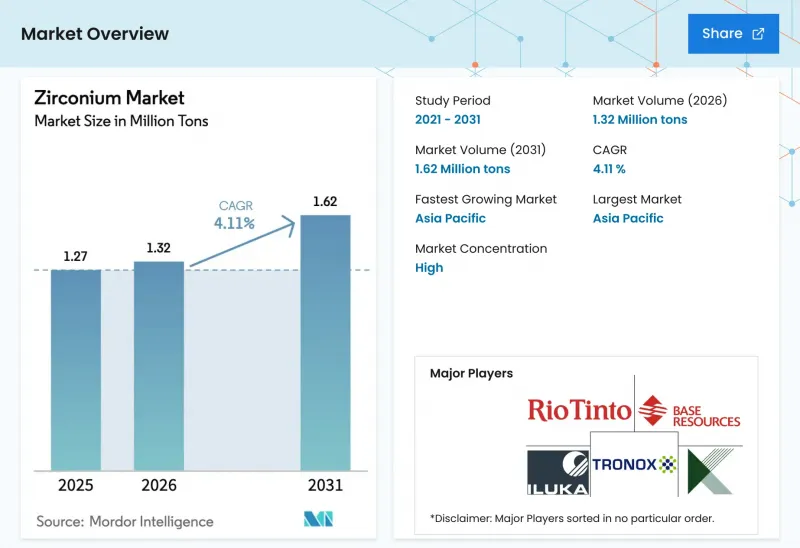
Mordor Intelligence에 의하면, 지르코늄 시장 규모는 2025년 127만 톤, 2026년 132만 톤에서 , 2031년까지 162만 톤으로 확대한다고 예측되고 있어 2026년부터 2031년까지 연평균 복합 성장률(CAGR)은 4.11%를 나타낼 전망입니다.
본 보고서는 발생 유형별(지르콘, 지르코니아, 기타), 용도별(지르콘 분말/분쇄 모래, 지르콘 불투명제, 내화물, 지르콘 화학제품, 지르콘 금속 및 합금), 지역별(생산 분석, 호주, 브라질, 중국, 인도, 인도네시아 등; 소비 분석, 중국, 미국, 일본 등)으로 분류되어 있습니다. 시장 전망은 수량(톤) 기준으로 제시되어 있습니다.
세계 지르코늄 시장 동향 및 분석
주조 및 내화물 산업에서의 지속적인 수요
2025년, 전 세계 주조 업계는 저열팽창성 및 화학적 비활성 등 지르코늄의 뛰어난 특성을 중시하여 정밀 코어와 주형에 지르코늄 모래를 널리 사용했습니다. 비용 효율을 중시하는 용도에서는 지르콘보다 크로마이트나 올리빈이 선호되는 경향이 있었으나, Noram Technology사의 모래 재활용 관련 특허가 유럽에서 지르콘의 가치를 유지하는 데 있어 매우 중요한 역할을 했습니다. 내화물 제조업체들은 지르코니아를 마그네시아나 알루미나와 혼합함으로써 용광로의 수명을 연장했으며, 대체재 도입이 어려운 상황임에도 불구하고 지르코니아 수요를 끌어올렸습니다. 한편, 유럽의 엄격한 방사성 폐기물 처분 규제로 인해 폐쇄형 주조 공정이 추진되어 지르콘 분획의 확보가 도모되었습니다.
첨단 세라믹 분야에서 지르코늄계 불투명제의 사용 확대
2025년에는 세라믹 분야에서 지르콘 모래 사용량의 대부분을 차지하게 되었으며, 디지털 프린트 타일의 보급으로 인해 1제곱미터당 지르콘 함유량이 증가했습니다. 세계 타일 생산의 주요국인 중국과 인도는 불투명제 수요를 확대했으며, 그 결과 초저철분 분말에 대한 수요가 증가했습니다. 적층 가공 분야에서 초정밀 등급에 대한 수요는 해마다 급증하고 있으며, 전자 및 재생 에너지 장비 분야에서 프리미엄 틈새 시장을 개척했습니다. 이러한 추세를 반영하여, 돌핀 리소시즈는 수익성이 높은 이러한 판매 기회를 최대한 활용하기 위해 분쇄 능력을 확대했습니다.
주조 및 내화물 분야에서 크로마이트/올리빈의 대체재
크로마이트는 가격이 더 저렴하면서도 내화성 면에서는 다른 재료에 뒤지지 않습니다. 동시에, 올리빈의 실리카 함량이 낮기 때문에 규폐증의 위험을 줄여줍니다. 그 결과, 유럽과 북미의 파운드리에서는 지르콘에서 점진적으로 전환하는 방안이 검토되고 있습니다. 노람 테크놀로지사는 재생 모래에서 크로마이트 또는 지르콘 중 하나를 선택적으로 추출하는 기술에 대한 특허를 취득했으며, 이를 통해 미사용 원료에 대한 의존도를 낮추고 있습니다. 내화물 제조업체들은 마그네시아·알루미나 혼합재를 점점 더 선호하여 채택하고 있으며, 지르코니아는 극한의 열에 노출되는 영역으로만 사용을 제한하고 있습니다.
부문별 분석
2025년, 지르콘은 시장을 휩쓸며 전체의 88.89%라는 큰 비중을 차지했습니다. 호주와 남아프리카공화국 양국이 공급망에서 매우 중요한 역할을 수행함에 따라, 이미 확립된 세라믹 및 주조 업계에는 지르콘이 안정적으로 공급되었습니다. 성숙한 광산이 새로운 광상으로 전환됨에 따라, 지르코늄 분야의 지르콘 시장 규모는 2025년에 상당한 수준에 도달했을 뿐만 아니라 꾸준한 성장 궤도에 올랐습니다. 지르콘은 수량 면에서 주도적인 위치를 차지하고 있었지만, 그 가격 동향은 건설 경기 주기와 밀접하게 연동되어 있어 광산 기업들은 해당 부문의 변동 영향을 쉽게 받게 되었습니다.
한편, 지르코니아는 취급량이 적은 품목으로, 2026년부터 2031년까지 연평균 성장률(CAGR) 5.27%를 기록하며 성장할 것으로 전망됩니다. 이러한 예상되는 성장은 고체 배터리, 바이오 세라믹, 항공우주용 코팅 등의 분야에서 고순도 지르코니아에 대한 수요가 급증함에 따라 뒷받침되고 있습니다. 서브미크론 분말 공급에 강점을 가진 생산자들은 상당한 가격 프리미엄을 누리며 수익성을 높였습니다. 에너지 퓨얼스(Energy Fuels)사가 ASM사의 고순도 기술을 도입하기로 한 전략적 움직임은 그동안 중국 가공업체들이 누려왔던 이익률을 업계가 확보하려는 의지를 여실히 보여주고 있습니다. 반면, 바데레이사이트 등 다른 품종들은 매장량이 주로 러시아에 집중되어 있고, 이에 따른 지정학적 문제로 인해 틈새 시장 수준에 머물렀습니다.
지역별 분석
2025년, 중국은 전 세계 소비량의 53.36%라는 압도적인 점유율을 차지하고 있으며, 2026년부터 2031년까지의 예측 기간 동안 연평균 성장률(CAGR) 4.78%로 성장할 것으로 전망됩니다. 중국은 광범위한 물류 네트워크와 지르코늄 화학제품 분야에서 주도적인 역할을 바탕으로 국내 가격을 세계 평균보다 낮은 수준으로 유지하고 있습니다. 그러나 미국의 관세와 EU의 ‘프렌드쇼어링’ 규제로 인해 세라믹 및 합금 구매자들은 조달처 다각화를 추진하며, 호주와 아프리카에서의 조달을 늘리고 있습니다. 2025년 중반까지 중국의 원자로 건설이 지르코늄의 주요 소비처가 될 것으로 보이며, 신규 생산 능력 승인과 함께 이러한 추세는 2031년까지 지속될 것으로 예측됩니다.
2023년, 북미에서는 대량의 농축 광석을 소비해 온 데 따라, 그동안 중국 정제업체에 양도해 왔던 부가가치를 되찾기 위해 유타주와 조지아주에서 새로운 가공 시설 건설을 시작했습니다. 미국의 고체 배터리 이니셔티브와 관련된 지르코늄 시장은 현재로서는 규모가 작지만, 전기차 제조업체들이 LLZO 전해질에 대한 실험을 진행함에 따라 급속히 성장하고 있습니다. 2025년 수요의 상당 부분을 차지한 유럽에서는 고순도 세라믹와 항공우주용 코팅이 우선적으로 채택되고 있습니다. ‘중요 원자재법’에 규정된 가공 목표에 따라 프랑스와 독일에서는 합작 사업이 촉진되고 있지만, 이러한 프로젝트는 자본 집약적이기 때문에 여러 과제도 발생하고 있습니다.
2023년에는 호주와 남아프리카공화국이 전 세계에서 채굴되는 지르콘의 대부분을 공급하는 주요 산지로 부상했습니다. 그러나 자산의 노후화에 따라 기존 광산의 가동 재개가 시급한 과제가 되고 있습니다. 2026년 3월, 리오 틴토는 모잠비크의 줄티 사우스 광산에서 조업을 재개하기로 승인했으며, 돌핀사의 발라날도 프로젝트도 2025년 말에 연간 생산 능력을 확대했습니다. 모잠비크, 마다가스카르, 케냐의 새로운 생산 거점은 인허가 및 ESG 규정 준수 요건을 충족할 경우, 2031년까지 연간 공급이 가능할 것으로 전망됩니다. 인도는 타일 수출과 원자력용 합금에 대한 투자를 원동력으로 시장 점유율을 확대해 나가고 있습니다. 한편, 러시아가 바데레이사이트에 중점을 두는 것은 국내 안보를 강화하는 동시에, 세계로의 진출을 제한하는 결과로 이어지고 있습니다.
기타 혜택:
- 엑셀 형식 시장 예측(ME) 시트
- 3개월간의 애널리스트 지원
자주 묻는 질문
목차
제1장 서론
제2장 조사 방법
제3장 주요 요약
제4장 시장 구도
제5장 시장 규모와 성장 예측
제6장 경쟁 구도
제7장 시장 기회와 향후 전망
JHS 26.06.29According to Mordor Intelligence, the zirconium market size is projected to expand from 1.27 million tons in 2025 and 1.32 million tons in 2026 to 1.62 million tons by 2031, registering a CAGR of 4.11% between 2026 to 2031.
This report is Segmented by Occurrence Type (Zircon, Zirconia, and Other Types), Application (Zircon Flour/Milled Sand, Zircon Opacifier, Refractories, Zircon Chemicals, and Zircon Metal and Alloys), and Geography (Production Analysis: Australia, Brazil, China, India, Indonesia, and More; Consumption Analysis: China, United States, Japan, and More). The Market Forecasts are Provided in Terms of Volume (Tons).
Global Zirconium Market Trends and Insights
Sustained Demand from Foundry and Refractory Industries
In 2025, global foundries, emphasizing zircon's prized qualities such as low thermal expansion and chemical inertness, heavily relied on zircon sand for precision cores and molds. Although cost-sensitive applications began favoring chromite and olivine over zircon, a sand recycling patent from Noram Technology played a pivotal role in preserving zircon's value in Europe. Refractory formulators, by blending zirconia with magnesia and alumina, extended furnace life, driving up zirconia demand despite its substitution hurdles. Meanwhile, Europe's stringent radioactive waste disposal regulations championed closed-loop foundry operations, ensuring the retention of zircon fractions.
Rising Use of Zircon-Based Opacifiers in Advanced Ceramics
In 2025, ceramics claimed a substantial portion of zircon sand usage, with digitally printed tiles enhancing zircon loading per square meter. As the primary producers of the world's tiles, China and India amplified their demand for opacifiers, leading to a need for ultra-low-iron powders. The appetite for finer grades in additive manufacturing surged annually, carving premium niches in electronics and renewable energy devices. Capitalizing on this trend, Iluka Resources boosted its milling capacity to capitalize on these profitable sales.
Substitution by Chromite/Olivine in Foundry and Refractories
Chromite, being more affordable, rivals its counterparts in refractoriness. At the same time, olivine's reduced silica content mitigates the risk of silicosis. As a result, foundries across Europe and North America are contemplating a gradual transition away from zircon. Noram Technology has secured a patent for a method that selectively extracts either chromite or zircon from recycled sand, thereby lessening the reliance on virgin materials. Refractory manufacturers are increasingly favoring magnesia-alumina blends, reserving zirconia for zones subjected to extreme heat.
Other drivers and restraints analyzed in the detailed report include:
- Commercialization of Zirconia Solid Electrolytes for Next-Gen Batteries
- Friend-Shoring and EU Critical Raw Materials Act
- Tightening Radioactivity and ESG Rules on Heavy-Mineral-Sand Mining
For complete list of drivers and restraints, kindly check the Table Of Contents.
Segment Analysis
In 2025, zircon dominated the market, constituting a substantial 88.89% of the total volume. With both Australia and South Africa playing pivotal roles in the supply chain, established ceramics and foundry sectors enjoyed a steady influx of zircon. As mature mines transitioned to new orebodies, the market size for zircon in the zirconium sector not only reached a notable level in 2025 but was also set on a trajectory of steady growth. While zircon led in terms of volume, its pricing dynamics were intricately linked to construction cycles, exposing miners to the sector's fluctuations.
On the other hand, zirconia, despite its smaller tonnage, is projected to grow at a 5.27% CAGR during the 2026-2031 period. This anticipated growth is fueled by the surging demand for high-purity zirconia in applications such as solid-state batteries, bioceramics, and aerospace coatings. Producers adept at offering sub-micron powders enjoyed a significant price premium, enhancing their profitability. Energy Fuels' strategic move to adopt ASM's high-purity technology highlights the industry's ambition to seize margins that have historically benefited Chinese processors. In contrast, other variants such as baddeleyite remained in a niche position, hampered by reserves predominantly located in Russia and the geopolitical challenges that accompany them.
Geography Analysis
In 2025, China held a dominant 53.36% share of global consumption and is projected to grow at a CAGR of 4.78% through the forecast period of 2026-2031. China's extensive logistics network and leading role in zirconium chemicals enable it to maintain domestic prices below global averages. However, U.S. tariffs and EU friend-shoring regulations are prompting ceramic and alloy buyers to diversify, increasingly sourcing from Australia and Africa. By mid-2025, Chinese reactor constructions were major consumers of zirconium, and with new capacity approvals, this trend is anticipated to persist through 2031.
In 2023, North America, having utilized a significant amount of concentrates, began establishing new processing facilities in Utah and Georgia, with the goal of reclaiming value that was previously ceded to Chinese refiners. Although the zirconium market tied to U.S. solid-state battery initiatives is currently modest, it is swiftly gaining momentum as electric vehicle producers experiment with LLZO electrolytes. Europe, which accounted for a substantial share of 2025's demand, is prioritizing high-purity ceramics and aerospace coatings. The processing targets set by the Critical Raw Materials Act have spurred joint ventures in France and Germany, though the capital-intensive nature of these projects presents challenges.
In 2023, Australia and South Africa emerged as the primary sources for the majority of the world's mined zircon. Yet, with aging assets, there is an urgent call for brownfield restarts. In March 2026, Rio Tinto approved a restart at Zulti South in Mozambique, while Iluka's Balranald project ramped up its annual capacity in late 2025. Newer hubs in Mozambique, Madagascar, and Kenya are eyeing a potential annual supply by 2031, contingent on permitting and ESG compliance. India is carving out a larger share, driven by tile exports and investments in nuclear alloys. On the other hand, while Russia's emphasis on baddeleyite bolsters its internal security, it curtails its global outreach.
- Astron Group
- Australian Strategic Materials Ltd.
- Base Resources Ltd
- Energy Fuels Inc.
- Eramet SA
- Iluka Resources Limited
- Image Resources NL
- Iwatani Corporation
- Kenmare Resources plc
- Lanka Mineral Sands Ltd
- Mineral Commodities Ltd
- Rio Tinto
- The Chemours Company
- Tronox Holdings plc
Additional Benefits:
- The market estimate (ME) sheet in Excel format
- 3 months of analyst support
TABLE OF CONTENTS
1 Introduction
- 1.1 Study Assumptions and Market Definition
- 1.2 Scope of the Study
2 Research Methodology
3 Executive Summary
4 Market Landscape
- 4.1 Market Overview
- 4.2 Market Drivers
- 4.2.1 Sustained demand from foundry and refractory industries
- 4.2.2 Rising use of zircon-based opacifiers in advanced ceramics and coatings
- 4.2.3 Commercialization of zirconia solid electrolytes for next-gen batteries
- 4.2.4 Friend-shoring and EU Critical Raw Materials Act spurring new refining capacity
- 4.2.5 High-purity zirconia for aerospace thermal-barrier coatings
- 4.3 Market Restraints
- 4.3.1 Substitution by chromite/olivine in foundry and refractories
- 4.3.2 Tightening radioactivity and ESG rules on heavy-mineral-sand mining
- 4.3.3 Chinese downstream dominance and US tariffs disrupting supply chains
- 4.4 Value Chain Analysis
- 4.5 Porter's Five Forces
- 4.5.1 Bargaining Power of Suppliers
- 4.5.2 Bargaining Power of Consumers
- 4.5.3 Threat of New Entrants
- 4.5.4 Threat of Substitutes
- 4.5.5 Degree of Competition
- 4.6 Supply Analysis (Global)
- 4.7 Regulatory Policy Analysis
- 4.8 Trade Analysis (Top 5-10 Countries)
- 4.9 Price Trend Analysis
- 4.10 Production Cost Analysis
5 Market Size and Growth Forecasts (Volume)
- 5.1 By Occurrence Type
- 5.1.1 Zircon
- 5.1.2 Zirconia
- 5.1.3 Other Types
- 5.2 By Application
- 5.2.1 Zircon Flour/Milled Sand
- 5.2.2 Zircon Opacifier
- 5.2.3 Refractories (Zirconia)
- 5.2.4 Zircon Chemicals (Oxychloride, Carbonate, Sulfate)
- 5.2.5 Zircon Metal and Alloys
- 5.3 By Geography
- 5.3.1 Production Analysis
- 5.3.1.1 Australia
- 5.3.1.2 Brazil
- 5.3.1.3 China
- 5.3.1.4 India
- 5.3.1.5 Indonesia
- 5.3.1.6 South Africa
- 5.3.1.7 Ukraine
- 5.3.1.8 Rest of the World
- 5.3.2 Consumption Analysis
- 5.3.2.1 China
- 5.3.2.2 United States
- 5.3.2.3 Japan
- 5.3.2.4 European Union
- 5.3.2.5 India
- 5.3.2.6 Russia
- 5.3.2.7 Rest of the World
- 5.3.1 Production Analysis
6 Competitive Landscape
- 6.1 Market Concentration
- 6.2 Strategic Moves
- 6.3 Market Share(%)/Ranking Analysis
- 6.4 Company Profiles (includes Global Overview, Market Overview, Core Segments, Financials, Strategic Information, Products and Services, Recent Developments)
- 6.4.1 Astron Group
- 6.4.2 Australian Strategic Materials Ltd.
- 6.4.3 Base Resources Ltd
- 6.4.4 Energy Fuels Inc.
- 6.4.5 Eramet SA
- 6.4.6 Iluka Resources Limited
- 6.4.7 Image Resources NL
- 6.4.8 Iwatani Corporation
- 6.4.9 Kenmare Resources plc
- 6.4.10 Lanka Mineral Sands Ltd
- 6.4.11 Mineral Commodities Ltd
- 6.4.12 Rio Tinto
- 6.4.13 The Chemours Company
- 6.4.14 Tronox Holdings plc
7 Market Opportunities and Future Outlook
- 7.1 White-space and Unmet-Need Assessment


