

|
시장보고서
상품코드
2066443
유럽의 자동 창고 시스템(ASRS) : 시장 점유율 분석, 업계 동향 및 통계, 성장 예측(2026-2031년)Europe Automated Storage And Retrieval Systems - Market Share Analysis, Industry Trends & Statistics, Growth Forecasts (2026 - 2031) |
||||||
 Mordor Intelligence
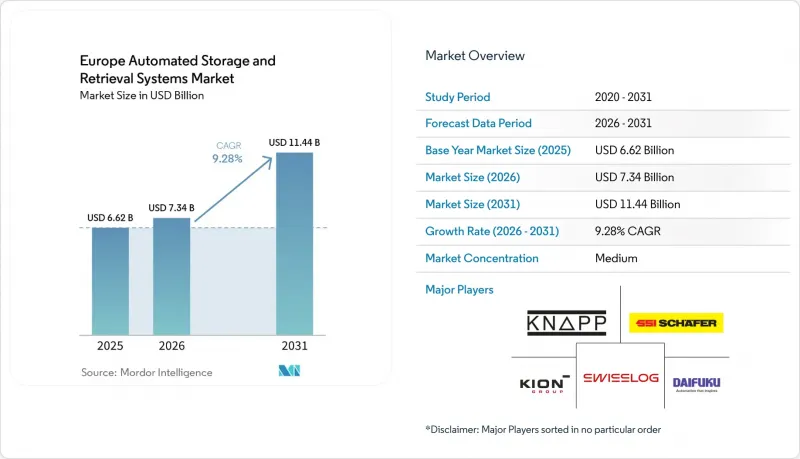
Mordor Intelligence에 의하면, 유럽의 자동 창고 시스템(ASRS) 시장 규모는 2025년 66억 2,000만 달러로 평가되었습니다. 2026년에는 73억 4,000만 달러로 확대되어 2026년부터 2031년에 걸쳐 CAGR 9.28%로 성장을 지속하여, 2031년에는 114억 4,000만 달러에 이를 것으로 예측됩니다.
본 보고서는 제품 유형(유닛 로드 ASRS, 미니 로드 ASRS 등), 적재 용량(경량 하중(100kg 미만), 중량 하중(100-500 kg), 중량 하중(500kg 이상)), 시스템 구성(이동식 통로 크레인, 큐브형 보관 등), 최종 사용자 산업(공항, 자동차 산업 등) 및 지역별로 분류되어 있습니다. 시장 전망은 금액(달러) 기준으로 제시되어 있습니다.
유럽의 자동 창고 시스템(ASRS) 시장 동향 및 인사이트
높은 처리량을 요구하는 전자상거래의 급증
현재 대도시권에서는 주문량 증가에 따라 2시간 이내 배송이 요구되고 있어, 사업자들은 하루 6,000팔레트를 처리할 수 있는 자동 창고 시스템 도입을 서둘러야 하는 상황입니다. 벨기에 람스트에서 진행된 기존 시설 개보수 프로젝트에서는 4개 층에 걸쳐 20대의 자율 주행 셔틀을 운행하고, 기존 랙을 재사용함으로써 이 기준을 달성했습니다. 그 결과, 68만 유로의 설비 투자 비용을 절감하고, 680톤의 이산화탄소 배출량을 감축했습니다. 2025년 12월에 가동을 시작한 영국의 시설에서는 3,000 m² 규모의 부지 내에 200대의 로봇을 도입하여 피킹 효율을 4배로 높였습니다. 식료품점의 뒷방에 도입된 마이크로 풀필먼트 모듈 덕분에 재고 분산이 더욱 진전되고 라스트 마일 비용이 절감됨에 따라, 모듈식 셔틀과 큐브 그리드가 최적의 아키텍처로 자리매김하고 있습니다.
유럽 전역에서 심화되고 있는 노동력 부족과 임금 인플레이션
2025년, 독일과 네덜란드 물류 업계의 임금은 두 자릿수 상승세를 보였으며, 자동화 투자 회수 기간을 3년 미만으로 단축했습니다. 유럽의 사업체를 대상으로 한 조사 결과, 기업들이 인력 부족을 메우기 위해 서둘러 대응한 결과, AI 도구 도입률이 90%에 달하는 것으로 밝혀졌습니다. 현재, 제3자 물류 분야의 주요 기업들은 다온도대 보관 구역에서 수천 대의 자율 주행 로봇을 운영하고 있으며, 협동 로봇과 인력에 의한 품질 관리를 결합하고 있습니다. 이러한 추세에 따라, 노동 안전 기준을 유지하면서도 교대 근무 없이 24시간 365일 가동할 수 있는 셔틀 시스템에 대한 수요가 높아지고 있습니다.
중소기업에 있어 막대한 초기 투자
기본 도입 비용은 100만 유로이지만, 고층 창고 프로젝트의 경우 토목 공사를 제외하더라도 2,000만 유로를 초과하는 경우가 있습니다. 2024년 기준으로 유럽 중소기업 중 첨단 디지털 도구를 도입한 곳은 고작 8%에 불과했으며, 그 이유로 자금적 제약이 꼽혔습니다. 리스나 ‘서비스형 자동화(Automation-as-a-Service)’와 같은 모델은 이용 가능하지만, 그 보급은 주로 서유럽에 국한되어 있습니다. 이러한 이용 기회의 제한으로 인해, 다른 지역의 물류 기업들에서 이러한 모델을 도입하는 것이 지연되고 있습니다. 이러한 기업들은 인프라 부족, 낮은 인지도, 그리고 특정 업무 요구 사항을 충족할 수 있는 맞춤형 솔루션의 부재와 같은 과제에 직면해 있기 때문입니다.
부문별 분석
2025년, 유닛 로드형 ASRS는 유럽의 자동창고 시스템(ASRS) 시장 점유율의 35.24%를 차지하며, 자동차 및 일반 제조 공장에서 팔레트 중심의 완충 재고가 갖는 우위를 반영했습니다. 셔틀 및 봇 시스템과 관련된 유럽의 자동 창고 시스템(ASRS) 시장 규모는 옴니채널 소매업체들이 랙을 재설계하지 않고도 로봇을 소규모로 도입해 나감에 따라 연평균 성장률(CAGR) 10.63%로 확대될 것으로 전망됩니다. 이 성능은 시간당 1,000병의 피킹 작업을 처리하는 Knapp사의 ‘OSR Shuttle Evo’를 통해 입증되었습니다. 큐브 그리드는 공항 면세점 등 공간이 제한된 거점에 혁신을 가져올 가능성이 있습니다. 오슬로의 AutoStore 도입 사례에서는 동일한 318 m²의 설치 면적 내에서 수용 능력을 64% 향상시켰습니다.
벨기에의 브라운필드 부지에서는 제2세대 셔틀 프로젝트를 통해 하루 6,000개의 팔레트 운송량을 유지하면서, 토목 공사비를 68만 유로 절감하고 이산화탄소 배출량을 680톤 줄였습니다. Axfood사의 쿵스바카 프로젝트에서 볼 수 있듯이, 식료품 소매업체들은 클릭 앤 콜렉트 수요에 대응하기 위해 백룸 내에 이와 유사한 그리드를 도입할 계획입니다. 음료 제조업체들은 하나의 SynQ 레이어 아래에서 팔레트 셔틀과 크레인, 컨베이어를 통합한 하이브리드 레이아웃을 선호하고 있으며, Ringnes사는 2026년부터 이 모델을 도입할 예정입니다.
100kg에서 500kg 사이의 중하중 시스템은 자동차 업계 및 제3자 물류(3PL) 분야에서 팔레트 유통을 주도하며, 2025년에는 유럽의 자동창고 시스템(AS/RS) 시장 점유율의 47.33%를 차지했습니다. 100kg 미만의 경량 하역 유닛 시장은 식료품점이나 약국에서 30분 이내에 주문을 처리하는 ‘토트 그리드’를 도입함에 따라 연평균 성장률(CAGR) 9.77%로 확대될 것으로 전망됩니다. 바이살라 사의 2,000 m² 부지 내에 설치된 8,000병 용량의 AutoStore 그리드는 이러한 콤팩트한 설계 트렌드를 상징하는 사례입니다. 로슈사의 카이저 아우구스트 하브는 토트 자동화가 냉장 의약품 창고에서도 성공적으로 운영되고 있음을 보여주었으며, 이곳에서는 +2°C에서 +8°C의 온도 범위 내에서 하루에 1,500개의 팔레트가 이동되고 있습니다.
도시 지역의 소매업체들은 소량 화물에 대한 고속 처리를 필요로 하기 때문에 라이트로드 모듈은 현재 유럽의 자동 창고 시스템(AS/RS) 시장에서 점유율을 확대되고 있습니다. 특히 스페인과 프랑스에서는 주말에 클릭 앤 콜렉트 이용량이 급증하고 있습니다. 자동차 공장에서는 여전히 시퀀싱화된 부품의 이송에 미디엄 로드 태거 열차가 활용되고 있으며, 단일 소프트웨어 스택 하에서 서로 다른 적재 등급을 지원하고 있습니다. 헤비 로드 레인은 여전히 틈새 시장용 서비스이며, 링네스사가 향후 가동할 예정인 셔틀 복합 시설에서는 상온 및 냉장 구역 내에서 1,000kg 팔레트를 운반하고, 음료용 케그 취급에 활용될 예정입니다.
기타 혜택 :
- 엑셀 형식 시장 예측(ME) 시트
- 3개월간의 애널리스트 지원
자주 묻는 질문
목차
제1장 서론
제2장 조사 방법
제3장 주요 요약
제4장 시장 구도
제5장 시장 규모 및 성장 예측
제6장 경쟁 구도
제7장 시장 기회 및 향후 전망
KTH 26.06.29According to Mordor Intelligence, the europe automated storage and retrieval systems market size is expected to grow from USD 6.62 billion in 2025 to USD 7.34 billion in 2026 and is forecast to reach USD 11.44 billion by 2031 at 9.28% CAGR over 2026-2031.
This report is Segmented by Product Type (Unit Load ASRS, Mini Load ASRS, and More), Load Capacity (Light Load (Below 100 Kg), Medium Load (100-500 Kg), Heavy Load (Above 500 Kg)), System Configuration (Moveable Aisle Crane, Cube-Based Storage, and More), End-User Vertical (Airports, Automotive, and More), and Geography. The Market Forecasts are Provided in Terms of Value (USD).
Europe Automated Storage And Retrieval Systems Market Trends and Insights
E-commerce Surge Requiring High Throughput Fulfillment
Order volumes now demand sub-two-hour delivery in large metropolitan areas, compelling operators to deploy automated storage and retrieval systems capable of 6,000 pallet movements per day. A brownfield retrofit in Rumst, Belgium, achieved this benchmark by operating 20 autonomous shuttles across four levels and reusing existing racking, resulting in EUR 680,000 in capital expenditure savings and a reduction of 680 t of carbon emissions. A United Kingdom facility, commissioned in December 2025, employs 200 robots across 3,000 m2 to quadruple picking efficiency. Micro-fulfillment modules inserted into grocery backrooms further decentralize inventory and reduce last-mile costs, positioning modular shuttles and cube grids as the preferred architecture.
Rising Labor Shortages and Wage Inflation Across Europe
Logistics wages in Germany and the Netherlands advanced by double digits in 2025, compressing payback periods on automation to under three years. A survey of European operators revealed a 90% adoption rate of AI tools as firms rushed to offset labor shortages. Third-party logistics leaders now operate thousands of autonomous mobile robots across multi-temperature zones, blending collaborative automation with human quality control. The dynamic strengthens demand for shuttle systems that can run 24/7 without shift changeovers while maintaining occupational safety standards.
High Upfront Capital Expenditure for SMEs
Entry-level installations cost EUR 1 million, while high-bay projects can exceed EUR 20 million, excluding civil works. Only 8% of European SMEs had adopted advanced digital tools by 2024, citing financing constraints. While leasing and automation-as-a-service models are available, their presence is largely confined to Western Europe. This limited availability has slowed the adoption of these models by logistics firms in other regions, as they face challenges such as lack of infrastructure, awareness, and tailored solutions to meet their specific operational needs.
Other drivers and restraints analyzed in the detailed report include:
- Shrinking Warehouse Space and Urban Land Costs
- Advancements in AI-Driven Warehouse Execution Software
- Integration Complexities with Legacy WMS and ERP
For complete list of drivers and restraints, kindly check the Table Of Contents.
Segment Analysis
Unit Load ASRS secured 35.24% of Europe Automated Storage and Retrieval Systems market share in 2025, reflecting the dominance of pallet-centric buffers at automotive and general manufacturing plants. The Europe Automated Storage and Retrieval Systems market size tied to Shuttle and Bot Systems is projected to rise at a 10.63% CAGR as omnichannel retailers add robots in small tranches without re-engineering racking, a capability proven by Knapp's OSR Shuttle Evo, which clears 1,000 bin picks per hour. Cube grids can disrupt space-constrained nodes, such as airport duty-free stores, where an AutoStore installation in Oslo increased capacity by 64% within the same 318 m2 footprint.
Second-generation shuttle projects have reduced civil costs by EUR 680,000 and 680 tonnes of carbon at a Belgian brownfield site, while maintaining 6,000 pallet moves per day. Grocers plan similar grids inside backrooms, as shown by Axfood's Kungsbacka project, to meet click-and-collect demand. Beverage producers favor hybrid layouts that merge pallet shuttles with cranes and conveyors under one SynQ layer, a model Ringnes will adopt from 2026.
Medium-load systems, ranging from 100 kg to 500 kg, captured 47.33% of the European Automated Storage and Retrieval System market share in 2025, driven by pallet flows in automotive and third-party logistics corridors. Light-load units below 100 kg are projected to expand at a 9.77% CAGR as grocers and pharmacies integrate tote grids that fulfill orders in under 30 minutes. Vaisala's 8,000-bin AutoStore grid, located within a 2,000 m2 site, exemplifies the compact design trend. Roche's Kaiseraugst hub demonstrates that tote automation also thrives in cooled drug warehouses, where 1,500 pallet moves occur daily at temperatures ranging from +2 °C to +8 °C.
Urban retailers require small payload speed, so Light Load modules now command a growing share of the European Automated Storage and Retrieval System market, especially in Spain and France, where click-and-collect volumes surge on weekends. Automotive plants still rely on Medium-Load tugger trains for sequenced parts, blending load classes under a single software stack. Heavy Load lanes remain a niche service, serving beverage kegs at Ringnes's forthcoming shuttle complex, which will transport 1,000 kg pallets within ambient and chilled zones.
List of Companies Covered in this Report:
- Daifuku Co. Ltd
- KION Group AG
- SSI Schaefer AG
- Knapp AG
- Swisslog AG
- Jungheinrich AG
- Toyota Industries Corporation
- Kardex Holding AG
- Mecalux SA
- Murata Machinery Ltd
- Viastore Systems GmbH
- Autostore Holdings Ltd
- Vanderlande Industries BV
- TGW Logistics Group GmbH
- System Logistics SpA
- Ocado Group plc
- Industore Ltd
- Honeywell Intelligrated Inc
Additional Benefits:
- The market estimate (ME) sheet in Excel format
- 3 months of analyst support
TABLE OF CONTENTS
1 INTRODUCTION
- 1.1 Study Assumptions and Market Definition
- 1.2 Scope of the Study
2 RESEARCH METHODOLOGY
3 EXECUTIVE SUMMARY
4 MARKET LANDSCAPE
- 4.1 Market Overview
- 4.2 Market Drivers
- 4.2.1 Shrinking Warehouse Space and Urban Land Costs
- 4.2.2 E-commerce Surge Requiring High Throughput Fulfilment
- 4.2.3 Rising Labor Shortages and Wage Inflation Across Europe
- 4.2.4 Advancements in AI-Driven Warehouse Execution Software
- 4.2.5 ESG Mandates Driving Energy-Efficient Warehouse Automation
- 4.2.6 EU Funding for Industry 4.0 and Digital Logistics Initiatives
- 4.3 Market Restraints
- 4.3.1 High Upfront Capital Expenditure for SMEs
- 4.3.2 Integration Complexities with Legacy WMS and ERP
- 4.3.3 Limited Skilled Technicians for Maintenance
- 4.3.4 Supply-Chain Disruptions Inflating Component Lead Times
- 4.4 Industry Value Chain Analysis
- 4.5 Regulatory Landscape
- 4.6 Impact of Macroeconomic Factors on the Market
- 4.7 Technological Outlook
- 4.8 Porter's Five Forces Analysis
- 4.8.1 Bargaining Power of Suppliers
- 4.8.2 Bargaining Power of Consumers
- 4.8.3 Threat of New Entrants
- 4.8.4 Intensity of Competitive Rivalry
- 4.8.5 Threat of Substitutes
- 4.9 Investment Analysis
- 4.10 Assessment of the Impact of COVID-19 on the Market
5 MARKET SIZE AND GROWTH FORECASTS (VALUE)
- 5.1 By Product Type
- 5.1.1 Unit Load ASRS
- 5.1.2 Mini Load ASRS
- 5.1.3 Shuttle and Bot Systems
- 5.1.4 Carousel Systems, Horizontal
- 5.1.5 Carousel Systems, Vertical
- 5.1.6 Vertical Lift Modules
- 5.1.7 Hybrid Integrated Systems
- 5.2 By Load Capacity
- 5.2.1 Light Load (Below 100 kg)
- 5.2.2 Medium Load (100-500 kg)
- 5.2.3 Heavy Load (Above 500 kg)
- 5.3 By System Configuration
- 5.3.1 Fixed Aisle Stacker Crane
- 5.3.2 Moveable Aisle Crane
- 5.3.3 Cube-Based Storage
- 5.3.4 Free-Roaming Robotic Shuttles
- 5.3.5 Micro-Fulfilment Modules
- 5.4 By End-User Vertical
- 5.4.1 Airports
- 5.4.2 Automotive
- 5.4.3 Retail and E-commerce
- 5.4.4 Third-Party Logistics Providers
- 5.4.5 General Manufacturing
- 5.4.6 Food and Beverage
- 5.4.7 Pharmaceuticals
- 5.4.8 Other End-User Verticals
- 5.5 By Country
- 5.5.1 United Kingdom
- 5.5.2 Germany
- 5.5.3 France
- 5.5.4 Italy
- 5.5.5 Spain
- 5.5.6 Central and Eastern Europe
- 5.5.7 Rest of Europe
6 COMPETITIVE LANDSCAPE
- 6.1 Market Concentration
- 6.2 Strategic Moves
- 6.3 Market Share Analysis
- 6.4 Company Profiles (includes Global Level Overview, Market Level Overview, Core Segments, Financials as Available, Strategic Information, Market Rank/Share for Key Companies, Products and Services, and Recent Developments)
- 6.4.1 Daifuku Co. Ltd
- 6.4.2 KION Group AG
- 6.4.3 SSI Schaefer AG
- 6.4.4 Knapp AG
- 6.4.5 Swisslog AG
- 6.4.6 Jungheinrich AG
- 6.4.7 Toyota Industries Corporation
- 6.4.8 Kardex Holding AG
- 6.4.9 Mecalux SA
- 6.4.10 Murata Machinery Ltd
- 6.4.11 Viastore Systems GmbH
- 6.4.12 Autostore Holdings Ltd
- 6.4.13 Vanderlande Industries BV
- 6.4.14 TGW Logistics Group GmbH
- 6.4.15 System Logistics SpA
- 6.4.16 Ocado Group plc
- 6.4.17 Industore Ltd
- 6.4.18 Honeywell Intelligrated Inc
7 MARKET OPPORTUNITIES AND FUTURE OUTLOOK
- 7.1 White-Space and Unmet-Need Assessment


