|
시장보고서
상품코드
2066455
탄약 : 시장 점유율 분석, 업계 동향 및 통계, 성장 예측(2026-2031년)Ammunition - Market Share Analysis, Industry Trends & Statistics, Growth Forecasts (2026 - 2031) |
||||||
 Mordor Intelligence
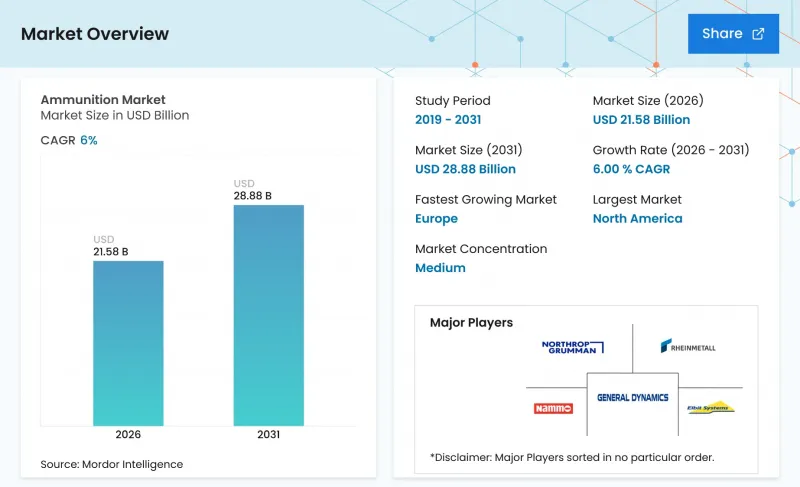
Mordor Intelligence에 의하면, 탄약 시장 규모는 2025년 203억 7,000만 달러로 평가되었습니다. 2026년에는 215억 8,000만 달러로 확대되어 2026년부터 2031년에 걸쳐 CAGR 6.00%로 성장을 지속하여, 2031년에는 288억 7,000만 달러에 이를 것으로 예측됩니다.
본 보고서는 구경(소구경, 중구경, 대구경, 기타), 제품(탄환 및 탄약, 포탄 및 박격포탄 등), 유도 방식(유도식 및 비유도식), 최종 사용자(군, 법 집행 기관 등), 플랫폼(육상, 해상, 항공), 지역(북미, 유럽, 아시아태평양 등)별로 분류되어 있습니다. 시장 전망은 금액(달러) 기준으로 제시되어 있습니다.
세계의 탄약 시장 동향 및 인사이트
우크라이나 전쟁 이후 NATO 비축 물자 보충 강화
나토(NATO) 회원국들은 2026년에 포탄 및 중구경 탄약의 생산 라인을 확대될 전망입니다. 이는 산업계와 정부의 프로그램이 자금을 안정적인 생산으로 전환하고 있음을 보여주는 것으로, 155mm 포탄 및 40mm 망원경 탄의 생산 규모를 확대하는 유럽의 신규 시설이 그 증거가 되고 있습니다. 독일의 운터뤼브 공장은 2025년 9월에 가동을 시작했으며, 해당 회사의 발표에 따르면 2027년까지 포탄 생산으로 확대할 예정이며, 2026년에는 중간 생산량 목표가 설정되어 있습니다. 벨기에의 자동화된 대구경 가공·밴드 감기 라인은 155mm 포탄 전용으로, 2026년 생산량의 약 6개월 분량이 벨기에 국방부에 배정되어 있습니다. 이는 동맹국의 비축 정책에 부합하는 국가 차원의 우선순위를 나타내고 있습니다. 미국의 조달 데이터에 따르면, 2026 회계연도 예산에 탄약 및 무기 재생산 라인에 대한 자금이 반영되어 있으며, 재고 보충과 훈련용 비축을 지원하는 보충 주기가 유지되고 있습니다. 또한 국방부 예산 자료에는 2026 회계연도 전체 포트폴리오에 걸친 탄약 조달 및 주요 공급망 관련 계획이 명시되어 있으며, 이는 즉각 대응 태세를 확보하기 위한 포탄 및 추진약의 대량 발주를 뒷받침하고 있습니다. 북유럽 각국 정부는 지정 공급업체와 함께 납품, 서비스 및 급증하는 수요에 대응할 수 있는 역량에 관한 다자간 협약을 통해 지역 간 협력을 강화하고 있으며, 위기 상황에서 수요가 정점에 달할 때를 대비해 각국의 비축 물자를 공유하고 있습니다.
방위비 증액과 현대화가 시장 성장을 견인
미국의 2026 회계연도 국방 예산 총액은 탄약 비축, 산업 기반 확대, 그리고 업스트림 단계의 투자 결정의 토대가 되는 특정 무기 체계의 반복 생산에 대한 지속적인 중점을 반영하고 있습니다. 2026 회계연도 주기에 관한 의회 자료에서는 패트리어트, THAAD, 토마호크, JASSM, LRASM, SM-3, AMRAAM에 대한 자금 지원이 강조되어 있으며, 이를 통해 부품, 추진약, 조립 라인에 대한 안정적인 수요 전망을 기대할 수 있습니다. 플랫폼 중심의 계약은 미 육군 부대를 위한 M109A7 팔라딘 곡사포 및 M992A3 탄약 수송차의 추가 생산 수주 사례에서 볼 수 있듯이, 차량 및 포병 장비 조달이 관련 탄약 수요를 얼마나 견인하는지를 여실히 보여주고 있습니다. 동시에, 미국의 계약 기록에 따르면, UAS(무인항공기 시스템) 대응 임무에 특화된 근접신관식 30mm 포탄의 대량 생산 규모 수주가 확인되었으며, 특수한 효과와 유도 로직을 갖춘 중구경 탄약의 조달이 정당화되고 있습니다. 중동 동맹국들의 조달로 인해 폭탄 본체 및 관통탄에 대한 수요가 더욱 증가하고 있으며, 공중 투하용 비축분을 보충하기 위한 대규모 탄약 패키지가 공식적으로 통보되었습니다. 또한, 미국의 산업 확대 발표에 따르면 니트로셀룰로오스와 삼기 추진제의 국내 생산도 대상에 포함되어 있으며, 이는 기존 에너지 재료 공급의 병목 현상을 해소함과 동시에 모듈식 추진약 시스템을 위한 장기적인 생산 능력을 구축하기 위한 것입니다.
무인 시스템을 위한 미국 국방부(DoD) 및 영국 국방부(MoD)의 예산 재조정
2026년도 미국 예산안에서는 소모성 저비용 무기를 포함한 다양한 역량이 우선시되고 있으며, 이러한 요소들은 기존의 탄약 재고 및 자금과 경쟁 관계에 있습니다. 예산 조정 및 배분에 관한 공개 보고서에서는 기존의 카트리지나 포탄과 동일한 산업 기술 및 공급망을 활용하여 일회용 공격용 드론과 저렴한 무기를 개발하기 위한 전용 예산 항목이 강조되고 있습니다. 동맹국 정부 역시 미국 국외에서 유도 로켓 및 미사일 조립 체계를 구축하고 있으며, 이를 통해 공급업체의 다각화가 진행되는 동시에, 단기적인 포병용 탄약 구매를 줄일 가능성이 있는 정밀 무기에 자원이 배분되고 있습니다. 해군 및 공군 전체 예산에서 2026년도 자금은 해상 공격 및 방공 임무에 사용되는 여러 정밀 무기 계열을 포괄하고 있으며, 이로 인해 일부 비유도 탄약의 비축량을 줄이는 대신 예산이 첨단 기술 분야로 재배정되고 있습니다. 산업계의 대응책으로는 UAS(무인항공기 시스템) 및 다목적 용도로 설계된 중구경 탄약을 들 수 있으며, 드론이 범람하는 환경에서도 기존 포병의 유용성을 유지하고 있습니다. 그 결과, 단기적으로는 일부 일반 탄약의 발주가 억제될 것이지만, 탄약 시장에서는 지속적인 작전 및 훈련을 위해 핵심이 되는 포탄 및 소구경 탄약공급량이 여전히 필수적입니다.
부문별 분석
2025년, 소구경 탄약은 탄약 시장의 43.04%를 차지했으며, 민간, 법 집행 기관, 군용 등 각 채널에서 수요가 동시에 지속됨에 따라 2031년까지 연평균 성장률(CAGR) 6.25%로 성장할 전망입니다. 2024년 미국에서 새로 유입된 소비자들이 2025년과 2026년의 훈련용 및 개인 방어용 구매를 견인하며, 소구경 탄약의 폭넓은 소매 기반을 형성했습니다. 방위 분야에서는 폴리머 케이스를 채택한 .50 구경 프로그램을 통해 경량화와 내열성 향상을 도모함으로써, 원정 임무 수행 시 기동성과 병참상의 이점이 강화되었습니다. 중구경 탄약의 경우, APEX 전투용 및 이에 상응하는 훈련용 제품을 포함해 유럽의 F-35 사용자들을 대상으로 한 프로그램 수주가 진행되면서, 25mm급 제품의 견실한 수주 파이프라인이 확인되었습니다. 40mm 텔레스코프식 탄약에 대한 유럽 수요는 해군 및 지상 시스템의 배치에 따라 증가했으며, 이는 2026년 이후를 위한 생산 계획을 확대하는 요인이 되었습니다. 대구경 포탄은 여전히 최우선 과제이며, 미국 및 유럽의 프로그램에서는 예정된 납품 일정을 맞추기 위해 155mm 포탄의 생산량을 확대하고 추진약의 용량을 조정하고 있습니다. 이러한 다양한 구경에 걸친 동향으로 인해, 탄약 시장은 안정적인 대량 수요 부문에 힘입어 성장하는 한편, UAS(무인항공기 시스템) 대응 및 기지 방어 임무에 사용되는 프리미엄 중구경 탄약에 의한 선택적 성장도 더해지고 있습니다.
소구경 탄약의 주도적 지위는 5.56mm 및 7.62mm 탄약에 관한 NATO 규격의 상호운용성 이점에 의해 강화되고 있으며, 이를 통해 동맹국들의 훈련 체계에서 국경을 초월한 자원 공유와 계약의 유연성이 뒷받침되고 있습니다. 중구경 탄약의 채택은 지상 및 해상 플랫폼의 통합 센서와 사격 통제 로직의 이점을 활용하여, 드론 및 저비용 공중 위협에 대한 살상 능력을 향상시키고 있습니다. 대구경 포탄의 경우, 2026년에 서방 국가들의 생산 거점에서 안정적인 생산량을 확보하기 위해 포탄 본체의 기계 가공과 추진약의 화학 조성 모두에 대한 투자 관심이 집중되고 있습니다. 소매, 훈련, 운용상 수요가 혼재되어 있기 때문에 예산이 유도 무기나 무인 시스템에도 배정되고 있음에도 불구하고, 탄약 시장에서는 각 구경에 걸쳐 균형 잡힌 성장이 유지되고 있습니다. 이 부문에서 탄약 업계는 대규모 물류와 신뢰성을 최적화하기 위해, 더 가벼운 탄피 소재와 개선된 추진약의 개발을 지속적으로 추진하고 있습니다.
2025년 기준으로, 탄환 및 카트리지는 탄약 시장 규모의 60.81%를 차지했으며, 고성능 프로그래밍식 탄약의 선택지 확대와 소구경 탄약의 안정적인 소비에 힘입어 연평균 성장률(CAGR) 6.13%로 확대될 것으로 전망됩니다. 북유럽에서 체결된 40mm 및 57mm 프로그램식 탄약 계약은 드론, 회전익 탄약, 헬리콥터에 대항하기 위한 공중 폭발 및 근접 신관에 의한 효과에 대한 지속적인 수요를 보여주고 있습니다. 2026 회계연도에 걸쳐 유럽과 미국에서는 포탄과 박격포탄이 보충 업무를 주도하고 있으며, 계약 데이터를 통해 155mm 포탄 및 모듈식 추진약에 대한 지속적인 투자가 확인되고 있습니다. 미 해군의 2026 회계연도 예산은 포탄 조달을 지원하고 있으며, 이는 유효기간이 만료되는 재고를 갱신하고 훈련 주기에 맞추어 부대의 장비를 정비하려는 각 군의 요구와 부합합니다. 항공폭탄과 수류탄의 경우, 정밀도를 높이는 신관 및 유도 장치를 추가로 장착함으로써 계속해서 이점을 얻을 것으로 예상되며, 이를 통해 부대는 모듈식 키트를 활용하여 기존 비축 물자의 유효 기간을 연장할 수 있게 됩니다. 2025년 대외 군사 판매(FMS)에서는 폭탄 본체 및 관통 탄두에 대한 대규모 수주가 확인되었으며, 이러한 동향은 포병에 대한 투자와 더불어 항공 투하형 탄약에 대한 꾸준한 수요를 뒷받침하고 있습니다.
신관, 추진약, 사격 통제 컴퓨터 간의 디지털 인터페이스는 현재 제품 전략에서 더욱 중요한 위치를 차지하고 있으며, 이는 다중 모드 효과를 목적으로 설계된, 지휘관이 프로그래밍할 수 있는 탄약에 반영되어 있습니다. 또한, 서방 국가들의 프로그램에서는 정책에 따라 집속탄 사용이 제한된 지역에서 서브탄두의 대안도 검토되고 있으며, 일반 시장 조사 결과, 첨단 155mm 서브탄두에 대한 큰 관심이 나타나고 있습니다. OEM 및 무기 제조업체들은 훈련 및 작전상의 요구에 부응할 수 있도록 월간 처리 능력을 향상시키기 위해, 미국 내 155mm 탄약의 장전, 조립, 포장 업무를 지속적으로 확대되고 있습니다. 전반적으로 탄약 시장은 포탄 및 박격포탄의 재고 보충에 따른 수요와 더불어, 프로그래밍 가능 카트리지 분야에서 급성장하고 있는 프리미엄 틈새 시장으로 구성되어 있으며, 이 두 가지 요인이 결합되어 판매량을 희생하지 않으면서도 평균 판매 가격을 끌어올리고 있습니다. 이 부문에서 탄약 업계는 높은 신뢰성과 설정 가능한 효과를 구현하기 위해 기폭 장치 기술, 비감응성 탄약 및 인터페이스 표준에 대한 투자를 지속하고 있습니다.
지역별 분석
2025년에 47.31%를 차지한 북미의 점유율은 미국의 조달 규모와 지속성을 반영한 것으로, 2026 회계연도 예산에서는 포탄, 부품 라인 및 재제조 프로그램에 자금이 배정되어 공장이 연중 내내 가동될 수 있도록 보장되고 있습니다. 조달 기록에 따르면, 구경이나 제품 범주를 불문하고 반복적인 수주가 확인되고 있으며, 이는 각 군이 공동으로 사용하는 포탄, 탄약, 특수 탄약을 안정적으로 공급하기 위한 균형 잡힌 접근 방식을 보여주고 있습니다. 차량 플랫폼 수주, 탄약 수송차 및 탄약 재생산이 맞물리면서 주요 OEM 거점과 추진약 및 장전 작업을 수행하는 정부 소유 시설의 생산 가동률이 더욱 향상되고 있습니다. 연방 정부의 임대 계약에 따라 계획된 새로운 추진제 생산 능력은 수입에 의존하는 니트로셀룰로오스 및 삼기 추진제에 대한 의존도를 낮추는 것을 목적으로 하며, 이를 통해 공급 차질에 대한 내성을 높이고 155mm 시스템용 추진제의 장기적인 생산을 뒷받침하게 될 것입니다. 이러한 상황에서 탄약 시장은 예측 가능한 조달의 혜택을 누리고 있으며, 이를 통해 다년간의 자본 계획 수립과 단계적인 인력 확충이 가능해졌습니다.
유럽은 연평균 성장률(CAGR) 9.48%를 기록하며 가장 빠르게 성장하고 있는 지역이며, 2026년에는 155mm 생산량을 중심으로 설계된 새로운 포탄 가공 설비, 새로운 밴딩 라인, 그리고 공장 확장을 통해 생산 능력이 대폭 확대될 전망입니다. 2026년에 발표된 생산량 목표치와 2027년의 목표 생산 속도는 민관 자금 조달 및 기본 계약을 바탕으로 탄약 자급자족에 초점을 맞춘 확고한 산업 정책을 뒷받침하고 있습니다. 40mm 망원경 탄약에 관한 보완 프로그램은 공군 기지 방어 및 해군 용도에서 프로그래밍 가능한 효과가 수행하는 역할을 부각시키고 있으며, 이를 통해 포병 분야를 넘어선 전문적인 수요를 확대되고 있습니다. 지역 방위 협력 협정에 따라 국경을 넘는 물류 및 비축 물자의 공유가 더욱 표준화되어 납품이 신속해질 뿐만 아니라, 2026년 국가 대비 목표 달성에 기여할 것입니다. 이 계획은 세계 탄약 시장에 대한 유럽의 기여도를 높이고, 동맹국 간공급원을 다각화할 것입니다.
아시아태평양의 파트너 국가들은 로켓포 및 모듈식 추진약에 대해 자체 생산과 공동 산업 사업을 추진하고 있으며, 이는 동맹국공급망에 탄탄함을 더하는 동시에 현지 전술 교리와 훈련 요구를 반영하고 있습니다. 중동에서는 2025년 공식 통보를 통해 공중 투하용 무기를 위한 대형 탄약 패키지가 확인되었으며, 이를 통해 2026년까지 공급업체의 안정적인 운영과 보충 주기가 뒷받침될 것입니다. 아프리카와 남미는 수요 규모가 비교적 작으며, 수출 규제나 현지 예산 상황에 따라 납품 속도가 좌우될 수 있고, 고급 제품 부문보다 훈련용 탄약 구매가 우선시될 가능성이 있습니다. 전반적으로, 2025년에는 북미가 가장 큰 점유율을 유지할 것이며, 2031년까지는 유럽이 성장을 주도하고, 아시아태평양과 중동이 다양한 수요를 창출할 것입니다. 이러한 추세가 2026년 세계 탄약 시장의 견조한 성장세를 뒷받침하는 기반이 될 것입니다.
기타 혜택 :
- 엑셀 형식 시장 예측(ME) 시트
- 3개월간의 애널리스트 지원
자주 묻는 질문
목차
제1장 서론
제2장 조사 방법
제3장 주요 요약
제4장 시장 구도
제5장 시장 규모 및 성장 예측
제6장 경쟁 구도
제7장 시장 기회 및 향후 전망
KTH 26.06.29According to Mordor Intelligence, the ammunition market size is expected to grow from USD 20.37 billion in 2025 to USD 21.58 billion in 2026 and is forecasted to reach USD 28.87 billion by 2031 at a 6.00% CAGR over 2026-2031.
This report is Segmented by Caliber (Small Caliber, Medium Caliber, Large Caliber, and Others), Product (Bullets and Cartridges, Artillery Shells and Mortars, and More), Guidance (Guided and Unguided), End-User (Military, Law Enforcement, and More), Platform (Land, Naval, and Airborne), and Geography (North America, Europe, Asia-Pacific, and More). The Market Forecasts are Provided in Terms of Value (USD).
Global Ammunition Market Trends and Insights
Intensified NATO Stockpile Replenishment Post-Ukraine War
NATO-aligned countries expand artillery and medium-caliber lines in 2026 as industry and government programs convert funding into stable production, evidenced by new European facilities that scale 155mm shells and 40mm telescoped rounds. Germany's UnterluB site opened in September 2025 and is scheduled to scale to artillery shells by 2027, with intermediate volume milestones in 2026, according to the company's statements. Belgium's automated large-caliber machining and banding line is dedicated to 155mm shells, and nearly six months of 2026 output is allocated to Belgian Defence, signaling sovereign prioritization consistent with allied stockpile policies. Procurement data in the United States shows ammunition and munitions rebuild lines funded in the FY2026 account, sustaining replenishment cycles that backfill inventories and support training stocks. The Department of Defense budget materials also identify ammunition procurement and key supply-chain initiatives across the 2026 portfolio, which reinforce volume orders for shells and energetics to ensure readiness. Nordic governments have deepened regional coordination through a multi-country framework on deliveries, services, and surge capacity with a named supplier, aligning national reserve sharing with peak demand in crisis settings.
Increased Defense Spending and Modernization Driving Market Growth
The US FY2026 defense budget totals reflect continued emphasis on munitions arsenals, industrial-base expansion, and repeatable production of selected weapon systems that anchor upstream investment decisions. Congressional materials covering the FY2026 cycle highlight funding for Patriot, THAAD, Tomahawk, JASSM, LRASM, SM-3, and AMRAAM, which provides stable demand visibility for components, energetics, and assembly lines. Platform-centric contracts underscore how vehicle and artillery acquisitions pull associated ammunition demand, as seen in awards to produce additional M109A7 Paladin howitzers and M992A3 ammunition carriers for US Army formations. At the same time, US contracting records show production-scale awards for proximity-fuzed 30mm rounds tailored for counter-UAS missions, validating procurement of medium-caliber ammunition with specialized effects and guidance logic. Allied procurement in the Middle East adds further demand for bomb bodies and penetrators, with formal notifications confirming large-scale munitions packages that feed air-delivered stockpiles. Industrial-expansion announcements in the United States also target domestic production of nitrocellulose and triple-base propellants, which respond to prior bottlenecks in energetic materials and build long-term capacity for modular charge systems.
DoD and MoD Budget Re-Prioritization Toward Unmanned Systems
The US budget materials in 2026 prioritize a diverse set of capabilities, including attritable and low-cost weapons, which compete for funding with legacy ammunition inventories. Public reporting on reconciliation allocations highlights dedicated lines for one-way attack drones and affordable weapon efforts that draw on similar industrial skill sets and supply chains as traditional cartridges and shells. Allied governments are also standing up guided-rocket and missile assembly outside the United States, which diversifies suppliers while allocating resources toward precision weapons that may reduce short-term artillery buys. Across naval and air portfolios, 2026 funding covers multiple precision families that serve maritime strike and air defense missions, which pulls budget into high-technology lines at the expense of some unguided stockpiles. Industry responses include medium-caliber rounds designed for counter-UAS and multipurpose roles, keeping legacy guns relevant in a drone-saturated environment. The net effect restrains some conventional ammunition orders in the near term, although core artillery and small-caliber volumes remain essential for sustained operations and training in the ammunition market.
Other drivers and restraints analyzed in the detailed report include:
- Rising Civilian Concealed-Carry Adoption Driving Ammunition Demand
- Growing Demand for Modern Artillery Propellant Systems
- Soaring Nitrocellulose Prices Due to Cotton Supply Shocks
For complete list of drivers and restraints, kindly check the Table Of Contents.
Segment Analysis
Small caliber ammunition accounted for 43.04% of the ammunition market in 2025 and is set to grow at a 6.25% CAGR through 2031 as civil, law enforcement, and military channels sustain parallel demand. New US consumers added in 2024 supported training and personal-defense purchases in 2025 and 2026, providing a broad retail base for small-caliber cartridges. On the defense side, polymer-cased .50-caliber programs reduced weight while improving heat resistance, supporting mobility and logistics benefits on expeditionary missions. Medium-caliber rounds progressed through program awards for F-35 users in Europe, including APEX combat and matched training variants, which confirms a robust pipeline in the 25mm class. European demand for 40mm telescoped ammunition increased with naval and land system deployments, which amplified production plans heading into 2026 and beyond. Large-caliber artillery remains a central priority, as US and European programs scale 155mm output and align propellant capacity to meet scheduled deliveries. These multi-caliber dynamics keep the ammunition market anchored in reliable volume segments while adding selective growth from premium medium-caliber rounds that address counter-UAS and base-defense tasks.
Small-caliber leadership is reinforced by the interoperability benefits of NATO standards around 5.56mm and 7.62mm cartridges, which support cross-border pooling and contract flexibility in allied training pipelines. Medium-caliber adoption benefits from integrated sensors and fire-control logic on land and maritime platforms, which improves lethality against drones and low-cost aerial threats. For large-caliber artillery, artillery body machining and propellant chemistry have both received investment attention to strengthen consistent throughput at Western sites in 2026. This mix of retail, training, and operational needs sustains balanced growth across calibers in the ammunition market, even as budgets also fund guided and unmanned systems. Within this segment, the ammunition industry continues to pursue lighter case materials and improved energetics to optimize logistics and reliability at scale.
Bullets and cartridges held 60.81% of the ammunition market size in 2025 and are projected to advance at a 6.13% CAGR, supported by premium programmable options and steady small-caliber consumption. Northern European contracts for 40mm and 57mm programmable munitions demonstrate sustained demand for airburst and proximity-fuzed effects that counter drones, loitering munitions, and helicopters. Artillery shells and mortars drive replenishment workflows in Europe and the United States through FY2026, and contracting data confirms ongoing investment in 155mm projectiles and modular charges. The US Navy's FY2026 budget supports artillery munitions procurement, which aligns with joint service needs to refresh expiring inventories and equip units for training cycles. Aerial bombs and grenades continue to benefit from fuze and guidance add-ons that enhance accuracy, allowing forces to extend the relevance of legacy stockpiles through modular kits. Foreign military sales in 2025 confirmed significant orders for bomb bodies and penetrators, a trend that supports steady demand for air-delivered munitions alongside artillery investment.
Digital interfaces between fuzes, propellants, and fire-control computers are now a more prominent part of product strategies, reflected in command-programmable cartridges designed for multi-mode effects. Western programs also consider submunition replacements where policy restricts cluster use, and public market surveys show interest in advanced 155mm submunitions at scale. OEMs and arsenals continue to expand 155mm load, assemble, and pack operations in the United States to achieve higher monthly throughput that aligns with training and operational needs. Overall, the ammunition market is shaped by replenishment-led demand in shells and mortars alongside growing premium niches in programmable cartridges, which together lift average selling prices without sacrificing volume. Within this segment, the ammunition industry continues to invest in fuze technology, insensitive munitions, and interface standards to create reliable, configurable effects.
Geography Analysis
North America's share of leadership with 47.31% in 2025 reflects the scale and continuity of US procurement, with FY2026 accounts funding artillery munitions, component lines, and rebuild programs that keep factories engaged throughout the year. Procurement records show repeat awards across calibers and product categories, indicating a balanced approach that sustains shells, cartridges, and specialty rounds for joint service use. The combination of vehicle platform orders, ammunition carriers, and ammunition rebuilds further raises production utilization at major OEM sites and at government-owned facilities that run energetics and loading operations. New energetic capacity planned under federal leases aims to reduce reliance on imported nitrocellulose and triple-base propellants, thereby improving resilience against supply disruptions and supporting long-term charge production for 155mm systems. In this context, the ammunition market benefits from predictable procurement, which enables multi-year capital planning and incremental workforce expansions.
Europe is the fastest-growing region, with a 9.48% CAGR, and 2026 marks a period of meaningful capacity ramp with fresh-shell machining units, new banding lines, and factory expansions designed around 155mm volumes. Announced volume milestones for 2026 and targeted run rates for 2027 reinforce a committed industrial policy focused on ammunition sovereignty, propelled by public-private financing and framework contracts. Complementary programs for 40mm telescoped ammunition highlight the role of programmable effects in airbase defense and naval applications, thereby increasing specialized demand beyond artillery. Regional defense cooperation agreements further standardize cross-border logistics and reserve sharing, speeding deliveries and helping meet national readiness targets in 2026. This trajectory expands Europe's contribution to the global ammunition market and diversifies supply sources across allied nations.
Asia-Pacific partners pursue sovereign production and joint industrial ventures for rocket artillery and modular charges, which adds depth to allied supply chains while reflecting local doctrine and training needs. In the Middle East, formal notifications in 2025 confirm large munitions packages for air-delivered ordnance, which support steady supplier utilization and replenishment cycles through 2026. Africa and South America represent smaller demand pools, where export controls and local budgets shape the cadence of deliveries and may channel purchases toward training munitions over premium segments. Overall, North America retains the largest 2025 position, Europe leads growth through 2031, and Asia-Pacific and the Middle East add diversified demand. This pattern underpins a resilient global ammunition market in 2026.
- BAE Systems plc
- Rheinmetall AG
- Elbit Systems Ltd.
- KNDS N.V.
- General Dynamics Corporation
- Nammo AS
- Singapore Technologies Engineering Ltd.
- Denel SOC Ltd.
- Northrop Grumman Corporation
- MESKO S.A.
- CBC Global Ammunition
- Yugoimport-SDPR J.P.
- Saab AB
- Hanwha Corporation
- ARSENAL JSCo.
- ASELSAN A.S.
- Winchester Ammunition (Olin Corporation)
- Poongsan Corporation
- Fiocchi Munizioni S.p.A.
- FN HERSTAL
- CZECHOSLOVAK GROUP a.s.
Additional Benefits:
- The market estimate (ME) sheet in Excel format
- 3 months of analyst support
TABLE OF CONTENTS
1 INTRODUCTION
- 1.1 Study Assumptions and Market Definition
- 1.2 Scope of the Study
2 RESEARCH METHODOLOGY
3 EXECUTIVE SUMMARY
4 MARKET LANDSCAPE
- 4.1 Market Overview
- 4.2 Market Drivers
- 4.2.1 Intensified NATO stockpile replenishment
- 4.2.2 Increased defense spending and modernization driving market growth
- 4.2.3 Increased use of programmable air-burst and proximity-fuzed rounds in urban operations
- 4.2.4 Rising civilian concealed-carry adoption driving ammunition demand
- 4.2.5 Growing demand for modern artillery propellant systems
- 4.2.6 Shift to lead-free ammunition driving market growth
- 4.3 Market Restraints
- 4.3.1 DoD and MoD budget re-prioritization toward unmanned systems
- 4.3.2 Soaring nitrocellulose prices due to cotton supply shocks
- 4.3.3 Heightened ESG scrutiny on heavy-metal discharge at training grounds
- 4.3.4 Civil export bans impacting US OEM sales to South America
- 4.4 Value Chain Analysis
- 4.5 Regulatory Landscape
- 4.6 Technological Outlook
- 4.7 Porter's Five Forces Analysis
- 4.7.1 Threat of New Entrants
- 4.7.2 Bargaining Power of Suppliers
- 4.7.3 Bargaining Power of Buyers
- 4.7.4 Threat of Substitutes
- 4.7.5 Intensity of Competitive Rivalry
5 MARKET SIZE AND GROWTH FORECASTS (VALUE)
- 5.1 By Caliber
- 5.1.1 Small Caliber
- 5.1.2 Medium Caliber
- 5.1.3 Large Caliber
- 5.1.4 Others
- 5.2 By Product
- 5.2.1 Bullets and Cartridges
- 5.2.2 Artillery Shells and Mortars
- 5.2.3 Aerial Bombs and Grenades
- 5.3 By Guidance
- 5.3.1 Guided
- 5.3.2 Unguided
- 5.4 By End-User
- 5.4.1 Military
- 5.4.2 Law Enforcement
- 5.4.3 Civil and Sports Shooting
- 5.5 By Platform
- 5.5.1 Land
- 5.5.2 Naval
- 5.5.3 Airborne
- 5.6 By Geography
- 5.6.1 North America
- 5.6.1.1 United States
- 5.6.1.2 Canada
- 5.6.1.3 Mexico
- 5.6.2 Europe
- 5.6.2.1 United Kingdom
- 5.6.2.2 France
- 5.6.2.3 Germany
- 5.6.2.4 Russia
- 5.6.2.5 Rest of Europe
- 5.6.3 Asia-Pacific
- 5.6.3.1 China
- 5.6.3.2 India
- 5.6.3.3 Japan
- 5.6.3.4 South Korea
- 5.6.3.5 Rest of Asia-Pacific
- 5.6.4 South America
- 5.6.4.1 Brazil
- 5.6.4.2 Rest of South America
- 5.6.5 Middle East and Africa
- 5.6.5.1 Middle East
- 5.6.5.1.1 Saudi Arabia
- 5.6.5.1.2 United Arab Emirates
- 5.6.5.1.3 Turkey
- 5.6.5.1.4 Rest of Middle East
- 5.6.5.2 Africa
- 5.6.5.2.1 South Africa
- 5.6.5.2.2 Rest of Africa
- 5.6.5.1 Middle East
- 5.6.1 North America
6 COMPETITIVE LANDSCAPE
- 6.1 Market Concentration
- 6.2 Strategic Moves
- 6.3 Market Share Analysis
- 6.4 Company Profiles (includes Global level Overview, Market level overview, Core Segments, Financials as available, Strategic Information, Market Rank/Share for key companies, Products and Services, and Recent Developments)
- 6.4.1 BAE Systems plc
- 6.4.2 Rheinmetall AG
- 6.4.3 Elbit Systems Ltd.
- 6.4.4 KNDS N.V.
- 6.4.5 General Dynamics Corporation
- 6.4.6 Nammo AS
- 6.4.7 Singapore Technologies Engineering Ltd.
- 6.4.8 Denel SOC Ltd.
- 6.4.9 Northrop Grumman Corporation
- 6.4.10 MESKO S.A.
- 6.4.11 CBC Global Ammunition
- 6.4.12 Yugoimport-SDPR J.P.
- 6.4.13 Saab AB
- 6.4.14 Hanwha Corporation
- 6.4.15 ARSENAL JSCo.
- 6.4.16 ASELSAN A.S.
- 6.4.17 Winchester Ammunition (Olin Corporation)
- 6.4.18 Poongsan Corporation
- 6.4.19 Fiocchi Munizioni S.p.A.
- 6.4.20 FN HERSTAL
- 6.4.21 CZECHOSLOVAK GROUP a.s.
7 MARKET OPPORTUNITIES AND FUTURE OUTLOOK
- 7.1 White-space and Unmet-need Assessment