|
시장보고서
상품코드
2066456
자궁내 피임 기구(IUD) : 시장 점유율 분석, 업계 동향 및 통계, 성장 예측(2026-2031년)Intrauterine Contraceptive Devices - Market Share Analysis, Industry Trends & Statistics, Growth Forecasts (2026 - 2031) |
||||||
 Mordor Intelligence
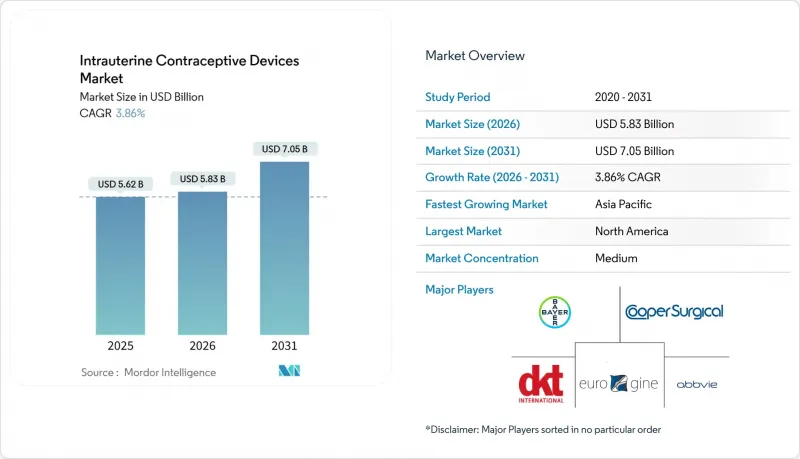
Mordor Intelligence에 의하면, 자궁내 피임 기구(IUD) 시장 규모는 2025년 56억 2,000만 달러로 평가되었습니다. 2026년에는 58억 3,000만 달러로 확대되어 2031년까지 70억 5,000만 달러에 이를 것으로 예상되며 2026년부터 2031년에 걸쳐 CAGR 3.86%로 성장할 전망입니다.
본 보고서는 기기 유형(호르몬 방출형 LNG-IUS, 구리제 IUD), 적응증(피임 등), 연령대(20세 미만, 20-24세, 25-34세, 기타), 최종 사용자(병원, 산부인과 클리닉 등), 유통 채널(공공 조달, 민간 클리닉 등), 지역(북미, 유럽 등)별로 분류되어 있습니다. 시장 전망은 금액(달러) 기준으로 제시되어 있습니다.
세계의 자궁내 피임 기구(IUD) 시장 동향 및 인사이트
효과적인 피임과 부작용 완화에 기여하는 기술 혁신
새로운 소재와 공학적 접근 방식을 통해 구리제 피임 기구의 개념이 재정의되고 있습니다. FDA 승인을 받은 ‘MIUDELLA’는 니치놀 소재의 프레임을 채택하여 구리 사용량을 50% 줄이면서도 99%의 유효성을 유지하고 있으며, 기존 설계로 인해 발생하던 통증과 과도한 출혈을 완화하고 있습니다. 조사팀은 피임 효과를 유지하면서 염증 반응을 완화할 가능성이 있는 유연한 철계 프레임에 대한 시험을 진행하고 있습니다. 이러한 개선 사항은 유해성에 대한 우려가 여전히 보급을 저해하고 있는 시장에서 특히 중요하며, 사용자의 편의성 향상에 연동된 프리미엄 가격 책정을 통해 공급업체에 경쟁 우위를 가져다줍니다. 바이엘의 ‘카일레나(Kyleena)’는 19.5 mg의 호르몬 함량과 3.8 mm 삽입기를 채택하여, 52 mg인 기존 제품에 비해 삽입 시 통증 점수를 30% 감소시켰으며, 12개월간 지속 사용률을 88%로 높였습니다. 이러한 개선을 통해 자궁내 피임 기구(IUD) 시장은 그동안 단기 작용형 제품을 선호하던 첫 이용자나 젊은 환자층에게 더욱 매력적인 선택지가 되었습니다.
장기 작용형 가역적 피임법(LARCs)에 대한 수요 증가
의료진은 매일 관리가 필요하지 않고, 첫해 실패율이 1% 미만인 피임기구를 환자에게 권장하고 있습니다. 25-34세 여성이 이미 IUD 사용자의 3분의 2에 가까운 비중을 차지하고 있으며, 이는 임신을 미루면서도 장기적인 피임 효과를 원하는 이들의 의향을 반영하고 있습니다. 2024년에 개정된 미국의 진료 지침에서는 상담 권장 순서에서 LARCs가 최우선으로 지정되어 있으며, 이러한 추세는 다른 국가의 진료 지침에도 영향을 미칠 가능성이 있습니다.
2025년, 전 세계 총 출산율은 여성 1인당 2.3명까지 떨어졌으며, 동아시아에서는 1.2명, 남유럽에서는 1.3명을 기록했습니다. 출산을 미루는 이용자들은 현재 매일 관리할 필요가 없으며, 그 효과가 불임 수술과 동등한 피임법을 중시하고 있으며, 이러한 인식이 자궁내 피임 기구(IUD) 시장의 성장을 뒷받침하고 있습니다. 2024년 가트마커 연구소가 15개국을 대상으로 실시한 조사에 따르면, LARC 이용자의 62%가 IUD를 선택한 주된 이유로 “한 번 삽입하면 그 후로는 신경 쓸 필요가 없습니다”는 편의성을 꼽았으며, 이는 단기 작용형 피임법의 38%를 웃도는 수치입니다. 이러한 이용률은 여성의 노동력 참여율이 55% 이상의 지역에서 두드러지게 나타나며, 경제적 역량 강화와 지속적인 피임 수요 간의 연관성을 여실히 보여주고 있습니다.
부작용 및 합병증의 위험
과다 출혈, 복통, 삽입 위치의 어긋남은 여전히 가장 큰 사용 장벽으로 남아 있습니다. 『International Journal of Pharmaceutics』지에 게재된 2024년 연구에 따르면, 폴리머의 배합 및 경화 조건이 LNG(레보노르게스트렐)의 방출량 편차와 관련이 있으며, 이것이 유해 사건의 발생에 영향을 미칠 가능성이 지적되고 있습니다. 의료진의 기술도 중요하며, 일반의가 IUD를 삽입한 경우, 산부인과 전문의가 삽입한 경우에 비해 위치 이상 발생률이 거의 2배에 달할 전망입니다. 2025년에 수행된 47건의 연구를 대상으로 한 메타분석에 따르면, 월경 변화나 삽입 시 통증으로 인해 구리제 IUD 사용자의 22%, 레보노르게스트렐제 IUD 사용자의 14%가 12개월 이내에 사용을 중단한 것으로 나타났습니다. 천공률이 낮더라도 의료과실 소송으로 이어질 가능성이 있어, 그 결과 진료소의 배상책임 보험료가 상승하고 있습니다. 이러한 현실로 인해 자원이 부족한 지역의 의료 제공업체들의 의욕이 꺾이고, 미충족 수요가 높음에도 불구하고 자궁내 피임 기구(IUD) 시장의 확대가 억제되고 있습니다.
부문별 분석
구리제 모델은 호르몬이 포함되지 않는다는 장점과 저렴한 가격 덕분에 2025년에는 자궁내 피임 기구(IUD) 시장의 66.10% 점유율을 차지했습니다. 레보노르게스트렐 계열 제품은 임신을 예방하면서 과다월경을 치료할 수 있기 때문에 연평균 성장률(CAGR) 6.25%로 성장하고 있습니다. 이를 통해 보험사는 비용을 두 가지 급여 범주로 배분할 수 있게 됩니다. 이러한 이중적인 유용성 덕분에, 자궁 적출술이나 절제술 비용(1만 5,000-2만 5,000달러)보다는 저렴하지만, 더 고가의 기기 구입에 대한 자금 지원 의향이 높아지고 있습니다. 2025년 2월에 승인된 ‘MIUDELLA’는 유연한 니치놀 프레임과 구리 함량 저감을 특징으로 하며, 기술적 개선을 통해 기존에 제기되던 통증 및 출혈에 대한 불만이 해소됨에 따라, 과거 부작용으로 인해 보급이 저해되었던 지역에서도 수용도가 높아지고 있음을 보여주고 있습니다. 철 기반 프레임 개발에 매진하고 있는 학술 연구팀은 염증 반응이 완화된 차세대 비호르몬계 제품의 가능성을 부각시키고 있으며, 이는 그동안 구리 재질 모델을 기피해 왔던 사용자들을 끌어모을 가능성이 있습니다.
또한, 각 제조업체는 생산 비용을 절감하기 위해 밸류체인의 효율화를 추진하고 있으며, 이러한 변화는 합리적인 가격대에서 대량 구매를 원하는 공공 부문의 입찰을 뒷받침하고 있습니다. 이러한 추세를 고려할 때, 구리 제품은 판매량 측면에서 계속해서 1위 자리를 유지할 것으로 보입니다. 그렇긴 하지만, 유럽과 북미에서 상환 한도액이 인상되면서 프리미엄 가격 책정이 뒷받침되고 있기 때문에 호르몬 계열 피임기구의 부가가치 점유율은 점차 확대될 전망입니다.
2025년, 피임용 자궁 내 장치 시장 규모의 78.80%를 피임 용도가 차지했습니다. 북미 갱년기 학회(NAMS)의 권고에 따라 60세 미만 여성을 대상으로 한 전신 에스트로겐 요법이 재개된 이후, 호르몬 대체 요법(HRT) 중 자궁내막 보호 분야는 연평균 성장률(CAGR) 9.28%를 기록하며 가장 빠른 성장세를 보이고 있습니다. ‘미레나(Mirena)’의 호르몬 대체 요법(HRT) 관련 적응증 표시에 따라, 산부인과 의사는 하나의 기기로 피임과 갱년기 증상 관리 모두를 해결할 수 있게 되어, 폐경 전후 여성들 사이에서 인기가 높아지고 있습니다.
1차 진료 의사들이 1차 치료법으로 경구용 약물에서 자궁내 피임 기구(IUD) 삽입으로 전환함에 따라, 과다월경 치료 시장도 확대되고 있습니다. 각 제약사는 가임 연령층의 감소에 대비하는 한편, 생애 주기 전반에 걸쳐 자궁내 피임 기구(IUD) 시장의 중요성을 유지하기 위해 갱년기 여성층을 대상으로 한 수익원의 다각화를 모색하고 있습니다.
지역별 분석
북미는 2025년, 12개 주에서 시행된 메디케이드 확대와 의료보험개혁법(ACA)에 따른 본인부담금 면제 규정에 힘입어 자궁내 피임 기구(IUD) 시장 점유율 39.90%를 유지했습니다. 미국이 이 지역의 판매량의 약 4분의 3을 차지하는 반면, 캐나다 각 주의 의료보험 제도에서는 2024년에 본 제품의 보험 적용이 추가되었습니다. 2026년부터 2031년에 걸쳐, 보험 지급 기관이 환급을 IUD의 장기 사용을 촉진하는 지속률에 연동함에 따라, 해당 지역은 한 자릿수 중반대의 성장률을 유지할 것으로 전망됩니다.
아시아태평양은 연평균 성장률(CAGR) 6.45%를 기록하며 가장 빠르게 성장하고 있습니다. 중국에서는 다자녀 정책으로의 전환에 따라 가역적 피임법에 대한 수요가 증가하고 있으며, 인도에서는 무료 IUD 프로그램의 확대에 힘입어 농촌 지역에서의 접근성이 높아지고 있습니다. 인도네시아, 베트남, 필리핀에서는 과다 출혈을 해결하기 위한 레보노르게스트렐 계열 피임 시스템의 도입이 중산층을 중심으로 진행되고 있습니다. 가격에 민감한 제품임에도 불구하고, 기부금과 국내 생산 덕분에 저소득층에서도 자궁내 피임 기구(IUD) 시장은 합리적인 가격을 유지하고 있습니다.
중동 및 아프리카는 다자간 이니셔티브를 통해 제품의 접근성과 공급 체계가 확대되고 있어 가장 빠르게 성장하고 있는 지역이지만, 문화적 거부감으로 인해 절대적인 보급률은 여전히 제한되고 있습니다. 유엔인구기금(UNFPA)의 ‘공급 파트너십’은 현재 54개국을 대상으로 하고 있으며, 2024년에는 2차 의료기관에서의 자궁내 피임 기구(IUD) 접근성이 65%로 상승할 것으로 전망됩니다. 사하라 이남 아프리카의 현대적 피임법 평균 보급률은 28.4%에 그치며, 장기 작용형 피임법을 이용하는 여성은 고작 9.6%에 불과합니다. 이는 연수 및 계몽 활동이 진행됨에 따라, 아직 개척되지 않은 잠재 수요가 매우 크다는 것을 보여줍니다.
기타 혜택 :
- 엑셀 형식 시장 예측(ME) 시트
- 3개월간의 애널리스트 지원
자주 묻는 질문
목차
제1장 서론
제2장 조사 방법
제3장 주요 요약
제4장 시장 구도
제5장 시장 규모 및 성장 예측
제6장 경쟁 구도
제7장 시장 기회 및 향후 전망
KTH 26.06.29According to Mordor Intelligence, the intrauterine contraceptive devices market size is expected to increase from USD 5.62 billion in 2025 to USD 5.83 billion in 2026 and reach USD 7.05 billion by 2031, growing at a CAGR of 3.86% over 2026-2031.
This report is Segmented by Device Type (Hormonal LNG-IUS, Copper IUD), Indication (Contraception and More), Age Group (<20, 20-24, 25-34, and More), End-User (Hospitals, Gynecology & Obstetrics Clinics, and More), Distribution Channel (Public Procurement, Private Clinics, and More), and Geography (North America, Europe, and More). Market Forecasts are Provided in Terms of Value (USD).
Global Intrauterine Contraceptive Devices Market Trends and Insights
Technological Innovation Leading to Effective Contraceptives and Fewer Side Effects
New materials and engineering approaches are redefining copper devices. The FDA-cleared MIUDELLA uses a nitinol frame and 50% less copper yet keeps 99% efficacy, easing pain and heavy bleeding previously linked to conventional designs. Research teams are testing flexible iron-based frames that could cut inflammatory responses while safeguarding contraceptive strength. These improvements matter most in markets where fear of adverse events still deters uptake, and they give suppliers an edge with premium pricing tied to better user comfort. Bayer's Kyleena uses a 19.5 mg hormone load and a 3.8 mm inserter, cutting insertion-pain scores by 30% compared with 52 mg predecessors, which lifts 12-month continuation to 88%. These refinements make the intrauterine contraceptive devices market more attractive to first-time users and younger patients who previously favored short-acting options.
Rising Demand for Long-Acting Reversible Contraceptives (LARCs)
Healthcare providers are steering patients toward devices that require no daily action and have a <1% first-year failure rate. Women aged 25-34 already represent nearly two-thirds of IUD use, mirroring their desire for extended protection while postponing pregnancies. Updated U.S. practice guidelines in 2024 place LARCs first in counseling scripts, a move likely to ripple into other national protocols.
Global fertility fell to 2.3 births per woman in 2025, with East Asia at 1.2 and Southern Europe at 1.3. Users postponing childbirth now prize methods that remove daily adherence and equal sterilization in effectiveness, a perception that propels the intrauterine contraceptive devices market. A 2024 Guttmacher survey across 15 nations showed 62% of LARC users cited "set-and-forget" convenience as the primary reason for choosing an IUD, up from 38% for short-acting methods. Uptake closely tracks female labor-force participation above 55%, which underscores the link between economic empowerment and sustained contraceptive demand.
Risk of Side Effects and Complications
Heavy bleeding, cramping, and misplaced insertions remain the top deterrents. A 2024 study in the International Journal of Pharmaceutics links polymer formulation and curing conditions to variable LNG release, which can influence the occurrence of adverse events. Provider skill also matters; malposition rates are nearly double when generalists insert devices versus obstetric-gynecology specialists. Bleeding changes and insertion pain still lead to 22% discontinuation among copper users and 14% among levonorgestrel users within 12 months, according to a 2025 meta-analysis of 47 studies. Even low perforation rates trigger malpractice suits, raising liability premiums for clinics. These realities dampen provider enthusiasm in low-resource areas, moderating expansion of the intrauterine contraceptive devices market despite high unmet need.
Other drivers and restraints analyzed in the detailed report include:
- Government Initiatives and Support Policies
- Favorable Recommendations from Global Health Organizations
- Cultural and Religious Opposition Coupled with Lack of Awareness
For complete list of drivers and restraints, kindly check the Table Of Contents.
Segment Analysis
Copper models captured 66.10% of the intrauterine contraceptive devices market share in 2025, driven by their hormone-free appeal and low device cost. Levonorgestrel systems are growing at a 6.25% CAGR because they treat heavy menstrual bleeding while preventing pregnancy, allowing insurers to allocate expenses across two benefit categories. This dual utility boosts willingness to fund higher device prices that nonetheless undercut the USD 15,000-25,000 cost of hysterectomy or ablation. The February 2025 approval of MIUDELLA featuring a flexible nitinol frame and reduced copper illustrates how engineering refinements address historic pain and bleeding complaints, boosting acceptance in regions where side effects once limited uptake. Academic teams pursuing iron-based frames highlight a potential next class of non-hormonal products with softer inflammatory profiles that could lure users who previously avoided copper models.
Manufacturers are also enhancing supply-chain efficiency to lower production costs, a change that supports public-sector tenders seeking bulk volumes at modest price points. Given these trends, copper units will remain volume leaders. Still, hormonal devices are set to capture incremental value share as higher reimbursement ceilings in Europe and North America favor premium pricing.
Contraception held 78.80% of the intrauterine contraceptive devices market size in 2025. Endometrial protection during hormone-replacement therapy shows the fastest growth at 9.28% CAGR since the North American Menopause Society endorsements revived systemic estrogen use for women under 60. Mirena's HRT-linked label allows gynecologists to serve both contraception and menopausal symptom management with one device, adding appeal among perimenopausal women.
Heavy-bleeding therapy is growing as primary-care physicians shift first-line management from oral drugs to IUD insertion. Manufacturers diversify revenue streams toward menopausal cohorts, hedging against shrinking fertility populations yet keeping intrauterine contraceptive devices market relevance across life stages.
Geography Analysis
North America retained 39.90% of % intrauterine contraceptive devices market share in 2025, buoyed by Medicaid expansion in 12 states and zero-copay rules under the Affordable Care Act. The United States contributed roughly three-quarters of regional volume, while Canada's provincial plans added device coverage in 2024. Between 2026 and 2031, the region is forecast to maintain mid-single-digit growth as payors tie reimbursement to continuation rates that favor IUD longevity.
Asia-Pacific is rising fastest, with a 6.45% CAGR. China's policy shift toward larger families amplifies demand for reversible contraception, and India's scaled-up free IUD program widens rural access. Indonesia, Vietnam, and the Philippines follow with middle-class uptake of levonorgestrel systems that tackle heavy bleeding. Despite price sensitivity, donor subsidies and domestic manufacturing keep the intrauterine contraceptive devices market affordable in lower-income pockets.
The Middle East and Africa are the fastest-growing regions as multilateral initiatives expand product availability and provider capacity, though cultural resistance still dampens absolute penetration. UNFPA's Supplies Partnership now covers 54 countries, with IUD availability at secondary care sites rising to 65% in 2024. Sub-Saharan Africa's average modern-method prevalence sits at 28.4%, and only 9.6% of women use long-acting methods, highlighting vast untapped potential as training and outreach progress.
- Abbvie
- Aetos Pharma Pvt Ltd
- Agile Therapeutics
- Bayer
- Contrel Europe NV
- The Cooper Companies
- DKT International
- Egemen International
- Eurim Group
- EUROGINE S.L.
- Gedeon Richter Polska
- Gynocare
- HLL Lifecare
- Melbea
- Meril Life Sciences
- Mona Lisa
- OCON Medical Ltd.
- Pregna International Ltd.
- Prosan International
- Sebela Pharmaceuticals
- SMB
- Viatris
Additional Benefits:
- The market estimate (ME) sheet in Excel format
- 3 months of analyst support
TABLE OF CONTENTS
1 Introduction
- 1.1 Study Assumptions & Market Definition
- 1.2 Scope of the Study
2 Research Methodology
3 Executive Summary
4 Market Landscape
- 4.1 Market Overview
- 4.2 Market Drivers
- 4.2.1 Technological Innovation Leading to Effective Contraceptives and Less Side Effects
- 4.2.2 Rising Demand for Long-Acting Reversible Contraceptives (LARCs)
- 4.2.3 Government Inititives and Support Policies
- 4.2.4 Favorable recommendations from Global Health Organziations
- 4.2.5 Increasing Trend of Delayed Childbirth
- 4.2.6 Expansion of NGO-led social-marketing campaigns and public private partnership distribution programs
- 4.3 Market Restraints
- 4.3.1 Risk Of Side Effects and Complications
- 4.3.2 Cultural & Religious Opposition to IUDs Coupled with Lack of Awareness
- 4.3.3 Skilled Provider Shortage for Insertions
- 4.3.4 High Up-Front Device and Insertion Cost
- 4.4 Supply-Chain Analysis
- 4.5 Regulatory Landscape
- 4.6 Technological Outlook
- 4.7 Porters Five Forces Analysis
- 4.7.1 Threat of New Entrants
- 4.7.2 Bargaining Power of Buyers
- 4.7.3 Bargaining Power of Suppliers
- 4.7.4 Threat of Substitutes
- 4.7.5 Intensity of Competitive Rivalry
5 Market Size & Growth Forecasts (Value, USD)
- 5.1 By Device Type
- 5.1.1 Hormonal LNG-IUS
- 5.1.2 Copper IUD
- 5.2 By Indication
- 5.2.1 Contraception
- 5.2.2 Heavy Menstrual Bleeding therapy
- 5.2.3 Endometrial Protection during HRT
- 5.3 By Age Group
- 5.3.1 <20 Years
- 5.3.2 20-24 Years
- 5.3.3 25-34 Years
- 5.3.4 35-44 Years
- 5.3.5 >44 Years
- 5.4 By End-User
- 5.4.1 Hospitals
- 5.4.2 Gynecology & Obstetrics Clinics
- 5.4.3 Community Health Centers
- 5.4.4 Family-Planning / Sexual-Health Centers
- 5.4.5 Tele-health Enabled Home-Insertion Programs
- 5.5 By Distribution Channel
- 5.5.1 Public Sector Procurement
- 5.5.2 Private Clinics & Retail
- 5.5.3 NGO/Donor-Funded Programs
- 5.5.4 Online & Pharmacy E-commerce
- 5.6 By Geography
- 5.6.1 North America
- 5.6.1.1 United States
- 5.6.1.2 Canada
- 5.6.1.3 Mexico
- 5.6.2 Europe
- 5.6.2.1 Germany
- 5.6.2.2 United Kingdom
- 5.6.2.3 France
- 5.6.2.4 Italy
- 5.6.2.5 Spain
- 5.6.2.6 Rest of Europe
- 5.6.3 Asia-Pacific
- 5.6.3.1 China
- 5.6.3.2 India
- 5.6.3.3 Japan
- 5.6.3.4 Australia
- 5.6.3.5 South Korea
- 5.6.3.6 Rest of Asia-Pacific
- 5.6.4 Middle East and Africa
- 5.6.4.1 GCC
- 5.6.4.2 South Africa
- 5.6.4.3 Rest of Middle East and Africa
- 5.6.5 South America
- 5.6.5.1 Brazil
- 5.6.5.2 Argentina
- 5.6.5.3 Rest of South America
- 5.6.1 North America
6 Competitive Landscape
- 6.1 Market Concentration
- 6.2 Market Share Analysis
- 6.3 Company Profiles (includes Global level Overview, Market-level Overview, Core Segments, Financials, Strategic Information, Market Rank/Share, Products & Services, Recent Developments)
- 6.3.1 AbbVie Inc (Allergan)
- 6.3.2 Aetos Pharma Pvt Ltd
- 6.3.3 Agile Therapeutics
- 6.3.4 Bayer AG
- 6.3.5 Contrel Europe NV
- 6.3.6 CooperSurgical Inc.
- 6.3.7 DKT International
- 6.3.8 Egemen International
- 6.3.9 Eurim Group
- 6.3.10 EUROGINE S.L.
- 6.3.11 Gedeon Richter Polska
- 6.3.12 Gynocare
- 6.3.13 HLL Lifecare Ltd
- 6.3.14 Melbea AG
- 6.3.15 Meril Life Sciences
- 6.3.16 Mona Lisa NV
- 6.3.17 OCON Medical Ltd.
- 6.3.18 Pregna International Ltd.
- 6.3.19 Prosan International BV
- 6.3.20 Sebela Pharmaceuticals
- 6.3.21 SMB Corporation of India
- 6.3.22 Viatris
7 Market Opportunities & Future Outlook
- 7.1 White-space & Unmet-Need Assessment