
|
시장보고서
상품코드
2066465
나노재료 : 시장 점유율 분석, 업계 동향 및 통계, 성장 예측(2026-2031년)Nanomaterials - Market Share Analysis, Industry Trends & Statistics, Growth Forecasts (2026 - 2031) |
||||||
 Mordor Intelligence
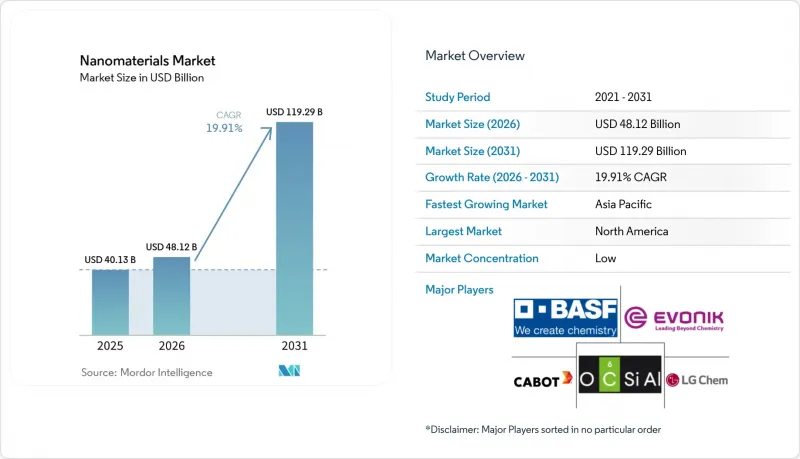
Mordor Intelligence에 의하면, 나노재료 시장 규모는 2025년에 401억 3,000만 달러로 평가되었습니다. 2026년에 481억 2,000만 달러에 달하고, 2031년까지 1,192억 9,000만 달러에 이를 것으로 예측되며, 2026년부터 2031년에 걸쳐 CAGR 19.91%로 성장할 전망입니다.
본 보고서는 제품 유형(나노입자, 나노섬유, 나노튜브, 나노클레이, 나노와이어), 구조 유형(비고분자 유기계 및 고분자계), 재료 범주(탄소계, 금속계, 금속산화물/세라믹계, 고분자/지질계), 최종 사용자 산업(건설, 전자, 에너지 등) 및 지역(아시아태평양, 북미 등)별로 분류되어 있습니다. 시장 전망은 금액(달러) 단위로 제시되어 있습니다.
세계의 나노재료 시장 동향 및 인사이트
반도체 팹에서 고순도 나노 슬러리의 도입 확대
TSMC의 애리조나 공장과 삼성의 텍사스 공장에서는 게이트 올 어라운드(GAA)의 수율 목표를 달성하기 위해, 특히 입자 직경이 50 nm 미만인 세리아 및 알루미나 CMP 슬러리로의 전환을 추진하고 있습니다. 한편, 인텔은 벤치마크 대비 결함 밀도 감소가 예상되는 콜로이드 실리카 배합제공급에 대해 캐보트 마이크로일렉트로닉스사에 승인을 부여했습니다. 국내 조달 요건을 포함하고 있는 미국의 ‘CHIPS법’에 따라 조달이 북미 생산자로 향하고 있으며, 그동안 아시아를 중심으로 이루어지던 공급망이 사실상 세분화되고 있습니다. 인라인 동적 광산란(DLS) 제어 기능을 갖추지 않은 공급업체는 조달 대상에서 제외될 가능성이 있으며, 그 결과 통합형 공급업체에 주문이 집중되고 있습니다. 팹이 후면 전원 공급 방식으로 전환됨에 따라 슬러리의 복잡성이 증가하고 있으며, 용도 특화형 등급의 가격 프리미엄이 높아지고 있습니다.
mRNA 백신 플랫폼에 나노 물질 통합
2025년, 모더나사는 인플루엔자 및 복합 호흡기 백신 개발을 지원하기 위해 이온화성 및 PEG화 지질의 처리를 확대했습니다. 한편, 바이오엔테크사는 연속류 마이크로플루이딕스 혼합기를 통합하여 입자 크기를 실시간으로 조절할 수 있게 함으로써 포집 효율을 최적화하고 있습니다. 화이자는 1회 투여당 지질 사용량을 줄여 바이알당 비용 절감으로 이어지는 자가 증폭형 RNA(saRNA) 구조체에 대한 시험을 진행하고 있습니다. 현재 지질 공급망은 공급량을 보장하는 테이크-오어-페이 계약을 통해 주로 관리되고 있습니다. 그러나 콜레스테롤이나 DSPC의 가격이 높은 수준을 유지할 경우, 공급업체는 이익률 압박에 직면할 가능성이 있으므로, 이러한 계약 형태는 공급업체에게 위험 요소가 됩니다. 긍정적인 신호로는 기존 공급업체들은 향후 몇 년간의 전망을 파악할 수 있는 반면, 신규 진출기업들은 진입 장벽이 높아지는 상황에 직면하게 될 것입니다.
중요한 나노 규모 원자재의 가격 변동
2025년, 모잠비크의 바라마 광산에서 사이클론으로 인한 피해가 발생하여 천연 플레이크 흑연공급이 중단됨에 따라, 산화 그래핀의 현물 가격이 급등했습니다. 이와 동시에, 중국의 제련소가 강화된 환경 규제에 대응해 생산량을 줄이면서 사염화티타늄의 가격도 급등했습니다. 또한, 세륨 산화물 슬러리에 일반적으로 사용되는 희토류 산화물에 대한 수출 허가 제한으로 인해 가격이 크게 등락했습니다. 장기 수거 계약을 맺지 않은 각 변환업체들은 이익률을 확보하기가 어려워지고 있습니다. BASF는 전략적 조치의 일환으로, 안정적인 원료 확보를 목적으로 캐나다의 흑연 개발 기업의 소수 지분을 인수했습니다. 이러한 업스트림 통합 전략은 변동성이 큰 현물 시장에 대한 노출을 줄여주는 한편, 자본 수요 증가도 수반합니다.
부문별 분석
2025년 나노재료 시장의 매출액 중 나노 입자가 66.78%를 차지했습니다. 이는 이산화티타늄을 사용한 자외선 차단제, 실리카 강화 자동차용 코팅제, 그리고 알루미나 필러에 대한 꾸준한 수요를 반영한 것입니다. 금이나 은 등의 나노 금속은 피코몰 수준에서 바이오마커를 검출하는 진단 기술을 뒷받침하고 있습니다. 수량 기준으로 볼 때, 비금속 산화물이 시장을 주도하고 있습니다. BASF의 루트비히스하펜 복합 단지는 주로 타이어 보강재로 사용되는 훈증 실리카를 생산함으로써 규모의 경제를 실현했습니다. 한편, 리튬 티타네이트 등의 복합 산화물은 고체 배터리 분야에서 큰 진전을 보이고 있으며, 심천과 서울에서 버스 충전이 가능하게 하고 있습니다.
전기자동차(EV)의 열 관리 시스템과 5G 안테나 어레이에는 EMI 차폐재로 다중벽 탄소나노튜브가 적용되어 있으며, 나노튜브 시장은 2031년까지 연평균 성장률(CAGR) 21.43%로 성장할 전망입니다. OCSiAl사는 사이클 수명을 연장하는 배터리용 첨가제로서 단층 탄소나노튜브의 생산을 확대했습니다. 한편, 나노파이버, 나노클레이, 나노와이어는 각각 여과, 포장, 투명 전도체 등으로 활용되고 있지만, 매출 측면에서는 모두 틈새 시장에 그치고 있습니다. ISO 10808에 부합하는 입자 특성 평가가 시장 진입의 표준 요건으로 부상하고 있으며, 이는 고도의 분석 능력을 갖춘 공급업체에게 경쟁 우위를 제공합니다.
2025년에는 비고분자계 유기 나노재료가 55.12%의 점유율을 차지했으며, 저회전저항 타이어용 카본블랙과 탄소나노튜브 전도성 첨가제가 성장을 주도했습니다. 아프타마는 현장 진단(Point-of-Care) 분야에서 진전을 보였으며, 2025년 초에는 CE 마크를 획득한 코로나19 검출 키트가 출시되었습니다. 현재 플래그십 스마트폰은 이리듐 착물을 활용한 저분자 OLED 발광체를 탑재하여 높은 양자 효율을 실현하고 있습니다.
고분자 등급 시장은 나노실리카를 활용한 내스크래치 코팅 및 고효율 CRISPR-Cas9 형질전입 시약에 대한 수요를 배경으로 연평균 성장률(CAGR) 20.05%로 성장할 전망입니다. 2024년에는 양자점을 활용한 진단 시약이 획기적인 성과를 거두어, 단 하나의 혈청 샘플만으로 12가지 항목을 면역 측정할 수 있게 되었습니다. 제약 업계에서는 도키실과 아브라크산이 선도적인 역할을 맡으면서, 리포솜과 덴드리머를 활용한 약물 전달 시스템에 대한 관심이 높아지고 있습니다. 유럽에서 새로운 살생물제에 관한 제안이 잇따르는 가운데, 기존에는 은 나노입자에 의존하던 섬유 가공 분야에서는 현재 산화아연을 이용한 대체제로의 전환이 진행되고 있습니다. 한편, 높은 수익률을 자랑하는 틈새 시장인 광학·유전체 필름 분야에서는 ISO 14001 인증 획득이 전략적 조달 측면에서 우위를 점하는 요소가 되고 있습니다.
지역별 분석
북미는 2025년 매출의 38.78%를 차지하며, 애리조나주에 위치한 TSMC 및 인텔의 팹(이 두 회사가 연간 나노 슬러리를 공동 사용)과, CHIPS 법 및 BARDA의 인센티브에 힘입은 화이자·모더나의 지질 네트워크가 주도적인 역할을 했습니다. 캐나다의 NanoXplore사는 자동차 및 건설용 복합재용 그래핀 생산을 확대할 계획이며, 한편 멕시코의 몬테레이 코리도에는 텍사스주의 기가팩토리에 서비스를 제공하는 나노코팅 생산 라인이 집적되어 있습니다. 미국 환경보호청(EPA)은 2026년 중반에 나노물질 보고 규정을 최종 확정하고, 정보 공개를 의무화할 전망입니다. 이는 소규모 생산자들에게는 부담이 될 수 있지만, 시장의 투명성을 높이는 데에도 기여할 것입니다.
아시아태평양은 중국의 그래핀 및 나노튜브 분야에서의 적극적인 확장에 힘입어 연평균 성장률(CAGR) 22.32%를 나타낼 것으로 전망됩니다. 특히, 장쑤 Cnano는 2026년까지 다중벽 탄소나노튜브의 생산량을 확대될 전망입니다. 한편, 일본에서는 미쓰비시 화학이나 스미토모 화학과 같은 주요 기업들 덕분에 OLED 발광 재료 분야에서 우위를 공고히 하고 있습니다. 한국의 대기업인 LG화학과 삼성SDI는 차세대 배터리에 실리콘 나노와이어 음극재를 적용하고 있습니다. 인도에서는 나노 이산화티타늄 제조업체들이 도료 및 자외선 차단제 분야 수요 급증에 대응하기 위해 생산을 확대되고 있습니다. 아세안 국가들, 특히 베트남을 필두로 전자 분야에 대한 외국인 직접 투자의 뒷받침을 받아 상수도용 산화 그래핀 막의 시범 운영이 진행되고 있습니다.
유럽에서는 엄격한 REACH 사전 등록 제도의 성과가 결실을 맺어, BASF, 에보닉, 바커와 같은 기존 대기업들이 그 혜택을 누리고 있습니다. 이 3개사는 특수 나노재료 매출에서 큰 점유율을 차지하고 있습니다. 영국에서는 베르사리안과 이탈리아의 다이렉타 플러스가 복합재료 용도의 그래핀 생산 확대를 추진하고 있습니다. 프랑스의 아르케마는 풀러렌을 기반으로 한 유기 태양전지 소재의 상용화를 통해 큰 진전을 이루고 있습니다. 남미는 아직 초기 단계에 있으며, 브라질에서는 상파울루 지하철 확장 공사를 위해 나노클레이 시멘트의 실증 실험이 진행되고 있습니다. 중동은 사우디아라비아의 얌부 이산화티타늄 복합 시설을 선두로, 가스 기반의 사염화티타늄 제조 공정을 활용하여 비용 효율이 뛰어난 전구체 허브로서의 입지를 확립해 가고 있습니다.
기타 혜택 :
- 엑셀 형식 시장 예측(ME) 시트
- 3개월간의 애널리스트 지원
자주 묻는 질문
목차
제1장 서론
제2장 조사 방법
제3장 주요 요약
제4장 시장 구도
제5장 시장 규모 및 성장 예측
제6장 경쟁 구도
제7장 시장 기회 및 향후 전망
KTH 26.06.29According to Mordor Intelligence, the nanomaterials market size is projected to be USD 40.13 billion in 2025, USD 48.12 billion in 2026, and reach USD 119.29 billion by 2031, growing at a CAGR of 19.91% from 2026 to 2031.
This report is Segmented by Product Type (Nanoparticles, Nanofibers, Nanotubes, Nanoclays, and Nanowires), Structure Type (Non-Polymer Organic and Polymeric), Material Category (Carbon-Based, Metal-Based, Metal-Oxide/Ceramic, and Polymeric/Lipid), End-User Industry (Construction, Electronics, Energy, and More), and Geography (Asia-Pacific, North America, and More). Market Forecasts are Provided in Value (USD).
Global Nanomaterials Market Trends and Insights
Semiconductor Fabs Scaling High-Purity Nano-Slurries
TSMC's Arizona and Samsung's Texas fabs are turning to ceria and alumina CMP slurries, specifically those with sub-50 nm particle sizes, to achieve gate-all-around yield targets. Meanwhile, Intel has greenlit Cabot Microelectronics to provide colloidal-silica formulations, which promise a reduction in defect density compared to benchmarks. The U.S. CHIPS Act, with its domestic-content clauses, is steering procurement towards North American producers, effectively fragmenting the previously Asia-centric supply chain. Vendors lacking inline dynamic-light-scattering controls face disqualification, leading to a concentration of orders with integrated suppliers. As fabs shift towards backside-power delivery, the rising complexity of slurries is driving price premiums for application-engineered grades.
Integration of Nanomaterials in mRNA-Vaccine Platforms
In 2025, Moderna ramped up its processing of ionizable and PEGylated lipids to support flu and combination respiratory vaccines. Meanwhile, BioNTech has integrated continuous-flow microfluidic mixers, enabling real-time adjustments of particle sizes to optimize uptake. Pfizer is testing self-amplifying RNA constructs, which utilize less lipid per dose, translating to a cost reduction per vial. The lipid supply chain is now largely governed by take-or-pay contracts, ensuring guaranteed volumes. However, this arrangement poses a risk for suppliers, as they might face margin compression if prices for cholesterol and DSPC remain high. The silver lining? Established vendors gain multi-year visibility, while newcomers face heightened entry barriers.
Volatile Prices of Critical Nanoscale Feedstocks
In 2025, cyclone damage at Mozambique's Balama mine disrupted the supply of natural-flake graphite, leading to a sharp rise in graphene-oxide spot prices. Simultaneously, costs for titanium tetrachloride surged as Chinese smelters, responding to tightened environmental quotas, curtailed their output. Additionally, export-license restrictions on rare-earth oxides, commonly used in cerium-oxide slurries, resulted in significant price fluctuations. Converters, lacking long-term offtake agreements, find it challenging to safeguard their margins. In a strategic move, BASF acquired a minority stake in a Canadian graphite developer, aiming to secure a steady feedstock. While such forward-integration strategies mitigate exposure to volatile spot markets, they also come with heightened capital demands.
Other drivers and restraints analyzed in the detailed report include:
- Rapid Adoption of Nano-Enabled Water Treatment Systems
- EV Battery Production Using Nano-Structured Electrodes
- High CAPEX for Precision Synthesis Equipment
For complete list of drivers and restraints, kindly check the Table Of Contents.
Segment Analysis
Nanoparticles accounted for 66.78% of 2025 revenue within the nanomaterials market, reflecting entrenched demand for titanium-dioxide sunscreens, silica-reinforced automotive coatings, and alumina fillers. Nanometals such as gold and silver underpin diagnostics that detect biomarkers at picomolar levels. By volume, non-metal oxides lead the market. BASF's Ludwigshafen complex showcased its scale economies by producing fumed silica, primarily for tire reinforcement. Meanwhile, complex oxides, such as lithium titanate, are making strides in solid-state batteries, enabling bus charges in both Shenzhen and Seoul.
Nanotubes are poised for a 21.43% CAGR to 2031 as EV thermal-management systems and 5G antenna arrays embed multi-walled carbon nanotubes for EMI shielding. OCSiAl ramped up its production of single-walled nanotubes, providing battery additives that enhance cycle life. While nanofibers, nanoclays, and nanowires find applications in filtration, packaging, and as transparent conductors, respectively, each remains a niche in terms of value. Compliance with ISO 10808 particle characterization is emerging as a standard entry requirement, giving an edge to vendors equipped with advanced analytics.
Non-polymer organic nanomaterials held 55.12% share in 2025, led by carbon black for low-rolling-resistance tires and carbon-nanotube conductive additives. Aptamers advanced in point-of-care diagnostics, with CE-marked COVID-19 detection kits launched in early 2025. Flagship smartphones now boast small-molecule OLED emitters, harnessing iridium complexes, achieving high quantum efficiencies.
Polymeric grades are set to expand at a 20.05% CAGR, riding demand for nano-silica scratch-resistant coatings and high-efficiency CRISPR-Cas9 transfection reagents. In 2024, diagnostic reagents leveraging quantum dots achieved a milestone, facilitating 12-plex immunoassays from just one serum sample. The pharmaceutical industry has increasingly focused on liposomal and dendrimer drug-delivery vehicles, with Doxil and Abraxane leading the charge. Amidst emerging European biocide proposals, fabric treatments previously reliant on silver nanoparticles are now shifting focus to zinc oxide alternatives. Meanwhile, in the realm of optical and dielectric films, a high-margin niche, securing an ISO 14001 certification has become a strategic procurement advantage.
Geography Analysis
North America contributed 38.78% of 2025 sales, anchored by Arizona's TSMC and Intel fabs that together use nano-slurries annually and by Pfizer-Moderna lipid networks supported by the CHIPS Act and BARDA incentives. Canada's NanoXplore plans to scale graphene output for automotive and construction composites, while Mexico's Monterrey corridor attracts nano-coating lines serving Gigafactory Texas. The U.S. Environmental Protection Agency expects to finalize a nanomaterial reporting rule in mid-2026, mandating disclosure, which may burden smaller producers but increase market transparency.
Asia-Pacific is projected to deliver a 22.32% CAGR, fueled by China's aggressive expansions in graphene and nanotubes. Notably, Jiangsu Cnano is on track to boost its multi-walled nanotube output by 2026. Meanwhile, Japan solidifies its dominance in OLED emitters, thanks to key players like Mitsubishi Chemical and Sumitomo Chemical. South Korea's giants, LG Chem and Samsung SDI, are integrating silicon-nanowire anodes into next-gen batteries. In India, producers of nano-titanium dioxide are ramping up production to cater to the surging demand in paints and sunscreens. ASEAN nations, with Vietnam at the forefront, are piloting graphene-oxide membranes for municipal water, bolstered by foreign direct investment in electronics.
Europe reaps the rewards of stringent REACH pre-registration, a move that benefits established players like BASF, Evonik, and Wacker, who together account for a significant share of the specialty-nanomaterial revenue. In the UK, Versarien and Italy's Directa Plus are scaling up graphene for composite applications. France's Arkema is making strides by commercializing fullerene-based organic photovoltaic materials. South America is still in its nascent stages, with Brazil experimenting with nano-clay cement for the metro expansion in Sao Paulo. The Middle East, spearheaded by Saudi Arabia's Yanbu titanium dioxide complex, is carving out a niche as a cost-effective precursor hub, capitalizing on gas-based titanium tetrachloride production routes.
- ACS Material
- American Elements
- Arkema
- Ascensus
- BASF SE
- Cabot Corporation
- Chasm Advanced Materials, Inc.
- Evonik Industries AG
- Jiangsu Cnano Technology Co., Ltd.
- LG Chem
- Merck KGaA
- Nano-C
- Nanocyl SA
- NAWAH
- OCSiAl
- QuantumSphere, Inc.
- Raymor Industries Inc.
- Resonac Holdings Corporation
- Solesence
- US Research Nanomaterials, Inc.
- Zyvex Technologies
Additional Benefits:
- The market estimate (ME) sheet in Excel format
- 3 months of analyst support
TABLE OF CONTENTS
1 Introduction
- 1.1 Study Assumptions and Market Definition
- 1.2 Scope of the Study
2 Research Methodology
3 Executive Summary
4 Market Landscape
- 4.1 Market Overview
- 4.2 Market Drivers
- 4.2.1 Expansion of semiconductor fabs driving high-purity nano-slurries
- 4.2.2 Rising integration of nanomaterials in mRNA-vaccine platforms
- 4.2.3 Rapid adoption of nano-enabled water treatment systems
- 4.2.4 Surge in EV battery production using nano-structured electrodes
- 4.2.5 EU CBAM incentivising nano-clay low-carbon cement
- 4.3 Market Restraints
- 4.3.1 Volatile prices of critical nanoscale feedstocks
- 4.3.2 High CAPEX for precision synthesis (ALD reactors, etc.)
- 4.3.3 Emerging EHS rules delaying approvals (EU and Canada)
- 4.4 Value Chain Analysis
- 4.5 Porter's Five Forces
- 4.5.1 Bargaining Power of Suppliers
- 4.5.2 Bargaining Power of Buyers
- 4.5.3 Threat of New Entrants
- 4.5.4 Threat of Substitutes
- 4.5.5 Competitive Rivalry
5 Market Size and Growth Forecasts (Value)
- 5.1 By Product Type
- 5.1.1 Nanoparticles
- 5.1.1.1 Nanometals
- 5.1.1.1.1 Gold
- 5.1.1.1.2 Silver
- 5.1.1.1.3 Platinum
- 5.1.1.1.4 Titanium
- 5.1.1.1.5 Aluminium
- 5.1.1.2 Non-metal Oxides
- 5.1.1.2.1 Alumina
- 5.1.1.2.2 Iron Oxide
- 5.1.1.2.3 Titanium Oxide
- 5.1.1.2.4 Silica
- 5.1.1.2.5 Zinc Oxide
- 5.1.1.3 Complex Oxides
- 5.1.1.3.1 Calcium Phosphate
- 5.1.1.3.2 Rare-earth Metal Oxides
- 5.1.1.3.3 Lithium Titanate
- 5.1.1.3.4 Silica Hydride
- 5.1.1.1 Nanometals
- 5.1.2 Nanofibers
- 5.1.3 Nanotubes
- 5.1.4 Nanoclays
- 5.1.5 Nanowires
- 5.1.1 Nanoparticles
- 5.2 By Structure Type
- 5.2.1 Non-polymer Organic Nanomaterials
- 5.2.1.1 Carbon Black
- 5.2.1.2 Carbon Nanotubes
- 5.2.1.3 Aptamers
- 5.2.1.4 Small-molecule OLED Materials
- 5.2.1.5 Activated Carbon
- 5.2.1.6 Carbon Nanotube Composites
- 5.2.2 Polymeric Nanomaterials
- 5.2.2.1 Coatings and Adhesives
- 5.2.2.2 Transfection Reagents
- 5.2.2.3 Diagnostic Reagents
- 5.2.2.4 Drug-delivery Vehicles
- 5.2.2.5 Fabric Treatments
- 5.2.2.6 Optical Coatings
- 5.2.2.7 Nano-porous Filtration Membranes
- 5.2.2.8 Dielectric Films
- 5.2.2.9 OLED Films
- 5.2.1 Non-polymer Organic Nanomaterials
- 5.3 By Material Category
- 5.3.1 Carbon-based
- 5.3.2 Metal-based
- 5.3.3 Metal-oxide and Ceramic-based
- 5.3.4 Polymeric and Lipid-based
- 5.4 By End-user Industry
- 5.4.1 Construction
- 5.4.2 Electronics
- 5.4.3 Energy
- 5.4.4 Healthcare
- 5.4.5 Personal Care
- 5.4.6 Rubber
- 5.4.7 Other End-user Industries
- 5.5 By Geography
- 5.5.1 Asia-Pacific
- 5.5.1.1 China
- 5.5.1.2 India
- 5.5.1.3 Japan
- 5.5.1.4 South Korea
- 5.5.1.5 ASEAN
- 5.5.1.6 Rest of Asia-Pacific
- 5.5.2 North America
- 5.5.2.1 United States
- 5.5.2.2 Canada
- 5.5.2.3 Mexico
- 5.5.3 Europe
- 5.5.3.1 Germany
- 5.5.3.2 United Kingdom
- 5.5.3.3 Italy
- 5.5.3.4 France
- 5.5.3.5 Rest of Europe
- 5.5.4 South America
- 5.5.4.1 Brazil
- 5.5.4.2 Argentina
- 5.5.4.3 Rest of South America
- 5.5.5 Middle-East and Africa
- 5.5.5.1 Saudi Arabia
- 5.5.5.2 South Africa
- 5.5.5.3 Rest of Middle-East and Africa
- 5.5.1 Asia-Pacific
6 Competitive Landscape
- 6.1 Market Concentration
- 6.2 Strategic Moves
- 6.3 Market Share/Ranking Analysis
- 6.4 Company Profiles (includes Global Overview, Market-level Overview, Core Segments, Financials, Strategic Information, Products and Services, and Recent Developments)
- 6.4.1 ACS Material
- 6.4.2 American Elements
- 6.4.3 Arkema
- 6.4.4 Ascensus
- 6.4.5 BASF SE
- 6.4.6 Cabot Corporation
- 6.4.7 Chasm Advanced Materials, Inc.
- 6.4.8 Evonik Industries AG
- 6.4.9 Jiangsu Cnano Technology Co., Ltd.
- 6.4.10 LG Chem
- 6.4.11 Merck KGaA
- 6.4.12 Nano-C
- 6.4.13 Nanocyl SA
- 6.4.14 NAWAH
- 6.4.15 OCSiAl
- 6.4.16 QuantumSphere, Inc.
- 6.4.17 Raymor Industries Inc.
- 6.4.18 Resonac Holdings Corporation
- 6.4.19 Solesence
- 6.4.20 US Research Nanomaterials, Inc.
- 6.4.21 Zyvex Technologies
7 Market Opportunities and Future Outlook
- 7.1 White-space and Unmet-need Assessment