

|
시장보고서
상품코드
2066479
음성 번역 : 시장 점유율 분석, 업계 동향 및 통계, 성장 예측(2026-2031년)Speech To Speech Translation - Market Share Analysis, Industry Trends & Statistics, Growth Forecasts (2026 - 2031) |
||||||
 Mordor Intelligence
Mordor Intelligence에 의하면, 음성 번역 시장 규모는 2025년 6억 9,000만 달러로 평가되었습니다. 2026년에는 7억 6,204만 달러로 확대되어 2026년부터 2031년에 걸쳐 CAGR 10.44%로 성장을 지속하여, 2031년에는 12억 5,000만 달러에 이를 것으로 예측됩니다.
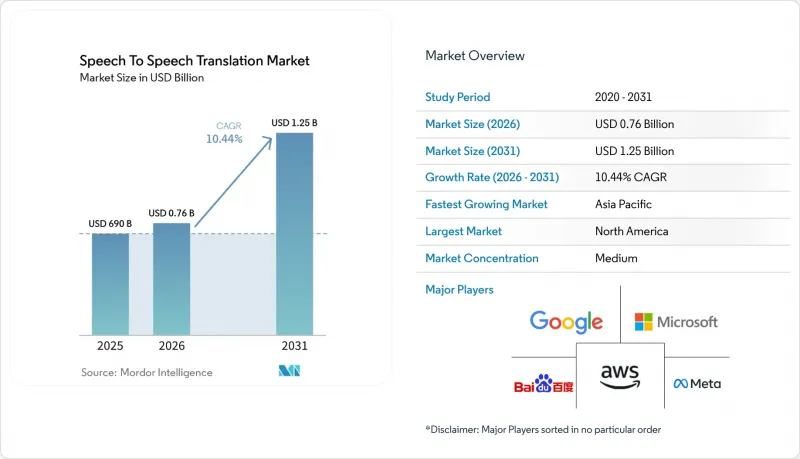
본 보고서는 유형(하드웨어, 소프트웨어), 배포 방식(On-Premise, 클라우드 기반, 엣지), 용도(여행 및 관광, 의료 등), 최종 사용자(개인 소비자, 기업 등), 기술(신경망 기계 번역, 통계적 기계 번역, 규칙 기반 번역 등) 및 지역별로 분류되어 있습니다. 시장 전망은 금액(달러) 기준으로 제시되어 있습니다.
세계의 음성 번역 시장 동향 및 인사이트
5G의 확산으로 저지연 클라우드 추론이 가능해졌습니다.
현재 독립형 5G 네트워크는 왕복 지연 시간을 20밀리초 미만으로 실현하고 있어, 클라우드 기반 스트리밍 번역의 주요 기술적 장벽이 해소되었습니다. 미국의 통신 사업자들은 2024년 중반까지 200개 이상의 대도시권에서 5G 코어 네트워크를 가동했습니다. 중국의 3대 통신사는 2025년 초까지 현급 도시의 95%에 동등한 서비스 범위를 확대되었습니다. Qualcomm Snapdragon 8 Gen 3를 탑재한 스마트폰은 45 TOPS로 로컬 모델을 실행하며, 정확도가 요구되는 경우에만 복잡한 쿼리를 엣지 클라우드로 전달합니다. 이러한 하이브리드 아키텍처 덕분에 데이터 전송 비용이 절감되고, 기밀성이 높은 음성 데이터는 단말기 내에 보관되므로 미국 등 시장의 더욱 엄격한 의료 개인정보 보호 규정을 충족할 수 있습니다.
음성 AI 생태계에 대한 빅테크 기업들의 투자
마이크로소프트, 구글, 아마존, 메타는 2024년에 AI 컴퓨팅에 총 약 2,000억 달러를 투자하고, 실시간 음성 번역에 막대한 처리 능력을 투입했습니다. Azure AI Speech는 현재 Teams 및 Dynamics 365에서 120개의 언어 쌍을 지원하며, 2024년 말 기준 기업용 API 호출 건수는 전년 대비 140% 증가를 기록했습니다. 구글의 스트리밍 방식 Cloud Translation API는 같은 기간 동안 Workspace 내 사용량이 180% 증가했습니다. 아마존은 Transcribe와 Translate를 Connect에 통합하여, 이를 조기에 도입한 기업들의 평균 통화 처리 시간을 30% 단축했습니다. Meta는 기기 내 처리 방식을 선택했습니다. 이 회사의 SeamlessM4T 모델은 암호화된 WhatsApp 음성을 로컬에서 처리함으로써, 클라우드 스토리지에 대한 경계심을 가진 시장에 어필하는 개인정보 보호 주장을 강화하고 있습니다. 각 하이퍼스케일러 기업들은 수십억 명의 사용자로부터 얻은 피드백 루프를 활용하여, 보다 광범위한 생산성 제품군 내에서 사용자 충성도 높은 기능으로서 번역 서비스를 수익화하고 있습니다.
개인정보 및 데이터 보안에 대한 우려
음성 스펙트럼 특징량은 GDPR(EU 개인정보보호규정), CCPA 및 중국의 PIPL에서 생체 인증 식별자에 해당하므로, 기업은 명시적인 동의를 얻어야 하며, 암호화된 상태로 저장해야 할 의무가 있습니다. 의료 분야에 도입할 경우, HIPAA의 감사 및 보존 규정도 준수해야 하므로, 이로 인해 통합 비용이 증가하고 클라우드 공급업체의 선택 폭이 제한됩니다. 마이크로소프트는 2024 회계연도에 개인정보 보호 규정 준수를 위한 추가 비용으로 12억 달러를 계상했습니다. 딥페이크 사기가 증가함에 따라 은행들은 생체 인식 기술 도입을 추진하고 있지만, 이로 인해 지연이 발생하여 대화 경험이 저하될 가능성이 있습니다. NIST의 2025년판 지침 초안에서는 페더레이티드 러닝이 잠재적인 해결책으로 제시되고 있지만, 과도한 계산 오버헤드로 인해 도입이 저해되고 있습니다.
부문별 분석
소프트웨어는 2025년 매출의 56.85%를 차지했으며, 2031년까지 연평균 성장률(CAGR) 11.63%를 기록할 전망입니다. 마이크로소프트, 구글, 아마존이 제공하는 종량제 API를 통해 컨택 센터는 하드웨어에 대한 설비 투자 없이도 실시간 다국어 음성 기능을 추가할 수 있게 됩니다. 또한, 구독 모델을 통해 사용자는 항상 최신 트랜스포머 체크포인트를 실행할 수 있게 됩니다. 오프라인 환경이나 내환경성이 요구되는 용도에서는 하드웨어의 중요성이 여전히 높습니다. 독립형 이어폰은 일반 여행객을 대상으로 하는 반면, 서버급 GPU 랙은 규제 대상 기업을 지원합니다. 신경망 코프로세서와 클라우드 폴백 기능을 갖춘 하이브리드 디바이스는 100밀리초 미만의 지연 시간을 요구하는 자동차 및 산업용 IoT 설계에 힘입어 가장 빠르게 성장하고 있습니다. 네트워크 지원 모델 압축에 관한 ISO의 지속적인 노력으로 인해 소프트웨어와 하드웨어의 구분이 모호해지면서, 하이브리드 방식의 도입이 더욱 촉진될 것입니다.
현재 하드웨어 공급업체들은 클라우드상의 모델 업데이트와 동기화되는 OTA 펌웨어를 함께 제공하고 있어, 소프트웨어와의 업데이트 주기 경계가 점차 모호해지고 있습니다. 그럼에도 불구하고, 스마트폰 OS 공급업체들이 추가 비용 없이 기본적인 번역 기능을 기본으로 탑재하고 있기 때문에 소비자용 하드웨어의 이익률은 하락하고 있습니다. 음성 번역 시장은 빔포밍 마이크 어레이, 소음 억제, 배터리 효율이 뛰어난 NPU 등의 하드웨어 혁신에 의존하고 있으며, 이를 통해 일반 스마트폰과의 차별화를 지속적으로 꾀하고 있습니다. 견고한 외장과 규정 준수 인증으로 인해 전환 비용이 높아지기 때문에 산업용 및 방위용 틈새 시장에서 확고한 입지를 다진 공급업체는 가격 변동의 영향을 덜 받게 되며, 이러한 추세는 2031년까지 지속될 전망입니다.
클라우드는 2025년 매출의 58.20%를 차지했으며, 기업들이 유연한 확장성과 SLA 수준의 가동률을 중시함에 따라 연평균 성장률(CAGR) 11.74%를 나타낼 것으로 예측됩니다. 하이퍼스케일러는 100개 이상의 언어 쌍에서 1초 미만의 지연 시간을 보장하며, 번역 기능을 기존의 ID 관리 및 분석 스택에 원활하게 통합하고 있습니다. On-Premise 시스템은 에어갭 네트워크가 필수로 요구되는 국방 및 금융 분야에서 28.35%의 점유율을 유지했습니다. 엣지 처리 시장 점유율은 13.45%로 작지만, 매우 중요합니다. 현재 스마트폰의 NPU는 최대 100억 개의 매개변수를 가진 모델을 처리할 수 있게 되었습니다. 2025년에는 애플의 아이폰이 번역 요청의 40%를 로컬에서 처리했습니다. 2031년까지는 개인정보 보호 관련 법규가 강화되고 칩 성능이 향상됨에 따라 엣지의 역할은 더욱 커질 것입니다. 다만, 희귀 언어에 대한 고도의 계산 처리를 위한 거점으로서 클라우드가 계속해서 중심적인 역할을 수행하게 될 것입니다.
엣지와 클라우드를 결합한 하이브리드 모델은 기업의 개인정보 처리방침에 가장 부합합니다. 콜센터에서는 일상적인 문구를 로컬에서 분석하고, 전문용어의 경우 정확도를 높이기 위해 클라우드로 에스컬레이션할 수 있습니다. 이러한 라우팅 방식 덕분에 데이터 전송 비용이 대폭 절감되고, GDPR(EU 개인정보보호규정) 위반 위험도 최소화될 수 있어, 2025년에는 많은 유럽 은행들이 하이브리드 게이트웨이의 시범 운영을 시작했습니다. 하드웨어 공급업체는 SIM 모듈을 탑재하여 안전한 대체 통신 경로를 유지함으로써, 기업의 VPN이 작동하지 않게 되더라도 업무 연속성을 보장하고 있습니다. 엣지 퍼스트 아키텍처와 관련된 음성 번역 시장 규모는 칩 비용이 예상대로 하락한다는 전제 하에, 2031년까지 1억 6,820만 달러에 달할 것으로 전망되며, 해당 부문 매출의 13.45%를 차지할 것으로 예측됩니다.
지역별 분석
북미는 하이퍼스케일러의 클라우드 API와 견조한 5G 확산의 혜택을 받아 2025년에 매출 점유율 36.35%를 유지했습니다. ADA(미국 장애인법) 준수 및 옴니채널 고객 경험 전략에 힘입어 미국 기업들이 수주를 주도했습니다. 총 90억 달러 규모의 연방 정부 5G 보조금이 지방 지역의 통신망 구축을 가속화하여 모바일 번역 서비스 제공을 가능하게 했습니다. 캐나다의 이중언어 사용 의무화로 인해 의료 및 이민 분야 전반에 걸쳐 안정적인 수요가 뒷받침되고 있습니다. 멕시코의 마키라도라 회랑에서는 2025년 초까지 Telcel이 인구의 60%를 커버하는 5G망을 구축함에 따라, 스페인어와 영어 워크플로우를 동기화하기 위해 다국어 음성 인터페이스가 도입되었습니다. 북미 음성 번역 시장 규모는 지속적인 클라우드 서비스 업그레이드에 힘입어 2031년에는 5억 1,260만 달러에 달할 것으로 전망됩니다.
아시아태평양은 연평균 성장률(CAGR) 12.52%를 기록하며 가장 빠르게 성장하는 지역이 될 전망입니다. 중국은 바이두(Baidu), iFLYTEK, 알리바바의 생태계를 통해 시장 규모를 주도하고 있으며, 중국 공업정보화부(MIIT)의 보고서에 따르면 2024년 중반 기준으로 350만 개 이상의 5G 기지국이 가동 중이었습니다. 일본에서는 호스피탈리티 업계의 인력 부족을 해소하기 위해 번역 기술이 활용되고 있으며, ‘Pocketalk’ 기기의 누적 판매 대수는 120만 대를 돌파했습니다. 인도의 ‘Bhashini’ 플랫폼은 오픈소스 API를 활용하여 22개 공용어에 걸친 도입을 촉진하고 있습니다. 한국의 ‘디지털 뉴딜’ 정책에서는 AI 인프라에 15억 달러를 투자하고 있으며, 삼성과 LG는 스마트폰 및 가전제품에 다국어 번역 기능을 직접 탑재하고 있습니다. 호주에서도 관광업이나 다문화 대응 공공 서비스 분야에서 이와 유사한 추세가 나타나고 있습니다.
2025년 매출액 중 유럽이 20.85%를 차지했습니다. 이는 EU의 24개 공용어와 엄격한 개인정보 보호 감독이 배경에 있습니다. 독일은 자동차용 음성 비서 분야를 선도하고 있습니다. 영국의 금융 부문은 ‘고객에 대한 공정한 대우’에 관한 지침을 충족하기 위해 클라우드 번역 서비스를 도입했습니다. 프랑스는 데이터 현지화 요건을 충족하기 위해 On-Premise 방식의 도입을 선호하는 경향이 있으며, CNIL(프랑스 국가정보자유위원회)은 생체 인증에 관한 동의 여부를 엄격하게 감사하고 있습니다. 2025년 6월에 시행될 ‘유럽 접근성법’에 따라 통신 사업자 및 공공 웹사이트의 다국어 지원이 의무화됨에 따라, 새로운 수요의 물결이 예상됩니다. EU의 ‘디지털 서비스법’ 조항은 이미 전자상거래 업체들에게 회원국의 언어로 된 음성 챗봇 지원을 의무화하고 있습니다.
남미, 중동 및 아프리카의 합계 점유율은 15.20%를 차지하고 있습니다. 브라질의 크로스보더 전자상거래 플랫폼 ‘메르카도 리브레’는 2024년 말에 내장 번역 기능을 추가하여, 포르투갈어 사용자와 스페인어 사용자 간의 원활한 거래를 촉진하고 있습니다. 아랍에미리트(UAE)의 스마트시티 프로젝트에서는 정부 키오스크 단말기에서 아랍어와 영어의 실시간 번역 기능이 요구되고 있으며, 사우디아라비아도 ‘비전 2030’에 발맞추어 이와 유사한 목표를 추구하고 있습니다. 남아프리카공화국에서는 줄루어와 코사어를 지원하는 다국어 비자 신청 처리 도구의 시범 운영이 진행되고 있습니다. 나이지리아에서는 억양으로 인한 어려움이 있음에도 불구하고 고객 서비스용 번역 시험이 실시되고 있으며, 현지 통신사인 MTN과 Airtel은 현지 언어 지원을 강화하기 위해 스타트업 기업과 제휴하고 있습니다.
기타 혜택 :
- 엑셀 형식 시장 예측(ME) 시트
- 3개월간의 애널리스트 지원
자주 묻는 질문
목차
제1장 서론
제2장 조사 방법
제3장 주요 요약
제4장 시장 구도
제5장 시장 규모 및 성장 예측
제6장 경쟁 구도
제7장 시장 기회 및 향후 전망
KTH 26.06.29According to Mordor Intelligence, the speech to Speech Translation market size is expected to grow from USD 690 million in 2025 to USD 762.04 million in 2026 and is forecast to reach USD 1.25 billion by 2031 at 10.44% CAGR over 2026-2031.
This report is Segmented by Type (Hardware, Software), Deployment Mode (On-Premise, Cloud-Based, Edge), Application (Travel and Tourism, Healthcare, and More), End-User (Individual Consumers, Enterprises, and More), Technology (Neural Machine Translation, Statistical Machine Translation, Rule-Based Translation, and More), and Geography. The Market Forecasts are Provided in Terms of Value (USD).
Global Speech To Speech Translation Market Trends and Insights
5G Roll-outs Enabling Low-Latency Cloud Inference
Standalone 5G networks now deliver sub-20-millisecond round-trip latency, erasing the chief technical barrier to cloud-based streaming translation. U.S. carriers are expected to activate 5G cores across more than 200 metropolitan areas by mid-2024. China's three mobile giants are expected to extend comparable coverage to 95% of prefecture-level cities by early 2025. Smartphones powered by the Qualcomm Snapdragon 8 Gen 3 run local models at 45 TOPS and escalate complex queries to the edge cloud only when accuracy demands it. The hybrid architecture lowers egress fees, keeps sensitive voice on the device, and satisfies stricter healthcare privacy rules in markets such as the United States.
Big-Tech Investments in Voice AI Ecosystems
Microsoft, Google, Amazon, and Meta collectively spent nearly USD 200 billion on AI compute in 2024, funneling substantial capacity into real-time speech translation. Azure AI Speech now supports 120 language pairs in Teams and Dynamics 365, with enterprise API calls up 140% YoY in late-2024. Google's streaming Cloud Translation API posted 180% usage growth inside Workspace during the same period. Amazon stitched Transcribe and Translate into Connect, trimming average call-handling time by 30% for early adopters. Meta opted for an on-device path: its SeamlessM4T model processes encrypted WhatsApp audio locally, reinforcing privacy claims that appeal to markets wary of cloud storage. Hyperscalers exploit feedback loops across billions of users, monetizing translation as a sticky feature inside broader productivity suites.
Privacy and Data-Security Concerns
Voice spectral features qualify as biometric identifiers under GDPR, CCPA, and China's PIPL, forcing enterprises to obtain explicit consent and maintain encrypted storage. Healthcare deployments must also comply with HIPAA audit and retention rules, which add to the integration cost and limit cloud vendor selection. Microsoft recorded USD 1.2 billion in additional privacy compliance expenditures in fiscal 2024. Rising deepfake fraud has prompted banks to adopt liveness detection, which introduces latency that can hinder conversational experiences. NIST's 2025 draft guidance highlights federated learning as a potential remedy, but its adoption is hindered by excessive compute overhead.
Other drivers and restraints analyzed in the detailed report include:
- Industrial IoT Demand for Multilingual Voice Control
- Growth of International Tourism and Cross-Border E-Commerce
- Dialect and Code-Switching Accuracy Gaps
For complete list of drivers and restraints, kindly check the Table Of Contents.
Segment Analysis
Software captured 56.85% of 2025 revenue and is on track for 11.63% CAGR to 2031. Usage-based APIs from Microsoft, Google, and Amazon enable contact centers to add real-time multilingual voice capabilities with no hardware capital outlay. Subscription models also ensure users always run the newest transformer checkpoints. Hardware remains important for offline or ruggedized roles. Standalone earbuds catered to mass-market travelers, while server-grade GPU racks supported regulated enterprises. Hybrid devices with neural coprocessors and cloud fallback are the fastest risers, driven by automotive and industrial IoT designs that seek latency under 100 milliseconds. Ongoing ISO work on network-aware model compression should narrow the software-hardware distinction and further boost hybrid adoption.
Hardware suppliers now bundle OTA firmware that syncs with cloud model updates, blurring update cycles with software. Even so, consumer hardware margins are thinning because smartphone OS vendors bundle basic translation at no incremental cost. The Speech to Speech Translation market relies on hardware innovations, such as beam-forming mic arrays, noise suppression, and battery-efficient NPUs, to continue differentiating itself from commodity phones. Vendors that secure defensible industrial or defense niches enjoy price insulation because compliance certificates and rugged housings raise switching costs, a trend likely to persist through 2031.
Cloud held 58.20% of 2025 revenue and is expected to grow at a 11.74% CAGR as enterprises value elastic scaling and SLA-grade uptime. Hyperscalers guarantee sub-second latency for over 100 language pairs, seamlessly integrating translation into existing identity and analytics stacks. On-premise systems maintained a 28.35% share within defense and finance, where air-gapped networks are mandatory. Edge processing's 13.45% share is small but pivotal: smartphone NPUs now handle up to 10-billion-parameter models. Apple's iPhone processed 40% of translation requests locally in 2025. By 2031, tighter privacy statutes and improved chip performance will elevate the edge's role, even as the cloud remains the hub for heavy computation for rare languages.
The hybrid model, combining edge and cloud, best aligns with enterprise privacy policies. A call center can parse routine phrases locally, then escalate domain-specific jargon to the cloud for higher accuracy. This routing slashes data-egress fees and minimizes GDPR exposure, leading many European banks to pilot hybrid gateways in 2025. Hardware vendors embed SIM modules to maintain secure fallback channels, ensuring continuity when corporate VPNs fail. The Speech to Speech Translation market size linked to edge-first architectures is projected to reach USD 168.2 million by 2031, accounting for 13.45% of the segment revenue, provided that chip costs decline as forecast.
Geography Analysis
North America retained 36.35% revenue share in 2025, benefiting from hyperscaler cloud APIs and robust 5G roll-outs. U.S. enterprises led orders, driven by ADA compliance and omnichannel customer-experience strategies. Federal 5G grants totaling USD 9 billion accelerated rural coverage, enabling mobile translation services. Canada's bilingual mandates boost steady demand across health and immigration. Mexico's maquiladora corridor adopted multilingual voice interfaces to synchronize Spanish-English workflows, aided by Telcel's 60% 5G population coverage by early 2025. The Speech to Speech Translation market size for North America is forecast to reach USD 512.6 million in 2031, driven by ongoing cloud-service upgrades.
The Asia Pacific will be the fastest-growing region, expanding at a 12.52% CAGR. China dominates the volume through its Baidu, iFLYTEK, and Alibaba ecosystems; the MIIT reported that more than 3.5 million 5G base stations were in operation by mid-2024. Japan leverages translation technology to offset labor shortages in the hospitality industry, with Pocketalk devices surpassing 1.2 million cumulative sales. India's Bhashini platform harnesses open-source APIs to spur adoption across 22 official languages. South Korea's Digital New Deal invests USD 1.5 billion into AI infrastructure, while Samsung and LG embed multilingual translation directly into smartphones and appliances. Australia mirrors these trends in tourism and multicultural public services.
Europe accounted for 20.85% of 2025 revenue, shaped by 24 official EU languages and strong privacy oversight. Germany spearheads automotive voice assistants. The U.K. financial sector adopted cloud translation to meet the 'treating customers fairly' guidance. France tends to gravitate toward on-premise deployments to satisfy data localization preferences, and the CNIL enforces strict biometric consent audits. The implementation of the European Accessibility Act in June 2025 will make multilingual access compulsory for telecoms and public websites, promising a new wave of demand. EU Digital Services Act clauses already push e-commerce vendors to support voice bots in member-state languages.
South America and the Middle East and Africa contribute 15.20% combined. Brazil's cross-border e-commerce platform Mercado Libre added embedded translation in late 2024, facilitating seamless transactions between Portuguese and Spanish speakers. The UAE's smart-city projects require Arabic-English real-time translation across government kiosks, while Saudi Arabia pursues similar goals tied to Vision 2030. South Africa pilots multilingual visa-processing tools covering Zulu and Xhosa. Nigeria experiments with customer-service translation despite accent challenges; local telcos MTN and Airtel collaborate with startups to strengthen vernacular support.
- Microsoft Corporation
- Google LLC
- Amazon.com Inc.
- Meta Platforms Inc.
- Baidu Inc.
- Cheetah Mobile Inc.
- IAC Search AND Media Technologies Ltd (APALON)
- Langogo Technology Co. Ltd.
- Shenzhen Timekettle Technologies Ltd.
- SSK Corporation
- Anhui USTC iFLYTEK Co. Ltd.
- TripLingo LLC
- Travis B.V.
- Logbar Inc.
- Waverly Labs Inc.
- Lingmo International Ltd.
- Mesay Technology Co. Ltd.
- Jarvisen Inc.
- Sourcenext Corporation
- Shenzhen Buoth Industry Co. Ltd.
- SpeechTrans Inc.
- ECTACO Inc.
- Nuance Communications Inc.
Additional Benefits:
- The market estimate (ME) sheet in Excel format
- 3 months of analyst support
TABLE OF CONTENTS
1 INTRODUCTION
- 1.1 Study Assumptions and Market Definition
- 1.2 Scope of the Study
2 RESEARCH METHODOLOGY
3 EXECUTIVE SUMMARY
4 MARKET LANDSCAPE
- 4.1 Market Overview
- 4.2 Market Drivers
- 4.2.1 Proliferation of Intelligent Voice Assistants
- 4.2.2 Growth of International Tourism and Cross-Border E-Commerce
- 4.2.3 5G Roll-outs Enabling Low-Latency Cloud Inference
- 4.2.4 Big-Tech Investments in Voice AI Ecosystems
- 4.2.5 Industrial IoT Demand for Multilingual Voice Control
- 4.2.6 Tele-health Adoption for Minority Languages
- 4.3 Market Restraints
- 4.3.1 Dialect and Code-Switching Accuracy Gaps
- 4.3.2 Privacy and Data-Security Concerns
- 4.3.3 High Cost of On-Device Real-Time Translation Hardware
- 4.3.4 Socio-Cultural Resistance to Machine-Mediated Dialogue
- 4.4 Impact of Macroeconomic Factors
- 4.5 Industry Value Chain Analysis
- 4.6 Regulatory Landscape
- 4.7 Technological Outlook
- 4.8 Porter's Five Forces Analysis
- 4.8.1 Bargaining Power of Suppliers
- 4.8.2 Bargaining Power of Buyers
- 4.8.3 Threat of New Entrants
- 4.8.4 Threat of Substitute Products
- 4.8.5 Intensity of Competitive Rivalry
5 MARKET SIZE AND GROWTH FORECASTS (VALUE)
- 5.1 By Type
- 5.1.1 Hardware
- 5.1.1.1 Stand-Alone
- 5.1.1.2 Server-Based
- 5.1.1.3 Hybrid
- 5.1.2 Software
- 5.1.1 Hardware
- 5.2 By Deployment Mode
- 5.2.1 On-Premise
- 5.2.2 Cloud-Based
- 5.2.3 Edge
- 5.3 By Application
- 5.3.1 Travel and Tourism
- 5.3.2 Healthcare
- 5.3.3 Customer Service and Contact Centers
- 5.3.4 Media and Entertainment
- 5.3.5 Education and E-Learning
- 5.3.6 Other Application
- 5.4 By End-user
- 5.4.1 Individual Consumers
- 5.4.2 Enterprises
- 5.4.3 Government and Defense
- 5.5 By Technology
- 5.5.1 Neural Machine Translation
- 5.5.2 Statistical Machine Translation
- 5.5.3 Rule-Based Translation
- 5.5.4 Hybrid Translation
- 5.6 By Geography
- 5.6.1 North America
- 5.6.1.1 United States
- 5.6.1.2 Canada
- 5.6.1.3 Mexico
- 5.6.2 South America
- 5.6.2.1 Brazil
- 5.6.2.2 Argentina
- 5.6.2.3 Rest of South America
- 5.6.3 Europe
- 5.6.3.1 Germany
- 5.6.3.2 United Kingdom
- 5.6.3.3 France
- 5.6.3.4 Italy
- 5.6.3.5 Spain
- 5.6.3.6 Russia
- 5.6.3.7 Rest of Europe
- 5.6.4 Asia Pacific
- 5.6.4.1 China
- 5.6.4.2 Japan
- 5.6.4.3 India
- 5.6.4.4 South Korea
- 5.6.4.5 Australia
- 5.6.4.6 Rest of Asia Pacific
- 5.6.5 Middle East and Africa
- 5.6.5.1 Middle East
- 5.6.5.1.1 Saudi Arabia
- 5.6.5.1.2 United Arab Emirates
- 5.6.5.1.3 Turkey
- 5.6.5.1.4 Rest of Middle East
- 5.6.5.2 Africa
- 5.6.5.2.1 South Africa
- 5.6.5.2.2 Nigeria
- 5.6.5.2.3 Egypt
- 5.6.5.2.4 Rest of Africa
- 5.6.5.1 Middle East
- 5.6.1 North America
6 COMPETITIVE LANDSCAPE
- 6.1 Market Concentration
- 6.2 Strategic Moves
- 6.3 Market Share Analysis
- 6.4 Company Profiles (includes Global Level Overview, Market Level Overview, Core Segments, Financials as Available, Strategic Information, Market Rank/Share for Key Companies, Products and Services, and Recent Developments)
- 6.4.1 Microsoft Corporation
- 6.4.2 Google LLC
- 6.4.3 Amazon.com Inc.
- 6.4.4 Meta Platforms Inc.
- 6.4.5 Baidu Inc.
- 6.4.6 Cheetah Mobile Inc.
- 6.4.7 IAC Search AND Media Technologies Ltd (APALON)
- 6.4.8 Langogo Technology Co. Ltd.
- 6.4.9 Shenzhen Timekettle Technologies Ltd.
- 6.4.10 SSK Corporation
- 6.4.11 Anhui USTC iFLYTEK Co. Ltd.
- 6.4.12 TripLingo LLC
- 6.4.13 Travis B.V.
- 6.4.14 Logbar Inc.
- 6.4.15 Waverly Labs Inc.
- 6.4.16 Lingmo International Ltd.
- 6.4.17 Mesay Technology Co. Ltd.
- 6.4.18 Jarvisen Inc.
- 6.4.19 Sourcenext Corporation
- 6.4.20 Shenzhen Buoth Industry Co. Ltd.
- 6.4.21 SpeechTrans Inc.
- 6.4.22 ECTACO Inc.
- 6.4.23 Nuance Communications Inc.
7 MARKET OPPORTUNITIES AND FUTURE OUTLOOK
- 7.1 White-Space and Unmet-Need Assessment


