

|
시장보고서
상품코드
2066518
인도의 에폭시 수지 : 시장 점유율 분석, 업계 동향 및 통계, 성장 예측(2026-2031년)India Epoxy Resins - Market Share Analysis, Industry Trends & Statistics, Growth Forecasts (2026 - 2031) |
||||||
 Mordor Intelligence
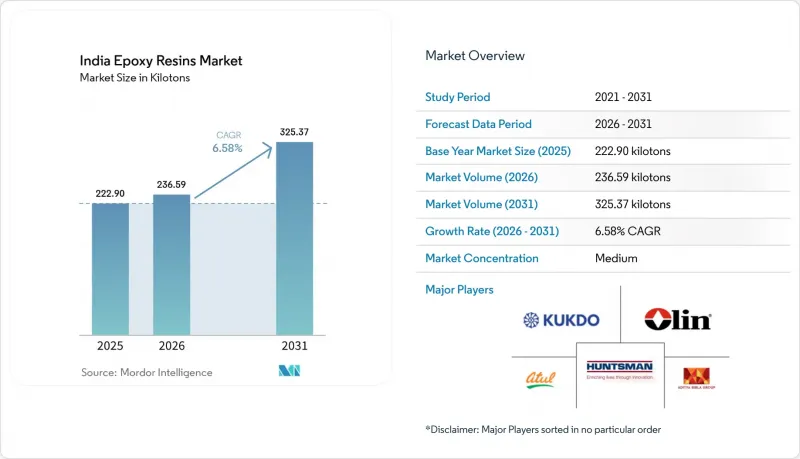
Mordor Intelligence에 의하면, 인도의 에폭시 수지 시장 규모는 2025년에 222.90 킬로톤으로 평가되었습니다. 2026년 236.59 킬로톤에서 2031년까지 325.37 킬로톤에 이를 것으로 추정되고 예측 기간 CAGR은 6.58%를 나타낼 전망입니다.
본 보고서는 원재료(DGEBA, DGEBF, 노보락, 지방족, 글리시딜아민, 기타 원재료) 및 용도(페인트 및 코팅, 접착제 및 실란트, 복합재료, 전기 및 전자, 기타 용도)별로 분류되어 있습니다. 시장 전망은 수량(톤) 단위로 표시되어 있습니다.
인도의 에폭시 수지 시장 동향 및 분석
2급 및 3급 도시에서의 인프라 투자 급증
지방 도시의 현대화를 목표로 하는 정부의 이니셔티브에 힘입어, 새로운 쇼핑몰, 병원, 교육 시설을 위한 내구성이 뛰어난 에폭시 바닥재, 보호 코팅재, 구조용 접착제에 대한 수요가 꾸준히 증가하고 있습니다. 이 지역들은 그린필드 수요가 있으며, 대도시권에 비해 가격 경쟁 압력이 낮기 때문에 제조업체는 이익률을 유지할 수 있습니다. 개발업체들은 세라믹이나 테라조와 같은 대체 자재보다 성능이 뛰어난, 이음매가 없어 위생적인 에폭시 바닥재를 선호하는 반면, 시공업체들은 프로젝트 공사 기간 단축을 높이 평가했습니다. 구자라트주와 마하라슈트라주의 생산 거점은 인근 항만과 통합된 석유화학 원료의 혜택을 받아 수지 공급량의 대부분을 담당하고 있습니다. 내륙 지역으로 유통망을 확대하는 공급업체는 건설 활동이 연안의 대도시권을 넘어 확산됨에 따라 판매량의 추가적인 증가를 기대할 수 있습니다.
2025년도 CAFE 기준에 따른 자동차 경량화 추진
더욱 엄격해진 기업 평균 연비(CAFE) 규제로 인해 자동차 제조업체들은 차량군의 배기가스 감축을 의무화받게 되었으며, 이에 따라 차체 패널, 구조 부품, 배터리 케이스에 탄소섬유·에폭시 복합재의 채택이 촉진되고 있습니다. 전기자동차, 하이브리드차, 수소연료전지차로 한정된, 정부가 시행하는 25,938 카롤 루피(31억 달러) 규모의 자동차 생산 연계 인센티브(PLI) 제도는 첨단 접착제 및 열전도성 에폭시 포팅 컴파운드에 대한 중간 수요를 가속화하고 있습니다. Tier 1 공급업체들은 대규모 전자기기 조립 분야에서 인도가 이미 입증한 역량을 활용하고, 복합재 하위 부품의 현지 생산을 확대함으로써 수지 조달량을 늘리고 있습니다. 경량화는 단기적인 생산량 변동이라기보다는 구조적인 필요성이며, 소비량의 꾸준한 성장을 보장하고 있습니다.
BIS의 수지 내 BPA 잔류량에 관한 규제안
제안된 품질 관리 명령에 따르면, 미반응 비스페놀 A(BPA) 함량에 대해 엄격한 상한선이 설정되어 있어, 제조업체들은 정제 공정, 대체 경화제 또는 BPA가 포함되지 않은 화학 물질에 대한 투자를 할 수밖에 없는 상황입니다. 충분한 연구개발 자금을 보유한 대형 종합 제조업체는 배합을 신속하게 조정할 수 있으며, 수출 시장에서 규정 준수 실적을 강점으로 활용할 가능성이 있습니다. 반면, 자본 수요가 유동성을 초과할 경우, 소규모 지역 기업은 이익률 압박이나 업계 재편의 위험에 직면할 가능성이 있습니다.
부문별 분석
DGEBA는 2025년에 인도의 에폭시 수지 시장 점유율의 64.02%를 차지했으며, 2031년까지 연평균 성장률(CAGR) 8.05%를 나타낼 것으로 전망됩니다. 이 조성은 뛰어난 기계적 강도, 내화학성 및 비용 효율성을 발휘하여, 도료, 전기 절연재, 복합재료 분야에서 폭넓게 보급되는 데 기여하고 있습니다. DGEBF는 낮은 점도와 높은 열안정성이 요구되는 전자 및 고온 분야를 대상으로 합니다. 노보락 계열 수지는 화학 처리 탱크의 라이닝 등, 뛰어난 내화학성이 요구되는 틈새 시장을 채우고 있습니다. 알킬계 수지는 장식용 마감에 뛰어난 자외선 안정성을 제공하는 반면, 글리시딜아민계 등급은 금속에 대한 높은 접착력과 내충격성을 갖추고 있어 선박 및 항공우주용 코팅에 활용되고 있습니다. 그 밖의 원료로는 지속가능성 요구에 부응하여 현재 주목받고 있는 바이오 원료 및 특수 화학물질이 포함됩니다.
각 제조업체는 경화 시간 단축, 저VOC 배합, BPA 저감 옵션 등 단계적인 기술 혁신을 통해 향후 도입될 기준에 대응하고 있습니다. BPA 잔류 기준이 강화됨에 따라, 배합 설계자들이 DGEBF나 바이오 에폭시로 전환해야 하는 상황에 직면할 경우, 경쟁이 심화될 것으로 예측됩니다. 그러나 현재의 가성비 우위를 고려할 때, 2030년 이전에 대규모 대체가 이루어질 가능성은 낮다고 볼 수 있습니다.
기타 혜택 :
- 엑셀 형식 시장 예측(ME) 시트
- 3개월간의 애널리스트 지원
자주 묻는 질문
목차
제1장 서론
제2장 조사 방법
제3장 주요 요약
제4장 시장 구도
제5장 시장 규모 및 성장 예측
제6장 경쟁 구도
제7장 시장 기회 및 향후 전망
KTH 26.06.29According to Mordor Intelligence, the india epoxy resins market size was valued at 222.90 kilotons in 2025 and is estimated to grow from 236.59 kilotons in 2026 to reach 325.37 kilotons by 2031, at a CAGR of 6.58% during the forecast period (2026-2031).
This report is Segmented by Raw Material (DGEBA, DGEBF, Novolac, Aliphatic, Glycidylamine, and Other Raw Materials), and Application (Paints and Coatings, Adhesives and Sealants, Composites, Electrical and Electronics, and Other Applications). The Market Forecasts are Provided in Terms of Volume (Tons).
India Epoxy Resins Market Trends and Insights
Surging Infrastructure Spending in Tier-2 and Tier-3 Cities
Government missions to modernize secondary cities are driving robust uptake of heavy-duty epoxy flooring, protective coatings, and structural adhesives for new malls, hospitals, and education facilities. These locations offer greenfield demand where competitive pricing pressure is lower than in metros, enabling producers to sustain margins. Developers prefer seamless, hygienic epoxy floors that outperform ceramic and terrazzo alternatives, while contractors appreciate shorter project turnaround times. Manufacturing hubs in Gujarat and Maharashtra supply most of the resin volumes, benefitting from nearby ports and integrated petrochemical feedstocks. Suppliers that expand distribution into interior districts can capture incremental volume growth as construction activity spreads beyond coastal metros.
Automotive Lightweighting Push from FY 2025 CAFE Norms
Stricter Corporate Average Fuel Economy rules oblige automakers to lower fleet emissions, spurring adoption of carbon-fiber-epoxy composites for body panels, structural parts, and battery enclosures. The government's INR 25,938 crore (USD 3.1 billion) vehicle PLI scheme, restricted to EV, hybrid, and fuel-cell platforms, accelerates intermediate demand for advanced adhesives and thermally conductive epoxy potting compounds. Tier-1 suppliers leverage India's proven capability in scaled electronics assembly to localize composite sub-component fabrication, increasing resin off-take. Lightweighting is a structural necessity rather than a short-term volume swing, ensuring consistent consumption growth.
BIS Draft Limits on BPA Residuals in Resins
Proposed Quality Control Orders impose stringent caps on unreacted bisphenol A content, compelling manufacturers to invest in purification, alternative curing agents, or BPA-free chemistries. Large integrated producers with robust research and development funding can adjust formulations swiftly and may leverage compliance credentials in export markets. Smaller regional firms risk margin compression and potential consolidation if capital requirements exceed liquidity.
Other drivers and restraints analyzed in the detailed report include:
- Wind-Turbine Blade Additions Under India's 500 GW Renewables Target
- Government PLI Scheme for Advanced Chemistry Cell Battery Packs
- Volatile Propylene and Phenol Feedstock Prices Linked to Crude Swings
For complete list of drivers and restraints, kindly check the Table Of Contents.
Segment Analysis
DGEBA accounted for 64.02% of India Epoxy Resin market share in 2025 and is forecast to post an 8.05% CAGR to 2031. The composition yields excellent mechanical strength, chemical resistance, and cost efficiency, supporting wide penetration in coatings, electrical insulation, and composites. DGEBF targets electronics and high-temperature sectors that require lower viscosity and higher thermal stability. Novolac systems fill niches needing exceptional chemical resistance, such as chemical-processing tank linings. Aliphatic resins deliver superior UV stability for decorative finishes, while glycidylamine grades provide high adhesion to metals and impact resistance, serving marine and aerospace coatings. Other raw materials include bio-based and specialty chemistries now emerging in response to sustainability mandates.
Producers use incremental innovations-faster cure, low-VOC blends, and BPA-reduced options-to address upcoming standards. Competitive tension may intensify if BPA residual limits push formulators toward DGEBF or bio-epoxies; however, current price-performance advantages make large-scale substitution unlikely before 2030.
List of Companies Covered in this Report:
- 3M
- Aditya Birla Group
- Atul Ltd
- BASF
- Daicel Corporation
- DuPont
- Huntsman International LLC
- Kukdo Chemical Co., Ltd.
- Macro Polymers Pvt Ltd
- Nan Ya Plastics Corporation
- Olin Corporation
- Westlake Corporation
Additional Benefits:
- The market estimate (ME) sheet in Excel format
- 3 months of analyst support
TABLE OF CONTENTS
1 Introduction
- 1.1 Study Assumptions and Market Definition
- 1.2 Scope of the Study
2 Research Methodology
3 Executive Summary
4 Market Landscape
- 4.1 Market Overview
- 4.2 Market Drivers
- 4.2.1 Surging infrastructure spending in Tier-2 and Tier-3 cities
- 4.2.2 Automotive lightweighting push from FY 2025 CAFE norms
- 4.2.3 Wind-turbine blade additions under India's 500 GW renewables target
- 4.2.4 Government PLI scheme for advanced chemistry cell (ACC) battery packs (encapsulants)
- 4.2.5 Rapid growth of organised retail flooring and decorative laminates
- 4.3 Market Restraints
- 4.3.1 BIS draft limits on BPA residuals in resins
- 4.3.2 Volatile propylene and phenol feedstock prices linked to crude swings
- 4.3.3 Rising popularity of bio-based unsaturated polyester alternatives
- 4.4 Value Chain Analysis
- 4.5 Porter's Five Forces
- 4.5.1 Bargaining Power of Suppliers
- 4.5.2 Bargaining Power of Buyers
- 4.5.3 Threat of New Entrants
- 4.5.4 Threat of Substitute Products
- 4.5.5 Degree of Competition
5 Market Size and Growth Forecasts (Value and Volume)
- 5.1 By Raw Material
- 5.1.1 DGEBA (Bisphenol A and ECH)
- 5.1.2 DGEBF (Bisphenol F and ECH)
- 5.1.3 Novolac (Formaldehyde and Phenols)
- 5.1.4 Aliphatic (Aliphatic Alcohols)
- 5.1.5 Glycidylamine (Aromatic Amines and ECH)
- 5.1.6 Other Raw Materials
- 5.2 By Application
- 5.2.1 Paints and Coatings
- 5.2.2 Adhesives and Sealants
- 5.2.3 Composites
- 5.2.4 Electrical and Electronics
- 5.2.5 Other Applications
6 Competitive Landscape
- 6.1 Market Concentration
- 6.2 Strategic Moves
- 6.3 Market Share (%)/Ranking Analysis
- 6.4 Company Profiles (includes Global level Overview, Market level overview, Core Segments, Financials as available, Strategic Information, Market Rank/Share for key companies, Products and Services, and Recent Developments)
- 6.4.1 3M
- 6.4.2 Aditya Birla Group
- 6.4.3 Atul Ltd
- 6.4.4 BASF
- 6.4.5 Daicel Corporation
- 6.4.6 DuPont
- 6.4.7 Huntsman International LLC
- 6.4.8 Kukdo Chemical Co., Ltd.
- 6.4.9 Macro Polymers Pvt Ltd
- 6.4.10 Nan Ya Plastics Corporation
- 6.4.11 Olin Corporation
- 6.4.12 Westlake Corporation
7 Market Opportunities and Future Outlook
- 7.1 White-space and Unmet-Need Assessment


