

|
시장보고서
상품코드
2066537
MEMS 에너지 수확 장치 : 시장 점유율 분석, 업계 동향 및 통계, 성장 예측(2026-2031년)MEMS Energy Harvesting Devices - Market Share Analysis, Industry Trends & Statistics, Growth Forecasts (2026 - 2031) |
||||||
 Mordor Intelligence
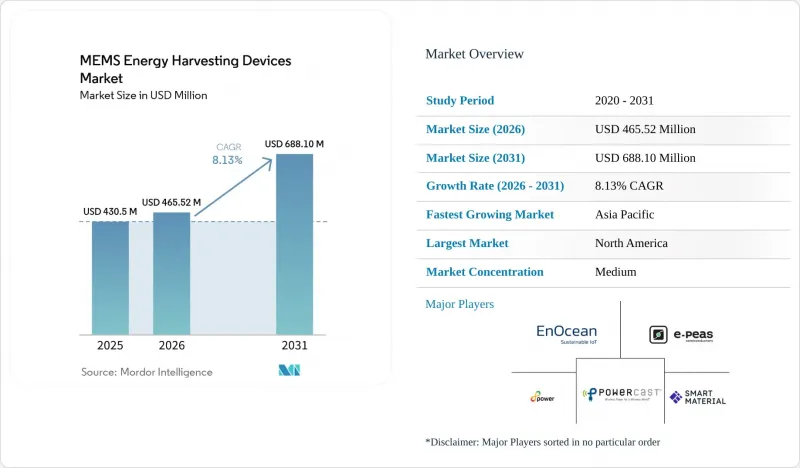
Mordor Intelligence에 의하면, MEMS 에너지 수확 장치 시장 규모는 2025년 4억 3,050만 달러로 평가되었습니다. 2026년에는 4억 6,552만 달러로 확대되어 2026년부터 2031년에 걸쳐 CAGR 8.13%로 성장을 지속하여, 2031년에는 6억 8,810만 달러에 이를 것으로 예측됩니다.
본 보고서는 기술별(태양광(태양광 발전), 에너지 수확, 열 에너지 수확 등), 도입 형태별(유선 시스템, 무선 시스템), 전력 공급 범위별(저전력 디바이스, 중-고전력 디바이스), 최종 사용자 산업별(빌딩·홈 오토메이션, 소비자용 전자기기 등), 지역별로 분류되어 있습니다. 시장 전망은 금액(달러) 기준으로 제시되어 있습니다.
세계의 MEMS 에너지 수확 장치 시장 동향 및 인사이트
배터리가 필요 없는 무선 센서 네트워크의 보급 확대
MEMS 에너지 수확 장치 시장은 배터리가 필요 없는 무선 센서 네트워크의 광범위한 확산에 의해 가장 직접적인 성장 동력을 얻어 왔습니다. 소규모 산업 현장이라 할지라도, 통신이 무선으로 이루어지는 경우, 축적된 화학 에너지에 의존하는 센서 노드의 유지보수에 막대한 인건비가 소요되기 때문에 대규모 배터리 교체는 여전히 숨겨진 운영상의 부담으로 남아 있습니다. 앰비언트 IoT 아키텍처는 에너지 수확과 저듀티사이클 통신을 결합하여 이 문제를 해결하고 있으며, 이를 통해 노드는 기존의 배터리를 탑재하지 않고도 신호를 전송할 수 있습니다. 2026년 연구에 따르면, 적응형 데이터 할당 방식을 채택한 에너지 수확 무선 센서 노드는 12µJ의 에너지로 128비트 패킷을 전송할 수 있는 것으로 나타났으며, 이는 상시 가동되는 노드에 비해 에너지 소비량이 88% 낮은 수치였습니다. IEEE 802.11 TGbp에서 진행 중인 주변 전력 통신에 관한 표준화 작업을 통해, 배터리가 필요 없는 엔드포인트를 위한 인증 절차가 점차 명확해지고 있으며, 이를 통해 MEMS 에너지 수확 디바이스 시장의 보다 광범위한 생태계 형성이 촉진되고 있습니다. 이러한 변화는 중요한 의미를 지닙니다. 왜냐하면 MEMS 에너지 수확 장치 시장에서 제한적인 시범 프로젝트를 거쳐 건물, 공장, 인프라에 대한 재현 가능한 대규모 도입으로 나아가는 길이 더욱 명확해졌기 때문입니다.
산업용 상태 모니터링 및 예측 유지보수의 성장
MEMS 에너지 수확 장치 시장의 성장을 가장 직접적으로 견인하고 있는 것은 배터리가 필요 없는 무선 센서 네트워크의 광범위한 확산입니다. 대규모 배터리 교체는 여전히 숨겨진 운영 부담으로 남아 있습니다. 왜냐하면, 소규모 산업 시설이라 할지라도 통신은 무선으로 이루어지며, 축적된 화학 에너지에 의존하는 센서 노드의 유지보수에 직원들이 막대한 시간을 쏟고 있기 때문입니다. 앰비언트 IoT 아키텍처는 에너지 수확과 저듀티 사이클 통신을 결합하여 이 문제를 해결함으로써, 노드가 기존의 배터리를 탑재하지 않고도 데이터를 전송할 수 있도록 합니다. 『Sensors』지에 게재된 2026년 연구에 따르면, 적응형 데이터 할당 방식을 채택한 에너지 수확 무선 센서 노드는 12µJ의 에너지 소비로 128비트 패킷을 전송할 수 있으며, 이는 상시 가동되는 노드에 비해 88% 낮은 수치입니다. IEEE 802.11 TGbp에서 진행 중인 주변 전력 통신에 관한 표준화 작업을 통해, 배터리가 필요 없는 엔드포인트를 위한 인증 절차가 점차 명확해지고 있으며, 이를 통해 MEMS 에너지 수확 디바이스 시장의 보다 광범위한 생태계 형성이 촉진되고 있습니다. 이러한 변화가 중요한 이유는 MEMS 에너지 수확 장치 시장에서 제한적인 시범 프로젝트를 거쳐 건물, 공장, 인프라에 대한 재현 가능한 대규모 도입으로 이어지는 길이 더욱 명확해졌기 때문입니다.
제한된 출력과 간헐적인 환경 에너지에 대한 의존
출력 전력의 제한은 여전히 MEMS 에너지 수확 장치 시장에서 가장 큰 제약 요인으로 남아 있습니다. 산업 환경에서 일반적으로 사용되는 환경 에너지 수확 장치는 수십-수백 마이크로와트의 발전량밖에 얻을 수 없으며, 이는 정기적인 저데이터율 통신에는 대응할 수 있지만, 지속적인 고부하 연산 작업에는 적합하지 않습니다. 이 문제는 환경 에너지가 소진되면 더욱 심각해집니다. 야간에 실내 조명이 어두워지거나, 기기가 정지함에 따라 온도 구배가 사라지거나, 기계 가동 정지 중에 진동에 의한 에너지 수확이 중단되기 때문입니다. 설계자는 하이브리드형 에너지 수확이나 대용량 축전 버퍼를 채택함으로써 이에 대응할 수 있지만, 두 가지 선택지 모두 비용, 시스템의 부피, 설계의 복잡성을 증가시킵니다. 따라서, 변화무쌍한 작동 조건 하에서 높은 신뢰성을 요구하는 용도의 경우, 배터리를 완전히 배제하기는 어렵습니다. 에너지 가용성을 보다 일관되게 예측하고 축적할 수 있게 될 때까지는 MEMS 에너지 수확 장치 시장은 지속적인 고부하 작동보다는 낮은 듀티 사이클의 이용 사례에서 가장 강력한 수요를 유지할 것으로 보입니다.
부문별 분석
2025년 기준으로, 진동 및 압전식 에너지 수확은 MEMS 에너지 수확 장치 시장 규모의 44.23%를 차지하며 가장 큰 기술 부문이 되었습니다. 이러한 우위는 이용 가능한 기계적 에너지를 생성하는 기계의 도입 대수가 많을 뿐만 아니라, 압전 변환과 회전 자산 모니터링 간의 호환성이 매우 뛰어나기 때문입니다. 2025년 『Smart Materials and Structures』 저널에 발표된 연구에 따르면, 가변 단면 다중 모드 압전 에너지 수확기는 구조 최적화를 통해 광대역에서 에너지 포집 성능을 향상시키고, 공진 불일치로 인해 발생하는 실제 도입상의 제한 사항을 직접 해결할 수 있는 것으로 나타났습니다. 태양광 발전은 여전히 주요 2차 기술 경로이며, 드라큘라 테크놀로지스는 2026년 1월, 자사의 유기 태양전지 플랫폼 ‘LAYER V2.0’이 실내 용도에서 이전 세대 대비 30%의 성능 향상을 달성했다고 발표했습니다.
열 에너지 수확 기술은 발열량이 많은 기기 주변에 안정적인 온도 차이가 존재하는 규모는 작지만 전략적으로 중요한 틈새 시장을 담당해 왔습니다. RF 에너지 수확은 MEMS 에너지 수확 디바이스 시장에서 가장 빠르게 성장하고 있는 기술 분야로, 주변의 IoT 태그가 기존 무선 인프라로부터 전력을 공급받게 됨에 따라 2031년까지 연평균 8.78%의 성장률이 예상됩니다. Wiliot사는 2026년 1월, 자사의 ‘Gen3 IoT Pixel’이 2.4GHz 및 서브 1GHz 대역을 아우르는 듀얼 밴드 아키텍처를 채택하여, 이전 세대에 비해 에너지 수확 효율과 전력 공급 범위를 향상시켰습니다고 발표했습니다. 또한, 2026년 『Micromachines』지에 게재된 논문에서는 BQ25504 기반의 전력 경로를 활용한 RF 에너지 수확 IoT 네트워크 아키텍처가 입증되었습니다. 한편, IEEE 802.11 TGbp는 인증된 앰비언트 파워 커뮤니케이션 프레임워크 구축을 계속하고 있습니다.
2025년 기준으로, 도입 형태 부문의 72.45%를 무선 시스템이 차지했으며, 2031년까지 연평균 9.23%라는 가장 높은 성장률을 보일 것으로 예상되는 부문이기도 합니다. 이러한 장점은 동일한 설계로 인해 전원 케이블이나 데이터 케이블도 필요 없게 되는 경우, 배터리 유지보수를 없앨 수 있다는 점의 가치가 가장 크게 부각된다는 것을 보여줍니다. MEMS 에너지 수확 장치 시장에서 이는 건물이나 분산형 산업 환경에서 대규모 센서 군을 구축할 때 무선 기술이 사실상 표준이 될 것임을 의미합니다. Atmosic사는 자사의 플랫폼이 에너지 수확과 IEEE 802.15.4 기능을 통합한 초저전력 연결성을 지원함으로써, 시스템 개발자의 통합 부담을 줄일 수 있다고 밝혔습니다.
유선 시스템은 지연, 대역폭 또는 전자기 간섭 등의 제약으로 인해 무선 방식이 적합하지 않은 경우, 여전히 중요한 역할을 수행하고 있습니다. 일부 산업 환경에서는 신뢰성을 확보하기 위해 유선 데이터 경로를 유지하면서, 센서 측에서 에너지 수확을 활용한 전력을 공급하는 등 전력 기능과 통신 기능을 분리하는 경우도 있습니다. MEMS 에너지 수확 장치 시장의 이 분야는 응용 분야 요구 사항이 광범위하지 않고 구체적으로 정의되어 있어 안정적인 상태를 유지하고 있습니다. 그 결과, 무선 기술이 신규 도입의 대부분을 차지하는 반면, 유선 설계는 성능에 민감한 제한적인 도입 사례에 그치는 등 양극화된 구조가 형성되고 있습니다.
지역별 분석
2025년, 북미는 MEMS 에너지 수확 장치 시장 점유율 32.78%를 기록하며 지역별 1위를 유지했습니다. 미국은 산업용 상태 모니터링, 스마트 빌딩 개보수, 데이터센터 센싱 분야가 다른 많은 지역보다 빠르게 상업적 성숙 단계에 도달함에 따라 계속해서 주요 수익원으로 자리매김했습니다. EnOcean사는 2025년, 자사의 에너지 수확 솔루션이 DesignLights Consortium의 인증 제품 목록(Qualified Products List)에 등재되었다고 발표했으며, 이를 통해 미국 내 유틸리티자의 리베이트 제도를 이용할 수 있게 되었습니다. 캐나다와 멕시코는 해당 지역 내에서 비교적 소규모 시장에 그쳤지만, 두 나라 모두 진동 기반 센싱 기술과 잘 어울리는 광업, 석유 및 가스, 제조업 분야의 활용 사례를 통해 수요를 뒷받침했습니다. MEMS 에너지 수확 장치 시장에서 이러한 지역적 우위는 잘 구축된 디지털 인프라와 효율적인 무선 빌딩 제어를 장려하는 규제 환경 모두에 의해 뒷받침되었습니다.
유럽은 독일, 영국, 프랑스, 이탈리아, 스페인이 주도하는 여전히 중요한 지역 시장이었습니다. 유럽 수요는 에너지 효율 및 산업 규정 준수와 밀접한 관련이 있으며, 이러한 요인들은 건물이나 공정 환경 모두에서 유지보수 부담이 적은 센서의 도입을 촉진하고 있습니다. 유럽연합 집행위원회는 2025년 11월 지침(EU) 2025/2363을 채택하고, 압전성 PZT 세라믹에 포함된 납에 대해 2027년 12월 31일까지 적용되는 면제 조항 7(c)-VI를 마련했습니다. 이를 통해 공급업체에는 명확한 계획 기간이 주어지는 한편, 무연 대체 작업이 추진되었습니다. 또한, 스웨덴 에너지청이 2025년에 Exeger사에 실내용 태양전지 기술 확대를 위해 1억 3,000만 스웨덴 크로나(1,220만 달러)의 보조금을 지급한 것을 계기로, 스웨덴도 주목할 만한 태양광 발전 수확의 거점으로 부상했습니다. 남미, 중동 및 아프리카는 여전히 시장 규모가 작지만, 광산 및 스마트시티 계획에 따라 유지보수가 필요 없는 센싱 기술에 대한 구체적인 수요가 발생하고 있습니다.
아시아태평양은 MEMS 에너지 수확 장치 시장에서 가장 빠르게 성장하고 있는 지역으로, 2031년까지 연평균 8.94%의 성장률을 보일 것으로 전망됩니다. 중국의 대규모 IoT 인프라 구축, 일본의 압전 소재 분야 강점, 한국의 PMIC 생태계, 그리고 인도의 건축·제조 분야 디지털화 진전이 이러한 성장 패턴을 뒷받침하고 있습니다. CiNii 조사에 수록된 2026년 조사에서는 유리 표면을 통해 건물 관리용 센서 모듈로 전력을 무선으로 전송하는 방식에 대해 설명하고 있으며, 이는 기존 설비에 미치는 영향을 최소화하는 개조 설계를 선호하는 일본의 경향과 부합합니다. 싱가포르, 말레이시아, 태국 등 아세안(ASEAN) 국가들도 물류 및 제조 현장에서 시범 운영 단계에서 생산 규모 수준의 환경 IoT 센싱으로 전환해 나가고 있습니다.
기타 혜택 :
- 엑셀 형식 시장 예측(ME) 시트
- 3개월간의 애널리스트 지원
자주 묻는 질문
목차
제1장 서론
제2장 조사 방법
제3장 주요 요약
제4장 시장 구도
제5장 시장 규모 및 성장 예측
제6장 경쟁 구도
제7장 시장 기회 및 향후 전망
KTH 26.06.29According to Mordor Intelligence, the mEMS energy harvesting devices market size is expected to grow from USD 430.50 million in 2025 to USD 465.52 million in 2026 and is forecast to reach USD 688.10 million by 2031 at 8.13% CAGR over 2026-2031.
This report is Segmented by Technology (Solar (Photovoltaic) Energy Harvesting, Thermal Energy Harvesting, and More), Deployment Type (Wired Systems, and Wireless Systems), Powering Range (Low-Power Devices, and Medium-To-High Power Devices), End-User Industry (Building and Home Automation, Consumer Electronics, and More), and Geography. The Market Forecasts are Provided in Terms of Value (USD).
Global MEMS Energy Harvesting Devices Market Trends and Insights
Rising Adoption of Battery-Free Wireless Sensor Networks
The MEMS energy harvesting devices market has been pushed most directly by the wider rollout of battery-free wireless sensor networks. Battery replacement at scale remains a hidden operating burden because even modest industrial sites spend large amounts of staff time servicing sensor nodes that are wireless in communication but still dependent on stored chemical energy. Ambient IoT architectures address this issue by pairing energy harvesting with low-duty-cycle communication so nodes can transmit without carrying a conventional battery. A 2026 study showed that energy-harvesting wireless sensor nodes using adaptive data allocation transmitted a 128-bit packet with 12 µJ of energy, which was 88% lower than continuously active nodes. Standardization work around ambient power communication in IEEE 802.11 TGbp is creating clearer certification pathways for battery-free endpoints, which supports broader ecosystem formation for the MEMS energy harvesting devices market. That shift matters because the MEMS energy harvesting devices market now has a clearer route from limited pilots to repeatable fleet deployments in buildings, factories, and infrastructure.
Growth in Industrial Condition Monitoring and Predictive Maintenance
The MEMS energy harvesting devices market is being pushed most directly by the wider rollout of battery-free wireless sensor networks. Battery replacement at scale remains a hidden operating burden because even modest industrial sites spend large amounts of staff time servicing sensor nodes that are wireless in communication but still dependent on stored chemical energy. Ambient IoT architectures address this issue by pairing energy harvesting with low-duty-cycle communication so nodes can transmit without carrying a conventional battery. A 2026 study in Sensors shows that energy-harvesting wireless sensor nodes using adaptive data allocation transmit a 128-bit packet with 12 µJ of energy use, which is 88% lower than continuously active nodes. Standardization work around ambient power communication in IEEE 802.11 TGbp is creating clearer certification pathways for battery-free endpoints, which supports broader ecosystem formation for the MEMS energy harvesting devices market. That shift matters because the MEMS energy harvesting devices market now has a clearer route from limited pilots to repeatable fleet deployments in buildings, factories, and infrastructure.
Limited Power Output and Dependence on Intermittent Ambient Energy
Limited power output remains the most binding restraint on the MEMS energy harvesting devices market. Typical ambient harvesters in industrial settings generate tens to hundreds of microwatts, which supports periodic low-data-rate transmission but not sustained compute-heavy operation. The problem becomes harder when ambient energy disappears, because indoor light drops at night, thermal gradients collapse when equipment stops, and vibration harvesting pauses during machine downtime. Designers can respond with hybrid harvesting or larger storage buffers, but both options add cost, system volume, and design complexity. That makes full battery elimination difficult in applications that require reliable performance across variable operating conditions. Until energy availability can be predicted and buffered with greater consistency, the MEMS energy harvesting devices market will remain strongest in low-duty-cycle use cases rather than continuous high-load operation.
Other drivers and restraints analyzed in the detailed report include:
- Expansion of Smart Buildings and Retrofit Building Controls
- Advances In Ultra-Low-Power PMICs and Wireless SoCs
- Narrow Bandwidth and Resonance Mismatch in Piezoelectric MEMS Designs
For complete list of drivers and restraints, kindly check the Table Of Contents.
Segment Analysis
Vibration and piezoelectric energy harvesting held 44.23% of the MEMS energy harvesting devices market size in 2025, making it the largest technology segment. This lead arose from the large installed base of machines that generate usable mechanical energy and from the strong fit between piezoelectric conversion and rotating asset monitoring. A 2025 study in "Smart Materials and Structures" showed that variable-section multimodal piezoelectric harvesters improved broadband capture through structural optimization, directly addressing real deployment limits caused by resonance mismatch. Solar harvesting remained the main secondary technology path, and Dracula Technologies stated in January 2026 that its LAYER V2.0 organic photovoltaic platform delivered a 30% performance increase over the prior generation for indoor applications.
Thermal harvesting served a smaller but strategically important niche where stable temperature differentials existed around heat-intensive equipment. RF energy harvesting is the fastest-growing technology segment in the MEMS energy harvesting devices market and is projected to expand at 8.78% through 2031 as ambient IoT tags draw power from existing wireless infrastructure. Wiliot stated in January 2026 that its Gen3 IoT Pixel uses a dual-band architecture across 2.4 GHz and sub-1 GHz to improve harvesting efficiency and energizing range over the prior generation. A 2026 "Micromachines" paper also demonstrated an RF energy-harvesting IoT network architecture using a BQ25504-based power path, while IEEE 802.11 TGbp continues to build a certified ambient power communications framework.
Wireless systems held 72.45% of the deployment type segment in 2025 and are also the fastest-growing category at 9.23% through 2031. That lead shows that removing battery maintenance is most valuable when the same design also removes power and data cabling. In the MEMS energy harvesting devices market, this makes wireless deployment the practical default for large sensor fleets in buildings and distributed industrial settings. Atmosic states that its platform supports ultra-low-power connectivity with integrated energy harvesting and IEEE 802.15.4 capability, which reduces integration burden for system developers.
Wired systems kept a meaningful role where latency, bandwidth, or electromagnetic interference limits made wireless less suitable. Some industrial environments still separate power and communication functions, using harvested energy at the sensor while keeping a wired data path for reliability. This portion of the MEMS energy harvesting devices market remains stable because the application requirements are specific rather than broad. The result is a two-speed structure where wireless captures most new installations while wired designs remain in a narrower set of performance-sensitive deployments.
Geography Analysis
North America retained 32.78% of the MEMS energy harvesting devices market share in 2025, which kept it in the leading regional position. The United States remained the main revenue center because industrial condition monitoring, smart building retrofits, and data center sensing all reached earlier commercial maturity than in many other regions. EnOcean stated in 2025 that its energy-harvesting solutions achieved listing on the DesignLights Consortium Qualified Products List, which opened a pathway for utility rebate access in the United States. Canada and Mexico stayed smaller within the region, but both supported demand through mining, oil and gas, and manufacturing use cases that align well with vibration-based sensing. For the MEMS energy harvesting devices market, this regional lead rested on both installed digital infrastructure and a regulatory setting that rewarded efficient wireless building controls.
Europe remained a substantial regional market led by Germany, the United Kingdom, France, Italy, and Spain. Demand in Europe is closely tied to energy efficiency and industrial compliance rules, which favor low-maintenance sensor deployments in both buildings and process environments. The European Commission adopted Directive (EU) 2025/2363 in November 2025 and created exemption 7(c)-VI for lead in piezoelectric PZT ceramics until December 31, 2027, which gave suppliers a defined planning window while pushing lead-free substitution work. Sweden also emerged as a notable photovoltaic harvesting center after the Swedish Energy Agency awarded Exeger SEK 130 million, or USD 12.2 million, in 2025 to scale indoor solar cell technology. South America and Middle East, and Africa remained smaller, but mining sites and smart city programs created targeted openings for maintenance-free sensing.
Asia-Pacific is the fastest-growing region in the MEMS energy harvesting devices market and is forecast to expand at 8.94% through 2031. China's large IoT infrastructure buildout, Japan's strength in piezoelectric materials, South Korea's PMIC ecosystem, and India's rising building and manufacturing digitalization are supporting this growth pattern. A 2026 study indexed by CiNii Research described wireless power transfer for building management sensor modules through glass surfaces, which fits Japan's preference for low-disruption retrofit design. ASEAN countries such as Singapore, Malaysia, and Thailand are also moving from pilots toward production-scale ambient IoT sensing in logistics and manufacturing settings.
- EnOcean GmbH
- e-peas S.A.
- 8power Limited
- Powercast Corporation
- Smart Material Corporation
- EH4 GmbH
- Smart Material GmbH
- ReVibe Energy AB
- MEMSYS B.V.
- Enervibe Ltd.
- Pyro-E, Inc.
- WePower Technologies LLC
- Everactive, Inc.
- Atmosic, Inc.
- Wiliot Ltd.
- Dracula Technologies SAS
- Exeger Sweden AB (publ)
- EPISHINE AB
- Cymbet Corporation
- MicroGen Systems, Inc.
Additional Benefits:
- The market estimate (ME) sheet in Excel format
- 3 months of analyst support
TABLE OF CONTENTS
1 INTRODUCTION
- 1.1 Study Assumptions and Market Definition
- 1.2 Scope of the Study
2 RESEARCH METHODOLOGY
3 EXECUTIVE SUMMARY
4 MARKET LANDSCAPE
- 4.1 Market Overview
- 4.2 Market Drivers
- 4.2.1 Rising Adoption of Battery-Free Wireless Sensor Networks
- 4.2.2 Expansion of Smart Buildings and Retrofit Building Controls
- 4.2.3 Growth in Industrial Condition Monitoring and Predictive Maintenance
- 4.2.4 Advances in Ultra-Low-Power PMICs and Wireless SoCs
- 4.2.5 Ambient IoT Protocol Standardization Opening Certified Self-Powered Device Classes
- 4.2.6 Need to Eliminate Battery Truck Rolls in Hard-to-Reach Rotating Assets
- 4.3 Market Restraints
- 4.3.1 Limited Power Output and Dependence on Intermittent Ambient Energy
- 4.3.2 Narrow Bandwidth and Resonance Mismatch in Piezoelectric MEMS Designs
- 4.3.3 RoHS Lead-Exemption Uncertainty for Piezoelectric Ceramics
- 4.3.4 Leakage Losses and Cold-Start Bottlenecks in Micro-Power Storage Paths
- 4.4 Industry Value Chain Analysis
- 4.5 Regulatory Landscape
- 4.6 Technological Outlook
- 4.7 Porter's Five Forces Analysis
- 4.7.1 Bargaining Power of Suppliers
- 4.7.2 Bargaining Power of Buyers
- 4.7.3 Threat of New Entrants
- 4.7.4 Threat of Substitutes
- 4.7.5 Intensity of Competitive Rivalry
- 4.8 Assessment of Macroeconomic Trends on the Market
5 MARKET SIZE AND GROWTH FORECASTS (VALUE)
- 5.1 By Technology
- 5.1.1 Solar (Photovoltaic) Energy Harvesting
- 5.1.2 Vibration and Piezoelectric Energy Harvesting
- 5.1.3 Thermal Energy Harvesting
- 5.1.4 Radio Frequency Energy Harvesting
- 5.2 By Deployment Type
- 5.2.1 Wired Systems
- 5.2.2 Wireless Systems
- 5.3 By Powering Range
- 5.3.1 Low-Power Devices
- 5.3.2 Medium-to-High Power Devices
- 5.4 By End-User Industry
- 5.4.1 Building and Home Automation
- 5.4.2 Industrial and Manufacturing
- 5.4.3 Consumer Electronics
- 5.4.4 Transportation and Logistics
- 5.4.5 Healthcare and Medical Devices
- 5.4.6 Aerospace and Defense
- 5.5 By Geography
- 5.5.1 North America
- 5.5.1.1 United States
- 5.5.1.2 Canada
- 5.5.1.3 Mexico
- 5.5.2 South America
- 5.5.2.1 Brazil
- 5.5.2.2 Argentina
- 5.5.2.3 Rest of South America
- 5.5.3 Europe
- 5.5.3.1 Germany
- 5.5.3.2 United Kingdom
- 5.5.3.3 France
- 5.5.3.4 Italy
- 5.5.3.5 Spain
- 5.5.3.6 Rest of Europe
- 5.5.4 Asia-Pacific
- 5.5.4.1 China
- 5.5.4.2 Japan
- 5.5.4.3 India
- 5.5.4.4 South Korea
- 5.5.4.5 ASEAN
- 5.5.4.6 Rest of Asia-Pacific
- 5.5.5 Middle East and Africa
- 5.5.5.1 Middle East
- 5.5.5.1.1 Saudi Arabia
- 5.5.5.1.2 United Arab Emirates
- 5.5.5.1.3 Turkey
- 5.5.5.1.4 Rest of the Middle East
- 5.5.5.2 Africa
- 5.5.5.2.1 South Africa
- 5.5.5.2.2 Nigeria
- 5.5.5.2.3 Rest of Africa
- 5.5.5.1 Middle East
- 5.5.1 North America
6 COMPETITIVE LANDSCAPE
- 6.1 Market Concentration
- 6.2 Strategic Moves
- 6.3 Market Share Analysis
- 6.4 Company Profiles (includes Global level Overview, Market level overview, Core Segments, Financials as available, Strategic Information, Market Rank/Share for key companies, Products and Services, and Recent Developments)
- 6.4.1 EnOcean GmbH
- 6.4.2 e-peas S.A.
- 6.4.3 8power Limited
- 6.4.4 Powercast Corporation
- 6.4.5 Smart Material Corporation
- 6.4.6 EH4 GmbH
- 6.4.7 Smart Material GmbH
- 6.4.8 ReVibe Energy AB
- 6.4.9 MEMSYS B.V.
- 6.4.10 Enervibe Ltd.
- 6.4.11 Pyro-E, Inc.
- 6.4.12 WePower Technologies LLC
- 6.4.13 Everactive, Inc.
- 6.4.14 Atmosic, Inc.
- 6.4.15 Wiliot Ltd.
- 6.4.16 Dracula Technologies SAS
- 6.4.17 Exeger Sweden AB (publ)
- 6.4.18 EPISHINE AB
- 6.4.19 Cymbet Corporation
- 6.4.20 MicroGen Systems, Inc.
7 MARKET OPPORTUNITIES AND FUTURE OUTLOOK
- 7.1 White-space and Unmet-Need Assessment


