

|
시장보고서
상품코드
2066551
세포주 개발 시장 : 점유율 분석, 업계 동향과 통계, 성장 예측(2026-2031년)Cell Line Development - Market Share Analysis, Industry Trends & Statistics, Growth Forecasts (2026 - 2031) |
||||||
 Mordor Intelligence
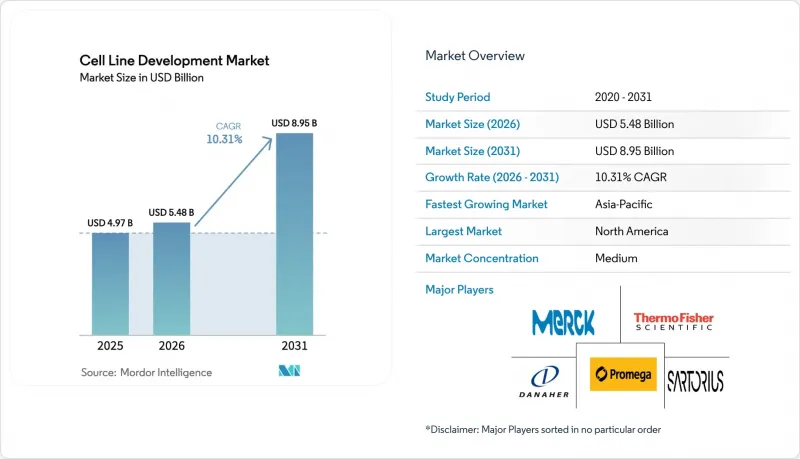
Mordor Intelligence에 의하면, 세포주 개발 시장 규모는 2025년 49억 7,000만 달러에서 2026년에는 54억 8,000만 달러로 확대되어 2026년부터 2031년까지 CAGR 10.31%로 성장을 지속하여, 2031년까지 89억 5,000만 달러에 이를 것으로 예측됩니다.
본 보고서에서는 해당 업계를 제품별(시약·배지, 장비, 기타 제품), 유래별(포유류 세포주, 비포유류 세포주), 용도별(재조합 단백질 발현, 하이브리도마 기술 등), 최종 사용자별(생명공학·제약 기업, CDMO 등), 지역별(북미, 유럽 등)로 분류하고 있습니다. 시장 전망은 금액(달러) 기준으로 제시되어 있습니다.
전 세계 세포주 개발 시장 동향 및 인사이트
증가하는 바이오의약품 수요
단일클론 항체는 이미 바이오의약품 파이프라인을 주도하고 있으며, 자가면역 질환 및 희귀질환으로의 적응증 확대로 인해 세포주 생산성에 대한 압박이 지속되고 있습니다. 200종 이상의 항체 치료제가 승인되었으며, 1,400건에 가까운 후보 약물이 활발히 개발되고 있기 때문에 후원사는 임상 프로그램의 초기 단계에서 견고하고 생산성이 높은 세포주를 확보할 수밖에 없습니다. 따라서 세포주 개발 시장은 프로젝트 전체의 일정과 상업적 실현 가능성을 크게 좌우하는 전략적 병목 요인으로 작용하고 있습니다. 이중 특이성 항체나 항체-약물 복합체(ADC)의 생산량이 증가함에 따라, 사슬의 발현 균형을 유지할 수 있도록 설계된 세포주가 요구되고 있으며, 이로 인해 전문적인 개발 서비스의 가격이 급등하고 있습니다. 주요 지역을 불문하고, 현재는 저분자 화합물보다 고분자 화합물에 대한 투자가 우선시되고 있으며, 첨단 세포 배양 시스템에 대한 장기적인 수요가 확고하게 자리 잡고 있습니다.
단일클론 항체 파이프라인의 확대
2020년 이후 이중 특이성 항체의 임상 승인은 듀얼 타겟 방식으로의 전환을 여실히 보여주고 있으며, 이로 인해 세포 공학 워크플로의 복잡성이 배가되고 있습니다. 대형 제약사들은 엔드투엔드 항체-약물 복합체(ADC) 생산 능력을 확보하기 위해 아스트라제네카의 15억 달러 규모 싱가포르 거점 등 전용 시설에 대한 투자를 계속하고 있습니다. 각 신규 항체 형식은 고유한 접힘 구조 및 당사슬 변형 요건을 가지고 있기 때문에 의뢰 기업들은 장기 공급 계약을 체결할 수 있는 독자적인 세포 플랫폼을 점점 더 선호하고 있습니다. 이러한 추세에 따라 세포주 개발 시장, 특히 턴키 방식의 엔지니어링과 다운스트림 공정의 분석을 함께 제공하는 서비스 제공업체 간의 경쟁이 치열해지고 있습니다.
엄격한 규정 준수
바이러스 안전성에 관한 FDA의 개정판 Q5A(R2) 지침에서는 특성 평가 시험의 확대가 요구되고 있으며, 신규 세포 배지에는 최대 1년간의 추가 시험이 필요합니다. 규제 관련 전문 지식이 없는 기업은 신청 내용이 변화하는 기준을 충족하지 못할 경우, 고액의 컨설팅 비용이나 재작업 비용을 부담할 수밖에 없습니다. 지역별 요건의 차이로 인해 전 세계 시장 출시 순서가 복잡해지고 있습니다. 유럽에서는 다른 지역에서는 요구되지 않는 부수적 병원체에 대한 추가 선별 검사가 빈번하게 요구되기 때문입니다. 이러한 압박으로 인해 세포주 개발 시장의 사업 운영에 드는 고정비가 증가하여, 중소기업의 철수나 통합을 초래할 가능성이 있습니다. 그 결과, 협상력은 수직 통합형 대형 제공업체 쪽으로 이동하게 될 것입니다.
부문별 분석
시약 및 배지는 2025년 매출의 43.55%를 차지했습니다. 이는 모든 생산 로트에서 대량의 배양 배지, 피더, 완충액이 소모되기 때문입니다. 이 부문의 예상 연평균 성장률(CAGR)은 10.64%로, 자본 설비 부문의 성장률을 상회하고 있습니다. 이는 새로운 치료법이 승인될 때마다 소모품의 정기적인 발주량이 증가하여, 세포주 개발 시장 전체에 걸쳐 예측 가능한 수요가 확보되기 때문입니다. 각 공급업체들은 배치 간 일관성을 높이는 동시에 오염 위험을 줄여주는 화학적으로 정의된 무혈청 제제를 우선적으로 채택하고 있으며, AI를 활용한 설계 도구를 통해 영양 성분의 배합을 최적화하여 최고 역가의 향상을 도모하고 있습니다. 바이오리액터 및 자동 세포 처리 시스템을 포함한 설비는 세포 밀도가 증가함에 따라 영양분의 고갈과 폐기물의 축적을 방지하기 위한 정밀한 공정 제어가 필요하기 때문에 여전히 매우 중요합니다. 세포 은행, 분석 시험, 바이러스 제거 시험 등의 부대 서비스는 규제 당국의 감독 강화로 인해 혜택을 받고 있는 성장세가 두드러진 롱테일 분야를 구성하고 있습니다.
시약 부문은 장기간에 걸친 관류 배양 과정에서 바이오리액터가 배지 성분을 지속적으로 소비하기 때문에 구독형 구매 방식으로부터 더 큰 혜택을 보고 있습니다. 전문 공급업체는 현재, 독자적인 대사 프로파일을 보이는 CRISPR 변형 세포주에 맞춘 모듈식 배지 키트를 판매하고 있습니다. 공정의 집약화가 진행됨에 따라 고순도 원료에 대한 수요가 증가하면서, 공급업체들은 아미노산 및 비타민 생산을 수직 통합하려는 움직임을 강화하고 있습니다. 이러한 동향들이 맞물리면서, 세포주 개발 시장에서 소모품의 경쟁적 중요성이 확고해졌으며, 배지의 혁신과 시설 전체의 생산량 간의 연관성이 더욱 강화되고 있습니다.
2025년에는 포유류 세포주가 세포주 개발 시장의 74.62%를 차지해, 10.42%에 달하는 연평균 성장률(CAGR)은 인간과 유사한 번역 후 변형에 대한 지속적인 선호도를 뒷받침하고 있습니다. 단일클론 항체 분야에서는 중국 햄스터 난소 세포가 여전히 골드 스탠다드로 여겨지지만, 주요 당사슬 변형 유전자를 제거한 CRISPR 녹아웃 세포주는 면역원성을 낮추면서도 보다 균일한 당사슬 형태를 제공합니다. 부유 배양에 최적화된 인간 배아 신장(HEK293) 세포주는 유전자 치료용 아데노연관 바이러스 벡터 생산의 대부분을 담당하고 있으며, 현재 바이러스 응용 분야의 세포주 개발 시장 규모에 상당한 수익을 창출하고 있습니다. 효모 및 곤충 세포주를 포함한 비포유류 시스템은 복잡한 당사슬 수정이 필요 없는 틈새 효소 및 백신 용도에 대응하고 있습니다.
고속 마이크로유체 스크리닝 기술의 발전으로 생산성이 높은 포유류 클론을 신속하게 분리할 수 있게 되었으며, 기존의 제한 희석법에 의한 스크리닝에 비해 수 주간의 시간을 단축할 수 있습니다. 새로운 유전체 불안정성 센서는 염색체 이상을 실시간으로 추적하여 불안정한 클론을 조기에 선별할 수 있게 해줍니다. 박테리아와 효모의 시스템은 단순한 단백질 생산에 있어서는 여전히 뛰어나지만, 전반적인 발전 속도는 포유류 시스템의 발전에 뒤처지고 있습니다. 이러한 기술의 결합을 통해 세포주 개발 시장은 특정 분자적 요건에 가장 비용 효율적인 세포 플랫폼을 조합할 수 있는 다양한 도구 모음을 갖추고 있습니다.
지역별 분석
북미는 2025년, 일라이 릴리사의 90억 달러 규모 인디애나주 복합 시설과 노보노르디스크사의 41억 달러 규모 노스캐롤라이나주 확장 계획과 같은 대규모 투자에 힘입어 매출 점유율 39.88%를 유지했습니다. 이 지역은 확립된 규제에 대한 전문 지식과 견실한 벤처 캐피털의 혜택을 누리고 있지만, 원자재 부족과 수출 관리에 대한 불확실성에 직면해 있어, 이로 인해 공급의 지속성이 복잡해지고 있습니다. 캐나다의 옴니아바이오(OmniaBio)는 생산 비용을 절반으로 줄이는 것을 목표로 AI를 탑재한 세포 치료 허브를 건설 중이며, 이는 해당 지역의 첨단 제조 분야를 향한 노력을 보여주는 사례입니다. 멕시코는 기업들이 국내 비용 구조를 부담하지 않으면서도 미국과의 근접성을 추구하는 가운데, 니어쇼어링에 대한 관심을 모으고 있습니다. 이러한 동향들이 맞물리면서, 북미의 세포주 개발 시장은 혁신적이고 자본 집약적인 상태를 유지하고 있습니다.
아시아태평양은 2031년까지의 연평균 성장률(CAGR)이 10.96%로 가장 높은 성장세를 기록하고 있으며, 그 원동력은 싱가포르 한 곳만 해도 2024년에 30억 달러를 넘는 바이오 제조 분야 투자가 약속되어 있다는 점입니다. 아스트라제네카의 15억 달러 규모 ADC 공장과 바이오엔테크의 독일 외 첫 시설은 이 지역이 프리미엄 바이오 제조 거점으로 부상하고 있음을 보여주는 대표적인 사례입니다. 중국과 인도는 여전히 비용 면에서의 우위와 막대한 내수 시장을 유지하고 있지만, 미국의 ‘BIOSECURE 법안’ 제안에 따라 인도의 CDMO, 한국의 바이오의약품 클러스터, 그리고 아세안(ASEAN) 회원국으로의 다각화가 가속화되고 있습니다. 일본과 호주는 각각 고정밀 분석 기술과 RNA 치료제 플랫폼을 통해 이 생태계를 보완하고 있습니다. 이러한 움직임들이 맞물리면서 세포주 개발 시장의 중심이 아시아태평양으로 이동하고 있으며, 동시에 지정학적 리스크를 완화하는 다극적인 공급망이 구축되고 있습니다.
유럽에서는 독일, 스위스, 아일랜드의 확고한 제약 회랑에 힘입어, 꾸준하지만 완만한 확대세가 나타나고 있습니다. 첨단 치료법에 대한 정부의 인센티브와 국경을 초월한 규제 조화를 통해 경쟁력은 유지되고 있지만, 에너지 비용과 임금 상승으로 인해 아시아에 비해 이익률은 축소되고 있습니다. 중동 및 아프리카에서는 전략적인 시장 진출이 진행되고 있으며, 사우디아라비아의 ‘국가 생명공학 전략’은 2040년까지 세계적 리더십을 확보하는 것을 목표로 하고 있고, 아랍에미리트(UAE)는 지역 물류 거점으로서의 위상을 확립하고자 하고 있습니다. 브라질이 주도하는 남미 지역에서는 내수 수요와 신흥 바이오시밀러 시장의 기회를 활용하고 있지만, 벤처 자금이 제한적이어서 생산 능력을 급속히 확대하는 데 제약이 따르고 있습니다. 전반적으로, 세포주 개발 시장은 현지 수요에 대응하고 공급망 리스크를 완화하기 위해 다양한 제조 거점에 의존하는 재균형화된 세계 전개 양상이 드러나고 있습니다.
기타 혜택:
- 엑셀 형식 시장 예측(ME) 시트
- 3개월간의 애널리스트 지원
자주 묻는 질문
목차
제1장 서론
제2장 조사 방법
제3장 주요 요약
제4장 시장 구도
제5장 시장 규모와 성장 예측
제6장 경쟁 구도
제7장 시장 기회와 향후 전망
JHS 26.06.29According to Mordor Intelligence, the cell line development market size is expected to grow from USD 4.97 billion in 2025 to USD 5.48 billion in 2026 and is forecast to reach USD 8.95 billion by 2031 at 10.31% CAGR over 2026-2031.
This report Segments the Industry Into by Product (Reagent & Media, Equipment, Other Products), by Source (Mammalian Cell Line, Non-Mammalian Cell Line), by Application (Recombinant Protein Expression, Hybridomas Technology, and More. ), by End User (Biotech & Pharma Companies, Cdmos, and More. ), and Geography (North America, Europe, and More). The Market Forecasts are Provided in Terms of Value (USD).
Global Cell Line Development Market Trends and Insights
Growing Biopharmaceutical Demand
Monoclonal antibodies already dominate biologic pipelines, and their growth into autoimmune and rare disease indications sustains pressure on cell line productivity. Over 200 antibody therapeutics are approved, with nearly 1,400 candidates in active development, forcing sponsors to secure robust, high-yielding cell lines early in clinical programs. The cell line development market therefore functions as a strategic bottleneck that largely dictates overall project timelines and commercial viability. Rising volumes of bispecific antibodies and antibody-drug conjugates require engineered cell lines capable of balanced chain expression, driving premium pricing for specialized development services. Across every major geography, large molecules now receive preferential investment over small molecules, cementing long-term demand for sophisticated cell culture systems.
Expansion of Monoclonal Antibody Pipelines
Clinical approvals of bispecific antibodies since 2020 highlight the shift toward dual-target formats, which double the complexity of cell engineering workflows. Pharmaceutical majors continue to finance dedicated facilities, such as AstraZeneca's USD 1.5 billion Singapore site, to secure end-to-end antibody-drug conjugate production capacity. As each novel antibody format carries unique folding and glycosylation needs, sponsors increasingly favor proprietary cell platforms that can be locked into long-term supply agreements. Those dynamics intensify the competitive race within the cell line development market, particularly for service providers that offer turnkey engineering plus downstream analytics.
Stringent Regulatory Compliance
The FDA's updated Q5A(R2) guidance on viral safety requires extended characterization studies, adding up to one year of additional testing for new cell substrates. Companies lacking in-house regulatory expertise must absorb higher consulting fees and possible rework if submissions fall short of evolving standards. Divergent regional expectations complicate global launch sequencing, as Europe often requests supplementary adventitious-agent screens not demanded elsewhere. These pressures raise the fixed costs of operating in the cell line development market and may lead smaller firms to exit or consolidate, shifting bargaining power toward large, vertically integrated providers.
Other drivers and restraints analyzed in the detailed report include:
- CAPEX Race for Continuous Bioprocessing Infrastructure
- AI-Guided Cell-Line Optimisation Platforms
- Shortage of cGMP-Grade Raw-Material Supply Chains
For complete list of drivers and restraints, kindly check the Table Of Contents.
Segment Analysis
Reagents and media represented 43.55% of 2025 revenue, as every production lot consumes large volumes of culture medium, feed, and buffer. The segment's 10.64% forecast CAGR exceeds that of capital equipment because each new therapy approval scales recurring consumable orders, ensuring predictable demand within the broader cell line development market. Suppliers prioritize chemically defined and serum-free formulations that improve batch consistency while reducing contamination risks, and AI-enabled design tools optimize nutrient blends to lift peak titers. Equipment, which covers bioreactors and automated cell-handling systems, remains crucial because rising cell densities require precise process control to avoid nutrient depletion and waste accumulation. Ancillary services, such as cell banking, analytical testing, and viral clearance studies, round out a growing long-tail category that benefits from heightened regulatory scrutiny.
The reagents category further benefits from subscription-like purchasing patterns, as bioreactors continuously draw feed components during extended perfusion runs. Specialized vendors now market modular media kits tailored to CRISPR-engineered cell lines that exhibit unique metabolic footprints. As process intensification expands, demand for high-purity raw materials will escalate, encouraging suppliers to vertically integrate amino-acid and vitamin production. Collectively, these trends consolidate the competitive importance of consumables within the cell line development market, tightening linkages between media innovation and overall facility output.
Mammalian lines controlled 74.62% of cell line development market share in 2025, and their 10.42% CAGR underscores sustained preference for human-like post-translational modifications. Chinese hamster ovary cells remain the gold standard for monoclonal antibodies, while CRISPR knockouts that delete key glycosylation genes deliver more homogeneous glycoforms with reduced immunogenicity. Human embryonic kidney (HEK293) lines, optimized for suspension growth, underpin most adeno-associated viral vector production for gene therapies and now contribute meaningful revenue to the cell line development market size for viral applications. Non-mammalian systems, including yeast and insect lines, address niche enzyme and vaccine applications where complex glycosylation is unnecessary.
Advances in high-throughput microfluidic screening enable the rapid isolation of top-producing mammalian clones, cutting weeks from traditional limiting dilution campaigns. Novel genomic instability sensors track chromosomal aberrations in real time, allowing early culling of unstable clones. Bacterial and yeast systems still excel for simple protein products, although their overall growth lags mammalian gains. That technology mix ensures that the cell line development market maintains a diverse toolbox capable of matching specific molecular requirements with the most cost-effective cellular chassis.
Geography Analysis
North America maintained 39.88% revenue share in 2025, buoyed by large-scale investments such as Eli Lilly's USD 9 billion Indiana complex and Novo Nordisk's USD 4.1 billion North Carolina expansion. The region benefits from entrenched regulatory expertise and robust venture capital, yet faces raw-material shortages and export-control uncertainties that complicate supply continuity. Canada's OmniaBio is building an AI-enabled cell therapy hub designed to halve production costs, signaling regional commitment to advanced manufacturing. Mexico attracts near-shoring interest as companies seek proximity to the United States without incurring domestic cost structures. Collectively, these dynamics ensure that the cell line development market in North America remains both innovative and capital intensive.
Asia-Pacific records the fastest 10.96% CAGR through 2031, fueled by more than USD 3 billion of 2024 biomanufacturing commitments in Singapore alone. AstraZeneca's USD 1.5 billion ADC plant and BioNTech's first ex-Germany facility exemplify the region's rise as a premium biomanufacturing destination. China and India retain cost advantages and large internal demand, yet the U.S. BIOSECURE Act proposal accelerates diversification toward Indian CDMOs, South Korean biologics clusters, and ASEAN member states. Japan and Australia complement the ecosystem through high-precision analytics and RNA therapeutics platforms, respectively. These moves collectively shift the gravitational center of the cell line development market toward Asia-Pacific while creating multipolar supply networks that mitigate geopolitical risks.
Europe experiences steady but slower expansion, supported by established pharmaceutical corridors in Germany, Switzerland, and Ireland. Government incentives for advanced therapies and cross-border regulatory harmonization preserve competitiveness, although energy costs and wage inflation narrow margins relative to Asia. The Middle East and Africa pursue strategic entry, with Saudi Arabia's National Biotechnology Strategy targeting global leadership by 2040 and the UAE positioning itself as a regional logistics node. South America, led by Brazil, taps domestic demand and emerging biosimilar opportunities, yet limited venture funding constrains rapid capacity build-out. Altogether, a rebalanced global footprint emerges in which the cell line development market relies on diverse manufacturing hubs to match local demand and de-risk supply chains.
- American Type Culture Collection
- Sartorius
- Danaher
- Merck KGaA (MilliporeSigma)
- Thermo Fisher Scientific
- Wuxi Biologics
- Corning
- Selexis SA (JSR Life Sciences)
- Promega
- FUJIFILM
- Lonza Group
- GE HealthCare (Cell Culture)
- Samsung Group
- AGC Biologics
- Horizon Discovery (PerkinElmer)
- Charles River
- KBI Biopharma
- BioReliance (Merck)
- GenScript Biotech
- Evotec
Additional Benefits:
- The market estimate (ME) sheet in Excel format
- 3 months of analyst support
TABLE OF CONTENTS
1 Introduction
- 1.1 Study Assumptions & Market Definition
- 1.2 Scope of the Study
2 Research Methodology
3 Executive Summary
4 Market Landscape
- 4.1 Market Overview
- 4.2 Market Drivers
- 4.2.1 Growing Biopharmaceutical Demand
- 4.2.2 Expansion of Monoclonal Antibody Pipelines
- 4.2.3 Surge in Biosimilar Production Post-patent Cliff
- 4.2.4 CAPEX Race for Continuous Bioprocessing Infrastructure
- 4.2.5 AI-guided Cell-line Optimisation Platforms
- 4.2.6 Rise of Regional Bio-CDMO Clusters in MENA & ASEAN
- 4.3 Market Restraints
- 4.3.1 Stringent Regulatory Compliance
- 4.3.2 Lengthy Cell-line Stability Timelines
- 4.3.3 Shortage of cGMP-grade Raw-material Supply Chains
- 4.3.4 Geopolitical Export-control Risks for CHO/HEK Cell Lines
- 4.4 Value / Supply-Chain Analysis
- 4.5 Regulatory Landscape
- 4.6 Technological Outlook
- 4.7 Porter's Five Forces Analysis
- 4.7.1 Threat of New Entrants
- 4.7.2 Bargaining Power of Buyers
- 4.7.3 Bargaining Power of Suppliers
- 4.7.4 Threat of Substitutes
- 4.7.5 Intensity of Competitive Rivalry
5 Market Size & Growth Forecasts (Value, USD Million)
- 5.1 By Product
- 5.1.1 Reagents & Media
- 5.1.2 Equipment
- 5.1.3 Other Products
- 5.2 By Source
- 5.2.1 Mammalian Cell Line
- 5.2.2 Non-mammalian Cell Line
- 5.3 By Application
- 5.3.1 Recombinant Protein Expression
- 5.3.2 Hybridoma Technology
- 5.3.3 Vaccine Production
- 5.3.4 Drug Discovery & Screening
- 5.3.5 Gene & Cell Therapy Manufacturing
- 5.3.6 Other Applications
- 5.4 By End User
- 5.4.1 Biopharma & Pharma Companies
- 5.4.2 Contract Development & Manufacturing Organisations (CDMOs)
- 5.4.3 Academic & Research Institutes
- 5.4.4 Other End-users
- 5.5 Geography
- 5.5.1 North America
- 5.5.1.1 United States
- 5.5.1.2 Canada
- 5.5.1.3 Mexico
- 5.5.2 Europe
- 5.5.2.1 Germany
- 5.5.2.2 United Kingdom
- 5.5.2.3 France
- 5.5.2.4 Italy
- 5.5.2.5 Spain
- 5.5.2.6 Rest of Europe
- 5.5.3 Asia-Pacific
- 5.5.3.1 China
- 5.5.3.2 Japan
- 5.5.3.3 India
- 5.5.3.4 South Korea
- 5.5.3.5 Australia
- 5.5.3.6 Rest of Asia-Pacific
- 5.5.4 Middle East and Africa
- 5.5.4.1 GCC
- 5.5.4.2 South Africa
- 5.5.4.3 Rest of Middle East & Africa
- 5.5.5 South America
- 5.5.5.1 Brazil
- 5.5.5.2 Argentina
- 5.5.5.3 Rest of South America
- 5.5.1 North America
6 Competitive Landscape
- 6.1 Market Concentration
- 6.2 Market Share Analysis
- 6.3 Company Profiles
- 6.3.1 American Type Culture Collection (ATCC)
- 6.3.2 Sartorius AG
- 6.3.3 Danaher Corporation (Cytiva)
- 6.3.4 Merck KGaA (MilliporeSigma)
- 6.3.5 Thermo Fisher Scientific
- 6.3.6 WuXi Biologics
- 6.3.7 Corning Incorporated
- 6.3.8 Selexis SA (JSR Life Sciences)
- 6.3.9 Promega Corporation
- 6.3.10 Fujifilm Diosynth Biotechnologies
- 6.3.11 Lonza Group
- 6.3.12 GE HealthCare (Cell Culture)
- 6.3.13 Samsung Biologics
- 6.3.14 AGC Biologics
- 6.3.15 Horizon Discovery (PerkinElmer)
- 6.3.16 Charles River Laboratories
- 6.3.17 KBI Biopharma
- 6.3.18 BioReliance (Merck)
- 6.3.19 GenScript Biotech
- 6.3.20 Evotec SE
7 Market Opportunities & Future Outlook
- 7.1 White-space & Unmet-Need Assessment


