

|
시장보고서
상품코드
2066603
열처리 강판 시장 : 시장 점유율 분석, 업계 동향 및 통계, 성장 예측(2026-2031년)Heat-treated Steel Plates - Market Share Analysis, Industry Trends & Statistics, Growth Forecasts (2026 - 2031) |
||||||
 Mordor Intelligence
Mordor Intelligence에 의하면, 열처리 강판 시장 규모는 2025년 75억 9,000만 달러로 평가되었고, 2026년에는 79억 1,000만 달러로 추정되고, 2026-2031년 CAGR 4.18%로 성장을 지속할 전망이며, 2031년에는 97억 1,000만 달러에 이를 것으로 예측됩니다.
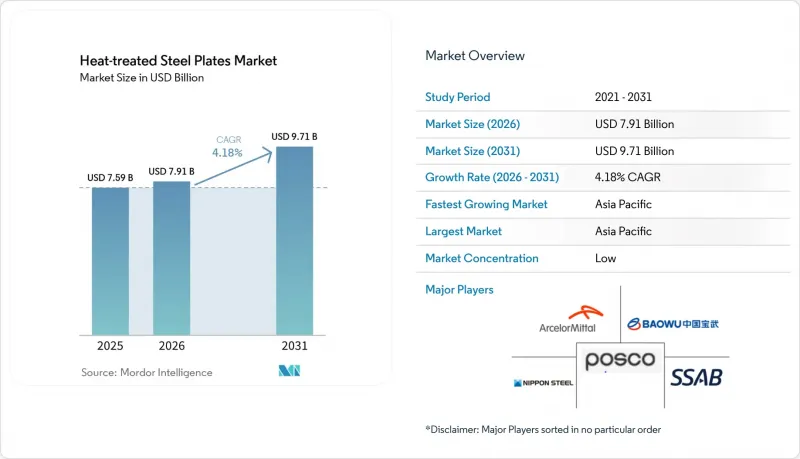
본 보고서는 강종별(탄소강, 합금강, 스테인리스 스틸), 열처리 유형별(어닐링, 템퍼링 등), 최종 용도 분야별(자동차 및 중장비, 건축 및 건설 등) 및 지역별(북미, 남미, 유럽, 중동 및 아프리카, 아시아태평양)로 분류되어 있습니다. 시장 전망은 금액(달러) 기준으로 제시되어 있습니다.
세계의 열처리 강판 시장 동향 및 분석
해상 풍력 발전용 모노파일 기초가 수요를 견인하고 있습니다.
15MW급 터빈용 모노파일의 직경은 11m, 두께는 150mm까지 확대되면서, DNV의 파괴 인성 기준을 충족하는 정규화 처리 또는 TMCP 강판에 대한 수요를 끌어올리고 있습니다. 대만의 China Steel Corporation은 태풍으로 인한 취성 파손을 완화하기 위해, -20°C에서 100 J의 샤르피 인성을 규정한 S355G10+N 강판 18만 톤에 대한 5년간의 수주를 2025년에 확보했습니다. Dillinger와 Orsted는 2024년, 담금질 및 템퍼링 처리를 거친 S690QL을 사용한 12m 길이의 모노파일을 공동 개발하기로 합의하여, MW당 강재 중량을 18% 줄이고 설치 비용을 절감했습니다. 세계풍력에너지협의회(GWEC)는 2030년까지 110GW 규모의 신규 해상 풍력 발전 용량이 확보될 것으로 전망하고 있으며, 모노파일의 점유율이 65%를 유지할 경우 이는 약 800만 톤의 강판에 해당합니다. 해상 풍력 발전 1GW당 약 7만 톤의 두꺼운 강판이 소비되는 것으로 추정되며, 이로 인해 이 분야가 열처리 능력에 미치는 수요가 얼마나 큰지가 여실히 드러나고 있습니다.
자율 주행 광산용 트럭의 적재함에 내마모성 강판이 채택됨
자율 주행형 운반 트럭은 하루 24시간 가동되기 때문에 라이너의 마모가 심해지고 있어, 교체 주기를 8,000시간에서 14,000시간으로 연장할 수 있는 500 브리넬 경도의 담금질 강판에 대한 수요가 증가하고 있습니다. SSAB가 2025년에 출시한 ‘Hardox 500 Tuf’는 45 J의 샤르피 인성을 갖추고 있어, 220 t의 적재물이 적재함에 충돌하더라도 균열의 확산을 방지합니다. JFE의 ‘EVERHARD 450’은 2024년에 출시되었으며, 인을 이용한 미량 합금화를 통해 담금질 변형을 줄이고, 예열 없이 레이저 절단이 가능해졌습니다. Austin Engineering의 보고서에 따르면, 2025년에는 자율주행 차량의 수주가 32% 증가했으며, 그 재료비의 68%를 내마모성 강판이 차지했습니다. 리오 틴토(Rio Tinto)의 필바라(Pilbara) 지역에서 운용되는 220대의 코마츠(Komatsu) 930E 트럭은 하도스(Hardox) 라이너로 교체함으로써 유지보수로 인한 가동 중단 시간을 22% 줄였습니다.
차세대 토목 건설 기계에서 복합재료가 내마모 플레이트를 대체하게 될 것
2025년에는 현무암 섬유에 접착된 초고분자량 폴리에틸렌 라이너가 운송 트럭 적재함 개조 작업의 18%를 차지했으며, 중량을 40% 줄이는 동시에 피로 균열의 원인이 되는 용접 스패터를 제거했습니다. 2024년에 출시된 Caterpillar의 794 AC 트럭은 브리넬 경도 400에 해당하는 내마모성을 갖춘 복합 소재로 제작된 적재함을 채택하여, 사용 수명을 16,000시간으로 연장했습니다. 코마츠는 2025년에 탄소섬유 강화 버킷 에지를 도입하여, 버킷 끝부분의 무게를 35% 줄이는 동시에 연료 소비량을 2.1% 절감했습니다. 볼보 건설기계(Volvo Construction Equipment)는 2025년 아티큘레이트 할러의 자재비 중 복합재 마모 부품이 차지하는 비중이 2023년의 4%에서 12%로 상승했다고 밝혔습니다. Bruce Rock Engineering은 UHMWPE 라이너로 전환함으로써 1대당 3년 동안 3만 1,000달러의 비용 절감이 가능함을 입증하여, 비용 효율성을 중시하는 광산에서의 도입을 가속화하고 있습니다.
부문별 분석
2025년, 열처리 강판 시장에서 탄소강의 점유율은 45.58%를 차지했으나, 듀플렉스 스테인리스 스틸 및 마르텐사이트계 강종이 전해조와 해저 파이프라인에 보급됨에 따라, 합금강은 2031년까지 연평균 성장률(CAGR) 5.05%로 확대될 것으로 예측됩니다. 이상 스테인리스 스틸, 특히 EN 1.4462는 EU의 그린 수소 프로젝트에 힘입어 2025년에는 합금강의 총 톤수 중 약 8%를 차지했습니다. 스테인리스 강판은 틈새 시장에 국한되어 있지만, 극저온 및 제약 분야에서 필수적인 소재로, 판매량 부족을 상쇄하는 가격 프리미엄이 유지되고 있습니다.
비용 차이가 탄소강의 견조한 실적을 설명해 줍니다. S355의 정규화 가격은 톤당 약 650달러인 반면, 듀얼 페이즈 강판은 약 2,400달러입니다. 그럼에도 불구하고, ArcelorMittal의 ‘Usibor 2000’ 프레스 경화강(전기차 배터리 케이스용으로 2,000 MPa의 인장 강도를 실현), 포스코의 ‘PosMAC’(아연 도금 제품에 비해 10배의 내해수 부식성을 발휘)과 같은 혁신적인 합금 배합이 시장 점유율을 확대되고 있습니다. Nippon Steel의 NSGP1 시운전용 합금은 북극권 해양 시추 설비용으로 -60°C에서의 샤르피 인성을 충족하여, 고사양 합금강판의 적용 분야를 더욱 확대되고 있습니다.
지역별 분석
아시아태평양은 2025년에 전 세계 매출의 52.95%를 차지한 것으로 평가되었으며, 중국의 풍력 터빈 공급망, 인도의 인프라 구축 계획, 그리고 동남아시아의 조선 산업에 힘입어 2031년까지 연평균 5.74%의 성장률을 보일 것으로 전망됩니다. 중국은 2025년에 약 5억 8,000만 톤의 조강을 생산할 것으로 예상되며, 이 중 열처리 강종이 1.8% 가까이 차지하고 있어 부가가치화로 전환할 여지가 충분함을 보여줍니다. 111조 루피(1조 3,000억 달러) 규모의 인도 국가 인프라 계획에 따라, JSW와 타타에서 220만 톤의 새로운 강판 생산 능력이 창출될 전망입니다.
유럽은 시장 점유율 면에서는 뒤처져 있지만, 수익성이 높은 듀플렉스강 생산에서는 주도적인 입지를 차지하고 있습니다. 2026년에 가동을 시작할 H2 Green Steel의 보덴 공장은 연간 50만 톤의 화석 연료가 사용되지 않은 강판을 공급할 예정이며, 톤당 50-80유로의 그린 프리미엄을 지불할 의사가 있는 고객을 대상으로 하고 있습니다. 독일의 티센크루프는 수소 DRI를 공동 개발하고 있으며, 도거 뱅크(Dogger Bank) 등 영국의 해상 풍력 발전 프로젝트에서는 2026-2031년 정규화 강판 및 TMCP 강판을 120만 톤 소비할 것으로 예측됩니다.
북미에서는 지진 대책 의무화와 LNG 시장의 성장이 맞물리면서, Nucor의 새로운 열처리 라인을 통해 동부 해안의 건설업체와 멕시코만 연안의 발전소를 대상으로 30만 톤의 생산 능력이 추가될 예정입니다. 중동은 사우디아라비아의 NEOM, 해수 담수화, 석유화학 프로젝트를 중심으로 하고 있으며, 2031년까지 철강 소비량이 연평균 6.2% 증가할 것으로 전망됩니다. 브라질과 아르헨티나를 필두로 한 남미 지역은 리튬 채굴과 농업 기계 생산으로 인한 혜택을 누리고 있으며, 포스코는 듀플렉스강으로 제작된 압력 용기가 필요한 수산화리튬 공장을 건설 중입니다.
기타 혜택 :
- 엑셀 형식 시장 예측(ME) 시트
- 3개월간의 애널리스트 지원
자주 묻는 질문
목차
제1장 서론
제2장 조사 방법
제3장 주요 요약
제4장 시장 구도
제5장 시장 규모 및 성장 예측
제6장 경쟁 구도
제7장 시장 기회 및 향후 전망
AJY 26.06.30According to Mordor Intelligence, the heat-treated steel plates market size is expected to grow from USD 7.59 billion in 2025 to USD 7.91 billion in 2026 and is forecast to reach USD 9.71 billion by 2031 at 4.18% CAGR over 2026-2031.
This report is Segmented by Steel Type (Carbon Steel, Alloy Steel, and Stainless Steel), Heat-Treatment Type (Annealing, Tempering, and More), End-Use Sector (Automotive and Heavy Machinery, Building and Construction, and More), and Geography (North America, South America, Europe, Middle East and Africa, Asia-Pacific). The Market Forecasts are Provided in Terms of Value (USD).
Global Heat-treated Steel Plates Market Trends and Insights
Offshore-Wind Monopile Foundations Driving Demand
Monopile diameters have climbed to 11 m and wall thicknesses to 150 mm for 15-MW turbines, pushing demand for normalized or TMCP plate that meets DNV fracture-toughness rules. Taiwan's China Steel Corporation secured a 5-year order for 180,000 tons of S355G10+N plate in 2025, specifying 100 J Charpy toughness at -20 °C to mitigate typhoon-induced brittle fracture. Dillinger and Orsted agreed in 2024 to co-develop 12-m monopiles using quenched-and-tempered S690QL, reducing steel weight per MW by 18% and cutting installation costs. The Global Wind Energy Council foresees 110 GW of new offshore capacity by 2030, equal to about 8 million tons of plate if monopiles keep a 65% share. Each GW of offshore wind consumes an estimated 70,000 tons of heavy plate, underlining the sector's pull on heat-treatment capacity.
Abrasion-Resistant Plates Adopted in Autonomous Mining Truck Bodies
Autonomous haul trucks run 24 h per day, intensifying liner wear and raising demand for 500-Brinell quenched plate that stretches replacement cycles from 8,000 h to 14,000 h. SSAB's Hardox 500 Tuf, launched in 2025, delivers 45-J Charpy toughness, avoiding crack propagation when 220-t payloads strike the bed. JFE's EVERHARD 450 debuted in 2024 with phosphorus micro-alloying that cuts quenching distortion and lets users laser-cut without preheating. Austin Engineering reported a 32% jump in autonomous-fleet orders in 2025, with abrasion-resistant plate making up 68% of material spend. Rio Tinto's Pilbara fleet of 220 Komatsu 930E trucks switched to Hardox liners and reduced maintenance downtime by 22%.
Composites Replacing Wear Plate in Next-Generation Earth-Moving Equipment
Ultra-high-molecular-weight polyethylene liners bonded to basalt fiber captured 18% of haul-truck bed retrofits in 2025, lowering weight by 40% and eliminating weld spatter that seeds fatigue cracks. Caterpillar's 794 AC truck, launched in 2024, offers composite beds rated to 400-Brinell equivalent abrasion resistance and extends life to 16,000 h. Komatsu introduced a carbon-fiber reinforced bucket edge in 2025 that trims tip weight by 35% and cuts fuel burn by 2.1%. Volvo Construction Equipment disclosed that composite wear parts climbed to 12% of its articulated-hauler material spend in 2025, up from 4% in 2023. Bruce Rock Engineering demonstrated a USD 31,000 three-year savings per truck when switching to UHMWPE liners, accelerating adoption in cost-focused mines.
Other drivers and restraints analyzed in the detailed report include:
- Seismic-Resilient Normalized Plate Mandated by New Building Codes
- Duplex Stainless Plates for Green-Hydrogen Electrolyzer Pressure Vessels
- Energy-Price Volatility Reducing Furnace Utilization
For complete list of drivers and restraints, kindly check the Table Of Contents.
Segment Analysis
The carbon steel accounted for 45.58% of the heat-treated steel plates market share in 2025, while alloy steel is forecast to expand at a 5.05% CAGR to 2031 as duplex stainless and martensitic grades penetrate electrolyzer vessels and subsea lines. Duplex stainless, notably EN 1.4462, covered about 8% of alloy tonnage in 2025, propelled by EU green-hydrogen projects. Stainless plate stays niche but essential in cryogenic and pharmaceutical uses, commanding price premiums that offset lower volume.
Cost differentials explain carbon steel's resilience-S355 normalized sells near USD 650/ton, versus duplex plate at roughly USD 2,400/ton. Even so, alloy formulations gain ground through innovations such as ArcelorMittal's Usibor 2000 press-hardening steel, which enables 2,000-MPa tensile strength for EV battery enclosures, and POSCO's PosMAC, which offers tenfold marine corrosion resistance relative to galvanized alternatives. Nippon Steel's NSGP1 normalized alloy meets -60 °C Charpy toughness for Arctic offshore rigs, further widening the addressable field for high-specification alloy plates.
Geography Analysis
Asia-Pacific held 52.95% of global revenue in 2025 and is forecast to grow at 5.74% through 2031, driven by Chinese wind-turbine supply chains, India's infrastructure pipeline, and Southeast Asian shipbuilding. China produced around 580 million tons of crude steel in 2025, with heat-treated variants accounting for close to 1.8%, indicating ample headroom for value-added migration. India's National Infrastructure Pipeline, worth INR 111 trillion (USD 1.3 trillion), is triggering 2.2 million tons of fresh plate capacity from JSW and Tata.
Europe trails in share but leads on margin-rich duplex output. H2 Green Steel's Boden mill, coming online in 2026, will supply 500,000 tons of fossil-free plate annually, aiming at users willing to pay EUR 50-80/ton green premiums. Germany's thyssenkrupp is co-developing hydrogen DRI, and UK offshore wind projects such as Dogger Bank are set to consume 1.2 million tons of normalized and TMCP plate from 2026 to 2031.
North America combines seismic mandates and LNG growth. Nucor's new normalizing line adds 300,000 tons of capacity for East Coast builders and Gulf Coast energy plants. The Middle East pivots on Saudi Arabia's NEOM, desalination, and petrochemical projects, anticipating a 6.2% annual steel-consumption rise to 2031. South America, led by Brazil and Argentina, benefits from lithium mining and farm-equipment production, with POSCO building a lithium-hydroxide plant requiring duplex pressure vessels.
- ArcelorMittal
- Baosteel Co.,Ltd.
- China Ansteel Group Corporation Limited
- China BaoWu Steel Group Corporation Limited
- Dillinger Hutte Saarstahl AG
- Essar
- Hyundai Steel
- JFE Steel Corporation
- JSW Steel Ltd.
- Nippon Steel Corporation
- Nucor Corporation
- POSCO
- SSAB AB
- thyssenkrupp Steel Europe
- Voestalpine AG
Additional Benefits:
- The market estimate (ME) sheet in Excel format
- 3 months of analyst support
TABLE OF CONTENTS
1 Introduction
- 1.1 Study Assumptions and Market Definition
- 1.2 Scope of the Study
2 Research Methodology
3 Executive Summary
4 Market Landscape
- 4.1 Market Overview
- 4.2 Market Drivers
- 4.2.1 Offshore-wind monopile foundations driving demand
- 4.2.2 Abrasion-resistant plates adopted in autonomous mining truck bodies
- 4.2.3 Seismic-resilient normalized plate mandated by new building codes
- 4.2.4 Duplex stainless plates for green-hydrogen electrolyzer pressure vessels in Europe
- 4.2.5 Lightweight cargo-ship designs utilising heat treated steel plate
- 4.3 Market Restraints
- 4.3.1 Composites replacing wear plate in next-gen earth-moving equipment
- 4.3.2 Energy-price volatility reducing furnace utilisation
- 4.3.3 Stricter NOx/CO2 furnace-emission caps raising compliance cost
- 4.4 Value Chain Analysis
- 4.5 Porter's Five Forces
- 4.5.1 Bargaining Power of Suppliers
- 4.5.2 Bargaining Power of Buyers
- 4.5.3 Threat of New Entrants
- 4.5.4 Threat of Substitutes
- 4.5.5 Degree of Competition
5 Market Size and Growth Forecasts (Value)
- 5.1 By Steel Type
- 5.1.1 Carbon Steel
- 5.1.2 Alloy Steel
- 5.1.3 Stainless Steel
- 5.2 By Heat-Treatment Type
- 5.2.1 Annealing
- 5.2.2 Tempering
- 5.2.3 Normalizing
- 5.2.4 Thermo-Mechanical Controlled Process (TMCP)
- 5.2.5 Quenching
- 5.3 By End-Use Sector
- 5.3.1 Automotive and Heavy Machinery
- 5.3.2 Building and Construction
- 5.3.3 Shipbuilding and Offshore Structures
- 5.3.4 Energy and Power (Oil, Gas, Renewables)
- 5.3.5 Others (Metalworking, Transportation)
- 5.4 By Geography
- 5.4.1 Asia-Pacific
- 5.4.1.1 China
- 5.4.1.2 India
- 5.4.1.3 Japan
- 5.4.1.4 South Korea
- 5.4.1.5 Malaysia
- 5.4.1.6 Thailand
- 5.4.1.7 Indonesia
- 5.4.1.8 Vietnam
- 5.4.1.9 Rest of Asia-Pacific
- 5.4.2 North America
- 5.4.2.1 United States
- 5.4.2.2 Canada
- 5.4.2.3 Mexico
- 5.4.3 Europe
- 5.4.3.1 Germany
- 5.4.3.2 United Kingdom
- 5.4.3.3 France
- 5.4.3.4 Italy
- 5.4.3.5 Spain
- 5.4.3.6 NORDIC Countries
- 5.4.3.7 Russia
- 5.4.3.8 Turkey
- 5.4.3.9 Rest of Europe
- 5.4.4 South America
- 5.4.4.1 Brazil
- 5.4.4.2 Argentina
- 5.4.4.3 Colombia
- 5.4.4.4 Rest of South America
- 5.4.5 Middle East and Africa
- 5.4.5.1 Saudi Arabia
- 5.4.5.2 United Arab Emirates
- 5.4.5.3 Qatar
- 5.4.5.4 Egypt
- 5.4.5.5 South Africa
- 5.4.5.6 Nigeria
- 5.4.5.7 Rest of Middle East and Africa
- 5.4.1 Asia-Pacific
6 Competitive Landscape
- 6.1 Market Concentration
- 6.2 Strategic Moves
- 6.3 Market Share(%)/Ranking Analysis
- 6.4 Company Profiles (includes Global level Overview, Market level overview, Core Segments, Financials as available, Strategic Information, Products and Services, and Recent Developments)
- 6.4.1 ArcelorMittal
- 6.4.2 Baosteel Co.,Ltd.
- 6.4.3 China Ansteel Group Corporation Limited
- 6.4.4 China BaoWu Steel Group Corporation Limited
- 6.4.5 Dillinger Hutte Saarstahl AG
- 6.4.6 Essar
- 6.4.7 Hyundai Steel
- 6.4.8 JFE Steel Corporation
- 6.4.9 JSW Steel Ltd.
- 6.4.10 Nippon Steel Corporation
- 6.4.11 Nucor Corporation
- 6.4.12 POSCO
- 6.4.13 SSAB AB
- 6.4.14 thyssenkrupp Steel Europe
- 6.4.15 Voestalpine AG
7 Market Opportunities and Future Outlook
- 7.1 White-space and Unmet-Need Assessment


