

|
시장보고서
상품코드
2066710
전기 이륜차 시장 : 시장 점유율 분석, 업계 동향 및 통계, 성장 예측(2026-2031년)Electric Two-Wheeler - Market Share Analysis, Industry Trends & Statistics, Growth Forecasts (2026 - 2031) |
||||||
 Mordor Intelligence
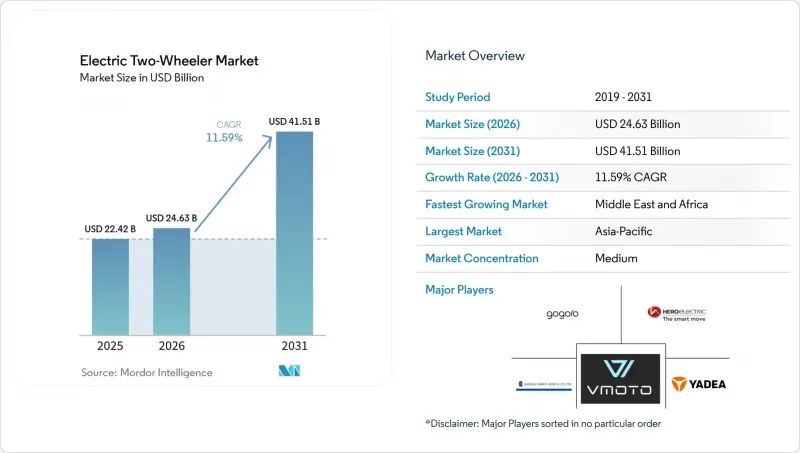
Mordor Intelligence에 의하면, 전기 이륜차 시장 규모는 2026년에 246억 3,000만 달러로 추정되고, 예측 기간(2026-2031년) CAGR 11.59%로 성장을 지속할 것으로 예측되며, 2031년까지 415억 1,000만 달러에 이를 전망입니다.
본 보고서는 차량 유형별(스쿠터 및 오토바이), 모터 출력별(1.0 kW 이하 및 그 이상), 전압별(48V, 60V, 72V, 기타), 배터리 구성별(고정식, 기타), 모터 유형별(BLDC, 기타), 가격대별(1,000달러 이하, 그 이상), 최종 사용자별(B2C, 기타), 판매 채널별(온라인, 오프라인) 및 지역별로 분류되어 있습니다. 예측은 금액(달러) 및 판매 대수(단위)로 이루어집니다.
세계의 전기 이륜차 시장 동향 및 인사이트
배터리 가격 하락이 TCO 패리티를 가속화
2024년, 리튬 이온 배터리 팩의 비용은 대폭 하락하여 전년 대비 현저한 감소를 기록했습니다. 예측에 따르면, 가까운 시일 내에 더욱 하락할 것으로 보입니다. 이러한 이정표를 달성함으로써 인도, 인도네시아, 베트남 등 시장에서 125cc 가솔린 스쿠터에 대한 초기 비용 부담이 해소되었습니다. 이러한 변화는 보조금에 의존하지 않는 자연스러운 수요 증가의 길을 열어줍니다. 특히 인도의 2선 도시에서는 Ather Energy나 TVS Motor와 같은 브랜드의 보조금에 의존하지 않는 전기 스쿠터 판매가 월간 판매 대수의 상당 부분을 차지하게 되었다고 보고하고 있습니다. 각 제조업체는 이러한 비용 절감분을 제품 라인업 확충에 활용하고 있습니다. 예를 들어, Ola Electric은 2025년 초에 연장 보증 프로그램을 도입했습니다. 전반적으로 볼 때, 공급망의 규모 확대와 배터리 비용 최적화는 여전히 전기 이륜차 시장의 주요 성장 요인으로 작용하고 있습니다.
긱 경제 분야의 배송 차량의 급속한 확대
Zomato와 같은 음식 배달 플랫폼들은 2020년대 말까지 상당수의 전기 차량을 도입하겠다는 야심 찬 목표를 세웠습니다. 한편, Swiggy는 Zypp Electric과 계약을 체결했으며, 향후 몇년내에 대규모 스쿠터 차량을 도입할 계획입니다. 중거리에서 장거리에 이르는 일상적인 운행에서 전기 차량은 가솔린 차량에 비해 총 소유 비용을 대폭 절감할 수 있습니다. 특히, 배터리 교체를 통해 가동 중단 시간을 최소화할 수 있는 경우에는 더욱 그렇습니다. 2024년, Gogoro는 Uber 및 Rapido와 차량 대여 계약을 체결하고, 광범위한 배터리 교환소 네트워크를 활용하여 방갈로르와 하이데라바드에서 사업 기반을 구축했습니다. 정부 규정에 따라 인도네시아의 GoTo Group은 향후 몇년내에 Gojek 차량의 상당 부분을 전기차로 전환할 전망이며, 이는 전기차 보급을 주도하는 아시아의 역할을 여실히 보여주고 있습니다. 대만을 제외한 지역에서는 표준화된 배터리 교체 프로토콜이 통일되어 있지 않은 상황이지만, 컨소시엄의 결성은 향후 표준화가 진전될 것임을 시사하고 있습니다.
중국과 유럽에서의 보조금 단계적 폐지
2024년 초, 독일이 2023년 말에 구매 보조금을 폐지하고 프랑스가 2024년 초에 에코보너스를 삭감한 결과, 등록 대수가 대폭 감소했습니다. 중국은 2022년 말에 소비자에 대한 직접 보조금을 종료했으나, 구매세 면제 조치는 앞으로 몇 년 동안 더 유효합니다. 인센티브가 축소되는 가운데, 각 OEM 업체들은 부품 원가 절감을 피할 수 없는 상황에 놓여 있으며, 특히 규모가 제한적인 중소 제조업체에 미치는 영향이 커지고 있습니다. 인도의 FAME-II 제도와 같이, 예측 가능한 다년 프로그램으로 알려진 시장에서는 수요 곡선이 보다 안정적입니다. 재정적 압박을 고려할 때, 향후 연장 조치는 이전만큼 후한 수준이 되지 않을 가능성이 높으며, 이로 인해 본질적인 비용 경쟁력의 중요성이 부각되고 있습니다.
부문별 분석
2025년, 전기 이륜차 시장에서 스쿠터는 전 세계 판매 대수의 94.71%를 차지하며 시장을 휩쓸었습니다. 이 스텝스루 디자인, 시트 하단 수납공간, 경량 프레임은 혼잡한 도심 이동이나 택배 업무에 적합합니다. 배송 플랫폼이 스쿠터를 선호하는 이유는 라이더가 빠르게 승하차할 수 있어 서비스 시간을 단축할 수 있기 때문입니다. 오토바이는 시장 점유율 측면에서는 미미한 수준이지만, 성능을 중시하는 라이더들이 고속도로의 법정 최고 속도나 공격적인 스타일을 추구함에 따라 연평균 성장률(CAGR) 11.61%로 성장하고 있습니다. Revolt사의 RV400과 Emflux사의 수냉식 ONE은 이러한 고출력화로의 전환을 상징하는 모델입니다.
오토바이를 둘러싼 이러한 흐름은 전기 이륜차 시장의 양극화를 시사하고 있습니다. 2031년까지는 대중 시장에서의 보급은 여전히 스쿠터가 주를 이룰 것으로 보입니다. 그러나 프리미엄층 고객들은 0-100km/h 가속 시간이 4초 미만이나 실제 주행 거리가 100km 이상인 모델이라면, 이를 위해 추가 비용을 지불할 의향이 있습니다. 스포츠 및 투어링 부문에서 내연기관의 전통을 지닌 브랜드는 배터리 비용이 계속 낮아진다면 활용할 수 있는 잠재적인 브랜드 가치를 보유하고 있습니다. 반대로, 기존 스쿠터 제조업체들은 제품 라인업을 오토바이형 실루엣으로 확대하지 않는 한, 해당 제품을 동경하는 구매층을 잃을 위험이 있습니다. 따라서 이 부문에서의 혁신은 항속 거리의 점진적인 향상보다는 폼 팩터의 확대를 중심으로 전개될 것입니다.
2025년에는 1.1-3.0 kW급 모델이 판매 대수의 39.78%를 차지했으며, 비용, 차량 중량, 도심 주행 성능의 균형이 잘 잡혀 있었습니다. 이 차량들은 60km 미만의 일상적인 통근에 적합하며, 가격에 민감한 구매자들에게는 여전히 대표적인 선택지로 자리 잡고 있습니다. 그러나 5.0 kW를 초과하는 등급이 가장 빠르게 성장하고 있으며, 연평균 성장률(CAGR)은 11.67%로 성장을 지속하고, 있습니다. 이는 아세안(ASEAN)과 라틴아메리카의 규제 당국이 면허 발급 기준을 통일하여, 고출력 스쿠터가 자동차와 마찬가지로 간선 도로를 주행할 수 있게 되었기 때문입니다. Ather사의 ‘450 Apex’는 주행 거리를 희생하지 않으면서도 신호 대기 시에도 거의 즉각적으로 토크를 발휘한다는 매력을 입증하고 있습니다.
한때 중국 농촌 지역에서 인기를 끌었던 1.0 kW 이하의 저출력 부문은 배터리 가격 하락으로 인해, 제한된 성능을 정당화해 주던 비용 측면의 이점이 점차 사라지고 있어 그 존재 의의를 잃어가고 있습니다. 대조적으로, 중출력(3.1-5.0 kW) 부문은 엔트리급 스쿠터에서 갈아타기를 고려 중인 라이더나, 대용량 배터리로 인한 가격 인상과 무게 증가를 아직 받아들이지 못하는 라이더들에게 과도기적인 선택지가 되어가고 있습니다. kWh당 비용이 90달러 아래로 떨어짐에 따라, 출력 등급의 분포는 계속해서 상위 등급으로 이동할 것입니다. 이를 통해 각 OEM 업체들은 대중 시장의 가격대를 벗어나지 않으면서도 더 대용량의 배터리 팩을 탑재할 수 있게 됩니다.
2025년 기준으로 60볼트 시스템은 전기 이륜차 시장 점유율의 37.73%를 차지했습니다. 이는 주로 그 구성 요소(컨트롤러, 충전기, 배터리 모듈)의 생태계가 성숙해 있고, 비용 면에서도 최적화되어 있기 때문입니다. 한편, 72볼트 플랫폼은 3kW의 전력을 공급하고, 최단 충전 시간을 약 90분으로 단축하는 DC 급속 충전기의 보급에 힘입어 연평균 성장률(CAGR) 11.71%를 기록하며 성장하고 있습니다. Gogoro사는 높은 듀티 사이클에 대응하기 위해 50.4V 배터리 팩을 직렬로 연결하여 100.8V를 구현함으로써 모듈식 구성의 유연성을 보여주고 있습니다.
공공 충전소의 밀도가 높아지고 있는 것은 본질적인 효율 이상으로 전압 선택에 영향을 미치고 있습니다. 이는 소유자들이 호환 가능한 하드웨어의 가용성을 기준으로 차량을 비교·검토하게 되었기 때문입니다. 한때 납산 배터리에서 전환하는 과정에서 주류를 이루었던 48V 아키텍처는 리튬 배터리 기술로 인해 기존의 전압 상한선이 해소되면서 그 위상이 약화되고 있습니다. 실험 단계에 있는 96V 및 120V 프로토타입은 규격이 확립될 때까지는 틈새 시장 제품으로 남을 것입니다. 따라서 각 OEM 업체들은 전략적인 절충의 기로에 서 있습니다. 즉, 일반적인 전력망의 전압 규격을 따를 것인지, 아니면 도시 외곽을 주행할 때 고객이 충전 설비를 이용할 수 없게 될 위험을 감수할 것인지의 선택입니다.
지역 분석
기타 혜택 :
- 엑셀 형식 시장 예측(ME) 시트
- 3개월간의 애널리스트 지원
자주 묻는 질문
목차
제1장 서론
제2장 조사 방법
제3장 주요 요약
제4장 시장 구도
제5장 시장 규모 및 성장 예측
제6장 경쟁 구도
제7장 시장 기회 및 향후 전망
제8장 CEO가 생각해야 할 중요 전략적 과제
AJY 26.06.30According to Mordor Intelligence, the electric two-Wheeler market size is estimated at USD 24.63 billion in 2026, and is expected to reach USD 41.51 billion by 2031, at a CAGR of 11.59% during the forecast period (2026-2031).
This report is Segmented by Vehicle Type (Scooters and Motorcycles), Motor Power (Less Than or Equal To 1. 0 KW and More), Voltage (48 V, 60 V, 72 V, and Others), Battery Config (Fixed and More), Motor Type (BLDC and Others), Price Band (Less Than or Equal To USD 1, 000 and More), End User (B2C and More), Sales Channel (Online and Offline), and Geography. Forecasts in Value (USD) and Volume (Units).
Global Electric Two-Wheeler Market Trends and Insights
Falling Battery Prices Accelerate TCO Parity
In 2024, lithium-ion pack costs experienced a significant decline, marking a notable year-on-year reduction. Projections suggest further decreases in the near future. Achieving this milestone eliminates the upfront premium over 125 cc petrol scooters in markets like India, Indonesia, and Vietnam. This shift paves the way for organic demand, independent of subsidies. Notably, in Tier-2 Indian cities, brands like Ather Energy and TVS Motor report that sales of electric scooters, free from subsidies, now account for a substantial portion of their monthly volumes. Manufacturers are channeling these cost savings into enhanced offerings; for instance, Ola Electric rolled out an extended warranty program in early 2025 . Overall, supply-chain scaling and battery cost optimization continue to be the primary growth drivers for the electric two-wheeler market.
Rapid Growth of Gig-Economy Delivery Fleets
Food-delivery platforms, such as Zomato, are setting ambitious targets, aiming for a significant number of electric units by the end of the decade. Meanwhile, Swiggy has inked a deal with Zypp Electric, planning to roll out a substantial fleet of scooters within the next few years. With daily runs covering moderate to long distances, electric vehicles can reduce total ownership costs significantly compared to petrol, especially when battery swapping minimizes downtime. In 2024, Gogoro clinched fleet contracts with Uber and Rapido, establishing a presence in Bangalore and Hyderabad, due to its extensive swap-station network . Under government mandates, Indonesia's GoTo Group is on track to electrify a considerable portion of its Gojek fleet within the next few years, underscoring Asia's leading role in the electric vehicle push. While standardized swapping protocols face fragmentation outside Taiwan, the formation of consortia hints at a future convergence.
Subsidy Phase-Outs in China & Europe
In early 2024, Germany's termination of purchase grants in late 2023 and France's reduction of its ecological bonus at the beginning of 2024 resulted in significant declines in registrations. While China ended direct consumer subsidies in late 2022, purchase-tax exemptions remain in effect for a few more years. As incentives dwindle, OEMs are compelled to tighten their bill-of-materials costs, particularly impacting smaller players with limited scale. Markets like India's FAME-II scheme, known for their predictable multiyear programs, showcase steadier demand curves. Given the fiscal pressures, it's likely that any future extensions will be less generous, underscoring the importance of intrinsic cost competitiveness.
Other drivers and restraints analyzed in the detailed report include:
- Urban Low-Emission-Zone Policies Spur Adoption
- Localised Cell-To-Pack Manufacturing Incentives
- Fragmented Charging Standards Hamper Roaming
For complete list of drivers and restraints, kindly check the Table Of Contents.
Segment Analysis
Scooters dominated the electric two-wheeler market with 94.71% of global volume in 2025. Their step-through design, under-seat storage, and lightweight frames suit congested urban trips and courier stops. Delivery platforms prefer scooters because riders can mount and dismount quickly, lowering service times. Motorcycles, although a residual share, are expanding at 11.61% CAGR as performance-oriented riders seek highway-legal speed ceilings and aggressive styling. Revolt's RV400 and Emflux's liquid-cooled ONE exemplify this transition toward higher power figures.
Momentum around motorcycles suggests a bifurcation of the electric two-wheeler market. Mass-market adoption will remain scooter-centric through 2031; however, premium customers are willing to pay for acceleration under four seconds and 100 km-plus real-world range. Brands with combustion heritage in sport and touring categories hold latent brand equity that they can leverage once battery cost curves allow. Conversely, scooter incumbents risk losing aspirational buyers unless they extend line-ups into motorcycle silhouettes. Segment innovation, therefore, revolves around expanding form factors rather than incremental range gains.
Models in the 1.1-3.0 kW bracket accounted for 39.78% of sales in 2025, balancing cost, curb weight, and city-grade performance. They suit daily commutes under 60 km and remain the default for price-sensitive buyers. Yet the above-5.0 kW class is the fastest-growing, logging an 11.67% CAGR as ASEAN and Latin American regulators align licensing norms so higher-output scooters can share arterial roads with cars. Ather's 450 Apex demonstrates the appeal of near-instant torque at traffic lights without sacrificing range.
The low-power less than or equal to 1.0 kW sub-segment, once popular in China's rural regions, is losing relevance because dropping battery prices erode the savings that justified limited performance. Conversely, the mid-power 3.1-5.0 kW tier is becoming a transitional step for riders upgrading from entry scooters but not yet ready to absorb the price premium or added weight of larger batteries. Power-class distribution will keep tilting upward as the cost per kWh settles below USD 90, enabling OEMs to ship larger packs without overshooting mass-market price bands.
Sixty-volt systems held 37.73% of the electric two-wheeler market share in 2025, largely because their component ecosystem-controllers, chargers, and battery modules-is mature and cost-optimized. Seventy-two-volt platforms, however, are growing at an 11.71% CAGR, aided by DC fast-chargers that deliver 3 kW and reduce minimal charge times to around 90 minutes. Gogoro uses 50.4 V packs in series to reach 100.8 V for high-duty cycles, demonstrating the flexibility of modular configurations.
Growing public-charging density influences voltage selection more than intrinsic efficiency because owners now cross-shop vehicles against the availability of compatible hardware. Forty-eight-volt architectures, once dominant in lead-acid conversions, are sliding as lithium chemistries eliminate past voltage ceilings. Experimental 96-V and 120-V prototypes will remain niche until standards emerge. OEMs therefore face a strategic trade-off: align with prevailing grid voltage norms or risk orphaning customers when traveling outside urban centers.
Geography Analysis
List of Companies Covered in this Report:
- Yadea Group Holdings Ltd.
- Jiangsu Xinri E-Vehicle Co. Ltd.
- Hero Electric Vehicles Pvt. Ltd.
- VMOTO SOCO ITALY SRL
- Gogoro Limited
- Ather Energy Pvt. Ltd.
- NIU Technologies
- Ola Electric Technologies Pvt. Ltd.
- TVS Motor Company Ltd.
- Bajaj Auto Ltd.
- Revolt Intellicorp Pvt. Ltd.
- Segway-Ninebot Group
- Horwin Global
- Aima Technology Group
- Super Soco Italy SRL
- Emflux Motors
- Lifan Technology Group
- Pure EV
Additional Benefits:
- The market estimate (ME) sheet in Excel format
- 3 months of analyst support
TABLE OF CONTENTS
1 Introduction
- 1.1 Study Assumptions & Market Definition
- 1.2 Scope of the Study
2 Research Methodology
3 Executive Summary
4 Market Landscape
- 4.1 Key Industry Trends
- 4.1.1 Population & Urbanization Rate
- 4.1.2 GDP per Capita (PPP) & Median Disposable Income
- 4.1.3 Consumer Spend on Vehicle Purchase/Transport (CVP)
- 4.1.4 Fuel Prices
- 4.1.5 Interest Rate for 2W/Auto Loans & Credit Access
- 4.1.6 2W Penetration (units/1,000 people) & Parc
- 4.1.7 Dealer/Service Network Density
- 4.1.8 Two-Wheeler Trade & Revenue (Imports/Exports)
- 4.1.9 Electrification Readiness (Infrastructure & Power)
- 4.1.10 Battery Pack Price & Chemistry Mix
- 4.1.11 Battery Swapping Stations (Network Density & Util.)
- 4.1.12 New Model Pipeline & OEM Coverage
- 4.1.13 Value-Chain Localization & Assembly Capacity
- 4.1.14 Regulatory Framework
- 4.2 Market Drivers
- 4.2.1 Falling Battery Prices Accelerate TCO Parity
- 4.2.2 Rapid Growth of Gig-Economy Delivery Fleets
- 4.2.3 Urban Low-Emission-Zone Policies Spur Adoption
- 4.2.4 Localised Cell-To-Pack Manufacturing Incentives
- 4.2.5 OEM Modular Platforms Cut Development Cycles
- 4.2.6 AI-Based Battery Management Extends Warranty Life
- 4.3 Market Restraints
- 4.3.1 Subsidy Phase-Outs in China & Europe
- 4.3.2 2W-Specific Finance Remains Under-Penetrated
- 4.3.3 Fragmented Charging Standards Hamper Roaming
- 4.3.4 Thermal Events Damage Consumer Trust
- 4.4 Value / Supply-Chain Analysis
- 4.5 Regulatory Landscape
- 4.6 Technological Outlook
- 4.7 Porter's Five Forces
- 4.7.1 Threat of New Entrants
- 4.7.2 Bargaining Power of Suppliers
- 4.7.3 Bargaining Power of Buyers
- 4.7.4 Threat of Substitutes
- 4.7.5 Competitive Rivalry
5 Market Size & Growth Forecasts (Value (USD) and Volume (Units))
- 5.1 By Vehicle Type
- 5.1.1 Scooters
- 5.1.2 Motorcycles
- 5.2 By Motor Power
- 5.2.1 Less than or equal to 1.0 kW
- 5.2.2 1.1-3.0 kW
- 5.2.3 3.1-5.0 kW
- 5.2.4 More than 5.0 kW
- 5.3 By Voltage Platform
- 5.3.1 48 V
- 5.3.2 60 V
- 5.3.3 72 V
- 5.3.4 Others
- 5.4 By Battery Configuration
- 5.4.1 Fixed Pack
- 5.4.2 Swappable (Single)
- 5.4.3 Swappable (Dual)
- 5.5 By Motor Type
- 5.5.1 BLDC
- 5.5.2 PMSM
- 5.5.3 Others
- 5.6 By Price Band (USD)
- 5.6.1 Less than or equal to 1,000
- 5.6.2 1,000-1,500
- 5.6.3 1,501-2,000
- 5.6.4 2,001-3,000
- 5.6.5 3,001-5,000
- 5.6.6 More than 5,000
- 5.7 By End User
- 5.7.1 B2C
- 5.7.2 B2B
- 5.7.3 Ride-hail / Bike-Taxi / Rental / Tourism
- 5.7.4 Delivery & Logistics
- 5.7.5 Corporate & SME Fleets
- 5.7.6 Others (Govt., NGO, Institutional)
- 5.8 By Sales Channel
- 5.8.1 Online
- 5.8.2 Offline
- 5.9 By Geography
- 5.9.1 North America
- 5.9.1.1 United States
- 5.9.1.2 Canada
- 5.9.1.3 Rest of North America
- 5.9.2 South America
- 5.9.2.1 Brazil
- 5.9.2.2 Argentina
- 5.9.2.3 Rest of South America
- 5.9.3 Europe
- 5.9.3.1 Germany
- 5.9.3.2 United Kingdom
- 5.9.3.3 France
- 5.9.3.4 Italy
- 5.9.3.5 Russia
- 5.9.3.6 Spain
- 5.9.3.7 Rest of Europe
- 5.9.4 Asia Pacific
- 5.9.4.1 China
- 5.9.4.2 India
- 5.9.4.3 Japan
- 5.9.4.4 South Korea
- 5.9.4.5 Rest of Asia Pacific
- 5.9.5 Middle East and Africa
- 5.9.5.1 Saudi Arabia
- 5.9.5.2 United Arab Emirates
- 5.9.5.3 South Africa
- 5.9.5.4 Turkey
- 5.9.5.5 Rest of Middle East and Africa
- 5.9.1 North America
6 Competitive Landscape
- 6.1 Market Concentration
- 6.2 Strategic Moves
- 6.3 Market Share Analysis
- 6.4 Company Profiles (includes Global Level Overview, Market Level Overview, Core Segments, Financials as Available, Strategic Information, Market Rank/Share for Key Companies, Products and Services, SWOT Analysis, and Recent Developments)
- 6.4.1 Yadea Group Holdings Ltd.
- 6.4.2 Jiangsu Xinri E-Vehicle Co. Ltd.
- 6.4.3 Hero Electric Vehicles Pvt. Ltd.
- 6.4.4 VMOTO SOCO ITALY SRL
- 6.4.5 Gogoro Limited
- 6.4.6 Ather Energy Pvt. Ltd.
- 6.4.7 NIU Technologies
- 6.4.8 Ola Electric Technologies Pvt. Ltd.
- 6.4.9 TVS Motor Company Ltd.
- 6.4.10 Bajaj Auto Ltd.
- 6.4.11 Revolt Intellicorp Pvt. Ltd.
- 6.4.12 Segway-Ninebot Group
- 6.4.13 Horwin Global
- 6.4.14 Aima Technology Group
- 6.4.15 Super Soco Italy SRL
- 6.4.16 Emflux Motors
- 6.4.17 Lifan Technology Group
- 6.4.18 Pure EV


