|
시장보고서
상품코드
2072448
사일리지 첨가제 : 시장 점유율 분석, 업계 동향 및 통계, 성장 예측(2026-2031년)Silage Additives - Market Share Analysis, Industry Trends & Statistics, Growth Forecasts (2026 - 2031) |
||||||
 Mordor Intelligence
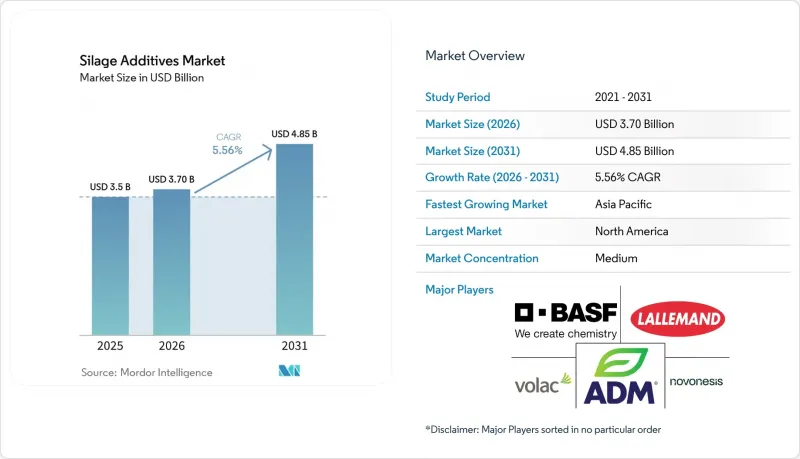
Mordor Intelligence에 의하면, 사일리지 첨가제 시장 규모는 2025년에 35억 달러로 평가되었습니다. 2026년 37억 달러에서 2031년까지 48억 5,000만 달러에 이를 것으로 예상되며, 예측 기간(2026-2031년) CAGR은 5.56%를 나타낼 전망입니다.
본 보고서는 첨가제의 유형(접종제, 유기산 및 염류, 효소, 흡착제, 방부제, 기타), 사일리지의 유형(곡물, 콩과 식물, 기타 사일리지), 그리고 지역(북미, 유럽, 아시아태평양, 남미, 중동 및 아프리카)별로 분류되어 있습니다. 시장 전망은 금액(달러) 및 수량(미터톤) 단위로 제시되어 있습니다.
세계의 사일리지 첨가제 시장 동향 및 인사이트
젖소와 육우의 생산성 목표 향상
두당 우유 생산량 및 쇠고기 생산량 극대화에 대한 관심이 높아지고 있는 것이 사일리지 첨가제 시장의 성장을 견인하고 있습니다. 이러한 제품들은 사료 배합의 효율과 사료의 품질을 향상시키는 데 필수적이기 때문입니다. 미국 농무부(USDA)는 2026년까지 1두당 평균 우유 생산량이 11.07미터톤에 달할 것으로 전망하며, 이러한 생산성을 뒷받침하기 위해서는 고품질의 사일리지 공급이 필수적이라고 강조하고 있습니다. 이를 뒷받침하듯, 라레만드사는 2025년에 자사의 목초 사일리지용 접종제 ‘MAGNIVA Platinum’이 160일 동안 중성세제 섬유(NDF)의 소화율을 5.4퍼센트 포인트 향상시켰으며, 시험 기간 동안 1두당 일일 우유 생산량을 1.23kg 증가시켰습니다고 보고했습니다. 이러한 결과는 가축의 생산성을 높이는 데 있어 사일리지 첨가제가 수행하는 역할을 부각시키고 있으며, 구매 결정의 기준이 단순한 처리 비용이 아니라 우유 및 육류 생산에 대한 기여도로 점차 전환되고 있습니다. 사료작물의 재배 면적이 제한된 지역에서는 동일한 토지 면적에서 더 높은 생산성을 달성해야 하므로, 이러한 변화는 더욱 중요해집니다. 그 결과, 사일리지 첨가제에 대한 수요 증가는 가축 관리에서 효율성과 생산성이 점점 더 중요시되고 있음을 반영하고 있습니다.
산업형 축산 및 사료 시스템의 확대
또한 중국, 인도, 브라질에서 산업형 축산 시스템이 보급되고, 표준화된 사료 보존 자재의 사용이 증가하고 있는 점도 사일리지 첨가제 시장의 확대에 기여하고 있습니다. 중국에서는 2025년 농업농촌가 발표한 ‘사료 절약 계획’에 따라, 사료 배합에서 곡물에 대한 의존도를 낮추기 위해 사일리지 이용이 장려되고 있습니다. 신화통신은 2026년 2월, 내몽골 퉁랴오시에서 2025년 사일리지용 옥수수 재배 면적이 8,039만 헥타르에 달했다고 보도하며, 상업적 축산 시스템을 위한 사료 기반이 얼마나 급속히 확대되고 있는지를 보여주고 있습니다. 또한, FAO(유엔 식량농업기구)와 OECD(경제협력개발기구)는 2034년까지 전 세계 가축 생산량이 16.6% 증가할 것으로 예측하고 있으며, 중·저소득 국가에서 가축 사육 두수 증가가 상대적으로 큰 비중을 차지할 것으로 전망됩니다. 이러한 추세에 따라 사일리지 첨가제 시장에서 보급형 접종제, 완충산 혼합제 및 지역별 특화 보존 제품에 대한 고객 기반이 확대되고 있습니다.
원자재 및 유기산의 가격 변동
사일리지 첨가제 시장에서는 유기산 제품이 가격 변동이 심한 화학 원료 및 에너지 비용의 영향을 받기 때문에 원자재 가격은 여전히 큰 변동을 보이고 있습니다. 이러한 압박은 이익률이 낮고 고객이 가격에 민감해지기 쉬운 프로피온산 및 포름산 제품군에서 가장 두드러지게 나타나고 있습니다. 대규모 상업 낙농장은 장기 공급 계약을 통해 이러한 가격 변동을 보다 수월하게 흡수할 수 있지만, 소규모 사업자는 가격이 상승하면 사용량을 줄이거나 사양이 더 낮은 제품으로 전환하는 경우가 많습니다. 또한, 유럽의 사료 첨가물 규제로 인해 원가 급등 시에도 제품 사양과 순도 기준을 유지해야 하므로, 배합의 저급화에는 제한이 따릅니다. 이러한 요인들이 복합적으로 작용하면서, 가격에 민감한 지역에서의 도입이 주춤해짐에 따라 사일리지 첨가제 시장에서 중견 제조업체들에 대한 압박이 더욱 커지고 있습니다.
부문별 분석
2025년에는 사일리지 첨가제 시장 점유율의 45.0%를 차지한 인오큘란트가 가장 높은 점유율을 유지했습니다. 이러한 우위는 옥수수, 목초, 콩과 식물의 사일리지로 폭넓게 사용되고 있다는 점 외에도, 집약적인 낙농 및 육우 생산 시스템에서 명확한 투자 대비 효과를 가져다주기 때문입니다. 유기산 및 염류는 가장 빠르게 성장하는 첨가제 유형으로, 2026년부터 2031년까지 연평균 성장률(CAGR) 6.0%로 성장을 지속하고, 있습니다. 생산자들이 순수 포름산 제품에서 점차 벗어나면서, 완충 처리 및 혼합산계 방부제가 주목을 받고 있습니다. 이러한 성장은 더 안전하고 부식성이 낮은 제제에 대한 수요, 그리고 접종제의 취급 편의성이나 콜드체인의 신뢰성이 반드시 충분하지 않은 지역에서 유연한 보관 수단에 대한 필요성과 관련이 있습니다.
사일리지 첨가제 시장의 다른 부문에서는 급격한 pH 저하와 사료 급여 시 높은 호기성 안정성을 모두 갖추고 있다는 점 때문에 복합형 스타터 균에 대한 수요가 증가하고 있습니다. 호모발효형 스타터 균주는 여전히 비교적 단순한 사일리지 조건에서 사용되고 있지만, 이종발효형 제품은 발열 위험이 높은 고건물 함량 옥수수 시스템에서의 사용이 증가하고 있습니다. 또한, 농장에서 섬유의 소화율, 곰팡이 억제, 미코톡신 관리를 더욱 중요시하게 되면서, 효소, 발효 및 부패 억제용 첨가제, 흡착제의 역할도 확대되고 있습니다. 당류 및 영양소 계열 제품을 포함한 기타 첨가제는 여전히 틈새 시장 제품으로 남아 있지만, 특히 아시아태평양과 아프리카에서 습식 사료 및 콩과 식물의 사일리지 프로그램에서 중요한 역할을 하고 있습니다.
지역별 분석
2025년, 북미는 사일리지 첨가제 시장 점유율의 34.5%를 차지하며 최대 지역 시장이 되었습니다. 미국이 이 선두 자리를 유지하고 있는 이유는 옥수수 사일리지 시스템이 고도로 기계화되어 있고, 대규모 낙농장에서 사료의 성능을 면밀히 모니터링하고 있기 때문입니다. 미국 농무부의 보고서에 따르면, 2025년 미국의 우유 생산량은 2,226억 파운드, 젖소 사육 두수는 906만 마리이며, 이에 따라 사일리지 생산량과 첨가제 수요는 높은 수준을 유지했습니다. 이 지역의 성장은 시장 침투가 성숙 단계에 접어든 반면, 다중 균주 제품을 통한 부가가치 확대가 지속되고 있음을 반영하고 있습니다. 캐나다와 멕시코에서는 집약적인 낙농 및 육우 사육이 확대되고, 공급업체들이 프리미엄 사료 제품에 대한 접근성을 넓혀감에 따라 수요가 점차 증가하고 있습니다.
아시아태평양은 2026년부터 2031년에 걸쳐 사일리지 첨가제 시장에서 가장 높은 연평균 성장률(CAGR) 7.0%를 나타낼 것으로 예측되며, 이러한 신규 수요의 대부분은 중국과 인도가 차지하고 있습니다. 중국의 ‘2025년 사료 절약 행동 계획’에서는 곡물 의존도를 낮추기 위해 사일리지 이용을 장려하고 있으며, 상업적 축산 시스템 전반에 걸쳐 보존용 자재의 도입이 더욱 정당화되고 있습니다. 남미는 브라질을 필두로 성장이 예상되며, 중동 및 아프리카에서도 호기성 부패 위험이 높아지는 고온 기후 속에서 상업적 낙농 사업이 확대됨에 따라 수요가 증가하고 있습니다.
유럽의 사일리지 첨가제 시장은 2026년부터 2031년에 걸쳐 견실한 연평균 성장률(CAGR)을 기록하며 성장할 전망이며, 독일, 프랑스, 영국, 네덜란드가 이를 주도할 것으로 보입니다. 해당 지역은 성숙한 시장이지만, 호기성 안정성과 인증 기준이 구매 결정에 영향을 미치기 때문에 여전히 활기찬 시장입니다. 독일의 ‘독일농업협회(DLG)’가 마련한 시험 체계는 품질의 필터 역할을 하며, 정의된 사일리지 프로토콜에 따라 지속적으로 유효성을 입증할 수 있는 공급업체를 평가합니다. 2024년 헥사민 금지 조치로 인해 해당 지역의 제품 라인업 일부에서 성분 조정이 불가피하게 되었으며, ADDCON사는 2024년 11월까지 헥사민이 함유되지 않은 ‘KOFASIL LP’ 및 ‘KOFASIL Ultra’로의 전환을 완료했습니다. 러시아는 여전히 대규모 사일리지 시장이지만, 수입 제한과 현지 생산의 제약으로 인해 프리미엄 제품의 보급 속도가 둔화되고 있습니다.
기타 혜택 :
- 엑셀 형식 시장 예측(ME) 시트
- 3개월간의 애널리스트 지원
자주 묻는 질문
목차
제1장 서론
제2장 조사 방법
제3장 주요 요약
제4장 시장 구도
제5장 시장 규모 및 성장 예측
제6장 경쟁 구도
KTH 26.07.03According to Mordor Intelligence, the silage additives market size was valued at USD 3.5 billion in 2025 and estimated to grow from USD 3.7 billion in 2026 to reach USD 4.85 billion by 2031, at a CAGR of 5.56% during the forecast period (2026-2031).
This report is Segmented by Additive Type (Inoculants, Organic Acids and Salts, Enzymes, Adsorbents, Preservatives, and Other Types), by Silage Type (Cereals, Legumes, and Other Silage Types), and by Geography (North America, Europe, Asia-Pacific, South America, Middle-East, and Africa). The Market Forecasts are Provided in Terms of Value (USD) and Volume (Metric Tons).
Global Silage Additives Market Trends and Insights
Intensifying Dairy and Beef Productivity Targets
The increasing focus on maximizing milk and beef production per animal is driving the silage additives market, as these products are essential for improving ration efficiency and forage quality. The United States Department of Agriculture (USDA) projects that average milk production per cow will reach 11.07 metric tons by 2026, highlighting the need for high-quality silage to support such productivity. Supporting this, Lallemand reported in 2025 that its MAGNIVA Platinum grass silage inoculant improved neutral detergent fiber digestibility by 5.4 percentage points over 160 days, resulting in an additional 1.23 kg of daily milk yield per cow during the trials. These results emphasize the role of silage additives in enhancing livestock output, shifting purchasing decisions to focus on their contribution to milk and meat production rather than just treatment costs. In regions with limited forage acreage, this shift is even more critical, as operations must achieve higher productivity from the same land base. Consequently, the growing demand for silage additives reflects the increasing priority placed on efficiency and output in livestock management.
Scaling Industrial Livestock and Forage Systems
The silage additives market is also expanding as industrial livestock systems spread across China, India, and Brazil, increasing the use of standardized forage preservation inputs. In China, the Ministry of Agriculture and Rural Affairs' feed-saving plan released in 2025 promotes silage use to reduce grain dependence in feed rations. Xinhua reported in February 2026 that Tongliao in Inner Mongolia had 80.39 million hectares of silage corn in 2025, showing how quickly the forage base is being scaled for commercial livestock systems. The FAO and the OECD also project global livestock output to grow by 16.6% through 2034, with lower-middle-income countries driving proportionately stronger herd expansion. That trend broadens the customer base for entry-level inoculants, buffered acid blends, and region-specific preservation products in the silage additives market.
Raw Material and Organic Acid Price Volatility
Raw material price remain volatile in the silage additives market because organic acid products are exposed to volatile chemical feedstocks and energy costs. This pressure is strongest in the propionic acid and formic acid lines, where margins are thinner and customers are often more price-sensitive. Large commercial dairies can absorb these moves more easily through longer supply contracts, but smaller operators often cut application rates or shift to lower-specification products when prices rise. European feed additive rules also limit downward reformulation because product specifications and purity standards must still be maintained during cost spikes. That combination slows adoption in price-sensitive regions and puts mid-scale manufacturers under more pressure in the silage additives market.
Other drivers and restraints analyzed in the detailed report include:
- Feed Shrink and Dry Matter Loss Reduction Focus
- Shift Toward Biological Inoculants and Precision Fermentation
- Regulatory Approval and Labeling Burden
For complete list of drivers and restraints, kindly check the Table Of Contents.
Segment Analysis
Inoculants held the largest share, accounting for 45.0% of the silage additives market share in 2025. Their lead came from broad use across corn, grass, and legume silage, along with a clear return on investment in intensive dairy and beef systems. Organic acids and salts are the fastest-growing additive type, registering 6.0% CAGR through 2026-2031, with buffered and blended acid preservatives gaining traction as producers shift away from neat formic acid products. This growth is tied to demand for safer, less corrosive formulations and to the need for flexible preservation tools in regions where inoculant handling and cold-chain reliability are less consistent.
Within the remaining segments of the silage additives market, combination inoculants are gaining premium demand because they pair rapid pH reduction with stronger aerobic stability at feedout. Homofermentative inoculants continue to serve simpler ensiling conditions, while heterofermentative products are seeing greater use in high-dry-matter corn systems where heating risks are high. Enzymes, fermentation and spoilage control additives, and adsorbents are also expanding their role as farms place more emphasis on fiber digestibility, mold control, and mycotoxin management. Other additive types, including sugar-based and nutrient-based products, remain niche but relevant in wet forage and legume silage programs, especially in the Asia-Pacific and Africa.
Complete Report Scope:
- Additive Type
- Inoculants
- Homofermentative
- Heterofermentative
- Combination Inoculants
- Organic Acids and Salts
- Formic Acid and Formates
- Propionic Acid and Propionates
- Lactic Acid and Lactates
- Buffered/Blended Acid Preservatives
- Enzymes
- Fiber-Digesting Enzymes
- Starch-Digesting Enzymes
- Multi-enzyme Blends
- Adsorbents
- Clay and Mineral Adsorbents
- Fiber and Grain Carriers
- Fermentation & Spoilage Control Additives
- Mold Inhibitors (Non-Acid Based)
- Aerobic Stability Enhancers
- Other Types
- Sugar-based Additives
- Nutrient-based Additives
- Inoculants
- Silage Type
- Grass Silage
- Cereals
- Corn
- Sorghum
- Oats
- Barley
- Other Cereal Silage
- Legumes
- Alfalfa
- Clover
- Other Legume Silage
- Mixed Forage Silage
- Other Specialty Silage
- Geography
- North America
- United States
- Canada
- Mexico
- Rest of North America
- South America
- Brazil
- Argentina
- Rest of South America
- Europe
- Germany
- United Kingdom
- France
- Italy
- Spain
- Netherlands
- Russia
- Rest of Europe
- Asia-Pacific
- China
- India
- Japan
- Australia
- New Zealand
- Rest of Asia-Pacific
- Middle East
- Saudi Arabia
- Turkey
- United Arab Emirates
- Rest of Middle East
- Africa
- South Africa
- Egypt
- Rest of Africa
- North America
Geography Analysis
North America held 34.5% of the silage additives market share in 2025, making it the largest regional market. The United States maintains this lead because corn silage systems are highly mechanized, and large dairies closely monitor feed performance. The United States Department of Agriculture reported milk production at 222.6 billion pounds in 2025 in the United States and a milking herd of 9.06 million head, which keeps silage volumes and additive demand high. Regional growth is reflecting mature penetration but continued value expansion through multi-strain products. Canada and Mexico add incremental demand as intensive dairy and beef operations expand and suppliers widen access to premium formulations.
Asia-Pacific is projected to record the fastest 7.0% CAGR during 2026-2031 in the silage additives market, with China and India providing most of the new demand. China's 2025 Feed-Saving Action Plan promotes the use of silage to reduce grain dependence, strengthening the case for preservation inputs across commercial livestock systems. South America is projected to grow, led by Brazil, while the Middle East and Africa are also seeing rising demand as commercial dairy operations expand in hot climates that increase the risk of aerobic spoilage.
Europe is set to grow at a descent CAGR during 2026-2031 in the silage additives market, with Germany, France, the United Kingdom, and the Netherlands leading the way. The region remains mature yet remains active because aerobic stability and certification standards shape buying decisions. Germany's Deutsche Landwirtschafts-Gesellschaft testing framework acts as a quality filter, rewarding suppliers that can continue to demonstrate efficacy under defined silage protocols. The 2024 hexamine ban forced reformulation across part of the regional portfolio, and ADDCON completed the move to hexamine-free KOFASIL LP and KOFASIL Ultra by November 2024. Russia remains a sizable silage market, but import access and local production constraints slow the adoption of premium products.
- Archer-Daniels-Midland Company
- BASF SE
- Alltech, Inc.
- Lallemand Inc.
- Volac International Limited
- Novonesis A/S
- Corteva, Inc.
- Kemin Industries, Inc.
- ADDCON GmbH
- H. Wilhelm Schaumann GmbH
- Agri-King, Inc.
- EW Nutrition
- Josera GmbH & Co. KG
- Nutreco N.V.
- Cargill, Incorporated
Additional Benefits:
- The market estimate (ME) sheet in Excel format
- 3 months of analyst support
TABLE OF CONTENTS
1 Introduction
- 1.1 Study Assumptions and Market Definition
- 1.2 Scope of the Study
2 Research Methodology
3 Executive Summary
4 Market Landscape
- 4.1 Market Overview
- 4.2 Market Drivers
- 4.2.1 Intensifying dairy and beef productivity targets
- 4.2.2 Scaling industrial livestock and forage systems
- 4.2.3 Feed shrink and dry matter loss reduction focus
- 4.2.4 Shift toward biological inoculants and precision fermentation
- 4.2.5 Mycotoxin risk control in high-moisture silage
- 4.2.6 Faster bunker turnaround and early feedout needs
- 4.3 Market Restraints
- 4.3.1 Raw material and organic acid price volatility
- 4.3.2 Regulatory approval and labeling burden
- 4.3.3 Live-microbe storage and application sensitivity
- 4.3.4 Performance variability from forage heterogeneity
- 4.4 Regulatory Landscape
- 4.5 Technological Outlook
- 4.6 Porter's Five Forces Analysis
- 4.6.1 Bargaining Power of Suppliers
- 4.6.2 Bargaining Power of Buyers
- 4.6.3 Threat of New Entrants
- 4.6.4 Threat of Substitute Products
- 4.6.5 Intensity of Competitive Rivalry
5 Market Size and Growth Forecasts (Value and Volume)
- 5.1 Additive Type
- 5.1.1 Inoculants
- 5.1.1.1 Homofermentative
- 5.1.1.2 Heterofermentative
- 5.1.1.3 Combination Inoculants
- 5.1.2 Organic Acids and Salts
- 5.1.2.1 Formic Acid and Formates
- 5.1.2.2 Propionic Acid and Propionates
- 5.1.2.3 Lactic Acid and Lactates
- 5.1.2.4 Buffered/Blended Acid Preservatives
- 5.1.3 Enzymes
- 5.1.3.1 Fiber-Digesting Enzymes
- 5.1.3.2 Starch-Digesting Enzymes
- 5.1.3.3 Multi-enzyme Blends
- 5.1.4 Adsorbents
- 5.1.4.1 Clay and Mineral Adsorbents
- 5.1.4.2 Fiber and Grain Carriers
- 5.1.5 Fermentation & Spoilage Control Additives
- 5.1.5.1 Mold Inhibitors (Non-Acid Based)
- 5.1.5.2 Aerobic Stability Enhancers
- 5.1.6 Other Types
- 5.1.6.1 Sugar-based Additives
- 5.1.6.2 Nutrient-based Additives
- 5.1.1 Inoculants
- 5.2 Silage Type
- 5.2.1 Grass Silage
- 5.2.2 Cereals
- 5.2.2.1 Corn
- 5.2.2.2 Sorghum
- 5.2.2.3 Oats
- 5.2.2.4 Barley
- 5.2.2.5 Other Cereal Silage
- 5.2.3 Legumes
- 5.2.3.1 Alfalfa
- 5.2.3.2 Clover
- 5.2.3.3 Other Legume Silage
- 5.2.4 Mixed Forage Silage
- 5.2.5 Other Specialty Silage
- 5.3 Geography
- 5.3.1 North America
- 5.3.1.1 United States
- 5.3.1.2 Canada
- 5.3.1.3 Mexico
- 5.3.1.4 Rest of North America
- 5.3.2 South America
- 5.3.2.1 Brazil
- 5.3.2.2 Argentina
- 5.3.2.3 Rest of South America
- 5.3.3 Europe
- 5.3.3.1 Germany
- 5.3.3.2 United Kingdom
- 5.3.3.3 France
- 5.3.3.4 Italy
- 5.3.3.5 Spain
- 5.3.3.6 Netherlands
- 5.3.3.7 Russia
- 5.3.3.8 Rest of Europe
- 5.3.4 Asia-Pacific
- 5.3.4.1 China
- 5.3.4.2 India
- 5.3.4.3 Japan
- 5.3.4.4 Australia
- 5.3.4.5 New Zealand
- 5.3.4.6 Rest of Asia-Pacific
- 5.3.5 Middle East
- 5.3.5.1 Saudi Arabia
- 5.3.5.2 Turkey
- 5.3.5.3 United Arab Emirates
- 5.3.5.4 Rest of Middle East
- 5.3.6 Africa
- 5.3.6.1 South Africa
- 5.3.6.2 Egypt
- 5.3.6.3 Rest of Africa
- 5.3.1 North America
6 Competitive Landscape
- 6.1 Market Concentration
- 6.2 Strategic Moves
- 6.3 Market Share Analysis
- 6.4 Company Profiles (Includes Global Level Overview, Market Level Overview, Core Segments, Financials as Available, Strategic Information, Market Rank/Share for Key Companies, Products and Services, and Recent Developments)
- 6.4.1 Archer-Daniels-Midland Company
- 6.4.2 BASF SE
- 6.4.3 Alltech, Inc.
- 6.4.4 Lallemand Inc.
- 6.4.5 Volac International Limited
- 6.4.6 Novonesis A/S
- 6.4.7 Corteva, Inc.
- 6.4.8 Kemin Industries, Inc.
- 6.4.9 ADDCON GmbH
- 6.4.10 H. Wilhelm Schaumann GmbH
- 6.4.11 Agri-King, Inc.
- 6.4.12 EW Nutrition
- 6.4.13 Josera GmbH & Co. KG
- 6.4.14 Nutreco N.V.
- 6.4.15 Cargill, Incorporated
- 6.5 Market Opportunities and Future Outlook