|
시장보고서
상품코드
2072510
자동 커튼 : 시장 점유율 분석, 업계 동향 및 통계, 성장 예측(2026-2031년)Automatic Curtain - Market Share Analysis, Industry Trends & Statistics, Growth Forecasts (2026 - 2031) |
||||||
 Mordor Intelligence
Mordor Intelligence에 의하면, 세계의 자동 커튼 시장 규모는 2025년에 38억 6,000만 달러로 평가되었습니다. 2026년 40억 7,000만 달러에서 2031년까지 53억 1,000만 달러에 이를 것으로 예상되며, 예측 기간(2026-2031년) CAGR은 5.47%를 나타낼 전망입니다.
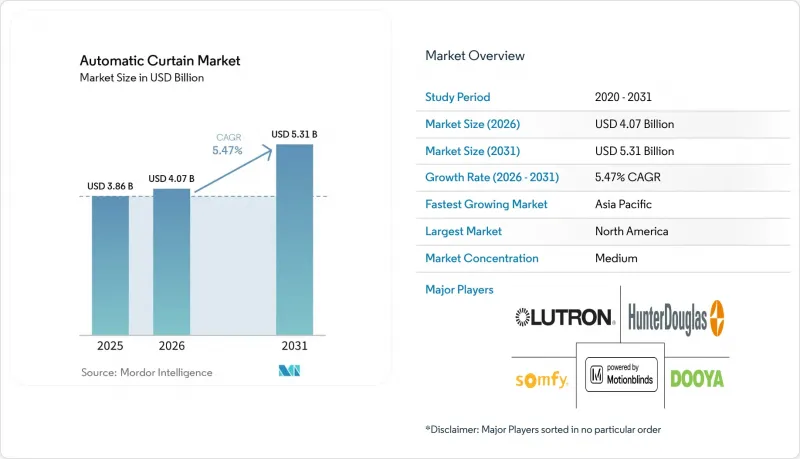
본 보고서는 제품별(리플 폴드, 핀치 플리츠 등), 제어 방식별(전동식, 스마트식), 최종 사용자별(주거용, 상업용), 유통 채널별(B2C/소매 채널, B2B/제조업체 직접 판매), 지역별(북미, 아시아태평양, 유럽, 남미, 중동 및 아프리카)로 분류되어 있습니다. 시장 전망은 금액(달러) 기준으로 제시되어 있습니다.
세계의 자동 커튼 시장 동향 및 분석
스마트 홈 자동화 시스템의 보급 확대
음성 비서와 통합형 모바일 앱은 연결된 생활 공간의 새로운 기준을 확립했습니다. 자동 커튼은 조명 및 공조 제어와 연동되는 사례가 늘어나고 있으며, 이를 통해 주택은 거주자의 재실 여부, 일출 시간, 혹은 기상 데이터에 따라 자동으로 대응할 수 있게 되었습니다. Matter 프로토콜에서는 창문 커버가 주요 기기 범주로 분류되어, 별도의 브리지를 거치지 않고도 Apple, Google, Amazon의 생태계와 연동할 수 있게 되었습니다. 호텔 업계에서는 Lutron사의 ‘"myRoom" 이 플랫폼과 통합된 차광 시스템은 수천 개의 객실에서 에너지 사용량을 줄이면서도 투숙객의 쾌적성을 향상시킨다는 사실을 입증하고 있습니다. 일기예보나 센서 데이터를 분석하는 예측 조정 알고리즘 덕분에 자동 커튼의 가치는 더욱 높아지고 있습니다.
친환경 건축 분야에서 에너지 절약형 창문 커버에 대한 수요 증가
역동적인 차광은 여름에는 태양열의 유입을 막고, 겨울에는 온기를 유지함으로써 공조(HVAC)에 대한 의존도를 낮춥니다. 미국 에너지부는 자동 차양 장치를 냉난방비 절감을 위한 주요 수동형 전략 중 하나로 꼽고 있습니다. ASHRAE 표준 90.1-2022에서는 자동 제어되는 유리 및 차광 시스템이 참조 대상으로 포함됨에 따라, 건축 기준 준수에 있어 해당 시스템의 역할이 공식적으로 규정되었습니다. 각 제조업체는 AERC 에너지 평가 인증을 획득한 높은 R값의 원단이나 셀룰러 구조의 제품으로 이에 대응하고 있으며, 헌터 더글라스(Hunter Douglas)사의 제품은 연방 정부의 세제 혜택 대상에도 포함됩니다. SwitchBot사의 “"Curtain 3 Solar"키트 등의 태양광 패널용 액세서리는 창문 장식을 소형 발전기로 바꿔주어, 실내 온도를 적정 온도로 유지하면서 배터리의 전력을 보존합니다.
초기 설치비와 모터 비용이 비싸다는 점
전동 레일, 전원 배선, 전문 업체의 시공 비용은 수동식 커튼에 비해 프로젝트 예산을 3배에서 4배까지 부풀릴 가능성이 있습니다. 인도에서는 스마트 홈 종합 패키지의 가격이 50만 루피에서 1,000만 루피(6,000-12만 달러)에 달하는 경우가 많으며, 그 보급은 고급 주택 단지에 국한되어 있습니다. 사후 장착이 가능한 배터리 유닛은 배선 비용을 절감해 주지만, 넓은 범위에 걸쳐 무거운 원단을 처리하는 데는 여전히 어려움이 있습니다. 자동 커튼 업계에서는 리스 모델이나 에너지 절약형 기기에 대한 전력회사의 리베이트 제도가 아직 초기 단계에 머물러 있어, 비용 절감 방안이 제한적입니다. 그 결과, 많은 중산층 소비자들은 주요 방이나 특정 커튼 패널만 전동화하는 등 부분적인 자동화를 선택하고 있습니다. 보다 광범위한 보급을 위해서는 조명 및 보안 서비스 제공업체와 같은 생태계 파트너들이 제공하는 표준화된 하드웨어 키트와 설치 서비스가 핵심이 될 가능성이 있습니다.
부문별 분석
2025년, 리플폴드식 시스템은 미니멀한 외관과 긴 전동 레일과의 호환성을 강점으로 삼아 자동 커튼 시장에서 47.62%의 점유율을 유지했습니다. 건축가들은 호텔, 사무실, 고급 주택의 넓은 유리 면에 끊김 없이 이어지는 물결 모양의 디자인을 선호합니다. 웨이브 폴드 및 유로 플리츠를 포함한 “"기타 자동 커튼 스타일"이 시장 규모는 디자이너들이 독특한 미학과 기능성 원단을 추구함에 따라 연평균 성장률(CAGR) 6.94%로 확대될 것으로 전망됩니다.
스타일의 다양화는 방음성, 난연성, 특수 코팅에 대한 수요를 반영하고 있습니다. 에너지 수확 기능을 갖춘 솔라 레일은 우선 틈새 디자인에 적용되어, IoT 무선 기기를 구동하는 소형 배터리에 전력을 공급하고 있습니다. 상업 분야의 구매자들은 내화성 및 항균성을 갖춘 섬유 제품을 찾고 있으며, 이로 인해 리플폴드 이외의 제품들에도 부가가치가 창출되고 있습니다. 예측 기간 동안 리플폴드는 판매량 기준 1위를 유지할 것으로 보이지만, 새로운 특수 형식이 보급됨에 따라 그 점유율은 축소될 전망입니다.
기존의 전동식 유닛은 검증된 구조와 저렴한 가격을 강점으로 삼아 2025년 시장 규모의 71.55%를 차지했습니다. 그러나 앱 기반 제어, 음성 연동, 클라우드 분석을 바탕으로 스마트 IoT 지원 모터가 탑재된 자동 커튼 시장 규모는 연평균 성장률(CAGR) 8.52%로 확대되고 있습니다. 신뢰성, 내구성, 중앙 관리가 스마트 기능보다 더 중요시되는 상업시설이나 공공시설에서는 여전히 기존의 모터 솔루션이 주류를 이루고 있습니다. 한편, 주택 분야, 특히 기술에 정통한 사용자들 사이에서는 자동화 및 원격 접속에 대한 기대감이 높아지면서 구매 기준이 변화하고 있습니다. 건설 회사에서는 대규모 파사드의 동기화된 작동을 위해 유선 모터를 지정하는 사례가 여전히 보이지만, 소비자 수요는 Wi-Fi나 Thread 기반의 키트로 기울고 있습니다.
자동 커튼 업계는 유선 연결의 신뢰성과 업그레이드 가능한 무선 모듈을 결합한 하이브리드 아키텍처로 전환되고 있습니다. “"Matter" 표준을 채택함으로써 앱에 대한 의존으로 인한 부담이 줄어드는 한편, 무선 업데이트를 통해 일조 추적 알고리즘 등의 기능이 추가됩니다. 이러한 하이브리드 모델은 신축·기존 주택을 불문하고 배선을 전면적으로 다시 하지 않고도 사후 설치가 가능하여, 시공업체와 주택 소유자 모두에게 유연성을 제공합니다. Apple HomeKit, Google Home, Alexa와 같은 생태계가 확대됨에 따라 호환성은 중요한 차별화 요소가 되고 있습니다. 비용, 통합 지원, 그리고 보안에 대한 신뢰도가 스마트 기기가 기존 모터의 우위를 얼마나 빠르게 잠식해 나갈지를 좌우할 것입니다.
지역별 분석
2025년, 북미는 전 세계 매출의 35.62%를 차지했습니다. 스마트 홈 허브의 가정 내 보급률이 높고, 손이 닿는 곳에 있는 코드를 사실상 금지하는 엄격한 아동 안전 규정, 그리고 견조한 상업용 건축 수요가 맞물리면서 자동 커튼에 대한 수요는 계속해서 견조한 양상을 보이고 있습니다. 캐나다와 멕시코는 국경을 초월한 제조 활동과 자동화된 사무실 및 호텔 증가를 통해 지역 성장에 기여하고 있습니다. 성숙한 광대역 네트워크와 IoT 기기에 대한 폭넓은 이해를 바탕으로, 설치 업체는 커튼 모터를 일반적인 홈 오토메이션 플랫폼에 손쉽게 통합할 수 있습니다. ASHRAE 90.1-2022의 동적 유리 및 차광에 관한 규정을 포함한 에너지 기준은 창문 커버의 자동화를 건물의 성능 목표와 연계함으로써 그 보급을 더욱 촉진하고 있습니다.
아시아태평양은 가장 빠른 성장세를 보이고 있으며, 2026년부터 2031년까지 연평균 성장률(CAGR) 8.28%로 확대될 것으로 전망됩니다. 도시화, 현지 생산의 심화, 그리고 정책적 인센티브가 중국의 막대한 수요를 견인하고 있으며, 중국에서는 고효율 가전제품에 대한 보조금 대상에 자동 커튼 시스템도 포함되어 있습니다. 인도에서는 고급 주택 구매자들이 전동 커튼과 기본적인 조명 제어 기능을 기본 사양으로 여기게 되었으며, 신규 고급 주택 프로젝트의 80%에서 이러한 요소들이 사양으로 채택되고 있습니다. 2030년까지 3,000억 달러에 달할 것으로 예상되는 전자상거래의 급속한 확대로 인해, 공급업체들은 전문 쇼룸이 없는 중소 도시에도 온라인을 통해 진출할 수 있게 되었습니다. 일본, 한국, 호주에서는 첨단 빌딩 자동화 기능에 대한 프리미엄 수요가 증가하고 있는 반면, 동남아시아 시장에서는 합리적인 가격의 개조용 키트 도입이 시작되고 있습니다.
유럽에서는 규제 당국과 소비자들이 에너지 효율을 우선시하고 있기 때문에 완만하기는 하지만 안정적인 성장을 유지하고 있습니다. 해당 지역의 건축 기준에 따르면, 동적 차광이 냉난방 부하 감소에 기여하는 것으로 인정되고 있으며, 태양광 발전 방식의 트랙 시스템은 각국의 지속가능성 목표와 잘 부합합니다. 남미, 중동 및 아프리카에서는 도입이 아직 초기 단계에 있습니다. 브라질에서는 고급 고층 빌딩 프로젝트가 해당 지역 내 도입을 주도하고 있는 반면, UAE와 남아프리카공화국에서는 스마트 상업 공간에 대한 투자가 진행되고 있습니다. 고비용의 전기 공사가 필요 없는 배터리 구동식 커튼 모터는 숙련된 설치 업체가 부족한 지역에서 새로운 기회를 창출하고 있습니다.
기타 혜택 :
- 엑셀 형식 시장 예측(ME) 시트
- 3개월간의 애널리스트 지원
자주 묻는 질문
목차
제1장 서론
제2장 조사 방법
제3장 주요 요약
제4장 시장 구도
제5장 시장 규모 및 성장 예측
제6장 경쟁 구도
제7장 시장 기회 및 향후 전망
KTH 26.07.03According to Mordor Intelligence, the global automatic curtains market size was valued at USD 3.86 billion in 2025 and estimated to grow from USD 4.07 billion in 2026 to reach USD 5.31 billion by 2031, at a CAGR of 5.47% during the forecast period (2026-2031).
This report is Segmented by Product (Ripple Fold, Pinch Pleat, and More), Control Type (Motorized, Smart), End-User (Residential, Commercial), Distribution Channel (B2C/ Retail Channel, B2B/ Directly From Manufacturers), and by Geography (North America, Asia-Pacific, Europe, South America, Middle East, and Africa). The Market Forecasts are Provided in Terms of Value (USD).
Global Automatic Curtain Market Trends and Insights
Growing Adoption of Smart-Home Automation Systems
Voice assistants and unified mobile apps have set a new baseline for connected living spaces. Automatic curtains are increasingly bundled with lighting and climate controls so homes can react to occupancy, sunrise, or weather data. The Matter protocol now treats window coverings as a core device class, letting products pair with Apple, Google, and Amazon ecosystems without proprietary bridges. In hotels, Lutron's myRoom platform shows how integrated shading boosts guest comfort while trimming energy use across thousands of rooms. Predictive adjustment algorithms that read weather forecasts or sensor inputs further raise the perceived value of automated drapery.
Rising Demand for Energy-Efficient Window Coverings in Green Buildings
Dynamic shading lessens reliance on HVAC by blocking solar heat gain in summer and retaining warmth in winter. The U.S. Department of Energy cites automated shades as a leading passive strategy for cutting heating and cooling bills. ASHRAE Standard 90.1-2022 now references automatically controlled glazing and shading, formalizing their role in code compliance. Manufacturers respond with high-R-value fabrics and cellular designs that earn AERC energy ratings; Hunter Douglas products even qualify for federal tax incentives. Solar-panel accessories, such as SwitchBot's Curtain 3 Solar kit, turn window treatments into micro-generators that sustain battery power while moderating indoor temperatures.
High Upfront Installation and Motor Costs
Motorized tracks, power wiring, and professional labor can triple or quadruple project budgets versus manual drapes. In India, complete smart-home packages often span INR 500,000 to INR 10 million (USD 6,000-120,000), limiting uptake to premium developments. Retrofit-friendly battery units relieve wiring expenses but still struggle with heavy fabrics in large spans. Leasing models and utility rebates for energy-saving equipment remain nascent in the automatic curtains industry, muting cost-mitigation options. As a result, many mid-tier consumers opt for partial automation-motorizing only key rooms or select curtain panels. Broader affordability may hinge on standardized hardware kits and bundled installation services from ecosystem partners like lighting or security providers.
Other drivers and restraints analyzed in the detailed report include:
- Increasing Hospitality & Commercial Construction Projects Incorporating Automated Interiors
- Integration of Matter & Thread Standards Enabling Interoperability
- Cybersecurity & Privacy Concerns with IoT-Enabled Curtain Systems
For complete list of drivers and restraints, kindly check the Table Of Contents.
Segment Analysis
Ripplefold systems retained a 47.62% share of the automatic curtains market in 2025, anchored by their minimalist profile and compatibility with long motorized tracks. Architects prefer the uninterrupted fabric wave for wide glazing in hotels, offices, and luxury homes. The automatic curtains market size for Other Automatic Curtain Styles, including wave fold and Euro pleat, is forecast to climb 6.94% CAGR as designers pursue distinctive aesthetics and functional fabrics.
Style diversification reflects demand for acoustic damping, flame retardancy, and specialty coatings. Energy-harvesting solar rails are appearing first in niche designs, feeding small batteries that support IoT radios. Commercial buyers seek fire-rated or antimicrobial textiles, adding value to non-Ripplefold options. Over the forecast horizon, Ripplefold retains volume leadership, yet its share narrows as new specialty formats proliferate.
Traditional motorized units captured 71.55% of 2025 market size, leveraging proven mechanics and lower price points. However, the automatic curtains market size for smart IoT-enabled motors is expanding at an 8.52% CAGR on the back of app control, voice integration, and cloud analytics. Established motor solutions remain dominant in commercial and institutional settings where reliability, durability, and centralized control outweigh smart features. Yet, in the residential segment, especially among tech-savvy users, expectations for automation and remote access are reshaping purchasing criteria. Construction firms still specify hard-wired motors for synchronized movement on large facades, but consumer appetite tilts toward Wi-Fi or Thread-based kits.
The automatic curtains industry is moving toward hybrid architectures that pair hard-wire reliability with upgradeable wireless modules. Matter endorsement reduces app fatigue, while over-the-air updates add features such as sun-tracking algorithms. These hybrid models allow retrofitting in both new and existing buildings without complete rewiring, offering flexibility to contractors and homeowners alike. As ecosystems like Apple HomeKit, Google Home, and Alexa expand, compatibility becomes a key differentiator. Cost, integration support, and perceived security will dictate how fast smart devices erode legacy motor dominance.
Complete Report Scope:
- By Product
- Ripplefold
- Pinch Pleat
- Other Automatic Curtain Styles
- By Control Type
- Motorized
- Smart (IoT-enabled)
- By End-User
- Residential
- Commercial
- Hospitality
- Offices
- Healthcare
- Other Commercial End-Users
- By Distribution Channel
- B2C / Retail Channels
- Multi-Brand Stores
- Specialty Stores
- Online
- Other Distribution Channels
- B2B / Directly From Manufacturers
- B2C / Retail Channels
- By Geography
- North America
- Canada
- United States
- Mexico
- South America
- Brazil
- Peru
- Chile
- Argentina
- Rest of South America
- Europe
- United Kingdom
- Germany
- France
- Spain
- Italy
- BENELUX (Belgium, Netherlands, Luxembourg)
- NORDICS (Denmark, Finland, Iceland, Norway, Sweden)
- Rest of Europe
- Asia-Pacific
- India
- China
- Japan
- Australia
- South Korea
- South-East Asia (Singapore, Malaysia, Thailand, Indonesia, Vietnam, Philippines)
- Rest of Asia-Pacific
- Middle East And Africa
- United Arab Emirates
- Saudi Arabia
- South Africa
- Nigeria
- Rest of Middle East And Africa
- North America
Geography Analysis
North America held 35.62% of global revenue in 2025. High household adoption of smart-home hubs, strict child-safety rules that effectively ban accessible cords, and steady commercial construction all keep demand for automated curtains strong. Canada and Mexico add to regional growth through cross-border manufacturing and a rising number of automated offices and hotels. A mature broadband network and widespread familiarity with IoT gear make it easy for installers to integrate curtain motors with popular home-automation platforms. Energy codes, including ASHRAE 90.1-2022 provisions on dynamic glazing and shading, further support uptake by tying window-covering automation to building-performance targets.
Asia-Pacific shows the fastest growth and is forecast to expand at 8.28% CAGR between 2026 and 2031. Urbanization, local manufacturing depth, and policy incentives drive large-volume demand in China, where subsidies for high-efficiency appliances include automated curtain systems. In India, luxury buyers now treat motorised drapes and basic lighting control as standard features, with 80% of new high-end projects specifying these elements. Rapid e-commerce expansion, expected to reach USD 300 billion by 2030, gives suppliers an online route into smaller cities that lack specialist showrooms. Japan, South Korea, and Australia add premium demand for advanced building-automation features, while Southeast Asian markets are starting to adopt affordable retrofit kits.
Europe maintains moderate but stable growth as regulators and consumers prioritise energy efficiency. Building codes across the region credit dynamic shading for lowering heating and cooling loads, and solar-powered track systems align well with national sustainability goals. South America, the Middle East, and Africa remain earlier in the adoption curve. Brazil leads regional uptake thanks to luxury high-rise projects, while the UAE and South Africa invest in smart commercial spaces. Battery-powered curtain motors, which avoid costly electrical work, are opening new opportunities where skilled installers are scarce.
- Dooya
- Hunter Douglas
- Lutron Electronics
- Coulisse
- Silent Gliss
- QMotion
- SwitchBot
- Hogar Controls
- Forest Group
- Bandalux
- Budget Blinds
- AutomaticCurtain.com
- Nice Group
- Aqara
- Dooya Tubular Motor
- TOSO Company
- Somfy
- Yoolax
- SmartWings
- Quoya
- Graywind
Additional Benefits:
- The market estimate (ME) sheet in Excel format
- 3 months of analyst support
TABLE OF CONTENTS
1 Introduction
- 1.1 Study Assumptions & Market Definition
- 1.2 Scope of the Study
2 Research Methodology
3 Executive Summary
4 Market Landscape
- 4.1 Market Overview
- 4.2 Market Drivers
- 4.2.1 Growing Adoption Of Smart Home Automation Systems
- 4.2.2 Rising Demand For Energy-Efficient Window Coverings In Green Buildings
- 4.2.3 Increasing Hospitality & Commercial Construction Projects Incorporating Automated Interiors
- 4.2.4 Integration Of Matter & Thread Standards Enabling Interoperability
- 4.2.5 Regulatory Moves Phasing Out Manual Cords For Child Safety
- 4.2.6 Emergence Of Retrofittable Battery-Powered Curtain Robots
- 4.3 Market Restraints
- 4.3.1 High Upfront Installation And Motor Costs
- 4.3.2 Lack Of Standardization & Interoperability Among Smart-Home Platforms
- 4.3.3 Cybersecurity & Privacy Concerns With IoT-Enabled Curtain Systems
- 4.3.4 Limited Awareness In Price-Sensitive Emerging Markets
- 4.4 Industry Value Chain Analysis
- 4.5 Porter's Five Forces Analysis
- 4.5.1 Threat of New Entrants
- 4.5.2 Bargaining Power Of Suppliers
- 4.5.3 Bargaining Power Of Buyers
- 4.5.4 Threat of Substitutes
- 4.5.5 Competitive Rivalry
- 4.6 Insights Into The Latest Trends And Innovations In The Market
- 4.7 Insights On Recent Developments (New Product Launches, Strategic Initiatives, Investments, Partnerships, JVs, Expansion, M&As, Etc.)
5 Market Size & Growth Forecasts
- 5.1 By Product
- 5.1.1 Ripplefold
- 5.1.2 Pinch Pleat
- 5.1.3 Other Automatic Curtain Styles
- 5.2 By Control Type
- 5.2.1 Motorized
- 5.2.2 Smart (IoT-enabled)
- 5.3 By End-User
- 5.3.1 Residential
- 5.3.2 Commercial
- 5.3.2.1 Hospitality
- 5.3.2.2 Offices
- 5.3.2.3 Healthcare
- 5.3.2.4 Other Commercial End-Users
- 5.4 By Distribution Channel
- 5.4.1 B2C / Retail Channels
- 5.4.1.1 Multi-Brand Stores
- 5.4.1.2 Specialty Stores
- 5.4.1.3 Online
- 5.4.1.4 Other Distribution Channels
- 5.4.2 B2B / Directly From Manufacturers
- 5.4.1 B2C / Retail Channels
- 5.5 By Geography
- 5.5.1 North America
- 5.5.1.1 Canada
- 5.5.1.2 United States
- 5.5.1.3 Mexico
- 5.5.2 South America
- 5.5.2.1 Brazil
- 5.5.2.2 Peru
- 5.5.2.3 Chile
- 5.5.2.4 Argentina
- 5.5.2.5 Rest of South America
- 5.5.3 Europe
- 5.5.3.1 United Kingdom
- 5.5.3.2 Germany
- 5.5.3.3 France
- 5.5.3.4 Spain
- 5.5.3.5 Italy
- 5.5.3.6 BENELUX (Belgium, Netherlands, Luxembourg)
- 5.5.3.7 NORDICS (Denmark, Finland, Iceland, Norway, Sweden)
- 5.5.3.8 Rest of Europe
- 5.5.4 Asia-Pacific
- 5.5.4.1 India
- 5.5.4.2 China
- 5.5.4.3 Japan
- 5.5.4.4 Australia
- 5.5.4.5 South Korea
- 5.5.4.6 South-East Asia (Singapore, Malaysia, Thailand, Indonesia, Vietnam, Philippines)
- 5.5.4.7 Rest of Asia-Pacific
- 5.5.5 Middle East And Africa
- 5.5.5.1 United Arab Emirates
- 5.5.5.2 Saudi Arabia
- 5.5.5.3 South Africa
- 5.5.5.4 Nigeria
- 5.5.5.5 Rest of Middle East And Africa
- 5.5.1 North America
6 Competitive Landscape
- 6.1 Market Concentration
- 6.2 Strategic Moves
- 6.3 Market Share Analysis
- 6.4 Company Profiles (includes Global Level Overview, Market Level Overview, Core Segments, Financials as available, Strategic Information, Market Rank/Share, Products & Services, Recent Developments)
- 6.4.1 Dooya
- 6.4.2 Hunter Douglas
- 6.4.3 Lutron Electronics
- 6.4.4 Coulisse
- 6.4.5 Silent Gliss
- 6.4.6 QMotion
- 6.4.7 SwitchBot
- 6.4.8 Hogar Controls
- 6.4.9 Forest Group
- 6.4.10 Bandalux
- 6.4.11 Budget Blinds
- 6.4.12 AutomaticCurtain.com
- 6.4.13 Nice Group
- 6.4.14 Aqara
- 6.4.15 Dooya Tubular Motor
- 6.4.16 TOSO Company
- 6.4.17 Somfy
- 6.4.18 Yoolax
- 6.4.19 SmartWings
- 6.4.20 Quoya
- 6.4.21 Graywind
7 Market Opportunities & Future Outlook
- 7.1 Integration with Smart Home Ecosystems