|
시장보고서
상품코드
2072551
아시아태평양의 IT 서비스 : 시장 점유율 분석, 업계 동향 및 통계, 성장 예측(2026-2031년)Asia Pacific IT Services - Market Share Analysis, Industry Trends & Statistics, Growth Forecasts (2026 - 2031) |
||||||
 Mordor Intelligence
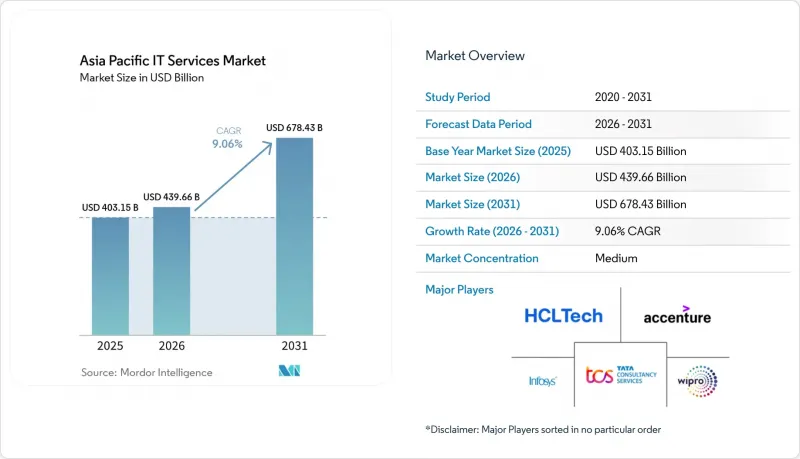
Mordor Intelligence에 의하면, 아시아태평양의 IT 서비스 시장 규모는 2025년 4,031억 5,000만 달러로 평가되었습니다. 2026년 4,396억 6,000만 달러에서 2031년까지 6,784억 3,000만 달러로 확대되어 2026년부터 2031년까지 연평균 복합 성장률(CAGR)은 9.06%를 나타낼 것으로 예측됩니다.
본 보고서는 서비스 유형(IT 컨설팅 및 도입, IT 아웃소싱 등), 도입 모델(On-Premise, 퍼블릭 클라우드, 프라이빗 클라우드 등), 기업 규모(대기업, 중견기업, 중소기업 및 영세기업), 최종 사용자 산업 분야(은행, 금융서비스 및 보험(BFSI), 제조업 등) 및 국가별로 분류되어 있습니다. 시장 전망은 금액(달러) 기준으로 제시되어 있습니다.
아시아태평양의 IT 서비스 시장 동향 및 인사이트
업계를 아우르는 급속한 디지털 전환
금융기관, 제조업, 소매업은 실시간 분석 및 옴니채널 대응을 지원하기 위해 API 기반 마이크로서비스를 중심으로 핵심 시스템을 재구축하고 있으며, 클라우드 전환 및 통합 컨설팅에 막대한 자금을 투입하고 있습니다. 지역 조사에 따르면, 73%의 조직이 변혁 예산을 증액할 계획이지만, 역량 격차는 여전히 존재하며, 상세한 로드맵을 유지하고 있는 태국의 경영진은 42%에 불과한 것으로 나타났습니다. 이러한 불일치로 인해, 레거시 메인프레임과 클라우드 플랫폼을 연결해 줄 수 있는 자문 파트너에 대한 수요가 꾸준히 증가하고 있습니다. 싱가포르와 일본의 은행들은 실시간 결제 및 AI를 활용한 신용 평가 시스템을 도입하고 있는 반면, 소매업체들은 전자상거래 경쟁사들에 대항하기 위해 동적 가격 책정을 위한 엣지 분석에 투자하고 있습니다. 그 결과, 클라우드 전환, 데이터 플랫폼 통합, 옴니채널 고객 경험 설계와 같은 프로젝트가 잇달아 진행되고 있으며, 각각은 최적화와 지원에 중점을 둔 수년에 걸친 매니지드 서비스 계약으로 이어지고 있습니다.
AI 및 생성형 AI 관리형 서비스 붐
기업들이 개발자의 생산성 향상과 콜센터 업무 흐름의 자동화를 도모함에 따라, 생성형 AI 도입이 가속화되고 있습니다. 2024년에는 지식 근로자의 주간 이용률이 78%에 달하고, 세계 최고 수준을 기록했으나, 공식적인 거버넌스 체계를 갖춘 기업은 고작 3분의 1에 불과하여, 모델 선정, 미세 조정, 책임 있는 AI 제어를 한데 묶은 매니지드 서비스 제공업체에게는 좋은 기회가 되었습니다. 인도에서 진행된 시범 프로그램에서는 생산성이 43-45% 향상된 것이 입증되었으며, 소프트웨어, 보험, 통신 업계에서 이 프로그램의 도입이 급속히 확대되고 있습니다. 사전 학습이 완료된 업계 특화형 모델, 지속적인 모니터링, 비용 최적화된 추론 인프라를 제공하는 업체는 높은 이익률을 확보하고 있습니다. 싱가포르나 한국 등 조기 도입 시장에서는 현재 개념 검증(PoC) 단계에서 전사적 도입 단계로 전환되고 있으며, 이는 AI 운영 아웃소싱의 두 자릿수 성장을 견인하고 있습니다.
주요 거점에서의 심각한 인력 부족과 임금 인플레이션
클라우드 아키텍트, 사이버 보안 분석가, AI 엔지니어의 인력 부족 현상이 지속되면서, 벵갈루루, 선전, 싱가포르에서는 임금이 두 자릿수 증가세를 보이고 있습니다. 콘 페리(Corn Ferry)사의 예측에 따르면, 2030년까지 이 지역 전체에서 470만 명의 숙련된 전문가가 부족할 것이며, 인도에서만 최대 150만 명의 전문가가 부족할 것으로 전망됩니다. 인건비가 연간 10-15% 상승하는 반면, 고객들은 청구 단가 인상에 저항하고 있어 서비스 제공업체들은 이익률 압박에 직면해 있습니다. 이러한 상황을 완화하기 위해 각 벤더사는 서비스 데스크의 정형화된 업무를 자동화하거나, 중견 엔지니어들에게 클라우드 보안 기술을 습득하게 하거나, 베트남이나 필리핀의 지방 도시로 업무를 이관하는 등의 조치를 취하고 있습니다. 이러한 조치로 인해 압박은 완화되겠지만, 수급 불균형은 2027년까지 지속될 것으로 예상되며, 이는 고도로 복잡한 서비스의 성장을 제약할 것으로 전망됩니다.
부문별 분석
기업들이 고정 용량 계약보다 유연한 이용 형태를 선택하는 경향이 있기 때문에 매니지드 클라우드 및 XaaS 서비스는 연평균 성장률(CAGR) 10.11%로 성장할 것으로 전망됩니다. 2025년에도 아시아태평양의 IT 아웃소싱 시장 규모는 여전히 지배적인 위치를 유지하며 32.74%의 점유율을 차지하고, 인프라 관리 및 용도 지원 수요를 뒷받침했습니다. 그러나 수요는 인프라, 플랫폼, 소프트웨어의 각 계층을 통일된 SLA 하에 통합한 성과 기반의 번들 서비스로 점차 전환되고 있습니다. 각 벤더사는 산업별 청사진, 쿠버네티스 오케스트레이션, 클라우드 비용 최적화를 통해 차별화를 꾀하고 있습니다. 한편, IT 컨설팅은 대규모 현대화 프로젝트, 특히 은행의 핵심 시스템 갱신이나 자동차 제조 분야의 공장 현장 디지털화에서 전략적 중요성을 유지하고 있습니다. 비즈니스 프로세스 아웃소싱은 재무 및 인사 업무 흐름에서 비용 효율성을 추구하는 소매업체와 통신 사업자들로부터 계속해서 주목을 받고 있습니다. 셀프 서비스 포털과 AIOps 덕분에 티켓 건수가 감소함에 따라 지원 및 유지보수 서비스는 가격 하락 압력에 직면해 있지만, 그럼에도 불구하고 지속적인 수익과 고객 유지율을 유지하고 있습니다. 이러한 동향들이 맞물리면서, 아시아태평양의 IT 서비스 시장은 ‘as-a-service’ 방식의 제공으로 전환되고 있으며, 클라우드 중심의 레퍼런스 아키텍처를 축으로 파트너 생태계가 재구축되고 있습니다.
이와 동시에, 각 하이퍼스케일러 기업들은 관리형 서비스 툴킷을 자사의 마켓플레이스에 통합하고 있으며, 이를 통해 소규모 제공업체들은 독자적인 플랫폼에 투자하지 않고도 모니터링, 백업, 보안 기능을 화이트 라벨 방식으로 제공할 수 있게 되었습니다. Flexera의 조사에 따르면, 전 세계 기업의 89%가 멀티클라우드 전략을 추진하고 있으며, 이러한 추세는 아시아태평양에서도 마찬가지로 나타나고 있습니다. 해당 지역에서는 고객들이 Amazon Web Services, Microsoft Azure, Google Cloud 간의 상호 운용성을 확보하기 위해 관리형 서비스 제공업체를 활용하고 있습니다. 이러한 멀티 클라우드의 복잡성으로 인해, 기존 인프라 아웃소싱 분야에서 상품화 압력이 거세지는 상황 속에서도 통합 전문 기업들은 평균 이상의 수익 성장을 유지하고 있습니다.
하이브리드 및 멀티 클라우드 환경은 규제, 지연, 비용 측면에서 연평균 성장률(CAGR) 10.46%로 확대되고 있습니다. 2025년에는 퍼블릭 클라우드가 지출의 49.73%를 차지했으나, 많은 금융 기관과 정부 기관은 데이터 상주 요건을 준수하기 위해 기밀성이 높은 워크로드를 프라이빗 인프라에서 운영하고 있습니다. 아시아태평양의 IT 서비스 시장에서 On-Premise 시스템이 차지하는 점유율은 꾸준히 감소하고 있지만, 제조업이나 에너지 기업에서는 머신 비전을 활용한 검사나 SCADA 제어 등 지연 시간이 중요한 용도의 경우 여전히 로컬 처리를 우선시하고 있습니다. 하이브리드 아키텍처는 기존 투자를 유지하면서 단계적인 전환을 가능하게 하는 실용적인 가교 역할을 합니다. HashiCorp의 보고서에 따르면, 2024년까지 아시아태평양 기업의 72%가 최소 2개의 클라우드 공급업체를 통합했으며, 상호 운용성 도구의 중요성이 부각되었습니다. 서비스 파트너는 현재 ‘정책으로서의 코드(Policy-as-Code)’ 기반의 거버넌스, FinOps 및 워크로드 배치 분석을 통합하고 있으며, 이를 통해 고객은 규정 준수 감사 요건을 충족하면서 지출을 최적화할 수 있게 되었습니다.
엣지 컴퓨팅은 하이브리드에 대한 수요를 더욱 확대시키고 있습니다. 특히 물류 및 소매 업계에서는 거의 실시간으로 이루어지는 분석을 통해 경로 최적화와 매장 내 맞춤형 서비스가 강화되고 있습니다. 엣지, 프라이빗 클라우드, 하이퍼스케일 지역에 걸쳐 단일 화면에서 가시성을 확장할 수 있는 벤더는 더 높은 이익률을 확보하고 있습니다. AI 추론이 데이터 소스에 점점 더 가까워짐에 따라 하이브리드 모델은 필수적인 요소가 되었으며, 아시아태평양의 IT 서비스 시장 동향에서 그 중심적인 역할을 더욱 공고히 하고 있습니다.
기타 혜택 :
- 엑셀 형식 시장 예측(ME) 시트
- 3개월간의 애널리스트 지원
자주 묻는 질문
목차
제1장 서론
제2장 조사 방법
제3장 주요 요약
제4장 시장 구도
제5장 시장 규모 및 성장 예측
제6장 경쟁 구도
제7장 시장 기회 및 향후 전망
KTH 26.07.03According to Mordor Intelligence, the asia pacific IT services market size is projected to expand from USD 403.15 billion in 2025 and USD 439.66 billion in 2026 to USD 678.43 billion by 2031, registering a CAGR of 9.06% between 2026 to 2031.
This report is Segmented by Service Type (IT Consulting and Implementation, IT Outsourcing, and More), Deployment Model (On-Premises, Public Cloud, Private Cloud, and More), Enterprise Size (Large, Medium-Sized, and Small and Micro), End-User Industry (BFSI, Manufacturing, and More), and Country. The Market Forecasts are Provided in Terms of Value (USD).
Asia Pacific IT Services Market Trends and Insights
Rapid Digital Transformation Across Industries
Financial institutions, manufacturers, and retailers are rebuilding core systems around API-driven microservices to support real-time analytics and omnichannel engagement, redirecting substantial capital toward cloud migration and integration consulting. A regional survey found that 73% of organizations plan to raise transformation budgets, yet capability gaps persist, with only 42% of Thai executives maintaining detailed roadmaps. This mismatch fuels steady demand for advisory partners that can bridge legacy mainframes and cloud platforms. Banks in Singapore and Japan are rolling out real-time payments and AI-based credit scoring, while retailers invest in edge analytics for dynamic pricing to counter e-commerce rivals. The resulting project pipeline spans cloud migration, data-platform unification, and omnichannel customer-experience design, each feeding multi-year managed-service contracts focused on optimization and support.
AI and Generative-AI Managed-Services Boom
Generative AI adoption is accelerating as firms seek to boost developer productivity and automate call-center workflows. Weekly usage among knowledge workers reached 78% in 2024, the highest global rate, yet just one-third of companies have formal governance, opening the door for managed service providers that bundle model selection, fine-tuning, and responsible-AI controls. Pilot programs in India demonstrated 43-45% productivity gains, prompting rapid scaling across software, insurance, and telecom firms. Providers that deliver pre-trained vertical models, continuous monitoring, and cost-optimized inference infrastructure are capturing premium margins. Early adopter markets such as Singapore and South Korea are now moving from proofs of concept to enterprise-wide rollouts, driving double-digit growth in AI-operations outsourcing.
Severe Talent Shortages and Wage Inflation in Tier-1 Hubs
Cloud architects, cybersecurity analysts, and AI engineers remain in short supply, driving double-digit wage jumps in Bengaluru, Shenzhen, and Singapore. Korn Ferry forecasts a regional deficit of 4.7 million skilled professionals by 2030, with India alone lacking up to 1.5 million experts. Providers face margin compression as labor costs rise 10-15% annually and clients resist billing-rate hikes. To mitigate, vendors are automating routine service-desk tasks, reskilling mid-level engineers in cloud security, and shifting delivery to secondary cities in Vietnam and the Philippines. While these measures relieve pressure, the supply-demand imbalance is projected to persist through 2027, constraining growth in high-complexity services.
Other drivers and restraints analyzed in the detailed report include:
- Sovereign-Cloud Mandates Reshaping In-Region Delivery
- Cost-Efficiency Push Driving ITO and BPO Adoption
- Escalating Cybersecurity and Data-Sovereignty Compliance Costs
For complete list of drivers and restraints, kindly check the Table Of Contents.
Segment Analysis
Managed cloud and XaaS services are forecast to grow at a 10.11% CAGR as enterprises opt for elastic consumption over fixed-capacity contracts. The Asia-Pacific IT Services market size for IT outsourcing remained dominant in 2025, holding a 32.74% share and underpinning infrastructure management and application support requirements. However, demand is tilting toward outcome-based bundles that integrate infrastructure, platform, and software layers under unified SLAs. Vendors differentiate through industry blueprints, Kubernetes orchestration, and cloud-cost optimization. Meanwhile, IT consulting retains strategic relevance for large-scale modernization projects, particularly in banking core-system replacement and plant-floor digitization within automotive manufacturing. Business-process outsourcing continues to attract retailers and telecom operators seeking cost efficiency in finance and human resources workflows. Support and maintenance services face price erosion as self-service portals and AIOps reduce ticket volumes, yet they sustain recurring revenue and client stickiness. Collectively, these dynamics pivot the Asia-Pacific IT Services market toward as-a-service delivery, reshaping partner ecosystems around cloud-centric reference architectures.
In parallel, hyperscalers are embedding managed-service toolkits into their marketplaces, enabling smaller providers to white-label monitoring, backup, and security features without investing in proprietary platforms. Flexera recorded that 89% of global enterprises pursue multi-cloud strategies, a pattern mirrored in Asia-Pacific where clients engage managed providers to navigate interoperability across Amazon Web Services, Microsoft Azure, and Google Cloud. This multi-cloud complexity sustains above-average revenue growth for integration specialists even as commoditization pressures intensify in traditional infrastructure outsourcing.
Hybrid and multi-cloud environments are expanding at a 10.46% CAGR, reflecting regulatory, latency, and cost considerations. Public cloud accounted for 49.73% of spending in 2025, but many financial institutions and governments maintain sensitive workloads on private infrastructure to comply with residency mandates. The Asia-Pacific IT Services market share attached to on-premises systems is steadily declining, yet manufacturing and energy companies still prioritize local processing for latency-critical applications such as machine-vision inspection and SCADA control. Hybrid architectures provide a pragmatic bridge, allowing gradual migration while preserving existing investments. HashiCorp reported that 72% of Asia-Pacific enterprises had integrated at least two cloud providers by 2024, underscoring the premium placed on interoperability tooling. Service partners now bundle policy-as-code governance, FinOps, and workload-placement analytics, enabling clients to optimize spend while satisfying compliance auditors.
Edge computing is further amplifying hybrid demand, particularly in logistics and retail where near-real-time analytics enhance route optimization and in-store personalization. Vendors that can extend single-pane observability across edge, private-cloud, and hyperscale regions are commanding higher margins. As AI inference moves closer to data sources, hybrid models become indispensable, reinforcing their centrality to the Asia-Pacific IT Services market trajectory.
Complete Report Scope:
- By Service Type
- IT Consulting and Implementation
- IT Outsourcing (ITO)
- Business-Process Outsourcing (BPO)
- Managed Cloud and XaaS
- Support, Maintenance and Other Services
- By Deployment Model
- On-premises / Captive
- Public Cloud
- Private Cloud
- Hybrid / Multi-cloud
- By Enterprise Size
- Large Enterprises
- Medium-sized Businesses
- Small and Micro Businesses
- By End-user Industry
- Banking, Financial Services and Insurance (BFSI)
- Manufacturing and Industrial
- Government and Public Sector
- Healthcare and Life Sciences
- Retail, E-Commerce and Consumer Goods
- Telecom and Media
- Transportation and Logistics
- Energy and Utilities
- Other End-user Industries
- By Country
- China
- India
- Japan
- South Korea
- Indonesia
- Malaysia
- Singapore
- Taiwan
- Thailand
- Australia
- Rest of Asia-Pacific
List of Companies Covered in this Report:
- Accenture plc
- Tata Consultancy Services Ltd.
- Infosys Ltd.
- Wipro Ltd.
- HCL Technologies Ltd.
- Tech Mahindra Ltd.
- Cognizant Technology Solutions Corp.
- Capgemini SE
- Fujitsu Ltd.
- NTT DATA Corp.
- NEC Corp.
- Samsung SDS Co., Ltd.
- LG CNS Co., Ltd.
- Alibaba Cloud Computing Co., Ltd.
- Tencent Cloud Computing (Beijing) Ltd.
- IBM Corp.
- DXC Technology Co.
- Deloitte Touche Tohmatsu Ltd.
- Ernst and Young Global Ltd.
- PricewaterhouseCoopers International Ltd.
- KPMG International Ltd.
- Singtel NCS Pte. Ltd.
- PCCW Solutions Ltd.
- Datacom Group Ltd.
- UST Global (Singapore) Pte. Ltd.
- Nihon Unisys, Ltd.
- Hitachi Vantara LLC
- Amazon Web Services Singapore Pte. Ltd.
- Google Cloud Asia Pacific Pte. Ltd.
- Huawei Cloud Computing Technologies Co., Ltd.
Additional Benefits:
- The market estimate (ME) sheet in Excel format
- 3 months of analyst support
TABLE OF CONTENTS
1 INTRODUCTION
- 1.1 Study Assumptions and Market Definition
- 1.2 Scope of the Study
2 RESEARCH METHODOLOGY
3 EXECUTIVE SUMMARY
4 MARKET LANDSCAPE
- 4.1 Market Overview
- 4.2 Market Drivers
- 4.2.1 Rapid Digital Transformation Across Industries
- 4.2.2 Sovereign-Cloud Mandates Reshaping In-Region Delivery
- 4.2.3 Cost-Efficiency Push Driving Ito And Bpo Adoption
- 4.2.4 Ai / Gen-Ai Managed-Services Boom
- 4.2.5 Smart-City Mega-Projects In Asean And India
- 4.2.6 Climate-Tech And Green-It Compliance Outsourcing
- 4.3 Market Restraints
- 4.3.1 Severe Talent Shortages And Wage Inflation In Tier-1 Hubs
- 4.3.2 Escalating Cybersecurity / Data-Sovereignty Compliance Costs
- 4.3.3 Legacy Tech-Debt In State-Owned Enterprises
- 4.3.4 Geopolitical Digital Blocs Fragmenting Supply Chains
- 4.4 Industry Value Chain Analysis
- 4.5 Regulatory Landscape
- 4.6 Technological Outlook
- 4.7 Porter's Five Forces Analysis
- 4.7.1 Bargaining Power of Suppliers
- 4.7.2 Bargaining Power of Consumers
- 4.7.3 Threat of New Entrants
- 4.7.4 Threat of Substitutes
- 4.7.5 Intensity of Competitive Rivalry
- 4.8 Pricing Analysis
- 4.9 Impact of Macroeconomic Factors
5 MARKET SIZE AND GROWTH FORECASTS (VALUE)
- 5.1 By Service Type
- 5.1.1 IT Consulting and Implementation
- 5.1.2 IT Outsourcing (ITO)
- 5.1.3 Business-Process Outsourcing (BPO)
- 5.1.4 Managed Cloud and XaaS
- 5.1.5 Support, Maintenance and Other Services
- 5.2 By Deployment Model
- 5.2.1 On-premises / Captive
- 5.2.2 Public Cloud
- 5.2.3 Private Cloud
- 5.2.4 Hybrid / Multi-cloud
- 5.3 By Enterprise Size
- 5.3.1 Large Enterprises
- 5.3.2 Medium-sized Businesses
- 5.3.3 Small and Micro Businesses
- 5.4 By End-user Industry
- 5.4.1 Banking, Financial Services and Insurance (BFSI)
- 5.4.2 Manufacturing and Industrial
- 5.4.3 Government and Public Sector
- 5.4.4 Healthcare and Life Sciences
- 5.4.5 Retail, E-Commerce and Consumer Goods
- 5.4.6 Telecom and Media
- 5.4.7 Transportation and Logistics
- 5.4.8 Energy and Utilities
- 5.4.9 Other End-user Industries
- 5.5 By Country
- 5.5.1 China
- 5.5.2 India
- 5.5.3 Japan
- 5.5.4 South Korea
- 5.5.5 Indonesia
- 5.5.6 Malaysia
- 5.5.7 Singapore
- 5.5.8 Taiwan
- 5.5.9 Thailand
- 5.5.10 Australia
- 5.5.11 Rest of Asia-Pacific
6 COMPETITIVE LANDSCAPE
- 6.1 Market Concentration
- 6.2 Strategic Moves
- 6.3 Market Share Analysis
- 6.4 Company Profiles (includes Global level Overview, Market level overview, Core Segments, Financials as available, Strategic Information, Market Rank/Share for key companies, Products and Services, and Recent Developments)
- 6.4.1 Accenture plc
- 6.4.2 Tata Consultancy Services Ltd.
- 6.4.3 Infosys Ltd.
- 6.4.4 Wipro Ltd.
- 6.4.5 HCL Technologies Ltd.
- 6.4.6 Tech Mahindra Ltd.
- 6.4.7 Cognizant Technology Solutions Corp.
- 6.4.8 Capgemini SE
- 6.4.9 Fujitsu Ltd.
- 6.4.10 NTT DATA Corp.
- 6.4.11 NEC Corp.
- 6.4.12 Samsung SDS Co., Ltd.
- 6.4.13 LG CNS Co., Ltd.
- 6.4.14 Alibaba Cloud Computing Co., Ltd.
- 6.4.15 Tencent Cloud Computing (Beijing) Ltd.
- 6.4.16 IBM Corp.
- 6.4.17 DXC Technology Co.
- 6.4.18 Deloitte Touche Tohmatsu Ltd.
- 6.4.19 Ernst and Young Global Ltd.
- 6.4.20 PricewaterhouseCoopers International Ltd.
- 6.4.21 KPMG International Ltd.
- 6.4.22 Singtel NCS Pte. Ltd.
- 6.4.23 PCCW Solutions Ltd.
- 6.4.24 Datacom Group Ltd.
- 6.4.25 UST Global (Singapore) Pte. Ltd.
- 6.4.26 Nihon Unisys, Ltd.
- 6.4.27 Hitachi Vantara LLC
- 6.4.28 Amazon Web Services Singapore Pte. Ltd.
- 6.4.29 Google Cloud Asia Pacific Pte. Ltd.
- 6.4.30 Huawei Cloud Computing Technologies Co., Ltd.
7 MARKET OPPORTUNITIES AND FUTURE OUTLOOK
- 7.1 White-space and Unmet-Need Assessment