

|
시장보고서
상품코드
2072587
데이터 레지던시 및 주권 규정 준수 도구 : 시장 점유율 분석, 업계 동향 및 통계, 성장 예측(2025-2030년)Data Residency and Sovereignty Compliance Tools - Market Share Analysis, Industry Trends & Statistics, Growth Forecasts (2025 - 2030) |
||||||
 Mordor Intelligence
Mordor Intelligence에 의하면, 데이터 레지던시 및 주권 규정 준수 도구 시장 규모는 2025년에 723억 7,000만 달러에 달했고, 2030년까지 2,283억 7,000만 달러로 확대되며 CAGR은 25.84%를 나타낼 전망입니다.
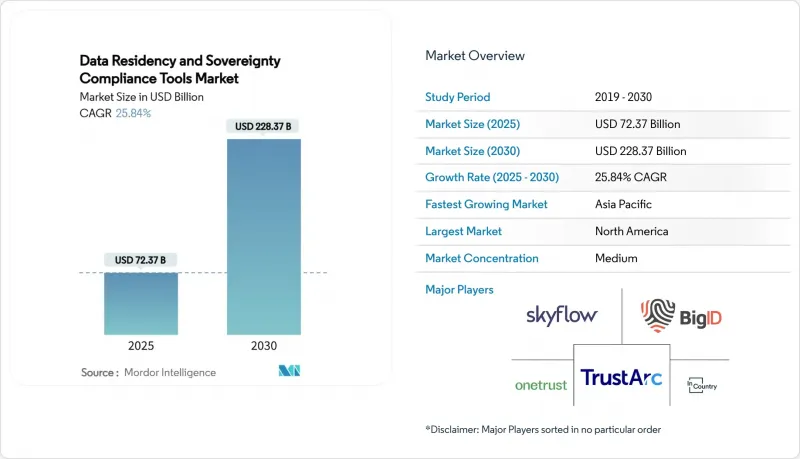
본 보고서는 배포 모델(On-Premise, 퍼블릭 클라우드, 하이브리드), 도구 유형(DRaaS(Data Residency-as-a-Service) 플랫폼, 기타), 조직 규모(대기업, 중소기업), 최종 이용 산업(은행, 금융서비스 및 보험(BFSI), 헬스케어 및 생명과학, 기타), 지역(북미, 남미, 유럽, 아시아태평양, 중동 및 아프리카)별로 분류되어 있습니다.
세계의 데이터 레지던시 및 주권 규정 준수 도구 시장 동향 및 인사이트
엄격한 데이터 현지화 법안과 처벌 강화
GDPR(EU 개인정보보호규정) 집행은 2024년에 정점을 찍었으며, 총 과징금은 12억 유로에 달했고, 하루 평균 데이터 유출 신고 건수는 363건이었습니다. 2025년 1월에 시행된 중국의 “네트워크 데이터 보안 관리 규정”는 대량의 개인 데이터를 처리하는 기업에 대해 단계적인 의무를 부과하고 있습니다. 인도의 “디지털 개인 데이터 보호법”는 역외 적용과 최대 25억 루피(3,000만 달러)의 벌칙을 도입하고 있습니다. 인도네시아와 말레이시아에서 나타나는 이와 유사한 움직임은 아시아태평양의 규제 조화를 시사하고 있습니다. 이러한 법규들은 종합적으로 규정 준수 비용을 증가시키며, 데이터 레지던시 솔루션 시장을 국경을 넘는 사업 운영의 기반이 되는 요건으로 자리매김하고 있습니다.
하이퍼스케일러에 의한 소버린 클라우드 구축
AWS는 2025년 말까지 완전 가동을 목표로 하는 유럽의 주권 클라우드 인프라에 78억 유로(88억 달러)를 배정했으며, 여기에는 EU 역내에 거주하는 인력도 포함됩니다. 마이크로소프트의 “Cloud for Sovereignty”는 암호화되고 정책에 따라 제어되는 워크로드를 구현하며, 지역별 키 관리 옵션을 지속적으로 추가하고 있습니다. Oracle을 비롯한 각 하이퍼스케일러 기업들도 아시아태평양에서 유사한 청사진을 전개하고 있으며, 기업들에게 클라우드 서비스와 관할 구역별 규제 관리를 결합할 것을 권장하고 있습니다. 이러한 투자는 독립성 인증을 받은 도구와 자문 오버레이용 연결 지점을 창출함으로써 데이터 상주 솔루션 시장을 확대되고 있습니다.
높은 도입 및 오케스트레이션 비용
도입 과정에는 인프라 변경, 법무 컨설팅, 지속적인 감사 관리가 결합되는 경우가 많으며, 그 결과 총 소유 비용이 당초 예산을 초과하게 됩니다. 클라우드 네이티브인 “RaaS(Residency-as-a-Service)”모델이 자본 지출의 평준화에 기여하고 있음에도 불구하고, 중소기업은 그 부담을 가장 크게 느끼고 있습니다. 자문 지원과 자동 모니터링을 결합한 벤더들이 지지를 얻고 있지만, 거시경제적 신중함으로 인해 일부 조직은 본격적인 도입 단계에 이르지 못하고 시범 운영 단계에 머물러 있습니다.
부문별 분석
하이브리드 환경은 기밀성이 높은 데이터를 주권 영역 내에 보관하면서, 기밀성이 낮은 워크로드에 대해서는 퍼블릭 클라우드의 비용 이점을 활용할 수 있는 유연성을 갖추고 있습니다. 이 부문의 연평균 성장률(CAGR) 30.2%는 다국적 기업의 민첩성을 이끌어내는 원동력으로서의 역할을 입증하고 있습니다. 퍼블릭 클라우드는 하이퍼스케일러들의 주권 영역에 대한 투자 덕분에 압도적인 시장 점유율을 유지하고 있지만, 국방 분야 등 규제가 극히 엄격한 워크로드의 경우 On-Premise 시스템이 여전히 필수적입니다. CIO는 특정 워크로드를 국내로 되돌릴 계획을 세우고 있으며, 이에 따라 구성 가능한 배치 엔진에 대한 수요가 더욱 증가할 것으로 예측됩니다. 오브젝트 스토어, 프라이빗 클라우드, 코로케이션 시설에 걸쳐 데이터 규칙을 통합 관리할 수 있는 벤더들은 경쟁 우위를 확보해 나가고 있습니다.
AWS, Microsoft, Oracle이 새로운 주권 리전 인증을 추진함에 따라, 퍼블릭 클라우드 도입에 따른 데이터 상주 솔루션 시장 규모는 앞으로도 계속 확대될 것으로 예측됩니다. 동시에, 하이브리드 솔루션에는 저위험 데이터를 재생에너지로 가동되는 시설로 이전하는 ‘ 탄소 배출을 고려한 배치 기능”가 점점 더 많이 반영되어, 규정 준수 및 지속가능성 측면의 요건을 모두 충족하고 있습니다. 지정학적 긴장이 고조되는 가운데, 많은 이사회는 하이브리드 전략 체계를 단순한 기술적 도구가 아닌, 강제적인 디커플링 시나리오에 대비한 전략적 보험으로 간주하고 있습니다.
데이터 개인정보 보호 관리 제품군은 감지, 분류, 조치 적용을 하나의 콘솔에 통합하고 있으며, 그 결과 2024년 매출 증가로 이어졌습니다. 현재, 수요는 사전 정의된 제어 기능, 국내 저장소, 자동화된 전송 영향 평가를 구독 요금제로 제공하는 ‘ RaaS(Residency-as-a-Service)”형 서비스로 전환하고 있습니다. Skyflow의 개인정보 저장소는 150개 이상의 관할권을 지원하며, 이는 턴키 방식 솔루션에 대한 시장 수요가 높음을 보여줍니다. AI 워크로드에서 제로 트러스트 프레임워크가 표준화됨에 따라, 토큰화 및 저장 도구가 특히 빠르게 보급되고 있습니다.
단일 화면에서의 통합을 추구하는 규제가 엄격한 기업들 사이에서는 데이터 레지던시 모듈이 통합된 거버넌스, 리스크, 컴플라이언스(GRC) 플랫폼에 대한 지출이 견조한 추세를 보이고 있습니다. 한편, 소버린 클라우드 지원 툴킷은 하이퍼스케일러의 소버린 리전 내에서 쿠버네티스 클러스터가 실행되도록 최적화하여 통합 장벽을 낮추고 있습니다. BigID 및 유사 업체들에 대한 자금 지원은 투자자들이 AI에 부합하는 데이터 거버넌스를 데이터 리지던시 솔루션 시장의 차기 성장 동력으로 보고 있음을 보여줍니다.
지역별 분석
북미는 2024년에 38.2%의 점유율을 차지했으며, 그 배경에는 미국의 CLOUD법, 캐나다의 PIPEDA, 그리고 하이퍼스케일러들의 광범위한 사업 확장이 있습니다. 이 지역은 규정 준수 테스트베드 역할을 수행하고 있으며, 다국적 기업들은 연방, 주, 산업별 법규를 조화시킨 아키텍처를 정교화한 뒤 전 세계로 확대되고 있습니다. AI 수출 규제와 관련된 미국의 최근 정책 문서는 플랫폼 공급업체가 준수해야 할 새로운 법적 규제 체계를 추가하고 있습니다. 캐나다가 “Protected B” 분류에 이르는 퍼블릭 클라우드 도입을 인정한 것은 정책의 명확성이 주권 관리를 유지하면서도 도입을 가속화할 수 있음을 보여줍니다.
아시아태평양은 연평균 성장률(CAGR) 28.1%를 나타낼 것으로 예측되며, 이는 모든 지역 중 가장 높은 성장률입니다. 인도의 “디지털 개인 데이터 보호법”, 중국의 “네트워크 데이터 보안 관리 규정”, 인도네시아의 “개인정보보호법”는 이 세 가지가 하나로 어우러져 조화로운 기반을 형성하고 있으며, 솔루션 제공업체가 지역 차원에서 사업을 전개하는 과정을 간소화해 줍니다. AI 워크로드를 중심으로 이루어진 대규모 데이터센터의 확장은 데이터 주권 저장소 및 주권 클라우드를 위한 물리적 인프라를 제공합니다. 다국적 기업들은 현재 아시아태평양의 현지화 예산을 예비비가 아닌 핵심 프로젝트 항목으로 간주하고 있으며, 이는 데이터 레지던시 솔루션 시장에서 해당 지역의 중요성을 확고히 하고 있습니다.
유럽은 GDPR(EU 개인정보보호규정)의 성숙도와 하이퍼스케일러들의 주권형 클라우드에 대한 설비 투자를 활용하고 있습니다. AWS의 78억 유로(88억 달러) 규모의 프로그램에는 EU 지역 내에 상주하는 전담 직원과 에어갭 방식의 네트워크가 포함되어 있습니다. 2024년 벌금 총액이 보여주듯이, 법 집행이 강화되고 있어 규정 준수 예산은 견조한 추세를 보이고 있습니다. EU의 AI법은 거버넌스의 적용 범위를 알고리즘의 출력 결과까지 확대하고 있어, 레지던시 도구가 제공할 수 있는 세밀한 감사 추적이 더욱 필요해지고 있습니다. 중동 및 아프리카에서는 각국 정부가 종합적인 개인정보 보호 체계를 수립하고, 외국인 투자를 유치하기 위해 클라우드 캠퍼스에 대한 지원을 실시하고 있어, 레지던시 전문가들에게 새로운 시장이 열리고 있습니다.
기타 혜택
- 엑셀 형식 시장 예측(ME) 시트
- 3개월간의 애널리스트 지원
자주 묻는 질문
목차
제1장 서론
제2장 조사 방법
제3장 주요 요약
제4장 시장 구도
제5장 시장 규모 및 성장 예측
제6장 경쟁 구도
제7장 시장 기회 및 향후 전망
KTH 26.07.07According to Mordor Intelligence, data residency and Sovereignty Compliance Tools market size reached USD 72.37 billion in 2025 and is forecast to rise to USD 228.37 billion by 2030, implying a compounding CAGR of 25.84%.
This report is Segmented by Deployment Model (On-Premises, Public Cloud, and Hybrid), Tool Type (Data Residency-As-A-Service Platforms, and More), Organisation Size (Large Enterprises, and Small and Medium Enterprises), End-Use Industry (BFSI, Healthcare and Life Sciences, and More), and Geography (North America, South America, Europe, Asia-Pacific, and Middle East and Africa).
Global Data Residency and Sovereignty Compliance Tools Market Trends and Insights
Proliferation of Strict Data-Localization Laws and Penalties
GDPR enforcement peaked during 2024 with EUR 1.2 billion in fines, while daily breach notifications averaged 363 incidents. China's Network Data Security Management regulations, which took effect in January 2025, layer tiered obligations on firms processing large personal data volumes. India's Digital Personal Data Protection Act introduces extraterritorial reach and penalties up to INR 250 crore (USD 30 million). Similar moves in Indonesia and Malaysia signal Asia-Pacific harmonisation. Collectively, these statutes boost the compliance premium and position the data residency solutions market as a foundational requirement for cross-border operations.
Hyperscaler Sovereign-Cloud Roll-outs
AWS earmarked EUR 7.8 billion (USD 8.8 billion) for European sovereign-cloud infrastructure to be fully operational by end-2025, including EU-resident personnel. Microsoft's Cloud for Sovereignty enables encrypted policy-controlled workloads and continues to add regional key-management options. Oracle and other hyperscalers mirror the blueprint across Asia-Pacific, encouraging enterprises to mix cloud services with jurisdictional controls. These investments enlarge the data residency solutions market by creating plug-in points for independence-certified tooling and advisory overlays.
High Implementation and Orchestration Costs
Deployment often combines infrastructure change, legal consultancy, and ongoing audit management, sending total ownership beyond initial budgets. SMEs feel the pinch most acutely, even though cloud-native residency-as-a-service models help to flatten capital outlays. Vendors that bundle advisory support with automated monitoring find traction, yet macro-economic caution keeps some organisations in pilot phases rather than full roll-outs.
Other drivers and restraints analyzed in the detailed report include:
- Rising Cost of Non-Compliance and Cyber-Breach Litigation
- AI-Model Localization Demands Compliant Data Pipes
- Regulatory Patchwork and Volatility Across Jurisdictions
For complete list of drivers and restraints, kindly check the Table Of Contents.
Segment Analysis
Hybrid environments deliver the flexibility to hold sensitive data within sovereign space while leveraging public-cloud cost benefits for non-sensitive workloads. The segment's 30.2% CAGR underscores its role as the agility lever for multinational firms. Public cloud maintains a commanding share due to hyperscaler investment in sovereign zones, whereas on-premises systems remain essential for ultra-regulated workloads such as defense. CIO plans to repatriate selected workloads to further energise demand for configurable placement engines. Vendors able to orchestrate data rules across object stores, private clouds, and colocation footprints are carving a competitive advantage.
The data residency solutions market size attributed to public-cloud deployments is expected to keep expanding as AWS, Microsoft, and Oracle certify additional sovereign regions. At the same time, hybrid solutions increasingly include carbon-aware placement features that shift low-risk data toward facilities powered by renewable energy, fulfilling both compliance and sustainability mandates. As geopolitical tensions rise, many boards consider hybrid policy engines not merely technical tooling but strategic insurance against forced decoupling scenarios.
Data-privacy management suites integrate discovery, classification, and policy enforcement in one console and therefore lead to 2024 revenue. Demand now tilts toward residency-as-a-service offerings that wrap predefined controls, in-country vaults, and automated transfer impact assessments behind subscription pricing. Skyflow's privacy vault supports 150+ jurisdictions, illustrating market appetite for turnkey coverage. Tokenisation and vaulting tools gain particular velocity as zero-trust frameworks become standard for AI workloads.
Spending on governance, risk, and compliance platforms that incorporate residency modules remains steady among highly regulated enterprises that want single-pane consolidation. Meanwhile, sovereign-cloud enablement toolkits optimise Kubernetes clusters to run inside hyperscaler sovereign regions, lowering integration friction. Funding into BigID and similar vendors signals that investors view AI-aligned data hygiene as the next catalyst for the data residency solutions market.
Complete Report Scope:
- By Deployment Model
- On-Premises
- Public Cloud
- Hybrid
- By Tool Type
- Data Residency-as-a-Service Platforms
- Data-Privacy Management Suites
- GRC Platforms with Residency Modules
- Sovereign-Cloud Enablement Tools
- Tokenisation and Data-Vault Solutions
- By Organisation Size
- Large Enterprises
- Small and Medium Enterprises (SMEs)
- By End-Use Industry
- BFSI
- Healthcare and Life Sciences
- Government and Public Sector
- IT and Telecom
- Retail and eCommerce
- Manufacturing and Industrial
- By Geography
- North America
- United States
- Canada
- Mexico
- South America
- Brazil
- Argentina
- Rest of South America
- Europe
- Germany
- United Kingdom
- France
- Italy
- Spain
- Russia
- Rest of Europe
- Asia-Pacific
- China
- Japan
- India
- South Korea
- Rest of Asia-Pacific
- Middle East and Africa
- Middle East
- Saudi Arabia
- United Arab Emirates
- Turkey
- Rest of Middle East
- Africa
- South Africa
- Nigeria
- Rest of Africa
- Middle East
- North America
Geography Analysis
North America held a 38.2% share in 2024, anchored by the US CLOUD Act, Canada's PIPEDA, and expansive hyperscaler footprints. The region serves as a compliance testbed; multinationals refine architectures that reconcile federal, state, and sectoral statutes before rolling them out globally. Recent US policy papers on AI export controls add another jurisdictional layer that platform vendors must encode. Canada's adoption of public cloud up to Protected B classification shows how policy clarity can accelerate rollout while maintaining sovereignty controls.
Asia-Pacific is forecast to register a 28.1% CAGR, the fastest among all regions. India's Digital Personal Data Protection Act, China's Network Data Security Management regulations, and Indonesia's Personal Data Protection Law together form a harmonising backbone that simplifies regional scaling for solution providers. Massive data-centre expansion, driven by AI workloads, provides the physical substrate for residency vaults and sovereign clouds. Multinationals now treat Asia-Pacific localisation budgets as core project lines rather than contingency items, cementing the region's importance within the data residency solutions market.
Europe capitalises on GDPR maturity and hyperscaler sovereign-cloud capital expenditure. AWS's EUR 7.8 billion (USD 8.8 billion) programme includes dedicated EU-resident staff and air-gapped networks. Rising enforcement, evidenced by 2024's fine tally, keeps compliance budgets resilient. The EU AI Act extends governance to algorithmic outputs, intensifying the need for fine-grained audit trails that residency tooling can supply. In the Middle East and Africa, governments are drafting comprehensive privacy frameworks and subsidising cloud campuses to attract foreign investment, opening a greenfield for residency specialists.
- OneTrust, LLC
- TrustArc Inc.
- BigID, Inc.
- InCountry, Inc.
- Skyflow, Inc.
- Riscosity, Inc.
- Odaseva SAS
- Protegrity USA, Inc.
- Privacera, Inc.
- SecuPi Ltd.
- Immuta, Inc.
- Securiti, Inc.
- DataGrail, Inc.
- DataGuard GmbH
- Ketch, Inc.
- Delphix Corporation
- Anonos Inc.
- Data Sentinel Inc.
- Egnyte, Inc.
- Atakama Inc.
- Virtru, Inc.
- Enveil, Inc.
- Evervault Ltd.
- CryptoMove, Inc.
- StrongSalt, Inc.
Additional Benefits:
- The market estimate (ME) sheet in Excel format
- 3 months of analyst support
TABLE OF CONTENTS
1 INTRODUCTION
- 1.1 Study Assumptions and Market Definition
- 1.2 Scope of the Study
2 RESEARCH METHODOLOGY
3 EXECUTIVE SUMMARY
4 MARKET LANDSCAPE
- 4.1 Market Overview
- 4.2 Market Drivers
- 4.2.1 Proliferation of strict data-localization laws and penalties
- 4.2.2 Hyperscalers' sovereign-cloud roll-outs
- 4.2.3 Rising cost of non-compliance and cyber-breach litigation
- 4.2.4 Residency-as-a-Service platforms reach 70+ nations
- 4.2.5 AI-model localisation demands compliant data pipes
- 4.2.6 Digital-trade pacts embed sovereignty clauses
- 4.3 Market Restraints
- 4.3.1 High implementation and orchestration costs
- 4.3.2 Regulatory patchwork/ volatility across jurisdictions
- 4.3.3 Sustainability-driven data-centre repatriation risk
- 4.3.4 Trade-barrier headwinds for cross-border SaaS
- 4.4 Impact of Macroeconomic Factors
- 4.5 Value Chain Analysis
- 4.6 Regulatory Landscape
- 4.7 Technological Outlook
- 4.8 Porter's Five Forces Analysis
- 4.8.1 Bargaining Power of Buyers
- 4.8.2 Bargaining Power of Suppliers
- 4.8.3 Threat of New Entrants
- 4.8.4 Threat of Substitutes
- 4.8.5 Competitive Rivalry
5 MARKET SIZE AND GROWTH FORECASTS (VALUE)
- 5.1 By Deployment Model
- 5.1.1 On-Premises
- 5.1.2 Public Cloud
- 5.1.3 Hybrid
- 5.2 By Tool Type
- 5.2.1 Data Residency-as-a-Service Platforms
- 5.2.2 Data-Privacy Management Suites
- 5.2.3 GRC Platforms with Residency Modules
- 5.2.4 Sovereign-Cloud Enablement Tools
- 5.2.5 Tokenisation and Data-Vault Solutions
- 5.3 By Organisation Size
- 5.3.1 Large Enterprises
- 5.3.2 Small and Medium Enterprises (SMEs)
- 5.4 By End-Use Industry
- 5.4.1 BFSI
- 5.4.2 Healthcare and Life Sciences
- 5.4.3 Government and Public Sector
- 5.4.4 IT and Telecom
- 5.4.5 Retail and eCommerce
- 5.4.6 Manufacturing and Industrial
- 5.5 By Geography
- 5.5.1 North America
- 5.5.1.1 United States
- 5.5.1.2 Canada
- 5.5.1.3 Mexico
- 5.5.2 South America
- 5.5.2.1 Brazil
- 5.5.2.2 Argentina
- 5.5.2.3 Rest of South America
- 5.5.3 Europe
- 5.5.3.1 Germany
- 5.5.3.2 United Kingdom
- 5.5.3.3 France
- 5.5.3.4 Italy
- 5.5.3.5 Spain
- 5.5.3.6 Russia
- 5.5.3.7 Rest of Europe
- 5.5.4 Asia-Pacific
- 5.5.4.1 China
- 5.5.4.2 Japan
- 5.5.4.3 India
- 5.5.4.4 South Korea
- 5.5.4.5 Rest of Asia-Pacific
- 5.5.5 Middle East and Africa
- 5.5.5.1 Middle East
- 5.5.5.1.1 Saudi Arabia
- 5.5.5.1.2 United Arab Emirates
- 5.5.5.1.3 Turkey
- 5.5.5.1.4 Rest of Middle East
- 5.5.5.2 Africa
- 5.5.5.2.1 South Africa
- 5.5.5.2.2 Nigeria
- 5.5.5.2.3 Rest of Africa
- 5.5.5.1 Middle East
- 5.5.1 North America
6 COMPETITIVE LANDSCAPE
- 6.1 Market Concentration
- 6.2 Strategic Moves
- 6.3 Market Share Analysis
- 6.4 Company Profiles (includes Global level Overview, Market level overview, Core Segments, Financials as available, Strategic Information, Market Rank/Share for key companies, Products and Services, and Recent Developments)
- 6.4.1 OneTrust, LLC
- 6.4.2 TrustArc Inc.
- 6.4.3 BigID, Inc.
- 6.4.4 InCountry, Inc.
- 6.4.5 Skyflow, Inc.
- 6.4.6 Riscosity, Inc.
- 6.4.7 Odaseva SAS
- 6.4.8 Protegrity USA, Inc.
- 6.4.9 Privacera, Inc.
- 6.4.10 SecuPi Ltd.
- 6.4.11 Immuta, Inc.
- 6.4.12 Securiti, Inc.
- 6.4.13 DataGrail, Inc.
- 6.4.14 DataGuard GmbH
- 6.4.15 Ketch, Inc.
- 6.4.16 Delphix Corporation
- 6.4.17 Anonos Inc.
- 6.4.18 Data Sentinel Inc.
- 6.4.19 Egnyte, Inc.
- 6.4.20 Atakama Inc.
- 6.4.21 Virtru, Inc.
- 6.4.22 Enveil, Inc.
- 6.4.23 Evervault Ltd.
- 6.4.24 CryptoMove, Inc.
- 6.4.25 StrongSalt, Inc.
7 MARKET OPPORTUNITIES AND FUTURE OUTLOOK
- 7.1 White-space and Unmet-Need Assessment


