

|
시장보고서
상품코드
2072594
G.Fast 칩셋 : 시장 점유율 분석, 업계 동향 및 통계, 성장 예측(2026-2031년)G.Fast Chipset - Market Share Analysis, Industry Trends & Statistics, Growth Forecasts (2026 - 2031) |
||||||
 Mordor Intelligence
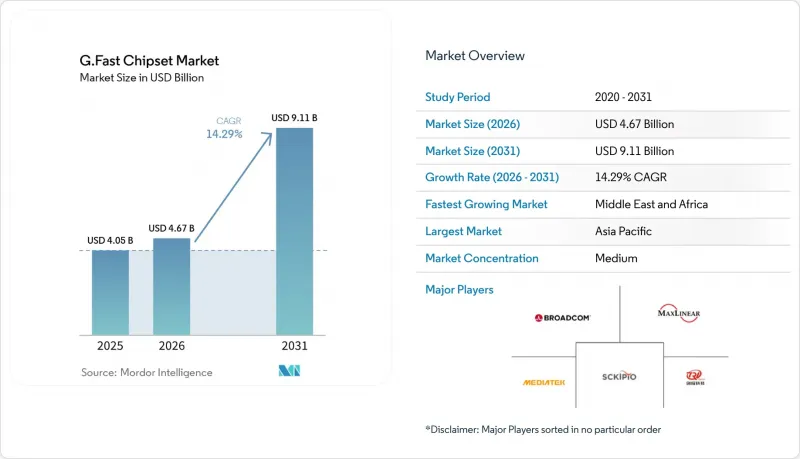
Mordor Intelligence에 의하면, G.Fast 칩셋 시장 규모는 2025년 40억 5,000만 달러로 평가되었습니다. 2026년에는 46억 7,000만 달러로 확대되어 2031년까지 91억 1,000만 달러에 이를 것으로 예상되며 2026-2031년에 걸쳐 CAGR 14.29%로 성장할 전망입니다.
본 보고서는 전개 유형(DPU(Distribution Point Unit) 칩셋, 기타), 주파수 프로파일(106MHz 프로파일, 212MHz 프로파일, 기타), 공정 노드(28nm 이상, 14-22nm, 기타), 최종 용도(아파트용 광대역, 단독주택용 FTTC/FTTB, 스몰 셀/Wi-Fi 오프로드 백홀, 기타), 지역별로 분류되어 있습니다. 시장 전망은 금액(달러) 기준으로 제시되어 있습니다.
세계의 G.Fast 칩셋 시장 동향 및 분석
Tier 1 통신 사업자에 의한 FTTdp(Fiber-to-the-Distribution-Point) 구축 가속화
유럽과 동아시아의 기존 통신 사업자들은 가입자의 주택 내부에 들어가지 않고도 기가비트 서비스를 제공하기 위해 FTTdp(Fiber-to-the-Distribution-Point) 구축을 강화하고 있습니다. 독일은 2026년 1월, 광섬유를 가로등 캐비닛까지만 확장하고 마지막 100-300미터를 G.Fast에 의존하는 536건의 광대역 프로젝트에 대해 18억 유로(19억 8,000만 달러)의 예산을 편성했습니다. 영국의 “프로젝트 기가비트”에서는 가구당 최대 4,500파운드(5,625달러)의 바우처 보조금이 마련되어 있으며, 통신 사업자가 농촌 지역에 마이크로 배선 거점 유닛을 구축하도록 장려하고 있습니다. 광섬유 보급률이 89%에 달하는 한국에서는 100Mbps를 보편적 서비스로 규정하고, 6,250억 원(4억 7,000만 달러)을 6G 연구에 투입하고 있지만, 배선 공사 비용이 터무니없이 비싼 오래된 공동주택에서는 여전히 G.Fast를 활용하고 있습니다. 2025년 11월부터 전면적으로 적용된 유럽연합(EU)의 ‘ 기가비트 인프라법”에 따른 토목 공사 규정의 합리화로 인해, 진행 일정이 더욱 단축될 것입니다. 이러한 정책 동향에 따라 투자 회수 기간이 단축됨에 따라, G.Fast 칩셋에 대한 투자는 임시적인 용량 솔루션으로서 매력적인 선택지가 되고 있습니다.
유럽과 동아시아의 국가 차원 기가비트 광대역 보조금
완전한 FTTH(Fiber-to-the-Home)의 경제성을 확보하기 어려운 상황에서는 공공 자금에 의한 지원 제도가 광섬유와 구리선을 병용하는 하이브리드 방식의 프로젝트를 가속화합니다. 유럽연합 집행위원회의 “Connecting Europe Broadband Fund”는 차세대 접속 인프라 구축을 위해 4억 2,000만 유로를 배정하고 있으며, 영국의 바우처 제도나 2015년 이후 누적 210억 유로(231억 달러)를 광대역에 투자해 온 독일 등 각국의 프로그램을 보완하고 있습니다. 일본의 “디지털 가든 시티”구상에서는 2027년까지 광섬유 보급률 99.9%를 목표로 하고 있지만, 지방의 현에서는 기존 구리선 인프라가 여전히 남아 있어, 가교 기술로서의 G.Fast에 대한 수요가 유지되고 있습니다. 이러한 보조금 제도는 시장 출시 속도를 중시하고 있어, 통신 사업자들은 수개월이 아닌 수일 내에 설치가 가능한 배선 거점 장치(DPU)의 구축을 촉진하고 있습니다.
인구 밀집 도시 지역에서의 FTTH 과잉 구축
북미와 유럽의 통신 사업자들은 구리선을 완전히 우회하는 수동형 광네트워크에 막대한 투자를 하고 있습니다. 버라이즌은 2024년부터 2027년까지 200억 달러를 투자하고, 추가로 340만 채의 건물에 광섬유를 설치하겠다고 약속했으며, AT&T는 2025년 말까지 3,000만 개의 광섬유 접속 지점을 달성하기 위해 연간 20억 달러를 배정했습니다. 영국에서도 비슷한 추세가 나타나, 2025년 중반에는 전국적인 기가비트 커버리지가 78%에 달했습니다. 통신 사업자들이 밀집해 있는 가입자 기반 전체에서 광섬유 설비 투자를 상각해 나감에 따라, G.Fast에 대한 경쟁은 줄어들고 있으며, 칩 수요는 일시적인 업그레이드나 특수한 백홀 용도로 제한되고 있습니다. 노키아(Nokia)나 화웨이(Huawei)와 같은 업체들은 이미 10기가비트 수동형 광네트워크 시스템을 출하하고 있으며, 이로 인해 성능에 대한 기대가 높아지면서 구리선 기반의 가치 제안은 점차 약화되고 있습니다.
부문별 분석
2025년 매출액 중 55.74%를 배전 지점용 실리콘이 차지했으며, 이는 가로등 캐비닛, 지하실 또는 전신주에 능동형 전자 기기를 집중 배치하는 것의 매력을 보여주었습니다. 통신 사업자가 이 아키텍처를 선호하는 이유는 역전력 공급을 통해 현지에서 전력을 공급할 필요가 없어질 뿐만 아니라, 통합된 벡터링 엔진이 여러 가입자 루프 간의 크로스톡을 최소화하기 때문입니다. 그 결과, 현장 설치 시간이 단축되고 네트워크 운영도 효율화됩니다. 고객 단말 장비(CPE) 부문은 기존 DSL 모뎀에서 G.Fast 기기로의 업그레이드 주기와, 새로운 하드웨어가 필요한 212MHz에서 424MHz 프로파일로 전환되는 추세에 힘입어 2031년까지 연평균 성장률(CAGR) 15.11%를 나타낼 것으로 전망됩니다. Broadcom의 BCM63158 등 주요 시스템 온 칩(SoC) 제품은 쿼드 코어 프로세서와 멀티 기가비트 이더넷 포트를 통합하여 OEM의 부품 원가를 절감합니다.
통신 사업자들은 소프트웨어 업데이트를 통해 길가의 장비를 변경하지 않고도 더 높은 주파수나 새로운 진단 기능을 활용할 수 있게 되므로, 배선 거점 장치(DPU)를 미래성이 있는 것으로 보고 있습니다. 한편, 특히 북미에서 고객 단말기 도입이 지연되고 있는 것은 최종 사용자가 서비스 업그레이드를 거부할 경우 재고 리스크를 초래하게 됩니다. 유럽과 아시아의 통신 사업자들은 하드웨어와 서비스 계약을 패키지로 판매함으로써 이러한 위험을 줄이고 있으며, 이를 통해 가입률을 높이고 있습니다. 전반적으로, 중앙 집중형 인텔리전스와 고객 단말 장비의 교체 주기의 균형이 G.Fast 칩셋 시장의 양대 부문에서 단기적인 수익 성장을 좌우하게 될 것입니다.
2025년 시장 점유율은 46.29%로, 212MHz 프로파일은 검증된 커버리지와 확립된 운영 툴셋을 중시하는 Tier 1 기존 사업자들에게 여전히 주력 제품으로 자리매김했습니다. 한편, 424MHz의 G.mgfast 프로파일은 사용 가능한 주파수 대역이 2배로 늘어났으며, 짧은 구리선 구간에서도 대칭형 기가비트 통신을 구현할 수 있어, 공동주택 배선이나 스몰 셀 백홀 분야에서 매력적인 선택지로 떠오르고 있습니다. Sckipio와 같은 벤더는 424 MHz 실리콘에 특화하여 사업을 전개하고 있으며, 하위 호환성이 그다지 중요하지 않은 신규 사업(그린필드)을 대상으로 하고 있습니다.
루프 길이가 150-200미터를 초과하거나, 감쇠 위험으로 인해 서비스 품질(QoE)이 위협받는 경우, 통신 사업자들은 여전히 212 MHz를 선택하고 있습니다. 현재의 반도체 로드맵에는 424 MHz의 통신 거리를 연장하는 고성능 에코 제거 모듈이 포함되어 있어, 성능 격차를 줄이고 적용 가능한 시나리오를 확대되고 있습니다. 브로드밴드 포럼의 TR-507 사양에 따른 규제가 명확해짐에 따라 상호 운용성이 확보되었으며, 고주파 칩셋의 채택이 더욱 가속화되고 있습니다.
지역별 분석
2025년에는 아시아태평양이 매출 점유율 34.11%를 기록하며 시장을 주도했습니다. 한국에서는 광섬유 보급률이 89%에 달하기 때문에 구리선 사용은 주로 오래된 공동주택으로 한정되어 있지만, 통신 사업자들은 고액의 실내 배선 공사 비용을 피하기 위해 지하실에 G.Fast를 계속해서 구축하고 있습니다. 중국에서는 2025년에 5,000만 개 이상의 FTTH(Fiber-to-the-Home) 포트가 추가되었으나, 구형 배선이 설치된 지방 도시에서는 계속해서 단계적인 용량 증설이 필요한 상황이며, 이것이 유닛 수요를 뒷받침하고 있습니다. 일본은 2027년까지 거의 모든 가구에 광섬유 연결을 제공하는 것을 목표로 하고 있지만, 지방의 도도부현에서는 잠정적인 G.Fast 구축에 충분한 품질을 갖춘 구리선 설비가 유지되고 있습니다. 지역 보조금 제도에서는 신속한 서비스 개시를 항상 장려하고 있기 때문에 모든 가정에 광섬유가 보급될 때까지 이 기술은 매력적인 가교 역할을 하고 있습니다.
유럽은 여전히 매우 중요한 지역이며, 그 배경에는 독일이 2026년 1월에 18억 유로(19억 8,000만 달러)를 광대역 사업에 배정했고, 영국이 50억 파운드(62억 5,000만 달러) 규모의 ‘ 프로젝트 기가비트”기금을 설립한 것 등이 그 예로 꼽힙니다. 이러한 프로그램들은 농촌 지역에서의 광범위한 FTDP(Fiber-to-the-Distribution-Point) 구축을 촉진하고 있으며, 이 프로그램들이 없었습니다면 토목 공사의 리드타임이 길어 기가비트 목표 달성이 저해되었을 것으로 보입니다. 그러나 주요 도시에서 Fiber-to-the-Home(FTTH)의 적극적인 중복 구축으로 인해, 도시 지역의 대상 구역은 축소되고 있습니다. 유럽연합(EU)의 ‘기가비트 인프라법”는 인허가 절차를 간소화하여 광섬유 및 하이브리드 방식의 확산을 가속화하는 한편, 도시 중심부에서의 장기적인 G.Fast 보급 규모에 하방 압력을 가하고 있습니다.
중동 및 아프리카는 2026년부터 2031년까지 연평균 성장률(CAGR) 14.78%라는 가장 높은 성장률을 보일 것으로 전망됩니다. 걸프협력회의(GCC) 회원국의 통신 사업자들은 2026년 1월에 시행된 아랍에미리트의 400기가비트 EMIX 코어 업그레이드를 비롯한 대규모 데이터센터 확장 사업에서 고속 스몰셀 백홀 및 광섬유와 구리선의 혼합 연결을 위해 G.Fast를 활용하고 있습니다. 급속한 도시화가 진행되고 있는 도시의 공동주택은 424MHz 실리콘에 대한 수요를 더욱 촉진하고 있습니다. 북미에서는 가장 심각한 역풍에 직면해 있습니다. Verizon과 AT&T의 대규모 광섬유 설비 투자에 더해, 케이블 업계의 기존 사업자들이 DOCSIS 4.0으로 업그레이드함에 따라 G.Fast의 도입은 일시적인 서비스 개통이나 구형 공동주택의 개보수 같은 틈새 용도로만 제한되고 있습니다. 만안 국가들을 제외한 남미와 아프리카에서는 인증을 받은 구리선 인프라가 제한적이고 고정 무선 접속이 널리 보급되어 있는 탓에, 시장은 여전히 거의 미개척 상태입니다.
기타 혜택
- 엑셀 형식 시장 예측(ME) 시트
- 3개월간의 애널리스트 지원
자주 묻는 질문
목차
제1장 서론
제2장 조사 방법
제3장 주요 요약
제4장 시장 구도
제5장 시장 규모 및 성장 예측
제6장 경쟁 구도
제7장 시장 기회 및 향후 전망
KTH 26.07.07According to Mordor Intelligence, the g.fast chipset market size is expected to increase from USD 4.05 billion in 2025 to USD 4.67 billion in 2026 and reach USD 9.11 billion by 2031, growing at a CAGR of 14.29% over 2026-2031.
This report is Segmented by Deployment Type (Distribution Point Unit (DPU) Chipsets, and More), Frequency Profile (106 MHz Profile, 212 MHz Profile, and More), Process Node (28 Nm and Above, 14 -22 Nm, and More), End-Use Application (Multi-Dwelling Unit Broadband, Single-Family FTTC / FTTB, Small-Cell / Wi-Fi Offload Backhaul, and More), and Geography. The Market Forecasts are Provided in Terms of Value (USD).
Global G.Fast Chipset Market Trends and Insights
Accelerated Fiber-to-the-Distribution-Point Build-Outs by Tier-1 Operators
European and East Asian incumbents intensify fiber-to-the-distribution-point (FTTdp) rollouts to deliver gigabit services without entering subscriber homes. Germany budgeted EUR 1.8 billion (USD 1.98 billion) in January 2026 for 536 broadband projects that extend fiber only to street cabinets yet rely on G.fast for the last 100-300 meters. The United Kingdom's Project Gigabit includes voucher grants of up to GBP 4,500 (USD 5,625) per premises, incentivizing operators to deploy micro-distribution point units in rural areas. South Korea, with 89% fiber penetration, treats 100 Mbps as a universal service and channels KRW 625 billion (USD 0.47 billion) into 6G research, but still leverages G.fast in older multi-dwelling units where rewiring costs are prohibitive. Streamlined civil-works rules under the European Union's Gigabit Infrastructure Act, fully applicable since November 2025, further compress deployment timelines. These policy signals shorten payback periods, making G.fast chipset investments attractive as an interim capacity solution.
National Gigabit Broadband Subsidies in Europe and East Asia
Public funding mechanisms accelerate hybrid fiber-copper projects when full fiber-to-the-home economics are challenging. The European Commission's Connecting Europe Broadband Fund earmarked EUR 420 million for next-generation access, complementing national programs such as the United Kingdom's vouchers and Germany's cumulative EUR 21 billion (USD 23.1 billion) broadband spend since 2015. Japan's Digital Garden City blueprint targets 99.9% fiber coverage by 2027; nevertheless, legacy copper in rural prefectures sustains demand for G.fast as a bridging technology. These subsidies value speed-to-market, prompting carriers to deploy distribution point units that can be installed in days rather than months.
Rapid Over-Build of Fiber-to-the-Home in Dense Metros
North American and European operators are heavily investing in passive optical networks that bypass copper altogether. Verizon pledged USD 20 billion between 2024-2027 to pass an additional 3.4 million premises, and AT&T allocates USD 2 billion annually to reach 30 million fiber locations by end-2025. Similar momentum exists in the United Kingdom, where nationwide gigabit coverage hit 78% in mid-2025. As operators amortize fiber capex across dense subscriber bases, G.fast becomes less competitive, confining chip demand to interim upgrades or specialized backhaul applications. Equipment vendors such as Nokia and Huawei are already shipping 10-gigabit passive optical network systems, raising performance expectations and eroding copper-based value propositions.
Other drivers and restraints analyzed in the detailed report include:
- Silicon Integration of Vectoring and Single-Ended Line Testing
- Cost-Effective Reverse-Power-Feed Designs Enabling Micro-DPUs
- Low Customer Premises Equipment Attach Rates in North America
For complete list of drivers and restraints, kindly check the Table Of Contents.
Segment Analysis
Distribution point unit silicon captured 55.74% of 2025 revenue, demonstrating the appeal of centralizing active electronics in street cabinets, basements, or poles. Operators favor this architecture because reverse-power-feed removes the need for local electricity, while integrated vectoring engines minimize crosstalk across multiple subscriber loops. As a result, field installation times fall and network operations remain streamlined. The customer premises equipment category is poised for 15.11% CAGR through 2031, lifted by upgrade cycles from legacy DSL modems to G.fast devices and by migrations from 212 MHz to 424 MHz profiles that require new hardware. Leading system-on-chip offerings, such as Broadcom's BCM63158, integrate quad-core processing with multi-gigabit Ethernet ports, cutting bill-of-materials costs for original equipment manufacturers.
Operators view distribution point units as future-proof because software updates can unlock higher frequencies or new diagnostic features without changing curbside equipment. Conversely, lagging customer premises equipment adoption, particularly in North America, creates an inventory liability if end users decline service upgrades. European and Asian carriers mitigate this risk by bundling hardware with service contracts, which lifts attachment rates. Overall, the balance between centralized intelligence and premises-level refresh cycles shapes near-term revenue growth across both segments of the G.fast chipset market.
At 46.29% market share in 2025, the 212 MHz profile remains the workhorse for tier-1 incumbents that value its proven reach and established operational toolsets. The 424 MHz G.mgfast profile, however, is expected to record a 14.67% CAGR because it doubles usable spectrum and enables symmetrical gigabit tiers across short copper runs, making it attractive for multi-dwelling unit distribution and small-cell backhaul. Vendors like Sckipio position exclusively around 424 MHz silicon, targeting greenfield deployments where backward compatibility is less critical.
Operators still choose 212 MHz when loop lengths exceed 150-200 meters or where attenuation risks jeopardize quality-of-experience. Silicon roadmaps now include advanced echo-cancellation modules that extend 424 MHz reach, narrowing the performance gap and broadening addressable scenarios. Regulatory clarity following the Broadband Forum's TR-507 specification ensures interoperability, further accelerating adoption of higher-frequency chipsets.
Complete Report Scope:
- By Deployment Type
- Distribution Point Unit (DPU) Chipsets
- Customer Premises Equipment (CPE) Chipsets
- By Frequency Profile
- 106 MHz Profile
- 212 MHz Profile
- 424 MHz Profile (G.mgfast)
- By Process Node
- 28 nm and Above
- 14 -22 nm
- 7 -10 nm
- By End-Use Application
- Multi-Dwelling Unit Broadband
- Single-Family FTTC / FTTB
- Small-Cell / Wi-Fi Offload Backhaul
- Industrial IoT / Smart-Grid Backhaul
- By Geography
- North America
- United States
- Canada
- Mexico
- Europe
- Germany
- United Kingdom
- France
- Italy
- Spain
- Rest of Europe
- Asia-Pacific
- China
- Japan
- South Korea
- India
- Australia
- Rest of Asia-Pacific
- South America
- Brazil
- Argentina
- Chile
- Rest of South America
- Middle East
- Saudi Arabia
- United Arab Emirates
- Turkey
- Rest of Middle East
- Africa
- South Africa
- Nigeria
- Egypt
- Rest of Africa
- North America
Geography Analysis
Asia-Pacific led the market with 34.11% revenue share in 2025. South Korea's 89% fiber penetration limits copper use primarily to older apartment blocks, yet operators still roll out G.fast in basements to avoid costly in-unit rewiring. China added more than 50 million fiber-to-the-home ports in 2025, but secondary cities with legacy cabling continue to require incremental capacity upgrades, sustaining unit demand. Japan aims for near-universal fiber by 2027, although rural prefectures retain sufficient copper plant quality for interim G.fast deployments. Local subsidy frameworks consistently reward rapid service activation, making the technology an attractive bridge until fiber reaches every doorstep.
Europe remains a pivotal region, thanks to Germany's EUR 1.8 billion (USD 1.98 billion) January 2026 broadband allocation and the United Kingdom's GBP 5 billion (USD 6.25 billion) Project Gigabit fund. These programs foster extensive fiber-to-the-distribution-point installations in rural areas, where long civil-works lead times would otherwise impede gigabit targets,. However, aggressive fiber-to-the-home over-builds in major cities compress the urban addressable space. The European Union's Gigabit Infrastructure Act expedites permitting, thereby accelerating both fiber and hybrid rollouts, and placing downward pressure on long-term G.fast volumes in metro cores.
The Middle East and Africa region is forecast to deliver the fastest growth at 14.78% CAGR from 2026-2031. Gulf Cooperation Council carriers exploit G.fast for rapid small-cell backhaul and mixed fiber-copper connectivity during large-scale data-center expansions, including the UAE's 400-gigabit EMIX core upgrade in January 2026. Multi-tenant housing in rapidly urbanizing cities further stimulates demand for 424 MHz silicon. North America experiences the most pronounced headwinds: sizable fiber capex commitments at Verizon and AT&T, alongside DOCSIS 4.0 upgrades by cable incumbents, restrict G.fast uptake to niche applications such as temporary service activation and legacy multi-dwelling unit refurbishments. South America and Africa outside the Gulf states remain largely untapped due to limited qualified copper infrastructure and the popularity of fixed wireless access.
- Sckipio Technologies Ltd.
- MaxLinear, Inc.
- Broadcom Inc.
- Qualcomm Technologies, Inc.
- MediaTek Inc.
- Hisilicon Technologies Co., Ltd.
- Triductor Technology (Suzhou) Co., Ltd.
- Metanoia Communications Inc.
- Realtek Semiconductor Corporation
- Marvell Technology, Inc.
- Renesas Electronics Corporation
- Microchip Technology Inc.
- NXP Semiconductors N.V.
- DZS Inc.
- Calix, Inc.
- Zyxel Communications Corp.
- Adtran, Inc.
- Proscend Communications Inc.
- Versatek, LLC
Additional Benefits:
- The market estimate (ME) sheet in Excel format
- 3 months of analyst support
TABLE OF CONTENTS
1 INTRODUCTION
- 1.1 Study Assumptions and Market Definition
- 1.2 Scope of the Study
2 RESEARCH METHODOLOGY
3 EXECUTIVE SUMMARY
4 MARKET LANDSCAPE
- 4.1 Market Overview
- 4.2 Market Drivers
- 4.2.1 Accelerated Fibre-to-the-Distribution-Point Build-Outs by Tier-1 Operators
- 4.2.2 National Gigabit Broadband Subsidies in Europe and East Asia
- 4.2.3 Silicon Integration of Vectoring, SDTA Enabling greater than 1 Gbps over Copper
- 4.2.4 Cost-Effective Reverse-Power-Feed Designs Enabling Micro-DPUs
- 4.2.5 Growing Adoption of G.mgfast (424 MHz) for MDUs and Small-Cell Backhaul
- 4.2.6 Transition of Ex-Intel/Lantiq DSL Portfolio to Pure-Play Suppliers
- 4.3 Market Restraints
- 4.3.1 Rapid Over-Build of Fibre-to-the-Home in Dense Metros
- 4.3.2 Low CPE Attach-Rates in North-American G.fast Footprints
- 4.3.3 Shrinking Availability of Broadband-Qualified Copper Pairs in New Housing
- 4.3.4 Uncertain Roadmap Beyond Profile 424 MHz amid 10 G PON Roll-Outs
- 4.4 Industry Supply-Chain Analysis
- 4.5 Regulatory Landscape
- 4.6 Technological Outlook
- 4.7 Impact of Macroeconomic Factors on the Market
- 4.8 Porter's Five Forces Analysis
- 4.8.1 Bargaining Power of Suppliers
- 4.8.2 Bargaining Power of Buyers
- 4.8.3 Threat of New Entrants
- 4.8.4 Threat of Substitutes
- 4.8.5 Competitive Rivalry
5 MARKET SIZE AND GROWTH FORECASTS (VALUE)
- 5.1 By Deployment Type
- 5.1.1 Distribution Point Unit (DPU) Chipsets
- 5.1.2 Customer Premises Equipment (CPE) Chipsets
- 5.2 By Frequency Profile
- 5.2.1 106 MHz Profile
- 5.2.2 212 MHz Profile
- 5.2.3 424 MHz Profile (G.mgfast)
- 5.3 By Process Node
- 5.3.1 28 nm and Above
- 5.3.2 14 -22 nm
- 5.3.3 7 -10 nm
- 5.4 By End-Use Application
- 5.4.1 Multi-Dwelling Unit Broadband
- 5.4.2 Single-Family FTTC / FTTB
- 5.4.3 Small-Cell / Wi-Fi Offload Backhaul
- 5.4.4 Industrial IoT / Smart-Grid Backhaul
- 5.5 By Geography
- 5.5.1 North America
- 5.5.1.1 United States
- 5.5.1.2 Canada
- 5.5.1.3 Mexico
- 5.5.2 Europe
- 5.5.2.1 Germany
- 5.5.2.2 United Kingdom
- 5.5.2.3 France
- 5.5.2.4 Italy
- 5.5.2.5 Spain
- 5.5.2.6 Rest of Europe
- 5.5.3 Asia-Pacific
- 5.5.3.1 China
- 5.5.3.2 Japan
- 5.5.3.3 South Korea
- 5.5.3.4 India
- 5.5.3.5 Australia
- 5.5.3.6 Rest of Asia-Pacific
- 5.5.4 South America
- 5.5.4.1 Brazil
- 5.5.4.2 Argentina
- 5.5.4.3 Chile
- 5.5.4.4 Rest of South America
- 5.5.5 Middle East
- 5.5.5.1 Saudi Arabia
- 5.5.5.2 United Arab Emirates
- 5.5.5.3 Turkey
- 5.5.5.4 Rest of Middle East
- 5.5.6 Africa
- 5.5.6.1 South Africa
- 5.5.6.2 Nigeria
- 5.5.6.3 Egypt
- 5.5.6.4 Rest of Africa
- 5.5.1 North America
6 COMPETITIVE LANDSCAPE
- 6.1 Market Concentration
- 6.2 Strategic Moves
- 6.3 Market Share Analysis
- 6.4 Company Profiles (includes Global Level Overview, Market Level Overview, Core Segments, Financials as available, Strategic Information, Market Rank/Share, Products and Services, Recent Developments)
- 6.4.1 Sckipio Technologies Ltd.
- 6.4.2 MaxLinear, Inc.
- 6.4.3 Broadcom Inc.
- 6.4.4 Qualcomm Technologies, Inc.
- 6.4.5 MediaTek Inc.
- 6.4.6 Hisilicon Technologies Co., Ltd.
- 6.4.7 Triductor Technology (Suzhou) Co., Ltd.
- 6.4.8 Metanoia Communications Inc.
- 6.4.9 Realtek Semiconductor Corporation
- 6.4.10 Marvell Technology, Inc.
- 6.4.11 Renesas Electronics Corporation
- 6.4.12 Microchip Technology Inc.
- 6.4.13 NXP Semiconductors N.V.
- 6.4.14 DZS Inc.
- 6.4.15 Calix, Inc.
- 6.4.16 Zyxel Communications Corp.
- 6.4.17 Adtran, Inc.
- 6.4.18 Proscend Communications Inc.
- 6.4.19 Versatek, LLC
7 MARKET OPPORTUNITIES AND FUTURE OUTLOOK
- 7.1 White-Space and Unmet-Need Assessment


