
|
시장보고서
상품코드
2072669
로컬 SEO 소프트웨어 시장 : 시장 점유율 분석, 업계 동향 및 통계, 성장 예측(2026-2031년)Local SEO Software - Market Share Analysis, Industry Trends & Statistics, Growth Forecasts (2026 - 2031) |
||||||
 Mordor Intelligence
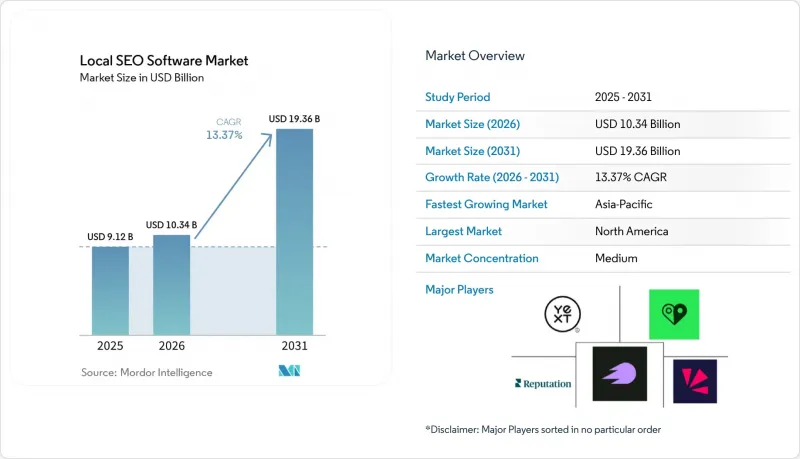
Mordor Intelligence에 의하면, 로컬 SEO 소프트웨어 시장 규모는 2025년 91억 2,000만 달러로 평가되었고, 2026년에는 103억 4,000만 달러로 추정되고, 2031년까지 193억 6,000만 달러에 이를 것으로 예상되며, 2026-2031년 CAGR 13.37%로 성장할 전망입니다.
본 보고서는 도입 모델별(클라우드 기반 및 온프레미스형), 조직 규모별(중소기업 및 대기업), 기능별(키워드 조사, 지역 검색 결과 관리, 평판 관리 등), 최종 사용자별(지역 기업, 마케팅 대행사, SEO 전문가 및 컨설턴트) 및 지역별로 분류되어 있습니다. 시장 전망은 금액(달러) 기준으로 제시되어 있습니다.
세계의 지역 SEO 소프트웨어 시장 동향 및 인사이트
다중 거점 및 프랜차이즈 마케팅 프로그램의 확대
프랜차이즈 시스템과 분산형 소매 네트워크의 확대는 각 거점이 독자적으로 가시성을 확보해야 하기 때문에 지역 SEO 소프트웨어 시장을 지속적으로 견인하고 있습니다. 브랜드 본부의 투자만으로는 지역별 검색 순위를 보장할 수 없기 때문에 사업자들은 추가 인력을 투입하지 않고도 대규모 네트워크를 관리할 수 있는 플랫폼을 찾고 있습니다. SOCi의 보고서에 따르면, ChatGPT가 추천하는 사업 거점은 불과 1.2%인 반면, 구글의 로컬 3팩에서의 노출률은 35.9%에 달할 전망입니다. 이는 AI 시대의 지역 검색에서 다중 거점 브랜드에 대한 검색 결과 선별이 얼마나 엄격해지고 있는지를 보여줍니다. 미국 상공회의소는 2025년 기준 중소기업의 58%가 이미 생성형 AI를 활용하고 있다고 보고했습니다. 이는 AI를 활용한 지역 마케팅에 대한 조직의 준비 태세가 이미 얼리 어답터 단계를 넘어섰음을 보여줍니다. 그 결과, 지역 SEO 소프트웨어 시장에서는 워크플로우 자동화, 브랜드 관리, 그리고 수백 곳에서 수천 곳에 이르는 지점으로 확장 가능한 실행 모델에 대한 수요가 높아지고 있습니다.
온라인 리뷰 및 평판 신호에 대한 의존도 증가
AI 시스템이 단순히 평가 점수만을 집계하는 데 그치지 않고, 리뷰 내용을 통해 감정, 서비스 주제, 게시물의 최신성을 파악하게 되면서, 리뷰 관리는 지역 SEO 소프트웨어 시장의 핵심 요소로 자리 잡았습니다. 이에 따라 평판 관리 도구의 가치도 변화하고 있습니다. 플랫폼은 브랜드가 규모에 맞추어 대응하고, 다양한 프로파일에 걸쳐 메시지의 일관성을 유지할 수 있도록 지원해야 하기 때문입니다. Rio SEO는 2025년에 소비자의 75%가 구매 결정을 내리기 전에 최소 4건의 리뷰를 읽고, 59%는 24시간 이내에 기업 측의 답변을 기대할 것이라고 발표했습니다. 이로 인해 다수의 매장을 운영하는 브랜드에 대한 압박이 커지고 있습니다. BrightLocal은 2026년 4월, 소비자들이 기업을 선택하기 전에 평균 6개의 리뷰 사이트를 확인한다고 보고했습니다. 이로 인해 지원 범위가 구글에만 국한되지 않고 더욱 확대되었습니다. 이러한 변화에 따라, 지역 SEO 소프트웨어 시장에서는 모니터링, 리뷰 모집, AI를 활용한 대응 관리를 하나의 시스템 내에서 통합한 솔루션으로의 전환이 진행되고 있습니다.
데이터 개인정보 보호, 동의 및 플랫폼 규정 준수 부담
개인정보 보호 및 동의 관련 규정은 지역 SEO 소프트웨어 시장에 걸림돌이 되고 있습니다. 왜냐하면 많은 고급 마케팅 기능은 고객 데이터, 위치 정보, 행동 추적에 의존하고 있기 때문입니다. GDPR(EU 개인정보보호규정)에 따라 기업은 최대 2,000만 유로의 벌금을 물게 될 수 있습니다. 이는 IRS가 인용한 2025년 연간 평균 환율을 적용해 환산하면 2,260만 달러에 해당합니다. 이러한 요건으로 인해 공급업체의 기능 도입 비용이 증가하게 되며, 일부 고객은 개인화를 많이 활용하는 지역 마케팅 프로그램에 대해 더욱 신중한 태도를 보이는 경향이 있습니다. 게다가, 기업의 구매 담당자가 조달 시 ISO 27001 인증, SOC 2 Type II 인증 및 공식적인 동의 관리 기능의 통합을 요구할 경우, 그 부담은 더욱 커집니다. 로컬 SEO 소프트웨어 시장에서는 이로 인해 거버넌스 비용을 감당할 수 있는 벤더와 기업의 기준을 충족하는 데 어려움을 겪을 가능성이 있는 소규모 공급업체 간에 격차가 발생하고 있습니다.
부문별 분석
2025년, 지역 SEO 소프트웨어 시장 규모 중 67.45%를 클라우드 기반 도입이 차지했습니다. 이는 퍼블리셔의 기준이 변경되었을 때 일괄적으로 업데이트할 수 있는 인프라를 대다수의 구매자가 선호했음을 보여줍니다. 이 모델은 리스팅, 리뷰, 프로파일 관리를 최신 상태로 유지하면서도 사내 유지보수의 필요성을 줄여주기 때문에 대기업과 중소기업 모두에 적합합니다. 지역 SEO 소프트웨어 시장에서 클라우드 기반 서비스는 Google 비즈니스 프로파일 정책, 퍼블리셔 스키마 또는 AI 엔드포인트 요구 사항이 사전 통지 없이 변경되더라도 신속하게 대응할 수 있게 해줍니다. 구조화된 데이터, 영업 시간, 프로파일 속성이 플랫폼 간에 동기화가 깨지면 가시성이 급격히 저하될 수 있으므로, 이 장점은 중요합니다.
또한, 클라우드 공급업체는 변경 사항을 전체 고객 기반에 일괄적으로 반영할 수 있다는 점에서도 장점이 있습니다. 이를 통해, 보다 정적인 환경에서 반응 시간을 늦추는 원인이 되는 버전 불일치 문제가 완화됩니다. 검색 엔진, 지도, 디렉토리, AI가 생성한 지역 검색 결과의 일관성이 엔티티의 신뢰성을 좌우하는 현재, 이 점은 더욱 중요해지고 있습니다. 클라우드 환경에서는 퍼블리셔와의 직접적인 연동을 유지하기가 쉬워지며, 이를 통해 신디케이션 지연이 완화되고, 로컬 SEO 소프트웨어 업계 전반에 걸친 NAP(이름·주소·전화번호) 불일치 위험이 줄어듭니다. 온프레미스 배포는 여전히 소규모 부문에 국한되어 있지만, 규제 대상 분야의 대기업들은 여전히 데이터 소재지, 내부 거버넌스, 하이브리드 제어 모델을 중요시하고 있어 2031년까지 연평균 성장률(CAGR) 13.40%로 확대될 것으로 전망됩니다.
2025년에는 중소기업(SME)이 지역 SEO 소프트웨어 시장 점유율의 60.14%를 차지했는데, 이는 고객 유치를 위해 지역 검색에 의존하는 지역 밀착형 기업이 많음을 반영하고 있습니다. 구독형 가격 정책과 클라우드 접근성을 통해 리스팅 관리, 순위 추적, 리뷰 모니터링 등의 도구를 활용할 기회가 확대됨에 따라, 중소기업도 지역 및 전국 규모의 브랜드와 경쟁할 수 있게 되었습니다. 지역 SEO 소프트웨어 시장에서 매장 방문객이나 서비스 지역에서의 수익에 의존하는 기업들에게 입지 정보의 가시화는 더 이상 선택 사항이 아니기 때문에 중소기업 수요는 여전히 광범위하게 이어지고 있습니다. 또한, 입문용 및 단계별 플랜이 마련되어 있어, 성장 중인 기업은 더 고급 패키지로 전환하기 전에 소프트웨어를 손쉽게 도입할 수 있습니다.
대기업 시장은 2031년까지 연평균 성장률(CAGR) 14.10%를 나타낼 것으로 예측되며, 이러한 성장은 제어, 규모, 규정 준수를 중심으로 한 다양한 구매 논리를 반영하고 있습니다. 수천 곳에 달하는 거점을 보유한 브랜드에는 역할 기반 권한 설정, 감사 추적, 체계적인 워크플로우, 그리고 인력 증원에 구애받지 않고 지속적으로 운영될 수 있는 자동화 기능이 필요합니다. 지역 SEO 소프트웨어 시장에서도 AI를 통한 시각화가 기존의 지역 검색 순위와 마찬가지로 거버넌스상의 과제로 인식되게 되면서, 대기업들 수요가 증가하고 있습니다. 지역 SEO 소프트웨어 업계에서 주요 브랜드들은 표준적인 검색 결과 관리 업무와 AI를 활용한 인용 정보 모니터링을 모두 관리할 수 있는 단일 플랫폼을 점점 더 선호하고 있기 때문에 단일 기능 솔루션은 이러한 요구 사항에 그다지 적합하지 않습니다. 이로 인해 중소기업 수요는 유지되는 한편, 고부가가치 플랫폼 계약은 계속해서 대기업 구매자로 이동하고 있습니다.
지역별 분석
2025년, 북미는 지역 SEO 소프트웨어 시장 점유율의 41.34%를 차지했으며, 계속해서 가장 큰 기여를 한 지역이 되었습니다. 이 지역은 프랜차이즈 시스템과 다중 지점 운영 브랜드가 밀집해 있다는 점, 그리고 디지털 마케팅 예산이 충분히 확보되어 있다는 점의 혜택을 누리고 있습니다. 미국은 방대한 중소기업 기반, 치열한 지역 내 경쟁, 그리고 AI를 활용한 시각화 도구의 조기 도입을 통해 여전히 핵심적인 국내 시장으로서의 위상을 유지하고 있습니다. Yext는 2026년 보고서에서 연소득 15만 달러를 초과하는 미국 가구에서 지역 비즈니스 검색의 출발점으로서 AI가 이미 구글을 추월했다고 밝혔습니다. 이는 해당 지역의 기업 구매자들이 AI를 활용한 정보 게시 대응을 빠르게 추진하고 있는 이유를 보여줍니다. 캐나다에서는 대리점 사업의 성장과 프랜차이즈 확대로 시장이 활기를 띠는 한편, 멕시코는 모바일 인터넷의 보급과 비즈니스의 정식화가 진행됨에 따라 신흥 시장으로서의 잠재력을 유지했습니다.
아시아태평양은 2031년까지 연평균 성장률(CAGR) 15.20%를 나타낼 것으로 예측되며, 지역 SEO 소프트웨어 시장에서 가장 빠르게 성장하는 지역이 될 전망입니다. 이러한 성장은 중소기업의 디지털화, 모바일 우선의 소비자 행동, 그리고 급성장하는 도시 시장에서 지역 검색 도구에 대한 수요 증가에 힘입은 것입니다. 또한, 이 지역에서는 플랫폼이 각국 시장의 다양한 문자 체계, 리뷰 생태계, 검색 행태에 대응해야 하기 때문에 언어 및 현지화와 관련된 과제도 존재합니다. 이로 인해 전 세계의 서비스 제공업체와 지역 전문 기업 모두 사용 편의성, 자동화, 컨텐츠 적응성 측면에서 경쟁할 여지가 생겨나고 있습니다.
2025년, 유럽은 지역 SEO 소프트웨어 시장에서 상당한 점유율을 차지했으며, 특히 독일, 영국, 프랑스가 기업 지출 측면에서 가장 활발한 시장으로 두각을 나타냈습니다. Semrush는 2026년 5월, AI 가시성 데이터베이스를 32개국으로 확대했으며, 여기에는 몇몇 유럽 시장도 포함되어 있어, 이는 플랫폼 공급업체에게 있어 해당 지역의 전략적 중요성이 높아지고 있음을 보여줍니다. 브라질과 아르헨티나를 필두로 한 남미 지역에서는 도입이 아직 초기 단계이지만, 모바일 인터넷의 보급과 전자상거래 활동의 활성화라는 혜택을 누리고 있습니다. 중동에서는 사우디아라비아와 아랍에미리트에서 수요가 증가하고 있으며, 스마트시티 계획과 높은 스마트폰 보급률로 인해 디지털을 통한 현지 입지의 중요성이 커지고 있습니다. 아프리카는 여전히 규모가 가장 작은 지역 부문이지만, 남아프리카공화국, 나이지리아, 케냐에서는 모바일 접속 환경이 개선되고 비즈니스가 정상화됨에 따라 장기적인 잠재력이 계속해서 기대되고 있습니다.
기타 혜택 :
- 엑셀 형식 시장 예측(ME) 시트
- 3개월간의 애널리스트 지원
자주 묻는 질문
목차
제1장 서론
제2장 조사 방법
제3장 주요 요약
제4장 시장 구도
제5장 시장 규모 및 성장 예측
제6장 경쟁 구도
제7장 시장 기회 및 향후 전망
AJY 26.07.03According to Mordor Intelligence, the local SEO software market size is expected to increase from USD 9.12 billion in 2025 to USD 10.34 billion in 2026 and reach USD 19.36 billion by 2031, growing at a CAGR of 13.37% over 2026-2031.
This report is Segmented by Deployment Model (Cloud-Based, and On-Premise), Organization Size (Small and Medium-Sized Enterprises, and Large Enterprises), Functionality (Keyword Research, Local Listings Management, Reputation Management, and More), End User (Local Businesses, Marketing Agencies, and SEO Professionals and Consultants), and Geography. The Market Forecasts are Provided in Terms of Value (USD).
Global Local SEO Software Market Trends and Insights
Expansion of Multi-Location and Franchise Marketing Programs
Expansion of franchise systems and distributed retail networks continues to support the local SEO software market because each location must win visibility on its own. Central brand spending does not guarantee location-level ranking strength, which pushes operators toward platforms that can manage large networks without adding matching labor. SOCi reported that only 1.2% of business locations are recommended by ChatGPT, compared with 35.9% visibility in Google's local 3-Pack, which shows how selective AI-era local discovery has become for multi-location brands. The U.S. Chamber of Commerce reported in 2025 that 58% of small businesses were already using generative AI, which shows that organizational readiness for AI-assisted local marketing has moved beyond early adopters. As a result, the local SEO software market is seeing stronger demand for workflow automation, brand controls, and execution models that scale across hundreds or thousands of locations.
Growing Dependence on Online Reviews and Reputation Signals
Review management has become a core part of the local SEO software market because AI systems now read review content for sentiment, service themes, and recency instead of only counting ratings. This changes the value of reputation tools because platforms must now help brands respond at scale and keep messaging consistent across many profiles. Rio SEO stated in 2025 that 75% of consumers read at least 4 reviews before making a purchase decision and 59% expect a business to respond within 24 hours, which raises the pressure on brands with large location footprints. BrightLocal said in April 2026 that consumers were checking an average of 6 review sites before choosing a business, which widened the operational scope beyond Google alone. These changes are pushing the local SEO software market toward solutions that combine monitoring, solicitation, and AI-assisted response management inside the same system.
Data Privacy, Consent, and Platform Compliance Burdens
Privacy and consent rules create friction for the local SEO software market because many advanced marketing functions depend on customer data, location signals, and behavioral tracking. Under GDPR, businesses can face fines of up to EUR 20 million, which equals USD 22.6 million using the 2025 yearly average exchange reference cited by the IRS. These requirements raise the cost of feature deployment for vendors and make some customers more cautious about personalization-heavy local marketing programs. The burden rises further when enterprise buyers require ISO 27001 certification, SOC 2 Type II attestation, and formal consent management integration during procurement. For the local SEO software market, this creates a gap between vendors that can absorb governance costs and smaller providers that may struggle to meet enterprise standards.
Other drivers and restraints analyzed in the detailed report include:
- Migration Toward Cloud-Based Local Marketing Stacks
- Growth in Mobile, Maps, and Near-Me Search Activity
- Search Algorithm And Google Business Profile Policy Volatility
For complete list of drivers and restraints, kindly check the Table Of Contents.
Segment Analysis
Cloud-based deployment accounted for 67.45% of the local SEO software market size in 2025, which shows that most buyers preferred infrastructure that can be updated centrally as publisher standards change. This model fits both enterprises and SMEs because it lowers the need for internal maintenance while keeping listings, reviews, and profile controls current. In the local SEO software market, cloud delivery also supports faster response when Google Business Profile policies, publisher schemas, or AI endpoint requirements shift with little notice. That advantage matters because visibility losses can appear quickly when structured data, hours, or profile attributes fall out of sync across platforms.
Cloud vendors also benefit from the ability to push changes across the entire customer base at once, which reduces the version mismatch that can slow reaction time in more static environments. This matters more now because entity trust is shaped by consistency across search engines, maps, directories, and AI-generated local answers. Direct publisher integrations become easier to maintain in the cloud, which helps reduce syndication lag and lowers the risk of NAP inconsistency across the local SEO software industry. On-premises deployments remained the smaller segment, yet they are projected to expand at a 13.40% CAGR through 2031 because large enterprises in regulated sectors still value data residency, internal governance, and hybrid control models.
SMEs held 60.14% of local SEO software market share in 2025, reflecting the volume of geographically bounded businesses that depend on local discovery to win customers. Subscription pricing and cloud access have widened availability for tools such as listings management, rank tracking, and review monitoring, which helps smaller firms compete with regional and national brands. In the local SEO software market, SME demand remains broad because location visibility is no longer optional for businesses that rely on walk-in or service-area revenue. Entry-level and tiered plans also make it easier for growing firms to adopt software before scaling into more advanced packages.
Large enterprises are projected to grow at a 14.10% CAGR through 2031, and that growth reflects a different buying logic centered on control, scale, and compliance. Brands with thousands of locations need role-based permissions, audit trails, structured workflows, and automation that can run continuously without matching headcount growth. The local SEO software market is also seeing enterprise demand rise because AI visibility now sits alongside traditional local ranking in the same governance problem. Within the local SEO software industry, point solutions are less suited to this need because large brands increasingly want a single platform that can manage both standard listings work and AI citation oversight. This keeps volume with SMEs, while higher-value platform contracts continue shifting toward enterprise buyers.
Complete Report Scope:
- By Deployment Model
- Cloud-Based
- On-Premises
- By Organization Size
- Small and Medium-Sized Enterprises
- Large Enterprises
- By Functionality
- Keyword Research
- Local Listings Management
- Reputation Management
- Analytics and Reporting
- By End User
- Local Businesses
- Marketing Agencies
- SEO Professionals and Consultants
- By Geography
- North America
- United States
- Canada
- Mexico
- South America
- Brazil
- Argentina
- Rest of South America
- Europe
- Germany
- United Kingdom
- France
- Italy
- Spain
- Rest of Europe
- Asia-Pacific
- China
- Japan
- India
- South Korea
- Rest of Asia-Pacific
- Middle East
- Saudi Arabia
- United Arab Emirates
- Turkey
- Rest of Middle East
- Africa
- South Africa
- Nigeria
- Kenya
- Rest of Africa
- North America
Geography Analysis
North America held 41.34% of local SEO software market share in 2025, which kept it as the largest regional contributor. The region benefits from a dense base of franchise systems, multi-location brands, and mature digital marketing budgets. The United States remained the core national market because of its large SME base, intense local competition, and early adoption of AI-enabled visibility tools. Yext reported in 2026 that AI has already overtaken Google as the starting point for local business discovery among U.S. households earning over USD 150,000, which shows why enterprise buyers in the region are moving faster on AI citation readiness. Canada added support through agency growth and franchise expansion, while Mexico remained an emerging opportunity tied to mobile internet growth and rising business formalization.
Asia-Pacific is projected to expand at a 15.20% CAGR through 2031, making it the fastest-growing region in the local SEO software market. Growth is supported by SME digitalization, mobile-first consumer behavior, and a wider need for local discovery tools in fast-growing urban markets. The region also presents a language and localization challenge because platforms must support varied scripts, review ecosystems, and search behavior across national markets. This gives both global providers and regional specialists room to compete on usability, automation, and content adaptation.
Europe held a meaningful share of the local SEO software market in 2025, with Germany, the United Kingdom, and France standing out as the strongest markets for enterprise spending. Semrush expanded its AI visibility database to 32 countries in May 2026, including several European markets, which shows the region's growing strategic weight for platform vendors. South America, led by Brazil and Argentina, is still earlier in adoption but benefits from mobile internet expansion and rising digital commerce activity. The Middle East is seeing stronger demand in Saudi Arabia and the United Arab Emirates, where smart-city programs and high smartphone use are lifting the importance of digital local presence. Africa remains the smallest regional segment, though South Africa, Nigeria, and Kenya continue to offer longer-term potential as mobile access and business formalization improve.
- Yext, Inc.
- Semrush Holdings, Inc.
- BrightLocal Ltd
- Reputation.com, Inc.
- Whitespark Inc.
- Birdeye Inc.
- SOCi, Inc.
- uberall GmbH
- Moz, Inc.
- Chatmeter, Inc.
- Advice Interactive Group LLC
- Vendasta Technologies Limited
- Thryv, Inc.
- Milestone Inc.
- DAC Group Holdings Limited
- SE Ranking
- Synup
- Rio SEO
- LocaliQ
- LocalClarity
Additional Benefits:
- The market estimate (ME) sheet in Excel format
- 3 months of analyst support
TABLE OF CONTENTS
1 INTRODUCTION
- 1.1 Study Assumptions and Market Definition
- 1.2 Scope of the Study
2 RESEARCH METHODOLOGY
3 EXECUTIVE SUMMARY
4 MARKET LANDSCAPE
- 4.1 Market Overview
- 4.2 Market Drivers
- 4.2.1 Expansion of Multi-Location and Franchise Marketing Programs
- 4.2.2 Growing Dependence on Online Reviews and Reputation Signals
- 4.2.3 Migration Toward Cloud-Based Local Marketing Stacks
- 4.2.4 Growth in Mobile, Maps, and Near-Me Search Activity
- 4.2.5 Shift From Citation Cleanup to AI Entity Verification
- 4.2.6 Need for Real-Time Location Data Syndication Across Search, Maps, and AI Endpoints
- 4.3 Market Restraints
- 4.3.1 Data Privacy, Consent, and Platform Compliance Burdens
- 4.3.2 Search Algorithm and Google Business Profile Policy Volatility
- 4.3.3 Zero-Click AI Answers Compressing Click-Based Attribution
- 4.3.4 Distribution Fragmentation Between Direct API and Aggregator Networks
- 4.4 Impact of Macroeconomic Factors on the Market
- 4.5 Industry Value Chain Analysis
- 4.6 Regulatory Landscape
- 4.7 Technological Outlook
- 4.8 Porter's Five Forces Analysis
- 4.8.1 Threat of New Entrants
- 4.8.2 Bargaining Power of Buyers
- 4.8.3 Bargaining Power of Suppliers
- 4.8.4 Threat of Substitutes
- 4.8.5 Competitive Rivalry
5 MARKET SIZE AND GROWTH FORECASTS (VALUE)
- 5.1 By Deployment Model
- 5.1.1 Cloud-Based
- 5.1.2 On-Premises
- 5.2 By Organization Size
- 5.2.1 Small and Medium-Sized Enterprises
- 5.2.2 Large Enterprises
- 5.3 By Functionality
- 5.3.1 Keyword Research
- 5.3.2 Local Listings Management
- 5.3.3 Reputation Management
- 5.3.4 Analytics and Reporting
- 5.4 By End User
- 5.4.1 Local Businesses
- 5.4.2 Marketing Agencies
- 5.4.3 SEO Professionals and Consultants
- 5.5 By Geography
- 5.5.1 North America
- 5.5.1.1 United States
- 5.5.1.2 Canada
- 5.5.1.3 Mexico
- 5.5.2 South America
- 5.5.2.1 Brazil
- 5.5.2.2 Argentina
- 5.5.2.3 Rest of South America
- 5.5.3 Europe
- 5.5.3.1 Germany
- 5.5.3.2 United Kingdom
- 5.5.3.3 France
- 5.5.3.4 Italy
- 5.5.3.5 Spain
- 5.5.3.6 Rest of Europe
- 5.5.4 Asia-Pacific
- 5.5.4.1 China
- 5.5.4.2 Japan
- 5.5.4.3 India
- 5.5.4.4 South Korea
- 5.5.4.5 Rest of Asia-Pacific
- 5.5.5 Middle East
- 5.5.5.1 Saudi Arabia
- 5.5.5.2 United Arab Emirates
- 5.5.5.3 Turkey
- 5.5.5.4 Rest of Middle East
- 5.5.6 Africa
- 5.5.6.1 South Africa
- 5.5.6.2 Nigeria
- 5.5.6.3 Kenya
- 5.5.6.4 Rest of Africa
- 5.5.1 North America
6 COMPETITIVE LANDSCAPE
- 6.1 Market Concentration
- 6.2 Strategic Moves
- 6.3 Market Share Analysis
- 6.4 Company Profiles (includes Global Level Overview, Market Level Overview, Core Segments, Financials as available, Strategic Information, Market Rank/Share, Products and Services, Recent Developments)
- 6.4.1 Yext, Inc.
- 6.4.2 Semrush Holdings, Inc.
- 6.4.3 BrightLocal Ltd
- 6.4.4 Reputation.com, Inc.
- 6.4.5 Whitespark Inc.
- 6.4.6 Birdeye Inc.
- 6.4.7 SOCi, Inc.
- 6.4.8 uberall GmbH
- 6.4.9 Moz, Inc.
- 6.4.10 Chatmeter, Inc.
- 6.4.11 Advice Interactive Group LLC
- 6.4.12 Vendasta Technologies Limited
- 6.4.13 Thryv, Inc.
- 6.4.14 Milestone Inc.
- 6.4.15 DAC Group Holdings Limited
- 6.4.16 SE Ranking
- 6.4.17 Synup
- 6.4.18 Rio SEO
- 6.4.19 LocaliQ
- 6.4.20 LocalClarity
7 MARKET OPPORTUNITIES AND FUTURE OUTLOOK
- 7.1 White-Space and Unmet-Need Assessment