

|
시장보고서
상품코드
2072694
미국의 의료용 냉장 창고 시장 : 시장 점유율 분석, 업계 동향 및 통계, 성장 예측(2026-2031년)United States Medical Cold Storage - Market Share Analysis, Industry Trends & Statistics, Growth Forecasts (2026 - 2031) |
||||||
 Mordor Intelligence
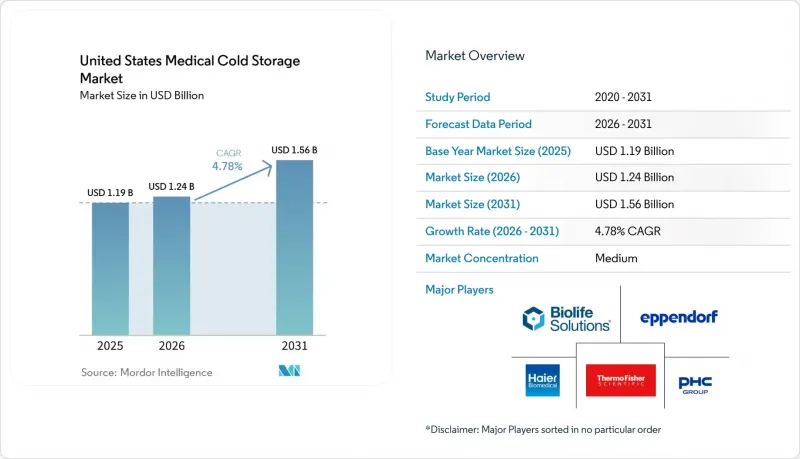
Mordor Intelligence에 의하면, 미국의 의료용 냉장 창고 시장 규모는 2025년 11억 9,000만 달러로 평가되었고, 2026년에는 12억 4,000만 달러로 추정되고, 2026-2031년 CAGR 4.78%로 성장을 지속할 전망이며, 2031년에는 15억 6,000만 달러에 이를 것으로 예측됩니다.
본 보고서는 제품 유형별(냉장고, 냉동고, 극저온 저장 장치, 워크인형, 모니터링 시스템), 온도 범위별(CRT, 냉장, 냉동, 초저온, 극저온), 용도별(백신, 혈액 성분, 생물학적 제제, 세포 및 유전자 치료, 검사 검체, 장기 및 조직), 최종 사용자별(병원, 약국, 혈액은행, 검사실, 제약 및 생명공학 기업, CRO/CMO)로 분류되어 있습니다. 예상치는 금액(달러)으로 표시되어 있습니다.
미국의 의료용 냉장 창고 시장 동향 및 인사이트
바이오의약품 및 전문의약품에 대한 냉장 창고 수요 증가
미국의 의료용 냉장 창고 시장은 제조, 유통, 의료 제공 각 거점에서 검증된 취급 절차가 필요한 바이오의약품 증가로 인해 지속적인 성장세를 보이고 있습니다. Biocon Biologics는 2025년에 호환 가능한 속효성 인슐린 아스파르트 'Kirsty'에 대해 FDA 승인을 획득했습니다. 이로 인해 약국, 병원 외래 진료 부서 및 전문 의료시설에서의 콜드체인 요건이 확대되었습니다. 새로운 바이오의약품이 출시될 때마다, 제조업체 외에도 보관 수요가 발생합니다. 이는 동일한 제품이 투여되기까지 유통 거점, 병원 약국, 감독 하의 임상 재고를 거쳐야 하기 때문입니다. 이 패턴은 미국의 의료용 냉장 창고 시장에 있어 중요합니다. 왜냐하면, 설비 판매를 단일 제품 출시 행사와 연결하는 것이 아니라, 공급망 전반에 걸쳐 반복적으로 발생하는 교체 수요를 창출하기 때문입니다. 또한, 보관에 대한 검증 기준에 따라 조달은 규정 준수와 밀접하게 연관되어 있으므로, 전용으로 설계된 냉장·냉동 설비의 도입은 일반 장비 구매에 비해 일정을 연기하기 어렵습니다. 바이오의약품 포트폴리오가 확대됨에 따라, 미국의 의료용 냉장 창고 시장은 일상 업무에서 문서화, 온도 균일성, 모니터링 요건을 충족해야 하는 규제 대상 자산으로 계속해서 전환되고 있습니다.
극저온 창고 용량이 필요한 세포 및 유전자 치료의 규모 확대
미국의 의료용 냉장 창고 시장은 극저온 처리에 의존하는 상업적 세포 및 유전자 치료 프로그램의 확대에 힘입어 성장하고 있습니다. 크라이오포트(Cryoport)는 2026년 1분기 실적 보고서에서 전 세계적으로 상업적으로 승인된 21개의 CGT(세포 및 유전자 치료) 제품과 766건의 진행 중인 임상시험(이 중 569건이 북미 및 남미 지역)을 지원하고 있다고 밝혔으며, 이는 특수한 보관 및 물류가 필요한 프로그램의 규모를 보여줍니다. BioLife Solutions는 2026년 5월, 자사의 생체 보존 배지가 17개의 승인된 CGT 제품에 채택되었으며, 향후 12개월 이내에 추가로 9건의 승인 또는 적응증 확대가 예상된다고 보고했습니다. 이는 검증된 극저온 워크플로우에 대한 수요가 지속되고 있음을 보여줍니다. 백신 재고와는 달리, 자가 요법의 경우 환자별, 로트별로 전용 라벨이 부착된 초저온 냉장 창고 공간이 필요하기 때문에 보관 수요는 벌크 배치의 양뿐만 아니라 치료 슬롯별로도 증가합니다. 이러한 환자 맞춤형 모델을 통해, 미국의 의료용 냉장 창고 시장에서 특히 관리 연쇄(체인 오브 카스투디) 관리가 가장 엄격한 외부 수탁 제조·가공 거점에서 극저온 시스템 분야에 강력한 성장 기반이 마련되고 있습니다. 또한, 이 모델을 통해 물리적 보관뿐만 아니라 검증 지원, 원격 진단, 문서화된 감사 추적을 제공할 수 있는 공급업체를 대상으로 한 조달이 집중적으로 이루어지고 있습니다.
ULT 자산의 높은 초기 투자 비용과 수명 주기 에너지 비용
미국의 의료용 냉장 창고 시장은 특히 자본 승인 절차가 까다로운 환경 속에서 초저온 장비로 인한 실질적인 비용 장벽에 여전히 직면해 있습니다. 규정 준수 기준을 충족하는 -80°C 시스템의 구매 가격은 여전히 높은 수준을 유지하고 있으며, 시설 측에서 교정, 서비스 계약, 비상 전원 통합 및 향후 냉매 관련 조정을 추가할 경우 비용 부담은 더욱 커집니다. 캘리포니아 대학교 산타바바라 캠퍼스의 추산에 따르면, ENERGY STAR 인증을 받은 초저온(ULT) 장비로 교체할 경우 상당한 에너지 절감 효과를 기대할 수 있음에도 불구하고, 투자 회수 기간은 6년에서 13년으로 추정됩니다. 이는 명확한 운영상의 이점이 있음에도 불구하고, 많은 시설이 업그레이드를 미루고 있는 이유를 보여줍니다. 이로 인해 미국의 의료용 냉장 창고 시장의 일부는 정체 상태에 있습니다. 왜냐하면 소규모 병원, 독립 검사 기관, 지방 의료 시스템은 대규모 학술 의료 센터와 같은 일정에 맞추어 노후된 장비를 교체할 수 없는 경우가 많기 때문입니다. 에너지 효율이 높은 대체 제품을 이용할 수 있다 하더라도, 조달 팀은 높은 초기 비용을 긴 교체 주기와 시설별 예산 제한과 저울질해야 합니다. 그 결과, 갱신 의향은 있더라도 자금력이 있는 기관을 제외하고는 실제 전환이 완만하게 진행되는 시장이 되었습니다.
부문별 분석
2025년, 의료용 냉동고는 미국 의료용 냉장 창고 시장 규모의 52.43%를 차지했으며, 매출 기준 최대 제품 카테고리가 되었습니다. 이러한 우위는 -20°C에서 -90°C의 성능이 일상적으로 요구되는 혈액 성분, 특수 생물 제제, 연구용 검체의 보존 등 폭넓은 분야에서 활용되고 있기 때문입니다. 미국의 의료용 냉장 창고 시장이 계속해서 이 부문에 의존하고 있는 이유는 냉동고가 의료, 연구, 바이오의약품 등 폭넓은 용도에 대응할 수 있기 때문입니다. 이 카테고리의 조달 활동은 온도 안정성, 경보 시스템 및 규정 준수가 문서화된 기능을 하나의 플랫폼에 통합할 수 있는 기종을 중심으로 진행되고 있습니다. VA Long Beach가 2025년에 실시한 TSX 유니버설 시리즈 -80°C 냉동고 입찰에서는 구매자들이 현재 듀얼 캐스케이드식 냉매 및 장기 보증을 사양으로 요구하고 있는 것으로 나타났으며, 이는 검증된 제품 라인을 보유한 유서 깊은 공급업체에 유리하게 작용하고 있습니다.
의료용 냉장고는 약국, 백신 보관소, 혈액은행 및 검사실에서 여전히 주요 설치 대수를 차지하고 있지만, 수요 패턴은 더욱 성숙해져 확장 주도보다는 교체 중심으로 바뀌고 있습니다. 이러한 장비들은 외래 진료 및 병원 내 폭넓은 활용을 통해 미국 의료용 냉장 창고 시장에서 상당한 설치 실적을 쌓아왔기 때문에 여전히 중요한 위치를 차지하고 있습니다. 워크인식 냉장실이나 극저온 시스템은 특히 GMP 기준을 준수하는 바이오리포지토리 기능이나 첨단 치료제 취급 등이 관련된 경우 등, 이용 사례는 제한적이지만 이용 빈도가 높은 분야에 대응하고 있습니다. 모니터링 시스템 및 부속품 시장은 2031년까지 연평균 성장률(CAGR) 6.36%를 나타낼 것으로 예측되며, 디지털 규정 준수가 '선택 사항'에서 '필수'로 전환되는 과정에서 가장 빠르게 성장하고 있는 제품군입니다. 이러한 성장은 구매 행동에 있어 실질적인 변화를 반영하고 있습니다. 시설에서는 수동으로 온도를 기록하는 것뿐만 아니라, 추적 가능한 로그, 자동 알림, 감사에 대응할 수 있는 대시보드에 대한 수요가 증가하고 있기 때문입니다.
극저온 보관은 현재 매출액 기준으로 볼 때 여전히 규모가 작지만, 이 제품 구성 중에서 자본 집약도가 가장 높은 분야입니다. 그 주된 이유는 세포 및 유전자 치료의 워크플로우에는 전용 보관 조건과 문서화된 보관 이력 관리가 필요하며, 이러한 요건들은 표준 냉동고 플랫폼으로는 충족할 수 없기 때문입니다. Cryoport의 MVE Biological Solutions는 2026년 1분기에 독립형 극저온 냉동고 'Fusion 800 시리즈'를 출시했습니다. 이는 액체 질소의 지속적인 공급에 대한 의존도를 낮춤으로써, 극저온 기술 도입 시 주요 운영상의 제약 중 하나를 해소한 것입니다. 이러한 제품 개발은 미국의 의료용 냉장 창고 업계가 단순한 온도 목표뿐만 아니라 운영상의 과제에도 어떻게 대응하고 있는지를 보여줍니다. 또한, 이는 경쟁사들이 통합 시스템 설계로 전환하고 있음을 의미하며, 이러한 시스템에서는 순수한 저장소의 성능뿐만 아니라 안전성, 원격 모니터링, 그리고 극저온 워크플로우에 대한 적합성이 중요하게 여겨지고 있습니다.
모니터링 분야도 이와 같은 규정 준수 동향의 혜택을 누리고 있지만, 그 가치 제안은 다릅니다. 구매자들은 수동 개입 없이도 기록을 생성할 수 있는 보관 장비를 점점 더 선호하고 있으며, 이를 통해 원격 진단 및 조사 준비 과정이 간소화됩니다. 2026년 1월 PHC가 출시한 'TwinGuard ECO 703VXH'는 초저온 성능에 원격 진단 기능 및 옵션인 ID 기반 접근 제어를 결합함으로써 이러한 변화를 반영하고 있습니다. 미국의 의료용 냉장 창고 시장에서 이러한 조합 덕분에 모니터링은 단순한 부속품 구매에서 제품 인증의 핵심 요소로 변화하고 있습니다. 향후에는 컴플라이언스 대응 플랫폼을 판매하는 벤더와 주로 저장소 하드웨어 분야에서 경쟁하는 벤더 간의 격차가 더욱 벌어질 가능성이 있습니다.
2025년, 미국 의료용 냉장 창고 시장 규모 중 초저온 창고가 43.21%를 차지했으며, 금액 기준으로 가장 큰 비중을 차지하는 온도대가 되었습니다. 많은 생물학적 제제, 연구용 시료 및 첨단 치료용 재료는 검증된 취급 절차에 따라 극저온에서 안정화되어 있기 때문에 이 온도대는 여전히 핵심적인 위치를 차지하고 있습니다. 미국의 의료용 냉장 창고 시장은 연구, 혈액 관련 용도, 특수 치료제 및 외부 위탁 바이오 제조가 교차하는 지점에 위치한 초저온 시스템에 크게 의존하고 있습니다. 이 분야 수요는 폭이 넓을 뿐만 아니라, 사양에 대한 요구 사항도 까다롭습니다. 이는 구매자들이 동일한 장비에서 에너지 효율, 중복성 및 감사 지원을 점점 더 요구하고 있기 때문입니다. 따라서 이 온도대에서 신제품을 출시하는 것은 경쟁사와의 차별화 측면에서 매우 큰 비중을 차지하고 있습니다.
북미의 PHC Corporation은 2026년 1월, 설정 온도 -80°C에서 하루 7.3 kWh의 전력 소비량, 천연 냉매, 인버터 제어를 통한 듀얼 컴프레서의 이중화 기능을 갖춘 'TwinGuard ECO 703VXH'를 출시했습니다. 이번 출시가 중요하게 여겨지는 이유는 에너지 비용, 백업 보호, 낮은 GWP로의 전환 준비라는 세 가지 구매 기준을 동시에 충족했기 때문입니다. 미국의 의료용 냉장 시장에서 이 세 가지 과제를 종합적으로 해결하는 공급업체는 이를 개별적인 조달 결정으로 다루는 공급업체보다 유리한 입장에 있습니다. 2°C-8°C의 냉장 창고는 백신, 의약품, 혈액 관련 분야에서 매일 지속적인 수요가 있기 때문에 여전히 안정적이고 대규모의 도입 기반을 유지하고 있습니다. -20°C--40°C의 냉동 보관 역시 혈장 제제, 변이 바이러스 백신, 검체의 보존에 있어 여전히 중요하지만, 초저온 창고만큼 자본 집약적이지는 않습니다.
-150°C 이하의 극저온 창고 시장은 2031년까지 연평균 성장률(CAGR) 5.87%를 나타낼 것으로 예측되며, 이는 각 온도 하위 부문 중 가장 빠른 성장률입니다. 이러한 추세는 기상 액체 질소 조건이 필요한 첨단 치료 워크플로우의 보급과, 더욱 엄격해진 보관 관리 요건을 반영한 것입니다. 따라서, 미국의 의료용 냉장 창고 시장은 초저온 창고가 여전히 핵심 수익 기반이며, 극저온 창고가 가장 높은 전략적 성장을 주도한다는 '양극화된 온도 구조'에 의해 재구축되고 있습니다. 이러한 양극화는 공급업체의 우선순위, 설치 장소 계획 및 서비스 요구 사항을 동시에 변화시키기 때문에 중요한 의미를 지닙니다. 구매자들은 더 이상 온도 성능만을 요구하지 않고, 각 온도 범위별 문서화, 에너지 소비 프로파일, 시설과의 적합성, 그리고 냉매 관련 규정 준수 여부도 중요하게 여기고 있습니다.
이러한 변화는 경쟁 환경과 업데이트 주기에 광범위한 영향을 미치고 있습니다. 초저온 시스템은 운영 비용에 대한 우려와 냉매 교체라는 시급한 압박에 직면해 있는 반면, 극저온 시스템은 워크플로우 설계 및 환자별 취급 요건으로 인해 더 큰 압박을 받고 있습니다. Cryometrix의 T-90 플랫폼은 격리 및 규정 준수 요구 사항을 독자적인 방식으로 충족시키며, 폐쇄 루프 방식이자 액체 질소(LN2)를 사용하지 않는 극저온 접근 방식으로의 전환을 상징합니다. 실용적인 관점에서 볼 때, 미국의 의료용 냉장 창고 업계는 각 온도대별로 더욱 전문화된 제품군으로 전환되고 있습니다. 저장 요건이 엄격해질수록, 장비의 적합성 평가는 단순한 일반적인 용량 요건뿐만 아니라 최종 용도의 공정 설계와 연계될 가능성이 높아집니다.
기타 혜택 :
- 엑셀 형식 시장 예측(ME) 시트
- 3개월간의 애널리스트 지원
자주 묻는 질문
목차
제1장 서론
제2장 조사 방법
제3장 주요 요약
제4장 시장 구도
제5장 시장 규모 및 성장 예측
제6장 경쟁 구도
제7장 시장 기회 및 향후 전망
AJY 26.07.03According to Mordor Intelligence, the united states medical cold storage market size is expected to grow from USD 1.19 billion in 2025 to USD 1.24 billion in 2026 and is forecast to reach USD 1.56 billion by 2031 at 4.78% CAGR over 2026-2031.
This report is Segmented by Product Type (Refrigerators, Freezers, Cryogenic Storage, Walk-Ins, Monitoring Systems), Temperature Range (CRT, Refrigerated, Frozen, Ultra-Low, Cryogenic), Application (Vaccines, Blood Components, Biologics, Cell/Gene Therapies, Lab Specimens, Organs/Tissues), and End User (Hospitals, Pharmacies, Blood Banks, Labs, Pharma/Biotech, CROs/CMOs). Forecasts in Value (USD).
United States Medical Cold Storage Market Trends and Insights
Expanding Biologics and Specialty-Drug Cold Storage Demand
The United States medical cold storage market is gaining durable support from the growing number of biologics that need validated handling across manufacturing, distribution, and care delivery sites. Biocon Biologics received FDA approval in 2025 for Kirsty, an interchangeable rapid-acting insulin aspart, which widened cold chain requirements across pharmacies, hospital outpatient departments, and specialty care settings. Each new biologic launch adds storage needs beyond the manufacturer because the same product must move through distribution nodes, hospital pharmacies, and monitored clinical inventories before administration. That pattern matters for the United States medical cold storage market because it creates repeat replacement demand across the full chain instead of tying equipment sales to a single launch event. Storage validation standards also keep procurement tied to compliance, which makes purpose-built refrigeration and freezer capacity harder to postpone than general equipment purchases. As biologics portfolios widen, the United States medical cold storage market continues to shift toward regulated assets that must meet documentation, temperature uniformity, and monitoring expectations in daily operations.
Cell and Gene Therapy Scale-Up Requiring Cryogenic Capacity
The United States medical cold storage market is also being lifted by the expansion of commercial cell and gene therapy programs that depend on cryogenic handling. Cryoport stated in its first quarter 2026 results that it supports 21 commercially approved CGTs and 766 active clinical trials globally, with 569 in the Americas, which shows the scale of programs requiring specialized storage and logistics. BioLife Solutions reported in May 2026 that its biopreservation media were embedded in 17 approved CGT products, with 9 additional approvals or expansions anticipated within 12 months, which points to continuing demand for validated cryogenic workflows. Unlike vaccine inventories, autologous therapies need a dedicated labeled cryogenic position for each patient lot, so storage demand rises with every treatment slot rather than only with bulk batch volumes. That patient-specific model gives the United States medical cold storage market a strong growth layer in cryogenic systems, especially at outsourced manufacturing and processing sites where chain-of-custody controls are most intensive. It also keeps procurement concentrated among vendors that can pair physical storage with validation support, remote diagnostics, and documented audit trails.
High Capital and Lifecycle Energy Costs of ULT Assets
The United States medical cold storage market still faces a real cost barrier from ultra-low temperature equipment, especially in settings with tight capital approval cycles. Purchase prices remain high for compliance-grade -80°C systems, and the cost burden rises further when facilities add calibration, service contracts, backup power integration, and future refrigerant-related adjustments. The University of California, Santa Barbara, estimated a 6 to 13 year payback period for ENERGY STAR ULT replacements, even with strong energy savings, which shows why many facilities delay upgrades despite clear operating benefits. This slows parts of the United States medical cold storage market because smaller hospitals, independent laboratories, and rural health systems often cannot replace aging units on the same timetable as large academic centers. Even when energy-efficient alternatives are available, procurement teams must weigh upfront premiums against long replacement cycles and site-specific budget limits. The result is a market where replacement intent is present, but actual conversion can move slowly outside well-funded institutions.
Other drivers and restraints analyzed in the detailed report include:
- Tighter FDA, CDC, and Accreditation Compliance Requirements
- Rising Vaccine Inventory Complexity Across Care Settings
- Refrigerant-Transition Procurement Complexity
For complete list of drivers and restraints, kindly check the Table Of Contents.
Segment Analysis
Medical-grade freezers accounted for 52.43% of the United States medical cold storage market size in 2025, which made them the largest product category by revenue. Their lead came from wide use across blood components, specialty biologics, and research sample preservation, where -20°C to -90°C performance is routine. The United States medical cold storage market continues to rely on this category because freezers serve the broadest mix of healthcare, research, and biopharma applications. Procurement activity within the category is centered on units that can combine temperature stability, alarm systems, and documented compliance features in one platform. The VA Long Beach 2025 solicitation for TSX Universal Series -80°C freezers showed how buyers are now specifying dual-cascade refrigerants and extended warranty expectations, which favors established suppliers with validated product lines.
Medical-grade refrigerators remain the installed volume base for pharmacy, vaccine, blood bank, and laboratory use, but the demand pattern is more mature, and replacement-led rather than expansion-led. These units still matter because broad ambulatory and hospital use gives them a large installed footprint across the United States medical cold storage market. Walk-in cold rooms and cryogenic systems serve narrower but higher-intensity use cases, especially where GMP biorepository functions or advanced therapy handling are involved. Monitoring systems and accessories are forecast to grow at a 6.36% CAGR through 2031, which makes them the fastest-growing product grouping as digital compliance shifts from optional to expected. That growth reflects a practical change in buying behavior, because facilities increasingly need traceable logs, automated alerts, and audit-ready dashboards rather than manual temperature records alone.
Cryogenic storage is still smaller in current revenue terms, but it represents the highest-intensity capital deployment area inside this product mix. The main reason is that cell and gene therapy workflows require purpose-built storage conditions and documented chain-of-custody controls that cannot be served by standard freezer platforms. Cryoport's MVE Biological Solutions introduced the Fusion 800 Series self-sustaining cryogenic freezer in the first quarter of 2026, which addressed one of the main operational limits of cryogenic adoption by reducing dependence on continuous liquid nitrogen supply. That type of product development shows how the US medical cold storage industry is responding to operational pain points, not just temperature targets. It also means product competition is moving toward integrated system design, where safety, remote oversight, and cryogenic workflow fit matter as much as pure cabinet performance.
The monitoring category is gaining from the same compliance shift, but with a different value proposition. Buyers increasingly want storage assets that can produce documentation without relying on manual intervention, which supports remote diagnostics and easier survey preparation. PHC's TwinGuard ECO 703VXH launch in January 2026 reflected this shift by pairing ultra-low performance with remote diagnostics and optional identity-based access control. In the United States medical cold storage market, that combination turns monitoring from an accessory purchase into a core part of product qualification. Over time, this is likely to widen the gap between vendors selling compliant platforms and vendors competing mainly on cabinet hardware.
Ultra-low storage represented 43.21% of the United States medical cold storage market size in 2025, which made it the largest temperature band by value. This range remains central because many biologics, research samples, and advanced therapy materials are stabilized at very low temperatures under validated handling protocols. The United States medical cold storage market depends heavily on ultra-low systems because they sit at the intersection of research, blood-related applications, specialty therapeutics, and outsourced biomanufacturing. Demand here is not only broad but also specification-heavy because buyers increasingly want energy efficiency, redundancy, and audit support in the same unit. That is why product launches in this band carry outsized weight in competitive positioning.
PHC Corporation of North America launched the TwinGuard ECO 703VXH in January 2026 with 7.3 kWh per day consumption at a -80°C setpoint, natural refrigerants, and inverter-controlled dual compressor redundancy. The launch matters because it addressed three purchase criteria at once, which were energy costs, backup protection, and low-GWP transition readiness. In the United States medical cold storage market, vendors that solve all three issues together are better placed than those that treat them as separate procurement decisions. Refrigerated storage at 2°C to 8°C remains a stable and large installed base because vaccines, medications, and blood-related applications continue to need it every day. Frozen storage at -20°C to -40°C also stays relevant for plasma products, vaccine variants, and specimen archiving, but it does not face the same degree of capital intensity as the ultra-low tier.
Cryogenic storage at or below -150°C is projected to grow at a 5.87% CAGR through 2031, which is the fastest rate across temperature sub-segments. That pace reflects the spread of advanced therapy workflows that need vapor-phase liquid nitrogen conditions and tighter chain-of-custody requirements. The United States medical cold storage market is therefore being reshaped by a two-speed temperature structure where ultra-low remains the core revenue base and cryogenic storage defines the highest strategic growth. This split is important because it changes vendor priorities, site planning, and service needs at the same time. Buyers are no longer looking only for temperature performance, but also for documentation, energy profile, facility fit, and refrigerant compliance within each range.
That shift has wider implications for competition and replacement cycles. Ultra-low systems face immediate pressure from operating cost concerns and refrigerant transitions, while cryogenic systems face stronger pressure from workflow design and patient-specific handling. Cryometrix's T-90 platform illustrates the push toward closed-loop, LN2-free cryogenic approaches that address containment and compliance needs in a differentiated way. In practical terms, the US medical cold storage industry is moving toward more specialized product stacks inside each temperature band. The deeper the storage requirement, the more likely equipment qualification becomes tied to end-use process design rather than only to generic capacity needs.
Complete Report Scope:
- By Product Type
- Medical-Grade Refrigerators
- Pharmacy / Vaccine Refrigerators
- Blood Bank Refrigerators
- Laboratory / General-Purpose Refrigerators
- Medical-Grade Freezers
- Low-Temperature Freezers (-20°C to -40°C)
- Ultra-Low Temperature Freezers (-60°C to -90°C)
- Cryogenic Storage Systems (<=-150°C)
- Walk-in Cold Rooms & Chambers
- Monitoring Systems & Accessories
- Medical-Grade Refrigerators
- By Storage Temperature Range
- Controlled Room Temperature / Ambient
- Refrigerated (+2°C to +8°C)
- Frozen (-20°C to -40°C)
- Ultra-Low (-60°C to -90°C)
- Cryogenic (<=-150°C)
- By Application
- Vaccines
- Blood & Blood Components
- Medications & Biologics
- Cell & Gene Therapies
- Laboratory / Diagnostic Specimens
- Organs & Tissues
- By End User
- Hospitals & Health Systems
- Pharmacies & Vaccination Sites
- Blood Banks & Transfusion Centers
- Academic & Research Laboratories
- Pharmaceutical & Biotechnology Companies
- CROs, CMOs & Cell Therapy Processing Sites
List of Companies Covered in this Report:
- Accucold
- Aegis Scientific, Inc.
- ARCTIKO A/S
- B Medical Systems S.a r.l.
- BioLife Solutions
- Binder
- Desmon S.p.A.
- Eppendorf
- Follett Products, LLC
- Haier Biomedical
- Helmer Scientific
- LabRepCo, LLC
- Liebherr Group
- Migali Scientific
- NuAire, Inc.
- PHC Holdings
- Philipp Kirsch
- So-Low Environmental Equipment Co.
- Thermo Fisher Scientific
- Vestfrost Solutions
Additional Benefits:
- The market estimate (ME) sheet in Excel format
- 3 months of analyst support
TABLE OF CONTENTS
1 Introduction
- 1.1 Study Assumptions & Market Definition
- 1.2 Scope of the Study
2 Research Methodology
3 Executive Summary
4 Market Landscape
- 4.1 Market Overview
- 4.2 Market Drivers
- 4.2.1 Expanding Biologics and Specialty-Drug Cold Storage Demand
- 4.2.2 Rising Vaccine Inventory Complexity Across Care Settings
- 4.2.3 Tighter FDA, CDC, and Accreditation Compliance Requirements
- 4.2.4 Cell And Gene Therapy Scale-Up Requiring Cryogenic Capacity
- 4.2.5 ENERGY STAR-Led Replacement of Aging Installed Base
- 4.2.6 Decentralized Clinical Trials Creating Distributed Storage Nodes
- 4.3 Market Restraints
- 4.3.1 High Capital and Lifecycle Energy Costs of ULT Assets
- 4.3.2 Calibration, Monitoring, and Audit Burden Across Facilities
- 4.3.3 Refrigerant-Transition Procurement Complexity
- 4.3.4 Backup-Power and Disaster-Resilience Requirements
- 4.4 Value / Supply-Chain Analysis
- 4.5 Regulatory Landscape
- 4.6 Technological Outlook
- 4.7 Porter's Five Forces Analysis
- 4.7.1 Threat of New Entrants
- 4.7.2 Bargaining Power of Suppliers
- 4.7.3 Bargaining Power of Buyers
- 4.7.4 Threat of Substitutes
- 4.7.5 Industry Rivalry
5 Market Size & Growth Forecasts
- 5.1 By Product Type
- 5.1.1 Medical-Grade Refrigerators
- 5.1.1.1 Pharmacy / Vaccine Refrigerators
- 5.1.1.2 Blood Bank Refrigerators
- 5.1.1.3 Laboratory / General-Purpose Refrigerators
- 5.1.2 Medical-Grade Freezers
- 5.1.2.1 Low-Temperature Freezers (-20°C to -40°C)
- 5.1.2.2 Ultra-Low Temperature Freezers (-60°C to -90°C)
- 5.1.3 Cryogenic Storage Systems (<=-150°C)
- 5.1.4 Walk-in Cold Rooms & Chambers
- 5.1.5 Monitoring Systems & Accessories
- 5.1.1 Medical-Grade Refrigerators
- 5.2 By Storage Temperature Range
- 5.2.1 Controlled Room Temperature / Ambient
- 5.2.2 Refrigerated (+2°C to +8°C)
- 5.2.3 Frozen (-20°C to -40°C)
- 5.2.4 Ultra-Low (-60°C to -90°C)
- 5.2.5 Cryogenic (<=-150°C)
- 5.3 By Application
- 5.3.1 Vaccines
- 5.3.2 Blood & Blood Components
- 5.3.3 Medications & Biologics
- 5.3.4 Cell & Gene Therapies
- 5.3.5 Laboratory / Diagnostic Specimens
- 5.3.6 Organs & Tissues
- 5.4 By End User
- 5.4.1 Hospitals & Health Systems
- 5.4.2 Pharmacies & Vaccination Sites
- 5.4.3 Blood Banks & Transfusion Centers
- 5.4.4 Academic & Research Laboratories
- 5.4.5 Pharmaceutical & Biotechnology Companies
- 5.4.6 CROs, CMOs & Cell Therapy Processing Sites
6 Competitive Landscape
- 6.1 Market Concentration
- 6.2 Market Share Analysis
- 6.3 Company Profiles (includes Global level Overview, Market-level Overview, Core Segments, Financials, Strategic Information, Market Rank/Share, Products & Services, Recent Developments)
- 6.3.1 Accucold
- 6.3.2 Aegis Scientific, Inc.
- 6.3.3 ARCTIKO A/S
- 6.3.4 B Medical Systems S.a r.l.
- 6.3.5 BioLife Solutions, Inc.
- 6.3.6 BINDER GmbH
- 6.3.7 Desmon S.p.A.
- 6.3.8 Eppendorf SE
- 6.3.9 Follett Products, LLC
- 6.3.10 Haier Biomedical
- 6.3.11 Helmer Scientific Inc.
- 6.3.12 LabRepCo, LLC
- 6.3.13 Liebherr Group
- 6.3.14 Migali Scientific
- 6.3.15 NuAire, Inc.
- 6.3.16 PHC Holdings Corporation
- 6.3.17 Philipp Kirsch GmbH
- 6.3.18 So-Low Environmental Equipment Co.
- 6.3.19 Thermo Fisher Scientific Inc.
- 6.3.20 Vestfrost Solutions
7 Market Opportunities & Future Outlook
- 7.1 White-space & Unmet-need Assessment


