|
시장보고서
상품코드
2072792
정밀 식재 장비 시장 : 시장 점유율 분석, 업계 동향 및 통계, 성장 예측(2026-2031년)Precision Planting Equipment - Market Share Analysis, Industry Trends & Statistics, Growth Forecasts (2026 - 2031) |
||||||
 Mordor Intelligence
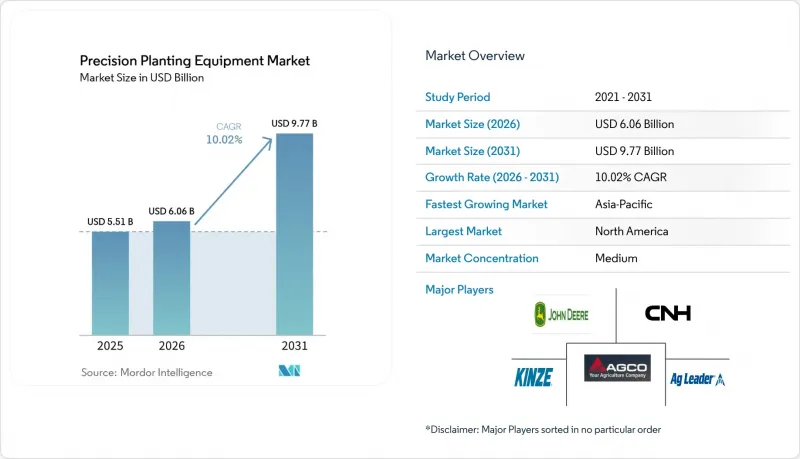
Mordor Intelligence에 의하면, 정밀 식재 장비 시장 규모는 2025년 55억 1,000만 달러로 평가되었고, 2026년에는 60억 6,000만 달러로 추정되고, 게다가 2031년까지 97억 7,000만 달러로 확대될 것으로 예측되며, 2026-2031년 연평균 복합 성장률(CAGR)은 10.02%를 나타낼 전망입니다.
본 보고서는 제공 내용별(하드웨어, 소프트웨어 등), 기기 유형별(파종기, 씨드 드릴 및 에어 시더 등), 구동 방식별(전기 구동 및 유압 구동), 용도별(줄 재배 작물 등), 농장 규모별(400헥타르 미만 및 400헥타르 이상), 지역별(북미, 남미 등)로 분류되어 있습니다. 본 보고서에서는 시장 규모 및 전망을 금액(달러) 기준으로 제시하고 있습니다.
세계의 정밀 식재 장비 시장 동향 및 인사이트
수확량 극대화와 식량 안보에 대한 압박
정밀 식재 장비 시장은 식량 수요 증가의 영향을 받고 있지만, 한편으로 농산물 생산자들은 경작지 확대에 제약을 받고 있습니다. 미국 농무부 경제조업체국(USDA ERS)은 83개 중저소득국의 곡물 총 수요가 2035년까지 연평균 2.2% 증가할 것으로 전망하고 있으며, 이에 따라 주요 재배 시스템 전반에 걸쳐 생산 압박이 높은 수준을 유지할 것으로 보입니다. 이 평가에 따르면, 아시아 및 사하라 이남 아프리카 전역에서 곡물 수요 부족량은 2025년 2억 7,140만 메트르톤에서 2035년까지 3억 9,430만 메트르톤으로 증가할 것으로 예상되며, 이는 농지의 생산성 향상이 지속적으로 필요함을 시사하고 있습니다. 이 압력은 파종 시에 특히 중요합니다. 왜냐하면 발아의 균일성, 종자의 배치, 그리고 종자와 토양의 접촉 상태가 이후 작물의 생육 성과 상한선을 결정하기 때문입니다. 2025년 『Frontiers in Agronomy』지에 게재된 체계적 문헌 고찰에 따르면, 유럽연합(EU)에서 실시된 실험에서 정밀 농업이 수확량을 10%에서 15%까지 향상시키는 동시에 비료 사용량을 25%, 물 사용량을 30% 줄인 것으로 밝혀졌습니다. 따라서 정밀 식재 장비 시장은 일시적인 장비 수명 주기가 아닌, 구조적인 수요의 조짐으로부터 혜택을 받고 있습니다. 이는 특히 아시아태평양과 남미에서 중요한데, 이 지역들에서는 수출용 작물 생산과 식량 안보라는 두 가지 목표가 모두 1에이커당 재배 가치를 높이고 있습니다. 농가들이 토지, 물, 양분의 제약에 점점 더 직면하고 있는 가운데, 파종 정밀도는 최종 수확량을 확보하기 위한 가장 초기 단계에서 시행할 수 있고 관리하기 쉬운 수단 중 하나가 되고 있습니다.
종자 및 비료 사용 효율화를 통한 투입 비용 절감
또한, 파종을 놓친 종자, 이중 파종 또는 파종 중복이 이제 더 뚜렷한 경제적 손실로 이어지기 때문에 정밀 식재 장비 시장은 계속 발전하고 있습니다. 전동 계량 시스템은 기존의 기계식 시스템에 비해 파종 밀도 관리를 개선하고, 유지보수 부담을 줄여줍니다. 이를 통해 고가의 종자를 보다 효율적으로 활용할 수 있게 됩니다. 앨라배마주 협동보급국의 보고에 따르면, 전동 구동 시스템은 기존의 기계식 시스템에 비해 파종 밀도의 정확도를 최대 20% 향상시키는 동시에 체인과 샤프트의 유지보수가 필요 없게 합니다. 디아사에 따르면, 이 회사의 'ExactShot' 액체 비료 시스템은 종자가 있는 곳에만 비료를 시비함으로써, 이랑 내 영양분 사용량을 최대 60%까지 줄일 수 있으며, 이를 통해 줄 단위의 관리가 직접적인 비용 절감 수단이 됩니다. 또한, 디아사는 'AccuRate' 미터 설계를 통해 곡선형 고랑에서 과다 파종을 23% 줄일 수 있었습니다고 보고하고 있으며, 이는 섹션 제어와 곡선 보정이 불규칙한 형태의 밭에서 종자의 경제성을 어떻게 보호하는지를 보여줍니다. 이러한 운영상의 이점 덕분에, 작물 가격이 불안정한 상황에서도 고사양의 파종기나 업그레이드 키트를 도입하는 것이 타당해집니다. 농가들이 파종 정밀도를 단순히 수확량 증대를 위한 수단으로만 여기지 않게 되면서, 정밀 식재 장비 시장은 이러한 요인으로 인해 혜택을 보고 있습니다. 정밀 파종은 한 번의 작업으로 종자, 비료 및 작업 시간을 절약할 수 있는 투입 비용 관리 도구로서 점점 더 중요하게 여겨지고 있습니다.
막대한 초기 투자와 자금 조달의 압박
정밀 식재 장비 시장은 특히 농업 기계 시장이 가장 성숙한 지역을 제외하고는 여전히 기본적인 자금 조달상의 장벽에 직면해 있습니다. 미국 정부감사원(US GAO)의 보고서에 따르면, 가변 시비 기술을 지원하는 살포기에는 5,600달러의 추가 비용이 들며, 수확량 모니터 교체 비용은 약 8,000달러에 달할 전망입니다. 이는 단일 부품이라 할지라도 총 소유 비용을 높일 수 있음을 보여줍니다. 화분의 전면적인 업그레이드에 전동 구동 시스템, 모니터, 컨트롤러, 다운포스 부품 등이 포함될 경우, 총 지출액은 수입이 부진한 시기에는 많은 생산자가 조달할 수 있는 범위를 금세 초과할 가능성이 있습니다. 이 문제는 금리가 높고 보조금 적용 범위가 불충분한 개발도상국 시장에서 더욱 두드러집니다. 소규모 농가라도 농업적 가치를 인식하고 있는 경우라 하더라도, 절약 효과는 몇 시즌에 걸쳐 나타나는 반면, 현금 지출은 즉시 발생하기 때문에 도입을 미루는 경우가 많습니다. 따라서 정밀 식재 장비 시장은 지역에 따라 고르지 않게 성장하고 있으며, 사후 개조 옵션이나 딜러를 통한 금융 지원, 정책 지원 등으로 진입 장벽이 낮아진 지역에서는 도입이 더욱 활발하게 진행되고 있습니다. 이러한 제약은 제품 구성에도 영향을 미치고 있어, 제조업체들은 완전히 통합된 정밀 패키지보다는 부분적인 업그레이드를 선호하는 경향이 있습니다. 농가의 수입이 주기적인 변동을 거듭하는 한, 자금 조달에 대한 압박은 하위 고객층에서의 도입 속도를 계속해서 둔화시킬 것입니다.
부문별 분석
2025년 기준으로, 하드웨어는 정밀 식재 장비 시장 규모의 46.5%를 차지했으며, 여전히 최대 공급 부문으로서의 지위를 유지했습니다. 한편, 이 서비스는 2031년까지 연평균 성장률(CAGR) 11.4%를 기록하며 가장 빠르게 성장하는 부문으로 부상했습니다. 하드웨어가 주도하고 있다는 사실은 정밀 식재 장비 시장에서 여전히 주요 설비 투자를 차지하고 있는 열 유닛, 계량기, 컨트롤러, 센서, 안내 부품의 중요성이 지속되고 있음을 반영합니다. 그렇긴 하지만, 생산자들 사이에서는 설정, 보정, 데이터 분석, 소프트웨어 지원을 판매 후 서비스가 아닌 기계 본체에 포함된 기능으로 기대하는 경향이 강해지고 있어, 성장 양상이 변화하고 있습니다. AGCO사는 자사의 PTx 플랫폼을 통해 2029년까지 정밀 농업 분야에서 20억 달러의 매출을 달성할 계획이라고 밝혔습니다. 이는 주요 공급업체들이 커넥티드 솔루션을 중심으로 더 대규모의 지속적인 수익 기반을 구축하고 있음을 보여줍니다. 이러한 경향은 향후 가치 창출이 개별 하드웨어의 이익률에 의존하는 정도가 줄어들고, 대신 공급업체가 농장 작업에 서비스를 얼마나 효과적으로 연계할 수 있는지에 크게 좌우될 것임을 시사합니다.
서비스 분야가 성장세를 보이고 있는 것은 커넥티드 기기의 도입 대수가 증가함에 따라 딜러 주도의 지원, 데이터 처리 및 농업 기술 지도에 대한 수요가 높아지고 있기 때문입니다. 생산자들은 단순히 장비 납품뿐만 아니라, 처방전에 따른 비료 시비 및 파종 실행, 계절별 최적화, 그리고 여러 기종이 혼재된 장비군의 통합에 관한 지원을 요구하고 있습니다. 이에 따라 정밀 식재 장비 시장에서 구독형 소프트웨어, 계절별 컨설팅, 그리고 관리형 파종 프로그램의 역할이 확대되고 있습니다. 이 서비스 계층이 견고해질수록 고객 유지율은 높아지는 경향이 있습니다. 왜냐하면, 관계가 초기 장비 판매를 넘어 확대되기 때문입니다. 이는 또한 대규모 딜러 네트워크와 여러 시즌에 걸쳐 생산자를 지원할 수 있는 디지털 플랫폼을 갖춘 공급업체에게 유리하게 작용합니다. 하드웨어는 여전히 기반을 이루는 요소이며, 부문별 구성은 명확해지고, 소프트웨어와 지원 서비스가 금속 부품보다 더 빠르게 성장하는 번들형 솔루션으로 전환되고 있습니다.
2025년, 파종기는 정밀 식재 장비 시장 점유율의 58%를 차지했으며, 지출의 대부분이 여전히 줄 재배 작물용 파종 시스템에 집중되어 있는 것으로 확인되었습니다. 이러한 우위는 옥수수, 대두 및 이와 유사한 재배 시스템에서 작물 정착, 발아의 균일성, 줄 단위의 투입 관리에 있어 파종기의 정밀도가 핵심적인 역할을 하고 있음을 반영합니다. 킨제(Kinze)의 5000 시리즈는 현재 전동 구동 방식만 제공되고 있으며, 이는 주요 제조업체들이 전동 계량 기능을 단순한 프리미엄 기능에서 핵심 사양으로 전환했음을 보여줍니다. Vaderstad AB 역시 개별 전동 구동과 무선 제어를 핵심으로 삼아 '템포(Tempo)' 시리즈를 포지셔닝하고 있으며, 정밀 파종기 시장에서 이와 유사한 설계 방향성을 뒷받침하고 있습니다. 이처럼 파종기에 주력하고 있다는 점에서 OEM의 혁신이 여전히 열 단위 아키텍처, 속도, 단립 파종 및 업그레이드 호환성에 중점을 두고 있는 이유를 설명할 수 있습니다.
드론과 자율형 파종기는 2031년까지 연평균 성장률(CAGR) 13.4%를 나타낼 것으로 예측되며, 시장 규모는 작지만 가장 빠르게 성장하는 장비 유형입니다. 이러한 성장은 무인 농장 작업, 더욱 경량화된 입문용 모델, 그리고 과거에는 실험적인 것으로 여겨졌던 직접 파종 방식의 활용 사례에 대한 관심이 확산되고 있음을 반영하고 있습니다. 이 부문의 부상은 파종기의 중요성을 떨어뜨리는 것은 아니지만, 정밀 식재 장비 시장의 기술적 가능성을 넓혀줄 것입니다. 자율형 및 드론을 활용한 시스템은 특히 노동력이 부족한 지역이나 지형상의 이유로 기존의 작업 범위를 확보하기 어려운 지역에서 그 유용성이 두드러집니다. 또한, 농업의 디지털화에 대한 정책 지원 및 자율 주행에 대한 수용도 증가와도 부합합니다. 장기적으로는 이 부문의 매출이 기존 파종기보다 소규모에 그칠 가능성이 높지만, 제조업체들이 파종, 제어 및 장비 구성에 대해 고려할 때 계속해서 영향을 미칠 것입니다.
지역별 분석
2025년 기준으로 북미는 정밀 식재 장비 시장의 44% 점유율을 차지했으며, 이 지역은 2031년까지 연평균 성장률(CAGR) 9.2%로 성장할 것으로 전망됩니다. 대규모 줄 재배 농업 경영자들이 전동 구동식 파종기, 실시간 모니터링 및 사후 개조 프로그램에 대한 투자를 지속함에 따라, 미국과 캐나다는 여전히 이 지역 수요를 주도하고 있습니다. 2005년으로 거슬러 올라가는 디아사의 파종기 업그레이드 전략은 해당 지역이 신규 판매와 기존 설비의 수익화를 동시에 지원하고 있다는 사실을 여실히 보여주고 있습니다. 이러한 규모, 딜러 네트워크의 충실도, 그리고 업그레이드에 대한 대응력이 결합되어 북미는 정밀 식재 장비 시장의 중심적인 위치를 유지하고 있습니다. 멕시코는 여전히 시장 규모가 작지만, 정밀 농업이 가져다주는 이점이 점점 더 매력적으로 부각되고 있는 관개용 옥수수 및 수수 생산 지역에서 수요가 서서히 증가하고 있습니다.
아시아태평양은 2031년까지 연평균 성장률(CAGR)이 12.5%로 가장 빠르게 성장하고 있는 지역 블록이며, 정밀 식재 장비 시장의 주요 성장 동력으로 자리 잡고 있습니다. 중국은 스마트 농업 계획에서 명확한 정보화 목표를 제시하고, 주요 작물 전반에 걸친 디지털 운영의 보급을 뒷받침하고 있어, 이 지역에서 가장 큰 정책적 지원이 되고 있습니다. 중국의 '2025년 농업기계 교체 보조금 확대 방안'은 디지털 대응 기기 카테고리의 도입 환경을 한층 더 강화하고 있습니다. 호주 역시 대규모 농장 구조가 대용량 시스템과 광범위한 디지털 통합을 뒷받침하고 있어, 성숙한 정밀 파종 기반을 갖추고 있습니다. 이 지역 전체에서 성장 양상은 정책 지원, 식량 생산에 대한 압박, 그리고 규모가 확대되고 있는 상업적 농업 부문이 복합적으로 작용한 결과입니다.
남미에서는 브라질과 아르헨티나를 필두로 꾸준한 성장이 나타나고 있습니다. 이 국가들에서는 대규모 대두 및 옥수수 재배 사업으로 인해 파종 장비에 대한 견조한 수요가 유지되고 있습니다. 이 지역은 다양한 농기계를 병행하여 사용하는 정밀 농업 시장으로서의 중요성 덕분에 계속해서 기술 공급업체들을 끌어들이고 있습니다. 유럽 역시 지속가능성을 중시하는 농업 관행과, 소규모로 세분화된 농지에 적합한 유연성이 높은 정밀 농업 장비에 대한 수요에 힘입어 성장을 이어가고 있습니다. 중동 및 아프리카에서는 식량 안보 노력과 기계화 프로그램에 힘입어 특정 시장에 성장이 집중되고 있어, 비교적 완만한 발전을 이루고 있습니다. 그러나 비용 및 통신 환경의 문제로 인해, 더 광범위한 보급에는 여전히 제약이 있습니다. 전반적으로, 정밀 식재 장비 시장은 농업적 수요, 지원 정책, 그리고 견고한 유통망이 조화를 이루는 지역에서 가장 빠르게 발전하고 있습니다.
기타 혜택 :
- 엑셀 형식 시장 예측(ME) 시트
- 3개월간의 애널리스트 지원
자주 묻는 질문
목차
제1장 서론
제2장 조사 방법
제3장 주요 요약
제4장 시장 구도
제5장 시장 규모 및 성장 예측
제6장 경쟁 구도
제7장 시장 기회 및 향후 전망
AJY 26.07.07According to Mordor Intelligence, the precision planting equipment market size is projected to expand from USD 5.51 billion in 2025 to USD 6.06 billion in 2026, and to USD 9.77 billion by 2031, registering a CAGR of 10.02% between 2026 and 2031.
This report is Segmented by Offering (Hardware, Software, and More), by Equipment Type (Planters, Seed Drills and Air Seeders, and More), by Drive Type (Electric Drive and Hydraulic Drive), by Application (Row Crops, and More), by Farm Size (Below 400 Ha and Above 400 Ha), and by Geography (North America, South America, and More). The Report Offers the Market Size and Forecasts in Terms of Value (USD).
Global Precision Planting Equipment Market Trends and Insights
Yield Maximization and Food Security Pressure
The precision planting equipment market is influenced by the growing demand for food, while crop producers face limitations in expanding arable land. USDA ERS projected total grain demand across 83 low and middle-income countries to grow at 2.2% annually through 2035, which keeps output pressure elevated across major cropping systems. The same assessment showed the grain demand shortfall rising from 271.4 million metric tons in 2025 to 394.3 million metric tons by 2035 across Asia and Sub-Saharan Africa, which points to a sustained need for higher field productivity. That pressure matters at planting because emergence uniformity, seed placement, and seed-to-soil contact set the ceiling for later crop performance. A 2025 systematic review in Frontiers in Agronomy found that precision agriculture raised yields by 10% to 15% in European Union (EU) trials while reducing fertilizer use by 25% and water use by 30%. The precision planting equipment market, therefore, benefits from a structural demand signal rather than a short-lived equipment cycle. This is especially relevant in Asia-Pacific and South America, where export crops and food security goals both raise the value of each planted acre. As growers face tighter land, water, and nutrient constraints, planting accuracy becomes one of the earliest and most controllable ways to protect final yield.
Input Cost Reduction through Seed and Fertilizer Efficiency
The precision planting equipment market is also advancing because every missed seed, double drop, or overlap now carries a clearer financial penalty. Electric metering systems improve population control and reduce maintenance exposure compared with older mechanical layouts, which directly supports better use of expensive seed inputs. Alabama Cooperative Extension reported that electric drives can deliver population accuracy advantages of up to 20% over mechanical predecessors while removing chain and shaft maintenance. Deere states that its ExactShot liquid fertilizer system can reduce in-furrow nutrient use by up to 60% by applying fertilizer only where seed is present, which turns row-level control into a direct cost-saving tool. Deere also reported a 23% reduction in overpopulation on curved rows through its AccuRate meter design, which shows how section control and curve compensation protect seed economics in irregular field shapes. These operating gains support the case for higher-spec planters and upgrade kits even when crop prices are uneven. The precision planting equipment market gains from this driver because growers no longer view planting precision only as a yield tool. It is increasingly treated as an input cost control tool that protects seed, fertilizer, and operating time in the same pass.
High Upfront Investment and Financing Pressure
The precision planting equipment market still faces a basic capital barrier, especially outside the most mature farm machinery regions. The United States Government Accountability Office (US GAO) reported that variable-rate technology applicators carry a premium of USD 5,600, and replacement yield monitors cost around USD 8,000, demonstrating that even single components can raise the total ownership burden. When full planter upgrades include electric drive systems, monitors, controllers, and downforce components, total spending can quickly exceed what many growers can finance during a weak income cycle. This issue is more pronounced in developing markets, where interest costs are higher, and subsidy coverage is incomplete. Smaller farms may still see the agronomic value, but they often delay adoption because the savings arrive over several seasons while the cash outlay is immediate. The precision planting equipment market, therefore, grows unevenly across regions, with stronger uptake in areas where retrofit paths, dealer financing, or policy support reduce the entry hurdle. This restraint also affects product mix, since growers may favor partial upgrades over fully integrated precision packages. As long as farm incomes stay cyclical, financing pressure will continue to slow adoption at the lower end of the customer base.
Other drivers and restraints analyzed in the detailed report include:
- Labor Shortages and Compressed Planting Windows
- Government Support and Sustainability-Linked Mechanization
- Technical Complexity and Training Gaps
For complete list of drivers and restraints, kindly check the Table Of Contents.
Segment Analysis
Hardware accounted for 46.5% of the precision planting equipment market size in 2025, which kept it as the largest offering segment while services moved ahead as the fastest-growing segment at an 11.4% CAGR through 2031. The hardware lead reflects the continued importance of row units, meters, controllers, sensors, and guidance components that still define the main capital purchase in the precision planting equipment market. Even so, the growth profile is shifting because growers increasingly expect setup, calibration, data interpretation, and software support to come with the machine rather than after the sale. AGCO stated that its PTx platform is targeting USD 2 billion in precision agriculture revenue by 2029, which shows how major suppliers are building a larger recurring revenue layer around connected solutions. This pattern suggests that future value capture will depend less on standalone hardware margins and more on how effectively suppliers attach services to field operations.
The services segment is gaining momentum because the installed base of connected equipment now needs more dealer-led support, data handling, and agronomic guidance. Growers are asking for help with prescription execution, seasonal optimization, and mixed-fleet integration, not only with equipment delivery. That creates a larger role for subscription software, seasonal consulting, and managed planting programs within the precision planting equipment market. The stronger this service layer becomes, the more durable customer retention tends to be because the relationship extends beyond the original equipment sale. This also favors suppliers with large dealer networks and digital platforms that can support growers over multiple seasons. Hardware will remain foundational, but the segment mix is clearly moving toward bundled solutions where software and support rise faster than steel and iron.
Planters captured 58% of the precision planting equipment market share in 2025, which confirms that most spending still sits inside row-crop planting systems. That lead reflects the central role of planter accuracy in stand establishment, emergence uniformity, and row-level input control across corn, soybean, and similar cropping systems. Kinze's 5000 Series lineup is now electric-drive only, which shows how leading manufacturers have turned electric metering from a premium feature into a core specification. Vaderstad AB has also positioned its Tempo line around individual electric drives and wireless control, reinforcing the same design direction in the precision planting equipment market. This concentration around planters explains why OEM innovation still focuses so heavily on row-unit architecture, speed, singulation, and upgrade compatibility.
Drones and autonomous seeding equipment are forecast to grow at a 13.4% CAGR through 2031, which makes them the fastest-growing equipment type, even from a smaller base. Their growth reflects wider interest in unmanned field operations, lighter deployment models, and direct seeding use cases that were once treated as experimental. The rise of this segment does not reduce the importance of planters, but it does widen the technology ceiling for the precision planting equipment market. Autonomous and drone-enabled systems are especially relevant where labor availability is tight or terrain makes conventional coverage harder. They also fit well with policy support for agricultural digitization and the growing comfort level around autonomous operations. Over time, this segment is likely to stay smaller than conventional planters in revenue, but it will keep influencing how manufacturers think about seeding, control, and fleet design.
Complete Report Scope:
- By Offering
- Hardware
- Automation and Control Systems
- Sensing and Monitoring Systems
- Software
- Farm Management and Mapping Software
- Prescription and Analytics Software
- Services
- System Integration and Consulting
- Managed and Connected Services
- Training and Support Services
- Hardware
- By Equipment Type
- Planters
- Seed Drills and Air Seeders
- Planting Attachments and Add-Ons
- Drones and Autonomous Seeding Equipments
- By Drive Type
- Electric Drive
- Hydraulic Drive
- By Application
- Row Crops
- Cereals, Oilseeds, and Pulses
- Forestry
- Horticulture
- Greenhouse and Controlled Environment Farming
- By Farm Size
- Below 400 Hectares
- Above 400 Hectares
- By Geography
- North America
- United States
- Canada
- Mexico
- Rest of North America
- South America
- Brazil
- Argentina
- Colombia
- Rest of South America
- Europe
- Germany
- France
- United Kingdom
- Italy
- Spain
- Russia
- Rest of Europe
- Asia-Pacific
- China
- India
- Japan
- Australia
- South Korea
- Rest of Asia-Pacific
- Middle East
- Saudi Arabia
- United Arab Emirates
- Turkey
- Rest of Middle East
- Africa
- South Africa
- Egypt
- Nigeria
- Rest of Africa
- North America
Geography Analysis
North America held 44% of the precision planting equipment market share in 2025, and the region is projected to grow at a 9.2% CAGR through 2031. The United States and Canada remain the core of regional demand because large row-crop operations continue to invest in electric drive planters, real-time monitoring, and retrofit programs. Deere's upgrade strategy for planters dating back to 2005 illustrates how the region supports both new sales and installed-base monetization at the same time. This combination of scale, dealer depth, and upgrade readiness keeps North America at the center of the precision planting equipment market. Mexico remains smaller, but it adds incremental demand in irrigated corn and sorghum areas where precision gains are becoming more attractive.
Asia-Pacific is the fastest-growing regional block at a 12.5% CAGR through 2031, which makes it the main expansion engine for the precision planting equipment market. China is the largest policy anchor in the region because its smart agriculture plan set explicit informatization targets and backed wider use of digital operations across major crops. China's 2025 subsidy expansion for agricultural machinery replacement further strengthens the adoption environment for digitally enabled equipment categories. Australia also contributes a mature precision seeding base because large farm structures support high-capacity systems and wider digital integration. Across the region, the growth pattern combines policy support, food production pressure, and an expanding commercial-scale farming segment.
South America is experiencing steady growth, led by Brazil and Argentina, where large soybean and corn farming operations sustain strong demand for planting equipment. The region continues to attract technology providers due to its importance as a mixed-fleet precision agriculture market. Europe is also expanding, supported by sustainability-driven farming practices and demand for adaptable precision equipment suited to smaller and more fragmented fields. The Middle East and Africa are developing more gradually, with growth concentrated in specific markets supported by food security initiatives and mechanization programs. However, broader adoption remains constrained by cost and connectivity challenges. Overall, the precision planting equipment market is advancing most rapidly in regions where agronomic needs, supportive policies, and strong distribution networks align.
List of Companies Covered in this Report:
- Deere and Company
- AGCO Corporation
- PTx Trimble LLC
- CNH Industrial N.V.
- Kinze Manufacturing, Inc.
- Ag Leader Technology
- Topcon Positioning Systems, Inc.
- Precision Planting LLC
- Kubota Corporation
- Vaderstad AB
- HORSCH Maschinen GmbH
- Great Plains Manufacturing, Inc.
- Bourgault Industries Ltd.
- Buhler Industries Inc.
- Morris Industries Ltd.
Additional Benefits:
- The market estimate (ME) sheet in Excel format
- 3 months of analyst support
TABLE OF CONTENTS
1 Introduction
- 1.1 Study Assumptions and Market Definition
- 1.2 Scope of the Study
2 Research Methodology
3 Executive Summary
4 Market Landscape
- 4.1 Market Overview
- 4.2 Market Drivers
- 4.2.1 Yield maximization and food security pressure
- 4.2.2 Input cost reduction through seed and fertilizer efficiency
- 4.2.3 Labor shortages and compressed planting windows
- 4.2.4 Government support and sustainability-linked mechanization
- 4.2.5 Premium seed economics favor singulation and row-level control
- 4.2.6 Retrofit economics extend the installed planter base
- 4.3 Market Restraints
- 4.3.1 High upfront investment and financing pressure
- 4.3.2 Technical complexity and training gaps
- 4.3.3 Interoperability friction across mixed fleets and data standards
- 4.3.4 Connectivity dependence and electronics cost inflation
- 4.4 Regulatory Landscape
- 4.5 Technological Outlook
- 4.6 Porter's Five Forces Analysis
- 4.6.1 Bargaining Power of Suppliers
- 4.6.2 Bargaining Power of Buyers
- 4.6.3 Threat of New Entrants
- 4.6.4 Threat of Substitutes
- 4.6.5 Intensity of Competitive Rivalry
5 Market Size and Growth Forecasts (Value, USD)
- 5.1 By Offering
- 5.1.1 Hardware
- 5.1.1.1 Automation and Control Systems
- 5.1.1.2 Sensing and Monitoring Systems
- 5.1.2 Software
- 5.1.2.1 Farm Management and Mapping Software
- 5.1.2.2 Prescription and Analytics Software
- 5.1.3 Services
- 5.1.3.1 System Integration and Consulting
- 5.1.3.2 Managed and Connected Services
- 5.1.3.3 Training and Support Services
- 5.1.1 Hardware
- 5.2 By Equipment Type
- 5.2.1 Planters
- 5.2.2 Seed Drills and Air Seeders
- 5.2.3 Planting Attachments and Add-Ons
- 5.2.4 Drones and Autonomous Seeding Equipments
- 5.3 By Drive Type
- 5.3.1 Electric Drive
- 5.3.2 Hydraulic Drive
- 5.4 By Application
- 5.4.1 Row Crops
- 5.4.2 Cereals, Oilseeds, and Pulses
- 5.4.3 Forestry
- 5.4.4 Horticulture
- 5.4.5 Greenhouse and Controlled Environment Farming
- 5.5 By Farm Size
- 5.5.1 Below 400 Hectares
- 5.5.2 Above 400 Hectares
- 5.6 By Geography
- 5.6.1 North America
- 5.6.1.1 United States
- 5.6.1.2 Canada
- 5.6.1.3 Mexico
- 5.6.1.4 Rest of North America
- 5.6.2 South America
- 5.6.2.1 Brazil
- 5.6.2.2 Argentina
- 5.6.2.3 Colombia
- 5.6.2.4 Rest of South America
- 5.6.3 Europe
- 5.6.3.1 Germany
- 5.6.3.2 France
- 5.6.3.3 United Kingdom
- 5.6.3.4 Italy
- 5.6.3.5 Spain
- 5.6.3.6 Russia
- 5.6.3.7 Rest of Europe
- 5.6.4 Asia-Pacific
- 5.6.4.1 China
- 5.6.4.2 India
- 5.6.4.3 Japan
- 5.6.4.4 Australia
- 5.6.4.5 South Korea
- 5.6.4.6 Rest of Asia-Pacific
- 5.6.5 Middle East
- 5.6.5.1 Saudi Arabia
- 5.6.5.2 United Arab Emirates
- 5.6.5.3 Turkey
- 5.6.5.4 Rest of Middle East
- 5.6.6 Africa
- 5.6.6.1 South Africa
- 5.6.6.2 Egypt
- 5.6.6.3 Nigeria
- 5.6.6.4 Rest of Africa
- 5.6.1 North America
6 Competitive Landscape
- 6.1 Market Concentration
- 6.2 Strategic Moves
- 6.3 Market Share Analysis
- 6.4 Company Profiles (Includes Global Level Overview, Market Level Overview, Core Segments, Financials as Available, Strategic Information, Market Rank/Share for Key Companies, Products and Services, and Recent Developments)
- 6.4.1 Deere and Company
- 6.4.2 AGCO Corporation
- 6.4.3 PTx Trimble LLC
- 6.4.4 CNH Industrial N.V.
- 6.4.5 Kinze Manufacturing, Inc.
- 6.4.6 Ag Leader Technology
- 6.4.7 Topcon Positioning Systems, Inc.
- 6.4.8 Precision Planting LLC
- 6.4.9 Kubota Corporation
- 6.4.10 Vaderstad AB
- 6.4.11 HORSCH Maschinen GmbH
- 6.4.12 Great Plains Manufacturing, Inc.
- 6.4.13 Bourgault Industries Ltd.
- 6.4.14 Buhler Industries Inc.
- 6.4.15 Morris Industries Ltd.