|
시장보고서
상품코드
2072818
독일의 식물 성장 조절제 시장 : 시장 점유율 분석, 업계 동향 및 통계, 성장 예측(2026-2031년)Germany Plant Growth Regulators - Market Share Analysis, Industry Trends & Statistics, Growth Forecasts (2026 - 2031) |
||||||
 Mordor Intelligence
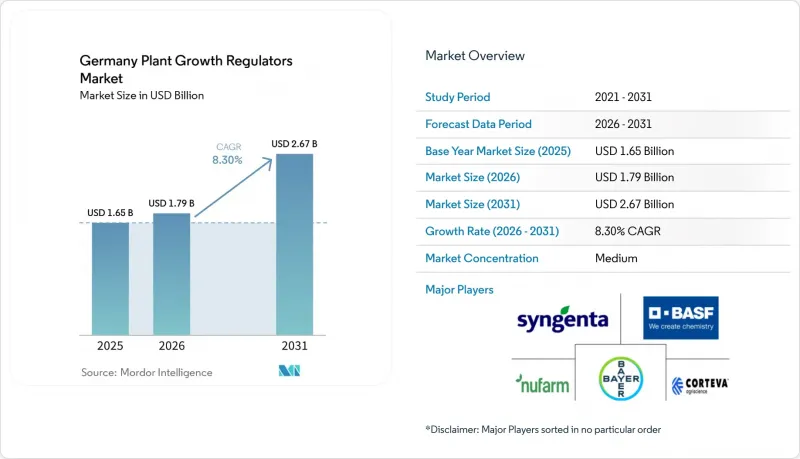
Mordor Intelligence에 의하면, 독일의 식물 성장 조절제 시장 규모는 2025년 16억 5,000만 달러로 평가되었고, 2026년에는 17억 9,000만 달러로 추정되고, 2031년까지 26억 7,000만 달러에 이를 것으로 예측되며, 2026-2031년 CAGR 8.30%로 성장할 전망입니다.
본 보고서는 유형별(옥신, 사이토카이닌, 지베렐린, 에틸렌, 기타), 제형별(액체, 수분산성, 유화성 농축액, 수용성 농축액, 분말 및 과립), 그리고 작물 유형별(곡물, 과일 및 채소, 유지종자 및 콩류, 잔디 및 관상용 식물)로 분류되어 있습니다. 시장 예측치는 금액(달러)으로 표시되어 있습니다.
독일의 식물 성장 조절제 시장 동향 및 분석
고부가가치 작물의 재배 확대
독일의 원예 및 다년생 작물 생산 기반은 식량 공급 목표와 국내 및 수출 시장에서 품질 프리미엄이 높아짐에 따라 확대되고 있습니다. 2025년에 발표된 '원예 행동 계획'은 국내 과일 및 채소 생산을 자급자족 수준까지 끌어올리는 것을 목표로 하고 있으며, 이는 솎아내기, 선과, 숙성 촉진제 사용 확대를 직접적으로 뒷받침하는 것입니다. 이러한 추세에 따라, 식물의 형태와 수확 시기가 수확량과 가격 형성에 모두 영향을 미치는 작물의 경우, 지베렐린, 사이토카이닌, 에테폰, 프로헥사디온 칼슘에 대한 수요가 증가하고 있습니다. 또한, 특히 과일 생산량이 여전히 상업적으로 중요한 바덴뷔르템베르크주와 니더작센주에서는 독일의 식물 성장 조절제 시장의 적용 범위가 곡물의 도복 방지를 넘어 확대되고 있습니다. 경작 면적이 부가가치가 더 높은 작물로 전환됨에 따라, 제품에 대한 수요는 이용 사례별로 확대되고 있으며, 농장 유형별로 회복탄력성이 강화되고 있습니다.
식량 안보 압박 속에서 작물 수확량 최적화에 대한 수요 증가
2025년, 독일에서는 겨울밀이 286만 헥타르, 겨울보리가 121만 헥타르에 걸쳐 재배되었으며, 이에 따라 트리넥사팩에틸 및 클로르메콰트 염화물 수요는 여전히 매우 광범위한 처리 면적에 힘입어 유지되고 있습니다. 쓰러짐 방지는 독일의 식물 성장 조절제 시장에서 특히 겨울 곡물의 경우, 여전히 가장 뚜렷한 수익성 중심 이용 사례 중 하나로 자리 잡고 있습니다. 곡물 작물이 쓰러지면 농가는 수확량 감소, 수확 효율 저하, 곡물 품질 저하에 직면하게 되므로, 다른 투입 자재에 대한 예산이 삭감되더라도 식물 성장 조절제의 사용은 유지되는 경우가 많습니다. 2025년 곡물 가격 하락으로 인해 생산자들은 헥타르당 수익을 보다 예측 가능하게 만들기 위해 노력했고, 이에 따라 수확 가능한 생산량을 보호해야 할 필요성이 커졌습니다. 따라서 독일의 식물 성장 조절제 시장은 연기나 감축이 용이한 다른 투입재 부문에 비해 더 견조한 시장을 형성하고 있습니다.
유럽연합(EU)의 엄격한 승인 체계
유럽연합 규정(EC) 제1107/2009호에 근거한 승인 체계는 여전히 독일의 식물 성장 조절제 시장에 대한 구조적 제약 요인으로 작용하고 있습니다. 독일에서는 연방위험평가연구소 및 연방환경청의 지원을 받아 연방소비자보호·식품안전청이 이 체계를 운영하고 있으며, 그 절차는 증거 요건과 심사 심도 양면 모두에서 여전히 엄격한 수준을 유지하고 있습니다. 연방 소비자 보호·식품 안전청은 2024년, 까다로운 규정 준수 요건과 긴 소요 기간으로 인해 신규 신청 건의 주요 보고국으로서 독일의 매력이 떨어졌습니다고 밝혔습니다. 이로 인해 신규 분자 시장 진입이 지연되고, 포트폴리오 유지 비용이 급증하고 있습니다. 그 결과, 시장에서는 농업적 성능과 마찬가지로 규제상의 접근성이 중요한 요소로 대두되고 있습니다.
부문별 분석
2025년, 독일의 식물 성장 조절제 시장에서 사이토카인은 38.2%를 차지했습니다. 이러한 압도적인 점유율은 총 재배 면적보다는 독일의 과수원, 포도 재배 및 묘목 생산 부문에서 작물 고유의 요건에 기인합니다. 독일의 상업용 과수 재배(Obstbau) 중심지인 바덴-뷔르템베르크주의 사과 및 배 과수원에서는 6-벤질아데닌(6-BA)이 표준적인 사이토카이닌계 솎아내기제로 사용되고 있습니다. 이는 과실 지름이 10-12 mm 단계에서 살포되며, 불필요한 과실을 솎아내는 동시에 남아 있는 과실의 세포 분열을 촉진함으로써 최종 과실 지름을 향상시킵니다. 이러한 이중 작용이 주는 이점은 다른 화학 물질군에서는 찾아볼 수 없는 것입니다. 또한, 독일의 묘목 산업에서는 조직 배양을 통한 증식 프로그램과 모종의 분지 처리를 통해 사이토카이닌에 대한 안정적인 수요가 뒷받침되고 있습니다. 이러한 처리 과정에서 사이토카인 살포는 겨드랑이눈의 발아를 촉진함으로써, 삽목의 수확량을 증가시킵니다.
옥신은 독일 식물 성장 조절제 시장에서 가장 빠르게 성장하고 있는 부문으로, 2026-2031년 연평균 성장률(CAGR) 7.2%를 나타낼 것으로 전망됩니다. 이러한 성장은 관상용 식물의 증식에 있어 기존의 발근 용도와, 바이오 자극제 및 옥신을 결합한 제품의 채택 확대에 힘입어 이루어지고 있습니다. 인돌-3-부티르산(IBA)을 주성분으로 하는 발근제는 독일의 관상용 묘목 및 과수 대목 증식 분야에서 표준적으로 사용되고 있으며, 이러한 분야에서는 증식률이 묘목 생산의 수익성에 직접적인 영향을 미칩니다. 또한, 합성 옥신 제품에서 해조류 유래의 생장촉진제 제제로의 전환이 시장을 확대시키고 있습니다. 『Frontiers in Horticulture』(2024년 5월호)에 게재된 연구에 따르면, 에클로니아 막시마(Ecklonia maxima)에서 유래한 '켈팩(Kelpak)'은 처리하지 않은 대조군과 비교했을 때, 장미 삽목에서 뿌리의 생중량을 62%, 뿌리의 길이를 75% 증가시키는 것으로 입증되었습니다. 이러한 결과는 합성 처리제의 효능을 입증하는 것이며, 생장촉진제와 옥신의 경계가 점점 더 모호해지고 있음을 여실히 보여주고 있어, 이에 따라 옥신 계열 제품의 잠재 시장 전체가 확대되고 있습니다.
기타 혜택 :
- 엑셀 형식 시장 예측(ME) 시트
- 3개월간의 애널리스트 지원
자주 묻는 질문
목차
제1장 서론
제2장 조사 방법
제3장 주요 요약
제4장 시장 구도
제5장 시장 규모 및 성장 예측
제6장 경쟁 구도
제7장 시장 기회 및 향후 전망
AJY 26.07.07According to Mordor Intelligence, the germany plant growth regulators market size is projected to increase from USD 1.65 billion in 2025 to USD 1.79 billion in 2026 and reach USD 2.67 billion by 2031, growing at a CAGR of 8.30% over 2026-2031.
This report is Segmented by Type (Auxins, Cytokinin, Gibberellins, Ethylene, and Others), by Formulation (Liquid, Water-Dispersible, Emulsifiable Concentrate, Soluble Concentrate, and Powders and Granules), and by Crop Type (Cereals and Grains, Fruits and Vegetables, Oilseeds and Pulses, and Turf and Ornamentals). The Forecasts are Provided in Terms of Value (USD).
Germany Plant Growth Regulators Market Trends and Insights
Expansion of High-Value Crop Cultivation
Germany's horticulture and permanent crop base is expanding in response to food supply goals and stronger quality premiums in domestic and export channels. The Horticulture Action Plan announced in 2025 aimed to raise domestic fruit and vegetable production to a level of self-sufficiency, which directly supports greater use of thinning, sizing, and ripening products. This trend lifts demand for gibberellins, cytokinins, ethephon, and prohexadion-calcium in crops where plant architecture and harvest timing affect both yield and price realization. It also widens the application base of the Germany plant growth regulators market beyond cereal lodging control, especially in Baden-Wurttemberg and Lower Saxony, where fruit output remains commercially significant. As acreage shifts toward more value-dense crops, product demand becomes broader by use case and more resilient by farm type.
Rising Demand for Crop Yield Optimization Under Food Security Pressures
Germany planted 2.86 million hectares of winter wheat and 1.21 million hectares of winter barley in 2025, which keeps demand for trinexapac-ethyl and chlormequat chloride tied to a very large treated area. Lodging prevention remains one of the clearest return-driven use cases in the Germany plant growth regulators market, especially in winter cereals. When cereal crops lodge, farms face yield loss, harvest inefficiency, and grain quality downgrades, so plant growth regulation is often maintained even as other input decisions are tightened. Lower cereal prices in 2025 increased the need to protect harvestable output, as growers sought a more predictable return per hectare. That makes the Germany plant growth regulators market more durable than input categories that are easier to postpone or reduce.
Stringent European Union Approval Framework
The approval framework under European Union Regulation (EC) No 1107/2009 remains a structural restraint on the Germany plant growth regulators market. Germany applies this framework through the Federal Office of Consumer Protection and Food Safety, with support from the Federal Institute for Risk Assessment and the Federal Environment Agency, and the process has remained demanding in both evidence requirements and review depth. The Federal Office of Consumer Protection and Food Safety stated in 2024 that high compliance demands and long timelines had made Germany less attractive as a central rapporteur location for new files. That slows the entry of new molecules and raises the cost of maintaining portfolios. The result is a market where regulatory access can matter as much as agronomic performance.
Other drivers and restraints analyzed in the detailed report include:
- Greater Focus on Sustainable and Resource-Efficient Farming
- Convergence Between Biostimulants and Growth Regulators
- Variable Farm Income and Weaker Commodity Prices
For complete list of drivers and restraints, kindly check the Table Of Contents.
Segment Analysis
Cytokinins accounted for 38.2% of the Germany plant growth regulators market in 2025. This dominance is attributed to the crop-specific requirements of Germany's fruit orchards, viticulture, and nursery plant sectors, rather than the total treated area. In apple and pear orchards located in Baden-Wurttemberg, the hub of Germany's commercial fruit production (Obstbau), 6-Benzyladenin (6-BA) is the standard cytokinin thinning agent. It is applied at the 10-12 mm fruitlet stage to thin excess fruits while promoting cell division in retained fruits, thereby enhancing the final fruit diameter. This dual-action benefit is unmatched by other chemical classes. Additionally, Germany's nursery plant industry supports consistent demand for cytokinins through tissue culture propagation programs and stock plant branching treatments, where cytokinin applications increase cutting yields by stimulating axillary bud break.
Auxins are the fastest-growing segment in Germany plant growth regulators market share, with a projected CAGR of 7.2% from 2026 to 2031. This growth is driven by traditional rooting applications in ornamental propagation and the increasing adoption of biostimulant-auxin convergence products. Indole-3-butyric acid (IBA)-based rooting preparations are standard in Germany's ornamental nursery and fruit tree rootstock propagation sectors, where propagation rates directly impact nursery economics. Additionally, the shift from synthetic auxin products to seaweed-derived biostimulant formulations is expanding the market. A study published in Frontiers in Horticulture (May 2024) demonstrated that Kelpak, derived from Ecklonia maxima, increased root fresh weight by 62% and root length by 75% in rose cuttings compared to untreated controls. These results approach the efficacy of synthetic treatments, highlighting the growing overlap between biostimulants and auxins, which is broadening the total addressable market for auxin-type products.
Complete Report Scope:
- By Type
- Auxins
- Cytokinins
- Gibberellins
- Ethylene
- Others
- By Formulation
- Liquid
- Water-dispersible options
- Emulsifiable concentrates
- Soluble concentrates
- Powders and granules
- By Crop Type
- Cereals and grains
- Fruits and vegetables
- Oilseeds and pulses
- Turf and ornamentals
List of Companies Covered in this Report:
- BASF SE
- Bayer AG
- Syngenta AG
- Nufarm Limited
- UPL Limited
- Certis Belchim B.V.
- Sumitomo Chemical Co., Ltd.
- Bergophor GmbH
- Stahler International GmbH and Co. KG
- Corteva, Inc.
- Gowan Company
- ABITEP GmbH
- STAR Agro Handels GmbH
- AlzChem Group AG
- Fine Agrochemicals Ltd.
Additional Benefits:
- The market estimate (ME) sheet in Excel format
- 3 months of analyst support
TABLE OF CONTENTS
1 Introduction
- 1.1 Study Assumptions and Market Definition
- 1.2 Scope of the Study
2 Research Methodology
3 Executive Summary
4 Market Landscape
- 4.1 Market Overview
- 4.2 Market Drivers
- 4.2.1 Expansion of high-value crop cultivation
- 4.2.2 Rising demand for crop yield optimization under food security pressure
- 4.2.3 Greater focus on sustainable and resource-efficient farming
- 4.2.4 Convergence between biostimulants and growth regulators
- 4.2.5 National Action Plan for sustainable plant protection use
- 4.2.6 Digital agriculture adoption for precision application
- 4.3 Market Restraints
- 4.3.1 Stringent European Union approval framework
- 4.3.2 Variable farm income and weaker commodity prices
- 4.3.3 Review pressure on key synthetic active ingredients
- 4.3.4 Slow authorization of new active substances
- 4.4 Regulatory Landscape
- 4.5 Technological Outlook
- 4.6 Porter's Five Forces Analysis
- 4.6.1 Threat of new entrants
- 4.6.2 Bargaining power of suppliers
- 4.6.3 Bargaining power of buyers
- 4.6.4 Threat of substitutes
- 4.6.5 Intensity of competitive rivalry
5 Market Size and Growth Forecasts (Value, USD)
- 5.1 By Type
- 5.1.1 Auxins
- 5.1.2 Cytokinins
- 5.1.3 Gibberellins
- 5.1.4 Ethylene
- 5.1.5 Others
- 5.2 By Formulation
- 5.2.1 Liquid
- 5.2.2 Water-dispersible options
- 5.2.3 Emulsifiable concentrates
- 5.2.4 Soluble concentrates
- 5.2.5 Powders and granules
- 5.3 By Crop Type
- 5.3.1 Cereals and grains
- 5.3.2 Fruits and vegetables
- 5.3.3 Oilseeds and pulses
- 5.3.4 Turf and ornamentals
6 Competitive Landscape
- 6.1 Market Concentration
- 6.2 Strategic Moves
- 6.3 Market Share Analysis
- 6.4 Company Profiles (Includes Global Level Overview, Market Level Overview, Core Business Segments, Financials, Key Information, Market Rank, Market Share, Products and Services, and Analysis of Recent Developments)
- 6.4.1 BASF SE
- 6.4.2 Bayer AG
- 6.4.3 Syngenta AG
- 6.4.4 Nufarm Limited
- 6.4.5 UPL Limited
- 6.4.6 Certis Belchim B.V.
- 6.4.7 Sumitomo Chemical Co., Ltd.
- 6.4.8 Bergophor GmbH
- 6.4.9 Stahler International GmbH and Co. KG
- 6.4.10 Corteva, Inc.
- 6.4.11 Gowan Company
- 6.4.12 ABiTEP GmbH
- 6.4.13 STAR Agro Handels GmbH
- 6.4.14 AlzChem Group AG
- 6.4.15 Fine Agrochemicals Ltd.