|
시장보고서
상품코드
2072819
미국의 광업 물류 시장 : 점유율 분석, 업계 동향과 통계, 성장 예측(2026-2031년)United States Mining Logistics - Market Share Analysis, Industry Trends & Statistics, Growth Forecasts (2026 - 2031) |
||||||
 Mordor Intelligence
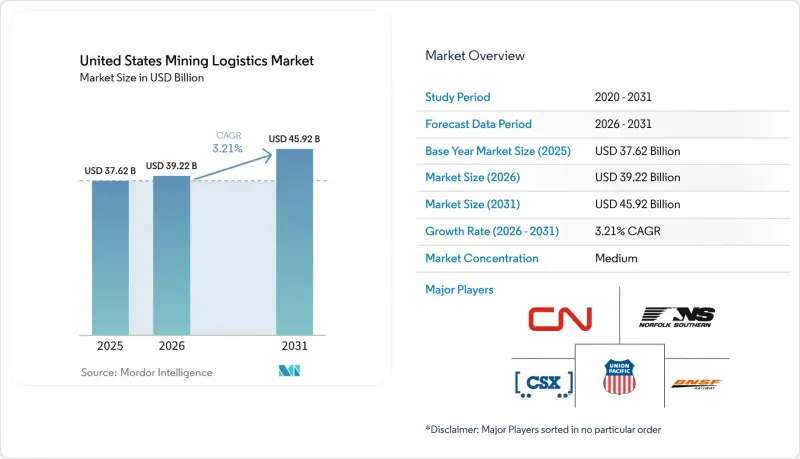
Mordor Intelligence에 의하면, 미국 광업 물류 시장 규모는 2025년에 376억 2,000만 달러로 평가되었고 2026년 392억 2,000만 달러에서 2031년까지 459억 2,000만 달러에 이를 것으로 예측되며, 2026년부터 2031년까지 예측 기간 CAGR은 3.21%를 나타낼 전망입니다.
연방 정부의 정책에 힘입어 물류 수요가 증가하고 있습니다. 이것은 “'프로젝트 볼트' 이는 120억 달러 규모의 중요 광물 비축 체계를 도입했기 때문이며, 본격적인 상업 생산이 시작되기 전에 운송 경로 계획, 저장 능력 및 안전한 취급이 필요하기 때문입니다. 본 보고서는 서비스별(운송(도로, 철도, 해상 및 내륙 수로, 항공), 창고·재고 관리, 부가가치 서비스), 상품별(철광석, 야금용 및 일반 석탄, 비귀금속(Cu, Zn, Ni), 금, 기타 광물·금속), 지역별(북동부, 남서부, 서부, 남동부, 중서부)로 분류되어 있습니다. 시장 전망은 금액(달러) 기준으로 제시되어 있습니다.
미국 광업 물류 시장 동향과 인사이트
중요 광물의 국내 회귀 및 국내 인수
연방 정부가 자문 중심의 지원에서 직접 조달로 방침을 전환함에 따라, 미국의 광업 물류 시장에는 프로젝트와 연계된 보다 지속적인 수요가 발생하고 있습니다. Project Vault가 보유한 120억 달러 규모의 비축량은 정책의 취지를 전국 규모의 안전한 운송, 보관 및 체계적인 재고 관리라는 물류 요건으로 전환하는 것입니다. 2026년 1월, 상무부는 USA 레어어스사와 텍사스주의 라운드탑 프로젝트와 연계된 ““광산에서 자석까지”공급망에 관한 의향서를 발송했습니다. 이 프로젝트에서는 하루에 4만 메트르톤의 희토류 및 중요 광물 원료를 채굴할 계획입니다. 이로 인해, 일반적인 화물량이 운송 데이터에 반영되기 전에 물류 사업자가 프로젝트 설계 단계부터 참여하게 되어 업무 흐름이 변화하고 있습니다. 스위칭, 환적, 안전한 보관, 장기적인 운송 통로 지원을 결합할 수 있는 사업자는 생산이 본격화된 후의 단기 운송을 쫓는 것보다 수년에 걸친 계약을 확보하는 데 있어 유리한 입장에 있습니다. 2025년 6월 와토코사가 듀레이션 캐피털 파트너스로부터 유치한 6억 달러 규모의 투자는 단절된 교통 회랑에서 민간 자본이 이미 이러한 접근 방식을 지원하고 있음을 보여줍니다.
철도 및 항만 회랑의 현대화
회랑의 개선을 통해 광산, 철도, 수출 경로를 가로지르며 미국의 광업 물류 시장을 뒷받침하는 물리적 핵심 인프라가 개선되고 있습니다. BNSF는 2026년을 목표로 36억 달러 규모의 설비 투자 계획을 발표했습니다. 이 계획은 벌크 광물 운송업체와 관련된 선로 개량, 터미널 확장 및 네트워크 신뢰성 향상을 목적으로 하고 있습니다. 연방철도청(FRA)의 2025-2026 회계연도 CRISI 주기에서는 41개 주에 걸친 122건의 철도 개선 프로젝트에 20억 달러 이상이 배정되어, 화물 운송의 혼잡 완화, 교량 개보수 및 항만으로의 철도 접근성 향상을 실질적으로 지원하고 있습니다. CSX는 2025년에 하워드 스트리트 터널의 더블 스택 대응 고가 확장 공사를 완료했으며, 이를 통해 볼티모어 회랑에서 보다 유연한 노선 설정이 가능해짐으로써, 오랫동안 지속되어 온 네트워크상의 제약 중 하나가 해소되었습니다. 또한, 조지아주 게인즈빌 내륙항도 2026년 5월 사바나행 일일 철도 운행을 시작하며 소프트 오픈을 맞이했습니다. 이는 혼잡한 연안 거점의 교통량을 분산시키기 위해 내륙 철도와 항만의 연계가 어떻게 구축되고 있는지를 보여줍니다. 공적 자금의 상당 부분이 규제 준수 및 복합운송 체계 구축에 연계됨에 따라, 회랑의 현대화가 미국 광업 물류 시장에서 어디에서 가장 신속하게 운송 능력을 확대할 수 있는지를 결정하는 요인이 되고 있습니다.
광산 허가 지연과 프로젝트 지연
허가 취득 지연으로 인해 프로젝트 승인이 완전히 내려질 때까지 신규 광산 공급물을 운송할 수 없기 때문에 이는 미국 광업 물류 시장의 발목을 계속 잡고 있습니다. 내무성은 미국에서 신규 경암 광산의 허가를 취득하는 데 역사적으로 7년에서 10년이 소요되어 왔으며, 탐사부터 첫 생산에 이르기까지의 전체 과정에서는 훨씬 더 긴 기간이 소요되어 왔습니다고 지적하고 있습니다. 광산이 상업 생산 단계에 도달하기 전에 회랑에 대한 투자가 이루어져야 하는 경우가 많기 때문에 이로 인해 정책 목표와 물류 계획 사이에 불일치가 발생하고 있습니다. 승인 일정이 지연될 경우, 지선, 터미널 또는 광산과 직접 연결된 하역 시설에 대한 초기 투자가 장기간에 걸쳐 충분히 활용되지 못한 채 방치될 가능성이 있습니다. 또한, 이러한 불확실성으로 인해 향후 광산과 관련된 초기 단계의 물류 자산에 대한 자금 조달 시 민간 자본의 선별 기준이 엄격해지는 경향도 있습니다. 이러한 시기적 위험으로 인해, 미국의 광업 물류 시장에서는 표면적인 수요 동향이 시사하는 만큼 신속하게 정책 지원을 화물량 증가로 이어가지 못하고 있습니다.
부문별 분석
2025년, 운송 부문은 미국 광업 물류 시장 점유율의 69.12%를 차지하며, 다른 부문을 크게 앞지르고 최대 서비스 부문이 되었습니다. 철도는 특히 대량의 수송량과 낮은 단위 비용이 요구되는 석탄, 구리, 철광석의 운송 경로에서 장거리 벌크 수송의 구조적 핵심 역할을 계속하고 있습니다. 트럭 운송은 외딴 지역의 광산에서 철도 환승 지점까지의 '퍼스트 마일' 그리고 '라스트 마일'의 운송을 계속해서 담당하고 있으며, 철도망과 연결되지 않은 지역에서의 운영에도 대응하고 있습니다. 해상 및 내륙 수로는 석탄 수출, 오대호의 철광석 수송, 미시시피강으로 연결되는 산업용 광물 수송에서 여전히 중요한 역할을 하고 있습니다. 2026년 3월 LOGISTEC이 Logistics Park Dubuque를 인수함에 따라, 중서부의 대규모 생산자와 멕시코만 연안의 수출 관문을 연결하는 내륙 운송 노선이 강화되었습니다.
부가가치 서비스는 연평균 성장률(CAGR) 3.86%로 확대될 것으로 예상되며, 2031년까지 미국 광업 물류 시장에서 가장 빠르게 성장하는 분야가 될 전망입니다. 미국의 광업 물류 업계에서는 국내 수거 계약이 더욱 공식화됨에 따라, 품위 검증, 재고 가시화 및 디지털 보관 이력 기록에 대한 수요가 증가하고 있습니다. 구매자들이 원산지 증명서나 각 운송 지점에서의 관리된 취급 절차를 점점 더 요구하게 됨에 따라, 이러한 서비스들은 더 이상 특수 광물 계약에서 선택적인 부가 서비스로 간주되지 않게 되었습니다. 또한, 전략적 비축 프로그램이나 안전한 광물 보관을 위해서는 일반적인 공공 창고가 아닌, 보세 시설이자 감사에 대응할 수 있는 거점이 필요하기 때문에 창고 보관 및 재고 관리의 중요성도 높아지고 있습니다. 따라서 미국의 광업 물류 시장의 수익 구조는 물리적 운송에 더해 규정 준수 및 데이터 서비스를 제공할 수 있는 사업자로 점차 전환되고 있습니다.
기타 혜택:
- 엑셀 형식 시장 예측(ME) 시트
- 3개월간의 애널리스트 지원
자주 묻는 질문
목차
제1장 서론
제2장 조사 방법
제3장 주요 요약
제4장 시장 구도
제5장 시장 규모와 성장 예측
제6장 경쟁 구도
제7장 시장 기회와 향후 전망
JHSAccording to Mordor Intelligence, the united states mining logistics market size was valued at USD 37.62 billion in 2025 and estimated to grow from USD 39.22 billion in 2026 to reach USD 45.92 billion by 2031, at a CAGR of 3.21% during the forecast period 2026-2031.
Federal action is pushing up logistics demand because Project Vault has introduced a USD 12 billion critical minerals reserve that requires corridor planning, storage capacity, and secure handling before full commercial output comes online. This report is Segmented by Service (Transportation (Road, Rail, Sea and Inland Waterways, Air), Warehousing and Inventory Management, Value-Added Services), by Commodity (Iron Ore, Metallurgical and Thermal Coal, Base Metals (Cu, Zn, Ni), Gold, Other Minerals/Metals), and by Geography (Northeast, Southwest, West, Southeast, Midwest). The Market Forecasts are Provided in Terms of Value (USD).
United States Mining Logistics Market Trends and Insights
Critical-Mineral Reshoring and Domestic Offtake
The federal shift from advisory support to direct procurement is giving the United States mining logistics market more durable project-linked demand. Project Vault's USD 12 billion reserve converts policy intent into a logistics requirement for secure movement, storage, and controlled inventory management at a national scale. In January 2026, the Department of Commerce issued a letter of intent with USA Rare Earth for a mine-to-magnet supply chain tied to the Round Top project in Texas, where the site is planned to extract 40,000 metric tons per day of rare earth and critical mineral feedstock. That changes the operating sequence because logistics providers are now being drawn into project design before normal freight volumes appear in shipment data. Operators that can combine switching, transloading, secure storage, and long-term corridor support are better positioned to win multi-year contracts rather than chasing spot moves after production ramps. Watco's June 2025 USD 600 million investment from Duration Capital Partners shows how private capital is already backing that approach in fragmented corridors.
Rail and Port Corridor Modernization
Corridor upgrades are improving the physical backbone that supports the United States mining logistics market across mine, rail, and export links. BNSF announced a USD 3.6 billion capital investment plan for 2026 that targets track renewal, terminal expansion, and network reliability improvements relevant to bulk mineral shippers. The Federal Railroad Administration's 2025-2026 CRISI cycle disbursed more than USD 2 billion across 122 rail improvement projects in 41 states, which materially supports freight congestion relief, bridge rehabilitation, and port rail access. CSX completed the Howard Street Tunnel double-stack clearance expansion in 2025, which opened more flexible routing on the Baltimore corridor and reduced one long-standing network constraint. The Gainesville Inland Port in Georgia also began its soft opening in May 2026 with daily rail service to Savannah, showing how inland rail-port links are being built to redistribute traffic away from congested coastal nodes. As more public funding is tied to compliance and intermodal readiness, corridor modernization is increasingly shaping where the United States mining logistics market can add capacity fastest.
Mine Permitting Delays and Project Slippage
Permitting delays continue to slow the United States mining logistics market because new mine supply cannot move until project approvals are fully in place. The Department of the Interior noted that the permitting phase for new United States hard-rock mines has historically taken 7 to 10 years, and the full path from exploration to first production has historically been far longer. That creates a mismatch between policy ambition and logistics planning, because corridor investment often needs to occur before a mine reaches commercial production. When approval schedules slip, early investments in branch lines, terminals, or mine-linked handling sites can sit underused for extended periods. The same uncertainty also makes private capital more selective when funding early-stage logistics assets tied to future mines. This timing risk keeps the United States mining logistics market from converting policy support into freight growth as quickly as headline demand signals might suggest.
Other drivers and restraints analyzed in the detailed report include:
- Domestic Processing Localization For Battery Materials
- Export Resilience In Coal And Industrial Minerals
- Remote-Haul Driver Scarcity and Wage Inflation
For complete list of drivers and restraints, kindly check the Table Of Contents.
Segment Analysis
Transportation held 69.12% of the United States mining logistics market share in 2025, making it the largest service category by a wide margin. Rail remains the structural backbone for long-haul bulk movements, especially on coal, copper, and iron ore corridors that favor high tonnage and lower unit costs. Trucking still handles first-mile and last-mile moves from remote mines to rail interchange points and serves operations outside rail-connected networks. Sea and inland waterways stay relevant for coal exports, Great Lakes iron ore flows, and Mississippi-linked industrial mineral traffic. LOGISTEC's March 2026 acquisition of Logistics Park Dubuque strengthened inland routing options between Midwest bulk producers and Gulf Coast export gateways.
Value-added services are projected to grow at a 3.86% CAGR, making it the fastest-expanding part of the United States mining logistics market size through 2031. The United States mining logistics industry is adding more demand for grade verification, inventory visibility, and digital chain-of-custody records as domestic offtake agreements become more formal. These services are no longer treated as optional extras in specialty mineral contracts because buyers increasingly want proof of origin and controlled handling across each transfer point. Warehousing and inventory management also gains relevance because strategic reserve programs and secure mineral storage need bonded, audit-ready sites instead of standard public warehouses. The margin structure of the United States mining logistics market is therefore shifting toward operators that can layer compliance and data services on top of physical transport.
Complete Report Scope:
- By Service
- Transportation
- Road
- Rail
- Sea and Inland Waterways
- Air
- Warehousing and Inventory Management
- Value-Added Services
- Transportation
- By Commodity
- Iron Ore
- Metallurgical and Thermal Coal
- Base Metals (Cu, Zn, Ni)
- Gold
- Other Minerals/Metals
- By Geography
- Northeast
- Southwest
- West
- Southeast
- Midwest
List of Companies Covered in this Report:
- Union Pacific Railroad
- BNSF Railway
- Norfolk Southern Railway
- CSX Transportation
- Canadian National Railway
- Watco
- OmnITRAX
- Patriot Rail Company
- Genesee and Wyoming
- Jaguar Transport Holdings
- Savage
- PLS Logistics Services
- Sheer Logistics
- Luminary Logistics Solutions
- Monarch Group International
- Gulf of America Logistics
- Creative Railcar Marketing Services (CRMS)
- BlackBridge Logistics
- R. J. Corman Railroad Group
- LOGISTEC
Additional Benefits:
- The market estimate (ME) sheet in Excel format
- 3 months of analyst support
TABLE OF CONTENTS
1 Introduction
- 1.1 Study Assumptions and Market Definition
- 1.2 Scope of the Study
2 Research Methodology
3 Executive Summary
4 Market Landscape
- 4.1 Market Overview
- 4.2 Strategic Logistics Corridor Analysis
- 4.3 Infrastructure and Modal Mix Analysis
- 4.4 Market Drivers
- 4.4.1 Critical-Mineral Reshoring and Domestic Offtake
- 4.4.2 Rail and Port Corridor Modernization
- 4.4.3 Domestic Processing Localization for Battery Materials
- 4.4.4 Export Resilience in Coal and Industrial Minerals
- 4.4.5 Rail-Interchange Visibility and Control-Tower Digitization
- 4.4.6 Strategic Mineral Stockpiling and Secure Storage Nodes
- 4.5 Market Restraints
- 4.5.1 Mine Permitting Delays and Project Slippage
- 4.5.2 Remote-Haul Driver Scarcity and Wage Inflation
- 4.5.3 Processing Bottlenecks after Mine Output Growth
- 4.5.4 Short-Line Interchange Friction at Bulk Handoff Nodes
- 4.6 Value / Supply-Chain Analysis
- 4.7 Regulatory Landscape
- 4.8 Technological Outlook
- 4.9 Porter's Five Forces Analysis
- 4.9.1 Threat of New Entrants
- 4.9.2 Bargaining Power of Suppliers
- 4.9.3 Bargaining Power of Buyers
- 4.9.4 Threat of Substitutes
- 4.9.5 Intensity of Rivalry
- 4.10 Impact of Geopolitical Events on the Market
5 Market Size and Growth Forecasts
- 5.1 By Service
- 5.1.1 Transportation
- 5.1.1.1 Road
- 5.1.1.2 Rail
- 5.1.1.3 Sea and Inland Waterways
- 5.1.1.4 Air
- 5.1.2 Warehousing and Inventory Management
- 5.1.3 Value-Added Services
- 5.1.1 Transportation
- 5.2 By Commodity
- 5.2.1 Iron Ore
- 5.2.2 Metallurgical and Thermal Coal
- 5.2.3 Base Metals (Cu, Zn, Ni)
- 5.2.4 Gold
- 5.2.5 Other Minerals/Metals
- 5.3 By Geography
- 5.3.1 Northeast
- 5.3.2 Southwest
- 5.3.3 West
- 5.3.4 Southeast
- 5.3.5 Midwest
6 Competitive Landscape
- 6.1 Market Concentration
- 6.2 Strategic Moves
- 6.3 Market Share Analysis
- 6.4 Company Profiles (Includes Global Level Overview, Market Level Overview, Core Segments, Financials as Available, Strategic Information, Market Rank/Share for Key Companies, Products and Services, and Recent Developments)
- 6.4.1 Union Pacific Railroad
- 6.4.2 BNSF Railway
- 6.4.3 Norfolk Southern Railway
- 6.4.4 CSX Transportation
- 6.4.5 Canadian National Railway
- 6.4.6 Watco
- 6.4.7 OmniTRAX
- 6.4.8 Patriot Rail Company
- 6.4.9 Genesee and Wyoming
- 6.4.10 Jaguar Transport Holdings
- 6.4.11 Savage
- 6.4.12 PLS Logistics Services
- 6.4.13 Sheer Logistics
- 6.4.14 Luminary Logistics Solutions
- 6.4.15 Monarch Group International
- 6.4.16 Gulf of America Logistics
- 6.4.17 Creative Railcar Marketing Services (CRMS)
- 6.4.18 BlackBridge Logistics
- 6.4.19 R. J. Corman Railroad Group
- 6.4.20 LOGISTEC
7 Market Opportunities and Future Outlook
- 7.1 White-space and unmet-need assessment