

|
시장보고서
상품코드
2072825
심박수 모니터 시장 : 점유율 분석, 업계 동향과 통계, 성장 예측(2026-2031년)Heart Rate Monitor - Market Share Analysis, Industry Trends & Statistics, Growth Forecasts (2026 - 2031) |
||||||
 Mordor Intelligence
Mordor Intelligence에 의하면, 심박수 모니터 시장 규모는 2025년 25억 2,000만 달러에서 2026년에는 27억 8,000만 달러로 확대되어 2031년까지 45억 2,000만 달러에 이를 것으로 예상되고 있어 2026년부터 2031년까지 CAGR 10.22%로 성장할 전망입니다.
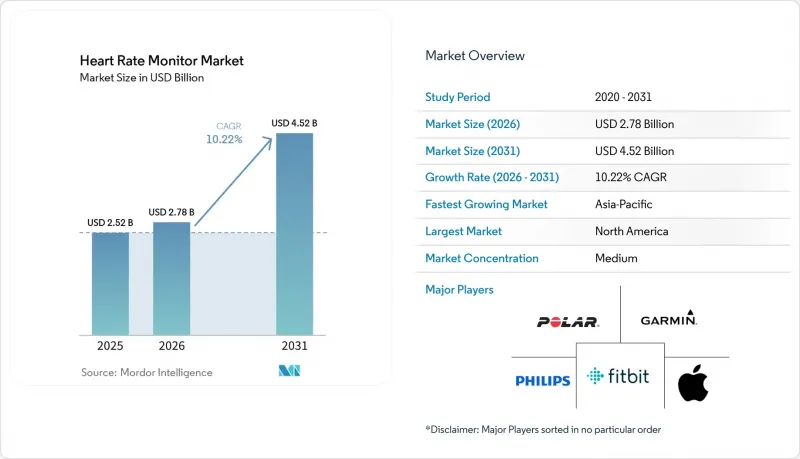
본 보고서는 제품 유형(손목 밴드형, 가슴 스트랩형 등), 기술(광학식 PPG 등), 용도(피트니스, 의료, 원격 환자 모니터링 등), 최종 사용자(병원, 재택치료, 피트니스 센터 등), 지역(북미, 유럽, 아시아태평양 등)별로 분류되어 있습니다. 시장 전망은 금액(달러) 기준으로 제시되어 있습니다.
전 세계 심박수 모니터 시장 동향 및 인사이트
비급성기 환경에서의 심혈관 검진 증가
심박수 모니터 시장은 심장 검진이 병원이라는 환경에서 지역 사회나 가정 환경에서의 일상적인 이용으로 전환됨에 따라 변화를 겪고 있습니다. 심혈관 질환의 높은 유병률은 임상적 개입을 최소화하면서도 심장 건강 상태를 빈번하게 모니터링할 수 있는 도구의 도입을 촉진하고 있습니다. 바젤 웨어러블 클리닉의 임상 모델은 병원 외 환경에서의 원격 심전도 진단 및 원격 진료의 실현 가능성을 입증했습니다. 이러한 변화에 따라 기업 대상 프로그램, 약국 내 선별 검사, 소비자 직접 판매 채널이 주요 성장 분야로 자리매김했으며, 고객 기반은 심장 질환 진단을 받은 환자를 넘어 확대되고, 다양한 가격대에 대응할 수 있게 되었습니다. 향후 이 모델은 특히 원격 사후 관리 서비스 제공이 가능한 분야에서 소비자용 및 임상용 각 부문에 걸친 시장 성장을 주도할 것으로 예측됩니다.
심박수의 연속 추적이 웰니스의 핵심 기능으로
소비자의 기대는 변화하고 있으며, 지속적인 심박수 추적 기능은 더 이상 프리미엄 기능이 아니라 표준 기능으로 간주되고 있습니다. 2025년 9월, 애플은 Apple Watch Series 11에 만성 고혈압 알림 기능과 24시간 연속 심박수 측정이 가능한 배터리 수명을 도입했습니다. 이에 이어 2026년 3월, 삼성은 미국의 갤럭시 워치 사용자를 대상으로 혈압 모니터링 기능을 제공했습니다. WHOOP의 보고에 따르면, 이 회사의 250만 명 회원은 하루에 8회 이상 앱을 이용하고 있으며, 지속적으로 앱을 사용하는 사용자들에서는 운동량과 심박 변이도 증가가 확인되었습니다. 이러한 변화는 시장이 센서 경쟁에서 지침, 치료 순응도, 일상적인 참여로 초점을 옮기고 있음을 여실히 보여주고 있습니다. 모니터링 기능에 코칭 및 습관 정착 지원을 통합한 브랜드는 가입자 유지와 수익 성장 측면에서 유리한 입장에 있습니다.
격렬한 운동이나 땀을 많이 흘리는 상황에서 정확도의 한계
심박수 모니터, 특히 손목에 착용하는 광학식 기기는 격렬한 움직임이 동반되는 환경에서 정확도 측면에서 어려움을 겪고 있습니다. 2025년에 실시된 연구에 따르면, 의료 인증을 받은 손목 착용형 PPG 기기는 안정성 관상동맥 질환 및 만성 심부전 환자의 일상 활동 중 심박수와 에너지 소비량을 모니터링하는 데 있어 정확도가 낮고 반응성도 중간 수준인 것으로 밝혀졌습니다. 심장 질환 환자의 경우, 건강한 운동선수보다 기기의 성능이 치료 방침 결정에 있어 더 중요하기 때문에 이러한 제한은 매우 심각합니다. 많은 일반용 웨어러블 제품의 주장은 복잡한 생리학적 상태에 관한 기존 증거를 뛰어넘고 있어, 그 결과 의사나 보험 급여 기관은 이러한 제품의 도입에 신중한 태도를 보이고 있습니다. 환자별 알고리즘의 발전과 보다 광범위한 임상 검증이 이루어지지 않는다면, 시장은 정확한 작동 상태 모니터링이 필요한 고부가가치 이용 사례에서 계속해서 어려움을 겪게 될 것입니다.
부문별 분석
2025년, 손목 착용형 기기는 심박수 모니터 시장 점유율의 49.6%를 차지하며 1위 자리를 지켰습니다. 이러한 우위는 Apple, Samsung, Garmin, Xiaomi, WHOOP 등 일반 소비자용 웨어러블 시장에서 확고한 입지를 다진 브랜드들에 의해 주도되고 있습니다. 가민의 피트니스 부문은 2026년 1분기 매출이 5억 4,700만 달러를 기록하며 전년 동기 대비 42% 증가했습니다. 이는 첨단 리스트형 플랫폼에 대한 수요가 지속되고 있음을 반영합니다. 현재 프리미엄 스마트 워치는 상시 추적 기능과 정교한 심혈관 모니터링 기능을 갖추고 있어, 이전에는 별도의 웰니스 기기에 의존하던 사용자들을 끌어들이고 있습니다.
2026년부터 2031년까지 연평균 성장률(CAGR) 11.3%를 나타낼 것으로 예측되는 가슴 스트랩은 격렬한 운동 시의 정확성과 보다 선명한 심전도(ECG) 스타일 신호에 대한 시장의 관심을 여실히 보여주고 있습니다. 이러한 보급은 운동선수, 체계적인 훈련 프로그램, 그리고 신호의 정확도 향상이 요구되는 이용 사례에 의해 뒷받침되고 있습니다. 손가락 착용형 모니터도 그 기세를 더해가고 있으며, 귀 착용형 기기도 정확도를 높이는 멀티모달 설계를 통해 그 가능성을 보여주고 있습니다. 독립형 모니터는 외래 진단이나 단기 모니터링에서 여전히 중요한 역할을 하고 있습니다. 시장에는 다양한 제품 구성이 나타나고 있으며, 손목 착용형 기기가 시장 규모를 주도하는 한편, 가슴 스트랩이나 신흥 형식의 기기들이 정확도 및 폼 팩터에 대한 요구를 충족시키고 있습니다.
2025년에는 광전 맥파계(PPG) 모니터링이 기술 매출의 59.8%를 차지했습니다. 이는 높은 비용 대비 효과, 통합의 용이성, 그리고 소비자에게 친숙하다는 점 덕분입니다. 애플이 여러 개의 PPG 센서, 가속도계 및 머신러닝 모델을 도입함으로써 확장성은 향상되었지만, 격렬한 운동 중이나 특정 환자 집단에서 정확도를 높이는 데는 여전히 과제가 남아 있습니다. PPG는 여전히 판매 대수 면에서 1위를 차지하고 있지만, 임상적 타당성을 입증해야 한다는 압박에 직면해 있습니다.
2026년부터 2031년까지 연평균 성장률(CAGR) 11.8%를 나타낼 것으로 예측되는 하이브리드 센싱은 PPG와 ECG 및 기타 센서를 결합함으로써 신뢰성과 진단 가치를 높입니다. WHOOP의 FDA 승인을 받은 ECG 하드웨어와 Withings 등 여러 브랜드가 제공하는 프리미엄 플랫폼은 멀티 센서 솔루션으로의 전환을 여실히 보여주고 있습니다. 조사에 따르면, 소프트웨어의 발전으로 인해 PPG 신호로부터 ECG와 같은 출력을 재구성할 수 있음이 밝혀졌으며, 알고리즘 품질의 중요성이 강조되고 있습니다. 현재 임상 워크플로우에서는 심전도(ECG) 기반 시스템이 주류를 이루고 있지만, 하이브리드 센싱 기술은 프리미엄 임상 시장 및 소비자 시장에서 성장이 예상되며, 경쟁력 있는 다층적인 기술 환경이 형성될 전망입니다.
지역별 분석
2025년, 북미는 심박수 모니터 시장에서 41.2%의 점유율을 차지하며 선도적인 위치를 유지했습니다. 이러한 우위는 높은 의료비 지출, 만성 심혈관 질환 위험에 노출된 인구가 많다는 점, 그리고 웨어러블 및 휴대용 모니터링 기기의 성숙한 인프라에 기인합니다. 이 지역은 원격 모니터링 서비스, 의사의 감독, 그리고 일상적인 간호에 연결 기기를 활용하는 것이 강력하게 통합되어 있는 이점을 누리고 있습니다.
아시아태평양은 심박수 모니터 시장에서 가장 빠르게 성장하는 지역으로, 2026년부터 2031년까지 연평균 성장률(CAGR) 13.0%를 나타낼 것으로 전망됩니다. 웨어러블 기기의 높은 소비자 보급률과 원격 및 재택 모니터링에 대한 수요 증가가 이러한 성장을 주도하고 있습니다. 중국과 인도에서는 원격의료의 확대와 합리적인 가격의 기기가 호재로 작용하고 있는 반면, 일본에서는 고령화에 따라 장기적인 건강 상태 추적에 대한 수요가 증가하고 있습니다. 또한 인도에서는 현지 수요에 맞춘 심전도(ECG) 기능이 탑재된 웨어러블 기기의 혁신이 진행되고 있습니다. 한국과 호주는 첨단 센서 기술과 보험 적용에 따른 수요를 통해 시장에 기여하고 있으며, 동남아시아에서는 가격 하락에 따라 더욱 광범위한 보급이 예상됩니다. 이러한 다양한 지역 구성이 프리미엄 제품 부문부터 합리적인 가격대의 제품 부문에 이르기까지 성장을 뒷받침하고 있습니다.
유럽 및 기타 지역에서는 규제, 고령화, 디지털 헬스케어의 확산 등의 영향으로 심박수 모니터 시장에서 다양한 성장 양상이 나타나고 있습니다. 유럽에서는 의학적으로 검증된 제품이 선호되며, 규정 준수 및 임상적 포지셔닝에 강점을 가진 유서 깊은 브랜드들이 그 혜택을 누리고 있습니다. 중동 및 아프리카에서는 GCC(걸프협력회의) 회원국들의 디지털 헬스 이니셔티브와 젊은 층의 심혈관 질환 발병 위험이 높은 점이 수요를 견인하고 있습니다. 브라질과 아르헨티나를 비롯한 남미 지역에서는 도시 중산층의 확대와 공공 모니터링 프로그램 덕분에 합리적인 가격의 웨어러블 기기의 보급이 확대되면서 성장이 기대되고 있습니다. 이러한 지역들은 주요 도시권 이외의 지역에서도 시장에 깊이를 더해주고 있습니다.
기타 혜택:
- 엑셀 형식 시장 예측(ME) 시트
- 3개월간의 애널리스트 지원
자주 묻는 질문
목차
제1장 서론
제2장 조사 방법
제3장 주요 요약
제4장 시장 구도
제5장 시장 규모와 성장 예측
제6장 경쟁 구도
제7장 시장 기회와 향후 전망
JHS 26.07.03According to Mordor Intelligence, the heart rate monitor market size is expected to increase from USD 2.52 billion in 2025 to USD 2.78 billion in 2026 and reach USD 4.52 billion by 2031, growing at a CAGR of 10.22% over 2026-2031.
This report is Segmented by Product Type (Wrist-Worn, Chest Strap, and More), Technology (Optical PPG, and More), Application (Fitness, Medical, Remote Patient and More), End User (Hospitals, Home Healthcare, Fitness Centers, and More), and Geography (North America, Europe, Asia-Pacific, and More). The Market Forecasts are Provided in Terms of Value (USD).
Global Heart Rate Monitor Market Trends and Insights
Rising Cardiovascular Screening in Non-Acute Settings
The heart rate monitor market is experiencing a shift as cardiac screenings transition from hospital settings to routine use in community and home environments. The high prevalence of cardiovascular diseases is driving the adoption of tools that enable frequent heart health monitoring with minimal clinical intervention. A clinical model from the Basel Wearable Clinic demonstrated the feasibility of remote ECG reviews and teleconsultations outside hospital settings. This shift positions employer programs, pharmacy screenings, and direct-to-consumer channels as key growth avenues, expanding the customer base beyond diagnosed cardiac patients and catering to various price points. Over time, this model is expected to drive market growth across consumer and clinical segments, particularly where remote follow-up care is feasible.
Continuous Heart Rate Tracking Becomes a Core Wellness Feature
Consumer expectations have evolved, with continuous heart rate tracking now considered a standard feature rather than a premium offering. In September 2025, Apple introduced chronic hypertension notifications and 24-hour continuous heart rate battery life in its Apple Watch Series 11. Samsung followed in March 2026 with blood pressure monitoring for Galaxy Watch users in the U.S. WHOOP reported that its 2.5 million members engage with its app over eight times daily, with consistent users recording increased exercise and heart rate variability. This shift highlights a market transition from sensor competition to a focus on guidance, adherence, and daily engagement. Brands integrating monitoring with coaching and habit reinforcement are better positioned for subscriber retention and revenue growth.
Accuracy Limitations in Motion-Heavy and High-Sweat Conditions
Heart rate monitors, particularly optical wrist-worn devices, face accuracy challenges in motion-heavy environments. A 2025 study highlighted that a medically certified wrist-worn PPG device showed poor accuracy and moderate responsiveness in monitoring heart rate and energy expenditure in patients with stable coronary artery disease and chronic heart failure during daily activities. This limitation is critical as device performance in cardiac patients holds greater importance for care decisions than in healthy athletes. Many consumer wearable claims surpass the evidence available for complex physiological conditions, leading to cautious adoption by physicians and reimbursement entities. Without advancements in patient-specific algorithms and broader clinical validations, the market will continue to face challenges in high-value use cases requiring precise motion-state monitoring.
Other drivers and restraints analyzed in the detailed report include:
- Remote Patient Monitoring Expands Reimbursement-Based Demand
- Sensor Fusion Improves Accuracy Across Activity and Rest
- Consumer Privacy Concerns Around Physiological Data
For complete list of drivers and restraints, kindly check the Table Of Contents.
Segment Analysis
In 2025, wrist-worn devices held 49.6% of the heart rate monitor market share, maintaining their leadership position. This dominance is driven by brands like Apple, Samsung, Garmin, Xiaomi, and WHOOP, which have a strong foothold in consumer wearables. Garmin's fitness segment reported Q1 2026 revenue of USD 547 million, a 42% year-over-year increase, reflecting sustained demand for advanced wrist-based platforms. Premium watches now offer always-on tracking and advanced cardiovascular features, attracting users who previously relied on separate wellness devices.
Chest straps, growing at an 11.3% CAGR from 2026 to 2031, highlight the market's focus on precision for intense activities or cleaner ECG-style signals. Their adoption is supported by athletes, structured training programs, and clinical use cases requiring enhanced signal fidelity. Finger-based monitors are gaining traction, while ear-based devices show potential with multimodal designs improving accuracy. Standalone monitors remain relevant for ambulatory diagnostics and short-term monitoring. The market reflects a diverse product mix, with wrist-worn devices dominating scale and chest straps and emerging formats addressing accuracy and form factor needs.
Optical photoplethysmography (PPG) monitoring accounted for 59.8% of technology revenue in 2025, driven by its cost-effectiveness, ease of integration, and consumer familiarity. Apple's use of multiple PPG sensors, accelerometers, and machine learning models has enhanced scalability, though challenges remain in improving accuracy during intense movement or in specific patient groups. PPG remains the volume leader but faces pressure for clinical validation.
Hybrid sensing, projected to grow at an 11.8% CAGR from 2026 to 2031, combines PPG with ECG and other sensors to enhance reliability and diagnostic value. WHOOP's FDA-cleared ECG hardware and premium platforms from brands like Withings highlight the shift toward multi-sensor solutions. Research indicates software advancements can reconstruct ECG-like outputs from PPG signals, emphasizing the importance of algorithm quality. While ECG-based systems dominate clinical workflows today, hybrid sensing is poised for growth in premium clinical and consumer markets, ensuring a competitive and layered technology landscape.
Complete Report Scope:
- By Product Type
- Wrist-Worn Heart Rate Monitors
- Chest Strap Heart Rate Monitors
- Finger-Based Heart Rate Monitors
- Ear-Based Heart Rate Monitors
- Standalone and Portable Heart Rate Monitors
- By Technology
- Optical Photoplethysmography Monitoring
- Electrocardiogram-Based Monitoring
- Hybrid Sensing Technology
- By Application
- Fitness and Sports Tracking
- Medical and Clinical Monitoring
- Remote Patient Monitoring
- Wellness and Preventive Health
- By End User
- Hospitals and Clinics
- Home Healthcare Settings
- Fitness Centers and Sports Institutes
- Ambulatory Care Centers
- Individual Consumers
- By Geography
- North America
- United States
- Canada
- Mexico
- Europe
- Germany
- United Kingdom
- France
- Italy
- Spain
- Rest of Europe
- Asia-Pacific
- China
- India
- Japan
- Australia
- South Korea
- Rest of Asia-Pacific
- Middle East and Africa
- GCC
- South Africa
- Rest of Middle East and Africa
- South America
- Brazil
- Argentina
- Rest of South America
- North America
Geography Analysis
In 2025, North America held a 41.2% share of the heart rate monitor market, maintaining its leadership position. This dominance stems from high healthcare spending, a significant population with chronic cardiovascular risks, and a mature base of wearable and ambulatory monitoring devices. The region benefits from strong integration of remote monitoring services, physician oversight, and connected device usage in routine care.
Asia-Pacific is the fastest-growing region in the heart rate monitor market, projected to grow at a 13.0% CAGR from 2026 to 2031. Strong consumer adoption of wearables and rising demand for remote and home-based monitoring drive this growth. China and India benefit from telehealth expansion and affordable devices, while Japan's aging population increases demand for long-term health tracking. India is also advancing with ECG-enabled wearable innovations tailored to local needs. South Korea and Australia contribute through advanced sensor technologies and insured demand, while Southeast Asia offers potential for higher adoption as prices decline. This diverse regional mix supports growth across premium and affordable product segments.
Europe and other global regions show varied growth patterns in the heart rate monitor market, influenced by regulations, aging populations, and digital health adoption. Europe favors medically validated products, benefiting established brands with strong compliance and clinical positioning. In the Middle East and Africa, GCC digital health initiatives and high cardiovascular risks in younger populations drive demand. South America, led by Brazil and Argentina, sees growth through urban middle-class expansion and public monitoring programs, enabling affordable wearable adoption. These regions collectively add depth to the market beyond the dominant centers.
- Abbott Laboratories
- AliveCor
- Apple
- Beurer
- BioTelemetry
- Fitbit
- Garmin
- HUAWEI Technologies Co., Ltd.
- iRhythm Technologies
- Koninklijke Philips
- Masimo
- Omron Healthcare Co., Ltd.
- Oura Health Oy
- Polar Electro
- Samsung Group
- Suunto Oy
- VitalConnect, Inc.
- WHOOP, Inc.
- Withings SA
Additional Benefits:
- The market estimate (ME) sheet in Excel format
- 3 months of analyst support
TABLE OF CONTENTS
1 INTRODUCTION
- 1.1 Study Assumptions and Market Definition
- 1.2 Scope of the Study
2 RESEARCH METHODOLOGY
3 EXECUTIVE SUMMARY
4 MARKET LANDSCAPE
- 4.1 Market Overview
- 4.2 Market Drivers
- 4.2.1 Rising Cardiovascular Screening in Non-Acute Settings
- 4.2.2 Continuous Heart Rate Tracking Becomes a Core Wellness Feature
- 4.2.3 Remote Patient Monitoring Expands Reimbursement-Backed Use Cases
- 4.2.4 Sensor Fusion Improves Accuracy Across Activity and Rest States
- 4.2.5 Subscription Analytics and Coaching Create Repeat Demand
- 4.3 Market Restraints
- 4.3.1 Accuracy Concerns in Motion-Heavy and High-Sweat Use Cases
- 4.3.2 Fragmented Interoperability Across Health Platforms
- 4.3.3 Battery Life and Form-Factor Tradeoffs Limit Premium Use
- 4.3.4 Consumer Privacy Concerns Around Physiological Data
- 4.4 Value and Supply Chain Analysis
- 4.5 Regulatory Landscape
- 4.6 Technological Outlook
- 4.7 Porter's Five Forces Analysis
- 4.7.1 Bargaining Power of Suppliers
- 4.7.2 Bargaining Power of Buyers
- 4.7.3 Threat of New Entrants
- 4.7.4 Threat of Substitutes
- 4.7.5 Competitive Rivalry
5 MARKET SIZE AND GROWTH FORECASTS (VALUE, USD)
- 5.1 By Product Type
- 5.1.1 Wrist-Worn Heart Rate Monitors
- 5.1.2 Chest Strap Heart Rate Monitors
- 5.1.3 Finger-Based Heart Rate Monitors
- 5.1.4 Ear-Based Heart Rate Monitors
- 5.1.5 Standalone and Portable Heart Rate Monitors
- 5.2 By Technology
- 5.2.1 Optical Photoplethysmography Monitoring
- 5.2.2 Electrocardiogram-Based Monitoring
- 5.2.3 Hybrid Sensing Technology
- 5.3 By Application
- 5.3.1 Fitness and Sports Tracking
- 5.3.2 Medical and Clinical Monitoring
- 5.3.3 Remote Patient Monitoring
- 5.3.4 Wellness and Preventive Health
- 5.4 By End User
- 5.4.1 Hospitals and Clinics
- 5.4.2 Home Healthcare Settings
- 5.4.3 Fitness Centers and Sports Institutes
- 5.4.4 Ambulatory Care Centers
- 5.4.5 Individual Consumers
- 5.5 By Geography
- 5.5.1 North America
- 5.5.1.1 United States
- 5.5.1.2 Canada
- 5.5.1.3 Mexico
- 5.5.2 Europe
- 5.5.2.1 Germany
- 5.5.2.2 United Kingdom
- 5.5.2.3 France
- 5.5.2.4 Italy
- 5.5.2.5 Spain
- 5.5.2.6 Rest of Europe
- 5.5.3 Asia-Pacific
- 5.5.3.1 China
- 5.5.3.2 India
- 5.5.3.3 Japan
- 5.5.3.4 Australia
- 5.5.3.5 South Korea
- 5.5.3.6 Rest of Asia-Pacific
- 5.5.4 Middle East and Africa
- 5.5.4.1 GCC
- 5.5.4.2 South Africa
- 5.5.4.3 Rest of Middle East and Africa
- 5.5.5 South America
- 5.5.5.1 Brazil
- 5.5.5.2 Argentina
- 5.5.5.3 Rest of South America
- 5.5.1 North America
6 COMPETITIVE LANDSCAPE
- 6.1 Market Concentration
- 6.2 Market Share Analysis
- 6.3 Company Profiles (includes Global Level Overview, Market Level Overview, Core Segments, Financials as available, Strategic Information, Market Rank/Share, Products and Services, Recent Developments)
- 6.3.1 Abbott Laboratories
- 6.3.2 AliveCor, Inc.
- 6.3.3 Apple Inc.
- 6.3.4 Beurer GmbH
- 6.3.5 BioTelemetry, Inc.
- 6.3.6 Fitbit LLC
- 6.3.7 Garmin Ltd.
- 6.3.8 HUAWEI Technologies Co., Ltd.
- 6.3.9 iRhythm Technologies, Inc.
- 6.3.10 Koninklijke Philips N.V.
- 6.3.11 Masimo Corporation
- 6.3.12 Omron Healthcare Co., Ltd.
- 6.3.13 Oura Health Oy
- 6.3.14 Polar Electro Oy
- 6.3.15 Samsung Electronics Co., Ltd.
- 6.3.16 Suunto Oy
- 6.3.17 VitalConnect, Inc.
- 6.3.18 WHOOP, Inc.
- 6.3.19 Withings SA
7 MARKET OPPORTUNITIES AND FUTURE OUTLOOK
- 7.1 White-Space and Unmet-Need Assessment


