

|
시장보고서
상품코드
2072827
피부 이식 시장 : 시장 점유율 분석, 업계 동향 및 통계, 성장 예측(2026-2031년)Skin Graft - Market Share Analysis, Industry Trends & Statistics, Growth Forecasts (2026 - 2031) |
||||||
 Mordor Intelligence
Mordor Intelligence에 의하면, 피부 이식 시장 규모는 2025년 22억 4,000만 달러로 평가되었고, 2026년에는 24억 1,000만 달러로 추정되고, 2026-2031년 CAGR 7.5%로 성장을 지속할 전망이며, 2031년에는 34억 6,000만 달러에 이를 것으로 예측됩니다.
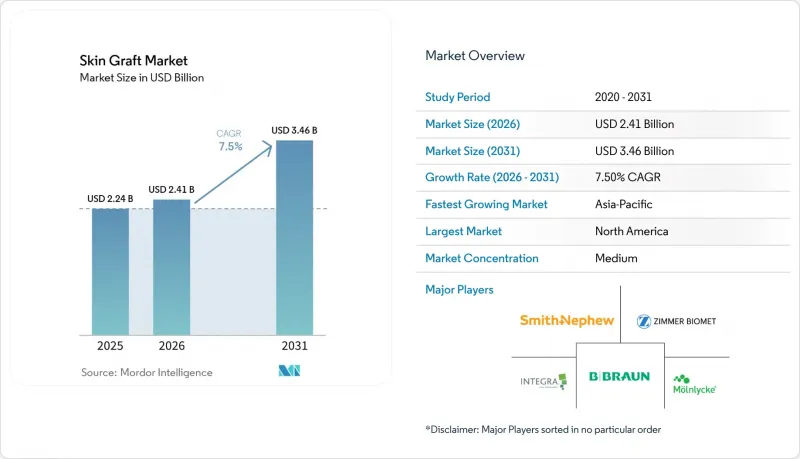
본 보고서는 이식편 유형별(자가 이식편, 동종 이식편, 기타), 공급원별(인체 피부, 동물 유래, 세포 기반 및 조직 공학, 합성 매트릭스 기반), 용도별(화상, 만성 상처, 외상성 상처, 수술 상처, 피부암), 최종 사용자별(병원, 외래수술센터(ASC), 전문 상처 치료 시설, 피부과 클리닉), 지역별(북미, 유럽, 아시아태평양, 중동 및 아프리카(MEA), 남미)로 분류되어 있습니다. 시장 예상치는 금액(달러)으로 표시되어 있습니다.
세계의 피부 이식 시장 동향 및 인사이트
화상 및 외상 사례 수 증가가 기본적인 수요를 뒷받침하고 있습니다.
피부 이식 시장은 안정적인 수요 기반으로 계속해서 화상 치료에 의존하고 있으며, 2024년에는 전 세계적으로 619만 건의 신규 화상 사례와 1억 476만 건의 유병 사례가 기록되었습니다. 환자 수는 1990년 대비 11.38% 증가했습니다. 예측에 따르면, 화상 환자 수는 2030년까지 1,030만 건에 달할 것이며, 화상과 관련된 장애 부담은 2030년의 1,150만 DALY에서 2050년까지 1,410만 DALY로 증가할 것으로 전망됩니다. 인도는 여전히 주요 수요 시장이며, 국민건강보험제도를 통해 의료 서비스 접근성이 개선된 것을 배경으로, 1990년부터 2024년에 걸쳐 화상 신규 환자 수는 23.88% 증가했습니다. 합성 대체재와 비교했을 때 어피 이식을 받은 환자의 입원 기간이 단축된 사실에서도 알 수 있듯이, 비용 대비 효과가 뛰어나기 때문에 이 첨단 이식 요법이 주목을 받고 있습니다.
만성 상처 치료에서 피부 대체재의 사용 확대가 병행된 성장 경로를 열어줍니다.
당뇨병성 족부 궤양이나 정맥성 하퇴 궤양과 같은 만성 상처는 피부 이식 시장을 확대시키고 있으며, 시술 빈도와 제품 구성에 영향을 미치고 있습니다. 75종 이상의 피부 대체 제품이 만성 상처 치료에 사용될 수 있으며, 2024년 1월부터 2025년 10월 사이에 가격이 1,000달러를 초과하는 102개 제품이 미국 시장에 출시되었습니다. 임상시험에 따르면, 당뇨병성 족부 궤양의 상처 치유에 있어 어피 이식편은 표준 치료보다 뛰어난 효과를 보이고 있습니다. 2026년 보험 환급 제도 개편에 따라 만성 상처 사례가 병원 외래 센터로 점차 이전되고 있으며, 일관된 근거와 표준화된 프로토콜을 갖춘 제품이 유리한 입지를 점하고 있습니다.
높은 시술비와 제품 비용이 대상 범위를 제한합니다.
피부 이식 시장에서 합리적인 가격을 실현하는 것은 여전히 큰 과제로 남아 있습니다. 특히, 첨단 상처 치료 제품이나 다단계 수술에 드는 비용을 감당할 수 없는 의료 제도에서는 이러한 경향이 두드러집니다. 세포 기반 또는 조직 공학을 이용한 이식편은 임상적으로 매력적이지만, 많은 공적 의료 제도나 비용에 민감한 의료 제공업체가 감당할 수 있는 범위를 초과하는 취득 비용이 드는 경우가 종종 있습니다. 이 문제는 상환 제도가 더 엄격하고, 전 세계 화상 환자 대다수가 집중되어 있는 미국 이외의 지역에서는 더욱 두드러집니다. 진피 기질에 단계적인 처치가 필요한 경우나 동종 이식편이 콜드체인 물류에 의존하는 경우, 취급 및 보관이 복잡해지기 때문에 비용 부담은 더욱 커집니다. 미국에서는 2026년 1월, 6개 시범 주에서 도입된 'WISeR 사전 승인 모델'과 같은 행정 조치로 인해, 당뇨병성 족부 궤양 및 정맥성 하지 궤양에 대한 피부 대체재 사용 심사가 엄격해지고 있습니다. 그 결과, 피부 이식 시장에서는 제품 합리화가 가속화될 것이며, 비용 효율성을 중시하는 병원 환경에서 저가 제품이 시장 점유율을 확대할 가능성이 있습니다.
부문별 분석
2025년, 자가 이식은 매출 점유율의 46.76%를 차지했으며, 이식편 유형 부문에서 주도적인 입지를 공고히 하고 피부 이식 시장에서 중요한 역할을 재확인했습니다. 외과 의사들은 생체 조직과의 통합성, 내구성, 거부 반응의 위험이 없습니다는 점 때문에 급성 화상이나 외상성 상처에 자가 이식을 선호하여 사용합니다. 피부 기증 부위에서 채취가 가능하며, 확실한 봉합이 필요한 경우 자가 이식은 여전히 표준 치료법으로 자리 잡고 있습니다. 동종 이식 및 이종 이식은 일시적인 생체 피복재로 기능하고 있으며, 사체 유래 동종 이식은 중증 환자의 상태를 안정시키고, 돼지 유래 이종 이식은 임시적인 피복 요구에 대응하기 위한 상처 부위를 준비하는 역할을 하고 있습니다.
합성 및 생합성 이식 시장은 2026-2031년 연평균 성장률(CAGR) 7.95%를 기록하며 성장할 것으로 예상되며, 가장 빠르게 성장하는 부문이 될 전망입니다. 이러한 제품은 특히 반복적인 채취가 불가능한 경우, 기증 부위에 가해지는 부담을 줄이고 이식재의 선택 폭을 넓혀줍니다. 생분해성 스캐폴드, 전기방사법을 이용한 PLGA 플랫폼, PermeaDerm과 같은 하이브리드 매트릭스 등 혁신적인 기술들이 피부 이식 시장에서 차별화를 주도하고 있습니다. 진피 기질은 일상적인 화상 치료에서 분할 두꺼운 피부 이식을 대체할 수준까지는 이르지 못했지만, 구축 재건이나 세포와의 병용과 같은 특정 용도에서는 유망한 것으로 평가받고 있습니다. 피부 이식 시장은 생합성 제품이 기존의 외과적 표준 치료를 보완하는 하이브리드 치료 모델로 전환되고 있습니다.
2025년에는 인간 피부가 매출의 67.88%를 차지했으며, 피부 이식 시장에서 중심적인 역할을 유지했습니다. 이러한 우위는 확립된 화상 치료 인프라와 규제 측면에서의 경험에 힘입어, 자가 이식 및 동종 이식 용도로의 사용을 반영하고 있습니다. 외과 의사들은 특히 중증 화상 환자의 경우, 취급, 조직과의 통합 및 치료 성과 측면에서 입증된 성능을 갖추고 있기 때문에 인간 유래 제품을 신뢰하고 있습니다. 돼지나 소에서 유래한 스캐폴딩 재료 등 동물 유래 제품은 일시적인 피복재나 상처 기반 정비 도구로서 틈새 시장을 유지하고 있습니다.
세포 유래 및 조직 공학을 통한 피부 시장은 2026-2031년 연평균 성장률(CAGR) 8.45%를 나타낼 것으로 예측되며, 가장 빠르게 성장하는 공급원 부문이 될 전망입니다. 이러한 제품들은 기증자공급에 의존하지 않으면서도 생물학적 활성을 높이고 있습니다. 연구를 통해 iPS 세포 유래의 중간엽 줄기세포와 다세포 바이오프린팅 피부의 가능성이 입증됨에 따라, 차세대 공학 피부의 길이 열리고 있습니다. 중국의 생산 능력 확대와 규제 체계 정비 역시 이 부문의 성장을 뒷받침하고 있으며, 당초에는 고부가가치 활용 사례에서 도입이 확대될 것으로 전망됩니다.
지역별 분석
2025년, 북미는 전 세계 피부 이식 시장 매출의 39.52%를 차지했으며, 많은 수술 건수, 광범위한 화상 치료 센터 네트워크, 그리고 첨단 피부 대체재에 대한 충실한 보험 환급 제도 덕분에 주도적인 위치를 유지했습니다. 지역별로는 미국이 수요를 주도하여, 2024년에는 메디케어 파트 B에서 코드 Q4100부터 Q4367에 해당하는 피부 대체재 청구액이 99억 달러에 달했습니다. 캐나다와 멕시코는 만성 상처 관리 및 화상 치료를 통해 성장에 기여했습니다. 그러나 2026년 상환 제도 개편에 따라, 해당 사례들이 진료소에서 병원 외래 진료로 전환될 것으로 예상되며, 시범 주에서는 사전 승인 요건이 강화될 전망입니다.
유럽은 독일, 영국, 프랑스의 주도 하에 피부 이식 시장에서 지역별 기준으로 두 번째로 큰 기여를 했습니다. 주요 의료 제도의 보상 기준이 더 엄격하기 때문에 화상 치료에 대한 도입이 만성 상처 치료보다 더 많이 이루어지고 있습니다. 독일에서는 화상 치료를 위한 첨단 이식편에 대한 자금 조달이 비교적 용이한 반면, 프랑스에서는 더 광범위한 제품 등록을 위해 보다 강력한 의료경제학적 근거가 요구되고 있습니다. 이탈리아와 스페인도 수요를 끌어올리고 있지만, 조달 및 지급 기관의 절차에 따라 이용 가능 여부는 달라집니다. MDR(의료기기 규정)과 관련된 증거 요건으로 인해 제품 등록의 폭이 좁아지고 있어, 보다 충실한 임상 데이터를 보유한 대기업이 유리한 입장에 있습니다. 케레시스사는 유럽에서의 사업 확장에 주력하고 있지만, 미국에 비해 도입 속도가 더딘 점을 인정하고 있습니다.
아시아태평양은 2026-2031년 연평균 성장률(CAGR) 8.88%를 기록하며 성장할 것으로 예상되며, 가장 빠르게 성장하는 지역 시장이 될 전망입니다. 이러한 성장은 의료 투자 증가, 당뇨병 유병률 상승, 그리고 중국 내 현지 생산 확대에 힘입어 이루어지고 있습니다. 중국에서는 인공 피부 생산량이 2020년 900만 개에서 2025년에는 1,230만 개로 증가했습니다. 인도에서는 화상 환자 수가 증가하고 있어 여전히 중요한 시장으로 남아 있습니다. 2026년 5월 Molnlycke사가 Zhende Medical사와 합작 회사를 설립한 사실에서도 알 수 있듯이, 전 세계 공급업체들은 중국 시장에 주력하고 있습니다. 또한, AVITA Medical사는 2026년 4월, 호주의 TGA 인증 및 뉴질랜드의 Medsafe WAND 등록을 획득하여 해당 지역에서의 규제적 입지를 강화했습니다. 중동 및 아프리카와 남미는 수익 기여도는 낮지만, GCC(걸프협력회의) 국가들의 인프라 투자와 브라질의 의료보험 적용 범위 확대를 통해 미래 성장 가능성을 보여주고 있습니다.
기타 혜택 :
- 엑셀 형식 시장 예측(ME) 시트
- 3개월간의 애널리스트 지원
자주 묻는 질문
목차
제1장 서론
제2장 조사 방법
제3장 주요 요약
제4장 시장 구도
제5장 시장 규모 및 성장 예측
제6장 경쟁 구도
제7장 시장 기회 및 향후 전망
AJY 26.07.07According to Mordor Intelligence, the skin graft market size is expected to grow from USD 2.24 billion in 2025 to USD 2.41 billion in 2026 and is forecast to reach USD 3.46 billion by 2031 at 7.5% CAGR over 2026-2031.
This report is Segmented by Graft Type (Autograft, Allograft, and More), Source (Human Skin, Animal-Derived, Cell-Based and Tissue-Engineered, Synthetic Matrix-Based), Application (Burns, Chronic Wounds, Traumatic, Surgical Wounds, Skin Cancer), End User (Hospitals, Ascs, Specialty Wound Care, Dermatology Clinics), and Geography (North America, Europe, Asia-Pacific, MEA, South America). Forecasts in Value (USD).
Global Skin Graft Market Trends and Insights
Rising Burn And Trauma Case Loads Sustain Baseline Demand
The skin graft market continues to rely on burn care as a stable volume base, with 6.19 million new burn cases and 104.76 million prevalent cases recorded globally in 2024. Prevalent cases were 11.38% higher than in 1990. Projections indicate burn cases will reach 10.3 million by 2030, with burn-related disability burden rising from 11.5 million DALYs in 2030 to 14.1 million by 2050. India remains a key demand center, with burn incident cases increasing by 23.88% between 1990 and 2024, supported by improved treatment access through national insurance programs. Advanced grafting is gaining traction due to its cost-effectiveness, as seen in reduced hospital stays for patients treated with fish-skin grafts compared to synthetic alternatives.
Expanding Skin Substitutes Use In Chronic Wounds Opens A Parallel Growth Channel
Chronic wounds, such as diabetic foot ulcers and venous leg ulcers, are expanding the skin graft market, influencing procedure frequency and product mix. Over 75 skin substitute products cater to chronic wound indications, with 102 products priced above USD 1,000 entering the U.S. market between January 2024 and October 2025. Clinical trials show fish-skin grafts outperform standard care in wound closure for diabetic foot ulcers. The 2026 reimbursement reset is shifting chronic wound cases to hospital outpatient centers, favoring products with consistent evidence and standardized protocols.
High Procedure And Product Costs Limit Addressable Reach
Affordability remains a significant challenge in the skin graft market, particularly in healthcare systems unable to absorb the costs of advanced wound products and multistep procedures. Cell-based and tissue-engineered constructs, while clinically appealing, often have acquisition costs beyond what many public systems or cost-sensitive providers can afford. This issue is more pronounced outside the U.S., where reimbursement systems are stricter and much of the global burn burden is concentrated. Cost pressures increase further when dermal matrices require staged procedures or when allografts rely on cold-chain logistics, adding complexity to handling and storage. In the U.S., administrative measures like the WISeR prior authorization model, introduced in January 2026 across six pilot states, have added scrutiny to skin substitute use for diabetic foot ulcers and venous leg ulcers. As a result, the market may see faster product rationalization, with lower-priced products gaining share in cost-conscious hospital settings.
Other drivers and restraints analyzed in the detailed report include:
- Shift Toward Evidence-Based, Reimbursable Products Reshapes Competitive Positioning
- Under-Penetration Of Novel Biological Graft Sources Offers Incremental Opportunity
- Reimbursement Uncertainty Creates Near-Term Demand Volatility
For complete list of drivers and restraints, kindly check the Table Of Contents.
Segment Analysis
In 2025, Autograft held a 46.76% revenue share, reaffirming its leadership in the graft type segment and its critical role in the skin graft market. Surgeons prefer autograft for acute burns and traumatic wounds due to its native tissue integration, durability, and immunity to rejection. It remains the gold standard when donor-site harvesting is feasible and definitive closure is required. Allograft and xenograft serve as temporary biological coverage, with cadaveric allograft stabilizing critically ill patients and porcine xenograft preparing wound beds for interim coverage needs.
Synthetic and biosynthetic grafts are projected to grow at a 7.95% CAGR from 2026 to 2031, making them the fastest-growing segment. These products reduce donor-site burden and expand coverage options, especially in cases where repeated harvesting is not viable. Innovations like biodegradable scaffolds, electrospun PLGA platforms, and hybrid matrices such as PermeaDerm are driving differentiation in the market. While dermal matrices have not replaced split-thickness skin grafting in routine burn care, they show promise in specific applications like contracture reconstruction and combined cellular use. The market is shifting toward a hybrid treatment model where biosynthetic products complement traditional surgical standards.
In 2025, human skin accounted for 67.88% of revenue, maintaining its central role in the skin graft market. This dominance reflects its use in autologous and allograft applications, supported by established burn care infrastructure and regulatory familiarity. Surgeons trust human-derived products due to their proven performance in handling, integration, and outcomes, particularly in severe burn cases. Animal-derived products, such as porcine and bovine scaffolds, retain a niche role as temporary coverage and wound bed preparation tools.
Cell-based and tissue-engineered skin is expected to grow at an 8.45% CAGR from 2026 to 2031, making it the fastest-growing source segment. These products offer enhanced biological activity without relying on donor supply. Studies have demonstrated the potential of iPSC-derived mesenchymal stem cells and multicellular bioprinted skin, paving the way for next-generation engineered skin. China's expanding manufacturing capabilities and evolving regulatory pathways are also driving growth in this segment, with initial adoption likely in high-value use cases.
Complete Report Scope:
- By Graft Type
- Autograft
- Allograft
- Xenograft
- Synthetic and Biosynthetic Graft
- By Source
- Human Skin
- Animal-Derived Skin
- Cell-Based and Tissue-Engineered Skin
- Synthetic Matrix-Based Skin
- By Application
- Burns
- Chronic Wounds
- Traumatic Wounds
- Surgical Wounds
- Skin Cancer Reconstruction
- By End User
- Hospitals
- Ambulatory Surgical Centers
- Specialty Wound Care Centers
- Dermatology and Plastic Surgery Clinics
- By Geography
- North America
- United States
- Canada
- Mexico
- Europe
- Germany
- United Kingdom
- France
- Italy
- Spain
- Rest of Europe
- Asia-Pacific
- China
- India
- Japan
- Australia
- South Korea
- Rest of Asia-Pacific
- Middle East and Africa
- GCC
- South Africa
- Rest of Middle East and Africa
- South America
- Brazil
- Argentina
- Rest of South America
- North America
Geography Analysis
In 2025, North America held 39.52% of the global skin graft market revenue, maintaining its leadership due to high procedural volumes, extensive burn center networks, and a robust reimbursement system for advanced skin substitutes. The U.S. led regional demand, with Medicare Part B processing USD 9.9 billion in skin substitute claims in 2024 across codes Q4100 to Q4367. Canada and Mexico contributed to growth through chronic wound management and burn care. However, the 2026 reimbursement reset is expected to shift cases from physician offices to hospital outpatient settings, increasing prior authorization requirements in pilot states.
Europe ranked as the second-largest regional contributor to the skin graft market, driven by Germany, the U.K., and France. Burn care adoption outpaces chronic wounds due to stricter reimbursement standards in major health systems. Germany funds advanced grafts more readily for burns, while France requires stronger health-economic evidence for broader product listings. Italy and Spain add to demand, though access varies by procurement and payer processes. MDR-related evidence requirements are narrowing product registrations, favoring larger companies with stronger clinical documentation. Kerecis is working to expand its European presence but acknowledges slower adoption compared to the U.S.
Asia-Pacific is projected to grow at an 8.88% CAGR from 2026 to 2031, making it the fastest-growing regional market. Growth is driven by rising healthcare investments, increasing diabetes prevalence, and expanded local manufacturing in China, where artificial skin production rose from 9 million units in 2020 to 12.3 million by 2025. India remains significant due to its growing burn burden. Global suppliers are focusing on China, as seen in Molnlycke's joint venture with Zhende Medical in May 2026. AVITA Medical also strengthened its regional regulatory position in April 2026 with TGA certification in Australia and Medsafe WAND listing in New Zealand. The Middle East, Africa, and South America contribute less revenue but show potential through GCC infrastructure investments and broader healthcare coverage in Brazil.
- AlloSource
- AVITA Medical, Inc.
- B. Braun
- Convatec
- De Soutter Medical Ltd.
- Exsurco Medical
- Humeca BV
- Integra LifeSciences
- Kerecis ehf.
- LifeNet Health
- MIMEDX Group
- Molnlycke Health Care
- MTF Biologics
- Organogenesis
- Smiths Group
- Stryker
- Surtex Instruments
- TELA Bio, Inc.
- Tissue Regenix Group PLC
- Zimmer Biomet
Additional Benefits:
- The market estimate (ME) sheet in Excel format
- 3 months of analyst support
TABLE OF CONTENTS
1 INTRODUCTION
- 1.1 Study Assumptions and Market Definition
- 1.2 Scope of the Study
2 RESEARCH METHODOLOGY
3 EXECUTIVE SUMMARY
4 MARKET LANDSCAPE
- 4.1 Market Overview
- 4.2 Market Drivers
- 4.2.1 Rising Burn and Trauma Case Loads Requiring Surgical Coverage
- 4.2.2 Expanding Use of Skin Substitutes in Chronic Wound Management
- 4.2.3 Broader Adoption of Outpatient Grafting and Ambulatory Wound Care
- 4.2.4 Shift Toward Evidence-Based, Reimbursable Advanced Wound Products
- 4.2.5 Under-penetration of Fish-Skin, Placental, and Biosynthetic Grafts in Emerging Care Pathways
- 4.2.6 Operating Room Efficiency Gains from Prefabricated and Easy-To-Handle Graft Systems
- 4.3 Market Restraints
- 4.3.1 High Procedure and Product Cost Relative to Standard Wound Closure Methods
- 4.3.2 Reimbursement Uncertainty and Coverage Tightening in Wound Care Markets
- 4.3.3 Donor-Site Morbidity, Infection Risk, and Graft Failure Concerns
- 4.3.4 Limited Availability of High-Quality Cadaveric and Specialty Biological Graft Supply
- 4.4 Supply/Value Chain Analysis
- 4.5 Regulatory Landscape
- 4.6 Technological Outlook
- 4.7 Porter's Five Forces Analysis
- 4.7.1 Bargaining Power of Suppliers
- 4.7.2 Bargaining Power of Buyers
- 4.7.3 Threat of New Entrants
- 4.7.4 Threat of Substitutes
- 4.7.5 Competitive Rivalry
5 MARKET SIZE AND GROWTH FORECASTS (VALUE, USD)
- 5.1 By Graft Type
- 5.1.1 Autograft
- 5.1.2 Allograft
- 5.1.3 Xenograft
- 5.1.4 Synthetic and Biosynthetic Graft
- 5.2 By Source
- 5.2.1 Human Skin
- 5.2.2 Animal-Derived Skin
- 5.2.3 Cell-Based and Tissue-Engineered Skin
- 5.2.4 Synthetic Matrix-Based Skin
- 5.3 By Application
- 5.3.1 Burns
- 5.3.2 Chronic Wounds
- 5.3.3 Traumatic Wounds
- 5.3.4 Surgical Wounds
- 5.3.5 Skin Cancer Reconstruction
- 5.4 By End User
- 5.4.1 Hospitals
- 5.4.2 Ambulatory Surgical Centers
- 5.4.3 Specialty Wound Care Centers
- 5.4.4 Dermatology and Plastic Surgery Clinics
- 5.5 By Geography
- 5.5.1 North America
- 5.5.1.1 United States
- 5.5.1.2 Canada
- 5.5.1.3 Mexico
- 5.5.2 Europe
- 5.5.2.1 Germany
- 5.5.2.2 United Kingdom
- 5.5.2.3 France
- 5.5.2.4 Italy
- 5.5.2.5 Spain
- 5.5.2.6 Rest of Europe
- 5.5.3 Asia-Pacific
- 5.5.3.1 China
- 5.5.3.2 India
- 5.5.3.3 Japan
- 5.5.3.4 Australia
- 5.5.3.5 South Korea
- 5.5.3.6 Rest of Asia-Pacific
- 5.5.4 Middle East and Africa
- 5.5.4.1 GCC
- 5.5.4.2 South Africa
- 5.5.4.3 Rest of Middle East and Africa
- 5.5.5 South America
- 5.5.5.1 Brazil
- 5.5.5.2 Argentina
- 5.5.5.3 Rest of South America
- 5.5.1 North America
6 COMPETITIVE LANDSCAPE
- 6.1 Market Concentration
- 6.2 Market Share Analysis
- 6.3 Company Profiles (includes Global Level Overview, Market Level Overview, Core Segments, Financials as available, Strategic Information, Market Rank/Share, Products and Services, Recent Developments)
- 6.3.1 AlloSource
- 6.3.2 AVITA Medical, Inc.
- 6.3.3 B. Braun SE
- 6.3.4 Convatec Group PLC
- 6.3.5 De Soutter Medical Ltd.
- 6.3.6 Exsurco Medical, Inc.
- 6.3.7 Humeca BV
- 6.3.8 Integra LifeSciences Holdings Corporation
- 6.3.9 Kerecis ehf.
- 6.3.10 LifeNet Health
- 6.3.11 MiMedx Group, Inc.
- 6.3.12 Molnlycke Health Care AB
- 6.3.13 MTF Biologics
- 6.3.14 Organogenesis Holdings Inc.
- 6.3.15 Smith & Nephew plc
- 6.3.16 Stryker Corporation
- 6.3.17 Surtex Instruments Limited
- 6.3.18 TELA Bio, Inc.
- 6.3.19 Tissue Regenix Group PLC
- 6.3.20 Zimmer Biomet Holdings, Inc.
7 MARKET OPPORTUNITIES AND FUTURE OUTLOOK
- 7.1 White-Space and Unmet-Need Assessment


