|
시장보고서
상품코드
2072864
트렘페야 시장 : 점유율 분석, 업계 동향과 통계, 성장 예측(2026-2031년)Tremfya Drug - Market Share Analysis, Industry Trends & Statistics, Growth Forecasts (2026 - 2031) |
||||||
 Mordor Intelligence
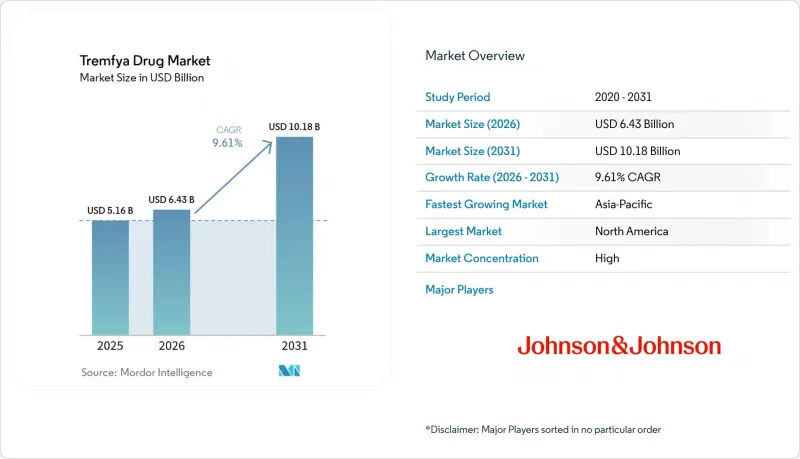
Mordor Intelligence에 의하면, 트렘페야 시장 규모는 2025년에 51억 6,000만 달러, 2026년에 64억 3,000만 달러되어, 2031년까지 101억 8,000만 달러에 이를 것으로 예측되며, 2026-2031년까지 CAGR 9.61%로 성장할 전망입니다.
본 보고서는 적응증(일반 건선, 건선성 관절염, 궤양성 대장염, 크론병), 투여 경로(피하 주사, 정맥 내 점적 주사), 유통 채널(병원 약국, 소매 약국 등), 지역(북미, 유럽, 아시아태평양, 중동 및 아프리카, 남미)별로 분류되어 있습니다. 시장 전망은 금액(달러) 기준으로 제시되어 있습니다.
전 세계 트렘페야(Tremfya) 시장 동향 및 인사이트
염증성 장질환에 대한 적응증 확대
2024년 9월 FDA가 궤양성 대장염 적응증을, 2025년 3월 크론병 적응증을 승인함에 따라 트렘페야 시장은 임상 기반을 확대했습니다. 이로 인해 구셀쿠맙은 기존보다 좁았던 면역학적 위치에서 벗어나, 보다 광범위한 전문 분야를 아우르는 생물학적 제제로서의 지위로 전환되었습니다. 그 후, 시장은 GALAXI-2 및 GALAXI-3의 3상 임상시험 결과에 힘입어 상승세를 보였습니다. 이러한 결과에 따르면, 크론병 환자에서 48주 시점에서 임상적 관해, 내시경적 반응 및 내시경적 관해의 모든 측면에서 우스테키누맙에 비해 우월성이 입증되었습니다. 이 근거가 중요한 이유는 트렘페야 시장이 더 이상 약물 군에 대한 인지도만으로 경쟁하는 것이 아니라, 치료 순서가 종종 이전 생물학적 제제 사용 이력에 따라 결정되는 상황에서 직접 비교를 통해 효능에 대한 메시지를 전달할 수 있게 되었기 때문입니다. 또한, 시장은 크론병 포지셔닝 자료에서 강조된 유지 요법 단계의 추세로부터도 혜택을 보고 있습니다. 그 연구에서 주요 평가 지표를 달성한 환자의 90% 이상이 스테로이드에 의존하지 않고 이를 달성했으며, 이 지표는 소화기내과 분야에서 보다 철저한 질환 관리를 추구하는 추세와 부합합니다. 2025년 4월 궤양성 대장염에 대한, 그리고 2025년 5월 크론병에 대한 유럽 내 승인으로 인해 미국과 유럽 간의 격차가 좁혀졌으며, 트렘페야 시장의 국제적 확장이 더욱 동기화되었습니다. 그 결과, 트렘페야 시장은 일반 건선에만 의존하던 수익 구조에서 벗어나, 치료 기간과 전문의의 추적 관찰이 구조적으로 긴 만성 위장관 질환 분야에서 보다 균형 잡힌 수익 구조로 전환되고 있습니다.
기존 생물학적 제제에 비해 IL-23 억제제로서의 지속적인 차별화
트렘페야 시장은 구셀쿠맙이 IL-23의 p19 서브유닛을 선택적으로 억제하고, 나아가 CD64에도 결합한다는 점에서 보다 광범위한 IL-12/23이나 TNF를 표적으로 하는 생물학적 제제와는 차별화되어 독자적인 특성을 유지하고 있습니다. 또한, 트렘페야 시장은 건선 치료 분야에서 오랜 상업적·임상적 실적을 쌓아온 장점을 가지고 있으며, 이에 따라 처방 의사들은 안전성, 치료의 지속성, 그리고 다른 약물로 전환하는 경향에 대해 수년에 걸쳐 잘 파악하고 있습니다. 영향이 큰 부위에 병변이 확인된 중등도 건선 환자들을 대상으로 한 제3b상 SPECTREM 임상시험에서 구셀쿠맙 투여군의 성인 환자 중 74.2%가 IGA 0/1 단계의 관해를 달성한 반면, 위약군에서는 12.4%에 그쳤습니다. 이를 통해, 그동안 반복적으로 외용제의 용량 증량에 의존할 수밖에 없었던 환자에게, 질환 경과의 더 초기 단계에서 본 제제의 사용이 가능해집니다. 이러한 조기 도입이 중요한 이유는 트레무피야의 적용 대상이 중증 환자에 국한되지 않고, 체표면적뿐만 아니라 병변의 부위나 일상생활에 미치는 영향으로 인해 질병 부담이 커지고 있는 환자들에게도 대응할 수 있게 되기 때문입니다. 2026년 5월 FDA의 적응증 확대는 임상적 차별화 요인으로 더욱 부각될 것입니다. 그 이유는 구셀쿠맙이 현재 활동성 건선성 관절염에서 구조적 관절 손상을 억제하는 효과가 입증된 유일한 IL-23 억제제가 되었기 때문입니다. 이로써 트렘페야 시장은 X선 소견의 진행 예방이 치료 선택에 있어 장기적으로 중요한 역할을 하는 피부과뿐만 아니라 류마티스학 분야에서도 그 존재 가치를 유지하게 될 것입니다.
고가인 생물학적 제제와 보험사의 사전 승인 압력
트렘페야 시장은 여전히 접근성 문제에 직면해 있습니다. 이는 구셀쿠맙이 전문 생물학적 제제 범주에 속하며, 해당 범주의 보험 적용 규칙이 이용 관리 및 정식 심사 절차를 통해 규정되어 있기 때문입니다. 궤양성 대장염의 경우, UnitedHealthcare의 민간 보험 약관에 따르면, 보험 적용이 승인되기 전에 기존 치료법이나 이전에 사용했던 생물학적 제제, 또는 JAK 억제제 치료에 대한 반응이 불충분하다는 사실이 문서로 입증되어야 합니다. 이는 시장 확대 이후에도 시장 진입이 얼마나 제한될 수 있는지를 보여줍니다. 따라서 트렘페야 시장은 의사의 선호도뿐만 아니라, 클리닉이 얼마나 신속하게 기록을 수집하고 승인 신청을 제출하며, 보험사의 후속 조치 요청에 대응할 수 있는지에 따라서도 좌우됩니다. 이러한 부담은 대규모 대학병원에 비해 지역 진료소에서 더 크기 때문에 트렘페야 시장에서는 임상시험 데이터만으로는 예상되는 것보다 실제 임상 현장에의 도입이 더디게 진행될 가능성이 있습니다. 만성 면역 질환의 경우, 특히 환자가 기존 치료법에서 전환하거나 복잡한 급여 제도에 직면할 때, 치료의 시작과 지속은 밀접하게 연관되어 있으므로 이러한 지연은 중요한 의미를 지닙니다. 그 결과, 트렘페야 시장에서 새로운 승인이 실제 처방량으로 어느 정도 신속하게 이어지는지에 관해, 보험사와의 조정은 여전히 가장 뚜렷한 단기적 제약 요인 중 하나입니다.
부문별 분석
2025년 기준으로, 트렘페야 시장의 86.31%를 일반 건선이 차지했습니다. 이는 더 새로운 소화기 계통 적응증에 대한 승인이 확대되기 시작하기 전에도, 해당 브랜드가 여전히 피부과 분야에서 확고한 입지를 다지고 있었음을 보여줍니다. 이러한 집중은 수년에 걸친 보험 적용 목록 등재 실적, 전문의들의 광범위한 사용, 그리고 건선 치료 진료 지침에서의 인지도에 힘입어 뒷받침되었으며, IBD(염증성 장질환)가 유의미한 증가분을 가져오기 시작하기 전부터 이미 트렘페야 시장에 견고한 기반을 마련해 주었습니다. 건선성 관절염은 여전히 두 번째로 큰 적응증 분야이며, 2026년 5월 FDA의 적응증 확대를 통해 활동성 질환에서의 구조적 관절 손상 억제가 추가됨에 따라 그 중요성이 더욱 커졌습니다. 이러한 적응 범위의 확대는 류마티스 전문의에게 중요한 의미를 지닙니다. 왜냐하면 장기적인 관리는 증상을 조절하는 것뿐만 아니라, 돌이킬 수 없는 방사선 소견의 진행을 막는 것을 통해서도 이루어지기 때문입니다. 크론병은 가장 빠르게 성장하고 있는 적응증으로, 2025년 3월 FDA 승인, 2025년 5월 유럽연합 집행위원회의 승인, 우스테키누맙을 대조군으로 한 GALAXI 임상시험의 48주 시점 결과를 바탕으로, 2026년부터 2031년까지 연평균 성장률(CAGR) 11.38%로 확대될 것으로 예측됩니다.
궤양성 대장염은 현재 매출 기여도 측면에서 여전히 3위를 차지하고 있는 적응증이며, 2024년 9월 FDA가 정맥 내 투여를 통한 초기 치료법을 최초로 승인하고, 이후 2025년 9월 피하 투여를 통한 초기 치료법도 승인됨에 따라 그 입지는 더욱 공고해졌습니다. 이 적응증에 대한 장기적인 효과는 QUASAR 연장 임상시험을 통해 입증되었으며, 유지 요법 요법은 92주까지 증상, 내시경 소견 및 조직학적 유효성을 유지했습니다. 이는 트렘페야의 제약 업계가 도입 기간을 넘어 신뢰를 쌓는 데 한몫하고 있습니다. 일본에서 손발톱 주위 농가진 및 홍피증형 건선을 포함한 기타 승인된 적응증은 규모는 작지만 트렘페야 시장에 안정적인 수익원을 지속적으로 제공합니다. 예측 기간 동안, 크론병 및 궤양성 대장염의 치료가 전문의에 의한 초기 도입 단계에서 보다 광범위한 지역 소화기과 진료로 전환됨에 따라, 트렘페야 시장은 일반 건선에 대한 의존도를 낮출 것으로 전망됩니다. 이러한 구성의 변화는 판매량 증가를 뒷받침하는 한편, 단계적 치료가 더욱 중시되는 보험 환경이나 의료 급여와 의약품 급여의 상환 균형에 따른 변화에 해당 브랜드가 노출되게 될 것입니다.
지역별 분석
북미는 2025년 기준 트렘페야 시장의 42.22%를 차지하고 있으며, 미국이 각 적응증에 대해 조기에 승인을 획득했고, 일상적으로 이용되는 전문 약국 인프라가 가장 잘 갖춰져 있기 때문에 이 지역은 계속해서 시장 기여도가 가장 높은 지역으로 자리매김하고 있습니다. 트렘페야 시장의 지역적 위상은 ‘TREMFYA with Me’ 지원 모델을 통해서도 뒷받침되고 있습니다. 이 모델은 만성 질환의 치료 주기를 통해 환자가 비용 부담, 치료 시작, 복약 순응도 등의 과제를 해결할 수 있도록 지원하는 것입니다. Johnson & Johnson의 2025년 연차 보고서에 따르면, 트렘페야는 기업 수익에 크게 기여하고 있으며, 이는 트렘페야 시장의 세계적 규모에서 미국이 얼마나 중심적인 역할을 하고 있는지를 여실히 보여주고 있습니다. 캐나다에서는 건선 및 건선성 관절염 치료제로서 확고한 입지를 다진 것이 이 브랜드의 강점으로 작용하고 있지만, 멕시코에서는 인프라 및 자금 조달 방식의 제약으로 인해 생물학적 제제의 보급이 여전히 제한적이어서 시장 규모는 비교적 작은 상태를 유지하고 있습니다. 이로 인해 북미는 트렘페야 시장에서 가장 광범위한 상업적 기반을 갖추고 있는 반면, 사전 승인 절차의 엄격성과 급여 설계의 복잡성으로 인한 영향을 가장 많이 받는 지역이 되었습니다.
유럽은 트렘페야 시장에서 두 번째로 큰 규모를 자랑하는 지역 블록으로, 유럽집행위원회가 2025년 4월에 궤양성 대장염, 2025년 5월에 크론병, 2025년 10월에 궤양성 대장염의 SC 도입 요법을, 그리고 2025년 12월 소아 건선에 대해 승인을 함으로써 그 위상이 더욱 높아졌습니다. 영국에서는 2025년 5월 MHRA가 크론병 및 궤양성 대장염 치료제로 구셀쿠맙을 승인함에 따라, 브렉시트 이후 독자적인 행보가 추가되었습니다. 유럽의 트렘페야 시장은 여전히 수익화 주기가 더딘이라는 과제에 직면해 있습니다. 이는 각국에서 의료기술평가(HTA) 기관에 의한 심사나 가격 협상이 이루어지기 때문에 규제 당국의 승인 후에도 광범위한 보험 적용이 지연될 가능성이 있기 때문입니다. 이러한 과제가 있음에도 불구하고, 유럽은 여전히 중요한 시장으로 남아 있습니다. 이는 소화기내과에서 치료 목표로 내시경적 관해가 점점 더 중요시되고 있으며, 이는 IBD(염증성 장질환) 시장에서 트렘페야의 포지셔닝과 부합하기 때문입니다.
아시아태평양은 트렘페야 시장에서 가장 빠르게 성장하고 있는 지역이며, 최근 승인 진전에 따라 적응증이 건선에서 염증성 장질환(IBD)으로 확대됨에 따라 2026년부터 2031년까지 연평균 성장률(CAGR) 10.65%로 성장할 것으로 전망됩니다. 일본은 이러한 경향에서 중심적인 역할을 하고 있습니다. 2025년 3월 궤양성 대장염, 같은 해 6월 크론병, 그리고 2026년 2월 궤양성 대장염의 SC 도입 요법으로 구셀쿠맙의 승인이 이루어짐에 따라, 주요 고소득 시장에서 트렘페야 시장은 보다 종합적인 치료 경로와 적응증 프로파일을 확보하게 되었기 때문입니다. 중국은 구셀쿠맙이 이미 일반 건선 및 IBD 관련 용도로 광범위한 승인을 획득한 만큼 시장 규모 확대의 잠재력을 지니고 있으며, 이는 대규모 치료 대상 환자층에서 트렘페야 시장의 장기적인 성장을 뒷받침할 것입니다. 중동 및 아프리카에서는 도입이 아직 초기 단계에 있으며, 고소득 걸프 국가 시장이 사용을 주도하고 있는 반면, 해당 지역의 다른 지역들의 기여도는 제한적입니다. 남미 시장 규모는 여전히 작지만, 브라질은 트렘페야 시장에서 두드러진 위치를 차지하고 있습니다. 이는 궤양성 대장염 및 크론병에 대한 승인이 소화기 분야에서 생물학적 제제의 사용 기반을 마련하고 있기 때문입니다. 이 모든 요소를 종합해 보면, 시장은 여전히 북미가 주도하고, 유럽이 이를 든든히 뒷받침하며, 아시아태평양이 가장 빠르게 성장하고 있는 추세를 보여주고 있습니다.
기타 혜택:
- 엑셀 형식 시장 예측(ME) 시트
- 3개월간의 애널리스트 지원
자주 묻는 질문
목차
제1장 서론
제2장 조사 방법
제3장 주요 요약
제4장 시장 구도
제5장 시장 규모와 성장 예측
제6장 경쟁 구도
제7장 시장 기회와 향후 전망
JHS 26.07.07According to Mordor Intelligence, the tremfya drug market size is projected to be USD 5.16 billion in 2025, USD 6.43 billion in 2026, and reach USD 10.18 billion by 2031, growing at a CAGR of 9.61% from 2026 to 2031.
This report is Segmented by Application (Plaque Psoriasis, Psoriatic Arthritis, Ulcerative Colitis, Crohn's Disease), Route of Administration (Subcutaneous Injection, Intravenous Infusion), Distribution Channel (Hospital Pharmacies, Retail Pharmacies, and More), and Geography (North America, Europe, Asia-Pacific, Middle East and Africa, South America). Market Forecasts are Provided in Terms of Value (USD).
Global Tremfya Drug Market Trends and Insights
Expanding Label Into Inflammatory Bowel Disease
The Tremfya drug market gained a wider clinical base when the FDA approved ulcerative colitis in September 2024 and Crohn's disease in March 2025, which moved guselkumab from a narrower immunology profile into a broader cross-specialty biologic position. The Tremfya drug market then gained support from the GALAXI-2 and GALAXI-3 Phase 3 results, which showed superiority versus ustekinumab across clinical remission, endoscopic response, and endoscopic remission at week 48 in Crohn's disease. That evidence matters because the Tremfya drug market is no longer competing only on class familiarity, and it now carries a head-to-head efficacy message in a setting where treatment sequencing often follows prior biologic exposure. The Tremfya drug market also benefits from the maintenance-phase pattern highlighted in the Crohn's disease positioning literature, where more than 90% of patients meeting primary endpoints did so without steroid dependence, a metric that aligns with the shift toward deeper disease control in gastroenterology. European approvals for ulcerative colitis in April 2025 and for Crohn's disease in May 2025 reduced the gap between the United States and Europe and supported a more synchronized international rollout of the Tremfya drug market. As a result, the Tremfya drug market is moving toward a revenue base that is less tied to plaque psoriasis alone and more balanced across chronic gastrointestinal use, where treatment duration and specialist follow-up are both structurally high.
Durable IL-23 Differentiation Versus Legacy Biologics
The Tremfya drug market retains a differentiated profile because guselkumab selectively inhibits the IL-23 p19 subunit and also binds CD64, which sets it apart from broader IL-12/23 and TNF-targeting biologics. The Tremfya drug market also carries the benefit of a longer commercial and clinical history in psoriasis, which gives prescribers years of familiarity in safety, persistence, and switching behavior. In moderate psoriasis with high-impact site involvement, the Phase 3b SPECTREM study showed that 74.2% of adults reached IGA 0/1 clearance on guselkumab versus 12.4% on placebo, which opens use earlier in the disease course for patients who were often left on repeated topical escalation. That earlier entry point matters because the Tremfya drug market can extend beyond severe cases and address patients whose disease burden is driven by location and daily impact rather than only by body surface area. The May 2026 FDA label expansion adds another clinical distinction because guselkumab is now the only IL-23 inhibitor with evidence of structural joint damage inhibition in active psoriatic arthritis. This keeps the Tremfya drug market relevant in rheumatology as well as dermatology, where prevention of radiographic progression carries long-term weight in treatment choice.
Premium Biologic Pricing and Payer Prior Authorization Pressure
The Tremfya drug market still faces access friction because guselkumab sits in the specialty biologic category, and coverage rules in that category are shaped by utilization controls and formal review pathways. In ulcerative colitis, UnitedHealthcare's commercial policy requires documented inadequate response to conventional therapy and or prior biologic or JAK inhibitor therapy before coverage is approved, which shows how restrictive entry can be even after label expansion. The Tremfya drug market therefore depends not only on physician preference but also on how quickly clinics can gather records, submit authorizations, and respond to follow-up payer requests. That burden is heavier in community practices than in large academic centers, so the Tremfya drug market can see slower real-world starts than trial data alone would suggest. These delays matter because treatment initiation and persistence are closely linked in chronic immune disease, especially when patients are moving across prior therapies and complex benefit designs. As a result, payer management remains one of the clearest near-term limits on how quickly the Tremfya drug market can convert new approvals into realized prescribing volume.
Other drivers and restraints analyzed in the detailed report include:
- Pediatric and Multi-Label Expansion Supports Longer Lifecycle
- Site-of-Care Flexibility Improves Access and Persistence
- Intensifying Competition From IL-23, IL-17, and TYK2 Therapies
For complete list of drivers and restraints, kindly check the Table Of Contents.
Segment Analysis
Plaque psoriasis accounted for 86.31% of the Tremfya drug market in 2025, which shows how strongly the brand was still anchored in dermatology before the newer gastrointestinal approvals began to scale. That concentration was supported by long-standing formulary familiarity, broad specialist use, and guideline recognition in psoriasis care, which gave the Tremfya drug market a durable base before IBD started contributing meaningful incremental volume. Psoriatic arthritis remained the second-largest application and gained added importance in May 2026, when the FDA label was expanded to include structural joint damage inhibition in active disease. That label depth matters for rheumatologists because long-term management is shaped not only by symptom control but also by protection against irreversible radiographic progression. Crohn's disease is the fastest-growing application and is forecast to expand at an 11.38% CAGR through 2026-2031, supported by the March 2025 FDA approval, the May 2025 European Commission authorization, and the week 48 GALAXI results against ustekinumab.
Ulcerative colitis remains the third application by current revenue contribution, and its profile strengthened after the FDA first approved IV induction in September 2024 and later approved the subcutaneous induction option in September 2025. Long-term support for that application is visible in the QUASAR extension, where maintenance regimens sustained symptomatic, endoscopic, and histologic efficacy through week 92, which helps the Tremfya drug industry build confidence beyond the induction window. Other approved uses, including palmoplantar pustulosis and erythrodermic psoriasis in Japan, continue to add a smaller but stable revenue layer to the Tremfya drug market. Over the forecast period, the Tremfya drug market is likely to show a lower dependence on plaque psoriasis alone as Crohn's disease and ulcerative colitis move from early specialist adoption into broader community gastroenterology practice. That mix shift supports volume growth, but it also exposes the brand to a more step-therapy-intensive payer environment and a different balance between medical-benefit and pharmacy-benefit reimbursement.
Complete Report Scope:
- By Application
- Plaque Psoriasis
- Psoriatic Arthritis
- Ulcerative Colitis
- Crohn's Disease
- Other Applications
- By Route of Administration
- Subcutaneous Injection
- Intravenous Infusion
- By Distribution Channel
- Hospital Pharmacies
- Retail Pharmacies
- Online Pharmacies
- Other Distribution Channels
- By Geography
- North America
- United States
- Canada
- Mexico
- Europe
- Germany
- United Kingdom
- France
- Italy
- Spain
- Rest of Europe
- Asia-Pacific
- China
- Japan
- India
- Australia
- South Korea
- Rest of Asia-Pacific
- Middle East and Africa
- GCC
- South Africa
- Rest of Middle East and Africa
- South America
- Brazil
- Argentina
- Rest of South America
- North America
Geography Analysis
North America retained 42.22% of the Tremfya drug market in 2025, and the region remains the largest geographic contributor because the United States secured early approvals across indications and has the deepest specialty pharmacy infrastructure in routine use. The regional position of the Tremfya drug market is also supported by the TREMFYA withMe support model, which helps patients navigate affordability, onboarding, and adherence across chronic treatment cycles. Johnson & Johnson's 2025 annual report shows that Tremfya contributed materially to company revenue, which underlines how central the United States is to the global scale of the Tremfya drug market. Canada benefits from the brand's established psoriasis and psoriatic arthritis presence, while Mexico remains smaller because biologic penetration is still constrained by infrastructure and funding patterns. This leaves North America with the broadest commercial base in the Tremfya drug market, but it also leaves the region most exposed to prior authorization intensity and benefit-design complexity.
Europe is the second-largest regional block in the Tremfya drug market, and its position improved after the European Commission approved ulcerative colitis in April 2025, Crohn's disease in May 2025, SC induction in ulcerative colitis in October 2025, and pediatric plaque psoriasis in December 2025. The United Kingdom added a separate post-Brexit path when the MHRA approved guselkumab for Crohn's disease and ulcerative colitis in May 2025. The Tremfya drug market still faces a slower revenue conversion cycle in Europe because national HTA bodies and price negotiations can delay broad reimbursement even after regulatory approval. Even with that friction, Europe remains important because treatment goals in gastroenterology increasingly emphasize endoscopic remission, which fits the way the Tremfya drug market is being positioned in IBD.
Asia-Pacific is the fastest-growing geography in the Tremfya drug market and is forecast to expand at a 10.65% CAGR during 2026-2031 as recent approval milestones widen use beyond psoriasis into IBD. Japan is central to that pattern because it approved guselkumab for ulcerative colitis in March 2025, Crohn's disease in June 2025, and SC induction for ulcerative colitis in February 2026, which gives the Tremfya drug market a more complete route and indication profile in a major high-income market. China adds scale potential because guselkumab already has approval breadth across plaque psoriasis and IBD-related use, which supports longer-term expansion of the Tremfya drug market in a large treated population base. The Middle East and Africa remain early in adoption, with higher-income Gulf markets leading use while the rest of the region contributes limited volume. South America also remains smaller, but Brazil stands out in the Tremfya drug market because approvals in ulcerative colitis and Crohn's disease create a base for biologic use in gastroenterology. Taken together, these patterns show a market that is still led by North America, well supported by Europe, and most rapidly widened by Asia-Pacific.
- Johnson & Johnson
Additional Benefits:
- The market estimate (ME) sheet in Excel format
- 3 months of analyst support
TABLE OF CONTENTS
1 Introduction
- 1.1 Study Assumptions & Market Definition
- 1.2 Scope of the Study
2 Research Methodology
3 Executive Summary
4 Market Landscape
- 4.1 Market Overview
- 4.2 Market Drivers
- 4.2.1 Expanding Label Into Inflammatory Bowel Disease
- 4.2.2 Durable IL-23 Differentiation Versus Legacy Biologics
- 4.2.3 Pediatric and Multi-Label Expansion Supports Longer Lifecycle
- 4.2.4 Site-of-Care Flexibility Improves Access and Persistence
- 4.2.5 Rising Demand for Endoscopic Remission in Biologic Sequencing
- 4.2.6 Specialty Pharmacy and Patient Support Programs Improve Uptake
- 4.3 Market Restraints
- 4.3.1 Premium Biologic Pricing and Payer Prior Authorization Pressure
- 4.3.2 Intensifying Competition From IL-23, IL-17, and TYK2 Therapies
- 4.3.3 Complex Induction and Administration Pathways Create Adoption Friction
- 4.3.4 Long-Term Biosimilar and Formulary Erosion Risk After Patent Cliff
- 4.4 Supply-Chain Analysis
- 4.5 Regulatory Landscape
- 4.6 Porter's Five Forces Analysis
- 4.6.1 Threat of New Entrants
- 4.6.2 Bargaining Power of Suppliers
- 4.6.3 Bargaining Power of Buyers
- 4.6.4 Threat of Substitutes
- 4.6.5 Industry Rivalry
5 Market Size & Growth Forecasts (Value, USD)
- 5.1 By Application
- 5.1.1 Plaque Psoriasis
- 5.1.2 Psoriatic Arthritis
- 5.1.3 Ulcerative Colitis
- 5.1.4 Crohn's Disease
- 5.1.5 Other Applications
- 5.2 By Route of Administration
- 5.2.1 Subcutaneous Injection
- 5.2.2 Intravenous Infusion
- 5.3 By Distribution Channel
- 5.3.1 Hospital Pharmacies
- 5.3.2 Retail Pharmacies
- 5.3.3 Online Pharmacies
- 5.3.4 Other Distribution Channels
- 5.4 By Geography
- 5.4.1 North America
- 5.4.1.1 United States
- 5.4.1.2 Canada
- 5.4.1.3 Mexico
- 5.4.2 Europe
- 5.4.2.1 Germany
- 5.4.2.2 United Kingdom
- 5.4.2.3 France
- 5.4.2.4 Italy
- 5.4.2.5 Spain
- 5.4.2.6 Rest of Europe
- 5.4.3 Asia-Pacific
- 5.4.3.1 China
- 5.4.3.2 Japan
- 5.4.3.3 India
- 5.4.3.4 Australia
- 5.4.3.5 South Korea
- 5.4.3.6 Rest of Asia-Pacific
- 5.4.4 Middle East and Africa
- 5.4.4.1 GCC
- 5.4.4.2 South Africa
- 5.4.4.3 Rest of Middle East and Africa
- 5.4.5 South America
- 5.4.5.1 Brazil
- 5.4.5.2 Argentina
- 5.4.5.3 Rest of South America
- 5.4.1 North America
6 Competitive Landscape
- 6.1 Pipeline Analysis
- 6.2 Company Profiles (includes Global Level Overview, Market Level Overview, Core Segments, Financials as available, Strategic Information, Products, Recent Developments)
- 6.2.1 Johnson & Johnson
7 Market Opportunities & Future Outlook
- 7.1 White-space & unmet-need assessment