

|
시장보고서
상품코드
2072884
의료기기 아웃소싱 시장 : 점유율 분석, 업계 동향과 통계, 성장 예측(2026-2031년)Medical Device Outsourcing - Market Share Analysis, Industry Trends & Statistics, Growth Forecasts (2026 - 2031) |
||||||
 Mordor Intelligence
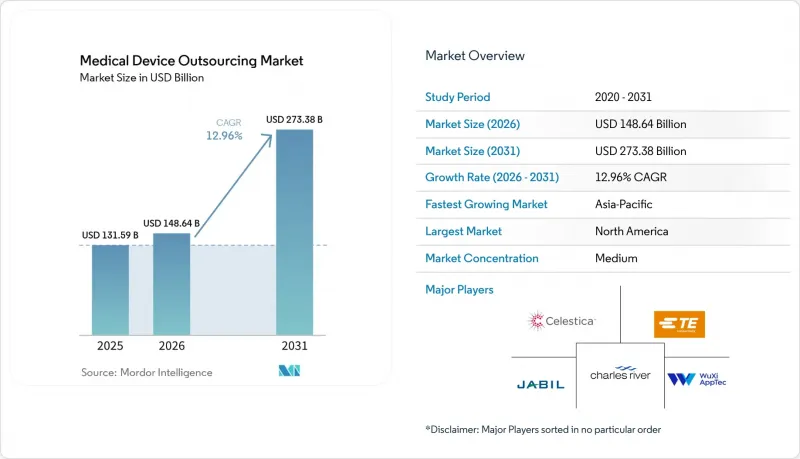
Mordor Intelligence에 의하면, 의료기기 아웃소싱 시장 규모는 2025년에 1,315억 9,000만 달러로 평가되었고 2026년 1,486억 4,000만 달러에서 2031년까지 2,733억 8,000만 달러에 이를 것으로 추정되고 있어 예측 기간(2026-2031년) CAGR은 12.96%를 나타낼 전망입니다.
본 보고서는 서비스 유형별(제품 설계·개발 서비스, 제품 시험·멸균 서비스 등), 의료기기 등급별(클래스 I 의료기기 등), 의료기기 유형별(소모품, 자본 설비 등), 용도별(심혈관, 정형외과 등) 및 지역별(북미, 유럽 등)로 분류되어 있습니다. 시장 전망은 금액(달러) 기준으로 제시되어 있습니다.
세계 의료기기 아웃소싱 시장 동향과 인사이트
OEM을 통한 핵심 경쟁력 강화 및 비용 최적화에 대한 관심 증가
의료기기 OEM 기업들은 제품 설계, 지적 재산권 및 상품화에 주력하는 한편, 자본 집약적인 생산 업무를 전문 파트너에게 아웃소싱하고 있습니다. 이러한 전환을 통해 클린룸 인증, 멸균 및 공정 검증에 대한 사내 관리 부담이 줄어듭니다. OEM 업체들이 이러한 활동을 고정자산이 아닌 변동 운영비로 처리함에 따라, 의료기기 아웃소싱 시장은 그 혜택을 누리고 있습니다. 치료 분야의 포트폴리오가 확대됨에 따라 인증 요건, 문서화 및 복잡성이 증가함에 따라 아웃소싱은 전략적인 선택지가 되고 있습니다. 주요 플랫폼에서는 제조, 멸균, 품질 지원이 통합되어 있어, 각 OEM 기업은 상업적 초점을 잃지 않으면서도 자산 집약도를 낮추고 유연성을 높일 수 있게 되었습니다.
복잡한 의료기기 시장 출시 기간 단축
규제 대상 카테고리에서 저침습 시스템, 커넥티드 플랫폼 및 복합 제품을 시장에 출시하는 OEM 기업에게 있어 속도는 매우 중요한 요소입니다. 신뢰할 수 있는 파트너가 문서화, 검증 및 출시 전 과정을 효율화함에 따라 의료기기 아웃소싱 시장이 확대되고 있습니다. 사전 검증을 거친 템플릿과 경험이 풍부한 품질 관리 팀 덕분에, 특히 높은 생체 적합성이나 멸균 처리가 필요한 의료기기의 경우 지연이 줄어듭니다. 클린룸 설비를 갖춘 아웃소싱 파트너는 OEM이 새로운 인프라를 구축하고 검증해야 하는 부담을 없애줌으로써, 보다 신속한 상품화를 실현합니다. Jabil과 HSE AG가 2025년에 맺은 제휴와 같은 파트너십은 공급망의 회복탄력성을 강화하는 동시에, 시제품 단계에서 시장 출시까지의 전환을 가속화하는 데 중점을 두고 있음을 여실히 보여주고 있습니다. 이처럼 이 시장은 생산 능력과 상업적으로 매우 중요한 시간, 이 두 가지를 모두 제공합니다.
아웃소싱된 공급망에서의 품질 책임과 리콜 위험
제조가 여러 외부 파트너를 통해 이루어지는 경우에도, 법적 제조업체는 의료기기의 품질에 대해 여전히 책임을 집니다. OEM은 계약을 통해 규제상의 의무를 완전히 이전할 수 없기 때문에 품질 관리는 의료기기 아웃소싱 시장에서 중요한 과제가 되고 있습니다. 코팅, 기계 가공, 멸균, 조립 등 각 공정에서 다양한 거점에 전문 공급업체가 필요한 의료기기의 경우, 그 복잡성은 더욱 커집니다. 유럽에서 공급망에 대한 책임이 확대됨에 따라 보상, 공급업체 관리 및 문서화에 대한 압박이 커지고 있으며, 이에 따라 감사, 품질 합의 및 시정 조치에 드는 비용이 증가하고 있습니다. 시장이 성장하는 한편, 품질에 대한 책임 문제가 민감한 분야의 아웃소싱 결정을 신중하게 만드는 요인이 되고 있습니다.
부문별 분석
2025년에는 수탁 제조가 매출의 55.13%를 차지하며, 의료기기 아웃소싱 시장에서 주도적인 위치를 유지했습니다. 이러한 경쟁력은 전문적인 자산과 엄격한 품질 시스템이 필요한 정밀 기계 가공, 클린룸 내 조립, 멸균 공정의 통합, 그리고 서브시스템의 적합성 평가를 각 OEM 업체들이 아웃소싱하는 경향을 반영하고 있습니다. 생산은 막대한 설비 투자가 필요한 반면, 비용 면에서 유연성을 갖추고 있어 여전히 아웃소싱의 주요 선택지이며, 다른 기능의 중요성이 커지는 상황에서도 매출의 기반을 지탱하고 있습니다.
규제 컨설팅 서비스는 OEM 각사가 사내에서 관리하기 어렵다고 느끼는 규정 준수 문제의 복잡성이 가중됨에 따라 가장 빠르게 성장하고 있는 분야입니다. 제품 시험, 멸균, 설계·개발, 업그레이드, 유지보수, 물류를 포함한 기타 서비스도 확대되고 있습니다. 제품 설계 단계에서의 조기 협력을 통해 설계 전환 시 발생하는 문제가 완화되는 한편, 물류 및 애프터마켓 지원은 보다 광범위한 서비스 계약으로 통합되는 경향이 강해지고 있어, 제조와 서비스 패키지 간의 격차가 점차 좁혀지고 있습니다.
클래스 III 의료기기는 2031년까지 연평균 성장률(CAGR) 14.55%를 기록하며 전체 시장의 평균 성장률을 상회할 것으로 전망됩니다. 이러한 성장은 무균 처리 및 생체 적합성에 관한 전문 지식이 필요한 이식형 및 임상적으로 복잡한 의료기기에 대한 아웃소싱 수요 증가에 힘입어 이루어지고 있습니다. 이러한 변화는 특히 고위험·복잡한 제품의 경우 아웃소싱이 점점 더 역량 중심적으로 변하고 있음을 여실히 보여주며, 클래스 III 프로그램을 전문 파트너들에게 중요한 성장 분야로 자리매김하고 있습니다.
클래스 II 의료기기는 심혈관, 정형외과 및 진단 관련 프로그램의 뒷받침을 받아 2025년에도 여전히 최대의 매출 부문으로 자리매김했습니다. 클래스 I 의료기기 역시, 특히 속도와 일관성이 중시되는 일회용 제품 및 소모품 분야에서 크게 기여하고 있습니다. 시장에서는 클래스 I 및 II 제품에 대한 양을 중시하는 아웃소싱과, 클래스 III 제품에 대한 역량을 중시하는 아웃소싱 사이에 뚜렷한 차이가 나타납니다. Integer Holdings는 2025년 이후 인수에 7억 달러 이상을 투자해 왔으며, 심혈관 시스템 및 신경 조절 기술에 중점을 두어 업계의 복잡한 플랫폼으로의 전환에 대응하고 있습니다.
지역별 분석
2025년, 북미는 의료기기 아웃소싱 시장의 39.56%를 차지하며 지역으로서의 주도적 위치를 유지했습니다. 해당 지역은 견고한 OEM 기반, 확립된 CDMO 네트워크, 그리고 FDA 규정을 준수하는 공급망과의 연계라는 장점을 갖추고 있습니다. 510(k) 및 PMA 관련 제조에 전문 지식을 갖춘 공급업체들은 문서화된 기술 이전 및 규모 확대 과정을 지원함으로써 생태계를 강화하고 있습니다. 니어쇼어링을 통해 멕시코나 코스타리카와 같은 인근 허브로도 해당 지역의 영향력이 확대되고 있습니다.
아시아태평양은 의료기기 아웃소싱 시장에서 가장 빠르게 성장하고 있는 지역으로, 2031년까지 연평균 성장률(CAGR)이 15.12%를 나타낼 것으로 전망됩니다. 이러한 성장은 의료 인프라 확충, 비용 효율적인 생산, 그리고 전 세계의 아웃소싱 프로그램을 유치하기 위한 유리한 정책에 힘입어 이루어지고 있습니다. 중국은 그 규모와 통합된 공급망 덕분에 여전히 최대의 제조 거점이지만, 지정학적 불확실성과 관세의 영향으로 인해 각 OEM 기업들은 말레이시아, 태국, 싱가포르, 인도 등 다른 국가들로의 다각화를 추진하고 있습니다.
유럽은 여전히 주요 생산 거점이며, 심혈관, 정형외과, 안과 및 IVD(체외진단용 의료기기) 프로그램 분야에서 독일, 아일랜드, 영국이 주도적인 역할을 하고 있습니다. 아일랜드는 카테터 제조, 클린룸 내 조립, 그리고 정밀 폴리머 가공 분야에서 뛰어난 역량을 갖추고 있습니다. EU의 MDR(의료기기 규정) 및 IVDR(체외진단용 의료기기 규정) 체계를 간소화하는 유럽위원회의 2025년 제안과 2026년 인증 기관 요건에 관한 규제로 인해, 인증 과정의 병목 현상이 완화되고 아웃소싱 시장의 성장이 가속화될 것으로 예측됩니다. 중동 및 아프리카와 남미는 시장 점유율은 작지만, 각 OEM 업체들이 생산 다각화와 탄탄한 공급망을 모색하는 가운데 전략적 중요성이 커지고 있습니다.
기타 혜택:
- 엑셀 형식 시장 예측(ME) 시트
- 3개월간의 애널리스트 지원
자주 묻는 질문
목차
제1장 서론
제2장 조사 방법
제3장 주요 요약
제4장 시장 구도
제5장 시장 규모와 성장 예측
제6장 경쟁 구도
제7장 시장 기회와 향후 전망
JHS 26.07.07According to Mordor Intelligence, the medical device outsourcing market size was valued at USD 131.59 billion in 2025 and is estimated to grow from USD 148.64 billion in 2026 to reach USD 273.38 billion by 2031, at a CAGR of 12.96% during the forecast period (2026-2031).
This report is Segmented by Service Type (Product Design and Development Services, Product Testing and Sterilization Services, and More), Device Class (Class I Medical Devices, and More), Device Type (Consumables, Capital Equipment, and More), Application (Cardiovascular, Orthopedic, and More), and Geography (North America, Europe, and More). The Market Forecasts are Provided in Terms of Value (USD).
Global Medical Device Outsourcing Market Trends and Insights
Rising OEM Focus on Core Competencies and Cost Optimization
Medical device OEMs are concentrating on product design, intellectual property, and commercialization while outsourcing capital-intensive production tasks to specialized partners. This shift reduces the burden of managing cleanroom qualifications, sterilizations, and process validations in-house. The medical device outsourcing market benefits as OEMs treat these activities as variable operating costs rather than fixed assets. With broader therapy portfolios, qualification demands, documentation, and complexity increase, making outsourcing a strategic choice. Major platforms are integrating manufacturing, sterilization, and quality support, enabling OEMs to lower asset intensity and enhance flexibility without losing commercial focus.
Faster Time to Market for Complex Medical Devices
Speed is a critical factor for OEMs launching minimally invasive systems, connected platforms, and combination products in regulated categories. The medical device outsourcing market gains as established partners streamline documentation, verification, and pre-launch processes. Pre-validated templates and experienced quality teams reduce delays, especially for devices requiring extensive biocompatibility and sterile processing. Outsourcing partners with cleanroom capacities enable faster commercialization by eliminating the need for OEMs to build and validate new infrastructure. Partnerships like Jabil's 2025 collaboration with HSE AG highlight the focus on accelerating prototype-to-market transitions while enhancing supply chain resilience. The market thus delivers both production capacity and commercially critical time.
Quality Liability and Recall Risk Across Outsourced Supply Chains
Legal manufacturers remain responsible for device quality, even when production involves multiple external partners. OEMs cannot fully transfer regulatory obligations through contracts, making quality oversight a critical challenge in the medical device outsourcing market. The complexity increases for devices requiring specialized suppliers for coatings, machining, sterilization, and assembly across various locations. Europe's expanded supply chain liability adds pressure on indemnification, supplier controls, and documentation, raising costs for audits, quality agreements, and corrective actions. While the market grows, quality accountability drives cautious outsourcing decisions in sensitive categories.
Other drivers and restraints analyzed in the detailed report include:
- Growing Need for Scalable Regulated Manufacturing Capacity
- Rising Outsourcing of Design, Development, and Validation Work
- High Switching Costs Due to Validation, Tooling, and Requalification
For complete list of drivers and restraints, kindly check the Table Of Contents.
Segment Analysis
In 2025, contract manufacturing accounted for 55.13% of the revenue, maintaining its leading role in the medical device outsourcing market. This dominance reflects OEMs' preference for outsourcing precision machining, cleanroom assembly, sterilization integration, and subsystem qualification, which require specialized assets and stringent quality systems. Production remains the primary outsourcing choice due to its significant capital requirements and cost flexibility, anchoring revenue even as other functions gain importance.
Regulatory consulting services are the fastest-growing segment, driven by increasing compliance complexities that OEMs find challenging to manage internally. Other services, including product testing, sterilization, design and development, upgrades, maintenance, and logistics, are also expanding. Early collaboration in product design reduces design transfer issues, while logistics and aftermarket support are increasingly integrated into broader service contracts, narrowing the gap between manufacturing and service bundles.
Class III devices are projected to grow at a 14.55% CAGR through 2031, outpacing the overall market average. This growth is driven by increased outsourcing demand for implantable and clinically complex devices, requiring expertise in sterile processing and biocompatibility. The shift highlights that outsourcing is increasingly capability-driven, especially for high-risk, complex products, positioning Class III programs as a key growth area for specialized partners.
Class II devices remained the largest revenue segment in 2025, supported by cardiovascular, orthopedic, and diagnostic programs. Class I devices also contribute significantly, particularly in disposables and consumables, where speed and consistency are prioritized. The market shows a clear distinction between volume-driven outsourcing in Class I and II products and capability-driven outsourcing in Class III. Integer Holdings has invested over USD 700 million in acquisitions since 2025, focusing on cardiovascular systems and neuromodulation capabilities, aligning with the industry's shift toward complex platforms.
Complete Report Scope:
- By Service Type
- Product Design And Development Services
- Product Testing And Sterilization Services
- Regulatory Consulting Services
- Contract Manufacturing Services
- Product Upgrade Services
- Product Maintenance Services
- Logistics And Aftermarket Services
- By Device Class
- Class I Medical Devices
- Class II Medical Devices
- Class III Medical Devices
- By Device Type
- Consumables
- Capital Equipment
- Implantable Devices
- In Vitro Diagnostics Devices
- Wearable Medical Devices
- By Application
- Cardiovascular
- Orthopedic
- Dental
- Respiratory
- Drug Delivery
- Diabetes Care
- Ophthalmic
- Others
- By Geography
- North America
- United States
- Canada
- Mexico
- Europe
- Germany
- United Kingdom
- France
- Italy
- Spain
- Rest of Europe
- Asia-Pacific
- China
- India
- Japan
- Australia
- South Korea
- Rest of Asia-Pacific
- Middle East and Africa
- GCC
- South Africa
- Rest of Middle East and Africa
- South America
- Brazil
- Argentina
- Rest of South America
- North America
Geography Analysis
In 2025, North America accounted for 39.56% of the medical device outsourcing market, maintaining its leading regional position. The region benefits from a strong OEM base, established CDMO networks, and alignment with FDA-regulated supply chains. Providers with expertise in 510(k) and PMA-related manufacturing strengthen the ecosystem by supporting documented transfer and scale-up processes. Nearshoring is expanding the region's influence into nearby hubs like Mexico and Costa Rica.
Asia-Pacific is the fastest-growing region in the medical device outsourcing market, with a projected 15.12% CAGR through 2031. Growth is driven by expanding healthcare infrastructure, cost-efficient production, and favorable policies attracting global outsourcing programs. China remains the largest manufacturing base due to its scale and integrated supply chains, but geopolitical uncertainties and tariffs are prompting OEMs to diversify into countries like Malaysia, Thailand, Singapore, and India.
Europe remains a key production base, led by Germany, Ireland, and the UK in cardiovascular, orthopedic, ophthalmic, and IVD programs. Ireland excels in catheter manufacturing, cleanroom assembly, and precision polymer processing. The European Commission's 2025 proposal to simplify EU MDR and IVDR frameworks and the 2026 regulation on notified body requirements are expected to ease certification bottlenecks, enabling faster outsourcing growth. The Middle East, Africa, and South America hold smaller shares but are gaining strategic importance as OEMs seek diversified manufacturing and resilient supply chains.
- Benchmark Electronics, Inc.
- Celestica
- Charles River
- Flex
- FUJIFILM
- Gerresheimer
- Integer Holdings
- Jabil
- Minnetronix Medical, Inc.
- Nipro
- Nordson
- Phillips-Medisize, LLC
- Plexus Corp.
- Repligen
- Sanmina Corporation
- TE Connectivity Ltd.
- Trelleborg AB
- Viant Medical, Inc.
- West Pharmaceutical Services
- WuXi AppTec Co., Ltd.
Additional Benefits:
- The market estimate (ME) sheet in Excel format
- 3 months of analyst support
TABLE OF CONTENTS
1 Introduction
- 1.1 Study Assumptions & Market Definition
- 1.2 Scope of the Study
2 Research Methodology
3 Executive Summary
4 Market Landscape
- 4.1 Market Overview
- 4.2 Market Drivers
- 4.2.1 Rising OEM Focus on Core Competencies and Cost Optimization
- 4.2.2 Faster Time to Market for Complex Medical Devices
- 4.2.3 Growing Need for Scalable Regulated Manufacturing Capacity
- 4.2.4 Rising Outsourcing of Design, Development, and Validation Work
- 4.2.5 Expansion of Connected, Software Enabled Medical Devices
- 4.2.6 Supply Chain Diversification and Nearshoring Initiatives
- 4.3 Market Restraints
- 4.3.1 Quality Liability and Recall Risk Across Outsourced Supply Chains
- 4.3.2 High Switching Costs Due to Validation, Tooling, and Requalification
- 4.3.3 Intellectual Property Protection and Confidentiality Concerns
- 4.3.4 Regulatory Complexity Across Multi Country Manufacturing Networks
- 4.4 Supply/Value Chain Analysis
- 4.5 Regulatory Landscape
- 4.6 Technological Outlook
- 4.7 Porter's Five Forces Analysis
- 4.7.1 Threat of New Entrants
- 4.7.2 Bargaining Power of Buyers
- 4.7.3 Bargaining Power of Suppliers
- 4.7.4 Threat of Substitutes
- 4.7.5 Intensity of Competitive Rivalry
5 Market Size & Growth Forecasts (Value, USD)
- 5.1 By Service Type
- 5.1.1 Product Design And Development Services
- 5.1.2 Product Testing And Sterilization Services
- 5.1.3 Regulatory Consulting Services
- 5.1.4 Contract Manufacturing Services
- 5.1.5 Product Upgrade Services
- 5.1.6 Product Maintenance Services
- 5.1.7 Logistics And Aftermarket Services
- 5.2 By Device Class
- 5.2.1 Class I Medical Devices
- 5.2.2 Class II Medical Devices
- 5.2.3 Class III Medical Devices
- 5.3 By Device Type
- 5.3.1 Consumables
- 5.3.2 Capital Equipment
- 5.3.3 Implantable Devices
- 5.3.4 In Vitro Diagnostics Devices
- 5.3.5 Wearable Medical Devices
- 5.4 By Application
- 5.4.1 Cardiovascular
- 5.4.2 Orthopedic
- 5.4.3 Dental
- 5.4.4 Respiratory
- 5.4.5 Drug Delivery
- 5.4.6 Diabetes Care
- 5.4.7 Ophthalmic
- 5.4.8 Others
- 5.5 By Geography
- 5.5.1 North America
- 5.5.1.1 United States
- 5.5.1.2 Canada
- 5.5.1.3 Mexico
- 5.5.2 Europe
- 5.5.2.1 Germany
- 5.5.2.2 United Kingdom
- 5.5.2.3 France
- 5.5.2.4 Italy
- 5.5.2.5 Spain
- 5.5.2.6 Rest of Europe
- 5.5.3 Asia-Pacific
- 5.5.3.1 China
- 5.5.3.2 India
- 5.5.3.3 Japan
- 5.5.3.4 Australia
- 5.5.3.5 South Korea
- 5.5.3.6 Rest of Asia-Pacific
- 5.5.4 Middle East and Africa
- 5.5.4.1 GCC
- 5.5.4.2 South Africa
- 5.5.4.3 Rest of Middle East and Africa
- 5.5.5 South America
- 5.5.5.1 Brazil
- 5.5.5.2 Argentina
- 5.5.5.3 Rest of South America
- 5.5.1 North America
6 Competitive Landscape
- 6.1 Market Concentration
- 6.2 Market Share Analysis
- 6.3 Company Profiles (includes Global level Overview, Market-level Overview, Core Segments, Financials, Strategic Information, Market Rank/Share, Products & Services, Recent Developments)
- 6.3.1 Benchmark Electronics, Inc.
- 6.3.2 Celestica Inc.
- 6.3.3 Charles River Laboratories International, Inc.
- 6.3.4 Flex Ltd.
- 6.3.5 FUJIFILM Holdings Corporation
- 6.3.6 Gerresheimer AG
- 6.3.7 Integer Holdings Corporation
- 6.3.8 Jabil Inc.
- 6.3.9 Minnetronix Medical, Inc.
- 6.3.10 Nipro Corporation
- 6.3.11 Nordson Corporation
- 6.3.12 Phillips-Medisize, LLC
- 6.3.13 Plexus Corp.
- 6.3.14 Repligen Corporation
- 6.3.15 Sanmina Corporation
- 6.3.16 TE Connectivity Ltd.
- 6.3.17 Trelleborg AB
- 6.3.18 Viant Medical, Inc.
- 6.3.19 West Pharmaceutical Services, Inc.
- 6.3.20 WuXi AppTec Co., Ltd.
7 Market Opportunities & Future Outlook
- 7.1 White-space & Unmet-Need Assessment


