

|
시장보고서
상품코드
2073058
소형 폼 팩터(SFF) PC 시장 : 점유율 분석, 업계 동향과 통계, 성장 예측(2026-2031년)Small Form Factor (SFF) PC - Market Share Analysis, Industry Trends & Statistics, Growth Forecasts (2026 - 2031) |
||||||
 Mordor Intelligence
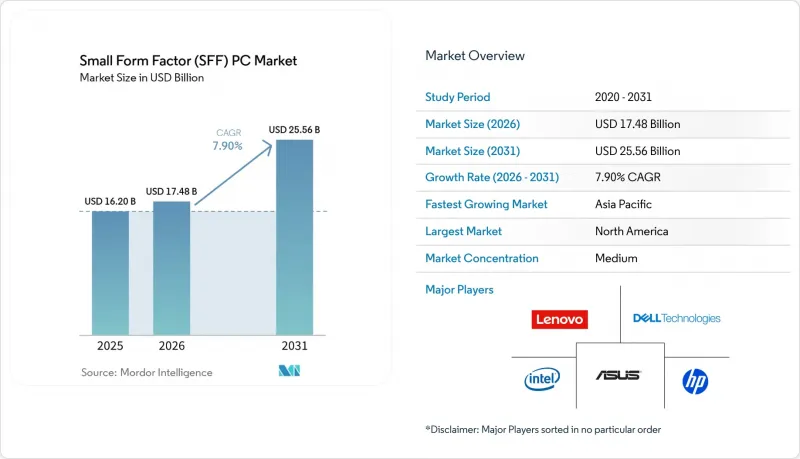
Mordor Intelligence에 의하면, 소형 폼 팩터 PC 시장 규모는 2025년 162억 달러에서 2026년에는 174억 8,000만 달러로 확대되어 2031년까지 255억 6,000만 달러에 이를 것으로 예측되며, 2026-2031년까지 CAGR 7.9%로 성장할 전망입니다.
본 보고서는 폼 팩터(미니 타워형 PC, 소형 데스크톱 PC, 초소형 폼 팩터 PC, 기타), 구성 요소(CPU, GPU, 메인보드, 메모리, 저장 장치, 기타), 최종 사용자(일반 소비자, 상업용 사무실, 산업 및 제조, 기타), 유통 채널(전자상거래, 소매점, B2B 직접 판매, 기타), 지역별로 분류되어 있습니다. 시장 전망은 금액(달러) 기준으로 제시되어 있습니다.
세계 소형 폼 팩터(SFF) PC 시장 동향 및 분석
팬데믹 이후 재택근무 환경에 대한 수요 증가
하이브리드 근무 방식의 확산으로 인해 두 곳에서 컴퓨터를 사용하는 것이 일상화되면서, 직원들은 성능을 희생하지 않으면서도 제한된 책상 공간에 들어맞는 시스템을 선택하고 있습니다. 스몰 폼 팩터(SFF) PC는 2리터 크기의 케이스 내에 코어 수가 많은 CPU와 통합 그래픽을 탑재하고 있어, 가정에서 멀티 모니터 4K 환경에서의 생산성을 실현하면서도 사무실의 핫데스크에서도 충분히 휴대할 수 있는 크기를 유지하고 있습니다. 기업의 IT 부서는 기존 타워형 PC에 비해 운송, 보관, 냉각 비용이 절감되기 때문에 이러한 유형의 장비를 선호하여 도입하고 있습니다. 또한, 집에서 소형 데스크톱 PC를 사용하는 직원들은 직장에서도 비슷한 사양의 하드웨어를 선호하는 경향이 있어, 이에 따라 미니 타워형이나 초소형 디자인의 PC로 교체하려는 수요가 증가하고 있습니다.
PC 게임과 e스포츠의 인기 상승
게이밍용 컴퓨터 부문에서는 3리터 이하의 케이스 내에 데스크톱급 프로세서와 RTX 시리즈 GPU를 통합한 콤팩트한 시스템이 널리 채택되고 있습니다. NVIDIA가 2024년에 발표한 폼 팩터 가이드라인에서는 SFF(소형 폼 팩터) 시스템 구축을 효율화하기 위해 GPU의 길이, 높이, 소비 전력의 상한선이 정의되어 있어, 사용자는 열 설계를 추측에 의존하지 않고도 최대 성능을 발휘하는 그래픽 카드를 사양으로 채택할 수 있게 되었습니다. e스포츠 경기장에서는 운송비와 설치 시간을 줄이기 위해 이러한 경량 시스템이 도입되고 있는 반면, 컨텐츠 크리에이터들은 스트리밍 장비를 설치할 수 있는 책상 공간을 확보할 수 있다는 점을 높이 평가했습니다. WiFi 7의 급속한 보급으로 인해, 타워형 PC가 가진 ‘유선 연결"이라는 마지막 장점마저 사라지면서, 휴대용 게이밍 데스크톱의 유용성이 한층 더 입증되고 있습니다.
풀 타워형 PC와 비교했을 때의 업그레이드 유연성 제한
SFF 마더보드, 외부 전원 어댑터, 납땜된 메모리는 사용자가 스토리지나 일부 SO-DIMM을 업그레이드하는 것을 제한하며, 성능을 대폭 향상시키려면 장치 전체를 교체해야만 합니다. 교육 기관이나 중소기업의 경우, GPU나 CPU의 비약적인 발전으로 인해 단일 부품 교체만으로는 해결되지 않고 새로운 시스템 전체가 필요하게 되면 총 비용이 높아집니다. 수입 관세가 높은 지역에서는 완전한 교체를 위한 비용 측면을 고려할 때, 장기 운용을 목적으로 하는 SFF 하드웨어의 도입을 자제하는 경향이 있습니다.
부문별 분석
디지털 사이니지 네트워크에서 HDMI 크기의 장치를 디스플레이에 직접 연결함으로써 별도의 본체가 필요 없어지므로, 스틱 PC는 연평균 성장률(CAGR) 10.9%라는 가장 빠른 성장세를 보이고 있습니다. 이 폼 팩터와 관련된 소형 폼 팩터 PC 시장은 USB를 통해 전원을 공급받는 팬리스 설계의 이점을 누리고 있으며, POS 키오스크나 회의실에서의 4K 컨텐츠 재생에 대응하고 있습니다. 미니 타워형 PC는 공구 없이도 유지보수가 가능하다는 점과 풀 하이트 PCIe 슬롯에 대한 기업 수요에 힘입어 2025년 매출의 37.2%를 차지했으나, 방열 성능이 향상됨에 따라 그 점유율은 점차 울트라 스몰형으로 넘어갈 전망입니다. 울트라 스몰형 및 견고형 모델은 운송 및 제조업 분야의 엣지 분석 노드를 강화하며, 내충격성 케이스와 확장된 온도 범위 지원 덕분에 더 높은 수익률을 실현하고 있습니다.
서버급 기술 혁신이 소비자용 큐브형 PC로도 확산되면서, 65와트 데스크톱용 CPU와 노트북급 RTX GPU가 함께 탑재되는 시대가 열렸습니다. 이를 통해 게이머들은 3kg 이하의 LAN 지원 PC를 직접 조립할 수 있게 되었습니다. 스틱형 모델의 소형 폼 팩터 PC 시장 점유율은 금액 기준으로는 여전히 작지만, 판매 대수 기준으로는 1위를 차지하고 있습니다. 이는 교육 기관들이 오래된 모니터를 Chromebox 스타일의 엔드포인트로 전환하기 위해 수천 대 단위로 구매하고 있기 때문입니다. 의료용 카트나 병원의 영상진단실에서는 디스플레이 뒷면에 설치할 수 있는 1.5리터 이하의 데스크톱 PC로의 전환이 진행되고 있으며, 이로 인해 통로에 타워형 PC 본체가 놓이는 일이 없어졌고, 점차 성숙해 가는 방열 솔루션이 뒷받침하는 용도의 다양성이 드러나고 있습니다.
GPU 출하량은 연평균 11.1% 증가할 것으로 전망되며, 게이밍과 AI 엣지 노드 분야에서 모두 디스크리트 카드와 납땜형 가속기가 채택됨에 따라 시스템 전체의 평균 성장률을 상회할 것으로 예측됩니다. GPU 탑재 모델의 소형 폼 팩터 PC 시장 규모는 카드의 전체 길이와 소비 전력을 제한하고, mini-ITX 조립 사용자들을 위해 드롭인 호환성을 보장하는 NVIDIA의 ‘SFF-Ready” 프로그램의 혜택을 받고 있습니다. CPU 매출은 여전히 부품 명세서(BOM)의 23.8%를 차지하고 있지만, 통합 NPU가 중앙 코어에서 AI 추론 처리를 오프로드함에 따라 그 성장세는 완만해지고 있습니다. 플랫폼의 와트 밀도가 높아짐에 따라 DDR5 SO-DIMM, PCIe 5.0 NVMe SSD, 소형 GaN 전원 어댑터 시장 점유율이 확대되고 있으며, 팬리스 사양의 프리미엄 빌드용으로는 솔리드 스테이트 AirJet 쿨러가 BOM에 포함되고 있습니다.
부품 공급업체는 시스템 전체의 구성 변화로 인해 이익을 얻고 있습니다. 초소형 PC용 메인보드에는 Wi-Fi 7, 듀얼 2.5기가비트 이더넷, Thunderbolt 4가 탑재되어 있어, PCB 크기가 작아졌음에도 불구하고 평균 판매 가격(ASP)이 상승하고 있습니다. 또한, 각 벤더사는 게이밍 큐브용 330와트 외부 어댑터를 적극 홍보하고 있으며, 수익성이 높은 액세서리를 판매함으로써 대당 총매출을 끌어올리고 있습니다. CHIPS법에 따라 자금을 지원받은 팹을 통해 공급망의 현지화가 진행되는 가운데, 북미와 일본의 메모리 제조업체들은 지정학적 리스크를 헤지하려는 SFF OEM을 위해 리드타임을 단축할 가능성이 있습니다.
지역별 분석
아시아태평양은 2025년 매출의 37.7%를 차지하며, 일본과 대만의 반도체 우대 조치, 선전과 타이베이의 OEM 집적화, 인도의 가처분 소득 증가에 힘입어 2031년까지 연평균 11.3%의 성장이 예상됩니다. 도쿄의 엣지 AI 하드웨어에 대한 보조금과 대만의 연구개발 세액 공제는 현지 조립형 미니 PC 생산을 촉진하고, 공급망을 단축하는 동시에 해당 지역의 구매자에게 제공되는 리드 타임을 단축하고 있습니다. MINISFORUM 등 중국 브랜드들은 선전의 생태계를 활용해 분기마다 설계를 개선하고, 다국적 기업보다 20% 저렴한 가격으로 제품을 제공함으로써 국내 시장에서의 점유율을 높이고 있습니다. 인도의 공공 서비스 디지털화와 IT 아웃소싱 붐은 부품에 대한 수입 관세가 있음에도 불구하고, 콜센터와 코딩 허브에서의 소형 데스크톱 수요를 뒷받침하고 있습니다.
북미에서는 “CHIPS법”의 자금을 통해 CPU와 DRAM 생산이 현지화되었고, 아시아에서공급 차질 위험이 줄어든 덕분에, 기업의 장비 교체 주기에서 압도적인 점유율을 차지하고 있습니다. 미국에서는 에너지 비용 절감과 사무 공간의 효율적 활용을 목적으로 노후화된 타워형 PC를 미니 데스크톱으로 교체하고 있으며, 교육구에서는 크롬북 스타일의 실습실용으로 스틱 PC를 도입하고 있습니다. 캐나다에서도 은행이나 행정 기관에서 비슷한 경향이 나타납니다. 에너지 효율 관련 규제로 인해 구매자들은 ENERGY STAR 8.0 기준을 충족하고, 대기 시 전력 소비가 적은 설계의 제품을 선택하고 있습니다.
유럽에서는 계속해서 꾸준한 도입이 진행되고 있으며, 독일, 프랑스, 영국에서는 재활용 플라스틱을 사용하여 조립된 소형 PC를 우선적으로 채택함으로써 WEEE(폐전기전자기기) 회수 의무를 지원하는 친환경 조달 기준을 충족하고 있습니다. 영국의 2025년 규제 개정에 따라 소형 전자기기에 대한 제조자 책임 비용이 폐지됨에 따라, 공급업체들은 포장 및 재활용 물류를 최적화할 수밖에 없게 되었습니다. 남유럽과 동유럽 국가들에서는 EU의 디지털화 지원금을 바탕으로 공장 설비 현대화에 친환경형 SFF 유닛이 선정되고 있는 반면, 북유럽 국가들에서는 재생에너지를 활용한 마이크로그리드로 구동되는 팬리스 데스크톱을 통합한 제로 카본 오피스의 도입을 선도하고 있습니다.
남미, 중동 및 아프리카는 소형 폼 팩터 PC 시장 규모에서 차지하는 비중은 작지만, 꾸준히 확대되고 있습니다. 브라질 정부는 학교의 공과금 절감을 목적으로 저전력 미니 PC를 IT 조달하고 있습니다. 사우디아라비아와 아랍에미리트는 스마트 시티의 키오스크 및 모니터링 시스템을 위해 엣지 분석 노드를 도입하고 있지만, 수입 부품에 의존하고 있어 운송 상황의 변동에 따른 영향을 받기 쉬운 상황에 놓여 있습니다. 나이지리아와 케냐는 소형 데스크톱 PC를 활용한 코워킹 허브에 투자하고 있으며, 전원 백업 시스템의 경우 저전력 하드웨어가 선호되지만, 전력망의 안정성이 불안정하기 때문에 대규모 보급에는 어려움이 있습니다.
기타 혜택
- 엑셀 형식 시장 예측(ME) 시트
- 3개월간의 애널리스트 지원
자주 묻는 질문
목차
제1장 서론
제2장 조사 방법
제3장 주요 요약
제4장 시장 구도
제5장 시장 규모와 성장 예측
제6장 경쟁 구도
제7장 시장 기회와 향후 전망
JHS 26.07.07According to Mordor Intelligence, the small form factor pC market size increased from USD 16.2 billion in 2025 to USD 17.48 billion in 2026 and is projected to reach USD 25.56 billion by 2031, expanding at a 7.9% CAGR between 2026 and 2031.
This report is Segmented by Form Factor (Mini-Tower PCs, Small Desktop PCs, Ultra-Small Form Factor PCs, and More), Component (CPU, GPU, Motherboard, Memory, Storage, and More), End User (Consumer, Commercial Office, Industrial and Manufacturing, and More), Distribution Channel (E-Commerce, Retail Stores, Direct B2B Sales, and More), and Geography. The Market Forecasts are Provided in Terms of Value (USD).
Global Small Form Factor (SFF) PC Market Trends and Insights
Growing Demand for Home Office Setups Post Pandemic
Hybrid work has normalized dual-location computing, pushing employees to select systems that fit limited desk real estate without trading performance. Small Form Factor units pair high-core-count CPUs and integrated graphics inside a 2-liter chassis, enabling multi-monitor 4K productivity at home while remaining portable enough for office hot-desks. Corporate IT teams prefer these units because shipping, storage, and cooling costs fall versus traditional towers, and employees who enjoy compact desktops at home lobby for identical hardware at work, driving refresh orders toward mini-tower and ultra-small designs.
Rising Popularity of PC Gaming and Esports
Competitive gaming has embraced compact rigs that integrate desktop-class processors and RTX-series GPUs inside sub-3-liter cases. Form-factor guidelines published by NVIDIA in 2024 define GPU length, height, and power ceilings to streamline SFF builds, encouraging adopters to spec full-performance cards without thermal guesswork. Esports venues turn to these lighter systems to cut freight and setup time, while content creators value the freed desk space for streaming equipment. Rapid WiFi 7 adoption removes the last tethered advantage of tower PCs, further validating portable gaming desktops.
Limited Upgrade Flexibility Compared to Full-Tower PCs
SFF motherboards, external power bricks, and soldered memory curtail user upgrades to storage or select SO-DIMMs, forcing entire-unit replacements for major performance gains. Educational buyers and small businesses face a higher total cost when GPU or CPU leaps demand new systems rather than a single part swap. In regions with high import tariffs, the economics of full replacements discourage specification of SFF hardware for long-life deployments.
Other drivers and restraints analyzed in the detailed report include:
- Advances in High-Performance, Low-Power Components
- Shift Toward Space-Saving IT Infrastructure in Enterprises
- Thermal Management Challenges in Compact Chassis
For complete list of drivers and restraints, kindly check the Table Of Contents.
Segment Analysis
Stick PCs hold the fastest trajectory at a 10.9% CAGR as digital signage networks plug HDMI-sized units into displays, removing the need for separate housings. The Small Form Factor PC market size tied to this form factor benefits from fanless layouts that draw power over USB and support 4K playback for point-of-sale kiosks and meeting-room casting. Mini-tower PCs retained 37.2% of 2025 revenue, upheld by enterprise demand for tool-free maintenance and full-height PCIe slots, yet their share will gradually yield to ultra-smalls as thermals improve. Ultra-small and rugged variants empower edge analytics nodes in transportation and manufacturing, adding higher margins through shock-proof casings and extended temperature ratings.
Server-class innovation trickles into consumer cubes where 65-watt desktop CPUs now coexist with laptop-tier RTX GPUs, letting gamers assemble LAN-ready rigs under three kilograms. The Small Form Factor PC market share for stick models stays minor in value terms but leads volume count, as educational programs buy thousands of units to convert old monitors into Chromebox-style endpoints. Healthcare carts and hospital imaging suites migrate toward sub-1.5-liter desktops that mount behind displays to keep aisles free of tower bases, illustrating the application diversity supported by maturing thermal solutions.
GPU shipments are forecast to rise 11.1% each year, eclipsing average system growth because discrete cards or solder-down accelerators now appear in both gaming and AI edge nodes. The Small Form Factor PC market size for GPU-equipped models benefits from NVIDIA's SFF-Ready program that limits card length and power draw, guaranteeing drop-in fit for mini-ITX builders. CPU revenue still rules the bill of materials at 23.8%, but grows more modestly as integrated NPUs offload AI inference from central cores. DDR5 SO-DIMMs, PCIe 5.0 NVMe SSDs, and tiny GaN power adapters gain share as platform watt density climbs, and solid-state AirJet coolers slide into BOMs for fanless premium builds.
Component suppliers profit from balance-of-system shifts: motherboards for ultrasmalls embed WiFi 7, dual 2.5-gigabit Ethernet, and Thunderbolt 4, raising ASPs despite smaller PCB sizes. Vendors also push external 330-watt adapters for gaming cubes, selling high-margin accessories that lift total revenue per unit. As supply chains localize under CHIPS-funded fabs, North American and Japanese memory producers may shorten lead times for SFF OEMs seeking to hedge geopolitical risk.
Complete Report Scope:
- By Form Factor
- Mini-Tower PCs
- Small Desktop PCs
- Ultra-Small Form Factor PCs
- Stick PCs
- Rugged and Industrial SFF PCs
- By Component
- CPU
- GPU
- Motherboard
- Memory
- Storage
- Power Supply
- Cooling System
- By End User
- Consumer
- Commercial Office
- Industrial and Manufacturing
- Healthcare
- Education
- Media and Entertainment
- Defense and Aerospace
- By Distribution Channel
- E-Commerce
- Retail Stores
- Direct B2B Sales
- System Integrators and VARs
- By Geography
- North America
- United States
- Canada
- Rest of North America
- South America
- Brazil
- Argentina
- Rest of South America
- Europe
- Germany
- United Kingdom
- France
- Italy
- Spain
- Russia
- Rest of Europe
- Asia-Pacific
- China
- Japan
- South Korea
- India
- Australia
- Rest of Asia-Pacific
- Middle East
- Saudi Arabia
- United Arab Emirates
- Turkey
- Rest of Middle East
- Africa
- South Africa
- Nigeria
- Kenya
- Rest of Africa
- North America
Geography Analysis
Asia-Pacific drove 37.7% of 2025 revenue and is expected to grow 11.3% a year through 2031, propelled by semiconductor incentives in Japan and Taiwan, OEM density in Shenzhen and Taipei, and rising disposable incomes in India. Tokyo's subsidies for edge-AI hardware and Taiwan's R and D tax credits encourage locally assembled mini-PCs, shortening supply chains and lowering lead times for regional buyers. Chinese brands such as MINISFORUM leverage Shenzhen's ecosystem to iterate designs quarterly and price products 20% below multinational peers, widening domestic penetration. India's digitization of public services and the boom in IT outsourcing fuel demand for compact desktops in call centers and coding hubs despite import duties on components.
North America captures an outsized share of enterprise refresh cycles thanks to CHIPS Act funds that localize CPU and DRAM production and reduce risk of Asian supply disruptions. U.S. businesses replace aging towers with mini-desktops to reduce energy bills and free office real estate, while education districts deploy stick PCs for Chromebook-style labs. Canada follows similar patterns in banking and public administration. Energy-efficiency regulations steer buyers toward low-idle-power designs that meet ENERGY STAR 8.0 targets.
Europe remains a steady adopter, with Germany, France, and the United Kingdom meeting green-procurement criteria that favor compact PCs assembled with recycled plastic and supporting WEEE take-back mandates. The United Kingdom's 2025 regulatory update lifts producer-responsibility costs for miniaturized electronics, pressuring vendors to optimize packaging and recycling logistics. Southern and Eastern Europe select rugged SFF units for factory upgrades under EU digitalization grants, while Nordic countries pioneer zero-carbon offices that integrate fanless desktops powered by renewable microgrids.
South America, the Middle East, and Africa collectively represent a smaller yet rising slice of the Small Form Factor PC market size. Brazil's government IT buys low-power mini-PCs for schools to cut utility bills. Saudi Arabia and the United Arab Emirates deploy edge-analytics nodes for smart-city kiosks and surveillance, albeit dependent on imported parts that expose them to shipping volatility. Nigeria and Kenya invest in co-working hubs that rely on compact desktops where power-backup systems favor lower-wattage hardware, though inconsistent grid stability hampers mass adoption.
- ASUSTeK Computer Inc.
- Intel Corporation
- Dell Technologies Inc.
- HP Inc.
- Apple Inc.
- Lenovo Group Limited
- Acer Inc.
- Zotac Technology Limited
- Micro-Star International Co., Ltd.
- Gigabyte Technology Co., Ltd.
- Shenzhen Kang Wang Electronic Co., Ltd.
- Elitegroup Computer Systems Co., Ltd.
- ASRock Inc.
- Chuwi Innovation Limited
- Simply NUC, Inc.
- Compulab Ltd.
- Shuttle Inc.
- Hon Hai Precision Industry Co., Ltd.
- Falcon Northwest Computer Systems Inc.
- NZXT, Inc.
Additional Benefits:
- The market estimate (ME) sheet in Excel format
- 3 months of analyst support
TABLE OF CONTENTS
1 INTRODUCTION
- 1.1 Study Assumptions and Market Definition
- 1.2 Scope of the Study
2 RESEARCH METHODOLOGY
3 EXECUTIVE SUMMARY
4 MARKET LANDSCAPE
- 4.1 Market Overview
- 4.2 Market Drivers
- 4.2.1 Growing Demand for Home Office Setups Post-Pandemic
- 4.2.2 Rising Popularity of PC Gaming and Esports
- 4.2.3 Advances in High-Performance, Low-Power Components
- 4.2.4 Shift Toward Space-Saving IT Infrastructure in Enterprises
- 4.2.5 OEM Adoption of Compute in Display Digital Signage Deployments
- 4.2.6 Government Incentives for Edge Computing Hardware Localization
- 4.3 Market Restraints
- 4.3.1 Limited Upgrade Flexibility Compared to Full-Tower PCs
- 4.3.2 Thermal Management Challenges in Compact Chassis
- 4.3.3 Price Premium of High-Density Components
- 4.3.4 Rising E-Waste Regulation Compliance Costs for Miniaturized Systems
- 4.4 Impact of Macroeconomic Factors on the Market
- 4.5 Industry Value / Supply-Chain Analysis
- 4.6 Regulatory Landscape
- 4.7 Technological Outlook
- 4.8 Porter's Five Forces Analysis
- 4.8.1 Threat of New Entrants
- 4.8.2 Bargaining Power of Buyers
- 4.8.3 Bargaining Power of Suppliers
- 4.8.4 Threat of Substitutes
- 4.8.5 Competitive Rivalry
5 MARKET SIZE AND GROWTH FORECASTS (VALUE)
- 5.1 By Form Factor
- 5.1.1 Mini-Tower PCs
- 5.1.2 Small Desktop PCs
- 5.1.3 Ultra-Small Form Factor PCs
- 5.1.4 Stick PCs
- 5.1.5 Rugged and Industrial SFF PCs
- 5.2 By Component
- 5.2.1 CPU
- 5.2.2 GPU
- 5.2.3 Motherboard
- 5.2.4 Memory
- 5.2.5 Storage
- 5.2.6 Power Supply
- 5.2.7 Cooling System
- 5.3 By End User
- 5.3.1 Consumer
- 5.3.2 Commercial Office
- 5.3.3 Industrial and Manufacturing
- 5.3.4 Healthcare
- 5.3.5 Education
- 5.3.6 Media and Entertainment
- 5.3.7 Defense and Aerospace
- 5.4 By Distribution Channel
- 5.4.1 E-Commerce
- 5.4.2 Retail Stores
- 5.4.3 Direct B2B Sales
- 5.4.4 System Integrators and VARs
- 5.5 By Geography
- 5.5.1 North America
- 5.5.1.1 United States
- 5.5.1.2 Canada
- 5.5.1.3 Rest of North America
- 5.5.2 South America
- 5.5.2.1 Brazil
- 5.5.2.2 Argentina
- 5.5.2.3 Rest of South America
- 5.5.3 Europe
- 5.5.3.1 Germany
- 5.5.3.2 United Kingdom
- 5.5.3.3 France
- 5.5.3.4 Italy
- 5.5.3.5 Spain
- 5.5.3.6 Russia
- 5.5.3.7 Rest of Europe
- 5.5.4 Asia-Pacific
- 5.5.4.1 China
- 5.5.4.2 Japan
- 5.5.4.3 South Korea
- 5.5.4.4 India
- 5.5.4.5 Australia
- 5.5.4.6 Rest of Asia-Pacific
- 5.5.5 Middle East
- 5.5.5.1 Saudi Arabia
- 5.5.5.2 United Arab Emirates
- 5.5.5.3 Turkey
- 5.5.5.4 Rest of Middle East
- 5.5.6 Africa
- 5.5.6.1 South Africa
- 5.5.6.2 Nigeria
- 5.5.6.3 Kenya
- 5.5.6.4 Rest of Africa
- 5.5.1 North America
6 COMPETITIVE LANDSCAPE
- 6.1 Market Concentration
- 6.2 Strategic Moves
- 6.3 Market Share Analysis
- 6.4 Company Profiles (includes Global Level Overview, Market Level Overview, Core Segments, Financials as available, Strategic Information, Market Rank/Share, Products and Services, Recent Developments)
- 6.4.1 ASUSTeK Computer Inc.
- 6.4.2 Intel Corporation
- 6.4.3 Dell Technologies Inc.
- 6.4.4 HP Inc.
- 6.4.5 Apple Inc.
- 6.4.6 Lenovo Group Limited
- 6.4.7 Acer Inc.
- 6.4.8 Zotac Technology Limited
- 6.4.9 Micro-Star International Co., Ltd.
- 6.4.10 Gigabyte Technology Co., Ltd.
- 6.4.11 Shenzhen Kang Wang Electronic Co., Ltd.
- 6.4.12 Elitegroup Computer Systems Co., Ltd.
- 6.4.13 ASRock Inc.
- 6.4.14 Chuwi Innovation Limited
- 6.4.15 Simply NUC, Inc.
- 6.4.16 Compulab Ltd.
- 6.4.17 Shuttle Inc.
- 6.4.18 Hon Hai Precision Industry Co., Ltd.
- 6.4.19 Falcon Northwest Computer Systems Inc.
- 6.4.20 NZXT, Inc.
7 MARKET OPPORTUNITIES AND FUTURE OUTLOOK
- 7.1 White-Space and Unmet-Need Assessment


