

|
시장보고서
상품코드
2073295
사내 인재 매칭 플랫폼 : 시장 점유율 분석, 업계 동향 및 통계, 성장 예측(2026-2031년)Internal Talent Marketplace Platform Market - Market Share Analysis, Industry Trends & Statistics, Growth Forecasts (2026 - 2031) |
||||||
 Mordor Intelligence
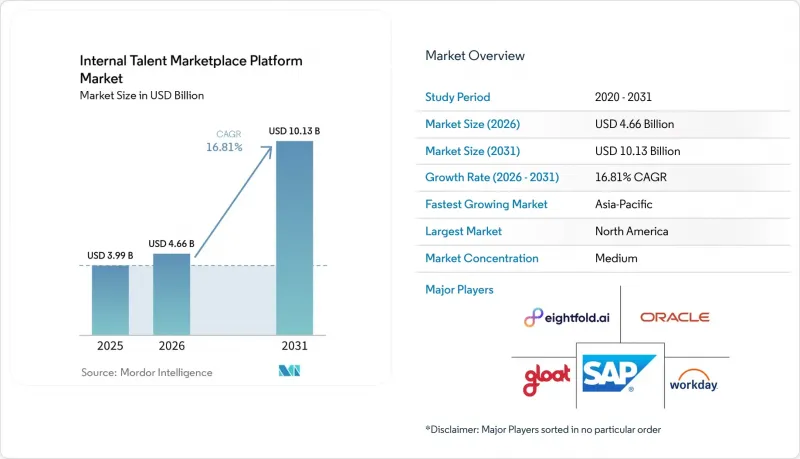
Mordor Intelligence에 의하면, 사내 인재 매칭 플랫폼 시장 규모는 2025년 39억 9,000만 달러로 평가되었습니다. 2026년에는 46억 6,000만 달러로 확대되어 2031년까지 101억 3,000만 달러에 이를 것으로 예상되며 2026년부터 2031년에 걸쳐 CAGR 16.81%로 성장할 전망입니다.
본 보고서는 기능(채용 매칭, 인재 계획 분석 등), 제공 모델(독립형 사내 인재 매칭 플랫폼 등), 도입 모델(클라우드 등), 기업 규모(대기업 등), 산업 분야(IT 및 통신 등) 및 지역별로 분류되어 있습니다. 시장 전망은 금액(달러) 기준으로 제시되어 있습니다.
세계의 사내 인재 매칭 플랫폼 시장 동향 및 인사이트
역량 기반 인재 계획
기업들은 경직된 직무 구조를 해체하고, 검증된 역량을 바탕으로 업무를 배정하는 유연한 인재 풀을 도입함으로써, 우선순위가 변경되었을 때의 대응 시간을 단축하고 있습니다. 사내 인재 매칭 플랫폼의 도입을 통해 프로젝트 성과, 동료 추천, 과정 이수 현황 등을 활용한 역량 검증 과정이 자동화되었으며, 재무 및 전략 팀이 자본 예산과 함께 모델링할 수 있는 기업의 역량에 관한 ‘실시간 재고"가 구축됩니다. 세계경제포럼(WEF)은 2030년까지 핵심 역량의 39%가 변화할 것으로 예측하고 있으며, 지속적인 재교육의 시급성이 더욱 커지고 있습니다. 학습 경로를 기회 제안에 통합한 플랫폼은 직원들이 생태계를 벗어나지 않고도 기술 격차를 해소할 수 있도록 하며, 역량 개발을 가치 창출과 직접적으로 연결합니다.
애자일 경력 경로에 대한 직원들 수요
투명성이 높은 사내 인사는 특히 경력 초기 단계의 전문직 직원들 사이에서 인재 유지를 결정짓는 핵심 요인으로 자리 잡고 있습니다. 그들은 소비자용 수준의 추천 엔진이 그 능력을 최대한 발휘할 수 있는 과제를 제시해 주기를 기대하고 있습니다. 대규모 도입 사례의 참여 지표에 따르면, 정적인 채용 게시판 대신 알고리즘 기반 매칭 시스템이 도입되자 사내 지원 건수가 세 자릿수 증가세를 보였습니다. 마켓플레이스 분석을 통해 부서 간 여러 경력 경로가 가시화됨에 따라, 직원들은 타사에서 승진을 추구하기보다는 자사 내에서 분야를 넘나드는 경력 포트폴리오를 구축할 이유를 발견하게 되어, 더 오랫동안 재직하게 됩니다. 수요의 급증에 직면한 소매업체, 물류업체, 호텔 및 레스토랑 체인들은 동일한 시스템을 활용해 계절 근로자를 재배치함으로써, 대규모 채용을 하지 않고도 인력 활용률을 안정적으로 유지하고 있습니다.
기존 HRIS와의 통합에 따른 과제
많은 기업에서는 여전히 핵심 인사 업무를, 실시간 기술 업데이트를 염두에 두고 설계되지 않은 배치 처리형 시스템으로 운영하고 있으며, 마켓플레이스 벤더는 플랫 파일을 통한 전송에 의존할 수밖에 없어, 그 결과 지연이나 데이터 품질의 차이가 발생하고 있습니다. On-Premise SAP나 Oracle에 얽매여 있는 기업은 미흡한 사용자 경험을 계속 감수할지, 아니면 고액의 미들웨어 프로젝트에 자금을 투입할지 결정해야 합니다. Workday의 Sana 인수를 통해 마켓플레이스 기능이 클라우드 제품군에 기본적으로 통합됨에 따라, 이미 해당 플랫폼을 이용 중인 고객은 통합 과정에서 발생할 수 있는 마찰을 피할 수 있지만, 다른 HR 스택에 묶여 있는 조직은 프로젝트 기간이 장기화되고 ROI가 낮아질 위험에 직면하게 됩니다.
부문별 분석
사내 인재 매칭 플랫폼 시장의 한 분야인 스킬 추론 엔진은 매칭의 질이 게시 건수의 많음이 아니라 온톨로지의 풍부함에 좌우된다는 점을 고용주가 인식함에 따라 2031년까지 연평균 성장률(CAGR) 18.71%로 성장할 것으로 전망됩니다. 2025년에는 기회 매칭이 사내 인재 매칭 플랫폼 시장 규모의 36.12%를 차지했으나, 기능의 균일화가 진행됨에 따라 차별화의 초점은 비정형 데이터에서 새로운 기술을 감지하는 엔진으로 옮겨가고 있습니다. 생성형 AI는 프로파일 선별에 소요되는 시간을 줄이고 관련 역량을 가시화해 주므로, 재무 팀은 외부 채용을 하지 않고도 직원들을 성장 프로그램에 재배치할 수 있게 됩니다. 학습 통합 모듈도 이에 발맞추어, 역량 향상을 공석인 직책과 직접 연계함으로써 직원들이 실시간으로 역량 격차를 해소할 수 있습니다. 인력 계획 분석은 용량 시나리오 계획 수립이 필요한 운영 책임자들에게 매력적이며, 이러한 부가 기능은 공급업체에게 합리적인 업셀링 경로가 됩니다.
후계자 계획이나 동문 네트워크를 포함한 2차적 기능은 여전히 틈새 영역에 머물러 있지만, 조직이 현직 직원뿐만 아니라 은퇴한 전문가나 재고용(부메랑 채용)에도 관심을 기울이면서 전략적 가능성을 보여주고 있습니다. 2026년에 도입된 대화형 인터페이스는 쉬운 영어로 된 질의에 응답함으로써 검색 과정의 번거로움을 줄여주고 있으며, 이러한 설계상의 선택이 기술에 익숙하지 않은 직원들 사이에서 도입을 촉진하고 있습니다. EU의 AI 법에 명시된 투명성 요건으로 인해 일부 유럽 다국적 기업에서는 도입이 주춤하고 있습니다. 이는 공개되는 추론 체인에 추가적인 검증이 필요하기 때문이지만, 일단 인증을 받으면 이러한 감사 가능성 기능은 규제 대상 고객에 대한 제안할 때 경쟁상의 차별화 요소가 됩니다.
광범위한 HR 제품군에 통합된 모듈은 기존 고객과의 관계 및 통합된 데이터 모델 덕분에 2025년에는 매출의 56.44%를 차지했습니다. 그러나 사내 인재 매칭 플랫폼 시장에서는 도입 주기를 단축하고 벤더 종속을 피할 수 있는 ‘베스트 오브 브리드’ 벤더가 연평균 성장률(CAGR) 19.04%로 성장을 지속하고 있습니다. 조달 팀은 HR 핵심 시스템에 지장을 주지 않으면서 계약 기간 단축이나 구성 요소 교체를 협상할 수 있다는 점을 중요하게 여기고 있습니다. 스위트 프로바이더들은 이러한 격차를 인식하고 로드맵을 가속화하기 위해 전문 기업을 인수하고 있으며, Workday가 11억 달러에 Sana를 인수한 사례가 대표적인 예입니다.
IT 팀이 소규모인 조직에서는 여전히 기존 제품군에서 작동하는 모듈을 선호하는 경향이 있지만, 분기별 업그레이드 주기에 대한 불만이 고조되면서, 리스크 회피 성향이 강한 구매자들조차 API 우선 전략을 내세우는 전문 벤더를 찾고 있습니다. 특히 중견 기업들은 독립형 벤더가 제시하는 8-12주 내 도입이라는 약속을 높이 평가하고 있으며, 이를 통해 전사적 도입에 앞서 시범 운영을 통해 ROI를 입증할 수 있게 됩니다. 예측 기간 동안 전문 벤더가 매핑을 담당하고, 제품군이 규정 준수 워크플로를 관리하는 하이브리드 방식이 주류를 이룰 가능성이 높습니다.
지역별 분석
북미에서는 2025년부터 성숙한 벤더 생태계 및 자동화된 채용 결정 도구에 대한 연례 편향 감사를 의무화하는 “로컬 로 144" 등의 규제적 지원에 힘입어, 사내 인재 매칭 플랫폼 시장의 매출에서 37.21%의 점유율을 유지했습니다. 세계 500대 기업에서의 도입은 이미 정착되었으나, 대기업에 대한 보급률이 정점에 가까워짐에 따라 성장의 초점은 중견 기업 및 공공 부문으로 옮겨가고 있습니다. 해당 지역에 본사를 둔 스위트 벤더는 M&A를 통해 시장 점유율을 지키려 하고 있지만, 독립 전문 벤더는 AI의 투명성에 초점을 맞춘 기능을 신속하게 출시함으로써 경쟁력을 유지하고 있습니다.
유럽에서는 GDPR(EU 개인정보보호규정)에 대한 이해가 깊어짐에 따라 구매자들이 체계적인 규정 준수 체계를 도입하는 데 자신감을 갖게 되었으며, 규제에 힘입어 꾸준한 확산이 진행되고 있습니다. 2025년에 최종 확정된 EU AI법에 따라, 구매자가 다년 계약 체결 전에 문서화된 설명 가능성을 요구함에 따라 조달 주기가 길어지고 있습니다. 독일과 프랑스는 고령화되는 노동력의 재교육이 필요한 제조업 및 금융 서비스 기업에서의 도입을 주도하고 있습니다. EU 내 기업 내 인재 매칭 플랫폼 시장 규모는 마켓플레이스가 촉진하는 국경을 초월한 인재 이동을 뒷받침하는 범유럽적 기술 제휴의 혜택을 받고 있습니다.
아시아태평양은 2031년까지 18.45%라는 가장 높은 연평균 성장률(CAGR)을 보일 것으로 전망됩니다. 인도의 IT 아웃소싱 기업들은 이직률이 높은 엔지니어들이 고객사 프로젝트 틈틈이 사내 프로젝트에 계속 참여할 수 있도록 마켓플레이스를 도입하고 있습니다. 한편, 중국의 국영 기업들은 인력 재배치를 산업 정책의 목표와 조화시키기 위해 플랫폼의 시범 운영을 진행하고 있습니다. 동남아시아에서는 클라우드 네이티브 중견 기업들이 채용 팀을 확대하지 않고도 지역의 인력 부족 문제를 해결하기 위해 마켓플레이스를 도입하고 있습니다. 만안협력회의(GCC) 회원국들은 도입 촉진요인이 유사하다는 점에서 여기서는 광의의 아시아태평양 성장 동향으로 분류되지만, ‘사우디화’ 및 ‘에미리트화’ 정책에 따라 의무화된 현지화 지표를 반영한 전문 플랫폼을 도입하고 있습니다.
기타 혜택 :
- 엑셀 형식 시장 예측(ME) 시트
- 3개월간의 애널리스트 지원
자주 묻는 질문
목차
제1장 서론
제2장 조사 방법
제3장 주요 요약
제4장 시장 구도
제5장 시장 규모 및 성장 예측
제6장 경쟁 구도
제7장 시장 기회 및 향후 전망
KTH 26.07.08According to Mordor Intelligence, the internal talent marketplace platform market size is expected to increase from USD 3.99 billion in 2025 to USD 4.66 billion in 2026 and reach USD 10.13 billion by 2031, growing at a CAGR of 16.81% over 2026-2031.
This report is Segmented by Capability (Opportunity Matching, Workforce Planning Analytics, and More), Delivery Model (Standalone Internal Talent Marketplace Platforms, and More), Deployment Mode (Cloud, and More), Enterprise Size (Large Enterprises, and More), Industry Vertical (IT and Telecommunications, and More), and Geography. The Market Forecasts are Provided in Terms of Value (USD).
Global Internal Talent Marketplace Platform Market Trends and Insights
Skills-Based Workforce Planning
Organizations are dismantling rigid job architectures in favor of fluid talent pools that allocate work according to verified competencies, shortening reaction times when priorities shift. Internal talent marketplace platform market deployments automate skills validation with project outcomes, peer endorsements, and course completions, creating a living inventory of enterprise capabilities that finance and strategy teams can model alongside capital budgets. The World Economic Forum projects that 39% of core skills will change by 2030, amplifying the urgency of continuous reskilling. Platforms that weave learning paths into opportunity suggestions ensure workers close gaps without leaving the ecosystem, linking development directly to value creation.
Employee Demand for Agile Career Paths
Transparent internal mobility is becoming a decisive factor in retention, especially among early-career professionals who expect consumer-grade recommendation engines to surface stretch assignments. Engagement metrics from large deployments show triple-digit growth in internal applications once algorithmic matching replaces static job boards. Employees stay longer because marketplace analytics illuminate multiple progression routes, even across functions, giving them reasons to build cross-domain portfolios instead of seeking advancement elsewhere. Retailers, logistics providers, and hospitality chains that experience demand spikes use the same mechanics to redeploy seasonal labor, smoothing workforce utilization without mass hiring.
Legacy HRIS Integration Challenges
Many corporations still run core HR on batch-oriented systems that were never designed for real-time skill updates, forcing marketplace vendors to rely on flat-file transfers that create latency and data-quality gaps. Enterprises locked into on-premises SAP or Oracle must decide whether to endure suboptimal user experiences or fund costly middleware projects. Workday's acquisition of Sana embeds marketplace functions natively within its cloud suite, sidestepping integration friction for customers already on its platform, but organizations tied to other HR stacks face longer project timelines and diluted ROI.
Other drivers and restraints analyzed in the detailed report include:
- Generative AI Skill Inference
- Recruiting Cost Reduction Pressure
- Data Privacy and Security Concerns
For complete list of drivers and restraints, kindly check the Table Of Contents.
Segment Analysis
Skill inference engines, a subset of the internal talent marketplace platform market, are set to grow at an 18.71% CAGR through 2031 as employers learn that match quality hinges on ontology richness rather than volume of listings. While opportunity matching accounted for 36.12% of the internal talent marketplace platform market size in 2025, feature parity is narrowing and differentiation is shifting to engines that detect emerging skills from unstructured artifacts. Generative AI reduces time spent curating profiles and surfaces adjacent capabilities, allowing finance teams to redeploy staff into growth programs without external hires. Learning-integration modules follow closely, linking upskilling directly to open roles so workers can bridge gaps in real time. Workforce-planning analytics appeal to operations leaders who need to scenario-plan capacity, making these add-ons a logical upsell path for vendors.
Second-tier functions, including succession planning and alumni networks, remain niche yet demonstrate strategic potential as organizations look beyond active employees to retired specialists and boomerang hires. Conversational interfaces launched in 2026 compress search friction by answering plain-English queries, a design choice that is lifting adoption among non-technical staff. The EU AI Act's transparency mandate slows rollouts in some European multinationals because exposed reasoning chains require additional validation, but the same auditability features, once certified, become competitive differentiators when bidding for regulated clients.
Integrated modules within broad HR suites held 56.44% of revenue in 2025 thanks to incumbent relationships and uniform data models. Yet the internal talent marketplace platform market is witnessing a 19.04% CAGR for best-of-breed vendors that deliver shorter implementation cycles and avoid vendor lock-in. Procurement teams value the ability to negotiate shorter contracts and swap components without disrupting the HR core. Suite providers, recognizing the gap, are buying specialists to accelerate road maps, evident in Workday's USD 1.10 billion Sana purchase.
Organizations with lean IT teams still gravitate toward modules that run on their existing suite, but growing dissatisfaction with quarterly upgrade windows is pushing even risk-averse buyers toward API-first specialists. Mid-market firms, in particular, prize the 8- to 12-week deployment promise that standalone vendors present, allowing pilots to prove ROI before an enterprise-wide roll-out. Over the forecast horizon, hybrid approaches, where a specialist handles matching while the suite manages compliance workflows, are likely to become mainstream.
Complete Report Scope:
- By Capability
- Opportunity Matching
- Skill Taxonomy and Inference
- Learning and Development Integration
- Workforce Planning Analytics
- Internal Gigs and Projects Management
- Other Capabilities
- By Delivery Model
- Standalone Internal Talent Marketplace Platforms
- Integrated HR Suite Modules
- By Deployment Mode
- Cloud
- On-Premises
- By Enterprise Size
- Large Enterprises
- Small and Medium Enterprises (SMEs)
- By Industry Vertical
- IT and Telecommunications
- Banking, Financial Services and Insurance
- Healthcare
- Manufacturing
- Retail and E-Commerce
- Government
- Other Industry Verticals
- By Geography
- North America
- United States
- Canada
- Mexico
- South America
- Brazil
- Argentina
- Rest of South America
- Europe
- Germany
- United Kingdom
- France
- Italy
- Spain
- Russia
- Rest of Europe
- Asia-Pacific
- China
- India
- Japan
- South Korea
- Australia and New Zealand
- Rest of Asia-Pacific
- Middle East
- Saudi Arabia
- United Arab Emirates
- Turkey
- Rest of Middle East
- Africa
- South Africa
- Nigeria
- Rest of Africa
- North America
Geography Analysis
North America maintained 37.21% of internal talent marketplace platform market revenue in 2025, buoyed by a mature vendor ecosystem and regulatory catalysts like Local Law 144, which requires annual bias audits of automated employment decision tools. Adoption is deep among Global 500 enterprises, yet growth is shifting to mid-market organizations and the public sector as large-enterprise penetration approaches the ceiling. Suite vendors headquartered in the region are using M&A to defend share, but independent specialists remain competitive through rapid feature launches focused on AI transparency.
Europe delivers steady, regulation-driven uptake, as GDPR familiarity gives buyers confidence in structured compliance roll-outs. The EU AI Act, finalized in 2025, extends procurement cycles because buyers demand documented explainability before signing multiyear contracts. Germany and France lead deployments in manufacturing and financial-services organizations that must reskill aging workforces. The internal talent marketplace platform market size in the bloc benefits from pan-European skills alliances, which encourage cross-border talent mobility that marketplaces facilitate.
Asia-Pacific is projected to record the highest CAGR at 18.45% through 2031. India's IT outsourcers deploy marketplaces to keep attrition-prone engineers engaged on internal gigs between client projects, while China's state-owned enterprises pilot platforms to align talent redeployment with industrial policy objectives. In Southeast Asia, cloud-native mid-caps adopt marketplaces to plug regional skill shortages without expanding recruiting teams. Gulf Cooperation Council economies, classified here under the broader Asia-Pacific growth narrative due to similar adoption drivers, install specialized platforms that embed localization metrics mandated by Saudisation and Emiratisation policies.
- Gloat Ltd.
- Fuel50 Ltd.
- Eightfold AI, Inc.
- Workday, Inc.
- Oracle Corporation
- SAP SE
- Cornerstone OnDemand, Inc.
- Degreed, Inc.
- Hitch Works, Inc.
- SkyHive Technologies, Inc.
- Phenom People, Inc.
- Beamery Ltd.
- Avature, LLC
- iCIMS, Inc.
- ServiceNow, Inc.
- SeekOut II Corporation
- Pymetrics, Inc.
- HireRoad Holdings Pty Ltd
- Tandemploy GmbH
- Guild Education, Inc.
Additional Benefits:
- The market estimate (ME) sheet in Excel format
- 3 months of analyst support
TABLE OF CONTENTS
1 INTRODUCTION
- 1.1 Study Assumptions and Market Definition
- 1.2 Scope of the Study
2 RESEARCH METHODOLOGY
3 EXECUTIVE SUMMARY
4 MARKET LANDSCAPE
- 4.1 Market Overview
- 4.2 Market Drivers
- 4.2.1 Shift to Skills-Based Workforce Planning
- 4.2.2 Rising Employee Demand for Agile Career Development
- 4.2.3 Integration of Generative AI for Skill Inference
- 4.2.4 Pressure to Reduce External Recruiting Spending
- 4.2.5 Increasing Focus on Diversity, Equity and Inclusion Goals
- 4.2.6 Expansion of Remote and Hybrid Work Models
- 4.3 Market Restraints
- 4.3.1 Legacy HRIS Integration Challenges
- 4.3.2 Data Privacy and Security Concerns
- 4.3.3 Change Management Resistance from Line Managers
- 4.3.4 Ambiguity in Enterprise Skill Taxonomies
- 4.4 Industry Value Chain Analysis
- 4.5 Regulatory Landscape
- 4.6 Technological Outlook
- 4.7 Impact of Macroeconomic Factors on the Market
- 4.8 Porter's Five Forces Analysis
- 4.8.1 Threat of New Entrants
- 4.8.2 Bargaining Power of Suppliers
- 4.8.3 Bargaining Power of Buyers
- 4.8.4 Threat of Substitutes
- 4.8.5 Competitive Rivalry
5 MARKET SIZE AND GROWTH FORECASTS (VALUE)
- 5.1 By Capability
- 5.1.1 Opportunity Matching
- 5.1.2 Skill Taxonomy and Inference
- 5.1.3 Learning and Development Integration
- 5.1.4 Workforce Planning Analytics
- 5.1.5 Internal Gigs and Projects Management
- 5.1.6 Other Capabilities
- 5.2 By Delivery Model
- 5.2.1 Standalone Internal Talent Marketplace Platforms
- 5.2.2 Integrated HR Suite Modules
- 5.3 By Deployment Mode
- 5.3.1 Cloud
- 5.3.2 On-Premises
- 5.4 By Enterprise Size
- 5.4.1 Large Enterprises
- 5.4.2 Small and Medium Enterprises (SMEs)
- 5.5 By Industry Vertical
- 5.5.1 IT and Telecommunications
- 5.5.2 Banking, Financial Services and Insurance
- 5.5.3 Healthcare
- 5.5.4 Manufacturing
- 5.5.5 Retail and E-Commerce
- 5.5.6 Government
- 5.5.7 Other Industry Verticals
- 5.6 By Geography
- 5.6.1 North America
- 5.6.1.1 United States
- 5.6.1.2 Canada
- 5.6.1.3 Mexico
- 5.6.2 South America
- 5.6.2.1 Brazil
- 5.6.2.2 Argentina
- 5.6.2.3 Rest of South America
- 5.6.3 Europe
- 5.6.3.1 Germany
- 5.6.3.2 United Kingdom
- 5.6.3.3 France
- 5.6.3.4 Italy
- 5.6.3.5 Spain
- 5.6.3.6 Russia
- 5.6.3.7 Rest of Europe
- 5.6.4 Asia-Pacific
- 5.6.4.1 China
- 5.6.4.2 India
- 5.6.4.3 Japan
- 5.6.4.4 South Korea
- 5.6.4.5 Australia and New Zealand
- 5.6.4.6 Rest of Asia-Pacific
- 5.6.5 Middle East
- 5.6.5.1 Saudi Arabia
- 5.6.5.2 United Arab Emirates
- 5.6.5.3 Turkey
- 5.6.5.4 Rest of Middle East
- 5.6.6 Africa
- 5.6.6.1 South Africa
- 5.6.6.2 Nigeria
- 5.6.6.3 Rest of Africa
- 5.6.1 North America
6 COMPETITIVE LANDSCAPE
- 6.1 Market Concentration
- 6.2 Strategic Moves
- 6.3 Market Share Analysis
- 6.4 Company Profiles (includes Global Level Overview, Market Level Overview, Core Segments, Financials as available, Strategic Information, Market Rank/Share, Products and Services, Recent Developments)
- 6.4.1 Gloat Ltd.
- 6.4.2 Fuel50 Ltd.
- 6.4.3 Eightfold AI, Inc.
- 6.4.4 Workday, Inc.
- 6.4.5 Oracle Corporation
- 6.4.6 SAP SE
- 6.4.7 Cornerstone OnDemand, Inc.
- 6.4.8 Degreed, Inc.
- 6.4.9 Hitch Works, Inc.
- 6.4.10 SkyHive Technologies, Inc.
- 6.4.11 Phenom People, Inc.
- 6.4.12 Beamery Ltd.
- 6.4.13 Avature, LLC
- 6.4.14 iCIMS, Inc.
- 6.4.15 ServiceNow, Inc.
- 6.4.16 SeekOut II Corporation
- 6.4.17 Pymetrics, Inc.
- 6.4.18 HireRoad Holdings Pty Ltd
- 6.4.19 Tandemploy GmbH
- 6.4.20 Guild Education, Inc.
7 MARKET OPPORTUNITIES AND FUTURE OUTLOOK
- 7.1 White-Space and Unmet-Need Assessment


