

|
시장보고서
상품코드
2073315
소매 업계 기업 연수 : 시장 점유율 분석, 업계 동향 및 통계, 성장 예측(2026-2031년)Corporate Training In Retail - Market Share Analysis, Industry Trends & Statistics, Growth Forecasts (2026 - 2031) |
||||||
 Mordor Intelligence
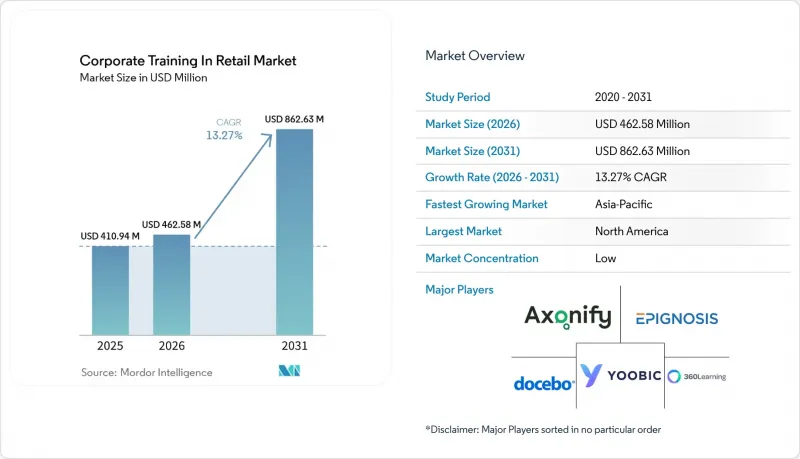
Mordor Intelligence에 의하면, 소매 업계 기업 연수 시장은 2025년에 4억 1,094만 달러로 평가되었습니다. 2026년에 4억 6,258만 달러에 달하고, 2031년까지 8억 6,263만 달러에 이를 것으로 예측되며, 2026년부터 2031년에 걸쳐 CAGR 13.27%로 성장할 전망입니다.
본 보고서는 연수의 중점 분야(신입 사원 연수 및 업무 프로세스 연수 등), 제공 방식(온라인 자기 주도형 학습 등), 운영 방식(클라우드 기반 등), 기업 규모(대기업 및 중소기업), 소매 형태(식료품점 및 슈퍼마켓 등), 지역별로 분류되어 있습니다. 시장 전망치는 금액(달러)으로 표시되어 있습니다.
세계의 소매 업계 기업 연수 시장 동향 및 인사이트
일선 직원의 높은 이직률과 계절에 따른 채용 집중
소매 업계 기업 연수에서 소매업체들은 업태나 계절에 관계없이 신입 사원 온보딩 프로세스를 지속적으로 재개해야 하기 때문에 지속적인 이직이 여전히 가장 강력한 단기 수요 요인으로 작용하고 있습니다. 2025년 소매 업계 전체의 연간 현장 직원 이직률은 평균 60%에 달했으며, 편의점 정규직 및 시간제 판매원의 이직률은 100%를 넘어섰습니다. 이는 매장 네트워크가 얼마나 자주 새로운 교육 주기를 필요로 하는지를 보여줍니다. 이처럼 이직률이 높아짐에 따라, 매장 관리자가 지도 내용을 처음부터 다시 만들어야 하는 부담을 주지 않으면서도 신속하고 반복적으로 운영할 수 있는 온보딩 시스템의 가치가 높아지고 있습니다. 계절적 채용으로 인해 이 문제는 더욱 시급해지고 있습니다. 왜냐하면 매장이 매장 내 인력 배치와 서비스 품질을 유지하면서, 임시 직원이 단기간 내에 생산성을 발휘할 수 있도록 해야 하기 때문입니다. 따라서 소매 시장의 기업 대상 교육에서는 신속하게 제공될 수 있고, 자주 업데이트되며, 대규모 채용 과정을 통해 재사용이 가능한 역할 기반 학습에 대한 수요가 높아지고 있습니다. 신속한 도입, 짧은 수업 형식, 그리고 다수의 거점에서 일관된 서비스를 지원하는 제공업체는 이직률 증가에 따른 지출을 확보하는 데 유리한 입장에 있습니다.
옴니채널 소매의 확대를 위해서는 표준화된 크로스채널 교육이 필수적입니다.
소매 업계 기업 연수에서는 옴니채널의 확대에 따라 표준화된 교육에 대한 수요가 증가하고 있습니다. 이는 매장 직원들이 현재 자문형 판매, 상품 수령 지원, 주문 처리, 디지털 서비스 등 다양한 업무를 아우르며 담당하고 있기 때문입니다. 2026년 1월 조사에 따르면, 소매 업계 경영진 중 자사의 옴니채널 시스템을 최대한 활용하고 있다고 응답한 비율은 고작 15%에 그쳤으며, 이는 교육 제공업체가 해결할 수 있는 큰 실행상의 격차가 존재함을 보여줍니다. 이러한 격차는 기술적인 측면에만 국한된 것이 아닙니다. 현재 현장 직원들은 연계된 전체 소매 체험 과정에서 상품 안내, 주문 처리, 고객 응대를 수행해야 합니다. 유럽 9개 회원국에서 전개되고 있는 ‘Skills4Retail" 프로그램은 소매 및 도매 업계에서 디지털 역량과 지속가능성 관련 역량 강화를 도모함으로써, 국경을 초월한 사업 환경 전반에 걸쳐 직원들의 역량을 높이고 있습니다. 소매 업계 기업 연수는 이러한 변화의 혜택을 누리고 있습니다. 소매업체들은 매장, 지원팀, 디지털 업무 전반에 걸쳐 동일한 교육 논리를 적용할 수 있는 통합된 학습 아키텍처를 선호하기 때문입니다. 소매업체들이 모든 접점에서 일관성을 추구하는 가운데, 통합된 컨텐츠 관리와 강력한 역할 매핑 기능을 갖춘 교육 제공업체의 중요성이 점점 더 커지고 있습니다.
예산 압박과 매장 차원에서의 교육 투자 수익률(ROI) 입증의 어려움
소매 업계 기업 연수에서 예산 압박은 여전히 큰 걸림돌이 되고 있습니다. 많은 사업자들이 짧은 회계 주기 속에서 학습 활동과 구체적인 매장 실적을 연계하는 데 어려움을 겪고 있기 때문입니다. 소매 기업의 조달 팀은 대개 1분기 이내에 성과를 입증해 달라고 요구하지만, 행동의 변화, 지식의 정착, 매출에 미치는 영향이 나타나기까지는 보통 더 오랜 시간이 걸립니다. 이 문제는 중소기업에서 더욱 심각합니다. 소규모 체인점의 경우, 교육의 영향을 가격 책정 변경, 방문객 수 변동 또는 판촉 효과와 분리하여 분석하는 데 필요한 분석 체계가 갖춰져 있지 않은 경우가 많기 때문입니다. Schoox사는 기술, 비즈니스 목표, KPI 추적을 보다 직접적으로 연계함으로써 이 문제를 해결하기 위해, “Learning Impact Suite"를 출시했습니다. 이는 공급업체들이 성과 측정을 얼마나 큰 구매 장벽으로 여기는지를 보여줍니다. 소매 업계 기업 연수은 특히 중소규모 사업자의 경우 매장 차원에서의 학습 효과를 정량화하기 어렵기 때문에 앞으로도 지출의 편차를 계속해서 겪게 될 것입니다. ROI 달성 경로를 더 명확하게 제시할 수 있는 공급업체일수록, 소매업의 이익률이 축소되었을 때도 예산을 확보할 가능성이 높아집니다.
부문별 분석
소매 업계 기업 연수에서는 2025년에 “신입 사원 오리엔테이션 및 업무 절차 교육"가 28.12%를 차지하여, 가장 중점을 둔 연수 분야가 되었습니다. 이는 소매업체가 일선 각 직책에서 신입 사원을 대상으로 반복적으로 교육을 실시해야 했기 때문입니다. 기본적인 프로세스 준비, 업무 규율 및 방침에 대한 이해는 매장 운영에 지장을 주지 않고는 미룰 수 없었기 때문에 예산이 빠듯한 상황에서도 이 부문은 여전히 핵심적인 위치를 차지했습니다. 많은 소매 부문에서 상품 카탈로그가 확대되고 업데이트 주기가 단축됨에 따라, 상품 지식 교육의 중요성은 여전히 유지되었습니다. 또한, 소매업체들이 직원의 안전, 개인정보 보호 및 책임 있는 판매 관행에 관한 정기적인 교육을 필요로 했기 때문에 규정 준수 및 안전 교육도 중요한 역할을 했습니다. 따라서 소매 업계 기업 연수에서는 신입 사원을 신속하고 일관되게 실무에 대응할 수 있는 상태로 이끌 수 있는 프로그램에 계속해서 지출의 대부분이 할당되었습니다.
또한, 소매 업계 기업 연수에서는 수익 중심의 학습으로의 명확한 전환이 나타나며, 판매 및 고객 서비스 교육은 2026년부터 2031년까지 연평균 성장률(CAGR) 13.31%를 기록했습니다. 이러한 경향은 매장, 매장 수령 및 판매 지원 환경에서 단순히 거래를 처리하는 데 그치지 않고 조언을 제공할 수 있는 직원의 가치가 높아지고 있음을 반영하고 있습니다. 보고서에 따르면, 신뢰할 수 있는 조언자로서 교육을 받은 직원은 기업 규모의 소매 환경에서 거래별 판매 수량이라는 지표로 볼 때, 단순히 거래 처리만 담당하는 직원보다 25% 더 높은 실적을 올리고 있는 것으로 나타났으며, 이는 해당 하위 부문의 비즈니스적 유효성을 더욱 뒷받침하고 있습니다. 리더십 및 매장 운영 교육은 관리직 인력을 확충하려는 소매업체에게 여전히 중요했지만, 이 분야에 대한 지출은 현장 직원을 대상으로 한 교육에 비해 지속성이 낮았습니다. 소매 업계 기업 연수 전반을 살펴보면, 현재 가장 주목받고 있는 것은 직원의 업무 준비 태세와 고객 응대 역량을 둘 다 분리하지 않고 동시에 향상시키는 연수입니다.
2025년 이 부문은 불규칙한 근무 패턴과 변동하는 매장 일정에 대한 적응력을 반영했습니다. 직원들은 휴식 시간이나 근무 시작 시, 혹은 고객 응대 중간에 모듈에 접속할 수 있었기 때문에 자신의 속도에 맞추어 진행할 수 있는 학습은 정해진 세션 형식에 비해 뚜렷한 장점이 있었습니다. 가상 강사 주도형 연수나 교실에서의 강사 주도형 연수는 실시간 토론이 효과적인 관리직 연수나 그룹 형태의 지도에서 여전히 유용했습니다. 그렇긴 하지만, 현장 팀은 많은 직원을 동시에 현장에서 빼내지 않고도 업무를 수행할 수 있는 방식이 필요했기 때문에 이러한 교육의 상대적 비중은 낮아졌습니다. 소매 업계 기업 연수 시장에서는 자기 주도형 컨텐츠 제공에 대한 수요가 계속해서 견조한 모습을 보였습니다. 이는 대부분의 매장 환경에서 접근성, 반복 수강의 용이성, 일정 조정의 부담이 적다는 점 등이 형식적인 세션 구성보다 더 중요하게 여겨졌기 때문입니다.
소매 업계 기업 연수은 더욱 다양한 형식의 조합으로 전환되고 있으며, 블렌디드 러닝 시장은 2031년까지 연평균 성장률(CAGR) 13.42%를 나타낼 것으로 전망됩니다. 소매업체들은 판매 현장에서의 행동 변화를 목표로 할 때, 디지털을 활용한 습득 학습과 지도 하에 진행되는 실습을 병행하는 것이 더 효과적이라는 사실을 깨닫기 시작하고 있습니다. AI를 활용한 적응형 학습과 AR·VR 교육은 숙달에 걸리는 시간을 단축하고, 상품에 대한 이해를 높이며, 업무 연습을 보다 현실감 있게 만들어 줄 수 있어 계속해서 높은 평가를 받고 있습니다. 또한, 매장 네트워크 전체에서 데스크톱보다 스마트폰 이용률이 높은 시장에서는 모바일 러닝과 마이크로러닝이 계속해서 특히 중요한 위치를 차지했습니다. 소매 업계의 사내 교육에서 제공 방식은 더 이상 단일 채널로만 국한되지 않고 있습니다. 이는 구매 담당자들이 코칭과 현장 기반 강화 학습에 힘입어 확장성이 뛰어난 디지털 접근 방식을 점점 더 많이 요구하고 있기 때문입니다.
지역별 분석
소매 업계 기업 연수 시장에서 2025년에는 북미가 매출의 36.12%를 차지하며, 지역별로는 가장 큰 기여도를 보였습니다. 이 지역은 e-러닝의 정착, 대규모 소매업체의 높은 집중도, 그리고 여러 거점으로 구성된 네트워크 전반에 걸친 반복 가능한 현장 교육에 대한 강력한 수요의 혜택을 누렸습니다. 또한, 소매 업계 기업 연수는 미국에서도 계속해서 견조한 추세를 보였습니다. 이는 대형 소매업체들이 인재 개발을 단순한 인사 기능의 일환이 아니라 사업 운영의 실행 과정의 일부로 간주하고 있기 때문입니다. 업계 주도의 연수 이니셔티브는 인재 공급망 확대를 지속적으로 촉진하고 있으며, 그 일환으로 2026년 2월에는 30개 파트너 기관에 소속된 3,000명의 참가자를 지원하는 프로그램이 시작되었습니다. 캐나다와 멕시코에서는 노동 시장 경색, 조직적인 소매 활동의 활성화, 체계적인 신입 사원 교육 및 규정 준수 관련 지도에 대한 수요 증가 등으로 인해 지역 전체의 성장에 기여했습니다.
소매 업계 기업 연수 시장에서 아시아태평양은 2026년부터 2031년까지 연평균 성장률(CAGR) 16.41%를 기록하며 가장 빠르게 성장하고 있는 지역입니다. 이러한 성장은 조직화된 소매업의 확대, 스마트폰을 활용한 학습의 보급, 그리고 현대적인 소매 형태 전반에 걸친 현장 직원의 역량 강화에 대한 폭넓은 수요에 힘입어 이루어지고 있습니다. 또한, 교육 수요가 더 이상 매장에 국한되지 않고 주문 처리, 고객 지원, 디지털 지원형 판매 분야로까지 확대되고 있는 만큼, 해당 지역에는 큰 잠재력이 있는 것으로 보입니다. 인도, 중국, 동남아시아, 호주 등 시장은 소매 규모의 크기, 노동력 증가, 그리고 업태별 교육 성숙도의 편차가 복합적으로 작용하여 교육 제공업체들의 주목을 받고 있습니다. 따라서 소매 업계 기업 연수은 아시아태평양에서 큰 성장 잠재력을 가지고 있습니다. 이 지역에서는 소매업의 급속한 확장이 여전히 많은 현장 팀이 이용할 수 있는 정식 교육 시스템의 구축 속도를 앞지르고 있기 때문입니다.
소매 업계 기업 연수 분야에서 2025년에는 유럽이 큰 점유율을 차지했으며, 독일, 영국, 프랑스가 해당 지역 최대 시장이 되었습니다. 회원국 간의 다자간 협력 체제를 통해 디지털, 환경, 회복탄력성 분야의 역량 개발을 강화하기 위한 노력이 진행되고 있으며, 이는 소매 및 도매 업계에서 기업 연수의 보다 광범위한 도입을 뒷받침하고 있습니다. 2025년에는 교육 제공업체와의 파트너십을 통해 체계적인 리더십 개발 프로그램에 대한 접근성도 확대되었으며, 업계 단체들이 소매 업계 전문가들을 위해 체계적인 학습 경로를 어떻게 구축하고 있는지가 드러났습니다. 남미는 규모는 작지만 활발한 움직임이 보였으며, 체계적인 소매 역량 구축을 위한 전문 역량 개발 활동이 더욱 두드러졌습니다. 중동 및 아프리카는 도입 측면에서 앞서 있었지만, 현대적인 소매업의 확대와 노동력의 정규화가 가속화됨에 따라 수요 기반도 점차 공고해지고 있습니다.
기타 혜택 :
- 엑셀 형식 시장 예측(ME) 시트
- 3개월간의 애널리스트 지원
자주 묻는 질문
목차
제1장 서론
제2장 조사 방법
제3장 주요 요약
제4장 시장 구도
제5장 시장 규모 및 성장 예측
제6장 경쟁 구도
제7장 시장 기회 및 향후 전망
KTH 26.07.08According to Mordor Intelligence, the corporate training market in the retail sector is projected to be USD 410.94 million in 2025, USD 462.58 million in 2026, and reach USD 862.63 million by 2031, growing at a CAGR of 13.27% from 2026 to 2031.
This report is Segmented by Training Focus (Onboarding and Process Training, and More), Delivery Mode (Online Self-Paced Learning, and More), Deployment Mode (Cloud-Based, and More), Enterprise Size (Large Enterprises and Small and Medium-Sized Enterprises), Retail Format (Grocery and Supermarkets, and More), and Geography. The Market Forecasts are Provided in Terms of Value (USD).
Global Corporate Training In Retail Market Trends and Insights
High Frontline Turnover and Seasonal Hiring Intensity
In corporate training for the retail market, persistent attrition remains the strongest near-term demand trigger, as retailers must keep reopening onboarding pipelines across formats and seasons. Annual frontline turnover across retail averaged 60% in 2025, and full-time and part-time sales associate turnover in convenience stores exceeded 100%, indicating how often store networks need fresh training cycles. This churn raises the value of onboarding systems that can be rolled out quickly and repeatedly without putting pressure on store managers to rebuild instruction from scratch. Seasonal hiring makes the issue more urgent because temporary workers must become productive in short windows while stores still maintain floor coverage and service quality. The corporate training in the retail market is therefore seeing stronger demand for role-based learning that can be delivered quickly, refreshed often, and reused across high-volume hiring waves. Providers that support rapid deployment, short lesson formats, and consistent rollout across many locations are better placed to capture spending tied to turnover pressure.
Omnichannel Retail Expansion Requires Standardized Cross-Channel Training
In corporate training for the retail market, omnichannel expansion is increasing demand for standardized training because store associates now move across advisory selling, pickup support, fulfillment, and digital service tasks. A January 2026 survey found that only 15% of retail leaders believed they were using their omnichannel systems to their full potential, indicating a significant execution gap that training vendors can address. That gap is not only technical; frontline staff now need to handle product guidance, order processing, and customer service across connected retail journeys. The Skills4Retail program across 9 European member states is reinforcing digital and sustainability upskilling in retail and wholesale, thereby raising workforce standards across cross-country operating environments. The corporate training in the retail market benefits from this shift because retailers prefer unified learning architectures that can push the same lesson logic across stores, support teams, and digital operations. As retailers seek consistency across touchpoints, training providers with centralized content management and strong role mapping are gaining relevance.
Budget Pressure and Hard-to-Prove Store-Level Training ROI
In corporate training in the retail market, budget pressure remains a real brake because many operators still struggle to connect learning activities with specific store results within a short financial cycle. Retail procurement teams often want proof within one quarter, while behavior change, knowledge retention, and sales effects usually take longer to appear. This issue is more severe for SMEs because smaller chains rarely have the analytics setup needed to separate the impact of training from pricing moves, footfall changes, or promotional effects. Schoox launched its Learning Impact Suite to address this problem by linking skills, business goals, and KPI tracking more directly, which shows how strongly vendors see outcome measurement as a buying obstacle. Corporate training in the retail market will continue to face uneven spending, where learning benefits are hard to quantify at the store level, especially among smaller and mid-market operators. Providers that can show cleaner ROI pathways are more likely to defend budgets when retail margins tighten.
Other drivers and restraints analyzed in the detailed report include:
- Rising Compliance Burdens Across Safety, Privacy, and Responsible Selling
- Mobile-First Microlearning Adoption for Deskless Retail Workforces
- Integration Complexity Across POS, HRIS, Scheduling, and Communication Systems
For complete list of drivers and restraints, kindly check the Table Of Contents.
Segment Analysis
In corporate training in the retail market, Onboarding and Process Training accounted for 28.12% in 2025, making it the largest training focus, as retailers had to repeatedly train new hires across frontline roles. This segment remained central even when budgets tightened because basic process readiness, task discipline, and policy understanding could not be delayed without affecting store operations. Product Knowledge Training stayed important as product catalogs expanded and update cycles shortened across many retail categories. Compliance and Safety Training also played a meaningful role, as retailers needed recurring training on worker safety, privacy, and responsible selling practices. The corporate training in the retail market, therefore, continued to direct a large portion of spend toward programs that quickly and consistently bring new hires to operational readiness.
The corporate training in the retail market also showed a clear shift toward revenue-oriented learning, with Sales and Customer Service Training growing at a 13.31% CAGR from 2026 to 2031. This pattern reflects the growing value of associates who can advise rather than only process transactions in store, pickup, and assisted selling environments. Reports indicated that associates trained as trusted advisors outperformed their transactional counterparts by 25% on units-per-transaction metrics in enterprise retail settings, further supporting the stronger business case for this sub-segment. Leadership and Store Operations Training remained relevant for retailers building management depth, but spending in that area was less recurring than frontline-focused instruction. Across the corporate training in the retail industry, the strongest momentum now lies in training that improves both employee readiness and customer-facing performance without separating the two.
segment in 2025, which reflected its fit with uneven shift patterns and variable store schedules. Associates could access modules during breaks, at shift starts, or between customer tasks, giving self-paced learning a clear advantage over fixed-session formats. Virtual Instructor-led Training and Classroom Instructor-led Training remained useful for manager training and group-based instruction that benefited from live discussion. Even so, their relative weight was lower because frontline teams needed formats that worked without pulling many employees off the floor simultaneously. The corporate training market in the retail sector for self-paced delivery remained strong because accessibility, repeatability, and lower scheduling friction mattered more than formal session structure in most store environments.
Corporate training in the retail market is also moving toward richer combinations of formats, with Blended Learning projected to grow at a 13.42% CAGR through 2031. Retailers are finding that digital reinforcement and coached practice work better together when the goal is behavior change on the sales floor. AI-powered adaptive learning and AR or VR training kept premium positions because they can shorten time to competence, improve product understanding, and make task practice more realistic. Mobile learning and microlearning also remained especially relevant in markets where smartphone access was stronger than desktop access across store networks. In corporate training in the retail industry, delivery is no longer defined by a single channel, as buyers increasingly want scalable digital access supported by coaching and real-world reinforcement.
Complete Report Scope:
- By Training Focus
- Onboarding and Process Training
- Product Knowledge Training
- Sales and Customer Service Training
- Compliance and Safety Training
- Leadership and Store Operations Training
- By Delivery Mode
- Online Self-paced Learning
- Virtual Instructor-led Training (VILT)
- Classroom Instructor-led Training
- Blended Learning
- Mobile Learning and Microlearning
- AI-powered Adaptive Learning
- AR/VR Immersive Training
- By Deployment Mode
- Cloud-based
- On-premises
- Hybrid
- By Enterprise Size
- Large Enterprises
- Small and Medium-sized Enterprises
- By Retail Format
- Grocery and Supermarkets
- Fashion and Apparel
- Electronics Retail
- Department Stores
- Specialty Retail
- Convenience Stores
- E-commerce Retailers
- By Geography
- North America
- United States
- Canada
- Mexico
- South America
- Brazil
- Argentina
- Chile
- Rest of South America
- Europe
- Germany
- United Kingdom
- France
- Italy
- Spain
- Rest of Europe
- Asia-Pacific
- China
- Japan
- India
- South Korea
- Australia
- Singapore
- Rest of Asia-Pacific
- Middle East
- Saudi Arabia
- United Arab Emirates
- Rest of Middle East
- Africa
- South Africa
- Nigeria
- Rest of Africa
- North America
Geography Analysis
In the corporate training market for the retail industry, North America accounted for 36.12% of revenue in 2025, making it the largest regional contributor. The region benefited from established eLearning adoption, a high concentration of large-format retailers, and strong demand for repeatable frontline training across multi-site networks. Corporate training in the retail market also remained well supported in the United States because large retailers treat workforce development as part of operating execution rather than a narrow HR function. Industry-backed training initiatives continued to widen the talent pipeline, including programs launched in February 2026 to support 3,000 participants across 30 partner organizations. Canada and Mexico added to regional growth through tighter labor conditions, rising organized retail activity, and broader demand for structured onboarding and compliance-related instruction.
In the corporate training market for the retail industry, Asia-Pacific is the fastest-growing region, with a 16.41% CAGR from 2026 to 2031. Growth is being supported by organized retail expansion, rising adoption of smartphone-led learning, and a wide need for frontline capability building across modern trade formats. The region also shows strong potential, as training demand is no longer limited to stores and now extends to fulfillment, customer support, and digitally assisted selling roles. Markets such as India, China, Southeast Asia, and Australia are drawing provider attention because they combine retail scale, workforce growth, and uneven training maturity across formats. The corporate training in the retail market, therefore, has strong headroom in Asia-Pacific, where rapid retail expansion still outpaces the formal training systems available to many frontline teams.
In the corporate training in the retail market, Europe held a significant share in 2025, with Germany, the United Kingdom, and France as the largest markets in the region. Initiatives are strengthening digital, green, and resilience skill development through multi-partner structures across member states, which supports broader corporate training adoption in retail and wholesale. Structured leadership development access also expanded in 2025 through partnerships with learning providers, showing how industry associations are shaping formal learning pathways for retail professionals. South America remained smaller but active, with more visible professional development activity around organized retail capability building. The Middle East and Africa led earlier in adoption, but demand foundations are strengthening, with modern retail expansion and workforce formalization gaining pace.
- Axonify Inc.
- Docebo S.p.A.
- YOOBIC Inc.
- Epignosis LLC
- Absorb Software Inc.
- Continu Inc.
- SmartWinnr, Inc.
- Blossom KC Ltd.
- Schoox, LLC
- MOBIETRAIN NV
- LearnUpon Limited
- 360LEARNING SA
- Go1 Pty Limited
- Allen Communication Learning Services
- mVentix, Inc. d/b/a SellPro
- HALIGHT Inc.
- Learn Brands LLC
- The Friedman Group LLC
- The Retail Advocacy Group, LLC
- Certus Holdco, Inc.
Additional Benefits:
- The market estimate (ME) sheet in Excel format
- 3 months of analyst support
TABLE OF CONTENTS
1 INTRODUCTION
- 1.1 Study Assumptions and Market Definition
- 1.2 Scope of the Study
2 RESEARCH METHODOLOGY
3 EXECUTIVE SUMMARY
4 MARKET LANDSCAPE
- 4.1 Market Overview
- 4.2 Impact of Macroeconomic Factors on the Market
- 4.3 Market Drivers
- 4.3.1 High Frontline Turnover and Seasonal Hiring Intensity
- 4.3.2 Omnichannel Retail Expansion Requires Standardized Cross-Channel Training
- 4.3.3 Rising Compliance Burdens Across Safety, Privacy, and Responsible Selling
- 4.3.4 Mobile-First Microlearning Adoption for Deskless Retail Workforces
- 4.3.5 AI-Enabled Content Localization for Multi-Brand and Multi-Country Store Networks
- 4.3.6 Retail Media and Assisted Selling Models Increase Advisory-Sales Training Demand
- 4.4 Market Restraints
- 4.4.1 Budget Pressure and Hard-to-Prove Store-Level Training ROI
- 4.4.2 Integration Complexity Across POS, HRIS, Scheduling, and Communication Systems
- 4.4.3 Thin Store Staffing Limits Protected Learning Time
- 4.4.4 Franchise and Concession Governance Weakens Training Standardization
- 4.5 Industry Value Chain Analysis
- 4.6 Regulatory Landscape
- 4.7 Technological Outlook
- 4.8 Porter's Five Forces Analysis
- 4.8.1 Bargaining Power of Buyers
- 4.8.2 Bargaining Power of Suppliers
- 4.8.3 Threat of New Entrants
- 4.8.4 Threat of Substitutes
- 4.8.5 Intensity of Competitive Rivalry
5 MARKET SIZE AND GROWTH FORECASTS (VALUE)
- 5.1 By Training Focus
- 5.1.1 Onboarding and Process Training
- 5.1.2 Product Knowledge Training
- 5.1.3 Sales and Customer Service Training
- 5.1.4 Compliance and Safety Training
- 5.1.5 Leadership and Store Operations Training
- 5.2 By Delivery Mode
- 5.2.1 Online Self-paced Learning
- 5.2.2 Virtual Instructor-led Training (VILT)
- 5.2.3 Classroom Instructor-led Training
- 5.2.4 Blended Learning
- 5.2.5 Mobile Learning and Microlearning
- 5.2.6 AI-powered Adaptive Learning
- 5.2.7 AR/VR Immersive Training
- 5.3 By Deployment Mode
- 5.3.1 Cloud-based
- 5.3.2 On-premises
- 5.3.3 Hybrid
- 5.4 By Enterprise Size
- 5.4.1 Large Enterprises
- 5.4.2 Small and Medium-sized Enterprises
- 5.5 By Retail Format
- 5.5.1 Grocery and Supermarkets
- 5.5.2 Fashion and Apparel
- 5.5.3 Electronics Retail
- 5.5.4 Department Stores
- 5.5.5 Specialty Retail
- 5.5.6 Convenience Stores
- 5.5.7 E-commerce Retailers
- 5.6 By Geography
- 5.6.1 North America
- 5.6.1.1 United States
- 5.6.1.2 Canada
- 5.6.1.3 Mexico
- 5.6.2 South America
- 5.6.2.1 Brazil
- 5.6.2.2 Argentina
- 5.6.2.3 Chile
- 5.6.2.4 Rest of South America
- 5.6.3 Europe
- 5.6.3.1 Germany
- 5.6.3.2 United Kingdom
- 5.6.3.3 France
- 5.6.3.4 Italy
- 5.6.3.5 Spain
- 5.6.3.6 Rest of Europe
- 5.6.4 Asia-Pacific
- 5.6.4.1 China
- 5.6.4.2 Japan
- 5.6.4.3 India
- 5.6.4.4 South Korea
- 5.6.4.5 Australia
- 5.6.4.6 Singapore
- 5.6.4.7 Rest of Asia-Pacific
- 5.6.5 Middle East
- 5.6.5.1 Saudi Arabia
- 5.6.5.2 United Arab Emirates
- 5.6.5.3 Rest of Middle East
- 5.6.6 Africa
- 5.6.6.1 South Africa
- 5.6.6.2 Nigeria
- 5.6.6.3 Rest of Africa
- 5.6.1 North America
6 COMPETITIVE LANDSCAPE
- 6.1 Market Concentration
- 6.2 Strategic Moves
- 6.3 Market Share Analysis
- 6.4 Company Profiles (includes Global Level Overview, Market Level Overview, Core Segments, Financials as available, Strategic Information, Market Rank/Share, Products and Services, Recent Developments).
- 6.4.1 Axonify Inc.
- 6.4.2 Docebo S.p.A.
- 6.4.3 YOOBIC Inc.
- 6.4.4 Epignosis LLC
- 6.4.5 Absorb Software Inc.
- 6.4.6 Continu Inc.
- 6.4.7 SmartWinnr, Inc.
- 6.4.8 Blossom KC Ltd.
- 6.4.9 Schoox, LLC
- 6.4.10 MOBIETRAIN NV
- 6.4.11 LearnUpon Limited
- 6.4.12 360LEARNING SA
- 6.4.13 Go1 Pty Limited
- 6.4.14 Allen Communication Learning Services
- 6.4.15 mVentix, Inc. d/b/a SellPro
- 6.4.16 HALIGHT Inc.
- 6.4.17 Learn Brands LLC
- 6.4.18 The Friedman Group LLC
- 6.4.19 The Retail Advocacy Group, LLC
- 6.4.20 Certus Holdco, Inc.
7 MARKET OPPORTUNITIES AND FUTURE OUTLOOK
- 7.1 White-space and Unmet-Need Assessment


