

|
시장보고서
상품코드
2073428
임상시험 지원 서비스 : 시장 점유율 분석, 업계 동향 및 통계, 성장 예측(2026-2031년)Clinical Trials Support Services - Market Share Analysis, Industry Trends & Statistics, Growth Forecasts (2026 - 2031) |
||||||
 Mordor Intelligence
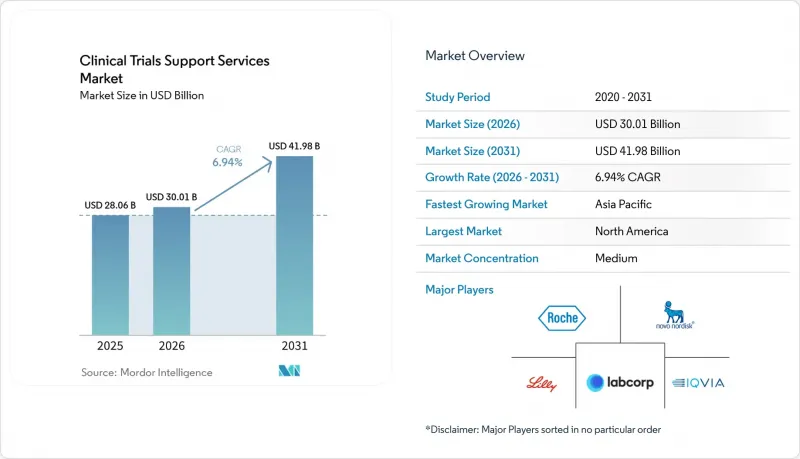
Mordor Intelligence에 의하면, 임상시험 지원 서비스 시장 규모는 2025년 280억 6,000만 달러로 평가되었습니다. 2026년에는 300억 1,000만 달러로 확대되어 2026년부터 2031년에 걸쳐 CAGR 6.94%로 성장을 지속하여, 2031년에는 419억 8,000만 달러에 이를 것으로 예측됩니다.
본 보고서는 단계(1상, 2상 등), 서비스 유형별(임상시험 시설 관리, 피험자 모집·유지 등), 최종 사용자(제약사, 생명공학 기업 등), 치료 분야(종양학, 순환기학 등) 및 지역(북미, 유럽 등)별로 분류되어 있습니다. 시장 전망은 금액(달러) 기준으로 제시되어 있습니다.
세계의 임상시험 지원 서비스 시장 동향 및 인사이트
제약·바이오기술 업계에서 풀서비스 제공업체로의 아웃소싱 전환
세계의 제약사들은 조정상의 격차를 해소하고 책임성을 강화하기 위해 공급업체 목록 통합을 추진하고 있습니다. 풀서비스 파트너는 프로토콜 설계, 데이터 관리, 규제 당국에 대한 신청을 단일 계약 하에 통합함으로써 사이클 타임과 관리상의 부담을 줄이고 있습니다. NVIDIA와 IQVIA의 제휴와 같이, AI 모델을 임상 워크플로우에 통합하는 기술 제휴는 벤더가 임상시험 기관 선정, 전자 자료 검토, 이상반응 감지를 자동화하는 데 도움이 되고 있습니다. 이러한 접근 방식은 다분야에 걸친 전문 지식과 지속적인 데이터 검토가 필수적인 종양학 및 희귀질환 프로그램에서 특히 가치가 있습니다. 자금 조달의 제약이나 일정 단축에 직면한 생명공학 기업들은 초기 단계의 자산을 주요 임상시험 단계로 발전시키기 위해 이러한 통합형 서비스에 대한 의존도를 높이고 있습니다.
비용 대비 효과가 높은 신흥 시장으로의 임상시험 확대
이 스폰서는 활동을 아시아태평양의 허브로 이전함으로써 40-60%의 비용 절감을 실현하는 동시에, 임상시험 피험자 모집 서비스를 통해 치료를 받지 않은 환자층에 접근하여 피험자 모집을 신속하게 진행하고 있습니다. 중국의 3SBio는 60억 달러 규모의 라이선싱 계약을 체결함으로써, 해당 지역에서 후기 임상시험을 수행할 수 있는 역량이 강화되고 있음을 보여주고 있습니다. 인도의 CDSCO를 비롯한 각국의 규제 당국은 승인 절차의 효율화를 추진하며, 시험 시작까지의 리드타임을 지속적으로 단축하고 있습니다. 그렇긴 하지만, 인프라 격차와 임상시험 책임의사의 연수는 이 지역의 성장세를 유지하기 위한 성공의 열쇠로 여전히 남아 있습니다.
엄격한 데이터 개인정보 보호 규정(GDPR(EU 개인정보보호규정), HIPAA 등)
데이터 거버넌스 요건은 복잡성과 비용을 증가시키고 있습니다. HIPAA의 온라인 추적 관련 지침 일부를 무효로 한 미국 연방 법원의 판결은 디지털 환자 모집 도구를 둘러싼 불확실성이 여전히 지속되고 있음을 여실히 보여주고 있습니다. 다국적 기업의 프로그램에서는 예산의 15-20%를 규정 준수 전문가, 보안 호스팅, 동의 관리 플랫폼에 할당하는 경우가 많습니다. 의료기관의 44%가 데이터 거버넌스 보고에 어려움을 겪고 있어, 전문적인 리스크 관리 소프트웨어에 대한 수요가 증가하고 있습니다.
부문별 분석
2025년에는 3상 임상시험이 매출 점유율의 45.06%를 차지하며, 규제 당국에 안전성과 유효성을 입증하는 데 있어 매우 중요한 역할을 하고 있음을 반영했습니다. 이러한 후기 임상시험에서는 대개 수천 명의 피험자와 여러 지역이 포함되며, 엄격한 데이터 일관성 검증이 수반되므로, 고도의 모니터링과 실시간 분석이 요구됩니다. 임상시험 의뢰자들은 통계적 유의성을 훼손하지 않으면서도 변경이 가능하도록 하는 적응형 설계 요소를 점점 더 많이 도입하고 있습니다. 3상 임상시험은 규모가 크고 비용 부담이 크기 때문에 기업들은 프로토콜 설계를 최적화하고 위험 기반 모니터링을 활용하여 현장 방문 횟수를 줄이려고 노력하고 있습니다.
1단계에서는 벤처 캐피탈의 지원을 받는 생명공학 기업이 새로운 치료법을 “인간 최초" 시험을 추진하고 있는 덕분에, 2031년까지의 연평균 성장률(CAGR)이 8.86%로 가장 높은 성장세를 보이고 있습니다. BlackfinBio와 같은 유전자 치료 분야의 신생 기업은 첨단 바이러스 벡터와 복잡한 용량 증량 방식을 활용한 유전성 경직성 마비에 대한 1/2상 임상시험 프로토콜에 대해 미국 식품의약국(FDA)의 승인을 획득했습니다. 이러한 급증에 따라, 약동학 모델링, 센티넬 투여 및 집중적인 안전성 모니터링에 대한 전문 지식을 갖춘 서비스 파트너가 요구되고 있습니다. 1상과 2상을 연결하는 적응형 원활한 접근 방식이 점차 확산되면서, 기존의 단계 정의는 더욱 모호해지고 있으며, 유연하고 기술 변화에 대응할 수 있는 공급업체에 대한 수요가 높아지고 있습니다.
2025년 임상시험 지원 서비스 시장 규모에서 피험자 모집 및 유지가 28.21%의 점유율을 차지한 것으로 나타나, 피험자 등록과 관련된 과제가 여전히 존재함이 드러났습니다. 각 벤더사는 AI 도구를 활용해 피험자를 매칭하고, 중도 탈락 위험을 예측하며, 참여 유도 컨텐츠를 개별적으로 최적화함으로써 치료 순응도 지표를 향상시키고 있습니다. 연평균 성장률(CAGR) 10.02%를 기록하며 성장하고 있는 규제 및 컨설팅 서비스는 FDA의 M13A 생물학적 동등성 프레임워크 등 전 세계 지침의 변화에 대응하고 있으며, 이에 따라 신청 서류 작성 및 전략적 자문에 대한 수요가 증가하고 있습니다. 지역 고유의 지식을 갖춘 서비스 제공업체는 현지 문서를 국제 표준에 부합하도록 조정함으로써 승인 절차를 가속화할 수 있습니다.
물류 혁신도 성장을 뒷받침하고 있습니다. 파나소닉의 ‘VIXELL"컨테이너는 전원이 없어도 10일간 초저온을 유지할 수 있으며, 이는 mRNA 및 세포 치료제 운송에 있어 필수적인 기능입니다. 제조와 포장을 통합한 체제를 통해, 의뢰사는 공급망의 위험을 줄이고 대륙을 넘나드는 임상시험용 의약품의 품질을 보장할 수 있습니다. 첨단 바이오 분석 연구소는 동반 진단 및 멀티오믹스 평가 지표에 대응할 수 있도록 분석법 제공 범위를 확대하고, 종단간 서비스 제안을 강화하고 있습니다.
지역별 분석
아시아태평양은 연평균 성장률(CAGR) 11.12%로 성장하고 있으며, 금세기 말까지 기존의 허브 지역을 추월할 것으로 전망됩니다. 정부의 인센티브, 치료받지 못한 환자층이 많다는 점, 그리고 신속한 윤리 심사 절차가 맞물리면서, 이전에는 유럽과 미국의 의료기관이 당연시되던 ‘인간 최초"시험을 해당 지역에 유치하고 있습니다. 중국 등 일부 국가에서는 복잡한 생물학적 제제를 관리할 수 있는 고처리량 1상 임상시험 단위가 구축되어 있으며, 일본의 기술 기업들은 임상시험 책임 의사의 데이터 입력 업무 부담을 줄여주는 맞춤형 AI 에이전트를 제공합니다.
북미는 여전히 임상시험 지원 서비스 시장 점유율에서 38.25%로 가장 큰 비중을 차지하고 있으며, 이는 미국 식품의약국(FDA)의 체계적인 피드백 체계와 임상시험 책임의사의 높은 밀도에 힘입은 것입니다. 그러나 해당 지역에서는 임금 인플레이션 가속화와 임상시험 시설 직원의 번아웃이 과제로 대두되고 있습니다. FDA의 자원 제약으로 인해 신청 심사 기간이 길어질 우려가 있으며, 이로 인해 임상시험 시작이 지연되어 후원사가 지역적 분산을 모색하게 될 가능성이 있습니다.
유럽은 엄격한 과학적 기준과 전문성이 뛰어난 임상시험 책임의사에 대한 접근성으로 높은 평가를 받고 있지만, 일반 데이터 보호 규정(GDPR(EU 개인정보보호규정)) 준수의 복잡성과 에너지 비용의 급등이 특히 초저온 물류 분야에서 예산을 압박하고 있습니다. 남미 및 중동 및 아프리카은 이중언어를 구사하는 임상시험 책임의사, 인프라 개선, 비용 절감에 힘입어 제2상 및 제3상 임상시험의 피험자 모집에서 점유율을 확대되고 있습니다. 이 지역들의 장기적인 성공은 임상시험 기관 인증, 사이버 보안 대책이 마련된 데이터 플랫폼, 그리고 지역별 맞춤형 환자 참여 전략에 대한 지속적인 투자에 달려 있습니다.
기타 혜택 :
- 엑셀 형식 시장 예측(ME) 시트
- 3개월간의 애널리스트 지원
자주 묻는 질문
목차
제1장 서론
제2장 조사 방법
제3장 주요 요약
제4장 시장 구도
제5장 시장 규모 및 성장 예측
제6장 경쟁 구도
제7장 시장 기회 및 향후 전망
KTH 26.07.08According to Mordor Intelligence, the clinical trial support services market size is expected to grow from USD 28.06 billion in 2025 to USD 30.01 billion in 2026 and is forecast to reach USD 41.98 billion by 2031 at 6.94% CAGR over 2026-2031.
This report is Segmented by Phase (Phase I, Phase II, and More), Service Types (Clinical Trial Site Management, Patient Recruitment & Retention, and More), End User (Pharmaceutical Companies, Biotechnology Companies, and More), Therapeutic Area (Oncology, Cardiology, and More), and Geography (North America, Europe, and More). The Market Forecasts are Provided in Terms of Value (USD).
Global Clinical Trials Support Services Market Trends and Insights
Outsourcing Shift Among Pharma & Biotech Toward Full-Service Providers
Global drug sponsors are consolidating vendor lists to cut coordination gaps and boost accountability. Full-service partners combine protocol design, data management, and regulatory filing under a single contract, lowering cycle times and administrative overhead. Technology alliances-such as NVIDIA's collaboration with IQVIA that embeds AI models into clinical workflows-help vendors automate site identification, electronic source review, and adverse-event detection. The approach is especially valuable for oncology and rare-disease programs, where multidisciplinary expertise and continuous data review are critical. Biotech firms, managing capital constraints and accelerated timelines, increasingly rely on these integrated offerings to convert early-stage assets into pivotal studies.
Expansion of Clinical Trials Into Cost-Efficient Emerging Markets
Sponsors achieve 40-60% cost relief by shifting activities to Asia-Pacific hubs while accessing treatment-naive populations that speed recruitment through clinical trial patient recruitment services. China's 3SBio secured a USD 6 billion licensing deal that demonstrates the region's growing sophistication in late-phase execution. National regulators, such as India's CDSCO, continue to streamline approvals, trimming site-initiation lead times. Nonetheless, infrastructure gaps and investigator training remain success determinants for sustained regional momentum.
Stringent Data-Privacy Regulations (GDPR, HIPAA, etc.)
Data-governance mandates add complexity and cost. A U.S. federal ruling that vacated sections of the HIPAA online-tracking guidance highlights ongoing uncertainty for digital recruitment tools. Multinational programs often divert 15-20% of budgets to compliance experts, secure hosting, and consent-management platforms. Forty-four percent of healthcare organizations struggle with data-governance reporting, amplifying the demand for specialized risk-management software.
Other drivers and restraints analyzed in the detailed report include:
- Growing R&D Expenditure in Innovative Therapeutics & Vaccines
- Demand for Complex Biologics & Personalized Medicine Trials
- Shortage of Qualified Investigators & Accredited Trial Sites
For complete list of drivers and restraints, kindly check the Table Of Contents.
Segment Analysis
Phase III commanded the largest 45.06% revenue share in 2025, reflecting its pivotal role in proving safety and efficacy to regulators. These late-stage studies often involve thousands of participants, multiple geographic regions, and stringent data-integrity checks, demanding sophisticated monitoring and real-time analytics. Sponsors increasingly integrate adaptive design elements that allow modifications without compromising statistical validity. Despite its size, Phase III cost pressures motivate companies to optimize protocol designs and leverage risk-based monitoring to reduce on-site visits.
Phase I displays the fastest 8.86% CAGR through 2031 as venture-backed biotech firms push novel modalities into first-in-human trials. Gene therapy entrants such as BlackfinBio secured Food and Drug Administration clearance for Phase 1/2 hereditary spastic paraplegia study protocols that rely on advanced viral vectors and complex dose-escalation schemes. This surge requires service partners with expertise in pharmacokinetic modeling, sentinel dosing, and intensive safety surveillance. Adaptive seamless approaches that bridge Phase I and Phase II are gaining popularity, further blurring traditional phase definitions and heightening demand for flexible, technology-ready vendors.
Patient recruitment and retention dominated with 28.21% share of the clinical trial support services market size in 2025, highlighting persistent enrollment challenges. Vendors deploy AI tools to match patients, predict dropout risk, and tailor engagement content to improve adherence metrics. Regulatory and consulting services, growing at 10.02% CAGR, address global guidance shifts such as the FDA's M13A bioequivalence framework, which deepens demand for dossier preparation and strategic advice. Providers with region-specific knowledge can accelerate approvals by aligning local documentation with international standards.
Logistics innovations also propel growth. Panasonic's VIXELL container maintains deep-frozen temperatures for ten days without power, a vital feature for mRNA and cell-therapy shipments. Integrated manufacturing and packaging arrangements help sponsors mitigate supply-chain risks and ensure investigational product integrity across continents. Advanced bio-analytical labs expand assay offerings to accommodate companion diagnostics and multi-omics endpoints, strengthening end-to-end service propositions.
Complete Report Scope:
- By Phase
- Phase I
- Phase II
- Phase III
- Phase IV / Post-marketing
- By Service Type
- Clinical Trial Site Management
- Patient Recruitment & Retention
- Assay Development & Bio-analytical Testing
- Contract Manufacturing & Packaging
- Storage & Distribution
- Regulatory & Consulting Services
- Commercialization Support
- Other Services
- By End User
- Pharmaceutical Companies
- Biotechnology Companies
- Medical Device Manufacturers
- Contract Research Organizations (CROs)
- Academic & Research Institutes
- By Therapeutic Area
- Oncology
- Cardiology
- Neurology
- Infectious Diseases
- Immunology & Autoimmune
- Other Indications
- Geography
- North America
- United States
- Canada
- Mexico
- Europe
- Germany
- United Kingdom
- France
- Italy
- Spain
- Rest of Europe
- Asia-Pacific
- China
- Japan
- India
- South Korea
- Australia
- Rest of Asia-Pacific
- Middle East and Africa
- GCC
- South Africa
- Rest of Middle East and Africa
- South America
- Brazil
- Argentina
- Rest of South America
- North America
Geography Analysis
Asia-Pacific is advancing at an 11.12% CAGR and is set to overtake traditional hubs by the end of the decade. Government incentives, large treatment-naive populations, and faster ethics approval processes attract first-in-human studies that previously defaulted to Western sites. Countries such as China build high-throughput phase-I units capable of managing complex biologics, and technology firms in Japan deliver tailored AI agents that reduce data-entry workloads for investigators.
North America still accounts for the largest 38.25% clinical trial support services market share, supported by the Food and Drug Administration's structured feedback mechanisms and high investigator density. Yet the region wrestles with escalating wage inflation and burnout among site staff. Resource constraints at the FDA raise concerns that application review timelines could lengthen, potentially slowing study starts and prompting sponsors to diversify geography.
Europe is respected for rigorous scientific standards and access to specialist investigators, but General Data Protection Regulation compliance complexity and elevated energy costs pressure budgets, especially for ultra-low-temperature logistics. South America and the Middle East & Africa contribute a growing share of phase II and phase III enrollment, aided by bilingual investigators, improving infrastructure, and cost savings. Long-term success in these regions will depend on sustained investments in site accreditation, cyber-secure data platforms, and region-specific patient-engagement strategies.
- IQVIA
- LabCorp
- Thermo Fisher Scientific Inc. (PPD)
- Charles River
- ICON
- Parexel International
- Syneos Health
- MedPace
- WuXi App Tec
- SGS Life Sciences
- Clinigen Group
- Catalent
- Pfizer
- Eli Lilly and Company
- Roche
- Sanofi
- Novo Nordisk
- GlaxoSmithKline
- AstraZeneca
- Novartis
Additional Benefits:
- The market estimate (ME) sheet in Excel format
- 3 months of analyst support
TABLE OF CONTENTS
1 Introduction
- 1.1 Study Assumptions & Market Definition
- 1.2 Scope of the Study
2 Research Methodology
3 Executive Summary
4 Market Landscape
- 4.1 Market Overview
- 4.2 Market Drivers
- 4.2.1 Outsourcing Shift Among Pharma & Biotech Toward Full-Service Providers
- 4.2.2 Expansion Of Clinical Trials Into Cost-Efficient Emerging Markets
- 4.2.3 Growing R&D Expenditure In Innovative Therapeutics & Vaccines
- 4.2.4 Demand For Complex Biologics & Personalized Medicine Trials
- 4.2.5 AI-Driven Patient Pre-Screening Accelerating Recruitment
- 4.2.6 Blockchain-Based Traceability For Investigational Supply Chains
- 4.3 Market Restraints
- 4.3.1 Stringent Data-Privacy Regulations (GDPR, HIPAA, Etc.)
- 4.3.2 Shortage Of Qualified Investigators & Accredited Trial Sites
- 4.3.3 Escalating Energy Costs Impacting Cold-Chain Logistics
- 4.3.4 Carbon-Footprint Scrutiny On Global Trial Logistics
- 4.4 Porter's Five Forces
- 4.4.1 Threat of New Entrants
- 4.4.2 Bargaining Power of Buyers
- 4.4.3 Bargaining Power of Suppliers
- 4.4.4 Threat of Substitutes
- 4.4.5 Intensity of Competitive Rivalry
5 Market Size & Growth Forecasts (Value, USD)
- 5.1 By Phase
- 5.1.1 Phase I
- 5.1.2 Phase II
- 5.1.3 Phase III
- 5.1.4 Phase IV / Post-marketing
- 5.2 By Service Type
- 5.2.1 Clinical Trial Site Management
- 5.2.2 Patient Recruitment & Retention
- 5.2.3 Assay Development & Bio-analytical Testing
- 5.2.4 Contract Manufacturing & Packaging
- 5.2.5 Storage & Distribution
- 5.2.6 Regulatory & Consulting Services
- 5.2.7 Commercialization Support
- 5.2.8 Other Services
- 5.3 By End User
- 5.3.1 Pharmaceutical Companies
- 5.3.2 Biotechnology Companies
- 5.3.3 Medical Device Manufacturers
- 5.3.4 Contract Research Organizations (CROs)
- 5.3.5 Academic & Research Institutes
- 5.4 By Therapeutic Area
- 5.4.1 Oncology
- 5.4.2 Cardiology
- 5.4.3 Neurology
- 5.4.4 Infectious Diseases
- 5.4.5 Immunology & Autoimmune
- 5.4.6 Other Indications
- 5.5 Geography
- 5.5.1 North America
- 5.5.1.1 United States
- 5.5.1.2 Canada
- 5.5.1.3 Mexico
- 5.5.2 Europe
- 5.5.2.1 Germany
- 5.5.2.2 United Kingdom
- 5.5.2.3 France
- 5.5.2.4 Italy
- 5.5.2.5 Spain
- 5.5.2.6 Rest of Europe
- 5.5.3 Asia-Pacific
- 5.5.3.1 China
- 5.5.3.2 Japan
- 5.5.3.3 India
- 5.5.3.4 South Korea
- 5.5.3.5 Australia
- 5.5.3.6 Rest of Asia-Pacific
- 5.5.4 Middle East and Africa
- 5.5.4.1 GCC
- 5.5.4.2 South Africa
- 5.5.4.3 Rest of Middle East and Africa
- 5.5.5 South America
- 5.5.5.1 Brazil
- 5.5.5.2 Argentina
- 5.5.5.3 Rest of South America
- 5.5.1 North America
6 Competitive Landscape
- 6.1 Market Concentration
- 6.2 Market Share Analysis
- 6.3 Company Profiles (includes Global level Overview, Market level overview, Core Business Segments, Financials, Headcount, Key Information, Market Rank, Market Share, Products and Services, and analysis of Recent Developments)
- 6.3.1 IQVIA Holdings Inc.
- 6.3.2 Laboratory Corporation of America Holdings (Labcorp)
- 6.3.3 Thermo Fisher Scientific Inc. (PPD)
- 6.3.4 Charles River Laboratories International Inc.
- 6.3.5 ICON plc
- 6.3.6 Parexel International Corporation
- 6.3.7 Syneos Health
- 6.3.8 Medpace Holdings Inc.
- 6.3.9 WuXi AppTec
- 6.3.10 SGS Life Sciences
- 6.3.11 Clinigen Group plc
- 6.3.12 Catalent Inc.
- 6.3.13 Pfizer Inc.
- 6.3.14 Eli Lilly and Company
- 6.3.15 F. Hoffmann-La Roche Ltd
- 6.3.16 Sanofi S.A.
- 6.3.17 Novo Nordisk A/S
- 6.3.18 GSK plc
- 6.3.19 AstraZeneca plc
- 6.3.20 Novartis AG
7 Market Opportunities & Future Outlook
- 7.1 White-space & Unmet-Need Assessment


