|
시장보고서
상품코드
2073579
아시아태평양의 LED 조명 : 시장 점유율 분석, 업계 동향 및 통계, 성장 예측(2026-2031년)Asia Pacific LED Lighting - Market Share Analysis, Industry Trends & Statistics, Growth Forecasts (2026 - 2031) |
||||||
 Mordor Intelligence
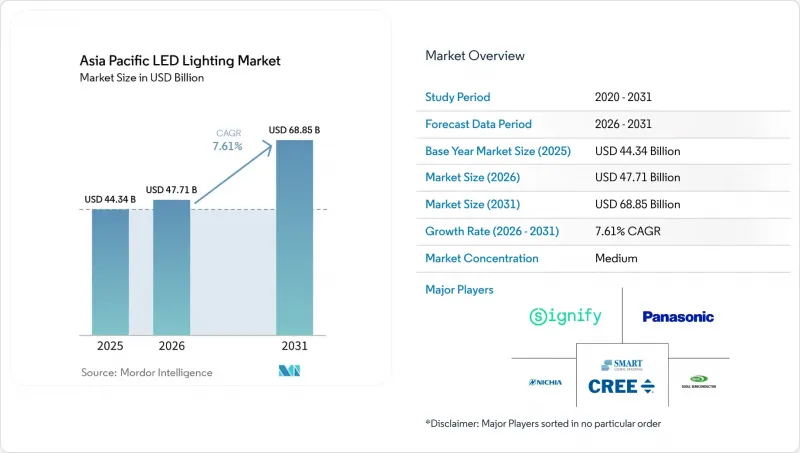
Mordor Intelligence에 의하면, 2026년 아시아태평양의 LED 조명 시장 규모는 477억 1,000만 달러에 달할 것으로 예상됩니다. 2025년 443억 4,000만 달러에서 확대해, 2031년에는 688억 5,000만 달러에 이를 것으로 예측됩니다.
2026년부터 2031년까지의 연평균 성장률(CAGR)은 7.61%를 나타낼 것으로 전망됩니다.
본 보고서는 제품 유형(램프, 조명 기구), 유통 채널(직접 판매, 도매·소매 등), 설치 유형(신규 설치, 개조 설치), 용도(상업용 사무실, 소매점 등), 최종 사용자(실내, 실외 등) 및 국가(영국 등)별로 분류되어 있습니다. 시장 전망은 금액(달러) 기준으로 제시되어 있습니다.
아시아태평양의 LED 조명 시장 동향 및 인사이트
정부의 에너지 효율화 의무화 및 보조금 프로그램이 시장 성장을 가속화하고 있습니다.
아시아태평양 전체에 걸친 형광등 단계적 폐지, 건축기준법 개정, 그리고 보조금 제도가 계속해서 수요를 급속히 끌어올리고 있습니다. 일본에서 2027년부터 시행될 형광등 생산 금지 조치는 이미 이와타시에서 3,000만 엔(20만 달러) 규모의 지역 리베이트 프로그램 시행으로 이어졌으며, 연간 126만 8,000 kWh의 전력 사용량 감축을 목표로 하고 있습니다. 베트남 에너지부는 LED를 국가의 탄소중립 목표 달성을 위한 지름길로 간주하고, 조달 전망을 명확히 함으로써 제조업체들이 현지 조립 라인에 투자할 수 있도록 지원하고 있습니다. 이와 더불어 인도에서는 LED 조명 생산과 연계된 인센티브 제도가 도입되어, 부품 비용 절감, 공급망 단축, 그리고 국내 자급자족 강화로 이어지고 있습니다. 전반적으로, 적절한 시기에 시행되는 정책 지원 덕분에 투자 회수 기간이 단축되면서 아시아태평양 시장에서 LED 조명의 보급이 가속화되고 있습니다.
급속한 도시화와 인프라 확충이 수요 패턴을 재편하고 있습니다.
이 지역에서는 매년 수백만 명의 새로운 도시 주민이 증가하고 있어, 지자체는 철도 허브, 공항, 간선 도로에 에너지 절약형 조명 기구를 도입해야 하는 압박을 받고 있습니다. 호치민시의 탄손 공항 제3터미널에서는 11만 2,500제곱미터에 달하는 시설에 연간 2,000만 명의 승객을 수용하기 위해 생물 중심의 LED 기준을 채택한 조명이 설치되어 있습니다. 1만 6,000대 이상의 전기버스를 포함한 중국의 차량 전기화 과정에서 충전 인프라와 LED 가로등을 결합함으로써 야간 안전성과 에너지 예산 관리를 실현하고 있습니다. 그 결과, 신규 건설 프로젝트에서는 기존 기술이 배제되면서 아시아태평양의 LED 조명 시장에서 선행 수주가 촉진되고 있습니다.
첨단 조명 기구 및 제어 시스템의 높은 초기 비용이 도입 속도를 제한하고 있습니다.
네트워크 지원 조명 기구는 기존 제품에 비해 비용이 2배에서 4배까지 들 수 있어, 중소기업의 도입을 지연시키고 있습니다. 세계은행이 실시한 도시 주도형 조명 계획에 대한 조사에 따르면, 보조금이 없을 경우 가로등 비용이 소규모 지자체의 총 예산에서 최대 20%를 차지할 수 있는 것으로 나타났습니다. 베트남의 수출 지향형 산업단지조차도 시그니파이(Signify)사의 스마트 개보수 공사를 통해 투자 회수까지 4-5년이 소요됩니다. ESCO 계약 등의 자금 조달 메커니즘은 장벽을 완화해 주지만, 계약 내용을 깊이 있게 이해해야 하며, 많은 현지 사용자들이 아직 그러한 지식이 부족하기 때문에 아시아태평양의 LED 조명 시장의 단기적인 성장이 억제되고 있습니다.
부문별 분석
2025년 아시아태평양의 LED 조명 시장에서 조명 기구는 매출의 62.05%를 차지했습니다. 이는 평균 판매 가격이 높고, 통합 요건이 더 엄격하기 때문입니다. 이러한 우위는 상업 프로젝트에서 종합적인 에너지 관리에 대한 필요성에서 비롯된 것으로, 이러한 프로젝트에서는 대개 구성 부품의 교체보다 종합적인 시스템의 도입이 우선시되는 경향이 있습니다. 램프 시장은 소형 제품을 중심으로, 주택용 교체 수요와 2차 업그레이드에 힘입어 2031년까지 연평균 성장률(CAGR) 9.35%를 나타낼 것으로 전망됩니다.
램프 시장의 성장은 전환 비용을 절감해 주는 표준화의 혜택을 누리고 있는 한편, 일본에서 형광등 사용 금지가 임박함에 따라 드롭인형 LED 튜브에 대한 수요도 증가하고 있습니다. 도입 대수가 증가함에 따라 판매량은 신규 조명 기구 설치에서 램프 교체로 점차 전환되고 있으며, 이는 아시아태평양의 LED 조명 시장 전체의 매출 구성을 재편하고 있습니다.
2025년, 아시아태평양의 LED 조명 시장의 매출액 중 53.88%는 도매 및 소매 부문이 차지했으며, 이는 대규모 프로젝트에 필수적인 시공업체와의 관계 및 신용 한도에 힘입은 결과입니다. 그러나 전자상거래는 연평균 성장률(CAGR) 7.86%로 성장하고 있으며, 중소기업 및 주택 소유자를 대상으로 투명한 가격 책정과 자택 배송이라는 장점을 활용하고 있습니다.
디지털 기업들은 현재 기존 서비스의 공백을 메우기 위해 제품 구성 도구와 사후 서비스 네트워크를 도입하고 있습니다. 예측 기간 동안 범용 SKU는 점점 더 온라인으로 전환될 가능성이 있으며, 그 결과 도매업체들은 설계 및 시공 서비스와 자금 조달에 주력하게 될 것입니다. 이에 따라 도매업체 시장 점유율은 점차 하락하겠지만, 아시아태평양의 LED 조명 시장의 가치 밀도는 유지될 전망입니다.
기타 혜택 :
- 엑셀 형식 시장 예측(ME) 시트
- 3개월간의 애널리스트 지원
자주 묻는 질문
목차
제1장 서론
제2장 조사 방법
제3장 주요 요약
제4장 시장 구도
제5장 시장 규모 및 성장 예측
제6장 경쟁 구도
제7장 시장 기회 및 향후 전망
KTH 26.07.08According to Mordor Intelligence, asia pacific LED lighting market size in 2026 is estimated at USD 47.71 billion, growing from 2025 value of USD 44.34 billion with 2031 projections showing USD 68.85 billion, growing at 7.61% CAGR over 2026-2031.
This report is Segmented by Product Type (Lamps, and Luminaires/Fixtures), Distribution Channel (Direct Sales, Wholesale/Retail, and More), Installation Type (New Installation, and Retrofit Installation), Application (Commercial Offices, Retail Stores, and More), End User (Indoor, Outdoor, and More), and Country (United Kingdom, and More). The Market Forecasts are Provided in Terms of Value (USD).
Asia Pacific LED Lighting Market Trends and Insights
Government Energy-Efficiency Mandates and Subsidy Programs Drive Market Acceleration
Fluorescent lamp phase-outs, building code revisions, and subsidy pools across the Asia Pacific continue to turbo-charge demand. Japan's 2027 production ban on fluorescent lamps already triggered a local rebate program worth JPY 30 million (USD 0.2 million) in Iwata City, targeting a 1,268,000 kWh annual cut in power use. Vietnam's energy ministry positions LEDs as a fast-track pathway toward achieving national carbon-neutrality goals, providing procurement certainty that enables manufacturers to invest in local assembly lines. Complementary Indian LED lighting production-linked incentives lower component costs, shorten supply chains, and reinforce domestic self-reliance. Overall, well-timed policy support shortens payback cycles and accelerates the uptake of LED lighting in the Asia Pacific market.
Rapid Urbanization and Infrastructure Build-Out Reshape Demand Patterns
The region adds millions of new urban residents each year, pushing municipalities to integrate energy-saving luminaires into rail hubs, airports, and arterial roads. Ho Chi Minh City's Tan Sơn Nhất Terminal 3 installation spans 112,500 square meters and utilizes bio-centric LED standards to accommodate 20 million annual passengers. China's fleet electrification, which includes over 16,000 e-buses, couples charging infrastructure with LED streetlighting to manage nighttime safety and energy budgets. New-build projects, therefore, sidestep legacy technologies, bolstering forward orders for the Asia Pacific LED lighting market.
High Upfront Cost of Advanced Fixtures and Controls Limits Adoption Velocity
Network-ready luminaires can cost two to four times more than conventional alternatives, slowing uptake among small enterprises. A World Bank review of city-led lighting schemes indicates that streetlighting may absorb up to 20% of a smaller municipality's total budget when unsubsidized. Even in Vietnam's export-oriented industrial parks, Signify's smart retrofits require four to five years to break even. Financing mechanisms, such as ESCO contracts, ease barriers but require contractual sophistication that many local users still lack, restraining near-term expansion in the Asia Pacific LED lighting market.
Other drivers and restraints analyzed in the detailed report include:
- Declining LED Prices With Higher Efficacy Expand Market Accessibility
- Surge in Smart and Connected Lighting Adoption Creates Premium Segments
- Margin Squeeze From Intense Price Competition Pressures Industry Profitability
For complete list of drivers and restraints, kindly check the Table Of Contents.
Segment Analysis
Luminaires accounted for 62.05% of the revenue in 2025 within the Asia Pacific LED lighting market, owing to higher average selling prices and tighter integration requirements. Their dominance stems from the holistic energy management needs in commercial projects, where comprehensive systems often outweigh the need for component replacements. Lamps, despite a lower base, are projected to record a 9.35% CAGR to 2031, buoyed by residential replacements and secondary upgrades.
Lamp growth benefits from standardization that lowers switching costs, while Japan's impending fluorescent ban boosts demand for drop-in LED tubes. As the installed base widens, volume shifts progressively from new fixture installations to lamp replacements, reshaping the revenue mix across the Asia Pacific LED lighting market.
Wholesale retail contributed 53.88% of the turnover in 2025 within the Asia Pacific LED lighting market, supported by contractor relationships and credit facilities essential for bulk projects. However, e-commerce is advancing at an 7.86% CAGR, capitalizing on transparent pricing and doorstep delivery for small firms and homeowners.
Digital players now embed product configurators and after-sales networks to close historical service gaps. Over the forecast horizon, commodity SKUs may increasingly migrate online, leaving wholesalers to focus on design-build services and financing, which should gradually dilute their share but sustain value density in the Asia Pacific LED lighting market.
Complete Report Scope:
- By Product Type
- Lamps
- Luminaires/ Fixtures
- By Distribution Channel
- Direct Sales
- Wholesale Retail
- E-commerce
- By Installation Type
- New Installation
- Retrofit Installation
- By Application
- Commercial Offices
- Retail Stores
- Hospitality
- Industrial
- Highway and Roadway
- Architectural
- Public Places
- Hospitals
- Horticulture Gardens
- Residential
- Automotive
- Others(Chemicals, Oil and gas, agriculture)
- By End User
- Indoor
- Outdoor
- Automotive
- By Country
- China
- Japan
- India
- South Korea
- Southeast Asia
- Rest of Asia-Pacific
List of Companies Covered in this Report:
- Signify N.V.
- Nichia Corporation
- Seoul Semiconductor Co., Ltd.
- Everlight Electronics Co., Ltd.
- Opple Lighting Co., Ltd.
- Foshan Electrical and Lighting Co., Ltd.
- Yankon Group Co., Ltd.
- MLS Co., Ltd. (Forest Lighting)
- Zhejiang NVC Lighting Technology Co., Ltd.
- Wipro Enterprises (P) Ltd. (Wipro Lighting)
- Havells India Ltd.
- Syska LED Lights Pvt Ltd.
- Panasonic Corporation (Lighting)
- Toshiba Lighting and Technology Corp.
- Sharp Corporation (LED)
- Honglitronic Co., Ltd.
- Lite-On Technology Corp.
- Cree LED (Smart Global Holdings)
- Lextar Electronics Corp.
- Stanley Electric Co., Ltd.
- Lumileds Holding B.V.
- Sanan Optoelectronics Co., Ltd.
- Nationstar Optoelectronics Co., Ltd.
- Leedarson Lighting Co., Ltd.
- Unilumin Group Co., Ltd.
Additional Benefits:
- The market estimate (ME) sheet in Excel format
- 3 months of analyst support
TABLE OF CONTENTS
1 INTRODUCTION
- 1.1 Study Assumptions and Market Definition
- 1.2 Scope of the Study
2 RESEARCH METHODOLOGY
3 EXECUTIVE SUMMARY
4 MARKET LANDSCAPE
- 4.1 Market Overview
- 4.2 Market Drivers
- 4.2.1 Government energy-efficiency mandates and subsidy programs
- 4.2.2 Rapid urbanization and infrastructure build-out
- 4.2.3 Declining LED prices with higher efficacy
- 4.2.4 Surge in smart and connected lighting adoption
- 4.2.5 Secondary replacement wave of first-gen LEDs
- 4.2.6 Growing demand for human-centric/circadian lighting
- 4.3 Market Restraints
- 4.3.1 High upfront cost of advanced fixtures and controls
- 4.3.2 Margin squeeze from intense price competition
- 4.3.3 Fragmented after-sales/retrofit service networks
- 4.3.4 IC supply-chain volatility and tariff exposure
- 4.4 Industry Value Chain Analysis
- 4.5 Impact of Macroeconomic Factors
- 4.6 Regulatory Landscape
- 4.7 Technological Outlook
- 4.8 Porter's Five Forces Analysis
- 4.8.1 Threat of New Entrants
- 4.8.2 Bargaining Power of Suppliers
- 4.8.3 Bargaining Power of Buyers
- 4.8.4 Threat of Substitute Products
- 4.8.5 Intensity of Competitive Rivalry
5 MARKET SIZE AND GROWTH FORECASTS (VALUE)
- 5.1 By Product Type
- 5.1.1 Lamps
- 5.1.2 Luminaires/ Fixtures
- 5.2 By Distribution Channel
- 5.2.1 Direct Sales
- 5.2.2 Wholesale Retail
- 5.2.3 E-commerce
- 5.3 By Installation Type
- 5.3.1 New Installation
- 5.3.2 Retrofit Installation
- 5.4 By Application
- 5.4.1 Commercial Offices
- 5.4.2 Retail Stores
- 5.4.3 Hospitality
- 5.4.4 Industrial
- 5.4.5 Highway and Roadway
- 5.4.6 Architectural
- 5.4.7 Public Places
- 5.4.8 Hospitals
- 5.4.9 Horticulture Gardens
- 5.4.10 Residential
- 5.4.11 Automotive
- 5.4.12 Others(Chemicals, Oil and gas, agriculture)
- 5.5 By End User
- 5.5.1 Indoor
- 5.5.2 Outdoor
- 5.5.3 Automotive
- 5.6 By Country
- 5.6.1 China
- 5.6.2 Japan
- 5.6.3 India
- 5.6.4 South Korea
- 5.6.5 Southeast Asia
- 5.6.6 Rest of Asia-Pacific
6 COMPETITIVE LANDSCAPE
- 6.1 Market Concentration
- 6.2 Strategic Moves
- 6.3 Market Share Analysis
- 6.4 Company Profiles (includes Global level Overview, Market level overview, Core Segments, Financials as available, Strategic Information, Market Rank/Share for key companies, Products and Services, and Recent Developments)
- 6.4.1 Signify N.V.
- 6.4.2 Nichia Corporation
- 6.4.3 Seoul Semiconductor Co., Ltd.
- 6.4.4 Everlight Electronics Co., Ltd.
- 6.4.5 Opple Lighting Co., Ltd.
- 6.4.6 Foshan Electrical and Lighting Co., Ltd.
- 6.4.7 Yankon Group Co., Ltd.
- 6.4.8 MLS Co., Ltd. (Forest Lighting)
- 6.4.9 Zhejiang NVC Lighting Technology Co., Ltd.
- 6.4.10 Wipro Enterprises (P) Ltd. (Wipro Lighting)
- 6.4.11 Havells India Ltd.
- 6.4.12 Syska LED Lights Pvt Ltd.
- 6.4.13 Panasonic Corporation (Lighting)
- 6.4.14 Toshiba Lighting and Technology Corp.
- 6.4.15 Sharp Corporation (LED)
- 6.4.16 Honglitronic Co., Ltd.
- 6.4.17 Lite-On Technology Corp.
- 6.4.18 Cree LED (Smart Global Holdings)
- 6.4.19 Lextar Electronics Corp.
- 6.4.20 Stanley Electric Co., Ltd.
- 6.4.21 Lumileds Holding B.V.
- 6.4.22 Sanan Optoelectronics Co., Ltd.
- 6.4.23 Nationstar Optoelectronics Co., Ltd.
- 6.4.24 Leedarson Lighting Co., Ltd.
- 6.4.25 Unilumin Group Co., Ltd.
7 MARKET OPPORTUNITIES AND FUTURE OUTLOOK
- 7.1 White-space and Unmet-need Assessment