

|
시장보고서
상품코드
2097254
DTG 프린터 : 시장 점유율 분석, 업계 동향과 통계, 성장 예측(2025-2030년)DTG Printers - Market Share Analysis, Industry Trends & Statistics, Growth Forecasts (2025 - 2030) |
||||||
 Mordor Intelligence
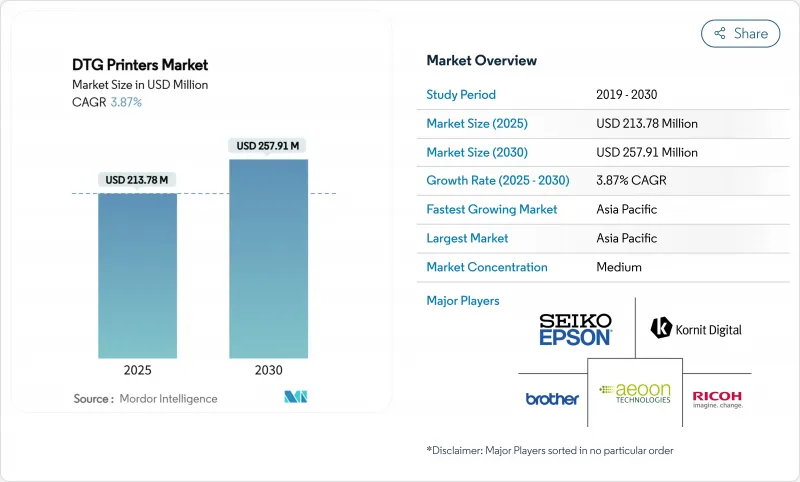
Mordor Intelligence에 의하면, 직DTG 프린터 시장은 2025년에 2억 1,378만 달러에 이르고, 2030년까지 2억 5,791만 달러에 이를 전망으로, CAGR은 3.87%를 기록할 전망입니다.
본 보고서는 프린터 유형별(산업용 DTG 프린터, 데스크톱/엔트리 레벨 DTG 프린터 등), 잉크 유형별(표준 CMYK 잉크, CMYK+화이트 잉크 등), 최종 사용자별(맞춤형 의류 매장, 대규모 인쇄 서비스 제공업체, 중소기업 등), 용도별(티셔츠, 스포츠웨어, 액티브웨어 등), 그리고 지역별로 분류되어 있습니다. 시장 전망은 금액(달러) 기준으로 제시되어 있습니다.
세계 DTG 프린터 시장 동향과 인사이트
맞춤형 의류 전자상거래의 부상
디지털 마켓플레이스에서는 현재 클릭부터 출하에 이르기까지 자동화된 개인화가 실현되고 있으며, 아마존의 주문 처리 알고리즘은 각 소량 주문에 맞추어 DTG 프린터의 생산 능력을 배정하고 있습니다. 월마트(Walmart)와 같은 대형 소매업체들은 코르닛(Kornit)의 아폴로(Apollo) 플랫폼을 통해 당주 내 재고 보충을 실현하여 재고 부진을 줄이는 동시에, DTG 프린터 시장을 중요한 인프라로 확립하고 있습니다. 틱톡(TikTok)이나 인스타그램(Instagram)에서 화제가 되는 소셜 디자인이 확산되면서, 최소 주문 수량 제한 없이 새로운 프린트 생산을 촉진하고 있습니다. 실시간 수요 데이터가 생산 소프트웨어에 반영됨으로써 사이클이 완성되고, 추측에 기반한 과잉 재고가 해소됩니다. 소비자의 ‘독창성’에 대한 기대가 높아짐에 따라, 대량 맞춤화는 신기함에서 표준으로 전환되며, DTG 장비에 대한 구조적인 수요를 더욱 심화시키고 있습니다.
노즐 밀도 향상을 통한 1회 인쇄당 비용 절감
피에조 프린트 헤드 기술의 진화로 노즐 수가 증가하여, 싱글 패스에서의 커버율이 향상됨과 동시에 잉크 낭비가 줄어들고 있습니다. 엡손(Epson)은 일본에서 3,400만 달러 규모의 생산 능력 확장을 통해 이 과제를 우선적으로 해결하고 있습니다. 라인 속도 향상으로 인해 산업용 운영자는 중규모 로트에서 스크린 인쇄에 가까운 가격 책정이 가능해졌으며, DTG 프린터 시장의 주요 비용 장벽이 해소되고 있습니다. 브라더(Brother)의 중기 판매 계획에 따르면, 매출의 40%를 산업용 부문이 차지할 것으로 전망되며, 이는 인쇄의 경제성이 스크린 인쇄와 동등한 수준에 도달하고 있다는 자신감을 보여줍니다. 반도체 제조와 같은 학습 곡선에 따라 수율이 향상됨에 따라 단가는 더욱 하락하고, 제품 업데이트 주기가 가속화되면서 소규모 매장에서도 이용하기 쉬워지고 있습니다.
높은 초기 설비 투자 비용
산업용 DTG 라인의 가격은 10만-50만 달러에 달할 뿐만 아니라 서비스 계약 비용도 발생하기 때문에 2024년 수요의 38.79%를 차지하는 중소기업의 경우 현금 흐름 예산을 압박하고 있습니다. 중고 DTG 장비의 2차 시장이 여전히 미미하기 때문에 대출 기관은 대출에 신중한 태도를 보이고 있으며, 자산 리스크 프리미엄이 커지고 있습니다. Kornit의 'All-Inclusive Click' 모델은 자본 지출을 인쇄 1장당 운영 비용으로 전환하지만, 도입은 초기 단계에 있습니다. 자금 조달 기준이 안정될 때까지는 장비 도입이 자금력이 있는 서비스 제공업체에 집중될 것이며, DTG 프린터 시장의 단기적인 성장 속도는 둔화될 것입니다.
부문 분석
산업용 유닛에 할당된 DTG 프린터 시장 규모는 2024년에 1억 190만 달러에 달하고, 전 세계 매출의 47.67%를 차지했습니다. 사업자에게 있어 이러한 플랫폼의 가치는 여러 교대 근무에 걸친 내구성, 자동 유지보수, 그리고 보정된 색상 안정성에 있습니다. 이는 전자상거래의 SLA(서비스 수준 계약) 준수에 필수적인 특성입니다. 실제로 각 산업용 라인은 시간당 200-400점을 생산할 수 있어, 이를 통해 인쇄 서비스 제공업체는 예측 가능한 월간 생산량을 통해 고가의 정가를 상쇄할 수 있습니다.
하이브리드 DTG·스크린 시스템은 현재 규모는 작지만 연평균 성장률(CAGR) 4.93%로 확대되고 있습니다. 이 시스템은 ‘원루프(one-roof)’ 요구 사항을 충족시키며, 5점 정도의 틈새 주문에는 디지털 인쇄를, 5,000점 규모의 프로모션용 출시에는 스크린 인쇄 헤드를 활용합니다. 이러한 설비의 유연성은 세계 브랜드의 요구 사항을 충족해야 하는 베트남, 방글라데시, 멕시코의 수탁 제조 공장에 매력적입니다. Dover의 Caldera 소프트웨어는 디지털 헤드와 아날로그 헤드 모두의 색상 관리를 통합적으로 관리하여 시너지 효과의 가능성을 보여주고 있습니다. 비용 곡선이 점점 더 타이트해짐에 따라 하이브리드 시스템은 신규 도입 시장에서 큰 점유율을 차지하며, DTG 프린터 시장공급망 구조를 재편할 가능성이 있습니다.
CMYK+화이트 잉크를 사용하는 DTG 프린터 시장 규모는 2024년에 9,280만 달러에 달했습니다. 스트리트웨어와 애슬레저 트렌드에 힘입어 어두운 색상의 의류에 대한 수요가 증가함에 따라, 불투명도를 확보하기 위한 화이트 층이 필수적입니다. 각 벤더사는 현재 침전 및 노즐 막힘을 억제하고 가동 시간을 연장하기 위해, 재순환 루프가 내장된 탈기 처리된 화이트 카트리지를 번들로 판매하고 있습니다.
1,210만 달러 규모의 틈새 시장인 특수 형광 잉크 및 메탈릭 잉크는 연평균 5.04%의 성장이 예상됩니다. 이러한 잉크가 주는 미적 효과 덕분에 안료 비용 상승분을 상쇄할 수 있는 소매 가격 인상이 가능해졌습니다. Chemours의 이산화티타늄 개량 기술로 반짝임의 지속성이 강화되는 한편, DuPont은 자외선 조사 하에서도 네온 컬러의 채도를 유지하는 바인더 매트릭스를 개발하고 있습니다. 맞춤형 스포츠 저지, 댄스웨어, 한정판 브랜드 상품이 초기 도입 사례로 꼽히며, 다채로운 패션 사이클이 가속화됨에 따라 DTG 프린터 시장 전반으로의 추가적인 확산이 예상됩니다.
지역별 분석
아시아태평양은 2024년 매출의 36.23%를 차지하며, 유리한 인건비 대 설비 투자 비율과 업스트림 공급망 통합에 힘입어 연평균 성장률(CAGR) 4.98%로 확대되고 있습니다. 중국에는 전 세계 수탁 봉제 공장의 대부분이 집중되어 있으며, 국내 프린터 OEM 업체들은 가격 경쟁력이 있는 중가형 기종으로 수출 시장에 진출하고 있습니다. 베트남과 태국에서 스마트 팩토리 개조를 위한 정부 보조금 덕분에 DTG 도입은 지방 도시로 더욱 확산되고 있습니다. 인도의 새로운 텍스타일 파크에서는 폐수 무방류 시설과 옥상 태양광 발전이 연계되어 있으며, DTG는 지속 가능한 수출 구역의 주력 기술로서 입지를 확립해 가고 있습니다.
북미에서는 시장 침투가 성숙 단계에 접어들었음에도 불구하고, 미가공 의류의 60%를 여전히 수입에 의존하고 있어, 리쇼어링을 주창하는 이들은 현지에서 신속 대응 허브 구축을 추진하고 있습니다. 각 브랜드는 DTG를 활용하여 ‘소비자 가까운 곳에서 생산’이라는 슬로건을 실천하고 있으며, 캘리포니아주와 텍사스주가 클러스터 형성의 거점으로 부상하고 있습니다. 전자상거래 거래량이 정점에 달할 때 일시적인 생산 능력 부족이 발생하지만, 이는 납기 기한이 촉박한 상황에서는 해외 생산의 낮은 단가보다 국내에서의 신속한 프린트 생산이 우위를 점한다는 것을 보여줍니다.
유럽의 환경 규제 대응 노력은 DTG의 수성 잉크와 잘 어울립니다. 이탈리아와 프랑스의 패션 브랜드는 ‘친환경’ 라벨 표시 기준을 충족하기 위해 마이크로 팩토리 거점을 도입하고 있습니다. 독일의 엔지니어링 기업들은 자동화를 통한 설비 현대화에 기여하고 있으며, 지역별 엄격한 규제로 인해 용제형 잉크의 단계적 폐지가 가속화되고 있습니다. 한편, 남미와 중동에서는 아직 시장이 발전 단계에 있지만, 브라질과 걸프 연안 국가들의 가처분 소득 증가가 현지 맞춤형 사업 확장을 뒷받침하고 있습니다. 중소기업의 설비 투자를 지원하는 보조금이 도입된다면, 이들 지역의 DTG(Direct-to-Garment) 프린터 시장 보급이 가속화될 가능성이 있습니다.
기타 혜택:
- 엑셀 형식 시장 예측(ME) 시트
- 3개월간의 애널리스트 지원
자주 묻는 질문
목차
제1장 서론
제2장 조사 방법
제3장 주요 요약
제4장 시장 구도
제5장 시장 규모와 성장 예측
제6장 경쟁 구도
제7장 시장 기회와 향후 전망
KTH 26.08.06According to Mordor Intelligence, the direct to Garment (DTG) Printers market stands at USD 213.78 million in 2025 and is on course to reach USD 257.91 million by 2030, expanding at a 3.87% CAGR.
This report is Segmented by Printer Type (Industrial DTG Printers, Desktop / Entry-Level DTG Printers, and More), Ink Type (Standard CMYK Inks, CMYK + White Inks, and More), End User (Custom Apparel Shops, Large Print Service Providers, and SMEs and More), Application (T-Shirts, Sportswear and Activewear and More), and Geography. The Market Forecasts are Provided in Terms of Value (USD).
Global DTG Printers Market Trends and Insights
Rise of Customized Apparel E-commerce
Digital marketplaces now deliver automated personalization from click to ship, and Amazon's fulfillment algorithms allocate DTG capacity to match each micro-order. Retail giants such as Walmart achieve same-week replenishment through Kornit's Apollo platform, cutting dead inventory and cementing the DTG Printers market as critical infrastructure. Viral social designs propagate across TikTok and Instagram, stimulating fresh print runs without minimum quantities. The cycle closes when real-time demand data feeds production software, eliminating guess-driven overstock. As consumer expectations for uniqueness harden, mass customization migrates from novelty to baseline, deepening structural demand for DTG equipment.
Declining Cost per Print Through Higher Nozzle Density
Piezo printhead engineering raises nozzle counts, boosting single-pass coverage and shrinking ink waste, a priority Epson is addressing via a USD 34 million capacity expansion in Japan. Increased line speed permits industrial operators to price closer to screen printing for medium-sized runs, eroding a key cost barrier within theDTG Printers market. Brother's mid-term sales plan anticipates a 40% industrial revenue mix, indicating confidence that print economics are reaching parity. As learned curves in semiconductor-style fabrication push yield gains, unit prices fall further, promoting faster refresh cycles and widening accessibility for small shops.
High Upfront Equipment Investment
Industrial DTG lines cost USD 100,000-500,000 plus service contracts, pinching the cash-flow budgets of the very SMEs that generate 38.79% of 2024 demand. Lenders hesitate because secondary markets for used DTG units remain thin, inflating asset-risk premiums. Kornit's All-Inclusive Click model turns capital expense into per-print operating cost, but adoption is early-stage. Until financing norms stabilize, unit placements will cluster with well-capitalized service providers, moderating the DTG Printers market's near-term acceleration.
Other drivers and restraints analyzed in the detailed report include:
- Stricter Eco-compliance Favoring Water-based Pigment Inks
- On-demand Micro-factory Integration with ERP
- Colour/Opacity Limitations on Dark Garments
For complete list of drivers and restraints, kindly check the Table Of Contents.
Segment Analysis
The DTG Printers market size allocated to industrial units stood at USD 101.9 million in 2024, reflecting a 47.67% grip on global revenue. Operators value these platforms for multi-shift durability, automated maintenance, and calibrated color stability, attributes essential for e-commerce SLA compliance. In practice, each industrial line can output 200-400 pieces per hour, letting print-service providers amortize high list prices over predictable monthly volumes.
Hybrid DTG-screen systems, though smaller today, are scaling at a 4.93% CAGR. They answer the "one roof" requirement: digital for 5-piece niche orders and screen heads for 5,000-piece promotional releases. The resulting equipment flexibility appeals to contract factories in Vietnam, Bangladesh, and Mexico that juggle global brand requirements. Dover's Caldera software orchestrates color management across both digital and analog heads, showcasing synergy potential. As cost curves tighten, hybrids may claim an outsize slice of incremental installations, reshaping supply-chain topology inside the DTG Printers market.
The DTG Printers market size tied to CMYK + White inks accounted for USD 92.8 million in 2024. Dark-garment demand, powered by streetwear and athleisure trends, forces white layers for opacity. Vendors now bundle degassed white cartridges with integrated recirculation loops to curb sedimentation and nozzle clogging, extending uptime.
Specialty fluorescent and metallic inks, occupying a niche USD 12.1 million slice, are on track for 5.04% annual growth. Aesthetic effects unlock retail mark-ups that offset higher pigment costs. Chemours' titanium-dioxide enhancements strengthen shimmer permanence, while DuPont develops binder matrices that hold neon chroma under UV exposure. Custom sports jerseys, dancewear, and limited-edition brand drops are early adopters, foreshadowing wider diffusion across the DTG Printers market as color-rich fashion cycles accelerate.
Complete Report Scope:
- By Printer Type
- Industrial DTG Printers
- Desktop / Entry-Level DTG Printers
- Hybrid DTG-Screen Printers
- Mobile/Portable DTG Units
- By Ink Type
- Standard CMYK Inks (for light garments)
- CMYK + White Inks (for dark garments)
- Specialty Fluorescent and Metallic Inks
- By End User
- Custom Apparel Shops and SMEs
- Large Print Service Providers
- In-house Corporate Branding Teams
- Fashion-Brand Micro-Factories
- By Application
- T-Shirts
- Sportswear and Activewear
- Children's Wear
- Uniforms and Workwear
- Hoodies and Sweatshirts
- By Geography
- North America
- United States
- Canada
- Mexico
- South America
- Brazil
- Argentina
- Rest of South America
- Europe
- Germany
- United Kingdom
- France
- Italy
- Rest of Europe
- Asia-Pacific
- China
- Japan
- South Korea
- India
- Rest of Asia-Pacific
- Middle East and Africa
- Middle East
- Saudi Arabia
- United Arab Emirates
- Turkey
- Rest of Middle East and Africa
- Africa
- South Africa
- Nigeria
- Rest of Africa
- Middle East
- North America
Geography Analysis
Asia-Pacific controlled 36.23% revenue in 2024 and is advancing at a 4.98% CAGR, thanks to favorable labor-to-capex ratios and upstream supply integration. China hosts most global contract garment factories, and domestic printer OEMs are entering export lanes with competitively priced mid-range units. Government subsidies for smart-factory retrofits in Vietnam and Thailand are pushing DTG adoption deeper into second-tier cities. India's new textile parks link zero-liquid-discharge facilities and solar rooftops, positioning DTG as a marquee technology for sustainable export zones.
North America shows mature penetration but still imports 60% of blank garments, leaving reshoring advocates to champion local quick-response hubs. Brands leverage DTG to execute "made-near-consumer" slogans, with California and Texas emerging as cluster states. E-commerce volume peaks trigger temporary capacity shortages, demonstrating that domestic print speed can outweigh lower offshore unit costs under tight delivery promises.
Europe's eco-compliance agendas dovetail with DTG's water-based inks. Fashion houses in Italy and France adopt micro-factory nodes to satisfy "green" labeling schemes. Germany's engineering firms contribute automation retrofits, while regional regulatory strictness accelerates solvent phase-outs. Conversely, South America and the Middle East remain nascent; yet rising disposable incomes in Brazil and the Gulf spur localized customization ventures. Grants that bolster SME equipment funding could accelerate Direct to Garment Printers market dispersion across these territories.
- Brother Industries, Ltd.
- Kornit Digital Ltd.
- Seiko Epson Corporation
- Ricoh Company, Ltd.
- Aeoon Technologies GmbH
- Polyprint S.A.
- Omniprint International, Inc.
- MandR Printing Equipment, Inc.
- Mimaki Engineering Co., Ltd.
- DTG Digital (Pigment.Inc)
- Resolute DTG Ltd.
- Lawson Screen and Digital Products, Inc.
- ROQ International
- Durst Group AG
- ColDesi Inc.
- Guangzhou Belike Digital Inkjet Equipment Co.
- Dongguan EverBright Printing Machinery Co.
- Vastex International Inc.
Additional Benefits:
- The market estimate (ME) sheet in Excel format
- 3 months of analyst support
TABLE OF CONTENTS
1 INTRODUCTION
- 1.1 Study Assumptions and Market Definition
- 1.2 Scope of the Study
2 RESEARCH METHODOLOGY
3 EXECUTIVE SUMMARY
4 MARKET LANDSCAPE
- 4.1 Market Overview
- 4.2 Market Drivers
- 4.2.1 Rise of customized apparel e-commerce
- 4.2.2 Declining cost per print through higher nozzle density
- 4.2.3 Stricter eco-compliance favouring water-based pigment inks
- 4.2.4 On-demand micro-factory integration with ERP
- 4.2.5 Expansion of DTG hubs in emerging markets
- 4.2.6 Advancements in inline pre-treatment systems
- 4.3 Market Restraints
- 4.3.1 High upfront equipment investment
- 4.3.2 Colour/opacity limitations on dark garments
- 4.3.3 Durability and wash-fastness concerns
- 4.3.4 Piezo print-head supply constraints
- 4.4 Industry Value Chain Analysis
- 4.5 Regulatory Landscape
- 4.6 Technological Outlook
- 4.7 Porter's Five Forces
- 4.7.1 Threat of New Entrants
- 4.7.2 Bargaining Power of Suppliers
- 4.7.3 Bargaining Power of Buyers
- 4.7.4 Threat of Substitutes
- 4.7.5 Competitive Rivalry
5 MARKET SIZE AND GROWTH FORECASTS (VALUES)
- 5.1 By Printer Type
- 5.1.1 Industrial DTG Printers
- 5.1.2 Desktop / Entry-Level DTG Printers
- 5.1.3 Hybrid DTG-Screen Printers
- 5.1.4 Mobile/Portable DTG Units
- 5.2 By Ink Type
- 5.2.1 Standard CMYK Inks (for light garments)
- 5.2.2 CMYK + White Inks (for dark garments)
- 5.2.3 Specialty Fluorescent and Metallic Inks
- 5.3 By End User
- 5.3.1 Custom Apparel Shops and SMEs
- 5.3.2 Large Print Service Providers
- 5.3.3 In-house Corporate Branding Teams
- 5.3.4 Fashion-Brand Micro-Factories
- 5.4 By Application
- 5.4.1 T-Shirts
- 5.4.2 Sportswear and Activewear
- 5.4.3 Children's Wear
- 5.4.4 Uniforms and Workwear
- 5.4.5 Hoodies and Sweatshirts
- 5.5 By Geography
- 5.5.1 North America
- 5.5.1.1 United States
- 5.5.1.2 Canada
- 5.5.1.3 Mexico
- 5.5.2 South America
- 5.5.2.1 Brazil
- 5.5.2.2 Argentina
- 5.5.2.3 Rest of South America
- 5.5.3 Europe
- 5.5.3.1 Germany
- 5.5.3.2 United Kingdom
- 5.5.3.3 France
- 5.5.3.4 Italy
- 5.5.3.5 Rest of Europe
- 5.5.4 Asia-Pacific
- 5.5.4.1 China
- 5.5.4.2 Japan
- 5.5.4.3 South Korea
- 5.5.4.4 India
- 5.5.4.5 Rest of Asia-Pacific
- 5.5.5 Middle East and Africa
- 5.5.5.1 Middle East
- 5.5.5.1.1 Saudi Arabia
- 5.5.5.1.2 United Arab Emirates
- 5.5.5.1.3 Turkey
- 5.5.5.1.4 Rest of Middle East and Africa
- 5.5.5.2 Africa
- 5.5.5.2.1 South Africa
- 5.5.5.2.2 Nigeria
- 5.5.5.2.3 Rest of Africa
- 5.5.5.1 Middle East
- 5.5.1 North America
6 COMPETITIVE LANDSCAPE
- 6.1 Market Concentration
- 6.2 Strategic Moves
- 6.3 Market Share Analysis
- 6.4 Company Profiles (includes Global level Overview, Market level overview, Core Segments, Financials as available, Strategic Information, Market Rank/Share for key companies, Products and Services, and Recent Developments)
- 6.4.1 Brother Industries, Ltd.
- 6.4.2 Kornit Digital Ltd.
- 6.4.3 Seiko Epson Corporation
- 6.4.4 Ricoh Company, Ltd.
- 6.4.5 Aeoon Technologies GmbH
- 6.4.6 Polyprint S.A.
- 6.4.7 Omniprint International, Inc.
- 6.4.8 MandR Printing Equipment, Inc.
- 6.4.9 Mimaki Engineering Co., Ltd.
- 6.4.10 DTG Digital (Pigment.Inc)
- 6.4.11 Resolute DTG Ltd.
- 6.4.12 Lawson Screen and Digital Products, Inc.
- 6.4.13 ROQ International
- 6.4.14 Durst Group AG
- 6.4.15 ColDesi Inc.
- 6.4.16 Guangzhou Belike Digital Inkjet Equipment Co.
- 6.4.17 Dongguan EverBright Printing Machinery Co.
- 6.4.18 Vastex International Inc.
7 MARKET OPPORTUNITIES AND FUTURE OUTLOOK
- 7.1 White-space and Unmet-Need Assessment


