|
시장보고서
상품코드
2097273
산업용 오일 시장 : 시장 점유율 분석, 업계 동향 및 통계, 성장 예측(2026-2031년)Industrial Oils - Market Share Analysis, Industry Trends & Statistics, Growth Forecasts (2026 - 2031) |
||||||
 Mordor Intelligence
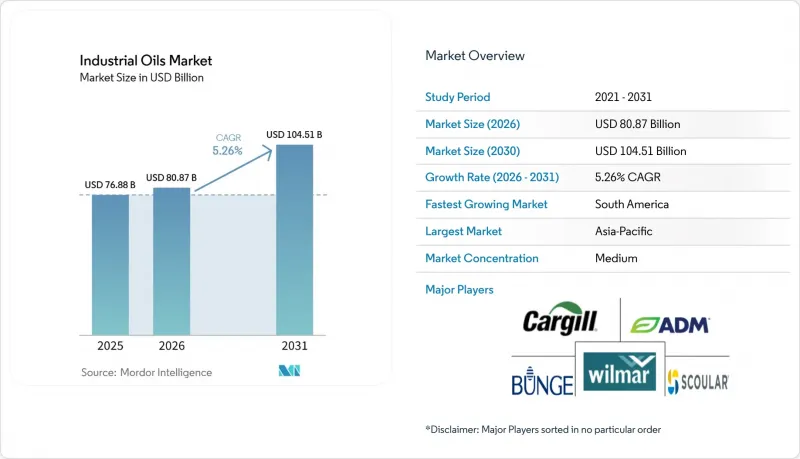
Mordor Intelligence에 의하면, 산업용 오일 시장 규모는 2025년에 768억 8,000만 달러로 평가되었고, 2026년 808억 7,000만 달러에서 2031년까지 1,045억 1,000만 달러에 이를 것으로 예측되며, 예측 기간(2026-2031년) CAGR은 5.26%를 나타낼 전망입니다.
본 보고서는 제품 유형별(대두, 팜, 유채, 해바라기, 목화씨, 기타), 카테고리별(유기농, 일반), 최종 용도별(바이오연료, 페인트 및 코팅, 화장품 및 퍼스널케어, 의약품, 동물사료 등), 지역별(북미, 유럽, 아시아태평양, 남미, 중동 및 아프리카)별로 분류되어 있습니다. 시장 전망은 금액(달러) 및 수량(리터)으로 제시되어 있습니다.
세계의 산업용 오일 시장 동향 및 인사이트
바이오 유래 및 저탄소 산업용 오일에 대한 수요 증가
연료, 화학 및 산업 분야의 사용자들이 화석 연료 유래 원료에서 벗어나면서, 산업용 오일 시장에서는 식물 유래 원료로의 뚜렷한 전환이 나타나고 있습니다. 미국에서는 2025년 10월부터 2026년 3월까지 바이오매스 유래 디젤 연료 생산에 사용된 대두유량이 61억 파운드에 달했습니다. 이는 에너지 수요가 식용유 공급망에 얼마나 큰 영향을 미치고 있는지를 보여줍니다. 또한 미국 농무부(USDA)는 2026/27 마케팅 연도의 전 세계 식물성 오일 산업용 사용량을 5,880만 메트릭 톤으로 예측하고 있으며, 이는 이러한 수요 변화가 특정 국가나 정책 체계에 국한된 것이 아니라 광범위하게 나타나고 있음을 뒷받침합니다. 인도네시아에서는 2025년에 B40 프로그램 하에서 이미 142억 리터의 팜 바이오디젤이 소비되었으며, 이는 국내 혼합 정책이 생산국 내에서 대량의 원료를 재분배할 수 있음을 보여줍니다. 산업용 오일 시장이 이러한 변화에 적응함에 따라, 과거에는 식품 수요에만 대응하던 가공 시설이 에너지 및 저탄소 인프라의 일부로 취급되기 시작했습니다. 이로 인해 인증을 받았고 확장성이 있으며 정책에 부합하는 유지 공급의 가치는 단순한 공급량 증가가 시사하는 것 이상으로 높아지고 있습니다.
식품, 화장품, 의약품 분야의 최종 용도 사양 강화
산업용 오일 시장은 규제 대상인 최종 용도 분야의 제품 사양 강화에 의해서도 형성되고 있습니다. 특히 순도나 성분의 추적 가능성이 공급업체의 인증 기준에 영향을 미치는 분야에서는 이러한 경향이 두드러집니다. 미국에서는 화장품 규제 체계에 기반한 FDA의 감독으로 인해 성분에 대한 문서화 및 안전성 입증 요건이 더욱 엄격해지고 있으며, 이는 퍼스널케어 제품의 배합에 사용되는 식물성 오일 원료 선정 방식에 영향을 미치고 있습니다. 유럽에서는 규정(EC) 1223/2009에 따라 화장품 성분에 대한 더욱 엄격한 심사가 지속적으로 요구되고 있으며, 이로 인해 유래 원료에 대해 검증된 품질과 일관된 조성에 대한 수요가 높아지고 있습니다. Croda의 2025년 연차 보고서에 따르면, 이 회사는 의약품 및 퍼스널케어 용도를 위한 고순도 지질 시스템 개발을 지속하고 있으며, 이는 정제되고 사양에 부합하는 원료가 중시되고 있음을 반영합니다. 실무적인 관점에서 볼 때, 이는 산업용 오일 시장이 더 이상 원료의 유형나 가격만으로 구분되는 것이 아님을 의미합니다. 구매자가 현재 표준으로 간주하는 문서화, 일관성 및 규제상 접근 요건을 공급업체가 충족할 수 있는지 여부에 따라 시장은 점점 더 세분화되고 있습니다.
원료 공급 상황의 변동과 가격 차이
산업용 오일 시장은 몇몇 주요 유지종자 시스템에서 정책 주도형 수요가 공급의 유연성을 능가하는 속도로 증가하고 있기 때문에 여전히 원료 가격 변동 위험에 노출되어 있습니다. 프랑스 농림부에 따르면, 2024년에는 전 세계 유채유 생산량의 27% 이상, 대두 생산량의 24%, 팜유 생산량의 17%가 바이오연료로 사용되고 있으며, 이는 식용유 공급량 중 얼마나 많은 부분이 이미 에너지 용도로 배정되어 있는지를 보여줍니다. 브라질에서는 바이오디젤 혼합 비율이 1% 상승할 때마다 약 40만 톤의 대두유가 추가로 필요합니다. 이는 사소한 정책 변경만으로도 다른 산업용 공급에 심각한 차질을 빚을 수 있음을 의미합니다. 이러한 정책적 압력이 기상 조건이나 병해충 위험, 불규칙한 재배 주기와 겹치면 각종 유지 및 지역 간 가격 차이가 급속히 확대될 가능성이 있습니다. 그 결과, 전 세계적인 조달망을 갖추지 못한 중규모 가공업체나 산업용 구매자에게는 사업 환경이 더욱 어려워질 것입니다. 따라서 산업용 오일 시장의 가격 변동은 단순한 조달 문제에 그치지 않습니다. 이는 이익률과 계약 동향, 나아가 장기적인 산업용 공급을 보장하는 능력에도 영향을 미칩니다.
부문 분석
2025년, 대두유는 시장의 32.34%를 차지했으며, 같은 해 산업용 오일 시장 규모에서 가장 큰 제품 유형이 되었습니다. 이러한 주도적 지위는 중국, 미국, 브라질의 대규모 압착 능력은 물론, 바이오매스 유래 디젤 및 바이오디젤 프로그램에 대한 강력한 수요에 힘입은 것입니다. 미국 농무부(USDA) 자료에 따르면, 2025년 10월부터 2026년 3월까지 미국 내 바이오매스 유래 디젤 연료에 사용된 대두유량은 61억 파운드에 달했습니다. 한편, 세계 유지종자 무역 전망은 산업용 채널에서 대두의 중요성이 여전히 높음을 뒷받침하고 있습니다. 또한 USDA는 경쟁이 여전히 치열하지만, 에너지 용도와 비에너지 용도 모두에서 지속적인 공급이 가능한 수준으로 전 세계 대두 및 유지종자의 유통량을 예측했습니다. 팜유는 동남아시아의 유지화학 시스템에서 여전히 중심적인 위치를 차지하고 있지만, 국내 바이오디젤 프로그램에서의 사용이 증가함에 따라 수출 지향적인 산업 가공용으로 이용 가능한 공급량이 변화하고 있습니다. 해바라기유 및 면실유는 순수한 수량보다 배합, 지역별 재배 패턴, 혹은 최종 용도 요건이 더 중요시되는 분야에서 계속해서 제한적인 역할을 수행하고 있습니다.
유채유는 2031년까지 연평균 성장률(CAGR) 6.72%를 나타낼 것으로 예측되며, 산업용 오일 시장에서 가장 빠르게 성장하는 제품 유형이 될 것입니다. 이러한 성장세는 유럽의 유리한 정책 환경에 기인합니다. 이 지역에서는 운송 부문의 탈탄소화 및 재생 가능 원료에 관한 규제가 작물 유래 바이오디젤 및 관련 산업 수요를 지속적으로 뒷받침하고 있습니다. RED III는 재생 가능 운송 에너지 확대를 위한 종합적인 틀을 마련하고 있으며, 회원국들의 이행 상황이 유채 유래 경로에 대한 상업적 수요를 뒷받침하고 있습니다. EU의 바이오연료 의무화에 관한 미국 농무부(USDA) 보고서에 따르면, 회원국들의 폐기물 유래 경로에 대한 처리 방식의 변화로 인해 독일 및 네덜란드 등 주요 시장에서 작물 유래 유채 바이오디젤의 상대적 위상이 높아지고 있는 것으로 나타났습니다. 이로 인해 유채유는 단순한 ‘식량 대 연료’ 비교가 시사하는 것보다 더 강력한 산업 성장 궤도에 올라섰습니다. 또한 이는 산업용 오일 업계에서 단순히 원유 생산뿐만 아니라 전환 및 다운스트림 공정으로의 특화에 가치가 이동하고 있는 이유를 설명하는 한 요인이 되고 있습니다.
지역별 분석
2025년, 아시아태평양은 산업용 오일 시장의 42.59%를 차지하며 지역별 1위를 유지했습니다. 이 지역은 팜유 분야에서 인도네시아와 말레이시아의 중요성에 더해, 세계 최대의 대두 압착국인 중국의 지위까지 겸하고 있어, 원료 공급과 하류 산업 활용 양면에서 가장 영향력 있는 지역으로 자리매김하고 있습니다. 인도네시아의 2025년 바이오디젤 계획에 따르면, B40 제도 하에서 이미 142억 리터의 팜 바이오디젤이 흡수되었으며, 이는 국내 정책이 아시아태평양 전체의 원료 배분을 얼마나 신속하게 재구성할 수 있는지를 보여줍니다. 또한 인도 역시 2025년 6월에 E20 에탄올 혼합 목표를 앞당겨 달성하는 등 강력한 정책 실행력을 보여주고 있으며, 이는 바이오연료 정책을 산업 수요의 지렛대로 활용하려는 해당 지역의 의지를 뒷받침하고 있습니다. 동시에 RSPO 인증 기준의 강화로 인해 해당 지역 전체의 팜유 기반 공급망에서 규정 준수 체제가 더욱 강화되고 있습니다. 이는 대규모 통합 생산자에게 유리하게 작용하며, 산업용 오일 시장에서 규모, 문서화 및 추적성의 가치를 높이고 있습니다.
남미는 2031년까지 연평균 성장률(CAGR)이 6.87%에 달하고, 가장 빠르게 성장하는 지역이 될 것으로 예측되며, 이 지역의 산업용 오일 시장은 주로 브라질의 대두 및 바이오디젤 제도에 의해 주도되고 있습니다. 브라질의 ‘미래의 연료(Fuels of the Future)’ 프레임워크는 대두유에 대한 꾸준한 수요를 뒷받침하고 있으며, 혼합 비율이 높아질 때마다 국내 가공 및 산업용도로의 명확한 수요가 창출되고 있습니다. 이로 인해 이 지역은 농업 생산과 에너지 정책 모두와 밀접하게 연결되어 있으며, 이것이 남미가 성숙한 시장보다 빠르게 성장하고 있는 이유입니다. 유럽도 마찬가지로 중요하지만, 그 이유는 다릅니다. 유럽의 산업용 오일 시장은 원료의 풍부함보다는 규제, 배합, 부가가치 가공에 의해 형성되고 있기 때문입니다. 프랑스에서는 여전히 유채유 대부분이 바이오디젤로 사용되고 있으며, 프랑스 농림부의 공식 자료는 바이오연료가 농업용 유지 이용에 얼마나 깊이 뿌리내리고 있는지를 보여줍니다. RED III 및 관련 회원국의 규제 변경 또한 운송 및 산업용 유채유 활용에 대한 상업적 근거를 뒷받침하고 있습니다. 그 결과, 유럽은 수량 면에서는 1위를 차지하지는 않지만, 기술 도입, 조달 체계, 그리고 고사양 수요라는 측면에서 여전히 중심적인 역할을 수행하고 있습니다.
북미에서는 여전히 대두유와 카놀라유가 주를 이루고 있으며, 이 지역의 산업용 오일 시장은 재생 가능 디젤 및 바이오매스 유래 디젤의 확대와 점점 더 밀접하게 연결되어 있습니다. 미국 농무부(USDA)의 데이터에 따르면, 미국의 바이오매스 유래 디젤에서 대두유 사용량은 계속해서 견조한 추세를 보이고 있으며, 캐나다의 카놀라유 압착 전망 또한 재생 가능 연료 분야에서의 사용 증가를 시사하고 있습니다. Bunge와 Chevron의 데스트레한 정유시설에 대한 투자는 기존의 상품 처리뿐만 아니라 재생 가능 연료의 원료가 되는 유지종자 가공을 핵심으로 하고 있어 이러한 지역적 추세를 반영하고 있습니다. 중동 및 아프리카의 구조는 여전히 다양하며, 수요는 잘 정비된 가공 기반보다는 식품, 화장품, 의약품용 수입에 집중되어 있습니다. 사우디아라비아와 아랍에미리트(UAE)는 특수 유지의 주요 구매국인 반면, 남아프리카공화국은 이 지역에서 가장 발전된 유지 화학제품 수요 구조를 보이고 있습니다. 나이지리아, 이집트, 모로코에서는 현지 가공 심도나 원료의 안정적 공급이 여전히 제한적이기 때문에 발전 속도가 완만합니다. 이에 따라 북미는 투자 주도형 공급 지역으로 자리 잡은 반면, 중동 및 아프리카는 산업용 오일 시장에서 보다 선택적이며, 수입 의존도가 높은 상태가 지속되고 있습니다.
기타 혜택 :
- 엑셀 형식 시장 예측(ME) 시트
- 3개월간의 애널리스트 지원
자주 묻는 질문
목차
제1장 서론
제2장 조사 방법
제3장 주요 요약
제4장 시장 역학
제5장 시장 규모 및 성장 예측
제6장 경쟁 구도
제7장 시장 기회 및 향후 동향
AJY 26.08.07According to Mordor Intelligence, the industrial oils market size was valued at USD 76.88 billion in 2025 and estimated to grow from USD 80.87 billion in 2026 to reach USD 104.51 billion by 2031, at a CAGR of 5.26% during the forecast period (2026-2031).
This report is Segmented by Product Type (Soybean, Palm, Rapeseed, Sunflower, Cottonseed, Others), Category (Organic, Conventional), End-Use (Biofuel, Paints & Coatings, Cosmetics & Personal Care, Pharmaceuticals, Animal Feed, and More), and Geography (North America, Europe, Asia-Pacific, South America, Middle East & Africa). The Market Forecasts are Provided in Terms of Value (USD) and Volume (Liters).
Global Industrial Oils Market Trends and Insights
Rising Demand for Bio-Based and Low-Carbon Industrial Oils
The industrial oils market is seeing a clear shift toward plant-based feedstocks as fuel, chemical, and industrial users move away from fossil-linked inputs. In the United States, soybean oil use in biomass-based diesel production reached 6.1 billion pounds from October 2025 through March 2026, which shows how strongly energy demand is pulling on edible oil supply chains. USDA also projected global vegetable oil industrial use at 58.8 million metric tonnes for MY 2026/27, confirming that this demand shift is broad rather than limited to one country or policy system. Indonesia had already absorbed 14.2 billion liters of palm biodiesel under its B40 program in 2025, demonstrating how domestic blending policy can reallocate large volumes of feedstock within a producing country. As the industrial oils market adjusts to these changes, processing assets that once served only food demand are increasingly treated as part of energy and low-carbon infrastructure. That raises the value of certified, scalable, and policy-aligned oil supply more than simple volume growth would suggest.
Tightening End-Use Specifications in Food, Cosmetics, and Pharmaceuticals
The industrial oils market is also being shaped by stricter product specifications in regulated end uses, especially where purity and ingredient traceability now influence supplier qualification. In the United States, FDA oversight under the cosmetics framework requires stronger ingredient documentation and safety support, which affects how vegetable oil inputs are selected for personal care formulations. In Europe, Regulation (EC) 1223/2009 continues to support closer scrutiny of cosmetic ingredients, which increases the need for verified quality and consistent composition in oil-derived inputs. Croda's 2025 annual report showed the company continuing to build on high-purity lipid systems for pharmaceutical and personal care uses, reflecting the premium being placed on refined, specification-led materials. In practical terms, this means the industrial oils market is no longer divided only by feedstock type or price. It is increasingly divided by whether a supplier can meet documentation, consistency, and regulatory access requirements that buyers now treat as standard.
Volatile Feedstock Availability and Price Spreads
The industrial oils market remains exposed to feedstock volatility because policy-led demand is rising faster than supply flexibility in several major oilseed systems. France's Ministry of Agriculture noted that more than 27% of global rapeseed, 24% of soybean, and 17% of palm oil were directed to biofuels in 2024, which shows how much of the oil pool is already committed to energy use. In Brazil, each 1 percentage-point increase in the biodiesel blend rate requires around 400,000 additional tonnes of soybean oil, which means even small policy shifts can materially tighten availability for other industrial uses. When this policy pressure overlaps with weather and disease risks and uneven crop cycles, price spreads can widen quickly across oils and regions. That creates a more challenging operating environment for mid-sized processors and industrial buyers without global origination options. In the industrial oils market, volatility is therefore not just a procurement issue. It shapes margins, contract behavior, and the ability to commit to long-term industrial supply.
Other drivers and restraints analyzed in the detailed report include:
- Substitution of Fossil-Derived Inputs in Process and Specialty Applications
- Growth in Oleochemical and High-Value Downstream Processing Capacity
- Sustainability Compliance and Certification Costs
For complete list of drivers and restraints, kindly check the Table Of Contents.
Segment Analysis
Soybean oils accounted for 32.34% of the market in 2025, making them the largest product type in the industrial oils market size profile that year. This leadership reflects deep crush capacity across China, the United States, and Brazil, along with the strong pull from biomass-based diesel and biodiesel programs. USDA showed that U.S. soybean oil use in biomass-based diesel reached 6.1 billion pounds from October 2025 through March 2026, while global oilseed trade projections continued to support high soybean relevance in industrial channels. USDA also projected global soybean and oilseed flows at levels that support continued availability for both energy and non-energy uses, even though demand competition remains intense. Palm oil remains central to Southeast Asian oleochemical systems, but its rising use in domestic biodiesel programs is changing the supply available for export-oriented industrial processing. Sunflower and cottonseed oils continue to serve narrower roles where formulation, regional crop patterns, or end-use requirements matter more than sheer volume.
Rapeseed oils are projected to grow at a 6.72% CAGR through 2031, which makes them the fastest-growing product type in the industrial oils market. Their momentum comes from a favorable policy setting in Europe, where transport decarbonization and renewable feedstock rules continue to support crop-based biodiesel and related industrial demand. RED III set the broader framework for renewable transport energy expansion, while member-state implementation is influencing commercial pull for rapeseed-based pathways. USDA reporting on EU biofuel mandates also showed that changes in member-state treatment of waste-based routes are improving the relative position of crop-based rapeseed biodiesel in key markets such as Germany and the Netherlands. That gives rapeseed oil a stronger industrial growth path than a simple food-versus-fuel comparison would suggest. It also helps explain why the industrial oils industry is seeing more value shift toward conversion and downstream specialization rather than only raw oil output.
Complete Report Scope:
- By Product Type
- Soybean
- Palm
- Rapeseed
- Sunflower
- Cottonseed
- Others
- By Category
- Organic
- Conventional
- By End-Use
- Biofuel
- Paints and Coatings
- Cosmetics and Personal Care
- Pharmaceuticals
- Animal Feed
- Food and Beverages
- Others
- By Geography
- North America
- United States
- Canada
- Mexico
- Rest of North America
- Europe
- Germany
- United Kingdom
- Italy
- France
- Spain
- Netherlands
- Poland
- Belgium
- Sweden
- Rest of Europe
- Asia-Pacific
- China
- India
- Japan
- South Korea
- Australia
- Indonesia
- Thailand
- Singapore
- Rest of Asia-Pacific
- South America
- Brazil
- Argentina
- Colombia
- Chile
- Peru
- Rest of South America
- Middle East and Africa
- South Africa
- Saudi Arabia
- United Arab Emirates
- Turkey
- Nigeria
- Egypt
- Morocco
- Rest of Middle East and Africa
- North America
Geography Analysis
Asia-Pacific accounted for 42.59% of the industrial oils market in 2025, maintaining its lead among regions. The region combines Indonesia and Malaysia's importance in palm oil with China's position as the largest soybean crusher, making it the most influential area for both feedstock supply and downstream industrial use. Indonesia's 2025 biodiesel program had already absorbed 14.2 billion liters of palm biodiesel under B40, demonstrating how quickly domestic policy can reshape feedstock allocation across Asia-Pacific. India also showed strong policy execution by reaching its E20 ethanol blending target ahead of schedule in June 2025, reinforcing the region's willingness to use biofuel policy as an industrial demand lever. At the same time, RSPO's tighter certification rules are adding a stronger compliance layer to palm-based supply chains across the region. That favors larger integrated producers and makes scale, documentation, and traceability more valuable in the industrial oils market.
South America is projected to be the fastest-growing region, with a 6.87% CAGR through 2031, and the industrial oils market there is being driven mainly by Brazil's soybean and biodiesel systems. Brazil's Fuels of the Future framework is reinforcing a steady pull on soybean oil, with each step-up in blending creating visible demand for domestic processing and industrial use. This keeps the region closely tied to both agricultural output and energy policy, which is why South America is growing faster than more mature markets. Europe remains equally important, but for different reasons, because the industrial oils market there is shaped more by regulation, formulation, and value-added processing than by raw feedstock abundance. France continues to direct a large share of rapeseed oil toward biodiesel, and official material from the French Ministry of Agriculture shows how deeply biofuels are embedded in agricultural oil use. RED III and related member-state changes are also supporting the commercial case for rapeseed pathways in transport and industrial applications. As a result, Europe does not lead by volume, but it remains central to technology adoption, sourcing discipline, and high-specification demand.
North America remains anchored by soybean oil and canola oil, and the industrial oils market there is increasingly linked to renewable diesel and biomass-based diesel expansion. USDA continued to show strong soybean oil use in U.S. biomass-based diesel, while Canada's canola oil crush outlook also pointed to rising use in renewable fuel channels. Bunge and Chevron's Destrehan processing investment captures this regional pattern, because it is built around oilseed processing for renewable fuel feedstocks rather than traditional commodity throughput alone. The Middle East and Africa remain more mixed in structure, with demand centered on imports for food-grade, cosmetic, and pharmaceutical uses rather than a fully developed processing base. Saudi Arabia and the UAE are important buyers of specialty oils, while South Africa shows the most developed oleochemical demand profile in the region. Nigeria, Egypt, and Morocco are moving more slowly because local processing depth and feedstock security are still limited. This leaves North America as an investment-led supply region, while the Middle East and Africa remain more selective and import dependent in the industrial oils market.
- Cargill, Incorporated
- Wilmar International Ltd
- Bunge Global SA
- Archer Daniels Midland Company
- The Scoular Company
- Avril Group
- Kuala Lumpur Kepong Berhad (KLK)
- Gustav Heess GmbH
- Richardson International Limited
- Best Oil Sp. z o. o.
- COFCO International
- RGE Group
- SD Guthrie Berhad
- Thai Export Oils
- K.T.C. (Edibles) Ltd
- Musim Mas Group
- AAK AB
- Croda International Plc
- The Nisshin OilliO Group, Ltd.
- OLVEA Group
Additional Benefits:
- The market estimate (ME) sheet in Excel format
- 3 months of analyst support
TABLE OF CONTENTS
1 INTRODUCTION
- 1.1 Study Assumptions and Market Definition
- 1.2 Scope of the Study
2 RESEARCH METHODOLOGY
3 EXECUTIVE SUMMARY
4 MARKET DYNAMICS
- 4.1 Market Overview
- 4.2 Market Drivers
- 4.2.1 Rising Demand for Bio-Based and Low-Carbon Industrial Oils
- 4.2.2 Tightening End-Use Specifications in Food, Cosmetics, and Pharmaceuticals
- 4.2.3 Substitution of Fossil-Derived Inputs in Process and Specialty Applications
- 4.2.4 Growth in Oleochemical and High-Value Downstream Processing Capacity
- 4.2.5 OEM Push for Higher-Purity and Application-Specific Oil Grades
- 4.2.6 Traceable Feedstock Sourcing as a Procurement Differentiator
- 4.3 Market Restraints
- 4.3.1 Volatile Feedstock Availability and Price Spreads
- 4.3.2 Sustainability Compliance and Certification Costs
- 4.3.3 Performance Trade-Offs Versus Petrochemical Alternatives
- 4.3.4 Supply Chain Concentration in Key Oilseed Origins
- 4.4 Supply Chain Analysis
- 4.5 Regulatory Landscape
- 4.6 Technological Outlook
- 4.7 Porter's Five Forces
- 4.7.1 Threat of New Entrants
- 4.7.2 Bargaining Power of Buyers/Consumers
- 4.7.3 Bargaining Power of Suppliers
- 4.7.4 Threat of Substitute Products
- 4.7.5 Intensity of Competitive Rivalry
5 MARKET SIZE AND GROWTH FORECASTS (VALUE AND VOLUME)
- 5.1 By Product Type
- 5.1.1 Soybean
- 5.1.2 Palm
- 5.1.3 Rapeseed
- 5.1.4 Sunflower
- 5.1.5 Cottonseed
- 5.1.6 Others
- 5.2 By Category
- 5.2.1 Organic
- 5.2.2 Conventional
- 5.3 By End-Use
- 5.3.1 Biofuel
- 5.3.2 Paints and Coatings
- 5.3.3 Cosmetics and Personal Care
- 5.3.4 Pharmaceuticals
- 5.3.5 Animal Feed
- 5.3.6 Food and Beverages
- 5.3.7 Others
- 5.4 By Geography
- 5.4.1 North America
- 5.4.1.1 United States
- 5.4.1.2 Canada
- 5.4.1.3 Mexico
- 5.4.1.4 Rest of North America
- 5.4.2 Europe
- 5.4.2.1 Germany
- 5.4.2.2 United Kingdom
- 5.4.2.3 Italy
- 5.4.2.4 France
- 5.4.2.5 Spain
- 5.4.2.6 Netherlands
- 5.4.2.7 Poland
- 5.4.2.8 Belgium
- 5.4.2.9 Sweden
- 5.4.2.10 Rest of Europe
- 5.4.3 Asia-Pacific
- 5.4.3.1 China
- 5.4.3.2 India
- 5.4.3.3 Japan
- 5.4.3.4 South Korea
- 5.4.3.5 Australia
- 5.4.3.6 Indonesia
- 5.4.3.7 Thailand
- 5.4.3.8 Singapore
- 5.4.3.9 Rest of Asia-Pacific
- 5.4.4 South America
- 5.4.4.1 Brazil
- 5.4.4.2 Argentina
- 5.4.4.3 Colombia
- 5.4.4.4 Chile
- 5.4.4.5 Peru
- 5.4.4.6 Rest of South America
- 5.4.5 Middle East and Africa
- 5.4.5.1 South Africa
- 5.4.5.2 Saudi Arabia
- 5.4.5.3 United Arab Emirates
- 5.4.5.4 Turkey
- 5.4.5.5 Nigeria
- 5.4.5.6 Egypt
- 5.4.5.7 Morocco
- 5.4.5.8 Rest of Middle East and Africa
- 5.4.1 North America
6 COMPETITIVE LANDSCAPE
- 6.1 Market Concentration
- 6.2 Strategic Moves
- 6.3 Market Ranking Analysis
- 6.4 Company Profiles (includes Global level Overview, Market level overview, Core Segments, Financials, Strategic Information, Market Rank/Share, Products and Services, Recent Developments)
- 6.4.1 Cargill, Incorporated
- 6.4.2 Wilmar International Ltd
- 6.4.3 Bunge Global SA
- 6.4.4 Archer Daniels Midland Company
- 6.4.5 The Scoular Company
- 6.4.6 Avril Group
- 6.4.7 Kuala Lumpur Kepong Berhad (KLK)
- 6.4.8 Gustav Heess GmbH
- 6.4.9 Richardson International Limited
- 6.4.10 Best Oil Sp. z o. o.
- 6.4.11 COFCO International
- 6.4.12 RGE Group
- 6.4.13 SD Guthrie Berhad
- 6.4.14 Thai Export Oils
- 6.4.15 K.T.C. (Edibles) Ltd
- 6.4.16 Musim Mas Group
- 6.4.17 AAK AB
- 6.4.18 Croda International Plc
- 6.4.19 The Nisshin OilliO Group, Ltd.
- 6.4.20 OLVEA Group