|
시장보고서
상품코드
2097285
SOAR 시장 : 점유율 분석, 업계 동향 및 통계, 성장 예측(2025-2030년)SOAR - Market Share Analysis, Industry Trends & Statistics, Growth Forecasts (2025 - 2030) |
||||||
 Mordor Intelligence
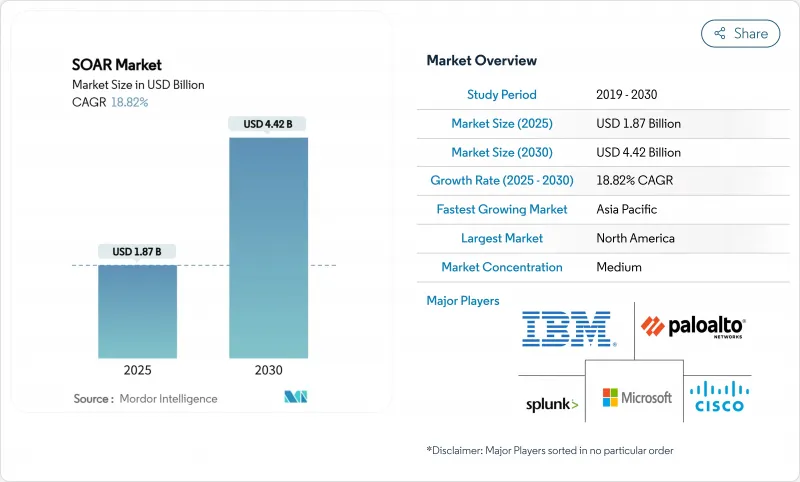
Mordor Intelligence에 의하면, SOAR 시장 규모는 2025년에 18억 7,000만 달러가 되고, 2030년까지 44억 2,000만 달러에 이르고, CAGR은 18.82%를 나타낼 것으로 예측됩니다.
본 보고서는 구성 요소별(소프트웨어/플랫폼 및 서비스), 배포 방식별(클라우드 기반 및 On-Premise형), 조직 규모별(대기업 및 중소기업(SME)), 산업별(은행, 금융서비스 및 보험(BFSI), 정부·국방, 헬스케어 및 생명과학, 기타), 지역별로 분류되어 있습니다. 시장 전망은 금액(달러) 기준으로 제시되어 있습니다.
세계 SOAR 시장 동향 및 인사이트
경보량의 급증과 복잡화
조직은 멀티 벤더 엔드포인트와 마이크로서비스가 하루에 수백만 건에 달하는 로그를 정기적으로 생성함에 따라, 전례 없는 보안 이벤트의 홍수에 직면해 있습니다. 수동 트리아지는 분석가를 압도하고, 번아웃을 악화시키며, 공격의 잠복 시간을 연장시키고 있습니다. SOAR 도입을 통해 조사 주기를 최대 75% 단축하고, 예기치 않은 다운타임을 82% 줄일 수 있으므로, 사이버 복원력 측면에서 자동화는 필수적입니다. 분산형 워크로드로 인해 이벤트 노이즈가 증폭되는 클라우드 네이티브 기업들은 경보의 우선순위를 결정하는 AI 기반 상관 분석 엔진으로부터 막대한 가치를 얻고 있습니다. 고도로 정교한 공격자들이 AI를 무기로 활용하는 사례가 증가하고 있으므로, 방어 스택은 기계가 생성한 플레이북과 자율적인 대응 루틴을 통해 이러한 추세를 따라잡아야 합니다. 기업이 마이크로서비스를 확대함에 따라 경보량 증가는 비선형적인 추세를 유지하고 있으며, 오케스트레이션 플랫폼에 대한 지속적인 수요가 확고해지고 있습니다.
규제 준수 주도형 자동화 요구 사항
규제 당국은 사이버 보안에 대한 기대치에 자동화를 반영하고 있습니다. GDPR(EU 개인정보보호규정)에 따라 침해 사고의 신속한 차단 증명이 필수화되면서, 이에 따른 ID 중심 오케스트레이션에 대한 지출은 연간 160억 달러를 초과하고 있습니다. 미국에서는 2022 회계연도 국방수권법(NDAA)을 통해 국방부의 SOAR 시범 사업에 2,500만 달러가 배정되어, 자동화된 대응에 대한 국가 차원의 신뢰가 드러났습니다. 마찬가지로, PCI-DSS 4.0, HIPAA 및 그램-리치-브라이리법 개정안에서도 자동 로그 기록 및 사고 연관성 분석이 법적으로 규정되어 있습니다. 감사관은 워크플로우에 대한 증거를 점점 더 요구하고 있으며, 플랫폼에서 생성되는 감사 추적 기록은 감사를 통과하기 위한 필수 요건이 되었습니다. 2026년까지 시행될 예정인 유럽연합(EU)의 ‘사이버 복원력 법’은 자동화를 운영 기술(OT) 및 중요 인프라 분야에 더욱 깊이 침투시킬 것으로 기대됩니다.
레거시 툴셋의 통합 부담
10년 이상 된 SIEM 어플라이언스는 최신 API가 부족한 경우가 많아 클라우드 텔레메트리 대응에 어려움을 겪고 있으며, 이로 인해 비용이 많이 드는 맞춤형 커넥터나 병렬 파이프라인 도입을 피할 수 없게 되었습니다. 레이크 중심 아키텍처로의 전환에는 직원 재교육과 감지 규칙 리팩토링이 필요하기 때문에 많은 기업이 이러한 비용 부담을 꺼리고 있습니다. 여러 SIEM 환경이 혼재된 경우 정규화가 더욱 복잡해지며, 독자적인 사양의 로그 형식이 데이터 이식성을 제한합니다. 벤더가 턴키 방식의 커넥터를 포함하거나, 팔로알토 네트웍스의 무료 QRadar SaaS 마이그레이션 서비스와 같은 마이그레이션 인센티브를 제공할 때까지는 업그레이드 주기의 지연이 SOAR의 광범위한 보급을 저해하게 될 것입니다.
부문 분석
2024년에는 소프트웨어가 매출 점유율의 64%를 차지한 반면, 서비스 분야에 대한 관심이 높아지고 있습니다. 서비스 분야의 SOAR 시장 규모는 연평균 성장률(CAGR) 20.8%로 확대될 것으로 예상되며, 이는 전문적인 도입, 플레이북 맞춤화 및 관리형 SOC 운영에 대한 강력한 수요를 반영합니다. Red Canary와 같은 MSSP는 현재 Cortex XSIAM을 턴키 솔루션에 통합하고 있으며, 이는 공급업체들이 자동화 전문 지식을 어떻게 수익화하고 있는지를 보여줍니다. 전문 서비스는 티켓 관리 시스템, CMDB, DevOps 파이프라인과의 통합을 다루고 있으며, 이는 사내 프로젝트가 정체되기 쉬운 영역입니다.
관리형 서비스는 자원이 제한적인 중소기업이나 연중무휴 24시간 대응을 요구하는 규정 준수 중심 산업으로부터 지지를 얻고 있습니다. IBM이 팔로알토 고객을 대상으로 ‘우선 관리형 제공업체’로서의 입지를 확립한 움직임은 벤더들이 라이선싱 중심의 비즈니스에서 지속적인 서비스 수익으로 전환하고 있음을 보여줍니다. 생성형 AI로 인해 플레이북의 복잡성이 증가함에 따라 지속적인 튜닝이 필수화되고, 외부 도메인 전문가에 대한 의존도가 높아지면서 SOAR 시장의 수익 구조에서 서비스가 더욱 중요한 위치를 차지하게 되었습니다.
2024년에는 하이브리드 자산을 신속하게 동기화하는 API 우선 설계에 힘입어 클라우드 배포가 SOAR 시장 점유율의 71%를 차지했습니다. 조직들이 동적이고 위치에 구애받지 않는 정책 적용이 필요한 제로 트러스트 모델을 채택함에 따라, 클라우드 기반 SOAR 솔루션 시장 규모는 2030년까지 연평균 성장률(CAGR) 24.4%로 확대될 것으로 전망됩니다. 벤더의 지속적인 업데이트, 탄력적인 컴퓨팅, 네이티브 위협 인텔리전스 피드를 통해 클라우드 퍼스트 플랫폼은 On-Premise 경쟁 제품에 비해 기능적 우위를 보이고 있습니다.
정부, 국방 및 규제가 엄격한 공공 서비스 분야에서는 데이터 관리 권한을 유지하기 위해 여전히 On-Premise 또는 소버린 클라우드로의 도입이 선호되고 있습니다. 오케스트레이션 로직을 클라우드에 배치하면서도 기밀성이 높은 로그는 On-Premise에 보관하는 하이브리드 모델이 등장하여, 규정 준수 및 기능성 간의 균형을 맞추고 있습니다. 미국 연방 정부의 클라우드 보안 참조 아키텍처에서는 자동화와 오케스트레이션이 핵심 요소로 명시되어 있으며, 공공 부문 환경에서의 클라우드 SOAR 도입이 표준화되고 있습니다.
지역별 분석
북미는 연방 정부의 사이버 보안 보조금, 선진적인 사이버 보험 시장, 그리고 탄탄한 벤더 생태계 덕분에 2024년 전 세계 매출의 43%를 차지했습니다. CISA가 2025년 5월에 발표한 SIEM-SOAR 지침은 자동화에 대한 기대를 더욱 제도화했으며, 경영진에게 오케스트레이션 계층에 대한 예산 편성을 강력히 요구하고 있습니다. 존스 홉킨스 대학교 APL의 시범 프로그램을 포함한 민관 협력 이니셔티브를 통해 모범 사례가 주 및 지방 자치단체의 SOC로 확산되며, 지역 내 리더십이 확립되고 있습니다.
아시아태평양은 인도, 인도네시아, 필리핀의 디지털화 가속화와 싱가포르, 일본, 호주에서의 규제 강화에 힘입어 2030년까지 연평균 성장률(CAGR) 18.7%라는 가장 높은 성장률을 기록하고 있습니다. 사이버 보험 도입률은 연간 약 50%의 속도로 증가하고 있으며, 자동화된 대응이 구체적인 경제적 이점을 가져옴으로써 이사회에 SOAR 도입을 촉진하고 있습니다. 각 벤더사는 플레이북의 현지화 및 데이터 상주 요건 대응을 위해 지역 파트너십을 강화하고 있습니다. ServiceNow의 inMorphis 및 Prodapt에 대한 투자가 그 대표적인 예입니다.
유럽에서는 GDPR(EU 개인정보보호규정) 및 향후 시행될 사이버 복원력 법의 요건을 배경으로 10%대 중반의 꾸준한 성장을 유지하고 있습니다. 데이터 주권에 대한 우려로 인해 하이브리드 배포 및 유럽에 호스팅된 클라우드 리전에 대한 관심이 높아지고 있습니다. 독일의 산업 자동화 분야에서는 운영 기술(OT) 방화벽과의 SOAR 통합이 요구되는 반면, 북유럽 국가 정부들은 시민의 데이터를 보호하기 위해 의료 시스템 전반에 걸친 사고 대응을 자동화하고 있습니다. 브렉시트로 인해 영국 기업들은 EU와 국내 규제를 동시에 준수해야 하는 상황에 직면해 있으며, 이종 혼합 프레임워크 전반에 걸쳐 규정 준수를 입증할 수 있는 워크플로우 엔진의 가치가 높아지고 있습니다.
기타 혜택:
- 엑셀 형식 시장 예측(ME) 시트
- 3개월간의 애널리스트 지원
자주 묻는 질문
목차
제1장 서론
제2장 조사 방법
제3장 주요 요약
제4장 시장 구도
제5장 시장 규모와 성장 예측
제6장 경쟁 구도
제7장 시장 기회와 향후 전망
JHS 26.08.07According to Mordor Intelligence, the SOAR market size is USD 1.87 billion in 2025 and is forecast to reach USD 4.42 billion by 2030, registering an 18.82% CAGR.
This report is Segmented by Component (Software/Platforms, and Services), Deployment Mode (Cloud-Based, and On-Premises), Organization Size (Large Enterprises, and Small and Mid-Size Enterprises (SMEs)), Industry Vertical (BFSI, Government and Defence, Healthcare and Life Sciences, and More), and Geography. The Market Forecasts are Provided in Terms of Value (USD).
Global SOAR Market Trends and Insights
Escalating Alert Volumes and Complexity
Organizations confront an unprecedented flood of security events, with multi-vendor endpoints and microservices regularly generating millions of logs per day.Manual triage overwhelms analysts, exacerbating burnout and prolonging dwell time. SOAR implementations cut investigation cycles by as much as 75% and drive an 82% decrease in unplanned downtime, making automation indispensable for cyber-resilience. Cloud-native businesses, whose distributed workloads amplify event noise, realize outsized value from AI-driven correlation engines that prioritize alerts. Advanced attackers increasingly weaponize AI, so defensive stacks must keep pace through machine-generated playbooks and autonomous response routines. As enterprises scale microservices, alert volume growth remains non-linear, locking in sustained demand for orchestration platforms.
Compliance-Driven Automation Mandates
Regulators are embedding automation into cybersecurity expectations. Under GDPR, proof of rapid breach containment is now essential, driving identity-centric orchestration spending above USD 16 billion annually. In the United States, the FY 2022 National Defense Authorization Act earmarked USD 25 million for Department of Defense SOAR pilots, signalling state-level confidence in automated response. PCI-DSS 4.0, HIPAA, and Gramm-Leach-Bliley Act revisions similarly codify automated logging and incident linkage. Auditors increasingly request workflow evidence, making platform-generated audit trails a prerequisite for passing inspections. The European Union's Cyber Resilience Act, set to mature by 2026, is expected to push automation deeper into operational technology and critical-infrastructure sectors.
Legacy Tool-Set Integration Debt
Decade-old SIEM appliances often lack modern APIs and struggle with cloud telemetry, forcing costly custom connectors or parallel pipelines. Migrating to lake-centric architectures demands retraining staff and refactoring detection rules, expenditures many firms hesitate to undertake. Multi-SIEM estates further complicate normalization, while proprietary log formats limit data portability. Until vendors bundle turnkey connectors or offer migration incentives-such as Palo Alto Networks' free QRadar SaaS migration services-the upgrade cycle slows widespread SOAR penetration.
Other drivers and restraints analyzed in the detailed report include:
- Cyber-Talent Scarcity
- Gen-AI Playbook Acceleration
- Cyber-Insurance Premium Incentives
- Budget Constraints Among SMBs
For complete list of drivers and restraints, kindly check the Table Of Contents.
Segment Analysis
Services captured growing attention even though software dominated 64% revenue share in 2024. The SOAR market size for services is projected to expand at 20.8% CAGR, reflecting acute demand for specialist implementation, playbook customization, and managed SOC operations. MSSPs such as Red Canary now bundle Cortex XSIAM into turnkey offerings, illustrating how providers monetize automation expertise. Professional services cover integration with ticketing, CMDB, and DevOps pipelines-areas that often stall in-house projects.
Managed services resonate with resource-constrained SMEs and compliance-driven sectors seeking 24/7 coverage. IBM's shift toward preferred managed provider status for Palo Alto customers exemplifies vendor pivots from license-centric business to recurring service revenue. As Gen-AI accelerates playbook complexity, continuous tuning becomes essential, intensifying reliance on external domain experts and embedding services further into the revenue mix of the SOAR market.
Cloud deployments controlled 71% of the SOAR market share in 2024, propelled by API-first designs that synchronize hybrid assets at speed. The SOAR market size for cloud solutions grows at a 24.4% CAGR through 2030 as organizations adopt Zero Trust models demanding dynamic, location-agnostic policy enforcement. Continuous vendor updates, elastic compute, and native threat-intel feeds give cloud-first platforms a functional edge over on-premises rival.
Government, defense, and highly regulated utilities still favour on-premises or sovereign-cloud deployments to retain data control. Hybrid modes are emerging, where orchestration logic resides in the cloud while sensitive logs stay on-site, balancing compliance with functionality. Federal cloud security reference architectures in the United States explicitly call out automation and orchestration pillars, normalizing cloud SOAR adoption in public sector environments.
Complete Report Scope:
- By Component
- Software / Platforms
- Services
- By Deployment Mode
- Cloud-based
- On-premise
- By Organisation Size
- Large Enterprises
- Small and Mid-size Enterprises (SME)
- By Industry Vertical
- Banking, Financial Services and Insurance (BFSI)
- Government and Defence
- Healthcare and Life Sciences
- IT and Telecom
- Retail and e-Commerce
- Energy and Utilities
- By Geography
- North America
- United States
- Canada
- Mexico
- Europe
- United Kingdom
- Germany
- France
- Italy
- Rest of Europe
- Asia-Pacific
- China
- Japan
- India
- South Korea
- Rest of Asia
- Middle East
- Israel
- Saudi Arabia
- United Arab Emirates
- Turkey
- Rest of Middle East
- Africa
- South Africa
- Egypt
- Rest of Africa
- South America
- Brazil
- Argentina
- Rest of South America
- North America
Geography Analysis
North America held 43% of global revenue in 2024 thanks to federal cybersecurity grants, advanced cyber-insurance markets, and a deep vendor ecosystem. CISA's May 2025 SIEM-SOAR guidance further institutionalizes automation expectations, urging executive boards to budget for orchestration layers. Public-private initiatives, including Johns Hopkins APL's pilot programs, spread best practices to state and municipal SOCs, consolidating regional leadership.
Asia-Pacific registers the fastest 18.7% CAGR through 2030, propelled by accelerated digitization in India, Indonesia, and the Philippines, and by regulatory crackdowns in Singapore, Japan, and Australia. Cyber-insurance uptake, growing almost 50% per year, creates tangible financial benefits for automated response, nudging boards toward SOAR procurement. Vendors deepen regional partnerships-ServiceNow's investments in inMorphis and Prodapt are prime examples-to localize playbooks and meet data-residency rules.
Europe maintains steady mid-teens growth, anchored in GDPR and upcoming Cyber Resilience Act mandates. Data-sovereignty concerns spur interest in hybrid deployments and European-hosted cloud regions. Germany's industrial automation sector demands SOAR integrations with operational-technology firewalls, whereas Nordic governments automate incident response across healthcare systems to secure citizen data. Brexit forces UK enterprises to juggle EU and domestic rules, elevating the value of workflow engines that can prove compliance across heterogeneous frameworks.
- Palo Alto Networks, Inc.
- Splunk Inc.
- IBM Corporation
- Microsoft Corporation
- Fortinet, Inc.
- Swimlane LLC
- Rapid7, Inc.
- Google LLC
- D3 Security Management Systems, Inc.
- LogRhythm, Inc.
- Cisco Systems, Inc.
- Exabeam, Inc.
- ServiceNow, Inc.
- Trellix LLC
- Tines Security Limited
- Elastic N.V.
- Sekoia SAS
- ThreatConnect, Inc.
- Resolve Systems LLC
- Heimdal Security A/S
Additional Benefits:
- The market estimate (ME) sheet in Excel format
- 3 months of analyst support
TABLE OF CONTENTS
1 INTRODUCTION
- 1.1 Study Assumptions and Market Definition
- 1.2 Scope of the Study
2 RESEARCH METHODOLOGY
3 EXECUTIVE SUMMARY
4 MARKET LANDSCAPE
- 4.1 Market Overview
- 4.2 Market Drivers
- 4.2.1 Escalating alert volumes and complexity
- 4.2.2 Compliance-driven automation mandates
- 4.2.3 Cyber-talent scarcity
- 4.2.4 Gen-AI playbook acceleration
- 4.2.5 Cyber-insurance premium incentives
- 4.2.6 API-first "composable SOC" uptake
- 4.3 Market Restraints
- 4.3.1 Legacy tool-set integration debt
- 4.3.2 Budget constraints among SMBs
- 4.3.3 Gen-AI IP-leakage concerns
- 4.3.4 SIEM / XDR bundling cannibalization
- 4.4 Industry Value Chain Analysis
- 4.5 Regulatory Landscape
- 4.6 Technological Outlook
- 4.7 Porter's Five Forces Analysis
- 4.7.1 Threat of New Entrants
- 4.7.2 Bargaining Power of Buyers
- 4.7.3 Bargaining Power of Suppliers
- 4.7.4 Threat of Substitutes
- 4.7.5 Competitive Rivalry
5 MARKET SIZE AND GROWTH FORECASTS (VALUE)
- 5.1 By Component
- 5.1.1 Software / Platforms
- 5.1.2 Services
- 5.2 By Deployment Mode
- 5.2.1 Cloud-based
- 5.2.2 On-premise
- 5.3 By Organisation Size
- 5.3.1 Large Enterprises
- 5.3.2 Small and Mid-size Enterprises (SME)
- 5.4 By Industry Vertical
- 5.4.1 Banking, Financial Services and Insurance (BFSI)
- 5.4.2 Government and Defence
- 5.4.3 Healthcare and Life Sciences
- 5.4.4 IT and Telecom
- 5.4.5 Retail and e-Commerce
- 5.4.6 Energy and Utilities
- 5.5 By Geography
- 5.5.1 North America
- 5.5.1.1 United States
- 5.5.1.2 Canada
- 5.5.1.3 Mexico
- 5.5.2 Europe
- 5.5.2.1 United Kingdom
- 5.5.2.2 Germany
- 5.5.2.3 France
- 5.5.2.4 Italy
- 5.5.2.5 Rest of Europe
- 5.5.3 Asia-Pacific
- 5.5.3.1 China
- 5.5.3.2 Japan
- 5.5.3.3 India
- 5.5.3.4 South Korea
- 5.5.3.5 Rest of Asia
- 5.5.4 Middle East
- 5.5.4.1 Israel
- 5.5.4.2 Saudi Arabia
- 5.5.4.3 United Arab Emirates
- 5.5.4.4 Turkey
- 5.5.4.5 Rest of Middle East
- 5.5.5 Africa
- 5.5.5.1 South Africa
- 5.5.5.2 Egypt
- 5.5.5.3 Rest of Africa
- 5.5.6 South America
- 5.5.6.1 Brazil
- 5.5.6.2 Argentina
- 5.5.6.3 Rest of South America
- 5.5.1 North America
6 COMPETITIVE LANDSCAPE
- 6.1 Market Concentration
- 6.2 Strategic Moves
- 6.3 Market Share Analysis
- 6.4 Company Profiles (includes Global level Overview, Market level overview, Core Segments, Financials as available, Strategic Information, Market Rank/Share for key companies, Products and Services, and Recent Developments)
- 6.4.1 Palo Alto Networks, Inc.
- 6.4.2 Splunk Inc.
- 6.4.3 IBM Corporation
- 6.4.4 Microsoft Corporation
- 6.4.5 Fortinet, Inc.
- 6.4.6 Swimlane LLC
- 6.4.7 Rapid7, Inc.
- 6.4.8 Google LLC
- 6.4.9 D3 Security Management Systems, Inc.
- 6.4.10 LogRhythm, Inc.
- 6.4.11 Cisco Systems, Inc.
- 6.4.12 Exabeam, Inc.
- 6.4.13 ServiceNow, Inc.
- 6.4.14 Trellix LLC
- 6.4.15 Tines Security Limited
- 6.4.16 Elastic N.V.
- 6.4.17 Sekoia SAS
- 6.4.18 ThreatConnect, Inc.
- 6.4.19 Resolve Systems LLC
- 6.4.20 Heimdal Security A/S
7 MARKET OPPORTUNITIES AND FUTURE OUTLOOK
- 7.1 White-space and Unmet-need Assessment