

|
시장보고서
상품코드
2097312
무선 충전 IC : 시장 점유율 분석, 업계 동향 및 통계, 성장 예측(2026-2031년)Wireless Charging IC - Market Share Analysis, Industry Trends & Statistics, Growth Forecasts (2026 - 2031) |
||||||
 Mordor Intelligence
Mordor Intelligence에 의하면, 무선 충전 IC 시장 규모는 2025년에 50억 2,000만 달러로 평가되었습니다. 2026년 61억 8,000만 달러에서 2031년까지 120억 5,000만 달러에 이를 것으로 예상되며, 예측 기간(2026-2031년) CAGR은 14.29%를 나타낼 전망입니다.
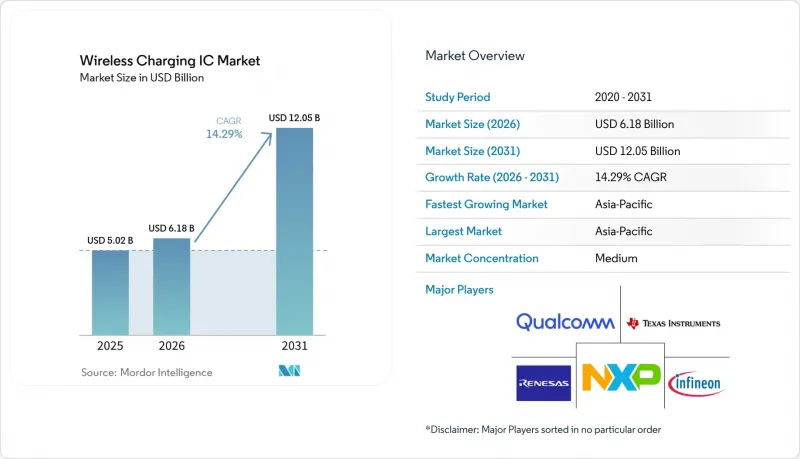
본 보고서는 IC의 유형(수신 IC 및 송신 IC), 정격 출력(저출력(20W 미만), 중출력(20-100W), 고출력(100W 초과)), 충전 규격(Qi 규격, Airfuel PMA/공진 방식 등), 용도(스마트폰/태블릿, 차량용, 산업용 및 IoT 기기 등), 그리고 지역별로 분류되어 있습니다. 시장 전망은 금액(달러) 기준으로 제시되어 있습니다.
세계의 무선 충전 IC 시장 동향 및 인사이트
플래그십 및 미드레인지 스마트폰의 무선 충전 탑재율 확대
무선 파워 컨소시엄(Wireless Power Consortium)은 2025년에 1,200건 이상의 Qi2 제품을 인증했습니다. 이를 통해 자기 정렬이 가능해져 위치 오차로 인한 손실을 5% 미만으로 줄일 수 있을 뿐만 아니라, 열적 악영향 없이 수신 IC의 소형화가 가능해졌습니다. 삼성, 구글, 애플은 각각 2026년 전체 제품 라인업에 Qi2를 채택하겠다고 약속했으며, 기능 세트의 표준화가 진행됨에 따라 경쟁의 초점은 소프트웨어 정의 전력 프로파일 및 이물질 감지로 이동하고 있습니다. 중국의 샤오미, OPPO, vivo는 500달러 미만의 기기에 50W 충전 패드를 탑재하여 수신 IC의 출하 대수를 늘리는 동시에 평균 판매 가격을 낮추고 있습니다. Silicon Source사의 2.0mm 정사각형 GY5502를 채택함으로써, 기판 재설계 없이 완전 무선 스테레오 이어폰부터 태블릿에 이르기까지 배터리에 전력을 공급할 수 있게 되어 규모의 경제가 강화됩니다. 중급 제품 라인에의 탑재율이 확산됨에 따라, 출하량의 탄력성이 단가 하락을 충분히 상쇄하여 무선 충전 IC 시장의 수익 성장세를 유지하고 있습니다.
포트리스 단말기에 대한 규제 추진, EU의 공통 충전기 지침, 중국의 IPX8 준수
지침 M/607은 유럽연합(EU) 전역에서 상호 운용 가능한 무선 충전 도입 기한을 2027년 3월로 정하고 있으며, 이에 따라 송신기 IC 공급업체들은 독자 규격의 확장 기능보다 Qi2 인증을 우선시해야 하는 상황에 놓여 있습니다. 에코디자인 규정 2025/2052는 대기 전력을 0.80 W로 제한하고 있으며, 이에 따라 정지 전류가 서브 마이크로암페어(sub-µA) 이하이고 동적 부하 감지 기능을 갖춘 통합 컨트롤러의 채택이 요구되고 있습니다. 중국의 개정된 EMC 프로젝트 20240568-T-339에서는 방사 제한이 강화되어, 무선 충전만 가능한 밀폐형이며 IPX8 규격을 준수하는 케이스로의 전환이 가속화되고 있습니다. 이러한 규제의 수렴으로 인해 기존 유선 커넥터에 대한 장벽이 높아지면서, 차세대 휴대용 전자 기기에서 무선 전력 공급이 기본 에너지 공급 경로로 자리 잡아가고 있습니다. 각 OEM 업체들이 재설계가 필요 없이 Qi 1.x, Qi 2 및 새롭게 등장한 AirFuel 확장 규격을 모두 아우르는 단일 칩 솔루션을 요구하게 됨에 따라, 다중 프로토콜 네고시에이션 스택을 보유한 벤더들이 우위를 점하고 있습니다.
65W를 초과하는 EMI 적합성 미비로 인해 노트북 채택 저해
65W 무선 급속 충전을 목표로 하는 초슬림 노트북은 금속 재질의 케이스가 80-300kHz 대역의 코일 스위칭 에너지를 증폭시키기 때문에 FCC Part 15 및 CISPR 32 Class B의 고조파 기준을 충족하는 데 어려움을 겪고 있습니다. 스펙트럼 확산 및 능동 소거 기술을 채택한 실리콘은 다이 크기를 최대 20% 증가시켜 송신기 IC의 비용을 상승시키는 한편, 여전히 초기 시험에서 방사 내성 기준을 통과하지 못하고 있습니다. 인증 주기가 2배인 20주까지 길어지는 경우도 있어 OEM 제조업체의 출시 일정을 압박하고 있으며, USB-C Power Delivery로 회귀하는 추세를 강화하고 있습니다. 내장형 차폐 및 지능형 위상 지터링 기술을 습득한 송신기 공급업체는 조기에 우위를 확보할 수 있겠지만, 현재 대부분의 로드맵에서는 100W 유도 충전 지원 노트북의 출시를 적어도 2028년까지 미루고 있어, 무선 충전 IC 시장의 단기적인 성장을 억제하고 있습니다.
부문 분석
2025년 기준, 수신 IC는 무선 충전 IC 시장 점유율의 62.52%를 차지했으며, 2031년까지 연평균 성장률(CAGR) 15.4%로 성장할 전망입니다. 이러한 성장 추세는 패드나 도크가 5년 주기로 교체되는 반면, 스마트폰, 스마트 워치, 차량용 모듈은 18-24개월마다 업데이트되는 수십억 대 규모 시장에 기인합니다. 수신 IC의 소형화는 현재 2.0×2.0 mm 칩 스케일 패키지 수준까지 진전되어, 설계자는 케이스 크기를 늘리지 않고도 스마트 링에 전력 관리 기능을 통합할 수 있게 되었습니다. 엡손의 0.1 W 웨이퍼 레벨 다이는 그 적용 범위를 에너지 수확 센서까지 확대되고 있습니다. 송신기 IC는 질화갈륨(GaN) 드라이버, 이물질 감지용 금속 산화물 센서, 경우에 따라 패드 및 스마트폰 인증용 블루투스 저에너지(BLE) 링크를 통합하고 있어 고가대 제품이지만, 그 생산량은 휴대전화 생산 대수가 아닌 가구나 자동차의 생산 대수에 따라 확대됩니다. 갈륨 질화물(GaN) 소자는 더 소형인 방열판으로도 충분할 뿐만 아니라 효율을 88%에서 95%로 향상시키지만, 각 OEM 업체들은 GaN 웨이퍼의 가격 변동에 노출되어 헤지 전략이 시험대에 오르게 됩니다.
자동차용 인증 공급업체의 수가 제한적이기 때문에 차량용 송신기의 선택지가 좁아지고, 이익률은 높아지지만 인증까지의 리드타임이 길어지고 있습니다. 웨어러블 기기의 경우, 설계자는 IEEE C95.1에 규정된 비흡수율(SAR) 제한을 준수해야 하며, 근거리 노출 시 전류를 적절히 억제하도록 수신기 펌웨어에 부담이 가해지고 있습니다. 이러한 대조적인 설계상의 제약으로 인해 무선 충전 IC 시장은 균형을 유지하고 있습니다. 송신기 공급업체는 수량보다 부가가치를 추구하는 반면, 수신기 공급업체는 규모 확대와 웨이퍼 비용 절감을 목표로 하고 있습니다. 이러한 비대칭성은 도로에 매설된 유도형 인프라가 널리 보급될 때까지 지속될 전망이며, 그 시점이 되면 고출력 송신기가 매출 측면에서 휴대용 수신기를 추월할 가능성이 있습니다.
2025년에는 침실의 충전 패드에서 매일 충전되는 스마트폰과 이어폰이 주도하면서, 20W 미만의 저전력 기기가 무선 충전 IC 시장의 46.56%를 차지했습니다. 20W에서 100W 사이의 중전력 시스템은 태블릿 및 자동차용 콘솔을 지원하며, 성숙한 방열 스택의 이점을 누리고 있습니다. 100W를 초과하는 고출력 등급은 산업용 로봇이나 전기 버스가 kW급 충전을 필요로 하기 때문에 2031년까지 연평균 성장률(CAGR) 18.6%로 가장 높은 성장률을 기록할 전망입니다. 델타 일렉트로닉스의 30kW 'MOOVair' 도크는 2025년 시험에서 95%의 효율을 유지하며 케이블 충전과 동등한 성능을 보였습니다. 인피니언의 WLC1150 송신기는 능동형 EMI 제거 기능을 통합하여 방사 노이즈를 10dB 저감하는 동시에, 외부 차폐 없이도 자동차용 EMC 요건을 충족합니다. 그러나 30-60 W 스마트폰용 스택에서 발생한 열 폭주로 인해 재설계가 불가피해졌고, 2025년 출시 예정이던 일부 플래그십 모델의 출시가 연기되면서 열 밀도가 여전히 병목 현상으로 작용하고 있음이 입증되었습니다.
65 W 패드를 목표로 하는 노트북 프로그램에서는 여전히 절반의 사례에서 FCC 방사 시험에 불합격하고 있어, 업계 전반에서 45 W의 ‘세이프 하버’ 모드로의 전환이 진행되고 있습니다. 각 벤더들은 검증 주기를 단축하기 위해 전력 협상, 이물질 감지, 온도 텔레메트리 기능을 단일 마이크로컨트롤러에 통합하고 있으나, 그 결과 실리콘 면적이 15% 증가했습니다. 따라서 고전력 부문에서 성공을 거두기 위해서는 실리콘 미세화뿐만 아니라 열 설계, EMC, 펌웨어 등 다방면에 걸친 전문 지식이 필수적이며, 바로 이러한 장벽이 다양한 반도체 제조업체들에게 기회를 제공하는 요인이 되고 있습니다.
지역별 분석
2025년, 아시아태평양은 무선 충전 IC 시장에서 47.81%의 점유율을 차지하며 시장을 주도했습니다. 이는 중국의 휴대전화 조립 클러스터, 일본의 1차 자동차 부품 공급업체, 그리고 한국의 수직 통합형 전자 대기업들에 의해 뒷받침되고 있습니다. 샤오미(Xiaomi), OPPO, 비보(vivo)는 50W 규격을 500달러 미만의 스마트폰에 지속적으로 도입하고 있으며, 이로 인해 수신기 수요는 증가하는 반면, 매출 총이익률은 압박을 받고 있습니다. 일본에 본사를 둔 파나소닉 오토모티브는 1,000만 개 이상의 무빙 코일형 유닛을 출하하고 있으며, 2026년 자동차 모델 체인지 주기에 맞추어 Qi2가 보급됨에 따라 추가적인 규모 확대가 예상됩니다. 삼성이 전체 제품 포트폴리오에 Qi2를 도입하겠다고 공언함에 따라, 공급망은 소프트웨어 중심의 전력 관리로 재편되고 있습니다. 그러나 구리 원자재 가격 변동에 따라 리츠선 코일의 비용은 분기마다 두 자릿수 비율로 변동할 가능성이 있으며, 이에 따라 아시아공급업체들은 다년 계약 확보 및 알루미늄 피복 대체재 검토를 추진하고 있습니다.
아시아태평양은 이 지역이 주도하는 스마트폰 제조 생태계, 확대되는 전기차 생산, 그리고 Qi 지원 소비자용 기기의 보급 확대에 힘입어 2031년까지 연평균 성장률(CAGR) 15.30%라는 가장 높은 성장률을 나타낼 것으로 예측됩니다. 중국, 한국, 대만, 일본은 반도체 제조, 고급 가전, 자동차용 전자 기기에 대한 투자를 통해 무선 충전 IC에 대한 수요를 지속적으로 강화하고 있습니다. 또한 웨어러블 기기, 산업용 IoT 기기, 스마트 홈 제품에서의 무선 충전 도입 확대가 아시아태평양을 가장 크고 가장 빠르게 성장하는 지역 시장으로서의 입지를 공고히 하고 있습니다.
유럽에서는 ‘공통 충전기 지침’ 및 0.80W의 에코디자인 대기 전력 상한선으로 인해 무선화 도입이 가속화되고 있지만, 65W를 초과하는 제품에서 EMI(전자기 간섭) 시험 불합격 사례가 잇따르면서 노트북 출시가 지연되고 있습니다. M/607 지침에 따라 칩 제조업체는 다중 표준 간의 상호 운용성을 입증해야 할 의무가 있으며, 이로 인해 연구 개발 부담이 가중되어 규정 준수 예산이 넉넉한 기업이 유리한 입장에 있습니다. 스웨덴에서 일렉트레온(Electron)사의 200kW 도로용 충전 스트립에 전력을 공급하고 있는 인피니언(Infineon)의 실리콘 카바이드 모듈은 이 지역이 차량 인프라에 유도 충전을 도입하려는 의지를 상징하고 있습니다. 중동 및 아프리카는 기반은 작지만 놀라운 연평균 성장률(CAGR)을 보이고 있으며, 두바이와 리야드의 스마트 시티 시범 프로젝트에는 무선 버스 정류장 및 도로 설비가 포함되어 있습니다. 라틴아메리카는 브라질과 멕시코의 자동차 제조 산업으로부터 혜택을 받고 있으며, 이들 국가에서는 크로스오버 SUV에 Qi2 패드가 기본 사양으로 장착되기 시작했습니다. 다만, 환율 변동이 가전제품의 보급을 둔화시키고 있습니다.
기타 혜택 :
- 엑셀 형식 시장 예측(ME) 시트
- 3개월간의 애널리스트 지원
자주 묻는 질문
목차
제1장 서론
제2장 조사 방법
제3장 주요 요약
제4장 시장 구도
제5장 시장 규모 및 성장 예측
제6장 경쟁 구도
제7장 시장 기회 및 향후 전망
KTH 26.08.05According to Mordor Intelligence, the wireless charging IC market size was valued at USD 5.02 billion in 2025 and estimated to grow from USD 6.18 billion in 2026 to reach USD 12.05 billion by 2031, at a CAGR of 14.29% during the forecast period (2026-2031).
This report is Segmented by IC Type (Receiver ICs, and Transmitter ICs), Power Rating (Low Power (Less Than 20W), Medium Power 20-100W, and High Power (More Than 100W)), Charging Standard (Qi Standard, Airfuel PMA/Resonant, and More), Application (Smartphones/Tablets, Automotive In-Cabin, Industrial and IoT Devices, and More), and Geography. The Market Forecasts are Provided in Terms of Value (USD).
Global Wireless Charging IC Market Trends and Insights
Expanding Attach-Rates of Wireless Charging in Flagship and Mid-Tier Smartphones
The Wireless Power Consortium certified more than 1,200 Qi2 products in 2025, enabling magnetic alignment that reduces misposition losses to under 5% and allows receiver ICs to shrink without thermal penalties. Samsung, Google, and Apple each committed to Qi2 across their 2026 portfolios, normalizing feature sets and moving competition toward software-defined power profiles and foreign-object detection. China's Xiaomi, OPPO, and vivo are pushing 50 W pads into devices priced below USD 500, multiplying receiver volumes while compressing average selling prices. Silicon Source's 2.0 mm-square GY5502 enables boards to power batteries from true wireless stereo earbuds to tablets without redesign, reinforcing economies of scale. As attach-rates percolate through mid-tier lines, shipment elasticity more than offsets unit price erosion, sustaining revenue momentum for the wireless charging IC market.
Regulatory Push for Port-Less Devices, EU Common Charger Directive and China IPX8 Compliance
Mandate M/607 sets a March 2027 deadline for interoperable cordless charging across the European Union, driving transmitter IC vendors to prioritize Qi2 certification over proprietary extensions. Ecodesign Regulation 2025/2052 further caps standby power at 0.80 W, compelling integrated controllers with sub-µA quiescent current and dynamic load detection. China's updated EMC project 20240568-T-339 tightens emission limits and accelerates the shift to sealed, IPX8-rated enclosures that can only recharge wirelessly. These converging statutes raise barriers for legacy wired connectors and fix wireless power as the default energy pathway for next-generation portable electronics. Vendors with multi-protocol negotiation stacks gain leverage because OEMs now require single-chip solutions that span Qi1.x, Qi2, and emerging AirFuel extensions without redesign.
EMI Compliance Failures Above 65 W Limiting Notebook Design Wins
Thin-profile laptops that target 65 W cordless fast-charge struggle to meet FCC Part 15 and CISPR 32 Class B harmonics because metal chassis amplify 80-300 kHz coil switching energies. Spread-spectrum and active-cancellation silicon pushes die size up to 20%, lifting transmitter IC cost curves while still failing to pass radiated immunity on the first attempt. Certification cycles can double to 20 weeks, eroding OEM release calendars and tilting preference back toward USB-C Power Delivery. Transmitter suppliers that master embedded shielding and intelligent phase dithering will secure early wins, yet most road maps now defer 100 W inductive notebooks until at least 2028, trimming near-term growth for the wireless charging IC market.
Other drivers and restraints analyzed in the detailed report include:
- Automakers Adopting In-Cabin Inductive Pads as a Standard Comfort Feature
- Rapid adoption of 15 W-50 W wireless charging in industrial handhelds and AMRs
- Fragmented Proprietary Standards Leading to OEM Supply-Chain Lock-Ins
For complete list of drivers and restraints, kindly check the Table Of Contents.
Segment Analysis
Receiver ICs accounted for 62.52% of the wireless charging IC market share in 2025 and are set to grow at a 15.4% CAGR through 2031. That trajectory stems from billions of smartphones, smartwatches, and in-cabin modules that refresh every 18-24 months, compared with five-year cycles for pads and docks. Receiver miniaturization now extends to 2.0 X 2.0 mm chip-scale packages, allowing designers to embed power management into smart rings without enlarging the enclosure. Epson's 0.1 W wafer-level die extends the reach to energy-harvesting sensors. Transmitter ICs command premium prices because they integrate gallium-nitride drivers, metal-oxide sensors for foreign-object detection, and sometimes Bluetooth Low Energy links for pad-to-phone authentication, but their numbers scale with furniture and automotive production, not handset volumes. Gallium-nitride devices boost efficiency from 88% to 95% while requiring smaller heat sinks, yet they expose OEMs to GaN wafer price swings that test hedging strategies.
A small pool of automotive-qualified suppliers limits choice for cabin transmitters, raising margins but increasing qualification lead times. In wearables, designers must comply with IEEE C95.1-specific absorption limits, putting pressure on receiver firmware to throttle current gracefully during near-field exposure. These contrasting design constraints keep the wireless charging IC market balanced: transmitter vendors pursue value over volume, while receiver vendors chase scale and wafer cost reductions. The asymmetry should persist until road-embedded inductive infrastructure deploys widely, at which point high-power transmitters may overtake hand-held receivers in revenue terms.
Low-power sub-20 W devices accounted for 46.56% of the wireless charging IC market in 2025, driven by smartphones and earbuds that charge daily on bedroom pads. Medium-power systems between 20 W and 100 W cater to tablets and automotive consoles and benefit from mature thermal stacks. High-power classes above 100 W will post the fastest 18.6% CAGR through 2031, as industrial robots and electric buses demand kilowatt-scale top-ups. Delta Electronics' 30 kW MOOVair dock sustained 95% efficiency in 2025 trials, matching cable benchmarks. Infineon's WLC1150 transmitter integrates active EMI cancellation, reducing radiated noise by 10 dB, and meets automotive EMC requirements without external shields. Yet thermal runaway events in 30-60 W smartphone stacks forced redesigns that delayed several 2025 flagships, proving that heat density remains a gating factor.
Notebook programs aiming for 65 W pads still fail FCC radiated tests half the time, provoking an industry-wide pivot toward 45 W "safe-harbor" modes. Vendors are combining power negotiation, foreign-object detection, and temperature telemetry in a single microcontroller to shorten validation loops, but silicon real estate increases by 15% as a result. Succeeding in high-power categories, therefore, depends on multidisciplinary expertise thermals, EMC, and firmware not just silicon scaling, a barrier that consolidates opportunity among diversified semiconductor houses.
Complete Report Scope:
- By IC Type
- Receiver (Rx) ICs
- Transmitter (Tx) ICs
- By Power Rating
- Low Power (Less than 20 W)
- Medium Power (20-100 W)
- High Power (More than 100 W)
- By Charging Standard
- Qi Standard
- AirFuel (PMA / Resonant)
- Other Charging Standards
- By Application
- Smartphones and Tablets
- Wearables and Hearables
- Automotive (In-cabin)
- Industrial and IoT Devices
- Medical Devices
- By Geography
- North America
- United States
- Canada
- Mexico
- Europe
- Germany
- United Kingdom
- France
- Rest of Europe
- Asia-Pacific
- China
- Japan
- India
- South Korea
- Rest of Asia-Pacific
- Middle East and Africa
- South America
- North America
Geography Analysis
Asia-Pacific dominated the wireless charging IC market with 47.81% share in 2025, underpinned by China's handset assembly clusters, Japan's tier-one automotive suppliers, and South Korea's vertically integrated electronics champions. Xiaomi, OPPO, and vivo keep pushing 50 W standards into sub-USD 500 phones, multiplying receiver demand while squeezing gross margins. Panasonic Automotive, headquartered in Japan, has shipped more than 10 million moving-coil units and stands to scale further as Qi2 permeates 2026 automotive refresh cycles. Samsung's pledge for full-portfolio Qi2 adoption reorganizes the supply base toward software-centric power management. Raw-copper volatility, however, can swing Litz-wire coil costs by double-digit percentages each quarter, prompting Asian suppliers to secure multi-year contracts and explore aluminum-clad alternatives.
Asia-Pacific is projected to register the fastest CAGR of 15.30% through 2031, supported by the region's dominant smartphone manufacturing ecosystem, expanding electric vehicle production, and increasing adoption of Qi-enabled consumer devices. China, South Korea, Taiwan, and Japan continue to strengthen demand for wireless charging ICs through investments in semiconductor manufacturing, premium consumer electronics, and automotive electronics. Additionally, the growing deployment of wireless charging in wearables, industrial IoT devices, and smart home products is reinforcing Asia-Pacific's position as the largest and fastest-growing regional market.
Europe accelerates cordless adoption through the Common Charger Directive and the 0.80 W Ecodesign standby cap, yet repeated EMI failures above 65 W delay notebook launches. Mandate M/607 forces chipmakers to prove multi-standard interoperability, lifting research and development intensity and favoring firms with large compliance budgets. Infineon's silicon-carbide modules powering Electreon's 200 kW road strips in Sweden exemplify the region's ambition to bring inductive charging to fleet infrastructure. While the Middle East and Africa grow from a smaller base at a significant CAGR, smart-city pilots in Dubai and Riyadh include cord-free bus stops and street furniture. Latin America gains from automotive manufacturing in Brazil and Mexico, where crossover SUVs now list Qi2 pads as standard; nonetheless, currency swings temper consumer electronics penetration.
- Renesas Electronics Corporation
- NXP Semiconductors N.V.
- Texas Instruments Incorporated
- Infineon Technologies AG
- Qualcomm Incorporated
- Rohm Co., Ltd.
- STMicroelectronics N.V.
- Onsemi Corporation
- Semtech Corporation
- Dialog Semiconductor GmbH (a Renesas Company)
- Torex Semiconductor Ltd.
- NuVolta Technologies (Shanghai) Co., Ltd.
- Efficient Power Conversion Corporation
- Powercast Corporation
- Energous Corporation
- HaloMicro Electronics Co., Ltd.
- iWatt Inc. (a Dialog/Renesas subsidiary)
- Shenzhen Injoinic Technology Co., Ltd.
- Chip Sea Technologies (Shenzhen) Corp.
- BQ Telecommunication AB (BQloud)
Additional Benefits:
- The market estimate (ME) sheet in Excel format
- 3 months of analyst support
TABLE OF CONTENTS
1 INTRODUCTION
- 1.1 Study Assumptions and Market Definition
- 1.2 Scope of the Study
2 RESEARCH METHODOLOGY
3 EXECUTIVE SUMMARY
4 MARKET LANDSCAPE
- 4.1 Market Overview
- 4.2 Market Drivers
- 4.2.1 Expanding Attach-rates of Wireless Charging in Flagship and Mid-tier Smartphones
- 4.2.2 Regulatory Push For Port-Less Devices (EU Common Charger Directive and China Ipx8 Compliance)
- 4.2.3 Automakers Adopting In-Cabin Inductive Pads as a Standard Comfort Feature
- 4.2.4 Rapid Adoption of 15-50 W Wireless Charging in Industrial Handhelds and AMRs
- 4.2.5 Miniaturised Rx ICs Enabling Sub-1 W Trickle Charging for Wearables And Hearables
- 4.2.6 Venture Funding into Mm-Wave Far-Field Power Beaming Start-Ups
- 4.3 Market Restraints
- 4.3.1 Emi Compliance Failures Above 65 W Limiting Notebook Design Wins
- 4.3.2 Fragmented Proprietary Standards Leading to OEM Supply-Chain Lock-Ins
- 4.3.3 Thermal Runaway Incidents in High-Density Coil/IC Stacks Above 30 W
- 4.3.4 Raw-Material Price Volatility for Gan and Litz-Wire Substrates
- 4.4 Industry Value Chain Analysis
- 4.5 Regulatory Landscape
- 4.6 Technological Outlook
- 4.7 Porter's Five Forces Analysis
- 4.7.1 Threat of New Entrants
- 4.7.2 Bargaining Power of Suppliers
- 4.7.3 Bargaining Power of Buyers
- 4.7.4 Threat of Substitutes
- 4.7.5 Competitive Rivalry
5 MARKET SIZE AND GROWTH FORECASTS (VALUE)
- 5.1 By IC Type
- 5.1.1 Receiver (Rx) ICs
- 5.1.2 Transmitter (Tx) ICs
- 5.2 By Power Rating
- 5.2.1 Low Power (Less than 20 W)
- 5.2.2 Medium Power (20-100 W)
- 5.2.3 High Power (More than 100 W)
- 5.3 By Charging Standard
- 5.3.1 Qi Standard
- 5.3.2 AirFuel (PMA / Resonant)
- 5.3.3 Other Charging Standards
- 5.4 By Application
- 5.4.1 Smartphones and Tablets
- 5.4.2 Wearables and Hearables
- 5.4.3 Automotive (In-cabin)
- 5.4.4 Industrial and IoT Devices
- 5.4.5 Medical Devices
- 5.5 By Geography
- 5.5.1 North America
- 5.5.1.1 United States
- 5.5.1.2 Canada
- 5.5.1.3 Mexico
- 5.5.2 Europe
- 5.5.2.1 Germany
- 5.5.2.2 United Kingdom
- 5.5.2.3 France
- 5.5.2.4 Rest of Europe
- 5.5.3 Asia-Pacific
- 5.5.3.1 China
- 5.5.3.2 Japan
- 5.5.3.3 India
- 5.5.3.4 South Korea
- 5.5.3.5 Rest of Asia-Pacific
- 5.5.4 Middle East and Africa
- 5.5.5 South America
- 5.5.1 North America
6 COMPETITIVE LANDSCAPE
- 6.1 Market Concentration
- 6.2 Strategic Moves
- 6.3 Vendor Positioning Analysis
- 6.4 Company Profiles (includes Global level Overview, Market level overview, Core Segments, Financials as available, Strategic Information, Products and Services, and Recent Developments)
- 6.4.1 Renesas Electronics Corporation
- 6.4.2 NXP Semiconductors N.V.
- 6.4.3 Texas Instruments Incorporated
- 6.4.4 Infineon Technologies AG
- 6.4.5 Qualcomm Incorporated
- 6.4.6 Rohm Co., Ltd.
- 6.4.7 STMicroelectronics N.V.
- 6.4.8 Onsemi Corporation
- 6.4.9 Semtech Corporation
- 6.4.10 Dialog Semiconductor GmbH (a Renesas Company)
- 6.4.11 Torex Semiconductor Ltd.
- 6.4.12 NuVolta Technologies (Shanghai) Co., Ltd.
- 6.4.13 Efficient Power Conversion Corporation
- 6.4.14 Powercast Corporation
- 6.4.15 Energous Corporation
- 6.4.16 HaloMicro Electronics Co., Ltd.
- 6.4.17 iWatt Inc. (a Dialog/Renesas subsidiary)
- 6.4.18 Shenzhen Injoinic Technology Co., Ltd.
- 6.4.19 Chip Sea Technologies (Shenzhen) Corp.
- 6.4.20 BQ Telecommunication AB (BQloud)
7 MARKET OPPORTUNITIES AND FUTURE OUTLOOK
- 7.1 White-space and Unmet-Need Assessment


