
|
시장보고서
상품코드
2097313
SUV : 시장 점유율 분석, 업계 동향 및 통계, 성장 예측(2025-2030년)SUV - Market Share Analysis, Industry Trends & Statistics, Growth Forecasts (2025 - 2030) |
||||||
 Mordor Intelligence
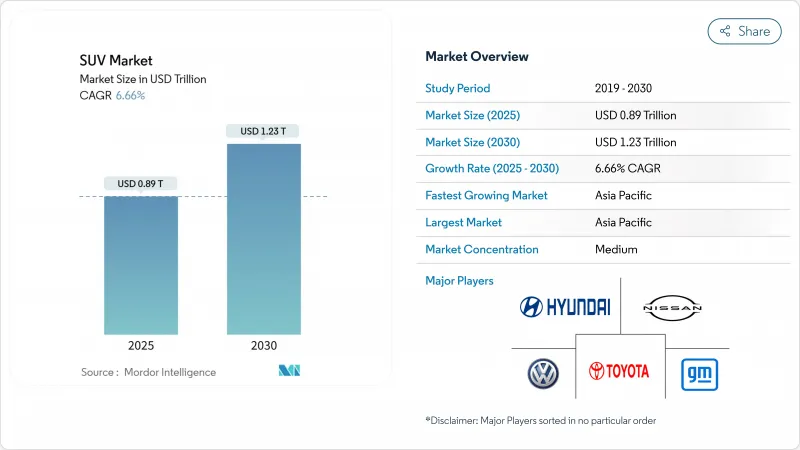
Mordor Intelligence에 의하면, SUV 시장은 2025년에 8,900억 달러로 평가되었고, 2030년까지 1조 2,300억 달러로 확대되어 CAGR은 6.66%를 나타낼 전망입니다.
본 보고서는 차량 크기별(컴팩트, 미드사이즈, 풀사이즈), 연료 유형별(가솔린, 디젤, 하이브리드, 전기차), 구동 방식별(2WD, 4WD, AWD), 최종 사용자별(개인용, 상업용), 승차 정원별(5인승, 7인승), 지역별(북미, 남미, 유럽, 아시아태평양, 중동 및 아프리카)로 분류되어 있습니다. 시장 전망은 금액(달러) 및 수량(대수)으로 제시되어 있습니다.
세계의 SUV 시장 동향과 인사이트
각 OEM 업체들은 전동화를 위한 자금 조달을 위해 높은 이익률을 보이는 SUV 플랫폼에 주력하고 있습니다.
자동차 제조업체들은 세단 제품군보다 항상 높은 이익률을 가져다주는 수익성 높은 SUV 라인에 자본을 집중시켜, 전동화를 위한 설비 갱신에 필요한 자금을 확보하고 있습니다. 예를 들어, 미국의 한 주요 브랜드는 22억 달러를 투자해 쾰른 공장을 신형 익스플로러 파생 모델을 위한 배터리식 전기차 전용 생산 기지로 전환했습니다. 이러한 선순환을 통해 현재의 조립 공장은 풀가동을 유지하는 동시에, 향후 모델을 뒷받침할 배터리 조달, 자체 개발한 전동 액슬, 그리고 OTA(Over-the-Air) 소프트웨어 인프라에 대한 투자도 충당되고 있습니다. 전동화 비용이 낮아짐에 따라 동일한 플랫폼이 순수 전기차로 전환되더라도 수익성이 높은 옵션 패키지를 유지함으로써 SUV 시장의 전략적 중요성은 더욱 높아지고 있습니다.
대형 차량에 대한 소비자 선호도의 변화
인도, 동남아시아, 라틴아메리카의 소득 증가는 다양한 도로 상황을 주행할 수 있고 사회적 지위 상승을 상징하는 고상형 차체에 대한 지속적인 수요를 뒷받침하고 있습니다. 농촌 지역에서 도시로 이주하는 사람들은 혼잡한 도로에서의 시인성, 주말의 다목적 활용, 그리고 충돌 시 안전성에 대한 기대감으로 인해 SUV를 선호합니다. 각국 제조업체의 인센티브가 현지 조립을 촉진하여 구매 비용을 절감하는 동시에 모델 선택의 폭을 넓히고 있습니다. 이처럼 확대되는 중산층이 장기적인 성장 전망을 뒷받침하고 있으며, 많은 신흥 경제국에서 SUV 시장의 성장률이 경차 시장 전체의 성장률을 상회할 것임을 확실히 하고 있습니다.
SUV를 대상으로 한 CAFE/CO2 규제 강화
차량군 평균 연비 목표에 따라, 현재 대부분의 SUV를 포함한 소형 트럭은 2031년까지 50.4mpg를 달성해야 할 의무가 있으며, 이는 현재 수치를 크게 상회하는 수준입니다. 이 규제를 준수하기 위해서는 차체 경량화, 다운사이징된 터보 엔진, 혹은 완전 전기화가 필요하며, 이 모든 조치에는 수십억 규모의 엔지니어링 비용이 소요됩니다. 기준치를 초과할 경우 부과되는 벌금은 대량 생산 제조업체에게 연간 10억 달러를 초과할 가능성이 있으며, 이로 인해 스타일링 개편이나 새로운 생산 라인에 대한 투자 자금이 압박을 받게 되어, 공기역학적 성능이 가장 떨어지거나 차량 중량이 가장 무거운 차종의 라인업이 축소될 우려가 있습니다.
부문 분석
2024년, 소형 SUV는 시장 점유율의 42.98%를 차지했습니다. 이는 도시권 소비자들이 도시에서의 실용성을 해치지 않으면서도 SUV의 스타일링과 높은 주행 자세를 유지하면서도 기동성이 뛰어난 차량을 선호하는 경향을 반영합니다. 대중 브랜드는 모듈러 섀시를 활용해 다양한 차체 스타일을 선보이는 동시에, 고급 사양의 트림 라인업을 통해 이익률을 확보하고 있습니다. 도시 거주자의 일상적인 주행 거리 요구를 충족시키는 더 소형인 55-65kWh 배터리 팩의 등장으로 엔트리 레벨 전동화 모델도 등장하고 있습니다.
판매 대수는 적지만, 풀사이즈 SUV는 매출을 견인하고 있습니다. 이는 구매자들이 3열 시트, 강력한 견인 능력, 플래그십급 인포테인먼트 시스템을 원해 고급차에 버금가는 가격을 지불하기 때문입니다. 차내 공간의 넓이를 중시하는 부유층이나 기업용 VIP 셔틀 서비스 덕분에, 그 연평균 성장률(CAGR)은 11.39%로 SUV 시장 전체를 상회하고 있습니다. 차내 공간을 활용함으로써 적재 공간 용량을 희생하지 않고도 100kWh를 넘는 배터리 팩을 탑재할 수 있게 되어, 고소득 지역의 제로 에미션 규제에도 부합하고 있습니다. 그 결과, 2030년에 이르러 풀사이즈 SUV 부문은 SUV 시장의 확대분에서 현저한 비중을 차지하게 될 것입니다.
가솔린 엔진을 탑재한 SUV는 2024년에 59.36%의 시장 점유율을 유지했으며, 충전 인프라가 여전히 제한적이고 소비자의 주행 거리 불안이 뿌리 깊은 시장에서 내연기관의 중요성이 여전히 높음을 보여주었습니다. 직분사 및 실린더 비활성화 기술을 통한 효율성 향상으로, 충전 환경이 갖춰지지 않은 가격에 민감한 지역에서도 규제 기준을 충족할 수 있게 되었습니다. 각 제조업체는 운전자의 운전 습관을 바꾸지 않고도 CO₂ 배출량을 줄이기 위해 마일드 하이브리드 시스템을 기본 사양으로 장착하고 있습니다.
연평균 성장률(CAGR) 20.56%가 예상되는 전기 SUV는 탈탄소화 로드맵의 핵심이 됩니다. 전기 전용 플랫폼은 스케이트보드형 배터리와 평평한 바닥을 지원하여 새로운 설계의 자유도를 제공합니다. 주요 도시의 보조금 및 제로 에미션 구역 도입이 보급률을 가속화하는 한편, 배터리의 2차 활용을 통한 리스 제도가 재판매 시의 불확실성을 완화하고 있습니다. 비용 평형 범위가 확대되고 있다는 점은 전기 SUV가 SUV 시장의 양적 성장의 원동력이 될 것임을 시사합니다.
지역별 분석
2024년 기준, 아시아태평양은 전 세계 SUV 시장 점유율의 38.89%를 차지했으며, 8.19%의 연평균 성장률(CAGR)을 기록하며 예측 기간 동안 이 지역이 주요 성장 엔진으로서의 입지를 확고히 했습니다. 현지 자동차 제조업체들은 광대한 제조 클러스터 전반에 걸쳐 규모의 경제를 최대한 활용하고 있으며, 능동형 안전 장비가 충실해지는 상황에서도 합리적인 판매 가격을 유지하고 있습니다. 급속한 도시화가 소형 SUV의 보급을 뒷받침하는 한편, 중국과 한국의 부유층은 레벨 3 자율주행 기능을 갖춘 스마트 EV 플래그십 모델에 매력을 느끼고 있으며, 이는 해당 지역의 SUV 시장 규모를 더욱 확대시키고 있습니다.
북미는 여전히 고부가가치 시장이며, 대형차는 문화적 지위를 누리고 있고, 인프라도 풀사이즈 바디-온-프레임 차량 수요를 뒷받침하고 있습니다. 임박한 50.4mpg의 차량 연비 목표에 따라 각 브랜드는 견인 성능을 저해하지 않으면서 하이브리드화된 V6 엔진 차량이나 배터리 구동 방식의 상징적인 모델로 방향을 전환하고 있으며, 라이프스타일 지향적인 구매자들로부터 지속적인 지지를 확보하고 있습니다. 캐나다와 멕시코의 부품 공급망 통합으로 비용 급등을 억제할 수 있게 되었으며, 겨울철 주행 성능을 향상시키는 차세대 AWD 시스템을 경쟁력 있는 가격에 제공할 수 있게 되었습니다. 루프탑 텐트부터 오버랜드용 서스펜션 키트에 이르기까지, 이 지역의 액세서리 생태계는 SUV 시장과 연동된 애프터마켓 수익을 확대되고 있습니다.
유럽에서는 대도시 지역의 교통 체증 대책으로 인해 중량급 모델의 소유 비용이 상승하고 있습니다. 그럼에도 불구하고 제조업체의 창의적인 노력 덕분에 전기 SUV는 규제 대응의 모범 사례로서 입지를 확고히 하고 있으며, 경량 알루미늄 차체 패널과 재활용 소재를 활용한 인테리어를 통해 전체 수명 주기 동안의 배출량을 줄이고 있습니다. 관세 장벽 내에서의 현지 생산을 통해 공급의 지속성이 확보되었으며, 스칸디나비아 국가들에서 진행 중인 배터리 교체 시범 운영을 통해 인근 시장에도 파급될 가능성이 있는 편의성 제안이 검증되고 있습니다. 이러한 대응책들이 종합적으로 작용함으로써, 기후 변화 대응 노력을 존중하면서도 진화하는 SUV 시장에서 유럽의 중요성을 유지하고 있습니다.
기타 혜택 :
- 엑셀 형식 시장 예측(ME) 시트
- 3개월간의 애널리스트 지원
자주 묻는 질문
목차
제1장 서론
제2장 조사 방법
제3장 주요 요약
제4장 시장 구도
제5장 시장 규모 및 성장 예측
제6장 경쟁 구도
제7장 시장 기회 및 향후 전망
KTH 26.08.10According to Mordor Intelligence, the SUV market reached USD 890 billion in 2025 and is forecast to climb to USD 1.23 trillion by 2030, advancing at a 6.66% CAGR.
This report is Segmented by Vehicle Size (Compact, Mid-Size, and Full-Size), Fuel Type (Petrol, Diesel, Hybrid, and Electric), Drivetrain (2WD, 4WD, and AWD), End-User (Personal Use and Commercial Use), Seating Capacity (5-Seater and 7-Seater), and Geography (North America, South America, Europe, Asia-Pacific and Middle East and Africa). The Market Forecasts are Provided in Terms of Value (USD) and Volume (Units).
Global SUV Market Trends and Insights
OEM Focus on High-Margin SUV Platforms to Fund Electrification
Automakers concentrate capital on lucrative SUV lines that routinely return margins higher than sedan portfolios, supplying the cash required to retool for electric output. For instance, a leading U.S. brand invested USD 2.2 billion to repurpose its Cologne complex into a dedicated battery-EV hub for a new Explorer derivative. This virtuous cycle keeps assembly plants humming today while underwriting battery sourcing, in-house e-axle design, and over-air software infrastructure that underpin tomorrow's models. As electrification costs slide, the same platforms migrate to pure-electric while retaining profitable option packs, reinforcing the strategic weight of the SUV market.
Consumer Preference Shift Toward Larger Vehicles
Rising incomes in India, Southeast Asia, and Latin America propel a sustained appetite for higher-riding body types that can navigate mixed road conditions and project upward mobility. Rural-to-urban migrants favor SUVs for visibility on congested streets, weekend versatility, and perceived crash security. National OEM incentives spur local assembly, containing acquisition cost and widening model choice. This expanding middle-class cohort anchors long-range growth prospects, ensuring the SUV market outpaces total light-vehicle expansion across many emerging economies.
Tightening CAFE / CO2 Rules Targeting SUVs
Fleet-average targets now compel light trucks, including most SUVs, to deliver 50.4 mpg by 2031, significantly above today's readings. Compliance mandates lighter bodies, downsized turbo engines, or full electrification, each demanding billions in engineering spend. Penalties for overshooting limits can surpass USD 1 billion yearly for volume producers, cutting capital available for styling updates or new production lines, and potentially shrinking variants with the poorest aerodynamics or heaviest curb weights.
Other drivers and restraints analyzed in the detailed report include:
- Proliferation of Compact and Sub-Compact SUVs in Urban Areas
- Demand for AWD/Off-Road Capability in Lifestyle Vehicles
- Battery-Material and Chip Supply Constraints for e-SUVs
For complete list of drivers and restraints, kindly check the Table Of Contents.
Segment Analysis
Compact SUVs commanded 42.98% market share in 2024, reflecting urban consumers' preference for maneuverable vehicles that retain SUV styling and elevated driving positions without compromising city practicality. Mass-market brands leverage modular chassis to spin multiple silhouettes while protecting margins through upscale trim ladders. Entry-level electrified variants are appearing, supported by more miniature 55-65 kWh packs that meet city dwellers' daily range needs.
Though contributing fewer units, full-size SUVs propel revenue as buyers pay luxury-car prices for three-row seating, robust towing, and flagship infotainment. Their 11.39% CAGR outpaces the overall SUV market thanks to affluent households and commercial VIP shuttle services that value cabin volume. Interior real estate enables battery packs surpassing 100 kWh without sacrificing cargo, aligning with zero-emission mandates in high-income regions. Consequently, the full-size slice will account for a notable portion of the incremental SUV market size through 2030.
Petrol-powered SUVs maintained 59.36% market share in 2024, demonstrating the continued relevance of internal combustion engines in markets where charging infrastructure remains limited and consumer range anxiety persists. Direct-injection upgrades and cylinder deactivation stretch efficiency, allowing compliance in price-sensitive regions where charging remains scarce. Manufacturers bundle mild hybrids to shave CO2 without altering driver behavior.
Electric SUVs, projected to post a 20.56% CAGR, are the linchpin of decarbonization roadmaps. E-platforms accommodate skateboard batteries and flat floors, opening new design freedom. Subsidies and zero-tailpipe zones in major cities accelerate take-rate, while secondary-life battery leasing schemes buffer resale uncertainty. The widening cost parity window signals electricity as the volume growth engine of the SUV market.
Complete Report Scope:
- By Vehicle Size
- Compact
- Mid-size
- Full-size
- By Fuel Type
- Petrol
- Diesel
- Hybrid
- Electric
- By Drivetrain
- 2WD
- 4WD
- AWD
- By End-User
- Personal Use
- Commercial Use
- By Seating Capacity
- 5-Seater
- 7-Seater
- By Region
- North America
- United States
- Canada
- Rest of North America
- South America
- Brazil
- Argentina
- Rest of South America
- Europe
- United Kingdom
- Germany
- Spain
- Italy
- France
- Russia
- Rest of Europe
- Asia-Pacific
- India
- China
- Japan
- South Korea
- Rest of Asia-Pacific
- Middle East and Africa
- United Arab Emirates
- Saudi Arabia
- Turkey
- Egypt
- South Africa
- Rest of Middle East and Africa
- North America
Geography Analysis
Asia-Pacific accounts for 38.89% of the global SUV market share in 2024, and its 8.19% CAGR positions the region as the prime growth engine over the forecast horizon. Local OEMs orchestrate economies of scale across sprawling manufacturing clusters, keeping transaction prices accessible even as active-safety content climbs. Rapid urbanization fuels compact-SUV penetration, whereas affluent cohorts in China and South Korea gravitate to smart-electric flagships with L3 autonomy, further boosting the regional SUV market size.
North America continues to represent a high-value arena where large vehicles enjoy cultural cachet and infrastructure supports full-size body-on-frame demand. Imminent 50.4 mpg fleet targets steer brands into hybridized V-6s and battery-powered icons without diluting towing credentials, ensuring sustained engagement by lifestyle buyers. Integration of Canadian and Mexican parts supply tempers cost escalation, allowing competitive pricing on next-gen AWD systems that enhance winter drivability. The region's accessory ecosystem, from rooftop tents to overland suspension kits, amplifies aftermarket revenues tied to the SUV market.
Europe grapples with dense-city congestion policies that raise ownership costs for heavier models. Nevertheless, manufacturer creativity positions electric SUVs as compliance champions, with lightweight aluminum closures and recycled interiors reducing life-cycle emissions. Production localization inside tariff walls safeguards supply continuity, and battery-swap trials in Scandinavia test convenience propositions that may spill into neighboring markets. Collectively, these adaptations preserve Europe's relevance within the evolving SUV market while honoring climate commitments.
- Toyota Motor Corporation
- Volkswagen AG
- Hyundai Motor Group
- Renault-Nissan-Mitsubishi Alliance
- General Motors Co.
- Tesla Inc.
- Stellantis N.V.
- Ford Motor Company
- BMW Group
- Mercedes-Benz Group AG
- Honda Motor Co., Ltd.
- SAIC Motor Corp.
- BYD Company Ltd.
- Geely Auto Holdings
- Tata Motors Ltd.
- Mahindra and Mahindra Ltd.
- Great Wall Motor Co.
- Changan Automobile
- Subaru Corp.
- Mazda Motor Corp.
- Mitsubishi Motors Corp.
- Suzuki Motor Corp.
- Jaguar Land Rover Plc
Additional Benefits:
- The market estimate (ME) sheet in Excel format
- 3 months of analyst support
TABLE OF CONTENTS
1 Introduction
- 1.1 Study Assumptions and Market Definition
- 1.2 Scope of the Study
2 Research Methodology
3 Executive Summary
4 Market Landscape
- 4.1 Market Overview
- 4.2 Market Drivers
- 4.2.1 OEM Focus on High-Margin SUV Platforms to Fund Electrification
- 4.2.2 Consumer Preference Shift Toward Larger Vehicles
- 4.2.3 Proliferation of Compact and Sub-Compact SUVs in Urban Areas
- 4.2.4 Demand for AWD/Off-Road Capability in Lifestyle Vehicles
- 4.2.5 Subscription-Based Premium SUV Uptake
- 4.2.6 Hydrogen Fuel-Cell SUV Pipeline for Long-Range Use Cases
- 4.3 Market Restraints
- 4.3.1 Tightening CAFE / CO2 Rules Targeting SUVs
- 4.3.2 Battery-Material and Chip Supply Constraints for e-SUVs
- 4.3.3 Urban Access Fees and Congestion Bans on Large Vehicles
- 4.3.4 Higher Insurance/TCO from Rising Curb-Weight
- 4.4 Value / Supply-Chain Analysis
- 4.5 Regulatory Landscape
- 4.6 Technological Outlook
- 4.7 Porter's Five Forces Analysis
- 4.7.1 Threat of New Entrants
- 4.7.2 Bargaining Power of Suppliers
- 4.7.3 Bargaining Power of Buyers
- 4.7.4 Threat of Substitutes
- 4.7.5 Intensity of Competitive Rivalry
5 Market Size and Growth Forecasts (Value (USD) and Volume (Units))
- 5.1 By Vehicle Size
- 5.1.1 Compact
- 5.1.2 Mid-size
- 5.1.3 Full-size
- 5.2 By Fuel Type
- 5.2.1 Petrol
- 5.2.2 Diesel
- 5.2.3 Hybrid
- 5.2.4 Electric
- 5.3 By Drivetrain
- 5.3.1 2WD
- 5.3.2 4WD
- 5.3.3 AWD
- 5.4 By End-User
- 5.4.1 Personal Use
- 5.4.2 Commercial Use
- 5.5 By Seating Capacity
- 5.5.1 5-Seater
- 5.5.2 7-Seater
- 5.6 By Region
- 5.6.1 North America
- 5.6.1.1 United States
- 5.6.1.2 Canada
- 5.6.1.3 Rest of North America
- 5.6.2 South America
- 5.6.2.1 Brazil
- 5.6.2.2 Argentina
- 5.6.2.3 Rest of South America
- 5.6.3 Europe
- 5.6.3.1 United Kingdom
- 5.6.3.2 Germany
- 5.6.3.3 Spain
- 5.6.3.4 Italy
- 5.6.3.5 France
- 5.6.3.6 Russia
- 5.6.3.7 Rest of Europe
- 5.6.4 Asia-Pacific
- 5.6.4.1 India
- 5.6.4.2 China
- 5.6.4.3 Japan
- 5.6.4.4 South Korea
- 5.6.4.5 Rest of Asia-Pacific
- 5.6.5 Middle East and Africa
- 5.6.5.1 United Arab Emirates
- 5.6.5.2 Saudi Arabia
- 5.6.5.3 Turkey
- 5.6.5.4 Egypt
- 5.6.5.5 South Africa
- 5.6.5.6 Rest of Middle East and Africa
- 5.6.1 North America
6 Competitive Landscape
- 6.1 Market Concentration
- 6.2 Strategic Moves
- 6.3 Market Share Analysis
- 6.4 Company Profiles (Includes Global level Overview, Market level overview, Core Segments, Financials as available, Strategic Information, Market Rank/Share for key companies, Products and Services, and Recent Developments)
- 6.4.1 Toyota Motor Corporation
- 6.4.2 Volkswagen AG
- 6.4.3 Hyundai Motor Group
- 6.4.4 Renault-Nissan-Mitsubishi Alliance
- 6.4.5 General Motors Co.
- 6.4.6 Tesla Inc.
- 6.4.7 Stellantis N.V.
- 6.4.8 Ford Motor Company
- 6.4.9 BMW Group
- 6.4.10 Mercedes-Benz Group AG
- 6.4.11 Honda Motor Co., Ltd.
- 6.4.12 SAIC Motor Corp.
- 6.4.13 BYD Company Ltd.
- 6.4.14 Geely Auto Holdings
- 6.4.15 Tata Motors Ltd.
- 6.4.16 Mahindra and Mahindra Ltd.
- 6.4.17 Great Wall Motor Co.
- 6.4.18 Changan Automobile
- 6.4.19 Subaru Corp.
- 6.4.20 Mazda Motor Corp.
- 6.4.21 Mitsubishi Motors Corp.
- 6.4.22 Suzuki Motor Corp.
- 6.4.23 Jaguar Land Rover Plc
7 Market Opportunities and Future Outlook
- 7.1 White-space and Unmet-Need Assessment