

|
시장보고서
상품코드
2097377
의학 용어 소프트웨어 시장 : 시장 점유율 분석, 산업 동향 및 통계 데이터, 성장 예측(2026-2031년)Medical Terminology Software - Market Share Analysis, Industry Trends & Statistics, Growth Forecasts (2026 - 2031) |
||||||
 Mordor Intelligence
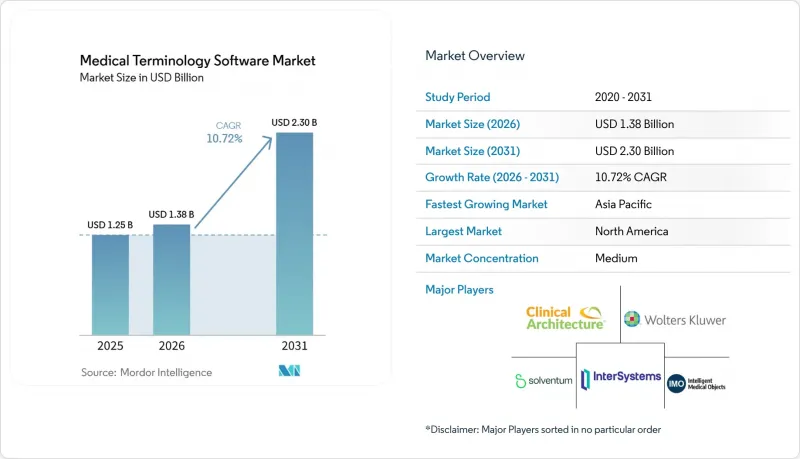
에 의하면, 의학 용어 소프트웨어 시장 규모는 2025년 12억 5,000만 달러로 평가되었고, 2026년에는 13억 8,000만 달러로 확대될 것으로 추정되고, 2026-2031년 CAGR 10.72%로 성장을 지속할 전망이며, 2031년에는 23억 달러에 이를 것으로 예측됩니다.

본 보고서는 컴포넌트별(솔루션, 서비스), 용도별(데이터 집계 등), 배포 방식별(클라우드 기반, 온프레미스형), 조직 규모별(대기업, 중소기업), 최종 사용자별(의료 제공업체, 의료 보험자, 기타 최종 사용자), 지역별(북미, 유럽, 아시아태평양 등)로 분류되어 있습니다. 시장 전망은 금액(달러) 기준으로 제시되어 있습니다.
세계의 의학 용어 소프트웨어 시장 동향 및 인사이트
의료 정보 기술(HCIT) 도입을 위한 정부의 인센티브 및 의무화 조치
의료 제공업체가 메디케어(Medicare) 환급을 유지하기 위해서는 ONC HIT-1 요건을 충족해야 하므로, 연방 정부 프로그램에 의해 도입이 가속화되고 있습니다. 이 규정에서는 2026년까지 USCDI v3로, 2028년까지 USCDI v4로 전환할 것을 의무화하고 있으며, 한편 ‘Trusted Exchange Framework and Common Agreement(TEFCA)’에서는 통일된 데이터 공유 조건이 정해져 있습니다. 시맨틱 상호운용성을 입증하지 못하는 병원은 메디케어 수입의 4%를 초과하는 지급 조정을 받을 위험이 있습니다. EU 회원국들도 ‘유럽 건강 데이터 공간(European Health Data Space)’을 통해 유사한 의무를 부과하고 있으며, 독일, 프랑스, 북유럽 국가들에서 조기 조달 주기가 촉진되고 있습니다. 이러한 정책적 지원이 맞물리면서, 각국의 밸류셋에 기반해 데이터를 검증하고 규제 당국을 위한 감사 로그를 자동으로 생성할 수 있는 클라우드 기반 용어 서버에 대한 단기적인 수요가 증가하고 있습니다.
가치 기반 진료 모델 구현을 위한 원활한 데이터 집계 필요성
현재 미국 지불의 40% 이상은 정확한 계층적 병태 분류(HCC) 파악과 거의 실시간 품질 보고를 요구하는 위험 분담형 계약을 통해 이루어지고 있습니다. 의료 제공업체는 데이터 레이크 위에 용어 엔진을 중첩하여 이종 코드를 정규화하고, 분석 도구에 데이터를 공급함으로써 위험 조정 비용 지표를 생성하고 있습니다. Innovaccer와 Wolters Kluwer의 Health Language Platform 간의 상호 운용성 제휴를 통해, 기존에 위험 점수를 왜곡하던 코딩 불일치를 해소함으로써 5,400만 명의 피보험자를 대상으로 15억 달러의 비용 절감이 예상됩니다. 의료 보험사가 계약에 용어 준수 요건을 포함시키는 사례가 늘어나고 있으며, 소프트웨어의 규정 준수는 공유 절감 제도의 적용 요건으로서 필수적인 요소가 되고 있습니다. FHIR 기반의 전자 임상 품질 지표가 성숙해짐에 따라, 구조화된 용어의 검증은 집단 건강 관리 대시보드의 기반이 됩니다.
개발도상 지역의 IT 인프라 제약
대역폭 부족, 클라우드 이용 가능 지역의 제한, 그리고 정보과학 전문가 부족이 중저소득 국가에서의 광범위한 도입을 저해하고 있습니다. 의료 IT 예산은 일반적으로 총 의료 지출의 2% 미만에 그치고 있지만, 선진국 시장에서는 4% 이상을 차지하고 있어, 이러한 격차가 첨단 용어 엔진에 대한 자금 투자를 제한하고 있습니다. 이러한 부족을 극복하기 위해, 인도의 ‘아유슈만 바라트 디지털 미션’과 같은 프로그램을 기반으로 한 민관 협력 노력을 통해 안전한 호스팅 및 공유 용어 저장소에 대한 지원이 이루어지고 있습니다. 이러한 조치로 접근성은 개선되겠지만, 인재 양성 및 안정적인 연결 환경이 필요하기 때문에 그 완전한 효과는 보다 장기적인 관점에서 나타날 것입니다.
부문 분석
솔루션 분야는 종합적인 매핑 엔진, 용어 관리 대시보드, 자동 업데이트 파이프라인을 통합 플랫폼에 포함시킴으로써 2024년 의학 용어 소프트웨어 시장 점유율의 64.78%를 차지했습니다. 주요 전자건강기록(EHR)과 직접 통합할 수 있는 기능 덕분에 중복된 인터페이스가 제거되고, 임상의의 도입이 가속화되며, 단일 조달 주기로 ONC(미국 국립의료정보기술조정국)의 인증 요건을 충족할 수 있게 됩니다. 구독형 라이선스 모델과 높은 갱신률이 결합되어 예측 가능한 수익을 창출하며, 업계 재편을 주도하는 기업에 대한 벤처 캐피털 및 사모펀드의 투자를 촉진하고 있습니다.
서비스 분야는 연평균 성장률(CAGR) 12.15%로 성장하고 있으며, 조직이 클라우드 네이티브 인프라로 전환함에 따라 컨설팅, 마이그레이션, 교육에 대한 지속적인 수요를 충족시키고 있습니다. 의료 제공업체가 기존 코드 세트나 품질 측정 로직을 온프레미스 데이터베이스에서 관리형 FHIR 스토리지로 이전할 때 수요가 증가합니다. 성과 기반의 마일스톤을 포함한 서비스를 제공하는 벤더는 다년 계약을 확보하여 고객의 성공을 보장하는 동시에 현금 흐름을 안정화할 수 있습니다.
'품질 및 성과 보고' 분야는 2024년 의학 용어 소프트웨어 시장 점유율의 23.01%를 차지했습니다. 이는 CMS(미국 의료보험서비스센터)가 각 프로그램 연도마다 메디케어 환급을 정확한 eCQM(전자 품질 관리 지표) 제출과 연계하도록 의무화하고 있기 때문입니다. 입원 및 외래 진료에서 SNOMED CT, LOINC, ICD-10 코드를 자동으로 추출함으로써 제출 주기가 단축되고 감사 위험이 감소합니다. 임상시험 및 RWE(실세계 데이터) 용도로 할당되는 의학 용어 소프트웨어 시장 규모는 제약사 후원사가 증거 패키지 작성을 위해 일상 진료 데이터를 재사용함에 따라 연평균 성장률(CAGR) 11.89%라는 더 빠른 속도로 확대될 것으로 예측됩니다.
실세계 데이터(RWE)에서는 임상 데이터, 의약품 데이터, 의료기기 데이터를 통합하기 위해 고정밀 매핑이 필요하며, 이를 통해 규제상의 추적성 검증을 충족할 수 있습니다. 생명과학 분야의 고객들이 분산형 임상시험 모델이나 의약품 안전성 모니터링 분석을 도입함에 따라, 종단적 데이터 세트 전체에 걸쳐 용어 체계를 일관되게 유지할 수 있는 벤더가 우위를 점하게 될 것입니다.
지역별 분석
북미는 2024년에 전 세계 매출의 40.35%를 차지한 것으로 평가되었으며, 이는 전자건강기록(EHR)의 꾸준한 도입과 정보 차단 규정 위반에 대한 명확한 금전적 제재가 원동력이 되고 있습니다. 2030년까지 해당 지역의 연평균 성장률(CAGR) 10.28%는 의료 시스템이 맞춤형 온프레미스형 사전에서 USCDI 업데이트에 지속적으로 대응하는 클라우드 플랫폼으로 전환되는 과정에서 발생하는 업데이트 수요에 기인합니다. 캐나다의 각 주에서도 유사한 규제가 도입되고 있으며, 멕시코의 공공 의료 네트워크에서는 FHIR 기반의 정보 교환 시범 운영이 진행되고 있어 대상 시장 규모가 확대되고 있습니다.
유럽은 연평균 성장률(CAGR) 10.67%로 2위를 차지하고 있으며, 그 배경에는 국경을 넘어 서비스를 제공하는 사업자가 EU 시민의 요청을 받아 수 시간 이내에 코드화된 기록을 제공하도록 의무화하는 ‘유럽 건강 데이터 공간(European Health Data Space)’ 규정이 있습니다. 의학 용어 소프트웨어 시장은 런던에 SNOMED International 본부가 위치해 있고, 오픈소스 참조 세트가 널리 이용 가능하다는 점에서 혜택을 보고 있습니다. 그러나 GDPR(EU 개인정보보호규정)(일반 데이터 보호 규정)에 따라 엄격한 거주 요건이 도입됨에 따라 로컬 클라우드 영역에 대한 수요가 증가하고 있습니다. IDMP 의약품 식별 규정의 도입은 생명과학 워크플로우 내에 큰 틈새 시장을 창출하고 있으며, 제약 기업 고객들이 사전의 지속적인 유지보수 계약을 연장하는 계기가 되고 있습니다.
아시아태평양은 인도, 중국 및 아세안(ASEAN) 신흥 경제국들의 정부 주도의 디지털화 추진에 힘입어 12.05%라는 가장 높은 연평균 성장률(CAGR)을 기록하고 있습니다. 인도의 국가 의료 시스템 통합 계획에서는 20개 이상의 공용어를 지원하기 위한 다국어 코드 라이브러리가 요구되고 있어, 전문 벤더의 사업 범위가 확대되고 있습니다. 다만, 광대역 환경의 불균형으로 인해 지방 지역으로의 확장이 제한되고 있으며, 개인정보 보호 규제의 다양성으로 인해 시장 진출기업들은 관할 구역별로 호스팅 전략을 조정할 수밖에 없습니다. 중동 및 아프리카 및 남미에서도 유사한 추세가 관찰됩니다. 정부가 새로운 병원이나 전국적인 정보 교환 플랫폼에 자금을 지원하고 있는 반면, 완전한 클라우드 전환에 대한 투자 속도는 인력의 기술 수준과 자본 상황에 따라 좌우되고 있습니다. 각 벤더는 지역 시스템 통합사업자와의 채널 파트너십을 통해 시장 내 입지를 확고히 하고, 인프라가 정비됨에 따라 조기에 시장 점유율을 확보하여 사업 규모를 확대하는 것을 목표로 하고 있습니다.
기타 혜택 :
- Excel 형식 시장 예측(ME) 시트
- 3개월간의 애널리스트 지원
자주 묻는 질문
목차
제1장 서론
제2장 분석 방법
제3장 주요 요약
제4장 시장 구도
제5장 시장 규모 및 성장률 예측
제6장 경쟁 구도
제7장 시장 기회 및 향후 전망
AJY 26.08.07According to Mordor Intelligence, the medical terminology software market size is expected to grow from USD 1.25 billion in 2025 to USD 1.38 billion in 2026 and is forecast to reach USD 2.30 billion by 2031 at 10.72% CAGR over 2026-2031.
This report is Segmented by Component (Solutions, Services), Application (Data Aggregation and More), Deployment Mode (Cloud-Based, On-Premise), Organization Size (Large Enterprises, Smes), End-User (Healthcare Providers, Healthcare Payers, Other End-Users), and Geography (North America, Europe, Asia-Pacific, and More). The Market Forecasts are Provided in Terms of Value (USD).
Global Medical Terminology Software Market Trends and Insights
Government Incentives & Mandates for HCIT Adoption
Federal programs are accelerating purchases as providers must meet ONC HIT-1 requirements to maintain Medicare reimbursements. The rule compels migration to USCDI v3 by 2026 and USCDI v4 by 2028, while the Trusted Exchange Framework and Common Agreement (TEFCA) sets uniform data-sharing terms. Hospitals unable to demonstrate semantic interoperability risk payment adjustments exceeding 4% of Medicare revenue. EU member states are imposing parallel mandates through the European Health Data Space, stimulating early procurement cycles across Germany, France, and the Nordics. The combined policy push lifts near-term demand for cloud-ready terminology servers that can validate data against national value sets and automatically create audit logs for regulators.
Need for Seamless Data Aggregation to Enable Value-Based Care Models
More than 40% of US payments now flow through risk-bearing contracts that demand precise hierarchical condition category capture and near real-time quality reporting. Providers are layering terminology engines on top of data lakes to normalize disparate codes and feed analytics tools, producing risk-adjusted cost metrics. An interoperability partnership between Innovaccer and Wolters Kluwer's Health Language Platform estimates USD 1.5 billion in savings across 54 million lives by eliminating coding gaps that previously distorted risk scores. Payers are increasingly embedding terminology conformance into contracts, making software compliance a table stake for shared-savings eligibility. As FHIR-based electronic clinical quality measures mature, structured terminology validation becomes foundational for population-health dashboards.
IT-Infrastructure Constraints in Developing Regions
Bandwidth shortfalls, limited cloud availability zones, and a scarcity of informatics professionals impede widespread deployment in lower-middle-income countries. Healthcare IT budgets typically represent less than 2% of overall healthcare spending, compared with more than 4% in developed markets, which restricts funds for advanced terminology engines. To overcome the shortfall, public-private initiatives under programs such as India's Ayushman Bharat Digital Mission subsidize secure hosting and shared terminology repositories. While these measures improve access, full impact will unfold over a longer horizon given the need for workforce training and stable connectivity.
Other drivers and restraints analyzed in the detailed report include:
- Rising Focus on Minimizing Medical Errors
- ONC/EMA Interoperability Mandates & Evolving FHIR Standards
- Persistent Semantic Interoperability Gaps Between Legacy Systems
For complete list of drivers and restraints, kindly check the Table Of Contents.
Segment Analysis
Solutions claimed 64.78% of the medical terminology software market share in 2024 by bundling comprehensive mapping engines, vocabulary management dashboards, and automated update pipelines into unified platforms. The ability to integrate directly inside leading EHRs eliminates redundant interfaces, speeds clinician adoption, and satisfies ONC certification requirements in a single procurement cycle. Subscription license models, combined with high renewal rates, drive predictable revenue and encourage venture and private-equity backing for consolidators.
Services, growing at a 12.15% CAGR, address the continuous need for consulting, migration, and training as organizations upgrade to cloud-native infrastructure. Demand rises when providers move historical code sets and quality-measure logic from on-premise databases to managed FHIR stores. Vendors that package services with outcome-based milestones secure multi-year contracts, stabilizing cash flow while ensuring client success.
Quality & Outcomes Reporting held 23.01% of the medical terminology software market share in 2024 because CMS mandates tie Medicare reimbursement to accurate eCQM submissions each program year. Automated extraction of SNOMED CT, LOINC, and ICD-10 codes across inpatient and ambulatory encounters shortens submission cycles and lowers audit risk. The Medical Terminology Software market size allocated to Clinical Trials & RWE applications is projected to grow faster at an 11.89% CAGR as pharmaceutical sponsors reuse routine-care data for evidence packages.
Real-world evidence requires high-fidelity mappings to unify clinical, pharmacy, and device data, thereby satisfying regulatory traceability checks. Vendors that can align terminologies across longitudinal datasets gain an edge as life-science clients deploy decentralized trial models and pharmacovigilance analytics.
Complete Report Scope:
- By Component
- Solutions
- Services
- Consulting & Planning
- Implementation & Training
- Maintenance
- By Application
- Data Aggregation
- Reimbursement & Revenue Integrity
- Clinical Decision Support
- Clinical Trials & RWE
- Quality & Outcomes Reporting
- Other Applications
- By Deployment Mode
- Cloud-Based
- On-Premise
- By Organization Size
- Large Enterprises
- SMEs
- By End-User
- Healthcare Providers
- Healthcare Payers
- Other End-Users
- By Geography
- North America
- United States
- Canada
- Mexico
- Europe
- Germany
- United Kingdom
- France
- Italy
- Spain
- Rest of Europe
- Asia-Pacific
- China
- India
- Japan
- Australia
- South Korea
- Rest of Asia-Pacific
- Middle East and Africa
- GCC
- South Africa
- Rest of Middle East and Africa
- South America
- Brazil
- Argentina
- Rest of South America
- North America
Geography Analysis
North America generated 40.35% of global revenue in 2024, driven by robust EHR adoption and clear financial penalties for non-compliance with information-blocking rules. The regional CAGR of 10.28% through 2030 stems from replacement demand as health systems transition from bespoke, on-premise dictionaries to cloud platforms that continuously align with USCDI updates. Canadian provinces are adopting comparable mandates, while Mexico's public health networks are piloting FHIR-based exchanges, broadening addressable spend.
Europe holds the second position with a 10.67% CAGR, underwritten by the European Health Data Space regulation, which obliges cross-border providers to supply coded records to any EU citizen within hours of a request. The Medical terminology software market benefits from SNOMED International's headquarters in London and the broad availability of open-source reference sets. However, GDPR introduces strict residency requirements that boost demand for local cloud zones. The implementation of IDMP drug identification rules creates a sizable niche within life-science workflows, prompting pharmaceutical clients to extend contracts for continuous dictionary maintenance.
The Asia-Pacific region records the fastest 12.05% CAGR, thanks to state-sponsored digitization drives in India, China, and emerging ASEAN economies. India's national health stack integration plan requires multilingual code libraries to support more than 20 officially recognized languages, enlarging the scope for specialty vendors. Still, patchy broadband limits rural roll-outs, and varied privacy regimes compel market participants to tailor hosting strategies per jurisdiction. The Middle East & Africa, as well as South America, show parallel paths: governments fund new hospitals and national exchanges, yet workforce skills and capital drive the pace of complete cloud migration outlays. Vendors position themselves through channel partnerships with regional system integrators, aiming to capture an early share and scale as the infrastructure catches up.
- Apelon Inc.
- B2i Healthcare Ltd.
- Bitac Informatica S.A.
- BT Clinical Computing Ltd.
- CareCom A/S
- Clinical Architecture
- Clinithink Ltd.
- Epic Systems
- Health Catalyst, Inc.
- HiveWorx Ltd.
- IBM
- Intelligent Medical Objects
- Intersystems
- Lexmark International, Inc.
- Nuance Communications, Inc.
- OptumInsight, Inc.
- Oracle
- SNOMED International
- Solventum Corporation
- Wolters Kluwer
Additional Benefits:
- The market estimate (ME) sheet in Excel format
- 3 months of analyst support
TABLE OF CONTENTS
1 Introduction
- 1.1 Study Assumptions & Market Definition
- 1.2 Scope of the Study
2 Research Methodology
3 Executive Summary
4 Market Landscape
- 4.1 Market Overview
- 4.2 Market Drivers
- 4.2.1 Government Incentives & Mandates for HCIT Adoption
- 4.2.2 Need for Seamless Data Aggregation to Enable Value-Based Care Models
- 4.2.3 Rising Focus on Minimizing Medical Errors
- 4.2.4 ONC/EMA Interoperability Mandates & Evolving FHIR Standards
- 4.2.5 Rise of RWE & AI Analytics Demanding High-Fidelity Terminologies
- 4.2.6 Monetization of Cloud-Native FHIR Terminology Servers
- 4.3 Market Restraints
- 4.3.1 IT-Infrastructure Constraints in Developing Regions
- 4.3.2 Persistent Semantic Interoperability Gaps Between Legacy Systems
- 4.3.3 High Recurring Cost of Local Terminology Curation & Licensing
- 4.3.4 Heightened Liability Risk from AI-Generated Clinical Code Mappings
- 4.4 Supply Chain Analysis
- 4.5 Regulatory Landscape
- 4.6 Technological Outlook
- 4.7 Porter's Five Forces Analysis
- 4.7.1 Threat of New Entrants
- 4.7.2 Bargaining Power of Buyers
- 4.7.3 Bargaining Power of Suppliers
- 4.7.4 Threat of Substitutes
- 4.7.5 Intensity of Competitive Rivalry
5 Market Size & Growth Forecasts (Value)
- 5.1 By Component
- 5.1.1 Solutions
- 5.1.2 Services
- 5.1.2.1 Consulting & Planning
- 5.1.2.2 Implementation & Training
- 5.1.2.3 Maintenance
- 5.2 By Application
- 5.2.1 Data Aggregation
- 5.2.2 Reimbursement & Revenue Integrity
- 5.2.3 Clinical Decision Support
- 5.2.4 Clinical Trials & RWE
- 5.2.5 Quality & Outcomes Reporting
- 5.2.6 Other Applications
- 5.3 By Deployment Mode
- 5.3.1 Cloud-Based
- 5.3.2 On-Premise
- 5.4 By Organization Size
- 5.4.1 Large Enterprises
- 5.4.2 SMEs
- 5.5 By End-User
- 5.5.1 Healthcare Providers
- 5.5.2 Healthcare Payers
- 5.5.3 Other End-Users
- 5.6 By Geography
- 5.6.1 North America
- 5.6.1.1 United States
- 5.6.1.2 Canada
- 5.6.1.3 Mexico
- 5.6.2 Europe
- 5.6.2.1 Germany
- 5.6.2.2 United Kingdom
- 5.6.2.3 France
- 5.6.2.4 Italy
- 5.6.2.5 Spain
- 5.6.2.6 Rest of Europe
- 5.6.3 Asia-Pacific
- 5.6.3.1 China
- 5.6.3.2 India
- 5.6.3.3 Japan
- 5.6.3.4 Australia
- 5.6.3.5 South Korea
- 5.6.3.6 Rest of Asia-Pacific
- 5.6.4 Middle East and Africa
- 5.6.4.1 GCC
- 5.6.4.2 South Africa
- 5.6.4.3 Rest of Middle East and Africa
- 5.6.5 South America
- 5.6.5.1 Brazil
- 5.6.5.2 Argentina
- 5.6.5.3 Rest of South America
- 5.6.1 North America
6 Competitive Landscape
- 6.1 Market Concentration
- 6.2 Competitive Benchmarking
- 6.3 Market Share Analysis
- 6.4 Company Profiles (includes Global level Overview, Market level overview, Core Segments, Financials as available, Strategic Information, Market Rank/Share for key companies, Products & Services, and Recent Developments)
- 6.4.1 Apelon Inc.
- 6.4.2 B2i Healthcare Ltd.
- 6.4.3 Bitac Informatica S.A.
- 6.4.4 BT Clinical Computing Ltd.
- 6.4.5 CareCom A/S
- 6.4.6 Clinical Architecture, LLC
- 6.4.7 Clinithink Ltd.
- 6.4.8 Epic Systems Corporation
- 6.4.9 Health Catalyst, Inc.
- 6.4.10 HiveWorx Ltd.
- 6.4.11 IBM Corporation
- 6.4.12 Intelligent Medical Objects, Inc.
- 6.4.13 InterSystems Corporation
- 6.4.14 Lexmark International, Inc.
- 6.4.15 Nuance Communications, Inc.
- 6.4.16 OptumInsight, Inc.
- 6.4.17 Oracle Corporation
- 6.4.18 SNOMED International
- 6.4.19 Solventum Corporation
- 6.4.20 Wolters Kluwer N.V.
7 Market Opportunities & Future Outlook
- 7.1 White-Space & Unmet-Need Assessment


