

|
시장보고서
상품코드
2097411
ESG 및 인적자본 공시 플랫폼 : 시장 점유율 분석, 업계 동향과 통계, 성장 예측(2026-2031년)ESG and Human Capital Disclosure Platform - Market Share Analysis, Industry Trends & Statistics, Growth Forecasts (2026 - 2031) |
||||||
 Mordor Intelligence
Mordor Intelligence에 의하면, ESG 및 인적자본 공시 플랫폼 시장 규모는 2025년에 81억 4,000만 달러, 2026년에 95억 7,000만 달러에서 2031년까지 227억 5,000만 달러에 이를 것으로 예측되며, 2026-2031년 CAGR 18.91%를 기록할 전망입니다.
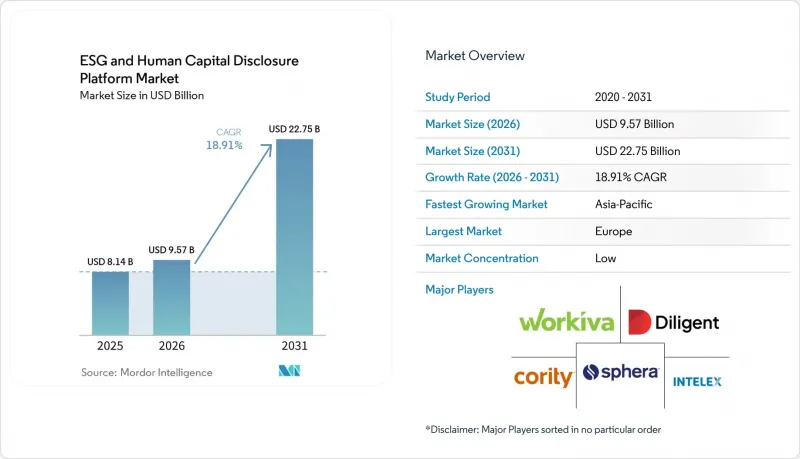
본 보고서는 제공 유형(플랫폼 소프트웨어 및 서비스), 배포 모델(클라우드, On-Premise, 하이브리드), 최종 사용자 기업 규모(대기업 등), 기능성(보고·공시 자동화 등), 최종 사용자 산업(은행, 금융서비스 및 보험(BFSI), 헬스케어 및 생명과학 등) 및 지역별로 분류되어 있습니다. 시장 전망은 금액(달러)으로 표시됩니다.
세계 ESG 및 인적 자본 공시 플랫폼 시장 동향 및 인사이트
CSRD, ISSB 및 캘리포니아주의 기후 변화 공시 의무화 도입
현재 의무적 공시 규정은 여러 주요 경제권으로 확대되고 있어, ESG 및 인적 자본 공시 플랫폼 시장에 대한 투자를 미룰 수 있는 선택지는 더 이상 없습니다. EU 지속가능성 패키지에 기반한 CSRD의 적용 범위는 현재, 직원 수 1,000명 이상이고 기업 매출이 4억 5,000만 유로(4억 8,600만 미 달러)를 초과하는 기업에 초점을 맞추고 있어, 이로 인해 적용 대상 기업 수는 감소했으나, 계속해서 적용 대상인 기업들에게는 규정 준수 부담이 증가했습니다. 또한 캘리포니아주에서는 SB 253법에 따라 캘리포니아주에서 사업을 영위하는 연간 기업 매출 10억 달러를 초과하는 미국 기업에 대해 2026년 8월 10일까지 스코프 1 및 스코프 2 배출량을 공시하도록 의무화하여 단기적인 보고 기한이 설정되었습니다. 이러한 병행되는 규제로 인해 기업들은 제각각인 파일을 환경, 거버넌스 및 노동력 관련 보고를 일원화하여 지원할 수 있는 관리형 공개 시스템으로 대체해야 하는 압박을 받고 있습니다. 이러한 영향은 공급망으로도 파급되고 있으며, 대규모 보고 기업들은 공급업체 전반에 걸쳐 데이터 요청을 표준화하고, 아직 직접적인 적용 대상에서 제외된 기업들에게도 구조화된 공시를 요구하고 있습니다.
감사 대응이 가능한 비재무 데이터에 대한 투자자 및 대출 기관 수요
투자자 및 대출 기관은 비재무 정보를 핵심적인 위험 평가의 일환으로 취급하고 있으며, 이로 인해 ESG 및 인적 자본 공시 플랫폼 시장 전반에 걸쳐 수요가 증가하고 있습니다. 이러한 변화에 따라 단순한 서술적 지속가능성 정보 공시보다는 재무 보고에 가까운 추적 가능성, 관리 체계 및 심사 기준에 대한 기대가 높아지고 있습니다. 증거 추적, 관리된 원본 데이터, 그리고 심사 대응이 완료된 결과를 제시할 수 있는 기업은 자금 조달, 실사, 포트폴리오 모니터링 상황에서 더 유리한 입지를 확보할 수 있습니다. 따라서 구매자들은 단순히 지표를 집계하는 단일 기능 도구가 아닌, 보증 워크플로우, 표준화된 보고 및 부서 간 거버넌스를 지원할 수 있는 플랫폼을 더욱 중시하게 되었습니다. 그 결과, 개별 보고 규정이 계속 변화하고 있음에도 불구하고, 지속가능성 및 직원 데이터를 감사 가능한 기록으로 변환할 수 있는 시스템에 대한 지속적인 수요가 발생하고 있습니다.
표준의 파편화와 관할권별 규제 변화
ESG 및 인적 자본 공시 플랫폼 시장은 여전히 중복되는 기준과 끊임없이 업데이트되는 관할권별 규제로 인해 단기적인 제약을 겪고 있습니다. EU, 캘리포니아주 및 여러 ISSB 관련 시장에서 사업을 영위하는 기업들은 단일 기초 데이터 세트를 바탕으로 서로 다른 공시 범위 규칙, 시기 가정 및 공시 구조에 대응할 수 있는 시스템을 필요로 합니다. EU의 지속가능성 패키지에서는 2026년에 적용 범위의 기준치가 변경되고, 캘리포니아주도 독자적인 단계적 보고 일정을 설정함에 따라, 많은 구매 기업들은 규정 세부 사항이 확정됨에 따라 도입 계획을 지속적으로 조정하고 있습니다. 이러한 ‘움직이는 표적’과 같은 상황은 조달을 지연시키는 요인이 될 수 있습니다. 기업들은 사내 컴플라이언스 팀이 규제 방향을 충분히 파악할 때까지는 복잡한 구성에 얽매이는 것을 피하고자 하기 때문입니다. 그 결과, 판매 주기가 장기화되면서 대규모 재구현 없이도 규정 업데이트에 대응할 수 있는 모듈형 아키텍처에 대한 선호도가 높아지고 있습니다.
부문 분석
2025년, 플랫폼 소프트웨어는 ESG 및 인적 자본 공시 플랫폼 시장 규모의 74.16%를 차지하며, 현재 매출 구성에서 가장 큰 제공 카테고리가 되었습니다. 이는 ESG 데이터 관리, 인적 자본 공시 및 인력 분석, 보고·규제 공시, ESG 성과 관리·분석, 그리고 리스크·감사·보증 플랫폼에서의 도입이 반영된 결과입니다. 이 카테고리는 단순히 지속가능성 지표를 저장하는 데 그치지 않고, 관리된 워크플로를 운영하는 시스템에 대한 기업 수요로부터 혜택을 받고 있습니다. 보증 의무로 인해 기업의 구매 결정에서 검증 가능성과 증거 추적의 중요성이 커짐에 따라, 이 부문에서 리스크·감사·보증 플랫폼이 급속히 확대되고 있습니다. 포춘 1,000대 기업의 85% 이상을 포함한 6,600개 이상의 조직에 서비스를 제공하는 Workiva사는 2025 회계연도 매출이 8억 8,500만 달러에 달하고, 2026 회계연도에는 10억 달러에 근접할 것으로 전망하고 있으며, 통합형 공시 플랫폼이 지닌 규모를 보여주고 있습니다.
서비스 분야는 2031년까지 연평균 성장률(CAGR) 19.72%를 나타낼 것으로 예측되며, ESG 및 인적 자본 공시 플랫폼 시장에서 가장 빠르게 성장하는 서비스 분야가 되고 있습니다. 2026년 및 2027년에 의무 공시 주기에 처음 진입하는 기업들은 소프트웨어 라이선스 외에도 도입 지원, 자문, XBRL 지원 및 보증 대응 준비 업무를 지속적으로 구매하고 있습니다. 이로 인해 소프트웨어 구독과 서비스 주도형 규정 준수 제공 간의 경계가 모호해지고 있습니다. 각 벤더들은 설정 지원이나 규제 업데이트를 일회성 프로젝트로 판매하기보다는 지속적인 계약에 포함시키는 경향이 강해지고 있습니다. 이 모델로 인해 계약 금액이 증가할 뿐만 아니라, 벤더가 고객의 업무 프로세스의 일부가 되므로 갱신 시 타사로 전환할 가능성이 낮아집니다.
2025년 ESG 및 인적 자본 공시 플랫폼 시장에서 클라우드 도입은 71.12%를 차지하며, 다른 도입 모델을 크게 앞질렀습니다. 구매자가 클라우드를 선호하는 이유는 사업체나 지역을 넘나들며 보다 용이하게 확장할 수 있고, 벤더 주도의 규제 업데이트를 통해 사내 IT 업무 부담이 경감되기 때문입니다. 이 모델은 기업이 여러 보고 관할 구역을 동시에 신속하게 전환해야 하는 경우에 특히 매력적입니다. 북미 및 북유럽은 기업의 기술 환경이 클라우드 지향적이며, 규정 준수 워크플로우의 이점을 즉시 얻을 수 있기 때문에 여전히 클라우드 도입이 가장 활발한 중심지입니다. ESRS 보고서에 대한 디지털 태깅 요건 제안 또한, 클라우드 플랫폼을 이용하면 기업 측의 막대한 개입 없이도 분류 체계를 최신 상태로 유지할 수 있기 때문에 클라우드 도입을 뒷받침하고 있습니다.
하이브리드 배포는 2031년까지 ESG 및 인적 자본 공시 플랫폼 시장 규모에서 연평균 성장률(CAGR) 20.14%로 확대될 것으로 예측되며, 가장 빠르게 성장하는 모델이 될 전망입니다. 이러한 경향은 금융 서비스, 의료, 정부 기관 환경에서 특히 두드러지며, 해당 분야의 구매자들은 클라우드의 유연성을 추구하는 한편, 기밀성이 높은 직원 데이터나 거버넌스 데이터에 대해서는 여전히 현지에서 엄격하게 관리하는 것을 선호하는 경향이 있습니다. 하이브리드 아키텍처를 통해 기업은 특정 데이터 세트를 On-Premise에 보관하면서, 데이터 공개, 워크플로우 관리 및 보고서 작성에는 클라우드 엔진을 활용할 수 있습니다. 유럽 데이터 보호 위원회는 2026년 4월, GDPR(EU 개인정보보호규정) 제42조 및 제46조에 기반한 국제적인 개인 데이터 이전을 지원하는 체계로서 Europrivacy 인증을 승인했습니다. 이는 국경을 넘어 직원 데이터를 다루는 플랫폼에 유익할 수 있습니다. On-Premise 도입은 여전히 이루어지고 있지만, 그 역할은 주권을 중시하는 이용 사례나 아직 전환을 원하지 않는 구식 EHS(환경·보건·안전) 및 거버넌스 시스템을 보유한 조직으로 제한되고 있습니다.
지역별 분석
2025년, 유럽은 ESG 및 인적 자본 공시 플랫폼 시장 점유율의 38.92%를 차지하며 선두 자리를 유지했습니다. 이 지역의 우위는 CSRD의 단계적 도입과 ESRS 보고 프레임워크에 기반한 지속가능성 성명서의 디지털 태깅을 지원하는 수요 증가에 기인합니다. 독일, 영국, 프랑스, 네덜란드는 가장 빠른 보고 기한을 맞이하는 대기업 다수가 거점을 두고 있어, 기업들의 도입을 주도하는 핵심 거점으로 자리매김했습니다. 2026년에 발효된 EU의 지속가능성 패키지에 따라, 적용 대상의 주요 기준이 직원 수 1,000명 이상 및 기업 매출 4억 5,000만 유로(4억 8,600만 달러) 이상의 기업으로 상향 조정되었습니다. 이로 인해 대상 기업의 수는 감소했으나, 예산과 거버넌스 역량이 더 탄탄한 대기업에 지출이 집중되는 결과를 낳았습니다. 이탈리아와 스페인은 여전히 중요한 추종 시장으로 자리매김했으나, 러시아는 규모가 작아 EU 기준에 부합하는 공시 체계에서 고립된 상태가 지속되었습니다.
북미는 미국과 캐나다 양국이 보다 엄격한 지속가능성 보고 요건으로 전환함에 따라, ESG 및 인적 자본 공시 플랫폼 시장의 주요 성장 동력으로 자리매김했습니다. 캘리포니아주는 해당 주에서 사업을 영위하는 미국 대기업에 대해 2026년 8월 10일까지 스코프 1 및 스코프 2 공시를 작성하도록 의무화함으로써, 단기적인 이행에 강력한 촉매 역할을 했습니다. 캐나다도 ISSB에 부합하는 보고 체계를 구축하고 있지만, 멕시코는 도입 초기 단계에 머물러 있어 미국 및 유럽 고객들의 수출 체인에 대한 보고 기대의 영향을 더 크게 받고 있습니다. 남미에서는 브라질과 아르헨티나가 지역 내 도입을 주도하고 있는 반면, 기타 남미 국가들은 여전히 초기 단계에 있습니다.
아시아태평양은 2031년까지 ESG 및 인적 자본 공시 플랫폼 시장 규모가 연평균 성장률(CAGR) 23.18%로 확대될 것으로 예측되며, 가장 빠르게 성장하는 지역 시장이 될 전망입니다. 일본이 주요 견인차 역할을 하고 있습니다. 이는 지속가능성 공시가 연례 유가증권 보고서 체계에 통합된 데다, 공급업체들의 투자도 이에 발맞추고 있기 때문입니다. 그 예로, Workiva가 2025년 11월 'Sustainability Explorer'에 호주 지속가능성 보고 기준(ASRS) 대응 기능을 추가한 것을 들 수 있습니다. 중국에서는 국제 투자자 및 수출 시장 바이어들 수요가 증가하고 있습니다. 한편, 인도와 한국은 도입 초기에서 중기 단계에 머물러 있는 반면, 싱가포르에서는 ‘Green 100’ 등의 프로그램을 활용하여 중소기업의 공시 워크플로우 참여를 확대되고 있습니다. 중동에서는 사우디아라비아와 아랍에미리트(UAE)가 해당 지역의 다른 국가들보다 빠르게 진전되고 있으며, 아프리카에서는 남아프리카공화국이 주도적인 역할을 하고 나이지리아가 부상하고 있는 반면, 대륙의 다른 지역은 여전히 초기 단계에 머물러 있습니다.
기타 혜택:
- 엑셀 형식 시장 예측(ME) 시트
- 3개월간의 애널리스트 지원
자주 묻는 질문
목차
제1장 서론
제2장 조사 방법
제3장 주요 요약
제4장 시장 구도
제5장 시장 규모와 성장 예측
제6장 경쟁 구도
제7장 시장 기회와 향후 전망
KTH 26.08.06According to Mordor Intelligence, the ESG and Human Capital Disclosure Platform Market size is projected to be USD 8.14 billion in 2025, USD 9.57 billion in 2026, and reach USD 22.75 billion by 2031, growing at a CAGR of 18.91% from 2026 to 2031.
This report is Segmented by Offering (Platform Software, and Services), Deployment Model (Cloud, On-Premises, and Hybrid), Enterprise Size (Large Enterprises, and More), Functionality (Reporting and Disclosure Automation, and More), End-User Industry (BFSI, Healthcare and Life Sciences, and More), and Geography. The Market Forecasts are Provided in Terms of Value (USD).
Global ESG and Human Capital Disclosure Platform Market Trends and Insights
Mandatory CSRD, ISSB, and California Climate Disclosure Rollouts
Mandatory disclosure rules now span several major economies, which removes the option to delay investment in the ESG and Human Capital Disclosure Platform Market. The CSRD scope under the EU sustainability package now centers on companies with more than 1,000 employees and revenue above EUR 450 million (USD 486 million), which reduced the company count in scope but increased the compliance burden for those that remain covered. California also fixed a near-term reporting deadline when SB 253 required U.S. companies with annual revenue above USD 1 billion that do business in California to disclose Scope 1 and Scope 2 emissions by August 10, 2026. These parallel rules are pushing enterprises to replace disconnected files with governed disclosure systems that can support environmental, governance, and workforce reporting in one place. The effect is spreading into supply chains as large reporters standardize data requests across suppliers and expect structured disclosures even from firms that are not directly in scope yet.
Investor And Lender Demand for Audit-Ready Non-Financial Data
Investors and lenders are treating non-financial information as part of core risk review, which is strengthening demand across the ESG and Human Capital Disclosure Platform Market. This shift is raising expectations for traceability, controls, and review standards that look closer to financial reporting than narrative sustainability communication. Enterprises that can show evidence trails, controlled source data, and review-ready outputs are in a stronger position during financing, diligence, and portfolio monitoring. That is why buyers are giving more weight to platforms that can support assurance workflows, standardized reporting, and cross-functional governance instead of point tools that only aggregate metrics. The result is durable demand for systems that can turn sustainability and workforce data into auditable records even when individual reporting rules continue to evolve.
Fragmented Standards and Jurisdictional Rule Changes
The ESG and Human Capital Disclosure Platform Market still faces a near-term drag from overlapping standards and rolling jurisdictional updates. Enterprises operating across the EU, California, and multiple ISSB-linked markets need systems that can support different scope rules, timing assumptions, and disclosure structures from a single set of underlying data. The EU sustainability package changed scope thresholds in 2026, while California also set its own phased reporting path, meaning many buyers are still adjusting their implementation plans as rule details settle. This moving target can delay procurement, as enterprises prefer not to lock into complex configurations before internal compliance teams are comfortable with the regulatory path. The result is longer sales cycles and a stronger preference for modular architectures that can absorb rule updates without major reimplementation.
Other drivers and restraints analyzed in the detailed report include:
- Shift From Spreadsheet Workflows to Unified Finance-HR-Sustainability Platforms
- Rising Supplier and Scope 3 Reporting Burdens Across Enterprise Value Chains
- High Integration Complexity Across ERP, HRIS, Finance, And EHS Data Stacks
For complete list of drivers and restraints, kindly check the Table Of Contents.
Segment Analysis
Platform Software captured 74.16% of the ESG and Human Capital Disclosure Platform Market size in 2025, making it the largest offering category in the current revenue mix. This reflects adoption across ESG Data Management, Human Capital Disclosure and Workforce Analytics, Reporting and Regulatory Disclosure, ESG Performance Management and Analytics, and Risk, Audit and Assurance Platforms. The category benefits from enterprise demand for systems that manage controlled workflows rather than simply storing sustainability metrics. Risk, Audit, and Assurance Platforms are expanding quickly within this layer because assurance obligations are making reviewability and evidence trails more important in enterprise buying decisions. Workiva, which serves more than 6,600 organizations, including over 85% of Fortune 1,000 companies, reported USD 885 million in revenue for fiscal 2025 and guided to nearly USD 1 billion in fiscal 2026, demonstrating the scale available to integrated disclosure platforms.
Services are projected to grow at a 19.72% CAGR through 2031, making it the fastest-growing offering in the ESG and Human Capital Disclosure Platform Market. First-time reporters entering mandatory disclosure cycles in 2026 and 2027 are still buying implementation, advisory, XBRL support, and assurance-readiness work alongside software licenses. This is narrowing the line between software subscriptions and service-led compliance delivery. Vendors are increasingly packaging configuration support and regulatory updates into recurring contracts rather than selling them as one-time projects. That model supports higher contract values and reduces the likelihood of replacement at renewal because the vendor becomes part of the client's operating process.
Cloud deployment accounted for 71.12% of the ESG and Human Capital Disclosure Platform Market in 2025, leaving it well ahead of other deployment models. Buyers have favored cloud because it scales more easily across entities and geographies, and because vendor-led regulatory updates reduce internal IT workload. The model is especially attractive when enterprises need to move quickly across multiple reporting jurisdictions simultaneously. North America and Northern Europe remain the strongest centers of cloud adoption because enterprise technology estates are more cloud-oriented, and compliance workflow benefits are immediate. Proposed digital tagging requirements for ESRS statements also support cloud adoption because cloud platforms can keep taxonomies current without heavy enterprise intervention.
Hybrid deployment is projected to expand at a 20.14% CAGR in the ESG and Human Capital Disclosure Platform Market size through 2031, making it the fastest-growing model. This pattern is strongest in financial services, healthcare, and government environments where buyers want cloud flexibility but still prefer to keep sensitive workforce or governance data under tighter local control. Hybrid architecture lets enterprises retain certain data sets on-premises while using cloud engines for data disclosure, workflow management, and reporting. The European Data Protection Board recognized Europrivacy certification in April 2026 as a mechanism that can support international personal data transfers under GDPR Articles 42 and 46, which may help platforms handling employee data across borders. On-premises deployment is still in use, but its role is narrowing to sovereignty-heavy use cases and to organizations with older EHS and governance systems that they do not want to move yet.
Complete Report Scope:
- By Offering
- Platform Software
- ESG Data Management Platforms
- Human Capital Disclosure and Workforce Analytics Platforms
- Reporting and Regulatory Disclosure Platforms
- ESG Performance Management and Analytics Platforms
- Risk, Audit and Assurance Platforms
- Services
- Platform Software
- By Deployment Model
- Cloud
- On-premises
- Hybrid
- By end user Enteprise size
- Large Enterprises
- Small and Medium-sized Enterprises
- By Functionality
- Reporting and Disclosure Automation
- Data Collection and Aggregation
- Materiality Assessment and Benchmarking
- Scenario Analysis and Forecasting
- Audit and Assurance Management
- Stakeholder Engagement and Questionnaire Management
- By End-user Industry
- BFSI
- Healthcare and Life Sciences
- Information Technology and Telecom
- Retail and E-commerce
- Industrial Manufacturing
- Government and Public Sector
- Other End-user Industries
- By Geography
- North America
- United States
- Canada
- Mexico
- South America
- Brazil
- Argentina
- Rest of South America
- Europe
- Germany
- United Kingdom
- France
- Italy
- Spain
- Russia
- Netherlands
- Rest of Europe
- Asia-Pacific
- China
- Japan
- India
- South Korea
- Australia and New Zealand
- Rest of Asia-Pacific
- Middle East
- Saudi Arabia
- United Arab Emirates
- Rest of Middle East
- Africa
- South Africa
- Nigeria
- Rest of Africa
- North America
Geography Analysis
Europe held 38.92% of the ESG and Human Capital Disclosure Platform Market share in 2025, maintaining its leading position. The region's lead came from the phased rollout of CSRD and from the growing need to support digital tagging for sustainability statements under the ESRS reporting structure. Germany, the United Kingdom, France, and the Netherlands remained the core centers of enterprise adoption because they housed many of the large entities facing the earliest reporting deadlines. The EU sustainability package that took effect in 2026 raised the main threshold to companies with more than 1,000 employees and revenue above EUR 450 million (USD 486 million), narrowing the number of companies in scope but concentrating spend among larger enterprises with stronger budgets and governance capacity. Italy and Spain remained important follow-on markets, while Russia stayed smaller and more isolated from the EU-aligned disclosure architecture.
North America remained a major contributor to the ESG and Human Capital Disclosure Platform Market, as the United States and Canada both moved toward stronger sustainability reporting requirements. California created a strong near-term implementation trigger by requiring large U.S. businesses operating in the state to prepare Scope 1 and Scope 2 disclosures by August 10, 2026. Canada is also moving through ISSB-aligned reporting development, while Mexico remains earlier in adoption and is influenced more by export-chain reporting expectations from U.S. and European customers. In South America, Brazil and Argentina lead regional adoption, while the rest of South America remains at an earlier stage.
Asia-Pacific is projected to expand at a 23.18% CAGR in the ESG and Human Capital Disclosure Platform Market size through 2031, making it the fastest-growing regional market. Japan is a key driver because sustainability disclosures have moved into the annual securities report structure, and vendor investment has followed, as shown by Workiva's November 2025 addition of support for the Australian Sustainability Reporting Standards to its Sustainability Explorer. China is seeing stronger demand from international investors and export-market buyers, while India and South Korea remain in early-to-mid adoption, and Singapore is using programs such as Green 100 to widen SME participation in disclosure workflows. In the Middle East, Saudi Arabia and the UAE are moving faster than the rest of the region, and in Africa, South Africa leads while Nigeria is emerging, and the rest of the continent remains at a nascent stage.
- Workiva Inc.
- Diligent Corporation
- Sphera Solutions, Inc.
- Cority Software Inc.
- Intelex Technologies ULC
- Novisto Inc.
- Persefoni AI Inc.
- Benchmark Digital Partners LLC
- Position Green AS
- EcoVadis SAS
- Watershed Technology, Inc.
- Sweep SAS
- Novata, Inc.
- Datamaran Limited
- ESG Book Ltd.
- IsoMetrix Software (Pty) Ltd.
- Deepki
- Plan A Earth GmbH
- VelocityEHS Holdings Inc.
- Diginex Limited
Additional Benefits:
- The market estimate (ME) sheet in Excel format
- 3 months of analyst support
TABLE OF CONTENTS
1 INTRODUCTION
- 1.1 Study Assumptions and Market Definition
- 1.2 Scope of the Study
2 RESEARCH METHODOLOGY
3 EXECUTIVE SUMMARY
4 MARKET LANDSCAPE
- 4.1 Market Overview
- 4.2 Market Drivers
- 4.2.1 Mandatory CSRD, ISSB, and California Climate Disclosure Rollouts
- 4.2.2 Investor and Lender Demand for Audit-Ready Non-Financial Data
- 4.2.3 Shift From Spreadsheet Workflows to Unified Finance-HR-Sustainability Platforms
- 4.2.4 Rising Supplier and Scope 3 Reporting Burdens Across Enterprise Value Chains
- 4.2.5 XBRL-Ready Digital Tagging and Assurance Workflows for Sustainability Statements
- 4.2.6 Workforce and Contingent Labor Metrics Moving Into Procurement and Risk Reviews
- 4.3 Market Restraints
- 4.3.1 Fragmented Standards and Jurisdictional Rule Changes
- 4.3.2 High Integration Complexity Across ERP, HRIS, Finance, and EHS Data Stacks
- 4.3.3 Sensitive Workforce Data Privacy and Cross-Border Data Localization Constraints
- 4.3.4 Weak Data Availability for Contractors and Value-Chain Workers
- 4.4 Industry Value-Chain Analysis
- 4.5 Regulatory Landscape
- 4.6 Technological Outlook
- 4.7 Impact of Macroeconomic Factors on the Market
- 4.8 Porter's Five Forces Analysis
- 4.8.1 Bargaining Power of Buyers
- 4.8.2 Bargaining Power of Suppliers
- 4.8.3 Threat of New Entrants
- 4.8.4 Threat of Substitutes
- 4.8.5 Intensity of Competitive Rivalry
5 MARKET SIZE AND GROWTH FORECASTS (VALUE)
- 5.1 By Offering
- 5.1.1 Platform Software
- 5.1.1.1 ESG Data Management Platforms
- 5.1.1.2 Human Capital Disclosure and Workforce Analytics Platforms
- 5.1.1.3 Reporting and Regulatory Disclosure Platforms
- 5.1.1.4 ESG Performance Management and Analytics Platforms
- 5.1.1.5 Risk, Audit and Assurance Platforms
- 5.1.2 Services
- 5.1.1 Platform Software
- 5.2 By Deployment Model
- 5.2.1 Cloud
- 5.2.2 On-premises
- 5.2.3 Hybrid
- 5.3 By end user Enteprise size
- 5.3.1 Large Enterprises
- 5.3.2 Small and Medium-sized Enterprises
- 5.4 By Functionality
- 5.4.1 Reporting and Disclosure Automation
- 5.4.2 Data Collection and Aggregation
- 5.4.3 Materiality Assessment and Benchmarking
- 5.4.4 Scenario Analysis and Forecasting
- 5.4.5 Audit and Assurance Management
- 5.4.6 Stakeholder Engagement and Questionnaire Management
- 5.5 By End-user Industry
- 5.5.1 BFSI
- 5.5.2 Healthcare and Life Sciences
- 5.5.3 Information Technology and Telecom
- 5.5.4 Retail and E-commerce
- 5.5.5 Industrial Manufacturing
- 5.5.6 Government and Public Sector
- 5.5.7 Other End-user Industries
- 5.6 By Geography
- 5.6.1 North America
- 5.6.1.1 United States
- 5.6.1.2 Canada
- 5.6.1.3 Mexico
- 5.6.2 South America
- 5.6.2.1 Brazil
- 5.6.2.2 Argentina
- 5.6.2.3 Rest of South America
- 5.6.3 Europe
- 5.6.3.1 Germany
- 5.6.3.2 United Kingdom
- 5.6.3.3 France
- 5.6.3.4 Italy
- 5.6.3.5 Spain
- 5.6.3.6 Russia
- 5.6.3.7 Netherlands
- 5.6.3.8 Rest of Europe
- 5.6.4 Asia-Pacific
- 5.6.4.1 China
- 5.6.4.2 Japan
- 5.6.4.3 India
- 5.6.4.4 South Korea
- 5.6.4.5 Australia and New Zealand
- 5.6.4.6 Rest of Asia-Pacific
- 5.6.5 Middle East
- 5.6.5.1 Saudi Arabia
- 5.6.5.2 United Arab Emirates
- 5.6.5.3 Rest of Middle East
- 5.6.6 Africa
- 5.6.6.1 South Africa
- 5.6.6.2 Nigeria
- 5.6.6.3 Rest of Africa
- 5.6.1 North America
6 COMPETITIVE LANDSCAPE
- 6.1 Market Concentration
- 6.2 Strategic Moves
- 6.3 Market Share Analysis
- 6.4 Company Profiles (includes Global Level Overview, Market Level Overview, Core Segments, Financials as available, Strategic Information, Market Rank/Share, Products and Services, Recent Developments).
- 6.4.1 Workiva Inc.
- 6.4.2 Diligent Corporation
- 6.4.3 Sphera Solutions, Inc.
- 6.4.4 Cority Software Inc.
- 6.4.5 Intelex Technologies ULC
- 6.4.6 Novisto Inc.
- 6.4.7 Persefoni AI Inc.
- 6.4.8 Benchmark Digital Partners LLC
- 6.4.9 Position Green AS
- 6.4.10 EcoVadis SAS
- 6.4.11 Watershed Technology, Inc.
- 6.4.12 Sweep SAS
- 6.4.13 Novata, Inc.
- 6.4.14 Datamaran Limited
- 6.4.15 ESG Book Ltd.
- 6.4.16 IsoMetrix Software (Pty) Ltd.
- 6.4.17 Deepki
- 6.4.18 Plan A Earth GmbH
- 6.4.19 VelocityEHS Holdings Inc.
- 6.4.20 Diginex Limited
7 MARKET OPPORTUNITIES AND FUTURE OUTLOOK
- 7.1 White-Space and Unmet-Need Assessment


