

|
시장보고서
상품코드
2097435
하이브리드 바닥재 : 시장 점유율 분석, 업계 동향과 통계, 성장 예측(2026-2031년)Hybrid Flooring - Market Share Analysis, Industry Trends & Statistics, Growth Forecasts (2026 - 2031) |
||||||
 Mordor Intelligence
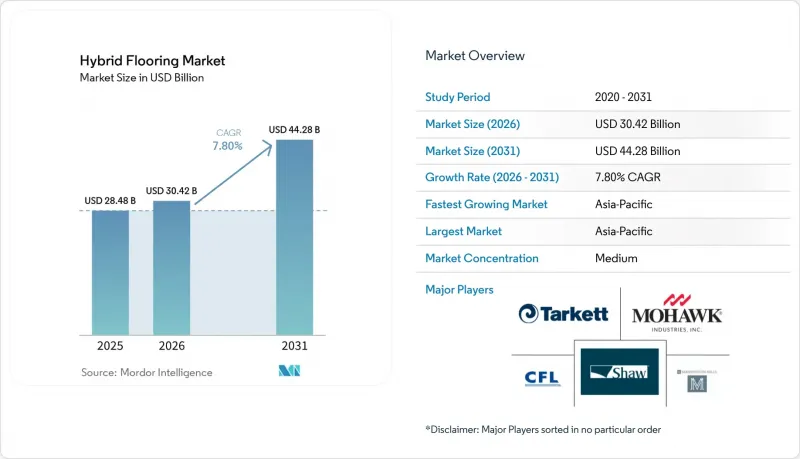
Mordor Intelligence에 의하면, 하이브리드 바닥재 시장 규모는 2025년 284억 8,000만 달러에서 2026년에는 304억 2,000만 달러로 확대되고, 2031년까지 442억 8,000만 달러에 이를 것으로 예측되며, 2026-2031년 CAGR 7.8%를 기록할 전망입니다.
본 보고서는 제품별(SPC, WPC, PVC 프리 경질 코어), 시공 방법별(클릭/클릭락식 플로팅, 접착식, 루즈레이), 건축 유형별(신축, 개보수·리모델링), 최종 사용자별(주택, 상업시설), 유통 채널별(B2C/소매, B2B/시공업체/건설업체), 지역별로 분류되어 있습니다. 시장 전망은 금액(달러) 기준으로 제시되어 있습니다.
세계 하이브리드 바닥재 시장 동향 및 인사이트
주택 리모델링 및 공동 주택에서의 방수성 경질 표면재 선호
내수성은 소비자 및 사양 결정자에게 최우선 선정 기준이며, 이에 따라 장기간에 걸쳐 액체 유출 및 습기 침투를 견딜 수 있는 방수성 리지드 코어 시스템에 대한 수요가 지속적으로 견인되고 있습니다. 장기간 습기에 노출된 상태에서의 치수 안정성은 사용 빈도가 높은 구역에서 제품의 포지셔닝에 있어 매우 중요하며, 일반 주거용 및 경량 상업용 용도에서 하부 구조를 보호하고 외관을 유지하는 역할을 합니다. 가장자리의 강도와 잠금 장치를 강화한 제품 플랫폼이 표준으로 자리 잡고 있으며, WetProtect와 같은 독자적인 시스템은 확실한 기계적 잠금을 유지하면서 표면의 물이 하부 구조에 도달하는 것을 방지하도록 설계되었습니다. 아파트나 임대 주택의 운영 프로그램에서는 이러한 방수 구조를 사고 발생 후 유닛의 가동 중단 기간을 단축하는 위험 완화 수단으로 간주하고 있습니다. 내습성 외에도 설계자들은 오염과 마모에 강하며 균일한 외관을 유지하고 재마감 빈도가 적은 표면 마감재나 탑코트를 요구하고 있습니다. 이러한 종합적인 성능 특성 덕분에, 수명 주기를 중시하는 구매자들은 자가 주택이나 임대 주택을 불문하고 하이브리드 바닥재 시장에 계속해서 매력을 느끼고 있습니다.
클릭 잠금식 플로팅 시공은 공사 기간을 단축하고, DIY 및 상업시설의 인테리어 공사를 신속하게 진행합니다.
플로팅식 클릭 시스템은 접착제 경화 시간을 없애고 단계적인 입주를 가능하게 함으로써 프로젝트 일정을 단축하고, 이를 통해 임차인의 정착을 지원하며 수익 공간의 가동 중단 시간을 줄입니다. 또한, 이 방식은 소규모 주택의 방에서 DIY의 가능성도 넓혀주며, 앵글 잠금 및 드롭 잠금 구조를 통해 손재주가 좋은 주택 소유자라면 일반적인 방 시공을 하루 만에 완료할 수 있습니다. 주말이나 야간 작업이 유일한 실용적인 선택지인 시장에서는 리모델링 인건비 절감이 큰 의미를 가지며, 전문 소매업체들도 시공 비용 절감을 프로젝트 입찰 시 지속적인 차별화 요인으로 꼽고 있습니다. 접이식 잠금 장치를 통해 시공 팀은 문틀이나 맞춤 가구 등 고정된 장애물 바로 근처에서 작업할 수 있어, 리모델링 공사 시 철거 범위를 축소하고 수정에 따른 공사 기간 지연을 방지할 수 있습니다. 또한, 클릭식 시스템은 공표된 허용 범위 내라면 바탕면의 미세한 요철에도 대응할 수 있으므로, 통상적으로 연마나 스킴 코팅이 필요한 슬래브 표면의 바탕 처리 공정을 줄일 수 있습니다. 이러한 시공상의 장점이 결합되어, 소유주에게는 비용의 확실성이 보장되며, 교체 주기가 짧은 상업시설 인테리어 시장에서 시공사에게는 더욱 경쟁력 있는 입찰이 가능해집니다.
PVC의 지속가능성에 대한 면밀한 검토와 VOC·가소제 규제
공공 및 민간 입찰에서 지속가능성 및 실내 공기질(IAQ)에 대한 심사가 더욱 엄격해지고 있으며, 규제 대상인 가소제에 의존하거나 저VOC 기준을 충족하지 못하는 배합에 대한 압박이 가해지고 있습니다. 미국에서는 바닥 마감재 및 접착제에 관한 VOC 규제가 강화되고 있어, 제조업체는 제출 서류의 일환으로 인증 및 시험 기록을 항상 최신 상태로 유지해야 합니다. 유럽의 조달 체계와 친환경 라벨 프로그램은 시장을 프탈레이트 무사용 및 재활용 가능한 방향으로 지속적으로 이끌고 있으며, 이로 인해 민감한 용도에서의 대체 재료 사용이 촉진되고 있습니다. 이러한 전환으로 인해 규정 준수 비용과 시장 출시까지의 시간이 추가되며, 이익 마진이 제한적인 가격 민감형 부문에서는 신제품 출시가 지연될 가능성이 있습니다. 규제 변경에 앞서 투자를 단행하는 공급업체는 필수 서류 제출이 요구되는 그린 빌딩 프로그램에서 조기에 유리한 입지를 확보할 수 있습니다. 건축 기준과 규격이 발전함에 따라, 저배출 및 청정 원자재 구성은 공공 및 기관용 공사에 채택되기 위한 중요한 요소로 계속 남아 있습니다.
부문 분석
SPC(스톤-플라스틱-컴포지트)는 2025년에 71.25%의 시장 점유율을 확보한 반면, 경질 고밀도 섬유판(HDF) 하이브리드 바닥재는 2031년까지 연평균 성장률(CAGR) 9.15%로 확대될 것으로 예측됩니다. 현재의 제품 로드맵에서는 시공 속도와 햇빛이 잘 드는 공간을 포함한 온도 변동 하에서도 안정성을 겸비한 경질 플랫폼이 중시되고 있습니다. PVC가 포함되지 않은 코어를 채택한 각 제조업체는 재생 가능 소재의 함유율과 낮은 VOC(휘발성 유기 화합물) 성능을 전면에 내세우면서, 상업시설 및 공동 주택용도에서 사양 결정자가 요구하는 표면 마감 및 잠금 성능을 충족시키고 있습니다. 이러한 제품 라인업은 내구성과 비용의 균형을 중시하는 소매 및 프로젝트 채널의 기존 SPC 제품 라인을 보완하는 것입니다. WPC는 주거 공간에서 발소리를 줄이거나 높은 흡음성을 요구하는 용도로 계속해서 활용되고 있습니다. 하이브리드 바닥재 시장은 성능, 지속가능성, 비용 등 각 수준에 걸친 선택지의 확대로부터 혜택을 받고 있습니다.
소재의 안전성이나 배출 가스를 중시하는 구매자들은 명확한 문서화와 짧은 리드 타임을 갖춘 플랫폼을 선호합니다. SPC는 구름 하중이나 심한 통행으로 인해 고밀도 코어와 두꺼운 마모층이 요구되는 상황에서 여전히 강점을 발휘하고 있습니다. 제품 차별화는 코어의 화학 조성뿐만 아니라 결합 강도, 표면 보호, 검증된 배출 가스 프로파일을 통해 점점 더 이루어지고 있습니다. 제품군이 확대됨에 따라 하이브리드 바닥재 업계는 용도 요구 사항과 제품 등급 간의 연관성을 더욱 명확하게 제시할 수 있게 되었습니다.
2025년에는 클릭/클릭락 방식의 플로팅 시스템이 70%의 시장 점유율을 차지하며 연평균 성장률(CAGR) 8.50%를 기록했습니다. 플로팅 방식은 단계적인 리모델링을 가능하게 하고, 접착제 경화 시간을 피함으로써 입주 중인 상업 공간의 임대 계약 요건을 충족시킵니다. DIY 사용자나 전문 시공업체 모두 리모델링 시 클릭 시스템을 선택하는 설득력 있는 이유로, 예정된 일정을 준수할 수 있다는 점과 공표된 허용 범위 내에서 하부 바닥 준비가 간소화된다는 점을 꼽고 있습니다. 또한, 폴드다운 조인트를 통해 해체 작업 없이 수직 장애물 근처에서 작업할 수 있어 프로젝트 일정을 차질 없이 진행하는 데 도움이 됩니다. 내구성과 높은 전동 하중이 주요 요구 사항인 경우, 의료 및 교육 분야의 사양 담당자들에게는 여전히 접착 공법이 선호되는 선택지입니다. 루즈레이 공법은 일시적인 용도나 고상식 바닥 시공과 같은 특정 요구 사항을 충족시킵니다. 하이브리드 바닥재 시장에서는 사용 상황과 목표 수명에 따라 이 세 가지 공법의 균형이 맞추어지고 있습니다.
시공업체들은 문제 없는 시공을 실현하기 위해서는 총 두께와 마찬가지로 잠금 부위의 품질 및 플랭크의 공차도 중요하다고 지적하고 있습니다. 카트나 들것이 지나가는 복도에서는 접착 시공의 장점이, 임차인 리모델링 공사에서는 플로팅 시공의 장점이 각각 발휘됩니다. 루즈 레이는 향후 레이아웃 변경이 예상되는 공간에서 단기간에 진행되는 리모델링 프로젝트의 선택지를 넓혀줍니다. 입찰 서류에서 슬래브의 평탄성이나 하층 처리 요건을 명확히 전달함으로써, 각 공사 범위에 적합한 시공 방법을 적절히 선정할 수 있습니다. 프로젝트 유형에 관계없이 판매 파트너들은 본격적인 도입에 앞서 모형 제작 및 현장 시험의 중요성을 점점 더 강조하고 있습니다. 이러한 철저한 노력을 통해 변경 지시가 줄어들고, 실제 제약 조건에 맞추어 제품을 선정할 수 있게 됩니다.
지역별 분석
아시아태평양은 2025년 하이브리드 바닥재 시장 점유율의 42.62%를 차지하며, 2031년까지 연평균 성장률(CAGR) 9.84%를 나타낼 것으로 예측됩니다. 중국 및 인근 거점에 위치한 제조업체들은 광범위한 SKU 라인업과 신속한 샘플 제작 주기를 뒷받침하는 대용량 압출 성형 및 마감 라인을 지속적으로 가동하고 있습니다. 자동화에 대한 투자는 처리 능력과 제품의 균일성을 향상시켜 수출 시장을 위한 안정적인 서비스 수준 유지에 기여하고 있습니다. 각 공급업체는 관세 및 통관 리스크를 관리하고 재고를 구매자 근처에 배치하기 위해 최종 조립 거점을 다각화하고 있습니다. 추적 가능성 및 노동 기준에 대한 규정 준수 기대가 높아지고 있으며, 이는 북미 및 유럽을 대상으로 한 조달 전략과 수입 서류 작성에 영향을 미치고 있습니다. 규제 체계가 진화함에 따라, 검증 가능한 공급망과 유연한 운송 경로를 갖춘 공급업체가 경쟁에서 우위를 점할 수 있습니다. 아시아태평양의 하이브리드 바닥재 시장은 규정 준수가 엄격해지는 상황 속에서도 비용 및 생산 능력 면에서의 우위를 유지하고 있습니다.
북미에서는 주방, 욕실, 지하실 리모델링 프로젝트에서 리지드 코어 제품의 도입이 계속되고 있는 반면, 상업 프로젝트에서는 성능과 가동 중단 시간 단축이 중시되고 있습니다. 국내 생산 능력에 대한 투자와 시장 인근에서의 조립을 통해 관세 변동 및 통관 지연으로 인한 위험이 완화되어 프로젝트 일정의 안정화에 기여하고 있습니다. 공공 기관 및 금융 기관은 공동 주택 및 복합 애플리케이션 개발에서 방음 및 생명 안전에 관한 요건을 강화하고 있으며, 이에 따라 통합 패드 시스템과 건축 기준에 부합하는 조립 방식이 사양서의 최전선에 자리 잡고 있습니다. 하이브리드 바닥재 시장 전반에 걸쳐 구매자들은 부동산 보험사가 인정하는 명확한 유지보수 지침과 보증 체계를 요구하고 있습니다. 규제가 엄격한 시 및 주 관할 구역에서는 VOC(휘발성 유기 화합물) 및 자재 성분에 관한 문서가 제출 서류의 핵심 요소로 계속 자리 잡고 있습니다. 주택 시장과 신용 여건이 완화되는 가운데, 이 지역에서는 프로젝트 공사와 소매점 리뉴얼이 균형 있게 진행되고 있습니다.
유럽에서는 주택 및 공공시설 프로젝트에서 사양 수립 활동이 견조한 추세를 보이고 있으며, 공공 조달에서는 저배출 자재와 재활용 가능한 경로가 중시되고 있습니다. 공동 주택 및 기숙사의 음향 성능 목표치는 계속해서 제품 선정 및 하부 마감재 선택에 영향을 미치고 있습니다. 각 브랜드는 VOC 및 자재 안전성에 관한 규정 준수를 입증하기 위해 독립적인 인증 제도를 활용하고 있으며, 이를 통해 승인 및 조달 프로세스가 원활해지고 있습니다. 공급원의 다각화와 현지 마감 가공은 공공 입찰에서의 납품 리스크 및 리드타임 관리에 도움이 되고 있습니다. 디자이너들은 소매점 및 호텔 및 레스토랑 업계에서 대형 비주얼과 세련된 나뭇결 무늬 디자인을 계속해서 채택하고 있습니다. 이러한 동향은 건축 기준에 따른 음향 성능 및 실내 공기질(IAQ) 요건과 맞물려, 유럽 전역의 리모델링 및 신축 프로젝트 전반에 걸쳐 하이브리드 바닥재 시장을 활기차게 유지하고 있습니다.
기타 혜택:
- 엑셀 형식 시장 예측(ME) 시트
- 3개월간의 애널리스트 지원
자주 묻는 질문
목차
제1장 서론
제2장 조사 방법
제3장 주요 요약
제4장 시장 구도
제5장 시장 규모와 성장 예측
제6장 경쟁 구도
제7장 시장 기회와 향후 전망
KTH 26.08.06According to Mordor Intelligence, the hybrid flooring market size is expected to increase from USD 28.48 billion in 2025 to USD 30.42 billion in 2026 and reach USD 44.28 billion by 2031, growing at a CAGR of 7.8% over 2026-2031.
This report is Segmented by Product (SPC, WPC, PVC-Free Rigid Cores), Installation Method (Click/Click-Lock Floating, Glue-Down, Loose Lay), Contruction Type (New Construction, Renovation & Remodel), End User (Residential, Commercial), Distribution Channel (B2C/Retail, B2B/Contractors/Builders), and Geography. The Market Forecasts are Provided in Terms of Value (USD).
Global Hybrid Flooring Market Trends and Insights
Waterproof Hard-Surface Preference In Residential Remodels and Multi-Family
Water resistance is a top selection criterion for consumers and specifiers, which continues to steer demand toward waterproof rigid-core systems that tolerate spills and moisture intrusion over long service lives. Dimensional stability under prolonged moisture exposure is central to product positioning in high-use areas, as it protects subfloors and preserves appearance under normal residential and light commercial use. Product platforms that strengthen edge integrity and lock design have become standard, with proprietary systems like WetProtect designed to keep surface water from reaching the subfloor while maintaining a secure mechanical lock. Multifamily and rental programs view these waterproof assemblies as risk mitigation tools that reduce unit downtime after incidents. In addition to moisture resistance, designers seek surface finishes and topcoats that resist staining and wear, maintain a uniform appearance, and require infrequent refinishing. The combined performance characteristics continue to draw lifecycle-driven buyers into the hybrid flooring market in both owner-occupied and rental settings.
Click-Lock Floating Installs Reduce Labor Time and Enable DIY And Faster Commercial Fit-Outs
Floating click systems compress project schedules by eliminating adhesive cure times and enabling staged occupancy, thereby supporting tenant retention and reducing downtime for revenue spaces. The format also opens a DIY path in smaller residential rooms, with angle-lock or drop-lock mechanisms enabling skilled homeowners to complete typical rooms in a single day. Labor savings in renovation scenarios are meaningful in markets where weekend or overnight work is the only viable option, and specialty retailers note installation cost avoidance as a recurring differentiator in their project bids. Fold-down locking formats help crews work closely to fixed obstructions such as door frames and casework, reducing demolition scope on retrofit jobs and avoiding schedule slippage tied to rework. Click systems also tolerate modest subfloor variation within published tolerances, which helps reduce prep steps on slabs that would otherwise require grinding or skim coating. Together, these installation levers support cost certainty for owners and more competitive bidding for contractors in high-churn commercial interiors.
PVC Sustainability Scrutiny and VOC/Plasticizer Restrictions
Sustainability and IAQ scrutiny are intensifying across public and private tenders, placing pressure on formulations that rely on restricted plasticizers or cannot meet low-VOC thresholds. United States jurisdictions have tightened VOC rules for floor finishes and adhesives, forcing manufacturers to keep their certifications and testing files up to date as part of the submittal package. European procurement frameworks and ecolabel programs continue to drive the market toward phthalate-free and recyclable pathways, which encourage substitution in sensitive applications. The transition adds compliance costs and time-to-market, which can slow launches in price-sensitive segments where margin headroom is limited. Suppliers that invest ahead of rule changes position themselves to win early in green building programs that require mandatory documentation. As codes and standards evolve, low-emissions and cleaner input profiles remain central to acceptance in public and institutional work.
Other drivers and restraints analyzed in the detailed report include:
- Asia-Pacific Scale in SPC Manufacturing and Rapid Adoption Accelerates Supply Innovation
- Entry-Level SPC Quality Issues Causing Failures and Dealer Fatigue
For complete list of drivers and restraints, kindly check the Table Of Contents.
Segment Analysis
SPC (Stone Plastic Composite) secured 71.25% market share in 2025, while rigid high-density fiberboard (HDF) hybrid flooring is projected to expand at a 9.15% CAGR through 2031. Product roadmaps now emphasize rigid platforms that pair installation speed with stability under temperature swings, including sun-exposed spaces. Manufacturers with PVC-free cores highlight renewable content and low-VOC credentials while matching surface and locking performance that specifiers require in commercial and multifamily applications. These portfolios complement established SPC lines in retail and project channels that prioritize a balance of durability and cost. WPC continues to serve applications that favor softer footfall or higher acoustic damping in occupied buildings. The hybrid flooring market benefits from a wider choice across performance, sustainability, and cost tiers.
Buyers who prioritize material health and emissions are receptive to platforms with clear documentation and short lead times. SPC retains strength where rolling loads and heavy traffic dictate denser cores and thicker wear layers. Product differentiation increasingly comes from lock strength, surface protection, and verified emissions profiles rather than from core chemistry alone. As product families expand, the hybrid flooring industry offers clearer mapping between application requirements and product tiers.
Click/click-lock floating systems commanded 70% share in 2025 while growing at an 8.50% CAGR. Floating formats enable phased renovations and meet lease requirements in occupied commercial spaces by avoiding adhesive cure times. DIY and pro installers alike cite predictable schedules and simpler subfloor prep within published tolerances as compelling reasons to select click systems for refreshes. Fold-down joints also allow crews to work close to vertical obstructions without demolition, which helps keep projects on track. Where permanence and heavy rolling loads are primary, glue-down remains the favored option for healthcare and education specifiers. Loose-lay serves targeted needs in temporary and raised-floor applications. The hybrid flooring market balances these three methods according to occupancy and service-life goals.
Installers highlight that lock quality and plank tolerance are as important as total thickness in achieving a trouble-free install. Glue-down's advantage in carts and gurney corridors coexists with floating's advantage in tenant improvements. Loose-lay expands the toolkit for quick-turn programs in spaces that anticipate future reconfiguration. Clear communication of slab flatness and prep needs in bid documents helps right-size the installation method for each scope. Across project types, channel partners increasingly emphasize mockups and site testing before full deployment. This discipline reduces change orders and aligns product choice with real-world constraints.
Complete Report Scope:
- By Product
- Stone Plastic Composite (SPC) Hybrid Flooring
- Wood Plastic Composite (WPC) Hybrid Flooring
- Rigid High-Density Fiberboard (HDF) Hybrid Flooring
- Other Hybrid Cores (e.g., MgO, Bamboo Composite)
- By Installation Method
- Floating / Click-Lock
- Glue-Down / Loose-Lay
- By Contruction Type
- New Construction
- Renovation & Remodel
- By End-User
- Residential
- Commercial
- By Distribution Channel
- B2C / Retail Consumers
- Home Centers
- Specialty Flooring Stores
- Online
- Local Hardware Shops (unorganized market)
- Other Distribution Channels
- B2B / Contractors / Builders
- B2C / Retail Consumers
- By Geography
- North America
- Canada
- United States
- Mexico
- South America
- Brazil
- Peru
- Chile
- Argentina
- Rest of South America
- Europe
- United Kingdom
- Germany
- France
- Spain
- Italy
- BENELUX (Belgium, Netherlands, Luxembourg)
- NORDICS (Denmark, Finland, Iceland, Norway, Sweden)
- Rest of Europe
- Asia-Pacific
- India
- China
- Japan
- Australia
- South Korea
- South East Asia (SG, MY, TH, ID, VN, PH)
- Rest of Asia-Pacific
- Middle East and Africa
- United Arab Emirates
- Saudi Arabia
- South Africa
- Nigeria
- Rest of Middle East And Africa
- North America
Geography Analysis
Asia-Pacific accounted for 42.62% of the hybrid flooring market share in 2025 and is projected to grow at a 9.84% CAGR through 2031. Producers across China and neighboring hubs continue to run high-capacity extrusion and finishing lines that support broad SKU ranges and quick sampling cycles. Investing in automation enhances throughput and product consistency, helping maintain stable service levels for export markets. Suppliers diversify final assembly locations to manage tariff and clearance risks and to position inventory closer to buyers. Compliance expectations are rising for traceability and labor standards, shaping sourcing strategies and import documentation for North America and Europe. As regulatory frameworks evolve, vendors with verifiable supply chains and flexible routing options are better positioned to win. The hybrid flooring market in Asia-Pacific retains cost and capacity advantages even as compliance rigor increases.
North America continues to deploy rigid-core across remodeling programs in kitchens, bathrooms, and basements, while commercial programs emphasize performance and downtime reduction. Domestic capacity investments and closer-to-market assembly reduce exposure to tariff swings and clearance delays, which helps stabilize project schedules. Public agencies and lenders reinforce acoustic and life-safety requirements in multifamily and mixed-use developments, which keep integrated-pad systems and code-ready assemblies at the forefront of specifications. Across the hybrid flooring market, buyers seek clear maintenance guidance and warranty pathways that property insurers recognize. Documentation on VOC and material content remains central to submittals in city and state jurisdictions with stricter rulemaking. The region balances project work with retail refreshes as housing and credit conditions ease.
Europe maintains steady specification activity in residential and institutional projects, with an emphasis on low-emissions materials and recyclable pathways in public procurement. Acoustic targets in shared residential buildings and student housing continue to influence product selection and underlayment choices. Brands lean into independent certification schemes to demonstrate compliance with VOCs and material health, which helps smooth approvals and procurement. Supply diversification and local finishing help manage delivery risk and lead times for public tenders. Designers continue to adopt larger-format visuals and refined wood looks across retail and hospitality. These trends, combined with code-driven acoustics and IAQ requirements, keep the hybrid flooring market active across European renovation and new-build programs.
List of Companies Covered in this Report:
- Mohawk Industries
- Shaw Industries Group
- Tarkett
- Mannington Mills
- CFL Flooring
- HMTX Industries (Metroflor)
- Karndean Designflooring
- NOX Corporation
- Novalis Innovative Flooring
- LX Hausys (HFLOR)
- Forbo Flooring Systems
- Gerflor
- Interface, Inc.
- Polyflor (James Halstead plc)
- Beaulieu International Group (BerryAlloc)
- AHF Products (Armstrong Flooring, Bruce, Robbins brands)
- Quick-Step (Unilin Flooring)
- Pergo (Mohawk brand)
- CALI
- Decno Group
Additional Benefits:
- The market estimate (ME) sheet in Excel format
- 3 months of analyst support
TABLE OF CONTENTS
1 Introduction
2 Research Methodology
3 Executive Summary
4 Market Landscape
- 4.1 Market Drivers
- 4.1.1 Waterproof Hard-Surface Preference In Residential Remodels And Multi-Family
- 4.1.2 Click-Lock Floating Installs Reduce Labor Time And Enable Diy And Faster Commercial Fit-Outs
- 4.1.3 Asia-Pacific Scale In Spc Manufacturing And Rapid Adoption Accelerates Supply Innovation
- 4.1.4 Commercial Refresh Cycles (Retail, Hospitality, Healthcare) Favor Durable, Low-Maintenance Rigid Core
- 4.1.5 Shift Toward PVC-Free Rigid Cores For Sustainability And Iaq Credentials
- 4.1.6 Acoustic Compliance Needs In Multi-Family (Iic Targets) Favor Padded Rigid Core Systems
- 4.2 Market Restraints
- 4.2.1 PVC Sustainability Scrutiny And Voc/Plasticizer Restrictions
- 4.2.2 Entry-Level Spc Quality Issues Causing Failures And Dealer Fatigue
- 4.2.3 Trade/Tariff And Forced-Labor Compliance Disruptions For China-Sourced Rigid Core
- 4.2.4 Low Recyclability/End-Of-Life Pathways For Multi-Material Rigid Cores
- 4.3 Industry Value Chain Analysis
- 4.4 Porter's Five Forces Analysis
- 4.4.1 Threat of New Entrants
- 4.4.2 Bargaining Power of Suppliers
- 4.4.3 Bargaining Power of Buyers
- 4.4.4 Threat of Substitutes
- 4.4.5 Competitive Rivalry
- 4.5 Insights into the Latest Trends and Innovations in the Industry
- 4.6 Insights on Recent Developments (New Product Launches, Strategic Initiatives, Investments, Partnerships, JVs, Expansion, M&As, etc.) in the Industry
5 Market Size & Growth Forecasts (Value in USD Billion)
- 5.1 By Product
- 5.1.1 Stone Plastic Composite (SPC) Hybrid Flooring
- 5.1.2 Wood Plastic Composite (WPC) Hybrid Flooring
- 5.1.3 Rigid High-Density Fiberboard (HDF) Hybrid Flooring
- 5.1.4 Other Hybrid Cores (e.g., MgO, Bamboo Composite)
- 5.2 By Installation Method
- 5.2.1 Floating / Click-Lock
- 5.2.2 Glue-Down / Loose-Lay
- 5.3 By Contruction Type
- 5.3.1 New Construction
- 5.3.2 Renovation & Remodel
- 5.4 By End-User
- 5.4.1 Residential
- 5.4.2 Commercial
- 5.5 By Distribution Channel
- 5.5.1 B2C / Retail Consumers
- 5.5.1.1 Home Centers
- 5.5.1.2 Specialty Flooring Stores
- 5.5.1.3 Online
- 5.5.1.4 Local Hardware Shops (unorganized market)
- 5.5.1.5 Other Distribution Channels
- 5.5.2 B2B / Contractors / Builders
- 5.5.1 B2C / Retail Consumers
- 5.6 By Geography
- 5.6.1 North America
- 5.6.1.1 Canada
- 5.6.1.2 United States
- 5.6.1.3 Mexico
- 5.6.2 South America
- 5.6.2.1 Brazil
- 5.6.2.2 Peru
- 5.6.2.3 Chile
- 5.6.2.4 Argentina
- 5.6.2.5 Rest of South America
- 5.6.3 Europe
- 5.6.3.1 United Kingdom
- 5.6.3.2 Germany
- 5.6.3.3 France
- 5.6.3.4 Spain
- 5.6.3.5 Italy
- 5.6.3.6 BENELUX (Belgium, Netherlands, Luxembourg)
- 5.6.3.7 NORDICS (Denmark, Finland, Iceland, Norway, Sweden)
- 5.6.3.8 Rest of Europe
- 5.6.4 Asia-Pacific
- 5.6.4.1 India
- 5.6.4.2 China
- 5.6.4.3 Japan
- 5.6.4.4 Australia
- 5.6.4.5 South Korea
- 5.6.4.6 South East Asia (SG, MY, TH, ID, VN, PH)
- 5.6.4.7 Rest of Asia-Pacific
- 5.6.5 Middle East and Africa
- 5.6.5.1 United Arab Emirates
- 5.6.5.2 Saudi Arabia
- 5.6.5.3 South Africa
- 5.6.5.4 Nigeria
- 5.6.5.5 Rest of Middle East And Africa
- 5.6.1 North America
6 Competitive Landscape
- 6.1 Strategic Moves
- 6.2 Market Share Analysis
- 6.3 Company Profiles (includes Global level Overview, Market level overview, Core Segments, Financials as available, Strategic Information, Market Rank/Share for key companies, Products & Services, and Recent Developments)
- 6.3.1 Mohawk Industries
- 6.3.2 Shaw Industries Group
- 6.3.3 Tarkett
- 6.3.4 Mannington Mills
- 6.3.5 CFL Flooring
- 6.3.6 HMTX Industries (Metroflor)
- 6.3.7 Karndean Designflooring
- 6.3.8 NOX Corporation
- 6.3.9 Novalis Innovative Flooring
- 6.3.10 LX Hausys (HFLOR)
- 6.3.11 Forbo Flooring Systems
- 6.3.12 Gerflor
- 6.3.13 Interface, Inc.
- 6.3.14 Polyflor (James Halstead plc)
- 6.3.15 Beaulieu International Group (BerryAlloc)
- 6.3.16 AHF Products (Armstrong Flooring, Bruce, Robbins brands)
- 6.3.17 Quick-Step (Unilin Flooring)
- 6.3.18 Pergo (Mohawk brand)
- 6.3.19 CALI
- 6.3.20 Decno Group
7 Market Opportunities & Future Outlook
- 7.1 Domestic/nearshore WPC capacity to mitigate tariff/UFLPA risk and shorten lead times
- 7.2 Circular SPC (EPD-backed, take-back) aligned to LEED v5 procurement


