

|
시장보고서
상품코드
2097436
블라스트 칠러 : 시장 점유율 분석, 업계 동향과 통계, 성장 예측(2026-2031년)Blast Chillers - Market Share Analysis, Industry Trends & Statistics, Growth Forecasts (2026 - 2031) |
||||||
 Mordor Intelligence
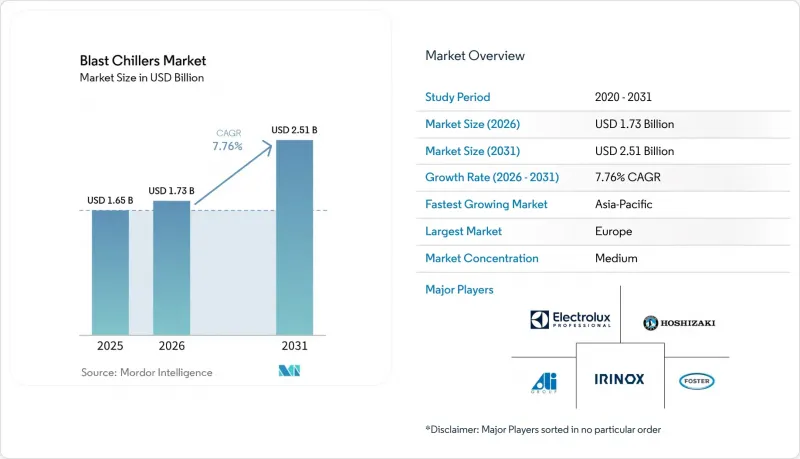
Mordor Intelligence에 의하면, 블라스트 칠러 시장 규모는 2025년 16억 5,000만 달러에서 2026년에는 17억 3,000만 달러로 확대되고, 2026-2031년 CAGR 7.76%로 성장을 지속하여 2031년에는 25억 1,000만 달러에 이를 것으로 예측됩니다.
본 보고서는 제품 유형(리치인형, 롤인/트롤리형, 롤스루형, 언더카운터형, 워크인형), 용량(50kg 미만, 50-100kg, 100-200kg, 200kg 이상), 최종 사용자(호텔 및 레스토랑, 베이커리, 케이터링, 기관용, 식품 가공), 유통 채널(직접 판매 및 도매업체/유통업체), 지역별로 분류되어 있습니다. 시장 전망은 금액(달러) 기준으로 제시됩니다.
전 세계 블라스트 칠러 시장 동향 및 인사이트
외식 산업의 에너지 효율 규제가 제품 재설계 주기를 촉진
블라스트 칠러 시장은 구매 결정을 냉매 및 장비의 규제 준수와 직접적으로 연결시키는 규정에 따라 재편되고 있습니다. 2025년 1월부터 미국 환경보호청(EPA)은 GWP가 150을 초과하는 냉매를 사용하는 새로운 독립형 상업용 냉동 장비의 사용을 금지했습니다. 이로 인해 블라스트 칠러의 최대 시장인 미국에서 사양 선택에 변화가 생겼습니다. 또한, 2026년 1월부터 시행되는 EPA 요건에 따라 GWP 상한선을 1,400으로 제한하는 원격 시스템이 규정되었으며, 이러한 압박은 식품 소매 및 가공 환경에서 사용되는 중용량 냉동 용도로도 파급되었습니다. 이미 자연 냉매 플랫폼으로의 전환을 추진해 온 공급업체들은 구매자들의 교체 결정이 가속화되었을 때 유리한 입장에 있었으며, 제품의 신속한 대응 능력은 분명한 상업적 우위를 가져다주었습니다. 그 결과, 블라스트 칠러 시장에서는 재설계 작업에 자금을 투입할 수 있는 대형 제조업체와 규제 지역에서 이익률 압박에 직면한 중소 제조업체 간의 격차가 더욱 확대되고 있습니다.
아시아태평양의 냉동 즉석식(Redi-Meal) 수요의 급성장이 새로운 조달층을 뒷받침하고 있습니다.
아시아태평양의 블라스트 칠러 시장은 더 이상 호텔이나 고급 주방에만 국한된 것이 아닙니다. QSR(퀵서비스 레스토랑)의 공동 조리장이나 냉동 조리 식품 시설이 블라스트 칠러를 표준 설비로 도입하고 있기 때문입니다. 수요 형성은 도시 지역의 음식 배달 시스템, 보다 광범위한 중앙 주방 모델, 그리고 중국, 인도, 동남아시아 전역에서 확대되는 콜드체인 네트워크에 의해 뒷받침되고 있습니다. 호시자키가 ARICO의 호치민시 시설 내에 동남아시아 최초의 생산 거점을 설립하고 2026년 4월부터 출하를 시작하기로 한 결정은 공급업체들이 이 지역 수요 변화에 맞추어 제조 거점을 조정하고 있음을 보여줍니다. 이러한 움직임은 지역 내 생산을 통해 리드 타임이 단축되고, 판로 개척이 촉진되며, 서비스 및 예비 부품 공급과 관련된 마찰이 완화되기 때문에 블라스트 칠러 시장에 중요한 의미를 지닙니다. 더 광범위한 영향으로, 아시아태평양의 조달은 일회성 이벤트가 아닌 지속적인 자본 순환으로 자리 잡고 있으며, 이는 예측 기간 동안 블라스트 칠러 시장의 지속적인 판매량 증가를 뒷받침할 것입니다.
중소규모 외식업자에게는 초기 투자 비용이 높기 때문에 시장의 하위층에서 판매량이 제한되고 있습니다.
블라스트 칠러 시장은 여전히 소규모 외식업자에게 기본적인 가격 측면의 장벽에 직면해 있습니다. 이러한 사업자들에게는 전용 블라스트 칠러의 초기 비용을 쉽게 정당화하기 어렵기 때문입니다. 엔트리 레벨 기종은 소규모 카페나 지역 주방의 설비 예산에서 큰 비중을 차지하기 때문에 이론상 인건비나 폐기물 절감 효과가 분명하더라도 도입의 걸림돌이 되고 있습니다. 이 문제는 남아시아 및 동남아시아에서 더욱 두드러집니다. 이 지역에서는 업소용 냉장 설비를 위한 설비 대출 제도가 충분히 정비되어 있지 않아, 소규모 구매자가 구매 전에 투자 회수 모델을 검증하기 어렵기 때문입니다. 리스 모델이나 구독형 설비 프로그램이 등장하기 시작하고 있지만, 이러한 자금 조달 구조가 이미 정착된 시장 이외에서는 그 보급 속도가 여전히 제한적입니다. 그 결과, 블라스트 칠러 시장은 여전히 ‘두 가지 속도’로 움직이고 있으며, 자금력이 있는 체인점은 보다 신속하게 교체를 진행하는 반면, 독립 사업자는 기존 냉장 설비를 오랫동안 계속 사용하고 있습니다.
부문 분석
2025년, 롤인식 블라스트 칠러는 제품 매출의 40.8%를 차지하며 블라스트 칠러 시장에서 가장 큰 제품 카테고리가 되었습니다. 그 우위는業務用 주방이나 대량 조리를 하는 외식 시설과의 높은 적합성에서 비롯됩니다. 이러한 현장에서는 트롤리를 활용한 배치 처리를 통해 작업자의 개입 지점을 줄이고, 주방의 작업 흐름을 개선할 수 있습니다. 또한, 이 부문은 인접한 조리 시스템과의 긴밀한 연동으로부터도 혜택을 받고 있으며, 특히 보다 예측 가능한 ‘조리·냉각’ 순서를 요구하는 주방에서 그 장점이 발휘되고 있습니다. 일렉트로룩스 프로페셔널의 ‘SkyDuo’ 통신 프로토콜은 ‘SkyLine’ 오븐과 ‘SkyLine ChillS’ 블라스트 칠러를 연동하는 것으로, 통합된 워크플로우 설계가 블라스트 칠러 시장에서 롤인형 제품에 대한 수요를 뒷받침하고 있음을 보여줍니다. 이러한 운영 논리는 호텔, 병원, 계약 급식, 중앙 주방과 같은 현장에서 가장 중요하게 여겨집니다. 이러한 현장에서는 최저 구매 가격보다 재현성이나 식품 안전 실적이 더 중시되기 때문입니다.
롤스루 방식 시스템은 2031년까지 연평균 7.97%의 성장이 예상되며, 블라스트 칠러 시장에서 가장 성장세가 두드러진 제품 분야가 될 전망입니다. 식품 제조 현장에서는 직선적인 투입 및 인출을 통해 처리 시간이 단축되고, 보다 연속적인 생산 흐름을 실현할 수 있기 때문에 이 방식이 선호되고 있습니다. 리치인형 유닛은 설치 면적 및 처리 용량 관리가 용이하기 때문에 베이커리, 소규모 케이터링 사업, 도심부 주방에서 여전히 중요한 역할을 수행하고 있습니다. 윌리엄스 리프리지레이션(Williams Refrigeration)이 2025년에 출시한 탄화수소 냉매 충전량이 150g 미만인 리치인형 유닛은 규제 준수를 목적으로 한 설계 개선이 대형 시스템뿐만 아니라 소형 폼 팩터로도 확대되고 있음을 보여줍니다.
2025년, 50-100 kg 용량대는 블라스트 칠러 시장의 34.1%를 차지하며, 매출 기준 최대 용량대가 되었습니다. 이러한 위상은 본격적인 산업용 처리 능력이 필요하지 않은 배치 냉각이 필요한 호텔, 계약 급식 업체, 제과점 및 기타 중규모 시설에서의 폭넓은 활용을 반영하고 있습니다. 이 용량 대는 최소 용량 모델이나 최대 용량 모델에 비해 용량, 설치 면적, 구매 비용의 균형이 뛰어나기 때문에 현재 블라스트 칠러 시장 동향과 부합합니다. 한편, 100-200kg 용량대에서는 더욱 엄격해진 식품 안전 감사 하에 더 신속한 냉각 주기를 문서화해야 하는 병원, 학교, 업무용 급식 사업자에 의한 꾸준한 기종 교체가 진행되고 있습니다. 50kg 미만 범위의 확대 속도는 비교적 완만합니다. 이는 많은 사업자들이 커미셔너리나 다크 스토어 형태로 발생하는 배치량에 비해 이 용량이 너무 작다고 생각하게 되었기 때문입니다.
200kg을 초과하는 부문은 2031년까지 연평균 8.16%의 성장이 예상되며, 블라스트 칠러 시장에서 가장 높은 성장률을 보이는 용량 대가 될 전망입니다. 이러한 수요는 여러 거점을 둔 유통 네트워크 전반에서 생산 규모를 확대하고 있는 중앙 조리 시설, 냉동 식품 공장 및 식품 가공업체와 관련이 있습니다. 또한, 이 범위의 구매자들은 처리 능력이 높아질수록 가동 중단으로 인한 비용 증가가 두드러지기 때문에 예측 유지보수, HACCP와의 통합, 원격 모니터링을 더욱 중시하고 있습니다. 호시자키가 2025년에 66개 모델에 걸쳐 자연 냉매로의 전환을 확대하는 것은 단일 프리미엄 라인뿐만 아니라 여러 기기 등급에서 유지보수 서비스 및 플랫폼의 연속성이 향상된다는 구매자의 신뢰를 뒷받침하는 것입니다.
지역별 분석
2025년, 유럽은 전 세계 매출의 33.3%를 차지하며 블라스트 칠러의 최대 지역 시장이 되었습니다. 이탈리아에는 Irinox, Coldline, Risco, Friulinox 등 수많은 전문 제조업체가 거점을 두고 있어, 유럽 제조업에서 여전히 중심적인 역할을 수행하고 있습니다. 독일, 프랑스, 영국은 호스피탈리티 업계 및 공공기관 수요를 지속적으로 뒷받침하고 있으며, 구매자들은 장비 선정 시 수명 주기 비용과 규제 준수를 그 어느 때보다 중요하게 여기고 있습니다. 또한, 유럽연합(EU)의 F가스 규제 면제와 관련된 2026년 6월 30일 마감 기한으로 인해 최종 교체 수요가 현재 기간에 집중되면서, 해당 지역 전체의 블라스트 칠러 단기 판매를 견인하고 있습니다.
북미에서는 2031년까지 블라스트 칠러 시장이 연평균 성장률(CAGR) 6.1%를 나타낼 것으로 예측되며, 규제 주도형 교체 수요가 현재 수요 주기의 대부분을 견인하고 있습니다. 미국과 캐나다는 여전히 이 지역 최대 수요 거점이며, 멕시코는 니어쇼어링과 관련된 식품 가공 투자로 혜택을 보고 있습니다. 미국 환경보호청(EPA)의 AIM 법은 구매자에게 규정을 준수하지 않는 독립형 장비의 사용 중단을 의무화함으로써, 레스토랑, 의료시설 주방, 고등교육 기관 급식 시설에서의 교체를 가속화했습니다.
아시아태평양은 2031년까지 연평균 성장률(CAGR) 9.12%를 기록하며 지역별 가장 높은 성장률을 보일 전망이며, 블라스트 칠러 시장의 주요 성장 동력으로 자리매김할 것입니다. 중국과 인도에서는 QSR(퀵서비스 레스토랑)의 확대, 다크 스토어 증가, 대규모 중앙 주방 네트워크 구축에 힘입어 도입이 촉진되고 있습니다. 한편, 일본은 보다 성숙한 기관용 시장으로, 커넥티드 시스템 도입이 진행되고 있습니다. 한국에서는 환경 규제 강화에 따라 구형 HFC(하이드로플루오로카본) 계열 장비의 교체가 진행되고 있으며, 동남아시아는 수요 거점 및 생산 거점 양면에서 그 중요성이 높아지고 있습니다.
기타 혜택:
- 엑셀 형식 시장 예측(ME) 시트
- 3개월간의 애널리스트 지원
자주 묻는 질문
목차
제1장 서론
제2장 조사 방법
제3장 주요 요약
제4장 시장 구도
제5장 시장 규모와 성장 예측
제6장 경쟁 구도
제7장 시장 기회와 향후 전망
KTH 26.08.06According to Mordor Intelligence, the blast chillers market size is expected to grow from USD 1.65 billion in 2025 to USD 1.73 billion in 2026 and is forecast to reach USD 2.51 billion by 2031 at 7.76% CAGR over 2026-2031.
This report is Segmented by Product Type (Reach-In, Roll-in/Trolley, Roll-Through, Under-Counter, and Walk-In), Capacity (Below 50 Kg, 50-100 Kg, 100-200 Kg, and Above 200 Kg), End-User (Hotels & Restaurants, Bakery, Catering, Institutional, and Food Processing), Distribution Channel (Direct and Distributors/Dealers), and Geography. Market Forecasts are in Value (USD).
Global Blast Chillers Market Trends and Insights
Energy-Efficiency Regulations In Foodservice Drive A Product Redesign Cycle
The blast chillers market is being reshaped by rules that now tie purchasing decisions directly to refrigerant and equipment compliance. From January 2025, the United States EPA barred new self-contained commercial refrigeration equipment using refrigerants with a GWP above 150, which changed specification choices in the largest national market for blast chillers. A further EPA requirement, effective from January 2026, for remote systems with a GWP cap of 1,400, extended this pressure to medium-capacity refrigeration applications used in food retail and processing environments. Suppliers that had already moved into natural refrigerant platforms were better placed when buyers accelerated replacement decisions, which gave product readiness a clear commercial advantage. The result in the blast chillers market is a wider gap between larger manufacturers that can fund redesign work and smaller fabricators that face tighter margins in regulated regions.
Rapid Growth Of Frozen Ready-Meal Demand In Asia-Pacific Sustains A New Procurement Class
The blast chillers market in Asia-Pacific is no longer tied solely to hotels and premium kitchens, as QSR commissaries and frozen meal facilities are adding blast chilling as standard line equipment. Demand formation is being supported by urban food delivery systems, wider central kitchen models, and expanding cold chain networks across China, India, and Southeast Asia. Hoshizaki's decision to establish its first Southeast Asia production base within ARICO's Ho Chi Minh City facility, with shipments beginning in April 2026, showed that suppliers are aligning manufacturing footprints with this regional demand shift . That move matters for the blast chillers market because regional production improves lead times, supports channel development, and lowers the friction around service and spare parts coverage. The broader effect is that procurement in Asia-Pacific is becoming a recurring capital cycle rather than a one-off event, which supports sustained volume growth in the blast chillers market through the forecast period.
High Upfront Capital Cost For SMB Operators Limits Volume At The Base Of The Market
The blast chillers market still faces a basic affordability barrier for small foodservice operators, who cannot easily justify the upfront cost of specialized rapid-chill equipment. Entry-level units can absorb a large share of a small cafe or local kitchen's equipment budget, which slows adoption even when labor or waste savings are clear in theory. This problem is stronger in South and Southeast Asia, where equipment finance for professional refrigeration is less developed and payback models are harder for smaller buyers to validate before purchase. Leasing models and subscription-style equipment programs are beginning to appear, but the pace of uptake remains limited outside markets where those financing structures are already familiar. The result is that the blast chillers market continues to move at 2 speeds, with well-funded chains upgrading faster while independent operators continue to use conventional refrigeration for longer.
Other drivers and restraints analyzed in the detailed report include:
- Decarbonization Targets Driving Low-GWP Refrigerants: Transform The Competitive Architecture
- Cold-Chain Expansion For E-Grocery Last-Mile Creates A New Demand Tier For Blast Chillers
- Skilled-Technician Shortage For Natural-Refrigerant Systems Slows Adoption Velocity
For complete list of drivers and restraints, kindly check the Table Of Contents.
Segment Analysis
Roll-in blast chillers accounted for 40.8% of product revenue in 2025, making them the largest product category in the blast chillers market. Their lead comes from a strong fit with institutional kitchens and high-volume foodservice sites, where trolley-based batch handling reduces labor touchpoints and improves kitchen flow. The segment also benefits from tighter integration with adjacent cooking systems, especially in kitchens seeking a more predictable cook-chill sequence . Electrolux Professional's SkyDuo communication protocol, which links the SkyLine oven and SkyLine ChillS blast chiller, shows how integrated workflow design is helping hold roll-in demand in the blast chillers market. That operating logic matters most in hotels, hospitals, contract catering, and central kitchen sites where repeatability and food safety records carry more weight than the lowest purchase price.
Roll-through systems are forecast to grow at 7.97% through 2031, making them the fastest-growing product niche in the blast chillers market. Food manufacturing settings favor them because straight-line loading and unloading lower turnaround time and support a more continuous production flow. Reach-in units remain important in bakeries, smaller catering operations, and urban kitchens because their footprint and ticket size are easier to manage. Williams Refrigeration's 2025 reach-in launch with a hydrocarbon refrigerant charge below 150 g shows that compliance-led design upgrades are now extending to smaller form factors as well as larger systems.
The 50-100 kg band accounted for 34.1% of the blast chillers market in 2025, making it the largest capacity range by revenue. Its position reflects broad use across hotels, contract caterers, bakeries, and other mid-scale sites that need batch chilling without full industrial throughput. The range fits the current shape of the blast chillers market because it balances capacity, floor space, and purchase cost better than either the smallest or the heaviest units. At the same time, the 100-200 kg band is seeing steady upgrades from hospitals, schools, and contract catering operators that must document faster chilling cycles under tighter food safety audits. The sub-50 kg range is expanding more slowly because many operators now see it as too small for the batch volumes generated by commissary and dark-store formats.
The above 200 kg segment is projected to grow at 8.16% through 2031, which makes it the fastest-growing capacity band in the blast chillers market. This demand is tied to central production units, frozen meal plants, and food processors that are scaling output across multi-site distribution networks. Buyers in this range also place greater weight on predictive maintenance, HACCP integration, and remote monitoring because downtime incurs higher costs at higher throughput levels. Hoshizaki's broader transition to natural refrigerants across 66 models in 2025 supports buyer confidence that servicing and platform continuity will improve across multiple equipment classes, not just in one premium line.
Complete Report Scope:
- By Product Type
- Reach-in Blast Chillers
- Roll-in / Trolley Blast Chillers
- Roll-through Blast Chillers
- Under-counter Blast Chillers
- Modular / Walk-in Blast Chillers
- By Capacity
- Less than 50 kg
- 50-100 kg
- 100-200 kg
- More than 200 kg
- By End User
- Hotels & Restaurants
- Bakery & Confectionery
- Catering & Banqueting
- Institutional Kitchens (Hospitals, Schools)
- Food Processing/Manufacturing Plants
- By Distribution Channel
- Direct Sales
- Distributors / Dealers
- By Geography
- North America
- United States
- Canada
- Mexico
- South America
- Brazil
- Peru
- Chile
- Argentina
- Rest of South America
- Europe
- United Kingdom
- Germany
- France
- Spain
- Italy
- BENELUX (Belgium, Netherlands, Luxembourg)
- NORDICS (Denmark, Finland, Iceland, Norway, Sweden)
- Rest of Europe
- Asia-Pacific
- India
- China
- Japan
- Australia
- South Korea
- South East Asia
- Rest of Asia-Pacific
- Middle East and Africa
- United Arab Emirates
- Saudi Arabia
- South Africa
- Nigeria
- Rest of Middle East and Africa
- North America
Geography Analysis
Europe accounted for 33.3% of global revenue in 2025, making it the largest regional market for blast chillers. Italy remains central to European manufacturing because it hosts several specialist producers, including Irinox, Coldline, Risco, and Friulinox. Germany, France, and the United Kingdom continue to anchor hospitality and institutional demand, with buyers placing greater emphasis on lifecycle costs and compliance-readiness during equipment selection. The June 30, 2026, deadline tied to the European Union F-gas exemption also compressed a final replacement wave into the current period, supporting near-term sales of blast chillers across the region.
North America is forecast to grow at 6.1% through 2031 in the blast chillers market, with regulation-led replacement now driving much of the current demand cycle. The United States and Canada remain the largest regional demand centers, while Mexico is benefiting from food processing investment linked to nearshoring. The EPA AIM Act accelerated replacement across restaurants, healthcare kitchens, and higher education foodservice by forcing buyers to move away from non-compliant standalone equipment.
Asia-Pacific is set to record the fastest regional CAGR of 9.12% through 2031, keeping it the main growth engine for the blast chillers market. China and India are driving installations through QSR expansion, dark-store growth, and larger central kitchen networks. At the same time, Japan remains a more mature institutional market with stronger adoption of connected systems. South Korea is upgrading older HFC-based equipment under tighter environmental requirements, and Southeast Asia is gaining importance as both a demand center and a production base.
- Ali Group Srl (Friginox, Lainox, Victory)
- Irinox S.p.A.
- Electrolux Professional AB
- Foster Refrigerator (ITW)
- Hoshizaki Corporation
- Williams Refrigeration
- Traulsen (ITW Food Equipment)
- Sagi Srl
- Infrico S.L.
- Coldline Srl
- Friulinox
- Liebherr-International AG
- Risco Spa
- Everlasting Srl
- Angelo Po S.p.A.
- Gram Commercial A/S
- Atosa Catering Equipment
- Precision Refrigeration Ltd
- Delfield (Welbilt)
- True Manufacturing
Additional Benefits:
- The market estimate (ME) sheet in Excel format
- 3 months of analyst support
TABLE OF CONTENTS
1 Introduction
- 1.1 Study Assumptions & Market Definition
- 1.2 Scope of the Study
2 Research Methodology
3 Executive Summary
4 Market Landscape
- 4.1 Market Overview
- 4.2 Market Drivers
- 4.2.1 Energy-efficiency regulations in foodservice
- 4.2.2 Rapid growth of frozen ready-meal demand in Asia-Pacific
- 4.2.3 Decarbonisation targets driving low-GWP refrigerants
- 4.2.4 Kitchen automation integration in QSR formats
- 4.2.5 Cold-chain expansion for e-grocery last-mile
- 4.2.6 European Union Ecodesign enforcement for professional refrigeration
- 4.3 Market Restraints
- 4.3.1 High upfront capital cost for SMB operators
- 4.3.2 Skilled-technician shortage for natural-refrigerant systems
- 4.3.3 Refrigerant phase-down uncertainty in emerging markets
- 4.3.4 Volatile stainless-steel prices post-2025
- 4.4 Industry Value Chain Analysis
- 4.5 Porter's Five Forces
- 4.5.1 Threat of New Entrants
- 4.5.2 Bargaining Power of Suppliers
- 4.5.3 Bargaining Power of Buyers
- 4.5.4 Threat of Substitutes
- 4.5.5 Competitive Rivalry
- 4.6 Insights into the Latest Trends And Innovations in the Industry
- 4.7 Insights Into the Recent Developments (New Product Launches, Strategic Initiatives, Investments, Partnerships, JVs, Expansion, M&As, Etc.) in the Industry
5 Market Size & Growth Forecasts (value in USD Billion)
- 5.1 By Product Type
- 5.1.1 Reach-in Blast Chillers
- 5.1.2 Roll-in / Trolley Blast Chillers
- 5.1.3 Roll-through Blast Chillers
- 5.1.4 Under-counter Blast Chillers
- 5.1.5 Modular / Walk-in Blast Chillers
- 5.2 By Capacity
- 5.2.1 Less than 50 kg
- 5.2.2 50-100 kg
- 5.2.3 100-200 kg
- 5.2.4 More than 200 kg
- 5.3 By End User
- 5.3.1 Hotels & Restaurants
- 5.3.2 Bakery & Confectionery
- 5.3.3 Catering & Banqueting
- 5.3.4 Institutional Kitchens (Hospitals, Schools)
- 5.3.5 Food Processing/Manufacturing Plants
- 5.4 By Distribution Channel
- 5.4.1 Direct Sales
- 5.4.2 Distributors / Dealers
- 5.5 By Geography
- 5.5.1 North America
- 5.5.1.1 United States
- 5.5.1.2 Canada
- 5.5.1.3 Mexico
- 5.5.2 South America
- 5.5.2.1 Brazil
- 5.5.2.2 Peru
- 5.5.2.3 Chile
- 5.5.2.4 Argentina
- 5.5.2.5 Rest of South America
- 5.5.3 Europe
- 5.5.3.1 United Kingdom
- 5.5.3.2 Germany
- 5.5.3.3 France
- 5.5.3.4 Spain
- 5.5.3.5 Italy
- 5.5.3.6 BENELUX (Belgium, Netherlands, Luxembourg)
- 5.5.3.7 NORDICS (Denmark, Finland, Iceland, Norway, Sweden)
- 5.5.3.8 Rest of Europe
- 5.5.4 Asia-Pacific
- 5.5.4.1 India
- 5.5.4.2 China
- 5.5.4.3 Japan
- 5.5.4.4 Australia
- 5.5.4.5 South Korea
- 5.5.4.6 South East Asia
- 5.5.4.7 Rest of Asia-Pacific
- 5.5.5 Middle East and Africa
- 5.5.5.1 United Arab Emirates
- 5.5.5.2 Saudi Arabia
- 5.5.5.3 South Africa
- 5.5.5.4 Nigeria
- 5.5.5.5 Rest of Middle East and Africa
- 5.5.1 North America
6 Competitive Landscape
- 6.1 Market Concentration
- 6.2 Strategic Moves
- 6.3 Market Share Analysis
- 6.4 Company Profiles (includes Global level Overview, Market level overview, Core Segments, Financials as available, Strategic Information, Market Rank/Share for key companies, Products & Services, and Recent Developments)
- 6.4.1 Ali Group Srl (Friginox, Lainox, Victory)
- 6.4.2 Irinox S.p.A.
- 6.4.3 Electrolux Professional AB
- 6.4.4 Foster Refrigerator (ITW)
- 6.4.5 Hoshizaki Corporation
- 6.4.6 Williams Refrigeration
- 6.4.7 Traulsen (ITW Food Equipment)
- 6.4.8 Sagi Srl
- 6.4.9 Infrico S.L.
- 6.4.10 Coldline Srl
- 6.4.11 Friulinox
- 6.4.12 Liebherr-International AG
- 6.4.13 Risco Spa
- 6.4.14 Everlasting Srl
- 6.4.15 Angelo Po S.p.A.
- 6.4.16 Gram Commercial A/S
- 6.4.17 Atosa Catering Equipment
- 6.4.18 Precision Refrigeration Ltd
- 6.4.19 Delfield (Welbilt)
- 6.4.20 True Manufacturing
7 Market Opportunities & Future Outlook
- 7.1 Integration of IoT-enabled predictive-maintenance platforms
- 7.2 Adoption of hydrocarbon refrigerants to meet ESG mandates


