|
시장보고서
상품코드
2098594
독일의 절단기 및 절단 장비 : 시장 점유율 분석, 업계 동향 및 통계, 성장 예측(2026-2031년)Germany Cutting Machine and Equipment - Market Share Analysis, Industry Trends & Statistics, Growth Forecasts (2026 - 2031) |
||||||
 Mordor Intelligence
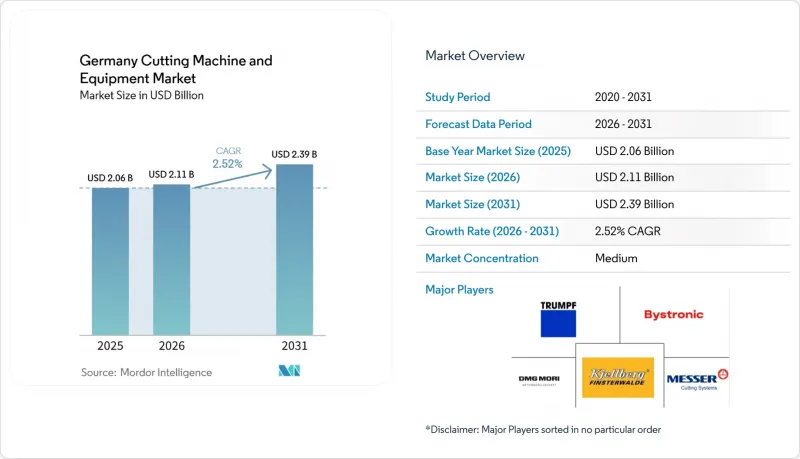
Mordor Intelligence에 의하면, 독일의 절단기 및 절단 장비 시장 규모는 2025년에 20억 6,000만 달러로 평가되었습니다. 2026년 21억 1,000만 달러, 2031년 23억 9,000만 달러에 이를 것으로 예측되며, 2026년부터 2031년에 걸쳐 CAGR 2.52%로 성장할 전망입니다.
본 보고서는 용도별(판금, 평판, 튜브·파이프, 구조용 강재, 기타), 기술별(레이저, 플라즈마, 워터젯, 기타), 자동화 수준별(수동, 반자동, 로봇/완전 자동), 최종 사용자 산업별(자동차, 항공우주 및 방위, 기타)로 분류되어 있습니다. 시장 전망은 금액(달러) 및 수량(단위)으로 제시되어 있습니다.
독일의 절단기 및 절단 장비 시장 동향과 인사이트
인더스트리 4.0 및 공장 자동화 도입 확대
독일의 절단기 및 절단 장비 시장은 생산 환경에서 시험 단계의 디지털화에서 플랜트 수준의 자동화로 명확하게 전환되고 있는 점으로부터 혜택을 받고 있습니다. 2026년 독일 기계 및 플랜트 제조업체 협회(German Machinery and Plant Manufacturers Association)가 실시한 조사에 따르면, 독일 기계 제조 기업의 80% 이상이 AI의 중요성이 점점 더 커지고 있다고 인식하고 있으며, 3분의 1 가까이가 이미 실제 생산 현장에서 AI 활용을 시작하여 적응형 제어 및 네트워크 연결을 통한 모니터링 기능을 갖춘 절단 시스템에 대한 수요를 뒷받침하고 있습니다. 동 조사에서는 엔지니어링 종사자를 대상으로 한 대규모 재교육 추진도 지적되고 있으며, 이를 통해 보다 고도화된 절단 플랫폼을 도입하기 위한 공장의 실무적 준비 태세가 향상되고 있습니다. 독일의 절단기 및 절단 장비 시장에서 이 점은 중요한 의미를 지닙니다. 가동률이 높은 상황에서는 네트워크로 연결된 절단 셀을 도입함으로써 레거시 시스템을 대체하는 경제적 이점이 줄어들기 때문입니다. 또한 구매자 측에는 자동화된 라인 레이아웃, 원격 모니터링 프로토콜, 최신 안전 구성에 부합하는 설비를 도입해야 한다는 더 큰 압박이 가해지고 있습니다. 이러한 요인들이 복합적으로 작용하여 많은 프로젝트에서 자동화는 단순한 옵션 업그레이드가 아닌 구매의 필수 요건이 되어가고 있습니다.
고정밀 레이저 절단 시스템에 대한 수요 증가
금속 가공 및 제조 분야의 품질 요건 강화 또한 독일의 절단기 및 절단 장비 시장을 견인하고 있습니다. 2025년에 보고된 조사에 따르면, 요구 사항이 까다로운 항공우주 및 자동차 분야에서 레이저를 이용한 제조는 기존 방식에 비해 생산 처리량을 최대 30%까지 향상시킬 수 있어, 이로 인해 정밀 절단 시스템의 보급이 가속화되고 있습니다. 주요 공급업체들은 연구 개발에 대한 막대한 투자를 지속하고 있으며, 이는 고효율 파이버 레이저 시스템과 자동 노즐 관리에 여전히 강력한 제품 개발 가치를 부여하고 있음을 보여줍니다. 또한, 2025년 독일의 한 시설에서 장갑용 탄도강 레이저 절단이 승인된 것은 레이저 가공이 더 엄격한 인증이 요구되는 방위 산업 분야로 진출하고 있음을 보여줍니다. 이에 따라 독일의 절단기 및 절단 장비 시장에서 고정밀도, 공정 안정성, 그리고 추적 가능한 절단 품질의 상업적 가치가 높아지고 있습니다. 또한 단순한 절단 속도보다 절단면 품질과 재현성을 중시하는 고객층에서 공차가 큰 플라즈마 및 화염 시스템의 대체가 가속화되고 있습니다.
높은 인건비 및 제조 운영 비용
독일의 절단기 및 절단 장비 시장은 높은 인건비, 사회보험료 및 일반적인 운영 경비로 인한 직접적인 압박에 직면해 있습니다. 2025년에 인용된 VDMA의 데이터에 따르면, 독일 기계·설비 부문의 고용자 수는 2025년 9월까지 2.4% 감소하여 약 100만 명으로 떨어졌습니다. 이는 단순한 단기적인 수요 감소가 아니라 구조적인 비용 문제를 반영한 것입니다. 또한 VDA는 2026년 보고서를 통해 자동차 부품 공급업체의 64%가 2025년에 독일 내 직원 수를 감축했으며, 87%가 그 주된 또는 매우 큰 원인으로 입지 경쟁력의 저하를 꼽았다고 밝혔습니다. 독일의 절단기 및 절단 장비 시장에서 이러한 상황은 갱신 프로젝트에 할당되는 자본 예산을 압박하고, 승인까지의 기간을 장기화시키고 있습니다. 여전히 신규 설비가 필요한 기업들은 가동 기간 전반에 걸쳐 노동 시간, 스크랩, 에너지 소비량을 줄일 수 있는 시스템을 더욱 중시하고 있습니다. 이 때문에 비록 소규모 구매 활동이라 하더라도 단순한 저비용 대체품이 아닌, 생산성이 높은 플랫폼으로 전환되고 있습니다.
부문 분석
2025년 기준, 판금은 시장의 43.5%를 차지하며 독일의 절단기 및 절단 장비 시장에서 가장 큰 용도 부문으로 자리 잡고 있습니다. 이러한 선도적 지위는 자동차 차체 구조, 전기 기기 케이스, HVAC 부품 및 일반 금속 가공 제품에 대한 안정적인 수요를 반영합니다. 이 부문은 독일의 주요 제조 지역에 널리 도입된 평판 절단 시스템의 도입 실적을 통해 혜택을 받고 있습니다. 또한, 산업 생산 분야에서 고처리량 레이저 절단 라인의 가장 확립된 이용 사례로 자리 잡고 있습니다. 신규 설비 증설이 제한적인 상황에서도, 교체 수요의 규모가 크기 때문에 판금 가공은 설비 투자의 중심적인 위치를 계속 차지하고 있습니다.
튜브·파이프는 가장 빠르게 성장하는 용도 부문으로, 2026년부터 2031년까지 연평균 성장률(CAGR) 3.1%로 확대될 것으로 예측됩니다. 이러한 성장은 재생에너지 시스템, 방위용 하드웨어 및 산업용 열교환기 생산에 따른 가공 수요 증가에 힘입은 것입니다. 판금에 비해 이 부문의 기반은 작지만, 단면 형상을 다용도로 활용하는 제조 분야에서 그 활용 사례가 점차 확대되고 있습니다. 구조용 튜브 어셈블리 및 중공 단면 부품으로의 전환 또한 고정밀 절단 시스템에 대한 수요를 높이고 있습니다. 그 결과, 독일의 절단기 및 절단 장비 시장에서는 판금이 판매 수량 면에서 여전히 주류를 이루는 한편, 튜브·파이프가 예측 기간 동안 더 강력한 성장세를 보일 것으로 예측됩니다.
2025년에는 레이저 기술이 50.2%의 점유율을 차지하며, 독일의 절단기 및 절단 장비 시장에서 가장 큰 기술 부문이 되었습니다. 이러한 주도적 지위는 판금, 튜브, 플레이트, 정밀 부품 등 폭넓은 용도에서의 활용에 반영되어 있습니다. 레이저 시스템이 선호되는 이유는 높은 절단 속도, 우수한 절단면 품질, 안정적인 가공, 그리고 자동화된 생산 라인과의 높은 호환성을 갖추고 있기 때문입니다. 또한, 이 부문은 파이버 레이저의 효율성 향상, 소프트웨어 통합, 그리고 더욱 스마트한 공정 제어에 대한 공급업체의 지속적인 투자의 혜택을 받고 있습니다. 이러한 요인들로 인해 레이저는 플라즈마, 워터젯, 화염 절단 및 기타 특수 기술에 비해 확실한 선두 위치를 유지하고 있습니다.
또한, 레이저는 가장 빠르게 성장하는 기술 분야이기도 하며, 2026년부터 2031년까지 연평균 성장률(CAGR) 3.7%로 확대될 것으로 예측됩니다. 이러한 성장은 구형 시스템을 고효율의 디지털 통합 플랫폼으로 대체하는 추세에 힘입고 있습니다. 이 기술은 조달 결정 시 더 엄격한 공차, 불량률 감소 및 에너지 효율이 중시되는 응용 분야에서 입지를 더욱 공고히 하고 있습니다. 플라즈마 및 워터젯은 두꺼운 재료나 온도에 민감한 용도에서 여전히 중요한 역할을 하고 있지만, 그 확대는 비교적 제한적일 것으로 예측됩니다. 이에 따라 레이저는 현재 독일의 절단기 및 절단 장비 시장 점유율 측면에서뿐만 아니라 향후 성장 측면에서도 중심적인 위치를 계속 차지하게 될 것입니다.
기타 혜택 :
- 엑셀 형식 시장 예측(ME) 시트
- 3개월간의 애널리스트 지원
자주 묻는 질문
목차
제1장 서론
제2장 조사 방법
제3장 주요 요약
제4장 시장 구도
제5장 시장 규모 및 성장 예측
제6장 경쟁 구도
제7장 시장 기회 및 향후 전망
KTH 26.08.10According to Mordor Intelligence, the Germany cutting machine and Equipment Market size is projected to be USD 2.06 billion in 2025, USD 2.11 billion in 2026, and reach USD 2.39 billion by 2031, growing at a CAGR of 2.52% from 2026 to 2031.
This report is Segmented by Application (Sheet Metal, Plate, Tube & Pipe, Structural Steel, and Others), by Technology (Laser, Plasma, Waterjet, and More), by Automation Level (Manual, Semi-Automated, and Robotic/Fully-automated), and by End-User Industry (Automotive, Aerospace & Defense, and More). The Market Forecasts are Provided in Terms of Value (USD) and Volume (Units).
Germany Cutting Machine and Equipment Market Trends and Insights
Growing Adoption of Industry 4.0 and Factory Automation
The Germany cutting machine and equipment market is benefiting from a clear shift from pilot-stage digitalization to plant-level automation in production environments. A German Machinery and Plant Manufacturers Association survey in 2026 showed that more than 80% of German mechanical engineering companies viewed AI as increasingly important, and close to one-third had already begun using AI in live production, supporting demand for cutting systems with adaptive controls and connected monitoring. The same body of research also pointed to a significant retraining push across the engineering workforce, which improves factories' practical readiness to adopt more advanced cutting platforms. In the Germany cutting machine and equipment market, this matters because connected cutting cells shorten the economic case for replacing legacy systems when utilization is high. Buyers are also under greater pressure to install equipment that aligns with automated line layouts, remote monitoring protocols, and modern safety configurations. That combination is making automation a purchasing requirement in many projects rather than an optional upgrade.
Rising Demand for High-Precision Laser Cutting Systems
Stricter quality requirements in metalworking and fabrication are also driving the Germany cutting machine and equipment market. Research reported in 2025 found that laser-based manufacturing can increase production throughput by up to 30% compared with conventional methods in demanding aerospace and automotive applications, supporting the broader use of precision cutting systems. Premium suppliers have continued investing heavily in research and development, indicating they still see strong product development value in higher-efficiency fiber laser systems and automated nozzle management. A 2025 approval for laser cutting of armor-grade ballistic steel at a German facility also showed that laser processing is moving into more tightly certified defense applications. In the Germany cutting machine and equipment market, this raises the commercial value of higher precision, process stability, and traceable cutting quality. It also speeds up the replacement of lower-tolerance plasma and flame systems in customer groups where edge quality and repeatability now matter more than simple cutting speed.
High Labor and Manufacturing Operating Costs
The Germany cutting machine and equipment market faces direct pressure from high labor costs, social charges, and general operating expenses. VDMA data referenced in 2025 showed that employment in Germany's machinery and equipment sector fell by 2.4% to nearly 1 million workers by September 2025, reflecting a structural cost problem rather than only a short-term demand decline. VDA also reported in 2026 that 64% of automotive suppliers reduced German headcount during 2025, and 87% cited weak location competitiveness as a major or very major cause. In the Germany cutting machine and equipment market, this reduces the capital budget available for replacement projects and extends approval timelines. Companies that still need new equipment are placing greater weight on systems that reduce labor hours, scrap, and energy intensity over the full operating life. This is why even modest purchasing activity is shifting toward higher-productivity platforms rather than simple low-cost substitutions.
Other drivers and restraints analyzed in the detailed report include:
- Strong Automotive and Industrial Machinery Manufacturing Base
- Expansion of Aerospace, Defense, and Engineering Applications
- Elevated Cost of Advanced Cutting Equipment
For complete list of drivers and restraints, kindly check the Table Of Contents.
Segment Analysis
Sheet metal accounted for 43.5% of the market in 2025, making it the largest application segment in the Germany cutting machine and equipment market. Its leading position reflects steady demand from automotive body structures, electrical enclosures, HVAC parts, and general fabricated metal products. This segment benefits from a wide installed base of flat sheet cutting systems across Germany's major manufacturing regions. It also remains the most established use case for high-throughput laser cutting lines in industrial production. The scale of replacement demand keeps sheet metal at the center of equipment spending even when new capacity additions remain selective.
Tube and pipe is the fastest-growing application segment and is projected to expand at a 3.1% CAGR during 2026-2031. Growth is supported by rising demand for fabrication in renewable energy systems, defense hardware, and industrial heat exchanger production. Compared with sheet metal, this segment is starting from a smaller base, but its use cases are broadening across profile-intensive manufacturing. The shift toward structural tube assemblies and hollow-section components is also improving demand for higher-precision cutting systems. As a result, the Germany cutting machine and equipment market is expected to retain sheet metal as the volume anchor, while tube and pipe delivers stronger growth momentum through the forecast period.
Laser technology held 50.2% share in 2025, making it the largest technology segment in the Germany cutting machine and equipment market. This leadership is reflected in its wide use across sheet metal, tube, plate, and precision component applications. Laser systems are preferred because they offer high cutting speed, high edge quality, consistent processing, and better compatibility with automated production setups. The segment has also benefited from continued supplier investment in fiber laser efficiency, software integration, and smarter process control. These factors have helped lasers maintain a clear lead over plasma, waterjet, flame, and other specialized technologies.
Laser is also the fastest-growing technology segment, projected to expand at a 3.7% CAGR during 2026-2031. Its growth is supported by replacing older systems with higher-efficiency, digitally integrated platforms. The technology is gaining further ground in applications where tighter tolerances, lower scrap, and energy performance matter more in procurement decisions. While plasma and waterjet remain relevant in thicker materials and temperature-sensitive applications, their expansion is expected to remain more limited. This keeps the laser at the center of both the current Germany cutting machine and equipment market share and future growth.
Complete Report Scope:
- By Application
- Sheet Metal
- Plate
- Tube & Pipe
- Structural Steel
- Others
- By Technology
- Laser
- Fiber
- CO2
- Others
- Plasma
- High-definition
- Conventional
- Waterjet
- Abrasive
- Pure
- Flame / Oxy-fuel
- Ultrasonic & Emerging
- Laser
- By Automation Level
- Manual
- Semi-automated
- Robotic / Fully-automated
- By End-User Industry
- Automotive
- Aerospace & Defense
- Electrical & Electronics
- Construction & Infrastructure
- Metal-Fabrication Job Shops
- Shipbuilding
- Energy & Power
- Others (Medical Devices, etc.)
List of Companies Covered in this Report:
- TRUMPF Group
- Messer Cutting Systems GmbH
- Kjellberg Finsterwalde Plasma und Maschinen GmbH
- DMG MORI AG
- Bystronic Deutschland GmbH
- Laserline GmbH
- Jenoptik AG
- LVD GmbH
- Precitec GmbH & Co. KG
- SCANLAB GmbH
- IPG Laser GmbH
- Kaltenbach GmbH
- MicroStep Europa GmbH
- LASERFACT GmbH
- Behringer GmbH
- AMADA GmbH
- ECKERT Cutting Technology GmbH
- HG Farley LaserLab Germany GmbH
- Coherent Germany GmbH
- ALPHA LASER GmbH
Additional Benefits:
- The market estimate (ME) sheet in Excel format
- 3 months of analyst support
TABLE OF CONTENTS
1 Introduction
- 1.1 Study Assumptions & Market Definition
- 1.2 Scope of the Study
2 Research Methodology
3 Executive Summary
4 Market Landscape
- 4.1 Market Overview
- 4.2 Market Drivers
- 4.2.1 Growing Adoption of Industry 4.0 and Factory Automation
- 4.2.2 Rising Demand for High-Precision Laser Cutting Systems
- 4.2.3 Strong Automotive and Industrial Machinery Manufacturing Base
- 4.2.4 Expansion of Aerospace, Defense, and Engineering Applications
- 4.2.5 Increasing Investment in Advanced Metal Processing Technologies
- 4.2.6 Focus on Energy-Efficient and Sustainable Manufacturing
- 4.3 Market Restraints
- 4.3.1 High Labor and Manufacturing Operating Costs
- 4.3.2 Elevated Cost of Advanced Cutting Equipment
- 4.3.3 Shortage of Skilled Technical Workforce
- 4.3.4 Economic Slowdown Affecting Industrial Investments
- 4.4 Value / Supply-Chain Analysis
- 4.5 Regulatory Landscape
- 4.6 Technological Outlook
- 4.7 Porter's Five Forces
- 4.7.1 Threat of New Entrants
- 4.7.2 Bargaining Power of Suppliers
- 4.7.3 Bargaining Power of Buyers
- 4.7.4 Threat of Substitutes
- 4.7.5 Industry Rivalry
- 4.8 Global Manufacturing-Sector Snapshot
- 4.9 Customer Purchasing Decision Analysis
- 4.10 Impact of Geopolitical Events on the market
5 Market Size & Growth Forecasts
- 5.1 By Application
- 5.1.1 Sheet Metal
- 5.1.2 Plate
- 5.1.3 Tube & Pipe
- 5.1.4 Structural Steel
- 5.1.5 Others
- 5.2 By Technology
- 5.2.1 Laser
- 5.2.1.1 Fiber
- 5.2.1.2 CO2
- 5.2.1.3 Others
- 5.2.2 Plasma
- 5.2.2.1 High-definition
- 5.2.2.2 Conventional
- 5.2.3 Waterjet
- 5.2.3.1 Abrasive
- 5.2.3.2 Pure
- 5.2.4 Flame / Oxy-fuel
- 5.2.5 Ultrasonic & Emerging
- 5.2.1 Laser
- 5.3 By Automation Level
- 5.3.1 Manual
- 5.3.2 Semi-automated
- 5.3.3 Robotic / Fully-automated
- 5.4 By End-User Industry
- 5.4.1 Automotive
- 5.4.2 Aerospace & Defense
- 5.4.3 Electrical & Electronics
- 5.4.4 Construction & Infrastructure
- 5.4.5 Metal-Fabrication Job Shops
- 5.4.6 Shipbuilding
- 5.4.7 Energy & Power
- 5.4.8 Others (Medical Devices, etc.)
6 Competitive Landscape
- 6.1 Market Concentration
- 6.2 Strategic Moves
- 6.3 Market Share Analysis
- 6.4 Company Profiles (Includes Global Level Overview, Market Level Overview, Core Segments, Financials as Available, Strategic Information, Products & Services, and Recent Developments)
- 6.4.1 TRUMPF Group
- 6.4.2 Messer Cutting Systems GmbH
- 6.4.3 Kjellberg Finsterwalde Plasma und Maschinen GmbH
- 6.4.4 DMG MORI AG
- 6.4.5 Bystronic Deutschland GmbH
- 6.4.6 Laserline GmbH
- 6.4.7 Jenoptik AG
- 6.4.8 LVD GmbH
- 6.4.9 Precitec GmbH & Co. KG
- 6.4.10 SCANLAB GmbH
- 6.4.11 IPG Laser GmbH
- 6.4.12 Kaltenbach GmbH
- 6.4.13 MicroStep Europa GmbH
- 6.4.14 LASERFACT GmbH
- 6.4.15 Behringer GmbH
- 6.4.16 AMADA GmbH
- 6.4.17 ECKERT Cutting Technology GmbH
- 6.4.18 HG Farley LaserLab Germany GmbH
- 6.4.19 Coherent Germany GmbH
- 6.4.20 ALPHA LASER GmbH
7 Market Opportunities & Future Outlook
- 7.1 White-Space & Unmet-Need Assessment