

|
시장보고서
상품코드
2099049
인도네시아의 거푸집 : 시장 점유율 분석, 업계 동향 및 통계, 성장 예측(2026-2031년)Indonesia Formwork - Market Share Analysis, Industry Trends & Statistics, Growth Forecasts (2026 - 2031) |
||||||
 Mordor Intelligence
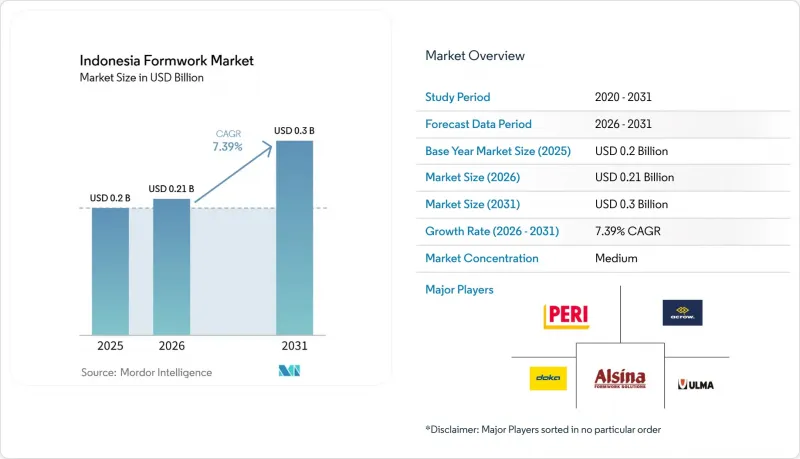
Mordor Intelligence에 의하면, 인도네시아의 거푸집 시장 규모는 2025년 2억 달러로 평가되었습니다. 2026년에는 2억 1,000만 달러로 확대되어 2026년부터 2031년에 걸쳐 CAGR 7.39%로 성장을 지속하여, 2031년에는 3억 달러에 이를 것으로 예측됩니다.
본 보고서는 유형(기존/전통형, 모듈형/시스템형), 구성(정형, 클라이밍형, 슬립폼형 등), 비즈니스 모델(판매, 임대), 부문(주택, 상업 등), 소재(목재/합판, 강철, 알루미늄, 플라스틱/유리섬유 등), 도시(자카르타, 수라바야, 반둥 등)별로 분류되어 있습니다. 시장 전망은 금액(달러) 기준으로 제시되어 있습니다.
인도네시아의 거푸집 시장 동향과 인사이트
교통·도시 개발 프로젝트에 따른 인프라 주도형 수요
인도네시아의 거푸집 시장은 도로, 대중교통, 교량, 수자원 관련 자산에 걸친 수요를 유지하기에 충분한 규모를 지속적으로 유지하고 있는 유틸리티 파이프라인에 힘입고 있습니다. 유틸리티부는 2026년도 예산을 118조 5,000억 루피아(73억 달러)로 확정했습니다. 이 중 45조 6,200억 루피아(28억 달러)가 도로망 정비에 배정되어, 이를 통해 건설업체들에게 토목 콘크리트 공사의 명확한 수주 전망이 제공되고 있습니다. 2025년부터 2029년에 걸친 인도네시아의 인프라 수요는 1,905조 3,000억 루피아(119억 1,000만 달러)로 추산되지만, 국가 예산은 그 금액의 불과 35.63%만을 충당하고 있기 때문에 건설 일정 측면에서 민간 및 PPP(민관협력)를 통한 시행이 여전히 중요한 역할을 하고 있습니다. 이러한 자금 조달 구조는 일련의 프로젝트 단계를 통해 장비를 지속적으로 배치할 수 있는 공급업체에게 유리합니다. 다중 패키지 계약에서는 유휴 시간이 줄어들고, 지속적인 납품이 높이 평가되기 때문입니다. 인도네시아의 거푸집 시장에서 이는 프로젝트 발주자가 여러 타설 및 작업 현장을 단일 공급업체에 지원받기를 원할 경우, 대형 렌탈 사업자가 소규모 지역 기업보다 더 쉽게 고객을 유지할 수 있음을 의미합니다. 또한 자바섬 및 일부 외딴 섬 지역에서 교통 인프라와 도시 개발 공사가 동시에 진행되고 있어, 수요 기반도 이전보다 분산되어 있습니다.
모듈형 및 시스템형 거푸집으로의 전환
인도네시아의 거푸집 시장은 항목별 자재 비용보다 프로젝트 총비용이 중시되는 추세로 바뀌면서, 모듈형 및 시스템형 솔루션으로 전환되고 있습니다. 2025년에는 모듈식/시스템식 거푸집이 수요의 58%를 차지했으며, 중견 건설업체에게도 반복적으로 건설되는 구조물에서 재사용의 경제성을 입증하기가 점점 더 쉬워지고 있습니다. 재사용 가능한 거푸집 패널은 일반적으로 50-200회의 재사용 주기를 달성할 수 있는 반면, 제재목은 대부분의 경우 10회 미만의 타설만 견딜 수 있어, 초대형 고층 빌딩 프로젝트를 앞두고 수명 주기 경제성을 대폭 향상시킬 수 있습니다. PERI 인도네시아가 2025년에 카라왕에 위치한 JKT09 데이터센터와 서자바의 인도네시아 은행 복합 시설에서 수행한 실적은 시스템 거푸집의 보급이 기존의 고층 건축 이용 사례를 넘어 산업 시설 및 공공시설 공사로까지 확대되고 있음을 보여줍니다. 와르마데와 대학이 2025년에 발표한 연구에서도 반복적인 보, 슬래브, 기둥 구조에서 알루미늄 거푸집은 기존 공법에 비해 사이클 타임 단축과 1회 타설당 인건비 절감을 실현한다는 사실이 밝혀졌습니다. 2029년까지 정부가 BIM의 보다 광범위한 도입을 지원하고 있는 점도 이러한 추세를 더욱 뒷받침하고 있습니다. 디지털 거푸집 계획을 통해 조정 주기가 단축되고, 상업적 제안에 엔지니어링 역량이 통합되기 때문입니다.
첨단 거푸집 시스템에 필요한 막대한 초기 투자
인도네시아의 거푸집 시장에서는 첨단 클라이밍 거푸집, 유압식 자동 승강 거푸집 및 터널용 시스템의 초기 비용이 여전히 큰 장벽으로 작용하고 있습니다. 많은 중견 건설업체들은 재사용 가능한 시스템의 수명 주기상 이점을 인식하고 있지만, 프로젝트 대금 회수가 지연될 경우 초기 도입 비용을 상쇄하기는 여전히 어렵습니다. 또한, 장비 자금 조달에는 계약서 체결이 요구되는 경우가 많아 자금 조달 수단도 제한적이며, 보다 기술적인 프로젝트에 입찰하는 건설업체의 경우 자격 요건을 충족하지 못하는 문제가 발생하고 있습니다. 게다가 규제 대상 프로젝트 범주에 속하는 구조용 제품의 경우, 공급업체가 SNI(인도네시아 국가 표준) 관련 요건을 충족해야 할 필요성이 점점 더 커지고 있어 규정 준수도 과제 중 하나가 되고 있습니다. 임대 서비스는 표준 용도에서의 부담을 줄이는 데 도움이 되지만, 연속적인 콘크리트 타설 사이에 유휴 상태가 될 가능성이 있는 특수 운반 장비나 유압 시스템과 관련된 경제적 과제를 완전히 해결해 주지는 못합니다. 인도네시아의 거푸집 시장에서는 이러한 이유로 재무 기반이 탄탄하고, 확립된 프로젝트 파이프라인을 보유하고 있거나, 국제적인 공급업체 네트워크의 지원을 받는 기업에서 도입률이 가장 높습니다.
부문 분석
2025년, 모듈식/시스템형 거푸집은 인도네시아의 거푸집 시장 점유율의 58%를 차지했으며, 이는 대형 건설사와 중견 기업 모두에서 채택이 확대되고 있음을 반영한 것입니다. 이러한 주도적인 지위는 공공 프로젝트에서 납기 단축에 대한 압박에 힘입은 것으로, 벽과 슬래브의 시공 주기가 반복되기 때문에 목재를 많이 사용하는 방식보다 재사용 가능한 시스템이 선호되고 있습니다. 기존/전통형은 여전히 저층 주택, 소규모 상업시설 및 많은 외딴 섬 프로젝트에서 사용되고 있으며, 작업자의 익숙함과 초기 비용의 저렴함이 실용적인 장점으로 남아 있습니다. 2025년 와르마데와 대학의 조사는 이러한 추세를 뒷받침하며, 알루미늄 거푸집이 기존 공법에 비해 반복적인 보, 슬래브, 기둥 시공에서 인건비를 절감하고 사이클 타임을 단축했음을 보여주었습니다. 또한, PERI Indonesia가 Two Sudirman Tower, 카라왕에 위치한 JKT09 데이터센터, 북자카르타의 Terminal Kalibaru 프로젝트에 도입한 사례를 통해 단일 모듈식 플랫폼이 주거, 산업, 해양 등 다양한 용도에 동시에 활용될 수 있음이 입증되었습니다.
인도네시아의 거푸집 업계는 규제 및 계획 수립 관행이 같은 방향으로 나아감에 따라, 앞으로도 모듈식 시스템으로의 전환을 계속할 것으로 보입니다. 유틸리티부는 지난 10년 동안 BIM의 보다 광범위한 도입을 추진해 왔으며, 대규모 프로젝트의 준비 및 심사 과정의 일환으로 상세한 거푸집 계획이 포함되도록 하고 있습니다. 입찰 단계의 계획에 거푸집 레이아웃을 포함시키는 건설사는 콘크리트 타설 시작 전에 조정상의 실수를 줄일 수 있으며, 이를 통해 사이클 타임을 단축할 수 있습니다. 기존 시스템은 소규모 현장이나 물류가 여전히 어려운 지역의 비용 구조에 적합하기 때문에 사라지지는 않을 것으로 예측됩니다. 그러나 더 많은 프로젝트에서 재현성, 공정 관리 및 기술 지원이 우선시됨에 따라, 2031년까지 인도네시아의 거푸집 시장의 가치 구성은 모듈식 제품 및 시스템 제품으로 더욱 전환될 전망입니다.
2025년에는 고정식 거푸집이 수요의 46%를 차지하며, 슬래브, 평면 공사, 기초 및 일회성 타설 등의 용도에서 주요 구성 요소가 되었습니다. 이러한 높은 점유율은 많은 프로젝트에서 일정 및 비용 목표를 달성하기 위해 여전히 재배치 시스템이나 수직 클라이밍 솔루션이 필요하지 않았다는 사실에 기인합니다. 클라이밍 형식은 2031년까지 연평균 성장률(CAGR)이 8.54%로 가장 빠르게 성장하는 구성 요소이며, 인도네시아의 거푸집 시장의 두 가지 서로 다른 프로젝트 흐름에 의해 주도되고 있습니다. 하나는 자카르타의 고층 주거 및 상업 타워에서 발생하는 수요입니다. 대조적으로, 다른 하나는 MRT(Mass Rapid Transit) 역, 터널, 배수로, 유틸리티 복도 등 샤프트 공사의 비중이 높은 유틸리티에서 수요입니다. MRT 2A 단계 패키지가 현재 가장 대표적인 사례입니다. 이는 지하 역의 경우, 표준 플랫폼 시스템으로는 제공할 수 없는 치수 관리 및 심부 작업 능력이 요구되기 때문입니다.
슬립폼 및 터널용 시스템은 그 시공량이 여전히 소규모이지만, 일단 시공 방법이 결정되면 대체하기 어려운 위치를 차지하고 있습니다. 사일로, 특정 터널 요소, 유틸리티 복도 등의 연속 타설 구조물은 중단이나 재시공을 피하기 위해 이러한 시공 방법에 의존하고 있습니다. 2026년 5월 IKN 멀티 유틸리티 터널에서 WIKA가 슬라이딩 거푸집을 채택한 것은 공공 부문에서 주목할 만한 실적 사례가 되었습니다. 이 사례는 기술적으로 어려운 현장에서 특수 시스템이 공사 기간 측면에서 이점을 가져다준다는 것을 입증했습니다. 인도네시아의 거푸집 시장에서 이는 중요한 의미를 지닙니다. 왜냐하면 공공 부문의 실적 사례는 제품 카탈로그의 광고 문구보다 향후 사양 선정에 더 큰 영향을 미치는 경우가 많기 때문입니다. 터널, 교통 시설, 고층 건축물 등의 인프라 프로젝트가 진행됨에 따라, 설치량 측면에서는 고정식 거푸집이 여전히 가장 큰 비중을 차지하겠지만, 클라이밍 거푸집이나 특수 구조의 거푸집이 고부가가치 공사에서 더 큰 점유율을 차지하게 될 것입니다.
기타 혜택 :
- 엑셀 형식 시장 예측(ME) 시트
- 3개월간의 애널리스트 지원
자주 묻는 질문
목차
제1장 서론
제2장 조사 방법
제3장 주요 요약
제4장 시장 구도
제5장 시장 규모 및 성장 예측
제6장 경쟁 구도
제7장 시장 기회 및 향후 전망
KTH 26.08.10According to Mordor Intelligence, the Indonesia formwork market size is expected to grow from USD 0.2 billion in 2025 to USD 0.21 billion in 2026 and is forecast to reach USD 0.3 billion by 2031 at 7.39% CAGR over 2026-2031.
This report is Segmented by Type (Conventional /Traditional and Modular / System Formwork), Configuration (Static, Climbing, Slipform, and More), Business Model (Sales and Rental), Sector (Residential, Commercial, and More), Material (Timber / Plywood, Steel, Aluminum, Plastic/Fiberglass and More), and City (Jakarta, Surabaya, Bandung, and More). The Market Forecasts are Provided in Terms of Value (USD).
Indonesia Formwork Market Trends and Insights
Infrastructure-Backed Demand from Transport and Urban Projects
The Indonesia formwork market is supported by a public works pipeline that remains large enough to sustain demand across roads, transit, bridges, and water-related assets. The Ministry of Public Works finalized a 2026 budget of IDR 118.5 trillion (USD 7.3 billion). It allocated IDR 45.62 trillion (USD 2.8 billion) to road connectivity alone, providing contractors with a clear order flow for civil concrete works. Indonesia's infrastructure requirements for 2025 to 2029 were estimated at IDR 1,905.3 trillion (USD 119.1 billion), and the state budget covers only 35.63% of that amount, so private and PPP execution still matter for the construction calendar. That funding structure benefits suppliers that can keep fleets deployed across sequential project phases, because multi-package contracts reduce idle time and reward delivery continuity. In the Indonesian formwork market, this means large rental operators can defend accounts more easily than smaller local firms when project owners want a single supplier to support multiple pours and work fronts. The demand base is also less concentrated than before, as transport and urban works are progressing simultaneously across Java and selected outer-island locations.
Shift Toward Modular and System Formwork
The Indonesia formwork market is moving toward modular and system solutions because the total project cost is becoming more important than line-item material cost. Modular / system formwork held 58% of demand in 2025, and the reuse economics are becoming easier for mid-tier contractors to justify for repetitive structures. Reusable formwork panels can typically achieve 50 to 200 reuse cycles, while sawn timber often remains below 10 pours, significantly improving lifecycle economics well before very large tower projects. PERI Indonesia's 2025 references at the JKT09 Data Center in Karawang and the Bank Indonesia complex in West Java show that system penetration now extends beyond traditional high-rise use cases into industrial and institutional work. A 2025 study published by Universitas Warmadewa also found that aluminum formwork delivered faster cycle times and lower labor costs per pour than conventional methods on repetitive beam, slab, and column structures. Government support for wider BIM adoption by 2029 further strengthens this trend, as digital formwork planning shortens coordination cycles and embeds engineering capability into the commercial offer.
High Initial Capital Requirement For Advanced Formwork Systems
The Indonesia formwork market still faces a meaningful barrier from the upfront cost of advanced climbing, hydraulic self-climbing, and tunnel-oriented systems. Many mid-tier contractors can see the lifecycle benefits of reusable systems, but the initial mobilization cost remains difficult to absorb when project cash collection is delayed. Access to financing is also limited because equipment lending often requires signed contracts, creating a qualification gap for contractors bidding on more technical projects. Compliance adds another layer, since suppliers increasingly need to meet SNI (Standar Nasional Indonesia)-related expectations for structural products in regulated project categories. Rental helps reduce the burden for standard applications, but it does not fully solve the economics of specialized carriers and hydraulic systems that can remain idle between sequential pours. In the Indonesia formwork market, this keeps adoption highest among firms with stronger balance sheets, established project pipelines, or support from international supplier networks.
Other drivers and restraints analyzed in the detailed report include:
- Rising Adoption of Rental-Based Procurement
- Specialized Formwork Need For Tunnels, Bridges, and Transit Corridors
- Raw Material Price Volatility in Steel, Aluminum, and Timber
For complete list of drivers and restraints, kindly check the Table Of Contents.
Segment Analysis
Modular / system formwork held 58% of the Indonesia formwork market share in 2025, which reflected widening adoption among both large contractors and mid-tier firms. The leading position was supported by tighter delivery schedules on public projects, where repeatable wall and slab cycles favor reusable systems over timber-heavy setups. Conventional / traditional formwork still served low-rise housing, small commercial work, and many outer-island projects, where crew familiarity and low upfront costs remained practical advantages. The 2025 Universitas Warmadewa study reinforced that direction, showing that aluminum formwork reduced labor costs and improved cycle times for repetitive beam, slab, and column work compared with conventional methods . PERI Indonesia's deployments across the Two Sudirman Tower, the JKT09 Data Center in Karawang, and the Terminal Kalibaru project in North Jakarta also demonstrated that a single modular platform can serve residential, industrial, and marine applications simultaneously.
The Indonesia formwork industry is likely to continue shifting toward modular systems as compliance and planning practices move in the same direction. The Ministry of Public Works is advancing broader BIM adoption throughout the current decade, making detailed formwork planning part of the preparation and review of larger projects. Contractors who include formwork layouts in tender-stage planning can reduce coordination errors before concrete placement begins, thereby supporting shorter cycle times. Conventional systems are not expected to disappear, as they still align with the cost profile of smaller sites and areas where logistics remain difficult. Even so, the value mix in the Indonesia formwork market is likely to move further toward modular and system products through 2031 as more projects prioritize repeatability, schedule control, and engineering support.
Static formwork accounted for 46% of demand in 2025, making it the leading configuration for applications such as slabs, flatwork, foundations, and single-repetition pours. Its large base came from the fact that many projects still did not need repositioning systems or vertical climbing solutions to meet schedule and cost targets. Climbing formwork is the fastest-growing configuration with an 8.54% CAGR through 2031, driven by two different project streams in the Indonesia formwork market. One stream comes from high-rise residential and commercial towers in Jakarta. In contrast, the other comes from shaft-heavy public works such as Mass Rapid Transit (MRT) stations, tunnels, spillways, and utility corridors. The MRT Phase 2A package is the clearest current example, because underground stations require dimensional control and working-at-depth capabilities that standard flat-form systems cannot provide.
Slipform and tunnel systems remain smaller in volume, but they occupy positions that are difficult to replace once the project method has been set. Continuous-pour structures such as silos, selected tunnel elements, and utility corridors depend on those methods to avoid interruptions and rework. WIKA's use of sliding formwork at the IKN Multi Utility Tunnel in May 2026 provided a visible public-sector reference. It demonstrated that specialized systems deliver schedule benefits on technically demanding sites. That matters for the Indonesia formwork market because public references often influence future specification choices more than product catalog claims. As tunnel, transit, and high-rise infrastructure projects move forward, climbing and specialized configurations are likely to take a larger share of higher-value work even if static formwork remains the largest by installed volume.
Complete Report Scope:
- By Type
- Conventional / Traditional
- Modular / System Formwork
- By Configuration
- Static
- Climbing
- Slipform
- Tunnel
- By Business Model
- Sales
- Rental
- By Sector
- Residential
- Commercial
- Industrial and Logistics
- Infrastructure
- By Material
- Timber / Plywood
- Steel
- Aluminum
- Plastic / Fiberglass
- Other Materials
- By City
- Jakarta
- Surabaya
- Bandung
- Medan
- Rest of Indonesia
List of Companies Covered in this Report:
- PERI SE
- Doka GmbH
- ULMA Construction
- Acrow Formwork and Construction Services Ltd.
- Alsina Formwork
- PASCHAL-Werk G. Maier GmbH
- MEVA Schalungs-Systeme GmbH
- Faresin Formwork S.p.A.
- Kumkang Kind Co., Ltd.
- NOE-Schaltechnik GmbH
- PERI Indonesia
- PT. Tangga Mas Jaya Makmur
- ALCA Metals (PT. ALFO CITRA ABADI)
- Indosteger
- Lianggong Formwork Co., Ltd.
- KMF Co., Ltd
- PT. Cokrosoemitro Wirast Utama
- PT. Waskita Beton Precast Tbk
- PT. Wijaya Karya Beton Tbk
- PT. Adhi Persada Beton
Additional Benefits:
- The market estimate (ME) sheet in Excel format
- 3 months of analyst support
TABLE OF CONTENTS
1 Introduction
- 1.1 Study Assumptions And Market Definition
- 1.2 Scope Of The Study
2 Research Methodology
3 Executive Summary
4 Market Landscape
- 4.1 Market Overview
- 4.2 Market Drivers
- 4.2.1 Infrastructure-Backed Demand From Transport and Urban Projects
- 4.2.2 Shift Toward Modular and System Formwork
- 4.2.3 Rising Adoption of Rental-Based Procurement
- 4.2.4 Specialized Formwork Need For Tunnels, Bridges, and Transit Corridors
- 4.2.5 Demand From High-Rise Residential Construction
- 4.2.6 Labor Productivity Pressure and Skilled Worker Shortages
- 4.3 Market Restraints
- 4.3.1 High Initial Capital Requirement For Advanced Formwork Systems
- 4.3.2 Raw Material Price Volatility in Steel, Aluminum, and Timber
- 4.3.3 Logistics and Handling Complexity Outside Major Demand Centers
- 4.3.4 Uneven Contractor Awareness and Training Gaps
- 4.4 Value and Supply-Chain Analysis
- 4.5 Regulatory Landscape
- 4.6 Technological Outlook
- 4.7 Cost Structure Analysis
- 4.8 Porter's Five Forces Analysis
- 4.8.1 Threat of New Entrants
- 4.8.2 Bargaining Power of Suppliers
- 4.8.3 Bargaining Power of Buyers
- 4.8.4 Threat of Substitutes
- 4.8.5 Intensity of Competitive Rivalry
- 4.9 Impact of Geopolitics
- 4.9.1 Raw Material Price Volatility
- 4.9.2 Supply Chain Disruptions and Longer Lead Times
- 4.9.3 Rising Energy and Logistics Costs
- 4.9.4 Infrastructure, Energy Security, and Defense-Led Demand
5 Market Size and Growth Forecasts
- 5.1 By Type
- 5.1.1 Conventional / Traditional
- 5.1.2 Modular / System Formwork
- 5.2 By Configuration
- 5.2.1 Static
- 5.2.2 Climbing
- 5.2.3 Slipform
- 5.2.4 Tunnel
- 5.3 By Business Model
- 5.3.1 Sales
- 5.3.2 Rental
- 5.4 By Sector
- 5.4.1 Residential
- 5.4.2 Commercial
- 5.4.3 Industrial and Logistics
- 5.4.4 Infrastructure
- 5.5 By Material
- 5.5.1 Timber / Plywood
- 5.5.2 Steel
- 5.5.3 Aluminum
- 5.5.4 Plastic / Fiberglass
- 5.5.5 Other Materials
- 5.6 By City
- 5.6.1 Jakarta
- 5.6.2 Surabaya
- 5.6.3 Bandung
- 5.6.4 Medan
- 5.6.5 Rest of Indonesia
6 Competitive Landscape
- 6.1 Market Concentration
- 6.2 Strategic Moves
- 6.3 Market Share Analysis
- 6.4 Company Profiles (Includes Global Level Overview, Market Level Overview, Core Segments, Financials as Available, Strategic Information, Products & Services, and Recent Developments)
- 6.4.1 PERI SE
- 6.4.2 Doka GmbH
- 6.4.3 ULMA Construction
- 6.4.4 Acrow Formwork and Construction Services Ltd.
- 6.4.5 Alsina Formwork
- 6.4.6 PASCHAL-Werk G. Maier GmbH
- 6.4.7 MEVA Schalungs-Systeme GmbH
- 6.4.8 Faresin Formwork S.p.A.
- 6.4.9 Kumkang Kind Co., Ltd.
- 6.4.10 NOE-Schaltechnik GmbH
- 6.4.11 PERI Indonesia
- 6.4.12 PT. Tangga Mas Jaya Makmur
- 6.4.13 ALCA Metals (PT. ALFO CITRA ABADI)
- 6.4.14 Indosteger
- 6.4.15 Lianggong Formwork Co., Ltd.
- 6.4.16 KMF Co., Ltd
- 6.4.17 PT. Cokrosoemitro Wirast Utama
- 6.4.18 PT. Waskita Beton Precast Tbk
- 6.4.19 PT. Wijaya Karya Beton Tbk
- 6.4.20 PT. Adhi Persada Beton
7 Market Opportunities and Future Outlook
- 7.1 White-Space and Unmet-Need Assessment


