

|
시장보고서
상품코드
2099289
의료 및 생명과학 분야 현장 근로자 기술 시장 : 시장 점유율 분석, 업계 동향 및 통계, 성장 예측(2026-2031년)Frontline Worker Technology In Healthcare and Life Sciences - Market Share Analysis, Industry Trends & Statistics, Growth Forecasts (2026 - 2031) |
||||||
 Mordor Intelligence
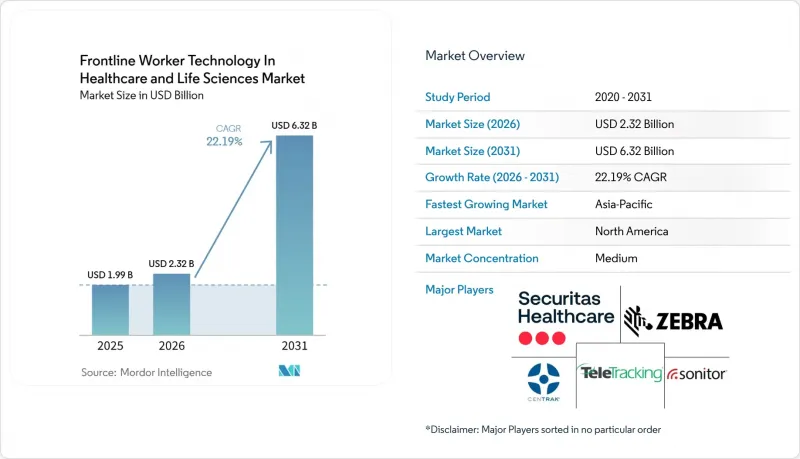
Mordor Intelligence에 의하면, 의료 및 생명과학 분야 현장 근로자 기술 시장 규모는 2025년 19억 9,000만 달러로 평가되었고, 2026년에는 23억 2,000만 달러로 확대될 것으로 추정되며, 2031년까지 63억 2,000만 달러에 이를 것으로 예측됩니다.
2026-2031년 연평균 성장률(CAGR) 22.19%로 성장할 것으로 전망됩니다.

본 보고서는 구성 요소별(소프트웨어 및 서비스), 도입 형태별(클라우드 기반, 하이브리드형, 온프레미스형), 조직 규모별(대기업 등), 용도별(직원 간 커뮤니케이션 및 참여도 향상 등), 최종 사용자 산업별(병원 및 의료 시스템 등), 지역별로 분류되어 있습니다. 시장 전망은 금액(달러) 기준으로 제시되어 있습니다.
세계의 의료 및 생명과학 분야 현장 근로자 기술 시장 동향 및 인사이트
핸즈프리 임상 워크플로우 도구의 도입 확대
간호사 및 케어 팀은 환자 대응 업무에서 벗어나지 않고도 정보를 신속하게 기록할 수 있는 방법이 필요하기 때문에 핸즈프리 워크플로우 지원은 의료 및 생명과학 분야 현장 근로자 기술 시장의 실질적인 핵심으로 자리 잡고 있습니다. 2026년 『JMIR Nursing』 저널에 게재된 연구에 따르면, 음성 인식과 대규모 언어 모델을 기반으로 한 음성 기반 간호 기록 시스템은 구조화된 기록 생성에서 F1 점수 0.82를 달성하여 일상적인 간호 업무에서 기록 작성의 부담을 경감시킨 것으로 나타났습니다. 이 결과는 중요한 의미를 지닙니다. 기록의 질과 속도는 교대 인계, 진료 기록의 완전성, 간병 연계에 영향을 미치기 때문에 의료 및 생명과학 분야 현장 근로자 기술 시장에서는 기능의 다양성보다 병상에서의 사용 편의성이 더 중요하기 때문입니다. 도이치 텔레콤은 2025년, 독일 내 데이터센터에서 병상에서의 음성 받아쓰기와 구조화된 보고서 생성을 가능하게 하는 AI 기반 간호 기록 솔루션을 발표했습니다. 이는 핸즈프리 기록 작성이 단순한 소비자용 부가 기능으로 취급되는 것이 아니라, 엄격한 의료 데이터 취급 요건에 부합해 가고 있음을 보여줍니다. 메이요 클리닉도 2025년에 유사한 방향성을 제시하며, 자사의 전자건강기록(EHR)에 통합된 간호사용 가상 비서를 도입했습니다. 이는 임상 팀이 독립적인 독립형 용도이 아닌, 일상적인 간호 현장에서 이미 사용되고 있는 기록 시스템에 적합한 도구를 원하고 있음을 강조하는 것입니다. 그 결과, 의료 및 생명과학 분야 현장 근로자 기술 시장에서는 워크플로우의 연속성과 임상 관리를 유지하면서 수동 입력을 줄여주는 솔루션이 주류를 이루고 있습니다.
인력 부족의 압박과 번아웃 완화의 시급성
의료 및 생명과학 분야 현장 근로자 기술 시장에서 가장 뚜렷한 성장 요인 중 하나로 여전히 인력 부족이 꼽힙니다. 이는 의료 제공업체들이 최소한의 인력과 막대한 문서 작성 요구 속에서 돌봄 제공을 안정화하려 노력하고 있기 때문입니다. 2025년, 인크레더블 헬스(Incredible Health)는 미국 내 100만 명 이상의 간호 전문직 데이터를 바탕으로, 간호사의 71%가 인력 부족이 치료의 질을 저하시키고 있다고 응답했다고 보고했습니다. 이러한 압박은 디지털 투자에 대한 평가 기준을 변화시키고 있습니다. 워크플로우 도구는 더 이상 효율성 향상뿐만 아니라, 직원 유지율 향상, 피할 수 있는 업무 부담 경감, 그리고 더 안전한 인력 배치 선택을 지원하는 능력으로도 평가받게 되었기 때문입니다. 의료 및 생명과학 분야 현장 근로자 기술 시장에서는 이로 인해 결근이나 이직 문제로 발전하기 전에 관리자가 스트레스 요인을 파악하는 데 도움이 되는 스케줄링 도구, 워크플로우 조정, 모바일 기록 및 분석 도구에 대한 관심이 높아지고 있습니다. 병원, 진료소, 재택 간호 사업에서도 유사한 추세가 나타나고 있습니다. 어느 현장이든 품질 및 규정 준수 기준을 충족하면서 더 짧은 시간 내에 더 많은 업무를 처리해야 하는 직원들에게 의존하고 있기 때문입니다. 이 때문에 의료 및 생명과학 분야 현장 근로자 기술 시장에서는 의료 제공업체의 예산이 엄격하게 관리되는 상황에서도 폭넓은 수요가 유지되고 있습니다.
임상 및 규제 환경에서의 높은 검증 부담
의료 및 생명과학 분야 현장 근로자 기술 시장에서 검증은 여전히 큰 제약 요인으로 작용하고 있습니다. 이는 의료용 도구가 문서화의 품질, 신뢰성, 그리고 기기의 작동 방식이 치료 결정에 영향을 미칠 수 있는 환경에서 사용되기 때문입니다. 2026년 FDA 품질 관리 시스템 규정에 대한 해설에 따르면, 해당 규정은 ISO 13485:2016을 반영하여 의료기기의 품질 프레임워크 내에 사이버 보안 검증을 포함하도록 명확히 하고 있으며, 이로 인해 커넥티드 임상 소프트웨어 및 웨어러블 기기에 대한 규정 준수 기준이 강화되었습니다. 이는 중요한 점입니다. 왜냐하면 워크플로우상 가치가 높은 제품이라 하더라도, 병원이 조달 전에 설계 관리, 시험 절차, 위험 관리에 대한 증거를 요구할 경우 도입 주기가 장기화될 가능성이 있기 때문입니다. 의료 및 생명과학 분야 현장 근로자 기술 시장에서는 이러한 부담으로 인해, 확립된 품질 시스템, 충실한 규제 관련 문서, 그리고 입원 환자를 위한 검증 요건을 이해하는 도입 팀을 보유한 벤더가 유리한 경향을 보입니다. 소규모 벤더도 여전히 경쟁력을 갖추고 있지만, 규제가 엄격한 의료 기관에 진입하는 데는 시간이 걸리며, 우선 복잡성이 낮은 환경부터 침투해 나가는 경우가 많을 것입니다. 그 결과, 규정 준수 준비 상황은 수익화까지 걸리는 기간뿐만 아니라, 어떤 이용 사례나 고객층에 먼저 도달할 수 있는지에 대해서도 영향을 미칩니다.
부문 분석
2025년에는 소프트웨어가 시장의 81.22%를 차지했으며, 의료 및 생명과학 분야 현장 근로자 기술 시장에서 핵심적인 상용 계층이 되었습니다. 이러한 우위는 워크플로우 용도, 커뮤니케이션 플랫폼, 분석 대시보드, 문서화 도구가 대규모 하드웨어 교체 주기를 기다리지 않고 기존 기기에서 도입될 수 있음을 반영합니다. 또한, 병원이나 케어 네트워크는 일반적으로 더 광범위한 기기나 인프라 변경에 착수하기 전에 눈에 띄는 워크플로우 개선 효과를 요구합니다. 따라서 많은 의료 제공 기관에서 소프트웨어는 여전히 가장 먼저 구매되는 제품으로 남아 있습니다. 의료 및 생명과학 분야 현장 근로자 기술 시장에서 이러한 경향은 소프트웨어 벤더에게 고객 계정 내에서 초기 입지를 확보하게 하며, 장기적으로 모듈을 확장할 수 있는 폭넓은 기회를 제공합니다. 또한, 제공되는 서비스의 다른 부분이 중요성을 더해가고 있음에도 불구하고 시장이 여전히 소프트웨어에 강하게 집중되어 있는 이유도 이 점에 기인합니다.
서비스 부문은 2031년까지 연평균 성장률(CAGR) 23.14%를 나타낼 것으로 예측되며, 이 시장에서 가장 빠르게 성장하는 부문이 될 전망입니다. 이러한 성장 속도는 도입상의 문제가 단순히 제품 기능의 부족에 있는 것이 아니라, 워크플로우 설계, 교육, 통합 및 변경 관리에 기인하는 경우가 많다는 인식이 의료 제공업체들 사이에서 높아지고 있음을 시사합니다. 2026년 『BMC Health Services Research』 저널에 발표된 체계적 문헌 고찰에 따르면, EHR 도입을 성공시키기 위해서는 테크노스트레스, 워크플로우에 미치는 영향, 그리고 업무의 동적 특성이 핵심 요소임이 밝혀졌습니다. 이는 임상 현장에서 보다 심층적인 도입 지원이 필요함을 뒷받침합니다. 의료 및 생명과학 업계의 현장 종사자들에게 있어, 서비스는 도구를 인력 배치 모델, 임상적 역할 및 현지 업무 절차에 부합하도록 조정함으로써 소프트웨어를 일상적인 실무에 정착시키는 데 도움을 줍니다. 의료 서비스 제공업체들은 단순히 플랫폼에 대한 접근 권한을 원하는 것이 아니라 측정 가능한 워크플로우 개선을 원하기 때문에 앞으로도 서비스 제공 수준은 경쟁상의 차별화 요인으로 남아 있을 것입니다.
2025년에는 클라우드 기반 도입이 78.61%의 점유율을 차지했으며, 의료 및 생명과학 분야 현장 근로자 기술 시장에서 하이브리드형이나 온프레미스형을 크게 앞질렀습니다. 이러한 우위는 분산된 팀이 근무 교대나 진료 장소에 관계없이 최신 일정, 업무, 알림 및 문서에 접근해야 하므로, 실시간 협업에 대한 실질적인 필요성을 반영하고 있습니다. 또한 클라우드 기반 도입은 자본 요건을 줄이고 대규모 인프라 개편 없이 기능을 추가할 수 있어, 많은 의료 현장의 예산 편성 경향에도 더 잘 부합합니다. 의료 및 생명과학 분야 현장 근로자 기술 시장에서 이러한 유연성은 의료 기관이 공유 운영 모델을 통해 시설 내 팀과 현장 팀 모두를 지원하는 경우에 특히 유용합니다. 그 결과, 클라우드 아키텍처는 더 이상 틈새 선택지로 간주되지 않으며, 신규 도입 시 표준적인 출발점으로 점점 더 자리 잡고 있습니다.
이 부문은 2031년까지 연평균 성장률(CAGR) 24.39%를 나타낼 것으로 예측되며, 규모와 성장세 양면에서 시장을 주도하고 있습니다. 이러한 조합은 신규 구매자나 기존 고객이 기존의 호스팅 모델로 되돌아가지 않고 여전히 같은 방향으로 나아가고 있음을 보여줍니다. 서비스 제공업체들은 더 신속한 도입, 더 쉬운 업데이트, 그리고 더 광범위한 모바일 접근성을 원하고 있으며, 이러한 요구 사항은 의료 및 생명과학 분야 현장 근로자 기술 시장에서 클라우드 주도형 플랫폼 설계와 밀접하게 부합합니다. 데이터 저장 위치, 레거시 시스템 또는 내부 거버넌스상의 사정으로 인해 전환 속도를 늦춰야 하는 상황에서는 하이브리드 도입이 여전히 일정한 역할을 수행하고 있습니다. 하지만 전반적인 추세로는 커뮤니케이션, 분석, 일정 관리 및 현장 업무 수행 도구의 기반으로서 클라우드 네이티브 운영 모델이 선호되는 방향으로 나아가고 있습니다.
지역별 분석
2025년, 북미는 시장의 41.11%를 차지했으며, 의료 및 생명과학 분야 현장 근로자 기술 시장에서 가장 규모가 큰 지역 기반을 형성했습니다. 이 지역은 병원 내 활발한 기술 투자, 전자 건강 기록의 보급, 그리고 심각한 인력 부족으로 인해 현장 생산성이 단순한 IT 문제가 아닌 전략적 과제로 대두되고 있다는 점에서 혜택을 보고 있습니다. 또한, 이 지역에는 대규모 엔터프라이즈 의료 시스템 도입 기반이 마련되어 있어, 초기 이용 사례를 통해 운영상의 가치가 입증되면 워크플로우, 문서 관리, 인력 배치 용도의 광범위한 확장을 지원할 수 있습니다. 의료 및 생명과학 분야 현장 근로자 기술 시장에서 이러한 구조는 대규모 시스템 내에서의 반복적인 도입과, 보다 전문적인 용도에 대한 지속적인 수요를 모두 뒷받침하고 있습니다. 보안 및 규정 준수 심사가 엄격해지고 있음에도 불구하고, 북미는 여전히 단기적으로 가장 확실한 수익원입니다.
유럽은 의료 제공업체의 자금 조달 모델, 데이터 규제, 도입 속도가 국가마다 다르기 때문에 중요하기는 하지만 상황이 제각각인 시장입니다. 독일에서는 병원의 디지털화에서 눈에 띄는 진전이 나타나고 있으며, 2025년 에반겔리셰스 크란켄하우스 베젤(Evangelisches Krankenhaus Wesel)에 도입된 폐쇄형 약물 관리 시스템은 의료 현장에서 현장 문서화와 투약 프로세스가 더욱 긴밀하게 연계되고 있음을 보여주었습니다. 또한, 도이치 텔레콤이 2025년에 발표한 AI 기반 간호 기록 솔루션은 유럽의 의료 제공업체들이 각국의 데이터 처리 관련 기대에 부응하는 병상 옆 생산성 향상 도구를 추구하고 있음을 보여줍니다. 이는 유럽의 의료 및 생명과학 분야 현장 종사자용 기술 시장이 큰 관심을 받으며 발전하고 있는 한편, 지역 실정에 맞는 도입 모델과 거버넌스 적합성이 더욱 중시되고 있음을 의미합니다.
아시아태평양은 2031년까지 연평균 성장률(CAGR) 27.99%를 나타낼 것으로 예측되며, 의료 및 생명과학 분야 현장 근로자 기술 시장에서 가장 빠르게 성장하고 있는 지역 부문입니다. 중국의 국가위생건강위원회를 비롯한 각 부처는 2025년 말에 ‘AI+의료’에 관한 시행 지침을 발표하여, 향후 수년 동안 AI를 활용한 진단 및 워크플로우의 적용 범위를 보다 견고한 정책적 기반 위에 놓았습니다. 또한 중국에서는 2026년에 병원 내 대규모 도입이 진행되어, 장시성 상야병원에 AI 기반 환자 안내 에이전트 시스템 등이 도입됨에 따라 현장용 AI가 운영 단계로 한 걸음 더 나아가고 있음을 보여주었습니다. 인도 및 동남아시아 역시 스마트폰 주도형 워크플로우와 원격의료 인프라가 커뮤니케이션, 일정 관리, 현장 종사자 조정을 위한 실질적인 진입점을 창출하고 있어 이 지역의 전망을 뒷받침하고 있습니다. 중동 및 아프리카는 매출 규모 면에서는 여전히 소규모이지만, 걸프 국가들의 의료 시스템에 대한 체계적인 디지털 투자로 인해 의료 및 생명과학 분야 현장 근로자 기술 시장에는 이 지역에서도 의미 있는 장기적인 성장 여지가 있습니다.
기타 혜택 :
- 엑셀 형식 시장 예측(ME) 시트
- 3개월간의 애널리스트 지원
자주 묻는 질문
목차
제1장 서론
제2장 조사 방법
제3장 주요 요약
제4장 시장 구도
제5장 시장 규모 및 성장 예측
제6장 경쟁 구도
제7장 시장 기회 및 향후 전망
AJY 26.08.11According to Mordor Intelligence, the frontline worker technology in healthcare and life sciences market size is expected to increase from USD 1.99 billion in 2025 to USD 2.32 billion in 2026 and reach USD 6.32 billion by 2031, growing at a CAGR of 22.19% over 2026-2031.
This report is Segmented by Component (Software, and Services), Deployment (Cloud-Based, Hybrid, and On-Premises), Organization Size (Large Enterprises, and More), Application (Employee Communication and Engagement, and More), End-User Industry (Hospitals and Health Systems, and More), and Geography. The Market Forecasts are Provided in Terms of Value (USD).
Global Frontline Worker Technology In Healthcare and Life Sciences Market Trends and Insights
Rising Adoption of Hands-Free Clinical Workflow Tools
Hands-free workflow support is moving into the practical core of the frontline worker technology in healthcare and life sciences market because nurses and care teams need faster ways to capture information without stepping away from patient-facing tasks. A 2026 study in JMIR Nursing showed that a voice-based nursing documentation system built on speech recognition and large language models achieved an F1-score of 0.82 for structured record generation and reduced perceived documentation burden during routine care. That result matters because documentation quality and speed influence shift handoffs, chart completeness, and care coordination, making bedside usability more important than broad feature count in the frontline worker technology market for healthcare and life sciences. Deutsche Telekom presented an AI-supported nursing documentation solution in 2025 that enabled bedside voice dictation and structured report generation within German data centers, demonstrating that hands-free documentation is being adapted to strict healthcare data-handling requirements rather than treated as a consumer-style add-on. Mayo Clinic moved in a similar direction in 2025 by deploying a nurse virtual assistant embedded within its EHR, underscoring that clinical teams want tools that fit the record system already used in daily care rather than separate, standalone applications. As a result, the frontline worker technology in healthcare and life sciences market is leaning toward solutions that reduce manual input while preserving workflow continuity and clinical control.
Staffing Pressure and Burnout Reduction Imperative
Workforce strain remains one of the clearest growth drivers for the frontline worker technology in healthcare and life sciences market because providers are trying to stabilize care delivery with lean staffing and high documentation demand. In 2025, Incredible Health reported, based on data from more than 1 million nursing professionals in the United States, that 71% of nurses said understaffing was harming care quality. That pressure changes how digital spending is evaluated, since workflow tools are now judged not only by efficiency gains but also by their ability to improve retention, reduce avoidable workload, and support safer staffing choices. In the frontline worker technology in healthcare and life sciences market, this has raised interest in scheduling tools, workflow coordination, mobile documentation, and analytics that help managers spot stress points before they become absenteeism or turnover problems. The same dynamic is evident across hospitals, clinics, and home-based care operations, as each setting relies on workers who must handle more tasks in less time while still meeting quality and compliance standards. This keeps demand broad-based across the frontline worker technology in healthcare and life sciences market even when provider budgets are selective.
High Validation Burden in Clinical and Regulated Environments
Validation remains a meaningful restraint for the frontline worker technology in healthcare and life sciences market because healthcare tools are used in settings where documentation quality, reliability, and device behavior can affect care decisions. Coverage of the FDA Quality Management System Regulation in 2026 noted that the rule incorporates ISO 13485:2016 and clarifies the inclusion of cybersecurity validation within the medical device quality framework, raising the compliance standard for connected clinical software and wearables. This matters because even products with strong workflow value may face longer deployment cycles when hospitals require evidence of design controls, testing discipline, and risk management before procurement. In the frontline worker technology in healthcare and life sciences market, that burden tends to favor vendors with established quality systems, stronger regulatory documentation, and implementation teams that understand inpatient validation requirements. Smaller vendors can still compete, but they often face slower entry into highly regulated provider environments and may gain traction first in lower-complexity settings. As a result, compliance readiness affects not only time-to-revenue but also which use cases and customer groups can be reached first.
Other drivers and restraints analyzed in the detailed report include:
- Interoperability With EHR, RTLS, and Medication Safety Systems
- Voice, Vision, and Sensor Fusion for Bedside Productivity
- Cybersecurity, Privacy, and Identity Governance Complexity
For complete list of drivers and restraints, kindly check the Table Of Contents.
Segment Analysis
Software accounted for 81.22% of the market in 2025, which made it the core commercial layer across the frontline worker technology in healthcare and life sciences market. That lead reflects how workflow applications, communication platforms, analytics dashboards, and documentation tools can be rolled out on existing devices without waiting for a large hardware refresh cycle. Software also remains the first purchase in many provider settings because hospitals and care networks typically want visible workflow gains before committing to broader device or infrastructure changes. In the frontline worker technology in healthcare and life sciences market, this gives software vendors an early position in customer accounts and a wider opening for module expansion over time. It also explains why the market continues to show strong software concentration even as other parts of the offering become more important.
Services are projected to grow at a 23.14% CAGR through 2031, making them the fastest-growing segment of this market. That pace suggests providers increasingly understand that adoption problems are often rooted in workflow design, training, integration, and change management rather than missing product features alone. A 2026 systematic review in BMC Health Services Research found that technostress, workflow impact, and task dynamism were central to successful EHR adaptation, which supports the need for deeper implementation support in clinical settings. In the frontline worker technology in healthcare and life sciences industry, services help turn software into daily practice by aligning tools with staffing models, clinical roles, and local operating routines. Over time, service intensity is likely to remain a competitive differentiator because providers want measurable workflow improvement, not just access to a platform.
Cloud-based deployment held 78.61% share in 2025, which placed it well ahead of hybrid and on-premises models across the frontline worker technology in healthcare and life sciences market. This dominance reflects a practical need for real-time coordination, as dispersed teams require current schedules, tasks, alerts, and access to documentation across shifts and care locations. Cloud-based deployment also aligns better with budgetary patterns in many healthcare settings because it reduces capital requirements and allows organizations to add functionality without a major infrastructure overhaul. In the frontline worker technology in healthcare and life sciences market, that flexibility is especially useful where providers are supporting both facility-based and field-based teams from a shared operating model. The result is that cloud architecture is no longer viewed as a niche option; it is increasingly the normal starting point for new deployments.
The same segment is projected to grow at a 24.39% CAGR through 2031, making it the leader in both scale and momentum. That combination shows that new buyers and existing customers are still moving in the same direction rather than shifting back to legacy hosting models. Providers want faster implementation, easier updates, and broader mobile access, and those needs closely align with cloud-led platform design in the frontline worker technology market for healthcare and life sciences. Hybrid deployments still retain a role where data residency, legacy systems, or internal governance require a slower transition path. Even so, the broader trajectory points toward cloud-native operating models as the preferred foundation for communication, analytics, scheduling, and frontline execution tools.
Complete Report Scope:
- By Component
- Software
- Services
- By Deployment
- Cloud-Based
- Hybrid
- On-Premises
- By Organization Size
- Large Enterprises
- Small and Medium Enterprises
- By Application
- Employee Communication and Engagement
- Workforce Execution and Task Management
- Workforce Scheduling and Coordination
- Learning and Knowledge Enablement
- Workforce Analytics and Performance Management
- Safety and Compliance Management
- Other Applications
- By End-user Industry
- Hospitals and Health Systems
- Clinics and Ambulatory Care Centers
- Long-Term Care and Skilled Nursing Facilities
- Home Healthcare Agencies
- Senior Living and Assisted Living Facilities
- By Geography
- North America
- United States
- Canada
- Mexico
- South America
- Brazil
- Argentina
- Rest of South America
- Europe
- Germany
- United Kingdom
- France
- Italy
- Spain
- Russia
- Rest of Europe
- Asia-Pacific
- China
- India
- Japan
- South Korea
- Australia
- Rest of Asia-Pacific
- Middle East and Africa
- Middle East
- Saudi Arabia
- United Arab Emirates
- Rest of Middle East
- Africa
- South Africa
- Nigeria
- Rest of Africa
- Middle East
- North America
Geography Analysis
North America held 41.11% of the market in 2025 and represented the largest regional base within the frontline worker technology in healthcare and life sciences market. The region benefits from stronger hospital technology spending, wider use of digital records, and acute workforce pressure that makes frontline productivity a strategic issue rather than a narrow IT concern. It also has a large installed base of enterprise healthcare systems that can support broader rollout of workflow, documentation, and staffing applications once early use cases show operational value. In the frontline worker technology in healthcare and life sciences market, that mix supports both repeat deployment within large systems and ongoing demand for more specialized applications. Even with tighter security and compliance review, North America remains the clearest near-term revenue center.
Europe remains an important but mixed opportunity because provider funding models, data rules, and implementation pace differ across countries. Germany has made visible progress in hospital digitalization, and Evangelisches Krankenhaus Wesel's closed-loop medication management rollout in 2025 demonstrated how frontline documentation and medication processes are being more closely connected within care settings. Deutsche Telekom's 2025 AI-assisted nursing documentation solution also showed that European providers are pursuing bedside productivity tools that align with domestic data processing expectations. This means the frontline worker technology in healthcare and life sciences market in Europe is advancing with strong interest, but with greater emphasis on localized deployment models and governance fit.
Asia Pacific is projected to advance at a 27.99% CAGR through 2031 and is the fastest-growing regional segment in the frontline worker technology in healthcare and life sciences market. China's National Health Commission and other ministries issued implementation guidelines for AI plus healthcare in late 2025, which placed AI-assisted diagnostic and workflow coverage on a much firmer policy footing for the years ahead. China also saw scaled hospital deployment in 2026, including an AI-powered patient navigation agent system at Xiangya Jiangxi Hospital, demonstrating that frontline AI is moving further into operational use. India and Southeast Asia add to the regional outlook because smartphone-led workflows and telemedicine infrastructure create practical entry points for communication, scheduling, and field-worker coordination. Middle East and Africa remain smaller in revenue terms, yet organized digital investment in Gulf healthcare systems gives the frontline worker technology in healthcare and life sciences market a meaningful long-term runway there as well.
- 36Zero Group Ltd.
- Aatmunn, Inc.
- Aetheer, Inc.
- Augmentir, Inc.
- Epicore Biosystems, Inc.
- Garmin Ltd.
- Hexagon AB
- Honeywell International Inc.
- Abridge Inc.
- Librestream Technologies Inc.
- MakuSafe Inc.
- Microsoft Corporation
- PTC Inc.
- UKG Inc.
- RealWear Inc.
- Hippocratic AI
- Siemens AG
- SlateSafety, Inc.
- Zebra Technologies Corporation
- Vuzix Corporation
Additional Benefits:
- The market estimate (ME) sheet in Excel format
- 3 months of analyst support
TABLE OF CONTENTS
1 INTRODUCTION
- 1.1 Study Assumptions and Market Definition
- 1.2 Scope of the Study
2 RESEARCH METHODOLOGY
3 EXECUTIVE SUMMARY
4 MARKET LANDSCAPE
- 4.1 Market Overview
- 4.2 Market Drivers
- 4.2.1 Rising Adoption of Hands-Free Clinical Workflow Tools
- 4.2.2 Staffing Pressure and Burnout Reduction Imperative
- 4.2.3 Interoperability With EHR, RTLS, and Medication Safety Systems
- 4.2.4 Voice, Vision, and Sensor Fusion for Bedside Productivity
- 4.2.5 Infection Control and Device Sanitization Requirements
- 4.2.6 Expansion of Decentralized Trials and Life Sciences Field Operations
- 4.3 Market Restraints
- 4.3.1 High Validation Burden in Clinical and Regulated Environments
- 4.3.2 Cybersecurity, Privacy, and Identity Governance Complexity
- 4.3.3 Workflow Disruption During Change Management and Training
- 4.3.4 Battery Life, Device Durability, and Sanitization Trade-Offs
- 4.4 Impact of Macroeconomic Factors on the Market
- 4.5 Industry Value Chain Analysis
- 4.6 Technology Outlook
- 4.7 Regulatory Landscape
- 4.8 Porter's Five Forces Analysis
- 4.8.1 Threat of New Entrants
- 4.8.2 Bargaining Power of Suppliers
- 4.8.3 Bargaining Power of Buyers
- 4.8.4 Threat of Substitutes
- 4.8.5 Intensity of Competitive Rivalry
5 MARKET SIZE AND GROWTH FORECASTS (VALUE)
- 5.1 By Component
- 5.1.1 Software
- 5.1.2 Services
- 5.2 By Deployment
- 5.2.1 Cloud-Based
- 5.2.2 Hybrid
- 5.2.3 On-Premises
- 5.3 By Organization Size
- 5.3.1 Large Enterprises
- 5.3.2 Small and Medium Enterprises
- 5.4 By Application
- 5.4.1 Employee Communication and Engagement
- 5.4.2 Workforce Execution and Task Management
- 5.4.3 Workforce Scheduling and Coordination
- 5.4.4 Learning and Knowledge Enablement
- 5.4.5 Workforce Analytics and Performance Management
- 5.4.6 Safety and Compliance Management
- 5.4.7 Other Applications
- 5.5 By End-user Industry
- 5.5.1 Hospitals and Health Systems
- 5.5.2 Clinics and Ambulatory Care Centers
- 5.5.3 Long-Term Care and Skilled Nursing Facilities
- 5.5.4 Home Healthcare Agencies
- 5.5.5 Senior Living and Assisted Living Facilities
- 5.6 By Geography
- 5.6.1 North America
- 5.6.1.1 United States
- 5.6.1.2 Canada
- 5.6.1.3 Mexico
- 5.6.2 South America
- 5.6.2.1 Brazil
- 5.6.2.2 Argentina
- 5.6.2.3 Rest of South America
- 5.6.3 Europe
- 5.6.3.1 Germany
- 5.6.3.2 United Kingdom
- 5.6.3.3 France
- 5.6.3.4 Italy
- 5.6.3.5 Spain
- 5.6.3.6 Russia
- 5.6.3.7 Rest of Europe
- 5.6.4 Asia-Pacific
- 5.6.4.1 China
- 5.6.4.2 India
- 5.6.4.3 Japan
- 5.6.4.4 South Korea
- 5.6.4.5 Australia
- 5.6.4.6 Rest of Asia-Pacific
- 5.6.5 Middle East and Africa
- 5.6.5.1 Middle East
- 5.6.5.1.1 Saudi Arabia
- 5.6.5.1.2 United Arab Emirates
- 5.6.5.1.3 Rest of Middle East
- 5.6.5.2 Africa
- 5.6.5.2.1 South Africa
- 5.6.5.2.2 Nigeria
- 5.6.5.2.3 Rest of Africa
- 5.6.5.1 Middle East
- 5.6.1 North America
6 COMPETITIVE LANDSCAPE
- 6.1 Market Concentration
- 6.2 Strategic Moves
- 6.3 Market Share Analysis
- 6.4 Company Profiles (includes Global Level Overview, Market Level Overview, Core Segments, Financials as available, Strategic Information, Market Rank/Share, Products and Services, Recent Developments)
- 6.4.1 36Zero Group Ltd.
- 6.4.2 Aatmunn, Inc.
- 6.4.3 Aetheer, Inc.
- 6.4.4 Augmentir, Inc.
- 6.4.5 Epicore Biosystems, Inc.
- 6.4.6 Garmin Ltd.
- 6.4.7 Hexagon AB
- 6.4.8 Honeywell International Inc.
- 6.4.9 Abridge Inc.
- 6.4.10 Librestream Technologies Inc.
- 6.4.11 MakuSafe Inc.
- 6.4.12 Microsoft Corporation
- 6.4.13 PTC Inc.
- 6.4.14 UKG Inc.
- 6.4.15 RealWear Inc.
- 6.4.16 Hippocratic AI
- 6.4.17 Siemens AG
- 6.4.18 SlateSafety, Inc.
- 6.4.19 Zebra Technologies Corporation
- 6.4.20 Vuzix Corporation
7 MARKET OPPORTUNITIES AND FUTURE OUTLOOK
- 7.1 White-Space and Unmet-Need Assessment


