

|
시장보고서
상품코드
2099291
생체적합성 3D 프린팅 재료 : 시장 점유율 분석, 업계 동향 및 통계, 성장 예측(2026-2031년)Biocompatible 3D Printing Materials - Market Share Analysis, Industry Trends & Statistics, Growth Forecasts (2026 - 2031) |
||||||
 Mordor Intelligence
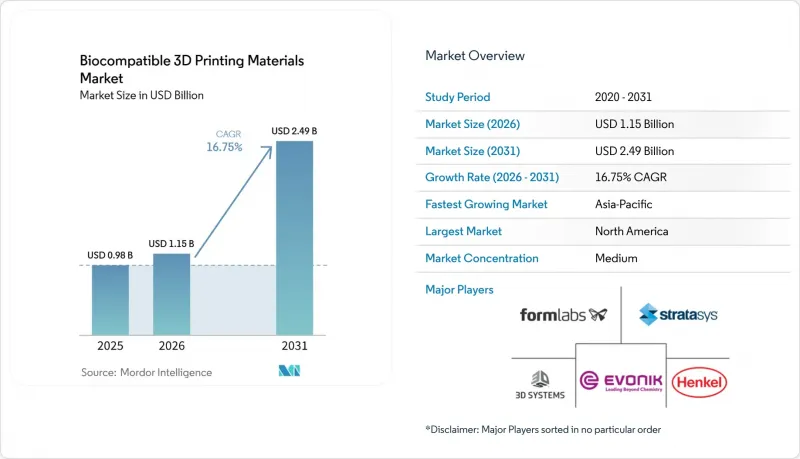
Mordor Intelligence에 의하면, 생체적합성 3D 프린팅 재료 시장 규모는 2025년 9억 8,000만 달러로 평가되었습니다. 2026년 11억 5,000만 달러에서 2031년까지 24억 9,000만 달러로 확대되어 2026년부터 2031년까지 CAGR 16.75%를 나타낼 것으로 예측됩니다.
본 보고서는 재료 유형(폴리머(광중합 수지 등), 금속, 세라믹 등), 형태(분말, 필라멘트 등), 기술(조내 광중합, 바이오 프린팅 등), 용도(임플란트, 조직 공학 등), 최종 사용자(병원, 치과 기공소 등), 지역(북미, 유럽 등)별로 분류되어 있습니다. 예측치는 금액(달러)으로 표시되어 있습니다.
세계의 생체적합성 3D 프린팅 재료 시장 동향 및 인사이트
환자 맞춤형 의료기기에 대한 수요 증가
생체적합성 3D 프린팅 재료 시장은 기존 제조 방식으로는 동일한 리드 타임 내에 구현할 수 없는 형상이 필요한 정형외과, 두개안면외과 및 척추외과 수술에 의해 주도되고 있습니다. 티타늄 합금, 특히 Ti-6Al-4V는 하중을 지탱하는 임플란트 분야에서 여전히 핵심적인 역할을 하고 있습니다. 그 탄성률 110 GPa는 코발트-크롬이나 스테인리스 스틸의 대체 소재보다 피질골에 가까운 값이기 때문에 스트레스 실드 위험을 줄일 수 있기 때문입니다. 2025년의 임상 연구에서는 적층 가공를 통해 제작된 다공성 Ti-6Al-4V 요추 고정용 임플란트가 사용 시 1차 안정성과 우수한 골 유착을 가져왔음이 밝혀졌습니다. 이를 통해 재료의 화학적 특성과 사전에 검증된 다공성 적층 가공 매개변수, 그리고 이를 뒷받침하는 임상 데이터를 결합할 수 있는 공급업체의 가치가 높아지고 있습니다. 마테리얼라이즈(Materialise)사의 생체 흡수성 폴리카프로락톤(PLA)으로 제작된 기관·기관지 스플린트는 2025년에 미국 FDA의 피보탈 임상시험에 진입했습니다. 이는 흡수성 폴리머 제품이 실제 임상 현장에서 사용되기까지 한 걸음 더 가까워졌음을 보여줍니다.
디지털 덴티스트리 및 체어사이드 제조의 확대
생체적합성 3D 프린팅 재료 시장은 체어사이드 시술이 더욱 보편화되고, 며칠이 걸리던 수복 주기가 단축되는 치과 워크플로우의 발전으로부터도 혜택을 받고 있습니다. 이러한 변화로 인해 수요가 중앙 집중형 실험실의 일괄 생산에서 관리된 진료실 대응 형태로 전환됨에 따라, 재료의 포장 및 사용 방법도 변화하고 있습니다. 또한, 체어사이드 시스템에서는 실험실의 생산 일정이 아닌 진료 예약 속도에 맞추어 재료가 소비되므로, 재료 소비 빈도도 높아지고 있습니다. Rapid Shape사의 RS VIVO 치과용 레진 제품군은 2026년 2월에 FDA 승인을 획득했습니다. 이를 통해 의치 및 스프린트 용도에 걸쳐 완전히 인증된 워크플로우를 제공할 수 있는 공급업체로서의 입지가 강화됩니다. 생체적합성 3D 프린팅 재료 시장에서 이로 인해 단순히 조제의 폭이 넓은 것보다 규제 요건을 충족하는 치과용 레진의 중요성이 더욱 높아지고 있습니다.
장기적인 생체적합성 및 멸균 검증 주기
생체적합성 3D 프린팅 재료 시장에서 공급업체가 새로운 의료용 등급 배합을 규제 대상 용도에 도입하려 할 때, 여전히 긴 인증 주기에 직면하고 있습니다. 세포 독성, 감작성, 이식 반응, 전신 독성 및 기타 평가 항목이 요구되는 경우, ISO 10993-1을 완전히 준수하는 평가에는 12-18개월이 소요될 수 있습니다. 이러한 시간적 부담은 확립된 규제 대응 팀을 보유한 대형 공급업체에게는 감당할 수 있는 수준이지만, 새로운 바이오 잉크나 생분해성 폴리머를 개발하는 소규모 개발자에게는 어려운 과제입니다. 그 결과, 임상 수요가 인증 능력을 앞지르는 속도로 진행되고 있는 분야에서도 제품 포트폴리오의 다각화가 지연되고 있습니다. 이러한 제약으로 인해 생체적합성 3D 프린팅 재료 시장은 이미 탄탄한 문서화 체계와 검증 인프라를 갖춘 공급업체에게 유리한 상황이 지속되고 있습니다.
부문 분석
2025년 시점에서 생체적합성 3D 프린팅 재료 시장 규모의 44.31%를 폴리머가 차지했으나, 바이오 잉크와 하이드로겔은 2031년까지 연평균 성장률(CAGR) 18.38%를 나타낼 것으로 예측됩니다. 생체적합성 3D 프린팅 재료 업계에서 이러한 구성 비율은 확고한 입지를 가진 폴리머가 시장의 기반을 이루고 있는 반면, 생체 유래 및 반생체 유래 제제가 시장을 주도하고 있음을 보여줍니다. PEEK 및 포토폴리머 수지는 이미 검증된 치료 경로에 통합되어 있기 때문에 치과, 악안면외과, 정형외과 각 워크플로우에서 여전히 중심적인 위치를 차지하고 있습니다. 에보닉(Evonik)의 ‘VESTAKEEP i4 3DF’는 3D 프린팅용 ASTM F2026 규격을 준수하는 최초의 임플란트 등급 PEEK 필라멘트로서, 업스트림 공정에서 중요한 기준점이 되고 있습니다.
임상 프로그램이 실제 임상 사용에 가까워짐에 따라 생분해성 폴리머의 형태도 발전하고 있습니다. 머테리얼라이즈(Materialise)의 생체흡수성 기관·기관지 스플린트에 대한 임상시험은 폴리머 개발을 단순한 연구 차원을 넘어 공식적인 FDA 승인 절차로 연결한다는 점에서 중요합니다. 티타늄 및 티타늄 합금을 필두로 하는 금속은 장기적인 강도가 필수적인 하중을 지탱하는 정형외과 및 척추 용도에서 여전히 없어서는 안 될 존재입니다. 세라믹은 치과 체어사이드 용도에서 중요성이 커지고 있는 반면, 복합재료는 보청기 본체나 두개안면 모델과 같은 특정 틈새 시장에서 계속해서 활용되고 있습니다. 따라서 생체적합성 3D 프린팅 재료 시장은 향후 성장 동력이 생체활성 소재 부문으로 이동하고 있음에도 불구하고, 수익 기반은 검증된 폴리머와 금속에 여전히 의존하고 있습니다.
2025년에는 필라멘트가 매출의 38.24%를 차지했으나, 바이오 잉크는 2031년까지 연평균 성장률(CAGR) 19.52%로 확대될 것으로 예측됩니다. 생체적합성 3D 프린팅 재료 시장이 여전히 필라멘트에 크게 의존하고 있는 이유는 정형외과, 척추, 악안면 분야의 워크플로우에서 의료용 PEEK용 FDM 및 FFF 시스템의 도입 기반이 여전히 광범위하게 자리 잡고 있기 때문입니다. 에보닉(Evonik)의 ‘VESTAKEEP’ 시리즈는 하나의 제품군 내에서 서로 다른 생체 이식 적합성 등급을 아우르고 있어, 이러한 형식이 여전히 중요한 이유를 보여줍니다. 이러한 유연성 덕분에 구매자는 소재 제품군을 변경하지 않고도 접촉 기간이나 규제 요건에 맞추어 형상을 조정할 수 있습니다.
바이오 잉크의 성장이 가속화되고 있는 것은 학술적 연구 단계를 넘어 체계적인 전임상 및 초기 임상 프로그램으로 전환되고 있기 때문입니다. GelMA 및 관련 하이드로겔 시스템에 대한 연구는 이 점에서 중요합니다. 발표된 연구에 따르면, 이러한 소재들은 각막 실질 세포의 유지 및 각막 재생 용도에서 지지적인 미세 환경을 조성할 수 있는 것으로 나타났기 때문입니다. 이러한 과학적 근거는 ‘형상’이 더 이상 단순한 ‘포장’의 문제가 아니라 생물학적 기능의 일부가 되어가고 있다는 생각을 뒷받침합니다. 바이오 잉크의 임상 적용 범위는 필라멘트나 액체 수지에 비해 여전히 좁지만, 그 방향성은 명확합니다. 이 때문에 생체적합성 3D 프린팅 재료 시장에서는 취급의 실용성과 세포를 지원하는 성능 모두에 계속해서 초점이 맞추어지고 있습니다.
지역별 분석
2025년, 북미는 생체적합성 3D 프린팅 재료 시장 점유율의 36.62%를 차지했으며, 현재 시장에서 가장 규모가 큰 지역적 입지를 확립하고 있습니다. 이 지역은 FDA 승인을 받은 소재 및 프린터 생태계의 가장 높은 집중도, 성숙한 병원 내 포인트 오브 케어(Point-of-Care) 프로그램, 그리고 임상 현장의 구매자와 공급업체 간의 긴밀한 협력이라는 이점을 누리고 있습니다. VA 퓨젯 사운드의 바이오프린팅 시설은 병원에 통합된 생산 대응형 모델로 건설되었으며, VA 시스템 전체로 확대될 것으로 기대되어 특히 중요합니다. 캐나다는 연구와 연계된 바이오 프린팅 및 치과 분야의 디지털화 활동을 통해 기여하고 있는 반면, 멕시코는 북미 의료 공급망에서 인근 제조 거점으로서의 입지를 강화하고 있습니다.
유럽은 2025년에 상당한 시장 점유율을 차지했으며, 여전히 엄격한 규제, 강력한 재료 과학 역량, 그리고 긴밀한 임상 혁신 기반을 특징으로 하고 있습니다. 독일, 영국, 프랑스가 지역 발전을 주도하고 있으며, 독일은 엔지니어링 폴리머 및 의료용 등급 원료 분야에서 업스트림 공정에서 큰 우위를 유지하고 있습니다. 마테리얼라이즈(Materialise)는 2026년 2월, EN ISO 13485 인증을 획득한 제조 환경에서 72시간 이내 납품을 약속하는 맞춤형 PEEK 임플란트를 CMF 포트폴리오에 추가했습니다. 또한, 프랑스는 3D Systems와 공동 개발한 TISSIUM의 광중합형 신경 복원 장치가 2025년 7월 FDA로부터 승인받은 최초의 조내 광중합형 임플란트가 되었습니다는 점에서도 주목받고 있습니다.
아시아태평양은 2031년까지 연평균 성장률(CAGR) 19.15%를 나타낼 것으로 예측되며, 생체적합성 3D 프린팅 재료 시장에서 가장 빠르게 성장하는 지역이 될 전망입니다. 이러한 성장은 바이오 프린팅에 대한 투자 확대, 치과 분야의 디지털화 가속화, 그리고 고령화 사회에 따른 정형외과 분야 수요 기반 확대와 밀접한 관련이 있습니다. 일본과 한국은 고정밀 제조 생태계의 혜택을 누리고 있는 반면, 중국은 그 규모와 첨단 의료 기술에 대한 정부 주도의 노력 덕분에 여전히 중요한 위치를 차지하고 있습니다. 인도는 외과용 가이드 및 골절 고정 용례에 사용되는 필라멘트와 펠릿 시스템을 생산하는 비용 중심의 생산 거점으로 발전하고 있습니다. 2025년 4월, 태국의 시릴라트 병원이 진료 현장에서 3D 프린팅된 티타늄 고관절 소켓을 사용하여 수술을 완료한 것은 동남아시아의 의료 기관들이 실현 가능성 검증 단계에서 실제 임상 도입 단계로 전환하고 있음을 보여줍니다. 중동 및 아프리카에서는 GCC(걸프협력회의) 국가들의 프리미엄 수요와 기타 지역의 인프라 제약 사이에서 여전히 양극화가 나타나고 있습니다. 한편, 남미에서는 주로 의료용 등급의 폴리머 및 금속 원료에 대한 접근성 부족이 여전히 발전의 걸림돌이 되고 있습니다. 즉, 생체적합성 3D 프린팅 재료 시장은 전 세계적으로 확대되고 있지만, 그 도입 준비 상황은 여전히 현지 검증 인프라 및 공급망 접근성에 크게 의존하고 있다는 것입니다.
기타 혜택 :
- 엑셀 형식 시장 예측(ME) 시트
- 3개월간의 애널리스트 지원
자주 묻는 질문
목차
제1장 서론
제2장 조사 방법
제3장 주요 요약
제4장 시장 구도
제5장 시장 규모 및 성장 예측
제6장 경쟁 구도
제7장 시장 기회 및 향후 전망
KTH 26.08.10According to Mordor Intelligence, the biocompatible 3D printing materials market size is projected to expand from USD 0.98 billion in 2025 and USD 1.15 billion in 2026 to USD 2.49 billion by 2031, registering a CAGR of 16.75% between 2026 to 2031.
This report is Segmented by Material Type (Polymers [Photopolymer Resins and More], Metals, Ceramics, and More), Form (Powder, Filament, and More), Technology (Vat Photopolymerization, Bioprinting, and More), Application (Implants, Tissue Engineering, and More), End User (Hospitals, Dental Labs, and More), and Geography (North America, Europe, and More). Forecasts are Provided in Value (USD).
Global Biocompatible 3D Printing Materials Market Trends and Insights
Rising Demand for Patient-Specific Medical Devices
The biocompatible 3D printing materials market is being pulled forward by orthopedic, craniofacial, and spinal procedures that need shapes conventional fabrication cannot match at the same turnaround. Titanium alloy, especially Ti-6Al-4V, remains central in load-bearing implants because its elastic modulus of 110 GPa is closer to cortical bone than cobalt-chrome or stainless steel alternatives, which lowers stress-shielding risk. A 2025 clinical study also showed that porous Ti-6Al-4V lumbar fusion implants produced through additive manufacturing delivered primary stability and favorable bone apposition in use. That is raising the value of suppliers that can pair material chemistry with pre-qualified porous print parameters and supporting clinical data. Materialise's bioresorbable polycaprolactone tracheobronchial splint entered a U.S. FDA pivotal clinical trial in 2025, which shows that resorbable polymer formats are moving closer to active clinical use.
Expansion of Digital Dentistry and Chairside Manufacturing
The biocompatible 3D printing materials market is also gaining from dental workflows that are moving closer to the chairside and reducing multi-day restorative cycles. This shift changes how materials are packaged and used, because demand moves away from centralized laboratory batches and toward controlled, clinic-ready formats. It also lifts material consumption frequency, since chairside systems turn materials over at the pace of appointments rather than lab production schedules. Rapid Shape's RS VIVO dental resin portfolio achieved FDA approval in February 2026, which strengthens the position of suppliers that can offer a full certified workflow across denture and splint applications. In the biocompatible 3D printing materials market, this makes regulatory-ready dental resins more important than simple formulation breadth alone.
Lengthy Biocompatibility and Sterilization Validation Cycles
The biocompatible 3D printing materials market still faces long qualification cycles when a supplier tries to bring a new medical-grade formulation into regulated use. A full ISO 10993-1-compliant evaluation can take 12 to 18 months when cytotoxicity, sensitization, implantation response, systemic toxicity, and other endpoints are required. That time burden is manageable for large suppliers with established regulatory teams, but it is harder for smaller developers working on novel bioinks or biodegradable polymers. The result is slower portfolio diversification, even in areas where clinical demand is moving faster than qualification capacity. This restraint keeps the biocompatible 3D printing materials market tilted toward suppliers that already have documentation depth and validation infrastructure.
Other drivers and restraints analyzed in the detailed report include:
- Regulatory Clarification for Biocompatible Material Qualification
- Faster Validation of Sterilizable Print Workflows
- Limited Cross-Platform Material Interoperability
For complete list of drivers and restraints, kindly check the Table Of Contents.
Segment Analysis
Polymers accounted for 44.31% share of the biocompatible 3D printing materials market size in 2025, while bioinks and hydrogels are projected to grow at an 18.38% CAGR through 2031. In the biocompatible 3D printing materials industry, that split shows a market anchored by established polymers but pulled forward by living and semi-living formulations. PEEK and photopolymer resins remain central across dental, maxillofacial, and orthopedic workflows because they already sit inside validated care pathways. Evonik's VESTAKEEP i4 3DF remains a key upstream reference point as the first ASTM F2026-compliant implant-grade PEEK filament for 3D printing.
Biodegradable polymer formats are advancing as clinical programs move closer to real-world use. Materialise's bioresorbable tracheobronchial splint trial is important because it connects polymer development to a formal FDA pathway rather than a research-only setting. Metals, led by titanium and titanium alloys, remain indispensable in load-bearing orthopedic and spinal applications where long-term strength is non-negotiable. Ceramics are becoming more relevant in chairside dental use, while composites continue to serve targeted niches such as hearing aid shells and craniofacial models. The biocompatible 3D printing materials market therefore keeps its revenue base in proven polymers and metals even as future momentum shifts toward biologically active material classes.
Filament held 38.24% of form revenue in 2025, while bioinks are forecast to expand at a 19.52% CAGR through 2031. The biocompatible 3D printing materials market still leans heavily on filament because the installed base of FDM and FFF systems for medical PEEK remains broad in orthopedic, spinal, and maxillofacial workflows. Evonik's VESTAKEEP range shows why this format stays relevant, because it covers different implantability grades within one product family. That flexibility helps buyers match form factor to contact duration and regulatory need without changing material family.
Bioinks are growing faster because they are moving beyond academic handling and into structured pre-clinical and early clinical programs. Work on GelMA and related hydrogel systems is relevant here, because published research shows these materials can create a supportive microenvironment for stromal keratocyte maintenance and corneal repair applications. That scientific base supports the idea that form is no longer just a packaging issue and is becoming part of biological function. The clinical corridor for bioinks is still narrower than for filament or liquid resins, but the direction of travel is clear. This keeps the biocompatible 3D printing materials market focused on both handling practicality and cell-supportive performance.
Complete Report Scope:
- By Material Type
- Polymers
- Photopolymer Resins
- Thermoplastic Polymers
- Biodegradable Polymers
- Metals
- Titanium and Titanium Alloys
- Stainless Steel
- Cobalt-Chrome Alloys
- Ceramics
- Zirconia
- Alumina
- Other Ceramics
- Composites
- Bioinks and Hydrogels
- Other Material Types
- Polymers
- By Form
- Powder
- Filament
- Liquid
- Resin
- Bioinks
- Other Forms
- By Technology
- Vat Photopolymerization
- Fused Deposition Modeling
- Selective Laser Sintering
- Multi Jet Modeling
- Material Jetting
- Bioprinting
- Other Technologies
- By Application
- Implants and Prosthesis
- Prototyping and Surgical Guides
- Tissue Engineering
- Scaffold Fabrication
- Prosthetics
- Drug Delivery Systems
- Surgical Instruments
- Hearing Aids
- Dental Appliances
- Other Applications
- By End User
- Hospitals and Clinics
- Dental Laboratories
- Medical Device Manufacturers
- Contract Manufacturing Organizations
- Other End Users
- By Geography
- North America
- United States
- Canada
- Mexico
- Europe
- Germany
- United Kingdom
- France
- Italy
- Spain
- Rest of Europe
- Asia-Pacific
- China
- Japan
- India
- Australia
- South Korea
- Rest of Asia-Pacific
- Middle East and Africa
- GCC
- South Africa
- Rest of Middle East and Africa
- South America
- Brazil
- Argentina
- Rest of South America
- North America
Geography Analysis
North America accounted for 36.62% of biocompatible 3D printing materials market share in 2025, giving it the largest regional position in the current market. The region benefits from the deepest concentration of FDA-cleared material-printer ecosystems, mature hospital point-of-care programs, and close interaction between clinical buyers and suppliers. The VA Puget Sound bioprinting facility is especially important because it was built as a hospital-embedded, production-ready model with replication potential across the VA system. Canada contributes through research-linked bioprinting and dental digitalization activity, while Mexico is strengthening its position as a nearby manufacturing base for North American medical supply chains.
Europe held a meaningful share in 2025 and remains defined by regulatory rigor, strong materials science capability, and a dense clinical innovation base. Germany, the UK, and France lead regional development, with Germany holding a major upstream advantage in engineering polymers and medical-grade feedstocks. Materialise added custom-made PEEK implants to its CMF portfolio in February 2026 under EN ISO 13485-certified manufacturing conditions with a 72-hour delivery commitment. France also stands out because TISSIUM's photopolymer nerve repair device, developed with 3D Systems, became the first vat-photopolymerized implant cleared by the FDA in July 2025.
Asia-Pacific is projected to grow at a 19.15% CAGR through 2031, making it the fastest-growing geography in the biocompatible 3D printing materials market. Growth is tied to rising bioprinting investment, faster dental digitization, and a widening base of orthopedic demand across aging populations. Japan and South Korea benefit from high-precision manufacturing ecosystems, while China remains important because of its scale and state-backed activity in advanced medical technologies. India is developing as a cost-focused production base for filament and pellet systems serving surgical guides and fracture fixation use cases. Thailand's Siriraj Hospital showed that Southeast Asian institutions are moving from feasibility work into real clinical deployment when it completed surgery using a point-of-care 3D-printed titanium hip socket in April 2025. The Middle East and Africa remain split between premium GCC demand and infrastructure constraints elsewhere, while South America is still held back mainly by access to qualified medical-grade polymer and metal feedstocks. This means the biocompatible 3D printing materials market is expanding globally, but readiness still depends heavily on local validation infrastructure and supply access.
- 3D Biotek, LLC
- 3D Systems
- Align Technology
- Arkema
- BASF
- Carbon, Inc.
- CELLINK AB
- Desktop Metal
- DWS S.r.l.
- EOS GmbH
- Evonik Industries
- Formlabs Inc.
- Henkel AG and Co. KGaA
- Johnson & Johnson
- Materialise
- Prodways Group
- Renishaw plc
- Stratasys
Additional Benefits:
- The market estimate (ME) sheet in Excel format
- 3 months of analyst support
TABLE OF CONTENTS
1 Introduction
- 1.1 Study Assumptions & Market Definition
- 1.2 Scope of the Study
2 Research Methodology
3 Executive Summary
4 Market Landscape
- 4.1 Market Overview
- 4.2 Market Drivers
- 4.2.1 Rising Demand for Patient-Specific Medical Devices
- 4.2.2 Expansion of Digital Dentistry and Chairside Manufacturing
- 4.2.3 Regulatory Clarification for Biocompatible Material Qualification
- 4.2.4 Faster Validation of Sterilizable Print Workflows
- 4.2.5 Growth in Point-of-Care Production Models
- 4.2.6 Reimbursement Pressure Favoring Lower-Fit-Error Customization
- 4.3 Market Restraints
- 4.3.1 Lengthy Biocompatibility and Sterilization Validation Cycles
- 4.3.2 Limited Cross-Platform Material Interoperability
- 4.3.3 High Cost of Qualified Medical-Grade Feedstocks
- 4.3.4 Process Drift Across Printer, Resin, and Post-Processing Steps
- 4.4 Supply Chain Analysis
- 4.5 Regulatory Landscape
- 4.6 Technological Outlook
- 4.7 Porter's Five Forces Analysis
- 4.7.1 Threat of New Entrants
- 4.7.2 Bargaining Power of Suppliers
- 4.7.3 Bargaining Power of Buyers
- 4.7.4 Threat of Substitutes
- 4.7.5 Intensity of Competitive Rivalry
5 Market Size & Growth Forecasts (Value, USD)
- 5.1 By Material Type
- 5.1.1 Polymers
- 5.1.1.1 Photopolymer Resins
- 5.1.1.2 Thermoplastic Polymers
- 5.1.1.3 Biodegradable Polymers
- 5.1.2 Metals
- 5.1.2.1 Titanium and Titanium Alloys
- 5.1.2.2 Stainless Steel
- 5.1.2.3 Cobalt-Chrome Alloys
- 5.1.3 Ceramics
- 5.1.3.1 Zirconia
- 5.1.3.2 Alumina
- 5.1.3.3 Other Ceramics
- 5.1.4 Composites
- 5.1.5 Bioinks and Hydrogels
- 5.1.6 Other Material Types
- 5.1.1 Polymers
- 5.2 By Form
- 5.2.1 Powder
- 5.2.2 Filament
- 5.2.3 Liquid
- 5.2.4 Resin
- 5.2.5 Bioinks
- 5.2.6 Other Forms
- 5.3 By Technology
- 5.3.1 Vat Photopolymerization
- 5.3.2 Fused Deposition Modeling
- 5.3.3 Selective Laser Sintering
- 5.3.4 Multi Jet Modeling
- 5.3.5 Material Jetting
- 5.3.6 Bioprinting
- 5.3.7 Other Technologies
- 5.4 By Application
- 5.4.1 Implants and Prosthesis
- 5.4.2 Prototyping and Surgical Guides
- 5.4.3 Tissue Engineering
- 5.4.4 Scaffold Fabrication
- 5.4.5 Prosthetics
- 5.4.6 Drug Delivery Systems
- 5.4.7 Surgical Instruments
- 5.4.8 Hearing Aids
- 5.4.9 Dental Appliances
- 5.4.10 Other Applications
- 5.5 By End User
- 5.5.1 Hospitals and Clinics
- 5.5.2 Dental Laboratories
- 5.5.3 Medical Device Manufacturers
- 5.5.4 Contract Manufacturing Organizations
- 5.5.5 Other End Users
- 5.6 By Geography
- 5.6.1 North America
- 5.6.1.1 United States
- 5.6.1.2 Canada
- 5.6.1.3 Mexico
- 5.6.2 Europe
- 5.6.2.1 Germany
- 5.6.2.2 United Kingdom
- 5.6.2.3 France
- 5.6.2.4 Italy
- 5.6.2.5 Spain
- 5.6.2.6 Rest of Europe
- 5.6.3 Asia-Pacific
- 5.6.3.1 China
- 5.6.3.2 Japan
- 5.6.3.3 India
- 5.6.3.4 Australia
- 5.6.3.5 South Korea
- 5.6.3.6 Rest of Asia-Pacific
- 5.6.4 Middle East and Africa
- 5.6.4.1 GCC
- 5.6.4.2 South Africa
- 5.6.4.3 Rest of Middle East and Africa
- 5.6.5 South America
- 5.6.5.1 Brazil
- 5.6.5.2 Argentina
- 5.6.5.3 Rest of South America
- 5.6.1 North America
6 Competitive Landscape
- 6.1 Market Concentration
- 6.2 Market Share Analysis
- 6.3 Company Profiles (includes Global Level Overview, Market Level Overview, Core Segments, Financials as available, Strategic Information, Market Rank/Share, Products and Services, Recent Developments)
- 6.3.1 3D Biotek, LLC
- 6.3.2 3D Systems, Inc.
- 6.3.3 Align Technology, Inc.
- 6.3.4 Arkema
- 6.3.5 BASF SE
- 6.3.6 Carbon, Inc.
- 6.3.7 CELLINK AB
- 6.3.8 Desktop Metal, Inc.
- 6.3.9 DWS S.r.l.
- 6.3.10 EOS GmbH
- 6.3.11 Evonik Industries AG
- 6.3.12 Formlabs Inc.
- 6.3.13 Henkel AG and Co. KGaA
- 6.3.14 Johnson and Johnson
- 6.3.15 Materialise NV
- 6.3.16 Prodways Group
- 6.3.17 Renishaw plc
- 6.3.18 Stratasys Ltd.
7 Market Opportunities & Future Outlook
- 7.1 White-Space and Unmet-Need Assessment


