

|
시장보고서
상품코드
2099306
해저 광섬유 백본 네트워크 : 시장 점유율 분석, 업계 동향 및 통계, 성장 예측(2026-2031년)Subsea Fiber Backbone Network - Market Share Analysis, Industry Trends & Statistics, Growth Forecasts (2026 - 2031) |
||||||
 Mordor Intelligence
Mordor Intelligence에 의하면, 해저 광섬유 백본 네트워크 시장 규모는 2025년에 77억 5,000만 달러로 평가되었습니다. 2026년 82억 1,000만 달러에서 2031년까지 123억 달러에 이를 것으로 예상되며, 예측 기간(2026-2031년) CAGR은 8.42%를 나타낼 전망입니다.
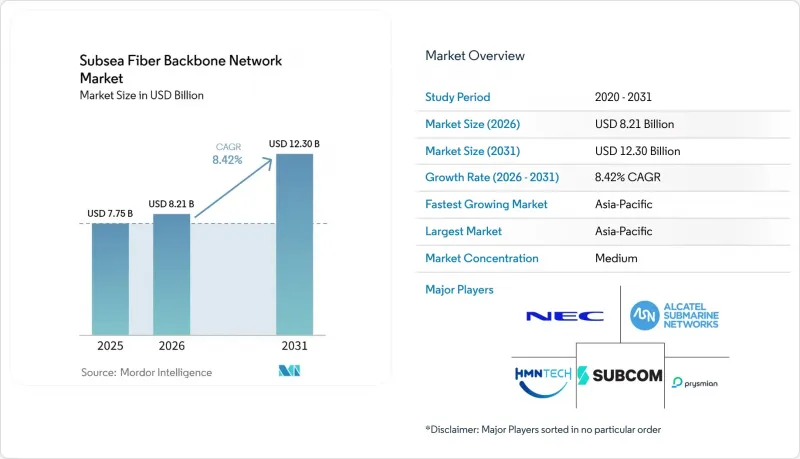
본 보고서는 구성 요소(웨트 플랜트, 드라이 플랜트 등), 케이블 유형(싱글모드 및 멀티모드 광섬유), 고객 유형(통신 사업자, 하이퍼스케일러, 해양 에너지 등), 소유 형태(컨소시엄 소유, 단독 소유 등), 지역(북미, 남미, 유럽, 아시아태평양 등)별로 분류되어 있습니다. 시장 전망은 금액(달러) 기준으로 제시되어 있습니다.
세계의 해저 광섬유 백본 네트워크 시장 동향 및 인사이트
클라우드 및 AI 트래픽으로 인한 국제 대역폭 수요 증가
AI 훈련 및 추론을 통해 대규모 데이터 세트가 단일 지역 내에서가 아니라 원격지 데이터센터 간에 이동하게 됨에 따라, 해저 광섬유 백본 네트워크 시장에서는 기존과는 다른 트래픽 패턴이 나타나고 있습니다. IEEE 통신 학회에 따르면, 2026년 1월 기준으로 570개 이상의 가동 중인 케이블이 국제 인터넷 트래픽의 99% 이상을 전송하고 있으며, 워크로드 설계의 변화가 이제 백본 수요의 급격한 증가로 이어지고 있는 이유가 부각되고 있습니다. 이러한 수요는 고르게 분포되어 있지 않습니다. 아시아의 급속한 디지털화에 따른 경로는 이미 설치 용량이 충분히 확보된 성숙한 회랑보다 더 많은 신규 트래픽을 흡수하고 있기 때문입니다. 해저 광섬유 백본 네트워크 시장에서 이러한 불균형한 부하는 공급이 부족한 회랑에 대한 자본 투자를 촉진하며, 기존 회랑을 단계적으로 업그레이드하는 것보다 경로의 다양성을 통해 더 큰 가치를 창출하고 있습니다.
하이퍼스케일러의 경로 소유권 및 용량 임대
해저 광섬유 백본 네트워크 시장은 많은 통신 사업자가 소유권을 공유하는 기존의 관행에서 클라우드 및 컨텐츠 플랫폼의 직접 자금 조달로 전환되고 있습니다. 2026년 6월, IEEE 통신 학회는 2026년 중반까지 하이퍼스케일러가 국제 해저 대역폭 총 용량의 75%를 보유하게 되며, 전 세계적으로 계획된 해저 케이블 부설 프로젝트의 3분의 2 이상에 참여하고 있다고 보고했습니다. 단독 소유를 통해 케이블은 성과 자산으로 변모합니다. 이는 지연, 라우팅 제어, 물리적 보안이 기업 및 클라우드 사용자에 대한 서비스 보증의 일부가 되기 때문입니다. 이러한 변화로 인해, 이용량이 가장 많은 해양 회랑에서 통신 사업자 주도의 컨소시엄 구조를 노릴 수 있는 도매 시장 기회는 축소되고 있습니다. 해저 광섬유 백본 네트워크 시장에서 턴키 시스템을 제공하고 보안 점검 요건을 충족할 수 있는 공급업체는 극소수의 초대형 구매자와의 장기 계약을 통해 이익을 얻고 있습니다.
높은 자본 집약도와 긴 투자 회수 기간
해저 광섬유 백본 네트워크 시장은 대륙 간 케이블 설치에 막대한 초기 투자와 긴 회수 기간이 필요하기 때문에 여전히 자금 조달의 장벽에 직면해 있습니다. 조사 데이터에 따르면, 단일 대륙간 노선만으로도 2억-5억 달러의 초기 투자가 필요하며, 회수 기간은 8년에서 15년에 달하기 때문에 진입할 수 있는 주체는 대규모 투자자나 컨소시엄으로 제한됩니다. 선박 일당, 조사 비용 및 방탄 케이블 요건이 동시에 상승하면 이러한 자금 조달 상황은 더욱 어려워집니다. 또한, 광학 기술은 계속 발전하고 있는 반면, 자본은 장년에 걸쳐 가치를 회수해야 하는 자산에 묶이게 되므로 시기적 문제도 발생합니다. 해저 광섬유 백본 네트워크 시장에서는 민관 혼합 자금 조달이 부상하고 있지만, 전체 프로젝트 파이프라인에 걸쳐 이러한 제약을 완화하기에는 아직 미치지 못하고 있습니다.
부문 분석
2025년에는 ‘습식 플랜트 장비’가 28.82%로 가장 큰 비중을 차지했습니다. 이는 해저 케이블, 리피터, 분기 장치가 모든 신규 건설 예산의 대부분을 차지하고 있다는 사실을 반영한 것입니다. 드라이 플랜트 장비가 2위를 차지한 것은 상륙국, 해저 회선 종단 장치 및 전력 공급 시스템이 신규 노선과 업그레이드 프로그램 모두에서 투자가 필요하기 때문입니다. 오픈 케이블 설계를 통해 사업자는 전체 경로를 교체하지 않고도 종단 장치를 업데이트할 수 있으므로, 이러한 업그레이드가 더욱 현실화되고 있습니다. 해저 광섬유 백본 네트워크 시장에서 이 지출은 케이블 자체와 그 상업적 가치를 이끌어내는 육상 시스템 사이에 분산되어 있습니다.
'보조 및 해양 서비스'는 2026년부터 2031년까지 연평균 성장률(CAGR) 9.41%로 확대될 것으로 예측되며, 이는 해저 광섬유 백본 네트워크 시장 전체를 상회하는 속도입니다. 전 세계 600개 이상의 케이블 시스템을 유지보수하는 수리선은 70척 미만이며, 유지보수 선단의 약 65%는 15년 이내에 수명이 다할 것으로 예측됩니다. 각 지역에서 케이블 도입이 확대됨에 따라 공급업체들은 선박 접근성, 조사 능력 및 유지보수 능력을 확충하여 이에 대응하고 있습니다. 따라서 해저 광섬유 백본 네트워크 시장은 성장뿐만 아니라 일정 관리 및 장애 복구 측면에서도 해양 서비스에 의존하고 있습니다.
2025년에는 싱글모드 광섬유가 케이블 유형별 매출의 67.33%를 차지했으며, 2031년까지 연평균 성장률(CAGR) 8.78%로 가장 높은 성장률을 나타낼 것으로 전망됩니다. 장거리 해상 전송에는 수천 킬로미터에 달하는 범위와 용량이 필요하며, 이는 멀티모드 설계로는 실현할 수 없기 때문에 싱글모드 광섬유가 시장을 독점하고 있습니다. 구글은 2026년, 미국, 버뮤다, 아조레스 제도, 스페인을 연결하는 대서양 횡단 케이블 ‘Sol’을 발표했습니다. 이는 노선 소유자들이 여전히 향후 업그레이드를 염두에 두고 대용량 장거리 시스템에 대한 투자를 지속하고 있음을 보여줍니다. 해저 광섬유 백본 네트워크 시장에서 자산의 수명 기간 동안 트래픽을 확대하고자 하는 소유자들에게는 싱글모드 설계가 표준적인 선택지가 되고 있습니다.
다중 모드 광섬유는 상륙국 인근의 짧은 해저 구간이나 얕은 연안 지역에 매설할 때 여전히 유용합니다. 백본 노선에는 적합하지 않지만, 큰 코어 직경 덕분에 이러한 국소적인 환경에서는 결합 효율을 유지할 수 있습니다. 또한, 광섬유 쌍 수가 많은 단일 모드 시스템은 소유자에게 예비 용량을 제공하며, 물리적 재설치 없이 코히런트 광 기술을 통한 업그레이드를 통해 추후 활용할 수 있습니다. 이러한 설계 철학 덕분에 해저 광섬유 백본 네트워크 시장은 전체 회랑을 시기상조로 재구축하지 않고도 미래 수요에 대응할 수 있게 됩니다.
지역별 분석
아시아태평양은 2025년에 30.12%라는 최대의 지역 점유율을 차지했으며, 2031년까지 연평균 성장률(CAGR) 9.13%로 가장 높은 성장률을 나타낼 것으로 예측됩니다. IEEE 통신 학회는 2026년 6월, 여러 신규 시스템이 완공에 가까워짐에 따라 2025년에는 인도의 해저 케이블 상륙 용량이 4배로 증가할 것으로 예측한다고 발표했습니다. 동 정보원에 따르면, 구글의 'America-India Connect' 이니셔티브를 통해 인도와 아프리카, 호주, 동남아시아를 연결하는 광섬유 연결이 추가될 것이라고 합니다. 또한, 일본은 세계 케이블 사업에 국내 기업의 참여를 추진하고 있으며, 한국은 새로운 지역 경로를 통해 국제 통신 케이블 계약에 참여하고 있습니다. 해저 광섬유 백본 네트워크 시장에서 수요 증가, 정책 지원, 경로 밀도의 조합으로 인해 아시아태평양은 새로운 용량 계획의 중심적인 위치를 계속 차지하고 있습니다.
북미는 미국이 대서양 횡단 및 태평양 횡단 양쪽의 상륙 거점 역할을 하고 있기 때문에 해저 광섬유 백본 네트워크 시장에서 여전히 주요 트래픽 및 공급 허브로서의 지위를 유지하고 있습니다. 서브콤(SubCom)은 2026년 1월, 해저 케이블 시스템 및 부품의 생산 능력을 확대하기 위해 뉴햄프셔주 뉴잉턴에 위치한 제조 거점을 확장할 것이라고 발표했습니다. MANTA 시스템은 베라크루즈와 플로리다주 산브라스에 상륙 지점을 마련함으로써 멕시코만으로의 새로운 연결성을 추가하고, 멕시코시티, 보고타, 파나마시티로의 연결을 확장했습니다. 남미는 여전히 외부 자금에 의한 시스템 의존도가 높으며, 브라질이 주요 상륙 거점으로 자리 잡고 있는 반면, 다른 경로들은 디지털 수요를 충족시키기에는 비교적 인프라가 미비한 상태입니다.
유럽에서는 공공 안전 자금을 통해 해저 광섬유 백본 네트워크 시장이 형성되고 있으며, 중동은 경로 다각화의 허브로서 중요성이 커지고 있고, 아프리카는 낮은 수준에서 확장을 계속하고 있습니다. 유럽 집행위원회는 2026년 2월, CEF Digital이 2027년까지 해저 케이블 프로젝트에 5억 3,300만 유로(5억 7,500만 달러)를 배정했으며, 2026년 초까지 이미 25개 프로젝트에 1억 8,600만 유로가 지급되었다고 발표했습니다. ASN, Sparkle, Elettra 각사는 2026년 2월에 GreenMed 계약을 체결했으며, SubCom은 2025년 5월에 Space Norway사와 Arctic Way 계약을 체결했습니다. 이는 유럽이 지중해에서 북극권에 이르는 회선 용량을 확대하고 있음을 보여줍니다. 해저 광섬유 백본 네트워크 시장에서 중동은 유럽과 아시아 간 트래픽에 대한 대체 상륙 거점을 제공하는 한편, 아프리카는 여전히 외부 자본이 큰 역할을 하고 있는 장기적인 확장 지역으로 자리 잡고 있습니다.
기타 혜택 :
- 엑셀 형식 시장 예측(ME) 시트
- 3개월간의 애널리스트 지원
자주 묻는 질문
목차
제1장 서론
제2장 조사 방법
제3장 주요 요약
제4장 시장 구도
제5장 시장 규모 및 성장 예측
제6장 경쟁 구도
제7장 시장 기회 및 향후 전망
KTH 26.08.10According to Mordor Intelligence, the subsea fiber backbone network market size was valued at USD 7.75 billion in 2025 and estimated to grow from USD 8.21 billion in 2026 to reach USD 12.30 billion by 2031, at a CAGR of 8.42% during the forecast period (2026-2031).
This report is Segmented by Component (Wet-Plant, Dry-Plant, and More), Cable Type (Single-Mode and Multimode Fiber), Client Type (Telecom Operators, Hyperscalers, Offshore Energy, and More), Ownership Model (Consortium-Owned, Single-Owner, and More), and Geography (North America, South America, Europe, Asia-Pacific, and More). The Market Forecasts are Provided in Terms of Value (USD).
Global Subsea Fiber Backbone Network Market Trends and Insights
Rising International Bandwidth Demand from Cloud and AI Traffic
The subsea fiber backbone network market is seeing a different traffic pattern, as AI training and inference move large datasets between distant data centers rather than within a single region. According to the IEEE Communications Society, in January 2026, more than 570 in-service cables carried over 99% of international internet traffic, underscoring why changes in workload design now translate into material backbone demand. This demand is not spreading evenly, because routes tied to fast digital adoption in Asia are absorbing more new traffic than mature corridors where installed capacity is already deeper. In the subsea fiber backbone network market, that uneven load is pushing capital toward undersupplied corridors and giving route diversity more value than another incremental upgrade on legacy lanes.
Hyperscaler-Funded Route Ownership and Capacity Leasing
The subsea fiber backbone network market is moving away from the older practice of shared ownership across many carriers and toward direct funding by cloud and content platforms. In June 2026, the IEEE Communications Society reported that hyperscalers held 75% of total international subsea bandwidth capacity by mid-2026 and were involved in over two-thirds of planned submarine cable deployments worldwide. Private ownership turns a cable into a performance asset because latency, routing control, and physical security become part of the service promise to enterprise and cloud users. That shift reduces the addressable wholesale opportunity for carrier-led consortium structures on the busiest ocean corridors. Within the subsea fiber backbone network market, suppliers that can deliver turnkey systems and satisfy security checks are gaining from longer contracts with a small group of very large buyers.
High Capital Intensity and Long Payback Cycles
The subsea fiber backbone network market still faces a financing barrier because intercontinental cable builds need very high upfront spending and long recovery periods. The input indicates that a single intercontinental route can require USD 200 million to USD 500 million in upfront investment and an 8-year to 15-year payback horizon, which narrows the field to large sponsors and consortia. This funding profile becomes more difficult when ship-day rates, survey costs, and armored cable requirements rise simultaneously. It also creates a timing problem, because optical technology continues to improve while capital is locked into assets that must recover value over many years. In the subsea fiber backbone network market, blended public-private financing is emerging, but it has not yet mitigated this restraint across the full project pipeline.
Other drivers and restraints analyzed in the detailed report include:
- Network Resilience Mandates and Redundancy Planning
- Offshore Energy and Remote-Island Connectivity Expansion
- Complex Cross-Border Permitting and Marine Survey Delays
For complete list of drivers and restraints, kindly check the Table Of Contents.
Segment Analysis
Wet-Plant Equipment held the largest component share at 28.82% in 2025, reflecting the fact that submarine cables, repeaters, and branching units account for a large share of every new build budget. Dry-Plant Equipment ranked second because landing stations, submarine line terminal equipment, and power-feed systems need investment on both greenfield routes and upgrade programs. Open cable designs are making these upgrades more practical, since operators can refresh terminal equipment without replacing the full route. In the subsea fiber backbone network market, this spending is distributed across the cable itself and the shore-based systems that unlock its commercial value.
Auxiliary and Marine Services is projected to expand at a 9.41% CAGR from 2026 to 2031, which is faster than the overall subsea fiber backbone network market. Fewer than 70 repair vessels worldwide serve more than 600 cable systems, and around 65% of the maintenance fleet is projected to reach the end of life within 15 years. Suppliers are responding by expanding vessel access, survey capacity, and maintenance capabilities as cable commitments widen across regions. The subsea fiber backbone network market, therefore, depends on marine services not only for growth, but also for schedule control and outage recovery.
Single-Mode Fiber commanded a 67.33% share of cable-type revenue in 2025 and is also projected to record the highest CAGR at 8.78% through 2031. It dominates because long-haul transoceanic transmission needs the range and capacity that multimode designs cannot match over thousands of kilometers. Google announced the Sol transatlantic cable in 2026 to connect the United States, Bermuda, the Azores, and Spain, underscoring that route owners are still investing in high-capacity long-haul systems built for future upgrades. In the subsea fiber backbone network market, single-mode design has become the default choice wherever owners want to scale traffic over the asset's life.
Multimode Fiber remains useful in short subsea spans near landing stations and shallow nearshore deployments. Its higher core diameter can support coupling efficiency in those localized settings, even though it is not suited to backbone routes. High-fiber-pair single-mode systems also provide owners with stranded capacity that can be activated later through coherent optical upgrades rather than physical redeployment. That design logic helps the subsea fiber backbone network market manage future demand without rebuilding whole corridors too early.
Complete Report Scope:
- By Component
- Wet-Plant Equipment
- Dry-Plant Equipment
- Auxiliary and Marine Services
- Other Components
- By Cable Type
- Single-Mode Fiber
- Multimode Fiber
- By Client Type
- Telecom Operators
- Content and Hyperscale Cloud Providers
- Offshore Energy Operators
- Government and Defense Agencies
- By Ownership Model
- Consortium-Owned Networks
- Single-Owner Networks
- Capacity-Leased Networks
- By Geography
- North America
- United States
- Canada
- Mexico
- South America
- Brazil
- Argentina
- Rest of South America
- Europe
- United Kingdom
- Germany
- France
- Italy
- Rest of Europe
- Asia-Pacific
- China
- Japan
- India
- South Korea
- Rest of Asia-Pacific
- Middle East and Africa
- Middle East
- Saudi Arabia
- United Arab Emirates
- Rest of Middle East
- Africa
- South Africa
- Egypt
- Rest of Africa
- Middle East
- North America
Geography Analysis
Asia-Pacific held the largest regional share at 30.12% in 2025 and is projected to record the fastest CAGR at 9.13% through 2031. IEEE Communications Society stated in June 2026 that India's submarine cable landing capacity was projected to quadruple in 2025 as multiple new systems moved toward completion. The same source noted that Google's America-India Connect initiative adds fiber connections linking India with Africa, Australia, and Southeast Asia. Japan is also pushing domestic participation in global cable programs, while South Korea is entering international telecom cable contracting through new regional routes. In the subsea fiber backbone network market, this combination of demand growth, policy support, and route density keeps Asia-Pacific at the center of new capacity planning.
North America remains a major traffic and supply hub in the subsea fiber backbone network market because the United States anchors both trans-Atlantic and trans-Pacific landings. SubCom announced in January 2026 that it was expanding its Newington, New Hampshire, manufacturing headquarters to raise the output of submarine cable systems and components. The MANTA system added new Gulf of Mexico connectivity with landing points in Veracruz and San Blas, Florida, extending links toward Mexico City, Bogota, and Panama City. South America still depends heavily on externally funded systems, leaving Brazil as the main landing hub while other routes remain relatively underbuilt to meet digital demand.
Europe is shaping the subsea fiber backbone network market through public security funding, while the Middle East is gaining importance as a route-diversification hub, and Africa continues to scale from a low base. The European Commission said in February 2026 that CEF Digital had allocated EUR 533 million (USD 575 million) to submarine cable projects through 2027, with EUR 186 million already awarded to 25 projects by early 2026. ASN, Sparkle, and Elettra signed the GreenMed contract in February 2026, and SubCom secured the Arctic Way contract with Space Norway in May 2025, which shows that Europe is adding capacity from the Mediterranean to the high Arctic. For the subsea fiber backbone network market, the Middle East offers alternative landing options for Europe-Asia traffic, while Africa remains a long-run expansion zone where outside capital still plays a large role.
- SubCom LLC
- NEC Corporation
- Prysmian S.p.A.
- Nexans S.A.
- Alcatel Submarine Networks
- HMN Tech Co., Ltd.
- Sumitomo Electric Industries, Ltd.
- Fujitsu Limited
- Hengtong Optic-Electric Co., Ltd.
- ZTT International Limited
- LS Cable & System Ltd.
- Hexatronic Group AB
- Global Marine Group
- Orange S.A.
- Ciena Corporation
- Corning Incorporated
- Telxius Telecom, S.A.
- Aqua Comms DAC
Additional Benefits:
- The market estimate (ME) sheet in Excel format
- 3 months of analyst support
TABLE OF CONTENTS
1 INTRODUCTION
- 1.1 Study Assumptions and Market Definition
- 1.2 Scope of the Study
2 RESEARCH METHODOLOGY
3 EXECUTIVE SUMMARY
4 MARKET LANDSCAPE
- 4.1 Market Overview
- 4.2 Market Drivers
- 4.2.1 Rising International Bandwidth Demand From Cloud and AI Traffic
- 4.2.2 Hyperscaler-Funded Route Ownership and Capacity Leasing
- 4.2.3 Network Resilience Mandates and Redundancy Planning
- 4.2.4 Offshore Energy and Remote-Island Connectivity Expansion
- 4.2.5 Reuse of Retired Cable Infrastructure and Landing Assets
- 4.2.6 Multi-Route Design To Reduce Geopolitical Single-Point Exposure
- 4.3 Market Restraints
- 4.3.1 High Capital Intensity and Long Payback Cycles
- 4.3.2 Complex Cross-Border Permitting and Marine Survey Delays
- 4.3.3 Repair Vessel Scarcity and Prolonged Outage Risk
- 4.3.4 Export Controls, Security Reviews, and Landing Restriction Risk
- 4.4 Supply-Chain Analysis
- 4.5 Regulatory Landscape
- 4.6 Technological Outlook
- 4.7 Porter's Five Forces Analysis
- 4.7.1 Threat of New Entrants
- 4.7.2 Bargaining Power of Suppliers
- 4.7.3 Bargaining Power of Buyers
- 4.7.4 Threat of Substitutes
- 4.7.5 Competitive Rivalry
5 MARKET SIZE AND GROWTH FORECASTS (VALUE)
- 5.1 By Component
- 5.1.1 Wet-Plant Equipment
- 5.1.2 Dry-Plant Equipment
- 5.1.3 Auxiliary and Marine Services
- 5.1.4 Other Components
- 5.2 By Cable Type
- 5.2.1 Single-Mode Fiber
- 5.2.2 Multimode Fiber
- 5.3 By Client Type
- 5.3.1 Telecom Operators
- 5.3.2 Content and Hyperscale Cloud Providers
- 5.3.3 Offshore Energy Operators
- 5.3.4 Government and Defense Agencies
- 5.4 By Ownership Model
- 5.4.1 Consortium-Owned Networks
- 5.4.2 Single-Owner Networks
- 5.4.3 Capacity-Leased Networks
- 5.5 By Geography
- 5.5.1 North America
- 5.5.1.1 United States
- 5.5.1.2 Canada
- 5.5.1.3 Mexico
- 5.5.2 South America
- 5.5.2.1 Brazil
- 5.5.2.2 Argentina
- 5.5.2.3 Rest of South America
- 5.5.3 Europe
- 5.5.3.1 United Kingdom
- 5.5.3.2 Germany
- 5.5.3.3 France
- 5.5.3.4 Italy
- 5.5.3.5 Rest of Europe
- 5.5.4 Asia-Pacific
- 5.5.4.1 China
- 5.5.4.2 Japan
- 5.5.4.3 India
- 5.5.4.4 South Korea
- 5.5.4.5 Rest of Asia-Pacific
- 5.5.5 Middle East and Africa
- 5.5.5.1 Middle East
- 5.5.5.1.1 Saudi Arabia
- 5.5.5.1.2 United Arab Emirates
- 5.5.5.1.3 Rest of Middle East
- 5.5.5.2 Africa
- 5.5.5.2.1 South Africa
- 5.5.5.2.2 Egypt
- 5.5.5.2.3 Rest of Africa
- 5.5.5.1 Middle East
- 5.5.1 North America
6 COMPETITIVE LANDSCAPE
- 6.1 Market Concentration
- 6.2 Strategic Moves
- 6.3 Market Share Analysis
- 6.4 Company Profiles (includes Global Level Overview, Market Level Overview, Core Segments, Financials as available, Strategic Information, Market Rank/Share, Products and Services, Recent Developments)
- 6.4.1 SubCom LLC
- 6.4.2 NEC Corporation
- 6.4.3 Prysmian S.p.A.
- 6.4.4 Nexans S.A.
- 6.4.5 Alcatel Submarine Networks
- 6.4.6 HMN Tech Co., Ltd.
- 6.4.7 Sumitomo Electric Industries, Ltd.
- 6.4.8 Fujitsu Limited
- 6.4.9 Hengtong Optic-Electric Co., Ltd.
- 6.4.10 ZTT International Limited
- 6.4.11 LS Cable & System Ltd.
- 6.4.12 Hexatronic Group AB
- 6.4.13 Global Marine Group
- 6.4.14 Orange S.A.
- 6.4.15 Ciena Corporation
- 6.4.16 Corning Incorporated
- 6.4.17 Telxius Telecom, S.A.
- 6.4.18 Aqua Comms DAC
7 MARKET OPPORTUNITIES AND FUTURE OUTLOOK
- 7.1 White-Space and Unmet-Need Assessment


