

|
시장보고서
상품코드
2099405
군용 항공기 충돌 회피 시스템 : 시장 점유율 분석, 업계 동향 및 통계, 성장 예측(2026-2031년)Military Aircraft Collision Avoidance Systems - Market Share Analysis, Industry Trends & Statistics, Growth Forecasts (2026 - 2031) |
||||||
 Mordor Intelligence
Mordor Intelligence에 의하면, 2026년 군용 항공기 충돌 회피 시스템 시장 규모는 8억 5,668만 달러로 추정되고 2025년 7억 9,000만 달러에서 증가해, 2031년에는 12억 8,000만 달러에 이를 것으로 예측됩니다.
2026년부터 2031년에 걸쳐 연평균 성장률(CAGR) 8.28%로 성장할 것으로 전망됩니다.
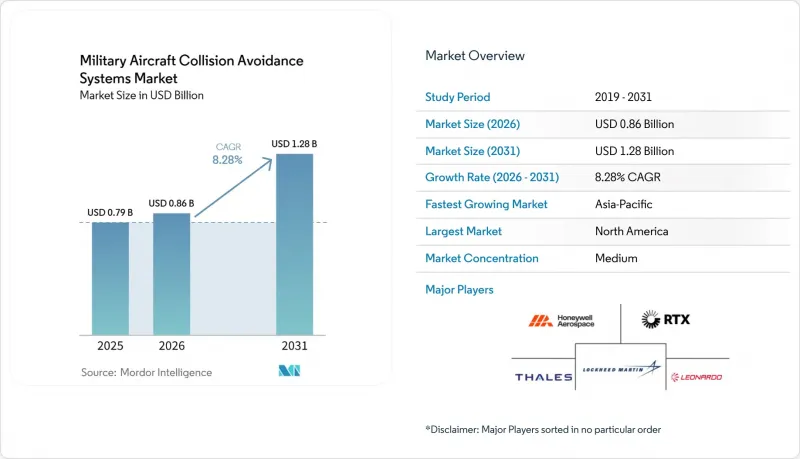
본 보고서는 시스템 유형(레이더, 교통 경보·충돌 회피 시스템(TACAS) 등), 플랫폼(유인 항공기 및 무인 항공기), 구성 요소(프로세서, 모드 5 트랜스폰더, 안테나 및 센서 등), 최종 사용자(OEM 및 애프터마켓), 지역(북미, 유럽 등)별로 분류되어 있습니다. 시장 전망은 금액(달러) 기준으로 제시되어 있습니다.
세계의 군용 항공기 충돌 회피 시스템 시장 동향 및 인사이트
국방비 증가와 신형 항공기 조달
세계 국방비 증가는 군용 항공기 충돌 회피 시스템 시장의 주요 수요 곡선을 형성하고 있습니다. 미국 인도-태평양 사령부는 설계 단계에서 회피 기능을 통합한 새로운 전술 항공 플랫폼에 막대한 자금을 할당하고 있으며, 이를 통해 향후 개조 시 발생할 수 있는 복잡성을 줄이고 있습니다. 인도의 114대 전투기 조달 프로젝트에서는 충돌 회피 기능이 항공 전자 장비의 기본 요건으로 포함되어 있어, 프로세서, 센서 및 보안 트랜스폰더 공급업체의 파이프라인이 확고하게 구축되어 있습니다. 고액 조달 계약에서는 충돌 회피 기능 업그레이드가 개방형 시스템 아키텍처와 결합되어, 기체의 전체 수명 주기 동안 지속적인 기능 도입이 가능해졌습니다. 전투기, 수송기, 특수 임무기에 걸친 지출 증가 추세로 인해, 수익 증가는 모듈식이며 다기능 패키지를 신속하게 인증할 수 있는 공급업체에 집중되고 있습니다. 또한, 조달 기관은 훈련 및 유지보수 비용을 절감하기 위해 공통성을 중시하고 있으며, 이로 인해 초기 납품 후 소프트웨어 정의형 업그레이드를 위한 추가적인 비즈니스 기회가 창출되고 있습니다.
TCAS II v7.1 및 ACAS-X 규격에 대한 필수 준수
규제상의 의무로 인해 충돌 회피 기능의 업그레이드는 선택적 투자에서 필수 투자로 전환되고 있습니다. TCAS II v7.1에서는 새로운 위협 해결 로직과 모드 S 감시 성능이 요구되며, 대부분의 경우 펌웨어 패치 적용이 아닌 LRU(라인 교체 가능 유닛)의 완전한 교체가 불가피합니다. 회전익 항공기 함대의 경우, 고도 제한 면제 또는 전용 저고도 사양 기체가 필요하게 되어 복잡성과 인증 비용이 증가합니다. NATO STANAG 4193의 상호운용성 요건에서는 암호화된 모드 5 식별이 의무화되어 있어, 이로 인해 IFF 트랜스폰더와 충돌 회피 계산이 긴밀하게 연계되게 됩니다. 인증 병목 현상으로 인해 수요는 소수의 인증 공급업체에 집중되고 있으며, 가격 상승 압력이 강해지는 한편, 각 기단이 설치 순서를 기다리는 상황에서 장기적인 애프터마켓 수익은 더욱 강화되고 있습니다. 2027년 규정 준수 기한을 맞추지 못하는 운항 사업자는 운항 중단 위험에 직면하게 되며, 이는 계약 수주의 단기적인 가속화를 뒷받침하고 있습니다.
구형 군용 항공기 기단의 고액 개조·인증 비용
노후화된 항공기는 대개 예비 중량, 전력, 공간 여유가 없기 때문에 차세대 프로세서나 안테나 스위트를 설치하려면 구조적인 배선 변경, 랙 재설계, 그리고 대규모 지상 시험 주기가 필요합니다. 인증 당국은 각 기체에 고유한 설치에 대해 비행 안전성 증명을 요구하기 때문에 시험 기간이 장기화되고, 기체당 비용이 증가하고 있습니다. 예산 제약을 받는 운영 사업자들은 업그레이드를 미루고 있으며, 이로 인해 규정 준수 유예 기간이 연장되면서 단기적인 수요 곡선이 둔화되고 있습니다. 공급업체들은 기존 항공전자 장비 베이에 장착 가능한 플러그 앤 플레이 키트를 제공하여 대응하고 있지만, 맞춤형 설계 및 생산 수량 제한으로 인해 단가는 여전히 높은 수준을 유지하고 있습니다. 이러한 개조 부담은 기술 서비스 및 예비 부품 부문의 수익 지속 기간을 보장하는 한편, 시장 전체의 성장 속도를 둔화시키고 있습니다.
부문 분석
TCAS 부문은 2025년 군용 항공기 충돌 회피 시스템 시장의 41.05%를 차지했으며, 2031년까지 연평균 성장률(CAGR) 9.03%로 성장할 것으로 전망됩니다. v7.1로의 업그레이드 의무화로 인해 하드웨어의 전면적인 갱신이 진행되고 있으며, 더 큰 연산 능력을 갖춘 프로세서에 대한 수요가 증가하고 있습니다. TAWS는 저고도 헬리콥터 운항에서 여전히 중요한 역할을 하고 있는 반면, 합성 시각 시스템은 여러 센서에서 얻은 정보를 3D 조종석 디스플레이에 통합함으로써 단순한 경보에 그치지 않고 조종사의 상황 인식을 향상시키고 있습니다.
운항 사업자들은 첨단 프로세서나 모드 5 대응 트랜스폰더의 도입을 보다 광범위한 항공전자 장비 현대화와 결합함으로써 비용 시너지를 얻을 수 있다는 점을 인식하고 있으며, 이에 따라 업데이트 주기가 가속화되고 있습니다. TCAS 내의 협업 로직은 현재 탑재형 전자전 자기방어 시스템과 통합되어 있어, 임무 수행을 위한 기동과 충돌 회피 사이에서 실시간 조정이 가능해졌습니다. 고객들이 전투 능력을 저해하지 않으면서 규정 준수를 확보할 수 있는 종합적인 업그레이드를 우선시함에 따라, 이러한 통합 패키지에 대한 인증을 획득한 제조업체들은 더 높은 이익률을 보이는 수익원을 확보하고 있습니다.
2025년에는 유인 항공기 플랫폼이 군용 항공기 충돌 회피 시스템 시장 점유율의 78.92%를 차지했으나, 2031년까지는 무인항공기(UAV)가 9.31%라는 가장 높은 연평균 성장률(CAGR)을 보일 것으로 예측됩니다. 전투기 프로그램에서는 고G 기동 중 조종석의 작업 부하를 최소화하기 위해 임무 컴퓨터에 충돌 회피 로직이 내장되어 있습니다. 한편, 대형 수송기에서는 시스템의 신뢰성과 비행 관리 컴퓨터와의 통합이 중시되고 있습니다.
무인 플랫폼의 경우, 공급업체는 회피 로직을 로컬에서 실행하는 엣지 AI 프로세서를 채택할 수밖에 없으며, 이를 통해 데이터 링크에 의존하는 의사결정 루프의 지연이 해소됩니다. MUM-T(유인·무인 팀) 개념에서는 통신 대역폭을 포화시키지 않으면서 유인기와 UAV가 상황 인식을 공유할 수 있도록 표준화된 위협 데이터 스키마가 요구됩니다. MUM-T 개념에 대한 관심이 압축 데이터 형식 및 표준 애플리케이션 프로그래밍 인터페이스(API) 개발을 촉진하고 있으며, 레거시 항공 전자 장비와 차세대 자율형 코어를 연결하는 미들웨어를 전문으로 하는 소프트웨어 벤더를 위한 틈새 시장이 형성되고 있습니다.
지역별 분석
2025년, 북미는 매출 점유율 40.78%를 차지하며 군용 항공기 충돌 회피 시스템 시장을 주도했습니다. 미국 국방부(DoD)의 현대화 예산은 전투기, 회전익기, 급유기의 대규모 업그레이드에 투입되고 있으며, 이들 모두는 규격에 부합하는 충돌 회피 서브시스템을 필요로 합니다. 캐나다의 ‘미래 전투기 역량 프로젝트(Future Fighter Capability Project)’ 역시 초기 납품 시점에서 모드 5 식별 및 충돌 회피 기능의 호환성을 규정하고 있어, 통합 솔루션에 대한 수요를 뒷받침하고 있습니다.
유럽에서는 NATO의 표준화 이니셔티브에 따라 회원국들이 동일한 회피 로직과 암호화 트랜스폰더의 채택을 추진하고 있어, 균형 잡힌 성장을 유지하고 있습니다. '유로드론'이나 '미래 전투 항공 시스템(FCAS)'과 같은 공동 프로그램에는 충돌 회피 요건이 포함되어 있어, 주요 계약업체들에게 안정적인 수주 잔고를 유지하고 있습니다. 주파수 대역 혼잡에 대한 우려로 인해 이 지역에서는 수동 레이더 기술에 대한 관심이 높아지고 있으며, 항공 교통 관제 서비스 제공업체와 제휴하는 공급업체들은 민수용 및 군용 이중 용도를 위한 인증을 가속화하고 있습니다.
아시아태평양은 인도, 한국, 일본, 호주의 대규모 항공기 조달에 힘입어 연평균 성장률(CAGR) 9.76%로 가장 빠르게 성장하고 있는 지역입니다. 수출 규제 장벽으로 인해 중국의 내수 수요는 여전히 내부에 국한되어 있으며, 이는 국산 센서 개발을 촉진하고 있습니다. 아세안(ASEAN) 국가들은 항공기 탑재 시스템을 보완하는 지상 기반 비시야(BVLOS) 네트워크에 투자하고 있으며, 분산된 군도 지역 전체로 충돌 회피 시스템의 적용 범위를 확대되고 있습니다. 이러한 요인들이 복합적으로 작용하여 해당 지역의 군용 항공기 충돌 회피 시스템 시장 규모가 확대되고 있으며, 유럽·미국 및 현지 공급업체들은 오프셋 요건과 기술 이전 규정에 대응하기 위해 합작 투자에 적극적으로 나서고 있습니다.
기타 혜택 :
- 엑셀 형식 시장 예측(ME) 시트
- 3개월간의 애널리스트 지원
자주 묻는 질문
목차
제1장 서론
제2장 조사 방법
제3장 주요 요약
제4장 시장 구도
제5장 시장 규모 및 성장 예측
제6장 경쟁 구도
제7장 시장 기회 및 향후 전망
KTH 26.08.10According to Mordor Intelligence, the military aircraft collision avoidance systems market size in 2026 is estimated at USD 856.68 million, up from the 2025 value of USD 790 million, with projections to USD 1.28 billion in 2031, growing at an 8.28% CAGR over 2026-2031.
This report is Segmented by System Type (Radars, Traffic Alert and Collision Avoidance System, and More), Platform (Manned Aircraft and Unmanned Aerial Vehicles), Component (Processors, Mode 5 Transponders, Antennas and Sensors, and More), End User (OEM and Aftermarket), and Geography (North America, Europe, and More). The Market Forecasts are Provided in Terms of Value (USD).
Global Military Aircraft Collision Avoidance Systems Market Trends and Insights
Rising Defense Spending and New Aircraft Procurement
Escalating global defense outlays shape the primary demand curve for the military aircraft collision avoidance systems market. The US Indo-Pacific Command allocates substantial funding to new tactical air platforms that integrate avoidance capability at the design stage, reducing retrofit complexity later. India's 114-fighter tender embeds collision avoidance as a baseline avionics requirement, cementing supplier pipelines for processors, sensors, and secure transponders. High-value procurement contracts bundle collision-avoidance upgrades with open-systems architectures, enabling continued capability insertion throughout the fleet life cycle. The spending uptrend, spanning fighters, transports, and special-mission aircraft, tilts revenue growth toward suppliers capable of quickly certifying modular, multi-function packages. Procurement agencies also emphasize commonality to reduce training and sustainment costs, thereby creating follow-on opportunities for software-defined upgrades after initial delivery.
Mandatory Compliance with TCAS II v7.1 and ACAS-X Standards
Regulatory obligations convert avoidance upgrades from discretionary to non-negotiable investments. TCAS II v7.1 requires new threat-resolution logic and Mode S surveillance performance, often forcing complete line-replaceable unit swaps rather than firmware patches. Rotary-wing fleets need altitude-inhibition waivers or specialized low-altitude variants, adding complexity and certification fees. NATO STANAG 4193 interoperability mandates encrypted Mode 5 identification that tightly couples IFF transponders with collision-avoidance computations. Certification bottlenecks concentrate demand among a handful of approved suppliers, heightening price pressure yet reinforcing long-term aftermarket revenue as fleets queue for installation slots. Operators unable to meet 2027 compliance cut-offs risk grounding, underscoring the short-term acceleration in contract awards.
High Retrofit and Certification Costs for Legacy Military Fleets
Aging aircraft often lack spare weight, power, and space margins, so installing next-generation processors or antenna suites demands structural rewiring, rack redesign, and extensive ground-test cycles. Certification authorities require flight-safety evidence for each airframe-unique installation, prolonging test campaigns and inflating the cost per tail. Budget-constrained operators delay upgrades, stretching compliance grace periods and dampening near-term demand curves. Suppliers respond with plug-and-play kits that fit existing avionics bays, but unit pricing remains high due to one-off engineering and limited production volumes. The retrofit burden tempers overall market velocity even as it guarantees a longer revenue tail in technical services and spares.
Other drivers and restraints analyzed in the detailed report include:
- Surge in UAV Acquisitions Requiring Detect-and-Avoid Capabilities
- Advancements in Miniaturized 4D AESA Radar and AI-Based Sensor Fusion
- Radio Frequency Spectrum Congestion Affecting Cooperative Systems
For complete list of drivers and restraints, kindly check the Table Of Contents.
Segment Analysis
The TCAS segment accounted for 41.05% of the military aircraft collision avoidance systems market in 2025 and is projected to grow at a 9.03% CAGR through 2031. Mandatory v7.1 upgrades drive complete hardware refreshes, lifting demand for processors with larger computational margins. TAWS remains relevant for low-altitude helicopter operations, while synthetic vision systems blend multiple sensor feeds into 3D cockpit displays that enhance pilots' situational awareness beyond simple alerting.
Replacement cycles gain momentum because operators find that installing advanced processors and Mode 5-capable transponders deliver cost synergies when bundled with broader avionics modernization. Cooperative logic within TCAS now integrates with onboard electronic warfare self-protection suites, enabling real-time deconfliction between mission maneuvers and collision avoidance. Manufacturers that certify such integrated packages capture higher-margin streams as customers prioritize holistic upgrades that ensure compliance without compromising combat capability.
Manned aircraft platforms accounted for 78.92% of the military aircraft collision avoidance systems market share in 2025, but UAVs are expected to deliver the fastest 9.31% CAGR to 2031. Fighter programs embed collision-avoidance logic within mission computers to minimize cockpit workload during high-G maneuvers, whereas large transports emphasize system reliability and integration with flight-management computers.
Unmanned platforms force suppliers to adopt edge AI processors that run avoidance logic locally, eliminating latency in datalink-dependent decision loops. MUM-T concepts require standardized threat-data schemas so that piloted aircraft and UAVs share situational awareness without saturating communications bandwidth. The focus on the MUM-T concept drives the development of compressed data formats and standard application programming interfaces, creating a niche for software vendors specializing in middleware bridging legacy avionics and next-generation autonomous cores.
Complete Report Scope:
- By System Type
- Radars
- Traffic Alert and Collision Avoidance System (TCAS)
- Terrain Awareness and Warning System (TAWS)
- Collision Warning System (CWS)
- Obstacle Collision Avoidance System (OCAS)
- Synthetic Vision Systems
- By Platform
- Manned Aircraft
- Combat Aircraft
- Transport Aircraft
- Special Mission Aircraft
- Helicopters
- Unmanned Aerial Vehicles (UAVs)
- Manned Aircraft
- By Component
- Processors
- Mode 5 Transponders
- Antennas and Sensors
- Display/Warning Units
- By End-User
- Original Equipment Manufacturer (OEM)
- Aftermarket
- By Geography
- North America
- United States
- Canada
- Mexico
- Europe
- United Kingdom
- Germany
- France
- Italy
- Rest of Europe
- Asia-Pacific
- China
- India
- Japan
- South Korea
- Rest of Asia-Pacific
- South America
- Brazil
- Rest of South America
- Middle East and Africa
- Middle East
- Saudi Arabia
- United Arab Emirates
- Rest of Middle East
- Africa
- South Africa
- Rest of Africa
- Middle East
- North America
Geography Analysis
North America dominated the military aircraft collision avoidance systems market in 2025 with 40.78% revenue share. The US Department of Defense (DoD) modernization budgets fund large-scale upgrades to fighters, rotorcraft, and tankers, each of which requires compliant avoidance subsystems. Canada's Future Fighter Capability Project similarly stipulates Mode 5 identification and collision-avoidance alignment at initial delivery, reinforcing demand for integrated solutions.
Europe maintains balanced growth as NATO standardization initiatives push members toward identical avoidance logic and encrypted transponders. Collaborative programs such as the Eurodrone and the Future Combat Air System (FCAS) embed collision-avoidance requirements, sustaining a steady backlog for prime contractors. Spectrum congestion concerns drive regional interest in passive radar technology, and suppliers partnering with air navigation service providers accelerate certification for dual-civil-military use cases.
Asia-Pacific is the fastest-growing region, with a 9.76% CAGR, driven by substantial aircraft procurement in India, South Korea, Japan, and Australia. Due to export-control barriers, China's domestic demand remains significant but inward-focused, prompting indigenous sensor development. ASEAN nations invest in ground-based beyond-visual-line-of-sight (BVLOS) networks that complement airborne systems, extending collision-avoidance coverage over dispersed archipelagic territories. These factors collectively expand the region's military aircraft collision-avoidance systems market footprint, attracting Western and local suppliers to enter joint ventures to navigate offset requirements and technology-transfer rules.
- Honeywell Aerospace Inc.
- L3Harris Technologies, Inc.
- Collins Aerospace (RTX Corporation)
- Leonardo S.p.A.
- Thales Group
- Avidyne Corporation
- Lockheed Martin Corporation
- BAE Systems plc
- Saab AB
- Elbit Systems Ltd.
- Sagetech Avionics, Inc.
- Iris Automation Inc.
- uAvionix Corporation
- General Atomics Aeronautical Systems Inc. (General Atomics)
Additional Benefits:
- The market estimate (ME) sheet in Excel format
- 3 months of analyst support
TABLE OF CONTENTS
1 INTRODUCTION
- 1.1 Study Assumptions and Market Definition
- 1.2 Scope of the Study
2 RESEARCH METHODOLOGY
3 EXECUTIVE SUMMARY
4 MARKET LANDSCAPE
- 4.1 Market Overview
- 4.2 Market Drivers
- 4.2.1 Rising defense spending and new aircraft procurement
- 4.2.2 Mandatory compliance with TCAS II v7.1 and ACAS-X standards
- 4.2.3 Surge in UAV acquisitions requiring detect-and-avoid capabilities
- 4.2.4 Advancements in miniaturized 4D AESA radar and AI-based sensor fusion
- 4.2.5 Increasing need for manned-unmanned teaming (MUM-T) interoperability
- 4.2.6 Deployment of ground-based BVLOS sense-and-avoid (SAA) networks
- 4.3 Market Restraints
- 4.3.1 High retrofit and certification costs for legacy military fleets
- 4.3.2 Radio frequency spectrum congestion affecting cooperative systems
- 4.3.3 Risk of GNSS jamming disrupting collision avoidance algorithms
- 4.3.4 Supply chain limitations for GaN-based RF devices
- 4.4 Value Chain Analysis
- 4.5 Regulatory Landscape
- 4.6 Technological Outlook
- 4.7 Porter's Five Forces
- 4.7.1 Threat of New Entrants
- 4.7.2 Bargaining Power of Suppliers
- 4.7.3 Bargaining Power of Buyers
- 4.7.4 Threat of Substitutes
- 4.7.5 Intensity of Competitive Rivalry
5 MARKET SIZE AND GROWTH FORECASTS (VALUE)
- 5.1 By System Type
- 5.1.1 Radars
- 5.1.2 Traffic Alert and Collision Avoidance System (TCAS)
- 5.1.3 Terrain Awareness and Warning System (TAWS)
- 5.1.4 Collision Warning System (CWS)
- 5.1.5 Obstacle Collision Avoidance System (OCAS)
- 5.1.6 Synthetic Vision Systems
- 5.2 By Platform
- 5.2.1 Manned Aircraft
- 5.2.1.1 Combat Aircraft
- 5.2.1.2 Transport Aircraft
- 5.2.1.3 Special Mission Aircraft
- 5.2.1.4 Helicopters
- 5.2.2 Unmanned Aerial Vehicles (UAVs)
- 5.2.1 Manned Aircraft
- 5.3 By Component
- 5.3.1 Processors
- 5.3.2 Mode 5 Transponders
- 5.3.3 Antennas and Sensors
- 5.3.4 Display/Warning Units
- 5.4 By End-User
- 5.4.1 Original Equipment Manufacturer (OEM)
- 5.4.2 Aftermarket
- 5.5 By Geography
- 5.5.1 North America
- 5.5.1.1 United States
- 5.5.1.2 Canada
- 5.5.1.3 Mexico
- 5.5.2 Europe
- 5.5.2.1 United Kingdom
- 5.5.2.2 Germany
- 5.5.2.3 France
- 5.5.2.4 Italy
- 5.5.2.5 Rest of Europe
- 5.5.3 Asia-Pacific
- 5.5.3.1 China
- 5.5.3.2 India
- 5.5.3.3 Japan
- 5.5.3.4 South Korea
- 5.5.3.5 Rest of Asia-Pacific
- 5.5.4 South America
- 5.5.4.1 Brazil
- 5.5.4.2 Rest of South America
- 5.5.5 Middle East and Africa
- 5.5.5.1 Middle East
- 5.5.5.1.1 Saudi Arabia
- 5.5.5.1.2 United Arab Emirates
- 5.5.5.1.3 Rest of Middle East
- 5.5.5.2 Africa
- 5.5.5.2.1 South Africa
- 5.5.5.2.2 Rest of Africa
- 5.5.5.1 Middle East
- 5.5.1 North America
6 COMPETITIVE LANDSCAPE
- 6.1 Market Concentration
- 6.2 Strategic Moves
- 6.3 Market Share Analysis
- 6.4 Company Profiles (includes Global level Overview, Market level overview, Core Segments, Financials as available, Strategic Information, Market Rank/Share for key companies, Products and Services, and Recent Developments)
- 6.4.1 Honeywell Aerospace Inc.
- 6.4.2 L3Harris Technologies, Inc.
- 6.4.3 Collins Aerospace (RTX Corporation)
- 6.4.4 Leonardo S.p.A.
- 6.4.5 Thales Group
- 6.4.6 Avidyne Corporation
- 6.4.7 Lockheed Martin Corporation
- 6.4.8 BAE Systems plc
- 6.4.9 Saab AB
- 6.4.10 Elbit Systems Ltd.
- 6.4.11 Sagetech Avionics, Inc.
- 6.4.12 Iris Automation Inc.
- 6.4.13 uAvionix Corporation
- 6.4.14 General Atomics Aeronautical Systems Inc. (General Atomics)
7 MARKET OPPORTUNITIES AND FUTURE OUTLOOK
- 7.1 White-Space and Unmet-Need Assessment


