

|
시장보고서
상품코드
2099409
DRAM IP 컨트롤러 : 시장 점유율 분석, 업계 동향 및 통계, 성장 예측(2026-2031년)DRAM IP Controller - Market Share Analysis, Industry Trends & Statistics, Growth Forecasts (2026 - 2031) |
||||||
 Mordor Intelligence
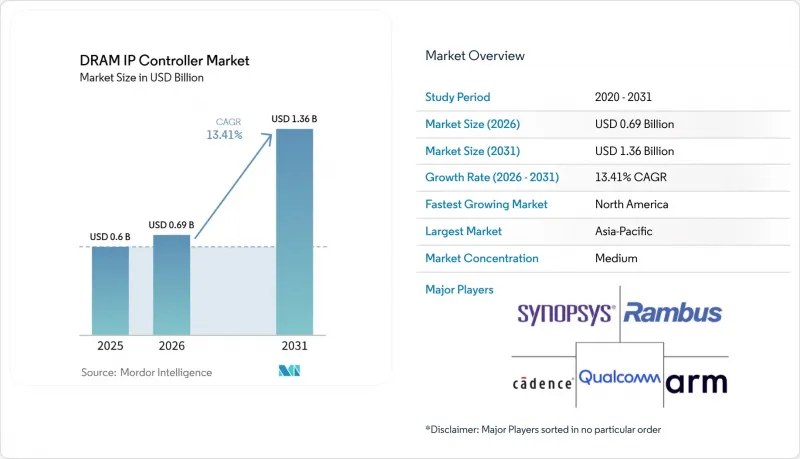
Mordor Intelligence에 의하면, DRAM IP 컨트롤러 시장 규모는 2025년에 6억 달러로 평가되었습니다. 2026년 6억 9,000만 달러, 2031년 13억 6,000만 달러에 이를 것으로 예측되며, 2026년부터 2031년에 걸쳐 CAGR 13.41%로 성장할 전망입니다.
본 보고서는 IP 서브시스템의 유형(DDR 컨트롤러 IP, LPDDR 컨트롤러 IP, GDDR 컨트롤러 IP 등), 용도(데이터센터/클라우드/HPC/AI, 모바일 및 소비자용 디바이스, 그래픽/게임, 자동차/ADAS, 산업용/IoT/네트워크 등), 고객 유형(팹리스 반도체 기업, IDM, 시스템 OEM 등), 지역별로 분류되어 있습니다. 시장 전망은 금액(달러) 기준으로 제시되어 있습니다.
세계의 DRAM IP 컨트롤러 시장 동향 및 인사이트
AI 및 HPC SoC에서의 메모리 대역폭 수요 증가
AI 훈련 클러스터 및 추론 가속기에는 기존 컨트롤러 IP 세대가 처리할 수 있도록 설계된 것보다 더 많은 대역폭이 필요합니다. DRAM IP 컨트롤러 시장은 더 빠른 HBM 인터페이스, 더 엄격한 컨트롤러 지연 시간 목표, 그리고 컨트롤러와 PHY 간의 더 정밀한 튜닝을 통해 이러한 수요에 부응하고 있습니다. Cadence는 2025년 4월, 12.8Gbps의 HBM4 메모리 IP 솔루션을 출시했습니다. 이는 HBM3E에 비해 전력 효율이 20% 향상되고 면적 효율이 50% 향상된 것으로, 주요 프로그램의 인증 기준이 얼마나 급격하게 변화했는지를 보여줍니다. Lambus는 2026년 3월, 핀당 최대 16GT/s, 디바이스당 4.1 TB/s의 대역폭을 지원하는 HBM4E 컨트롤러 IP를 출시했습니다. 이는 차세대 AI 가속기에 현재 요구되는 규모를 반영한 것입니다. 이러한 제품 발표는 컨트롤러 간의 경쟁이 더 이상 프로토콜 지원에만 초점을 맞추는 것이 아니라는 점을 보여줍니다. 왜냐하면 전력 소비, 면적, 텔레메트리, 그리고 시스템 수준의 효율성이 이제 동시에 중요시되고 있기 때문입니다. DRAM IP 컨트롤러 시장에서 이러한 AI 메모리 요구 사항을 조기에 충족할 수 있는 벤더는 클라우드 및 HPC 프로그램 분야에서 프리미엄 시장 점유율을 확보할 수 있는 입지에 서게 될 것입니다.
DDR5 및 LPDDR5X 플랫폼으로의 전환 가속화
DDR4에서 DDR5로, 또한 LPDDR5X에서 LPDDR6로의 전환에 따라 서버, 모바일, 엣지 컴퓨팅 각 설계 분야에서 새로운 라이선싱 주기가 요구되고 있습니다. 이 전환이 중요한 이유는 구형 컨트롤러 구현으로는 새로운 성능, 신뢰성 및 패키징 요구 사항을 원활하게 충족할 수 없기 때문입니다. 케이던스는 2026년 1월, 엔터프라이즈 및 데이터센터용 LPDDR5X 9600 Mbps 메모리 IP 시스템 솔루션을 발표했습니다. 이 솔루션에는 마이크로소프트의 RAIDDR ECC 방식이 통합되어 있으며, 마이크로소프트가 첫 번째 고객으로 언급되었습니다. 시노프시스는 2026년, LPDDR6가 24비트 채널 아키텍처를 도입하여 최대 14.4Gb/s의 데이터 전송 속도를 목표로 하고 있다고 발표했습니다. 이에 따라 모바일 메모리의 다음 단계는 단순한 사소한 업데이트가 아니라, 컨트롤러와 PHY의 전면적인 재설계가 필요하게 됩니다. DRAM IP 컨트롤러 시장은 이전 DRAM 세대에 비해 리프레시 주기가 빨라지고 있어, 이러한 고속화된 규격의 주기로부터 혜택을 받고 있습니다. 또한, 이로 인해 고객이 새로운 SoC 프로그램에서 DDR4 시대나 LPDDR5X 시대의 컨트롤러 자산을 계속 재사용하기가 어려워지고 있습니다.
장기적인 검증 및 실리콘 검증 주기
고속 DRAM 컨트롤러의 인증 프로세스는 양산에 이르기까지 여전히 RTL 시뮬레이션, 게이트 레벨 점검, 물리적 구현, 실리콘 브링업, 시스템 레벨 검증이라는 단계를 거칩니다. 이 프로세스에는 18-24개월이 소요될 수 있어, DRAM IP 컨트롤러 시장이 신규 시장 진출기업을 흡수하는 속도를 둔화시키고 있습니다. 또한, 이러한 긴 타임라인으로 인해 다음 DRAM 규격이 새로운 리프레시 주기를 시작하기 전까지 각 컨트롤러 세대의 수익 창출 기간이 단축되고 맙니다. 이에 반해 구매자들은 실리콘 검증된 라이브러리와 검증된 노드 수준의 경험을 보유한 벤더를 선호하는 경향이 있어, 기술력이 향상되고 있더라도 신규 시장 진출기업에게는 실질적인 진입 장벽이 높아지고 있습니다. 하이퍼스케일러와 팹리스 기업들은 설계 단계의 초기부터 공동 테스트벤치 작업을 시작하고 있는데, 이는 시장을 더욱 개방적으로 만드는 것은커녕 오히려 벤더 선택지를 조기에 고정시켜 버릴 가능성이 있습니다.
부문 분석
2025년 시점에서 DDR 컨트롤러 IP는 DRAM IP 컨트롤러 시장 규모의 46.77%를 차지했으나, HBM 컨트롤러 IP는 2031년까지 연평균 성장률(CAGR) 13.87%로 확대될 것으로 예측됩니다. 서버 및 클라이언트 플랫폼의 도입 기반이 여전히 광범위하게 퍼져 있고, 엔터프라이즈용 컴퓨팅 및 PC 분야에서 DDR5로의 전환이 완전히 완료되지 않았기 때문에 DDR은 계속해서 가장 큰 서브시스템으로 남아 있습니다. 이러한 광범위한 플랫폼으로의 보급으로 인해, DDR4 시대의 컨트롤러 실리콘을 재설계 없이 재사용할 수 없는 많은 SoC 프로그램에서 인증 수요가 활발하게 유지되고 있습니다. HBM이 가장 빠르게 성장하는 서브시스템인 이유는 AI 가속기가 여러 메모리 스택을 연결하는 사례가 증가하고 있어, 이에 따라 각 신규 설계에서 컨트롤러의 중요성이 높아지고 있기 때문입니다. Cadence와 Rambus는 모두 차세대 HBM 발표를 통해 이 분야에서 적극적인 움직임을 보이고 있으며, 이는 DRAM IP 컨트롤러 시장이 더 높은 부가가치를 지닌 성능 주도형 분야로 전환되고 있음을 여실히 보여주고 있습니다.
LPDDR은 모바일, 엣지 및 저전력 컴퓨팅 분야의 제품 주기가 짧아 지속적으로 업데이트되고 있기 때문에 DRAM IP 컨트롤러 시장에서 여전히 중요한 위치를 차지하고 있습니다. 시노프시스는 2026년에 24비트 채널 아키텍처로 최대 14.4Gb/s의 LPDDR6를 지원할 것이라고 강조했습니다. 이는 LPDDR5X 자산의 점진적인 확장이 아니라, 새로운 재설계 주기가 도래할 것임을 시사합니다. GDDR의 생산량은 비교적 적은 수준을 유지하고 있지만, 디스크리트 GPU 프로그램에서는 여전히 고속화에 따라 새로운 컨트롤러의 인증이 필요하기 때문에 전략적으로 중요한 위치를 계속 차지하고 있습니다. 또한, TSMC의 3nm 공정에서 GUC사의 12Gbps HBM4 데모는 벤더가 프리미엄 메모리 서브시스템 시장에서 입지를 유지하기 위해서는 대역폭, 전력 소비, 면적 절감이라는 세 가지 이점을 동시에 입증해야 함을 보여줍니다. DRAM IP 컨트롤러 업계에서는 규모 면에서 여전히 DDR이 주도적이지만, 부가가치 창출은 HBM 및 차세대 저전력 모바일 메모리 인터페이스로 이동하고 있습니다.
지역별 분석
2025년, 북미는 DRAM IP 컨트롤러 시장 점유율의 39.67%를 차지했습니다. 이 지역이 여전히 최대 규모를 유지하고 있는 이유는 주요 하이퍼스케일러, 최상위 AI 가속기 기업, 그리고 최대 규모의 상용 IP 공급업체의 본사 및 주요 설계 센터가 이곳에 집중되어 있기 때문입니다. 또한, 북미의 비즈니스 모델에서는 라이선싱 계약에 정액 요금 체계뿐만 아니라 로열티나 선불 NRE(비반복 설계) 비용이 포함되는 경우가 많아, 설계당 수익이 높은 경향이 있습니다. 게다가 미국의 수출 규제로 인해 국내 구매자들은 미국과 연계된 공급망 내에서 맞춤형 ASIC 개발을 강화하도록 유도받고 있으며, 이것이 추가적인 견인 요인으로 작용하고 있습니다. 이러한 요인들이 복합적으로 작용하여, 설계의 집중과 고부가가치 계약 구조라는 두 가지 측면을 통해 북미의 DRAM IP 컨트롤러 시장에는 견고한 수요 기반이 형성되고 있습니다.
아시아태평양은 2031년까지 연평균 성장률(CAGR) 13.88%로 확대될 것으로 예측됩니다. 대만은 TSMC의 공정 노드에서 첨단 SoC의 테이프아웃이 지속되고 있어 DRAM IP 컨트롤러 시장에서 여전히 중심적인 위치를 차지하고 있으며, 조기 공정 인증이 큰 경쟁 우위로 작용하고 있습니다. GUC가 2026년 4월 TSMC의 3nm 공정에서 12Gbps HBM4 플랫폼의 실증을 수행한 것은 해당 지역 내 설계 서비스, 패키징 및 최첨단 메모리 서브시스템 개발 간의 긴밀한 협력을 반영합니다. 한국은 강력한 HBM 및 첨단 메모리 개발을 통해 이 지역을 뒷받침하고 있으며, SK하이닉스가 2026년 1월에 발표한 ASIL-D 인증 역시 첨단 메모리 제품에 대한 인증 역량의 깊이를 보여줍니다. 중국은 국내 메모리 IP 현지화 노력을 통해 경쟁 압력을 강화하고 있는 반면, 일본은 자동차 및 엣지 컴퓨팅용 메모리 서브시스템 수요를 통해 기여하고 있습니다.
유럽은 DRAM IP 컨트롤러 시장에서 점유율은 작지만, 자동차용 반도체 공급망의 존재로 인해 전략적으로 중요한 역할을 담당하고 있습니다. ISO 26262 등의 인증 기준과 SOTIF에 대한 관심 증가가 진입 장벽을 높이고 있으며, 규모는 작지만 안정적인 인증 공급업체 기반을 뒷받침하고 있습니다. 독일, 네덜란드, 스웨덴은 계속해서 주요 설계 거점으로 자리 잡고 있으며, 인피니언, NXP, ST마이크로일렉트로닉스 등의 기업들이 자동차 등급 메모리 컨트롤러에 대한 꾸준한 수요를 뒷받침하고 있습니다. 세계 기타 지역에서는 단기적인 매출이 여전히 소폭에 그치고 있지만, 각국의 AI 인프라 구축과 인도의 팹리스 및 ASIC 생태계 확대로 인해 2027년 이후에는 설계 착수 프로젝트가 증가할 것으로 예측됩니다.
기타 혜택 :
- 엑셀 형식 시장 예측(ME) 시트
- 3개월간의 애널리스트 지원
자주 묻는 질문
목차
제1장 서론
제2장 조사 방법
제3장 주요 요약
제4장 시장 구도
제5장 시장 규모 및 성장 예측
제6장 경쟁 구도
제7장 시장 기회 및 향후 전망
KTH 26.08.10According to Mordor Intelligence, the DRAM IP controller market size is projected to be USD 0.60 billion in 2025, USD 0.69 billion in 2026, and reach USD 1.36 billion by 2031, growing at a CAGR of 13.41% from 2026 to 2031.
This report is Segmented by IP Subsystem Type (DDR Controller IP, LPDDR Controller IP, GDDR Controller IP, and More), Application (Data Center/Cloud/HPC/AI, Mobile and Consumer Devices, Graphics/Gaming, Automotive/ADAS, Industrial/IoT/Networking, and More), Customer Type (Fabless Semiconductor Companies, Idms, System OEMs, and More), and Geography. The Market Forecasts are Provided in Terms of Value (USD).
Global DRAM IP Controller Market Trends and Insights
Rising Memory Bandwidth Demand in AI And HPC SoCs
AI training clusters and inference accelerators require more bandwidth than earlier controller IP generations were built to handle. The DRAM IP controller market is responding through faster HBM interfaces, tighter controller latency targets, and closer controller and PHY tuning. Cadence released its HBM4 memory IP solution at 12.8Gbps in April 2025, with 20% better power efficiency and 50% better area efficiency versus HBM3E, which shows how sharply qualification thresholds have moved for leading programs. Rambus launched HBM4E Controller IP in March 2026 with support for up to 16 GT/s per pin and 4.1 TB/s of bandwidth per device, which reflects the scale now required for next-generation AI accelerators. These launches show that controller competition is no longer centered on protocol support alone, because power, area, telemetry, and system-level efficiency now matter at the same time. In the DRAM IP controller market, vendors that qualify early against these AI memory demands are better placed to hold premium sockets across cloud and HPC programs.
Accelerating Transition to DDR5 And LPDDR5X Platforms
The move from DDR4 to DDR5 and from LPDDR5X toward LPDDR6 is forcing a fresh licensing cycle across server, mobile, and edge compute designs. That shift matters because older controller implementations do not transfer cleanly into new performance, reliability, and packaging requirements. Cadence launched an LPDDR5X 9600 Mbps memory IP system solution for enterprise and data center use in January 2026, integrating Microsoft's RAIDDR ECC scheme and naming Microsoft as the first customer. Synopsys stated in 2026 that LPDDR6 introduces a 24-bit channel architecture and targets data rates up to 14.4Gb/s, which turns the next mobile memory step into a full controller and PHY redesign rather than a minor update. The DRAM IP controller market benefits from this faster standards cadence because refresh cycles are arriving more quickly than in earlier DRAM generations. It also reduces the ability of customers to keep reusing DDR4-era and LPDDR5X-era controller assets across new SoC programs.
Long Verification and Silicon Validation Cycles
High-speed DRAM controller qualification still moves through RTL simulation, gate-level checks, physical implementation, silicon bring-up, and system-level validation before production use. That process can stretch across 18 to 24 months, which slows how quickly the DRAM IP controller market can absorb new entrants. The long timeline also shortens the revenue window for each controller generation before the next DRAM standard starts another refresh cycle. Buyers respond by preferring vendors with silicon-proven libraries and proven node-level experience, which raises the practical barrier for challengers even when technical capability is improving. Hyperscalers and fabless companies are starting joint testbench work earlier in the design phase, but that can lock vendor choices sooner rather than making the market more open.
Other drivers and restraints analyzed in the detailed report include:
- Growing HBM Adoption in Advanced Compute Architectures
- Expanding Outsourced Semiconductor Design Activity
- High Switching Cost Between Qualified IP Vendors
For complete list of drivers and restraints, kindly check the Table Of Contents.
Segment Analysis
DDR Controller IP accounted for 46.77% of the DRAM IP controller market size in 2025, while HBM Controller IP is projected to expand at a 13.87% CAGR through 2031. DDR remains the largest subsystem because server and client platforms still span a broad installed base and because the DDR5 transition is not complete across enterprise compute and PCs. That broad platform reach keeps qualification demand active across many SoC programs that cannot reuse DDR4-era controller silicon without fresh redesign. HBM is the fastest-growing subsystem because AI accelerators increasingly attach multiple memory stacks, which raises controller intensity on each new design. Cadence and Rambus both moved aggressively in this area with next-generation HBM announcements, underscoring how the DRAM IP controller market is shifting toward higher-value, performance-led sockets.
LPDDR remains an important part of the DRAM IP controller market because mobile, edge, and low-power compute programs continue to refresh on short product cycles. Synopsys highlighted LPDDR6 support up to 14.4Gb/s on a 24-bit channel architecture in 2026, which points to a new redesign cycle instead of an incremental extension of LPDDR5X assets. GDDR stays narrower in volume, but it remains strategically important because discrete GPU programs still require fresh controller qualification at rising speeds. GUC's 12Gbps HBM4 demonstration on TSMC 3nm also shows how vendors must now prove bandwidth, power, and area gains together to stay relevant in premium memory subsystems. In the DRAM IP controller industry, scale still sits with DDR, but value capture is moving toward HBM and the next wave of low-power mobile memory interfaces.
Complete Report Scope:
- By IP Subsystem Type
- DDR Controller IP
- LPDDR Controller IP
- GDDR Controller IP
- HBM Controller IP
- By Application
- Data Center/Cloud/HPC/AI
- Mobile and Consumer Devices
- Graphics/Gaming
- Automotive/ADAS
- Industrial/IoT/Networking
- Other Applications
- By Customer Type
- Fabless Semiconductor Companies
- IDMs
- System OEMs
- Hyperscalers
- By Geography
- North America
- Europe
- Asia-Pacific
- China
- Japan
- South Korea
- Taiwan
- Rest of Asia-Pacific
- Rest of the World
Geography Analysis
North America held 39.67% of the DRAM IP controller market share in 2025. The region remains the largest because it houses the headquarters and major design centers of leading hyperscalers, top AI accelerator companies, and the largest merchant IP suppliers. The North American commercial model also supports higher revenue per design because licensing agreements often include royalties and upfront NRE elements rather than only flatter fee structures. U.S. export controls have added another layer of support by pushing domestic buyers to deepen custom ASIC activity within U.S.-aligned supply chains. That combination gives the DRAM IP controller market a durable demand base in North America through both design concentration and higher-value deal structures.
Asia-Pacific is projected to expand at a 13.88% CAGR through 2031. Taiwan remains central to the DRAM IP controller market because advanced SoCs continue to tape out at TSMC nodes, which makes early process qualification a major competitive advantage. GUC's April 2026 demonstration of a 12Gbps HBM4 platform on TSMC 3nm reflects the region's close link between design services, packaging, and leading-edge memory subsystem work. South Korea supports the region through strong HBM and advanced memory development, and SK hynix's January 2026 ASIL-D announcement also showed the depth of qualification capability around advanced memory products. China is adding competitive pressure through domestic memory IP localization efforts, while Japan contributes through automotive and edge compute memory subsystem demand.
Europe holds a smaller position in the DRAM IP controller market, but its role is strategically important because of the automotive semiconductor chain. Qualification standards such as ISO 26262 and the growing focus on SOTIF create high entry barriers, which supports a smaller but durable pool of approved suppliers. Germany, the Netherlands, and Sweden remain key design locations, while companies such as Infineon, NXP, and STMicroelectronics support steady automotive-grade memory controller demand. Rest of the World remains modest in near-term revenue, but sovereign AI buildouts and India's growing fabless and ASIC ecosystem are expected to add design-start activity after 2027.
- Synopsys, Inc.
- Cadence Design Systems, Inc.
- Rambus Inc.
- Arm Limited
- Qualcomm Incorporated
- Ceva, Inc.
- VeriSilicon Microelectronics (Shanghai) Co., Ltd.
- GUC (Global Unichip Corp.)
- Faraday Technology Corporation
- Socionext Inc.
- Andes Technology Corporation
- Innosilicon Technology Ltd.
- Sondrel Limited
- Silicon Creations, Inc.
- eMemory Technology Inc.
- Open-Silicon, Inc.
- Lattice Semiconductor Corporation
- Imagination Technologies Limited
- Keysight Technologies, Inc.
- Achronix Semiconductor Corporation
Additional Benefits:
- The market estimate (ME) sheet in Excel format
- 3 months of analyst support
TABLE OF CONTENTS
1 INTRODUCTION
- 1.1 Study Assumptions and Market Definition
- 1.2 Scope of the Study
2 RESEARCH METHODOLOGY
3 EXECUTIVE SUMMARY
4 MARKET LANDSCAPE
- 4.1 Market Overview
- 4.2 Market Sizing Framework
- 4.3 Impact of Macroeconomic Factors on the Market
- 4.4 Market Drivers
- 4.4.1 Rising Memory Bandwidth Demand in AI and HPC SoCs
- 4.4.2 Accelerating Transition to DDR5 and LPDDR5X Platforms
- 4.4.3 Growing HBM Adoption in Advanced Compute Architectures
- 4.4.4 Expanding Outsourced Semiconductor Design Activity
- 4.4.5 Increasing Demand for Automotive-Grade Memory Interfaces
- 4.4.6 Rising Need for Proven Multi-Protocol Controller IP
- 4.5 Market Restraints
- 4.5.1 Long Verification and Silicon Validation Cycles
- 4.5.2 High Switching Cost Between Qualified IP Vendors
- 4.5.3 Design Complexity Across Multiple DRAM Standards
- 4.5.4 Dependency on Foundry, EDA, and PHY Ecosystem Readiness
- 4.6 Industry Value Chain Analysis
- 4.7 Industry Cost Structure Analysis
- 4.8 Supply Chain and Ecosystem Analysis
- 4.9 Regulatory Landscape
- 4.10 Technological Outlook
- 4.11 Patent and IP Licensing Landscape
- 4.12 Porter's Five Forces Analysis
- 4.12.1 Bargaining Power of Suppliers
- 4.12.2 Bargaining Power of Buyers
- 4.12.3 Threat of New Entrants
- 4.12.4 Threat of Substitutes
- 4.12.5 Competitive Rivalry
5 MARKET SIZE & GROWTH FORECASTS (VALUE)
- 5.1 By IP Subsystem Type
- 5.1.1 DDR Controller IP
- 5.1.2 LPDDR Controller IP
- 5.1.3 GDDR Controller IP
- 5.1.4 HBM Controller IP
- 5.2 By Application
- 5.2.1 Data Center/Cloud/HPC/AI
- 5.2.2 Mobile and Consumer Devices
- 5.2.3 Graphics/Gaming
- 5.2.4 Automotive/ADAS
- 5.2.5 Industrial/IoT/Networking
- 5.2.6 Other Applications
- 5.3 By Customer Type
- 5.3.1 Fabless Semiconductor Companies
- 5.3.2 IDMs
- 5.3.3 System OEMs
- 5.3.4 Hyperscalers
- 5.4 By Geography
- 5.4.1 North America
- 5.4.2 Europe
- 5.4.3 Asia-Pacific
- 5.4.3.1 China
- 5.4.3.2 Japan
- 5.4.3.3 South Korea
- 5.4.3.4 Taiwan
- 5.4.3.5 Rest of Asia-Pacific
- 5.4.4 Rest of the World
6 COMPETITIVE LANDSCAPE
- 6.1 Market Concentration
- 6.2 Strategic Moves
- 6.3 Market Share Analysis
- 6.4 Company Profiles (includes Global Level Overview, Market Level Overview, Core Segments, Financials as available, Strategic Information, Market Rank/Share, Products and Services, Recent Developments)
- 6.4.1 Synopsys, Inc.
- 6.4.2 Cadence Design Systems, Inc.
- 6.4.3 Rambus Inc.
- 6.4.4 Arm Limited
- 6.4.5 Qualcomm Incorporated
- 6.4.6 Ceva, Inc.
- 6.4.7 VeriSilicon Microelectronics (Shanghai) Co., Ltd.
- 6.4.8 GUC (Global Unichip Corp.)
- 6.4.9 Faraday Technology Corporation
- 6.4.10 Socionext Inc.
- 6.4.11 Andes Technology Corporation
- 6.4.12 Innosilicon Technology Ltd.
- 6.4.13 Sondrel Limited
- 6.4.14 Silicon Creations, Inc.
- 6.4.15 eMemory Technology Inc.
- 6.4.16 Open-Silicon, Inc.
- 6.4.17 Lattice Semiconductor Corporation
- 6.4.18 Imagination Technologies Limited
- 6.4.19 Keysight Technologies, Inc.
- 6.4.20 Achronix Semiconductor Corporation
7 MARKET OPPORTUNITIES AND FUTURE OUTLOOK
- 7.1 White-Space and Unmet-Need Assessment


