

|
시장보고서
상품코드
2099421
AI 프레임워크 최적화 : 시장 점유율 분석, 업계 동향 및 통계, 성장 예측(2026-2031년)AI Framework Optimization - Market Share Analysis, Industry Trends & Statistics, Growth Forecasts (2026 - 2031) |
||||||
 Mordor Intelligence
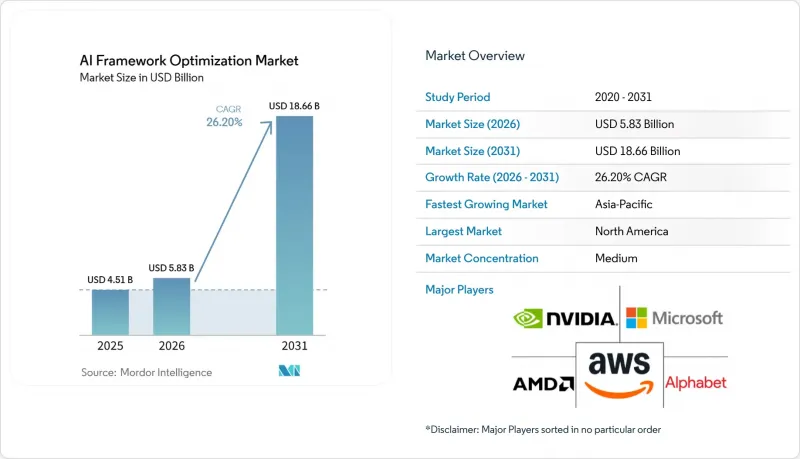
Mordor Intelligence에 의하면, AI 프레임워크 최적화 시장 규모는 2025년 45억 1,000만 달러로 평가되었습니다. 2026년에는 58억 3,000만 달러로 확대되어 2026년부터 2031년에 걸쳐 CAGR 26.20%로 성장을 지속하여, 2031년에는 186억 6,000만 달러에 이를 것으로 예측됩니다.
본 보고서는 솔루션 유형(모델 최적화 및 압축 소프트웨어 등), 도입 환경(On-Premise 및 프라이빗 클라우드, 온디바이스 AI 등), 조직 규모(대기업, 중소기업), 용도(로보틱스, 자율 시스템, 엣지 인텔리전스 등) 및 지역별로 분류되어 있습니다. 시장 전망은 금액(달러) 기준으로 제시되어 있습니다.
세계의 AI 프레임워크 최적화 시장 동향 및 인사이트
초저지연 추론에 대한 수요 증가
현재, 지연 시간은 대화형 AI, 사기 감지, 산업용 제어, 로봇 공학 및 기타 실시간 생산 시스템에서 기본적인 운영 요건이 되었습니다. 응답 시간 개선은 사용자 경험, 인프라 활용도, 서비스 안정성에 직접적인 영향을 미치기 때문에 AI 프레임워크 최적화 시장이 혜택을 보고 있습니다. 이러한 압박은 에이전트형 시스템에서 특히 강하게 나타나는데, 이는 단일 워크플로가 결과를 반환하기까지 여러 모델 호출, 데이터 수집 단계, 도구 조작을 유발할 가능성이 있기 때문입니다. NVIDIA는 2026년 2월, Blackwell 아키텍처에서 DFlash를 통한 투기적 디코딩을 통해 특정 워크로드에서 최대 15배의 처리량 향상을 달성했다고 보고했습니다. 이는 소프트웨어 계층에서 여전히 상당한 성능 개선 여지가 있음을 보여줍니다. 이러한 여지가 남아 있기 때문에 구매자들은 추론 속도를 ‘이미 해결된 문제’로 간주하기보다는 배치 처리, 캐시, 토큰 스케줄링 및 투기적 실행에 계속 집중하고 있습니다. 따라서 AI 프레임워크 최적화 시장에서는 워크로드가 복잡해짐에 따라, 지연 시간을 프로덕션 환경의 허용 범위 내로 억제할 수 있는 서빙 소프트웨어 및 런타임 제어에 대한 투자가 계속해서 집중되고 있습니다.
생성형 AI와 에이전트형 워크플로우의 성장
생성형 AI는 고립된 시범 프로젝트 단계를 넘어, 현재는 실제 비즈니스 프로세스, 고객 지원 흐름, 개발자용 도구 및 사내 지식 시스템에 더욱 밀접하게 통합되어 있습니다. 에이전트형 워크플로는 기존의 단일 단계 AI 이용 사례보다 더 빠르게 추론 이벤트를 증가시키기 때문에 AI 프레임워크 최적화 시장은 이러한 변화로부터 혜택을 받고 있습니다. 추론 경로, 검색 루프, 외부 도구 호출이 추가될 때마다 메모리 부하, 토큰 처리량 요구 사항, 그리고 더 우수한 실행 계획의 필요성이 높아집니다. NVIDIA는 2026년 3월, 에이전트형 AI 전용으로 설계된 프로세서 ‘Vera’를 발표했습니다. 이는 각 벤더들이 이미 다단계 AI 워크로드의 고부하 런타임 동작에 맞추어 시스템을 재설계하고 있음을 시사합니다. 그 결과, 기업들은 용납할 수 없는 지연을 유발하지 않으면서 프롬프트, 컨텍스트, 모델 라우팅 및 반복 실행을 관리할 수 있는 오케스트레이션 계층을 더욱 중시하게 되었습니다. 에이전트형 설계가 보급됨에 따라, AI 프레임워크 최적화 시장은 단순한 모델 혁신뿐만 아니라 서비스 제공의 효율성과도 밀접하게 연계된 상태가 지속될 것으로 보입니다.
전용 AI 인프라의 높은 비용
최적화는 여전히 프로덕션 환경에서 모델이 실제로 실행되는 하드웨어에 대한 직접적인 접근에 의존하고 있습니다. 따라서 AI 프레임워크 최적화 시장은 대규모 테스트에 필요한 가속기 플릿, 고성능 서버, 그리고 이를 뒷받침하는 전력 및 냉각 능력의 비용으로 인해 여전히 제약을 받고 있습니다. 이러한 부담은 중견 기업의 구매자나 컴퓨팅 리소스의 가용성 및 데이터센터 인프라가 충분하지 않은 지역에서 더욱 크게 다가옵니다. 클라우드 접근은 도움이 되지만, 한편으로는 지속적인 비용 증가로 이어질 수 있으며, 벤치마크, 커널 튜닝, 검증 주기에 대한 직접적인 통제력을 약화시킬 가능성도 있습니다. 유럽연합 집행위원회는 2026년 6월 ‘클라우드·AI 개발법’을 제안하여, 신뢰할 수 있는 클라우드 및 AI 개발을 위한 EU 전역에 걸친 프레임워크를 구축했습니다. 이를 통해 향후 접근 환경이 개선될 가능성은 있지만, 이는 어디까지나 정책적인 대응일 뿐, 즉각적인 효과를 발휘하는 인프라 해결책은 아닙니다. 접근 환경이 실질적으로 확대되기 전까지는 AI 프레임워크 최적화 시장은 효율성 향상을 원하면서도 효과적인 최적화를 수행하기에 충분한 전용 컴퓨팅 리소스를 확보하지 못하는 조직에서 도입 지연에 계속 직면할 것입니다.
부문 분석
2025년, AI 추론 서빙 및 오케스트레이션 소프트웨어는 AI 프레임워크 최적화 시장 점유율의 27.11%를 차지하며 최대 솔루션 부문이 되었습니다. 이러한 선두 위상은 안정적인 지연 시간과 가용성을 확보하여 프로덕션 환경에서 모델을 안정적으로 제공해야만 최적화가 명확한 비즈니스 가치를 창출한다는 사실을 반영합니다. 기업들은 대개 서빙 및 오케스트레이션부터 도입을 시작합니다. 이는 이 계층이 인프라 결정을 사용자 경험, 서비스 연속성 및 운영 비용과 직접적으로 연결하기 때문입니다. 또한, 이 부문은 에이전트형 워크플로우의 활용 확대로부터도 혜택을 받고 있습니다. 에이전트형 워크플로우에서는 모델에 대한 반복적인 호출에 따라, 기존의 AI 도입 시보다 강력한 라우팅, 캐시 및 세션 제어가 요구됩니다. 실용적인 관점에서 볼 때, 이로 인해 AI 프레임워크 최적화 시장은 단순히 고립된 벤치마크 점수를 향상시키는 것이 아니라, 모델을 대규모로 운영할 수 있는 소프트웨어를 중심으로 계속해서 자리매김하게 될 것입니다.
'모델 최적화 및 압축 소프트웨어' 부문의 AI 프레임워크 최적화 시장 규모는 2031년까지 연평균 성장률(CAGR) 27.21%로 확대될 것으로 예측되며, 가장 빠르게 성장하는 솔루션 부문이 될 것입니다. 이러한 성장은 새로운 하드웨어 구매를 통해 모든 도입 문제를 해결하는 것이 아니라, 기존 컴퓨팅 리소스에서 더 많은 처리량을 끌어내려는 상업적 움직임을 반영합니다. 2025년에 발표된 ACL Anthology의 조사에 따르면, 신중한 W8A8-INT 양자화를 통해 대규모 모델에서 FP8과의 정확도 차이가 0.7포인트까지 축소된 것으로 나타났으며, 이를 통해 더 대규모 도입을 위한 실제 운영 수준의 압축 기법의 유효성이 입증되었습니다. 그래프 컴파일, 런타임 가속화, 프로파일링, 관측 가능성 및 관리형 서비스는 각각 모델 준비부터 실제 운영에 이르기까지 서로 다른 단계를 다루기 때문에 여전히 중요합니다. 이를 종합해 보면, AI 프레임워크 최적화 시장에는 광범위한 솔루션 조합이 존재하며, 어떤 고객 환경에서도 단일 카테고리가 다른 모든 카테고리를 대체할 수는 없습니다.
2025년 AI 프레임워크 최적화 시장 규모 중 클라우드 및 하이퍼스케일 데이터센터가 54.33%를 차지하며, 클라우드 인프라가 도입에 있어 주요 수익 기반으로 자리매김했습니다. 이러한 상황은 하이퍼스케일러와 대기업이 공유 추론 플랫폼, 중앙 집중식 모델 업데이트 및 대규모 프로덕션 워크로드를 어느 정도 규모로 운영하고 있는지를 반영합니다. 또한 클라우드 환경에서는 최적화 변경을 한 번만 수행해도 그 이점을 많은 사용자, 팀 및 서비스에 쉽게 적용할 수 있습니다. 파일럿 단계에서 지속적인 프로덕션 운영으로 전환하는 조직에게 이러한 운영상의 편의성은 여전히 큰 이점으로 작용하고 있습니다. 그 결과, AI 프레임워크 최적화 시장에서는 클라우드 네이티브 서빙, 스케줄링 및 가시성 도구에 대한 지출이 계속해서 큰 비중을 차지하고 있습니다.
온디바이스 AI용 AI 프레임워크 최적화 시장 규모는 2031년까지 연평균 성장률(CAGR) 27.62%로 확대될 것으로 예상되며, 이는 도입 환경 중 가장 높은 성장률입니다. 개인정보 보호 요건, 낮은 연결성, 그리고 엄격한 응답 시간 목표로 인해 많은 워크로드를 클라우드 전용 추론만으로는 지원하기 어려워지면서, 로컬 실행이 주목받고 있습니다. NVIDIA는 2026년, 임베디드 자동차 및 로봇 공학용 추론을 위해 'TensorRT Edge-LLM'을 도입했는데, 이는 기기별 최적화 스택이 부상하고 있음을 보여줍니다. 또한, 많은 조직이 단일 런타임에 의존하기보다는 퍼블릭 환경과 프라이빗 환경 모두에 워크로드를 분산시키게 됨에 따라 On-Premise, 엣지 인프라 및 하이브리드 모델의 중요성도 커지고 있습니다. 이러한 다양화로 인해 AI 프레임워크 최적화 시장에서는 여러 도입 경로에 걸쳐 이식성, 거버넌스 및 성능을 동시에 관리할 수 있는 벤더들이 점점 더 우위를 점하고 있습니다.
지역별 분석
2025년, 북미는 AI 프레임워크 최적화 시장 규모의 48.44%를 차지하며, 해당 지역은 매출액 측면에서 1위를 유지했습니다. 미국은 하이퍼스케일 클라우드 용량, 탄탄한 벤더 생태계, 그리고 추론 소프트웨어 및 AI 하드웨어 분야의 꾸준한 제품 출시를 통해 이러한 입지를 공고히 하고 있습니다. 캐나다는 연구 기반과 상용화 네트워크를 통해 지역의 깊이를 더하고 있으며, 이는 모델 개발을 배포 가능한 런타임 및 서빙 도구로 전환하는 데 기여하고 있습니다. 남미는 여전히 규모는 작지만, 기업들이 디지털 인프라를 확장하고 현지에서 AI를 실행할 수 있는 저비용 방법을 모색하고 있어 관심이 높아지고 있습니다.
유럽은 AI 프레임워크 최적화 시장에서 여전히 주요 지역으로 자리 잡고 있습니다. 이는 현재 성능뿐만 아니라 규제가 도입 설계에 큰 영향을 미치고 있기 때문입니다. 2026년 8월 2일부터 전면적으로 적용되는 ‘EU AI법’에 따라, 고위험 시스템을 위한 감사 가능한 최적화 워크플로의 가치가 높아지고 있습니다. 독일, 영국, 프랑스는 신뢰성 높은 추론 동작이 요구되는 제조, 금융 서비스, 의료, 공공 부문의 이용 사례를 통해 주요 수요 거점으로 부상하고 있습니다. 또한, 유럽 집행위원회가 2026년 6월에 제안한 ‘클라우드·AI 개발법’ 역시 보다 견고한 주권적 컴퓨팅 프레임워크 구축을 지향하고 있으며, 이는 유럽 전역에서 On-Premise 및 하이브리드 스택의 도입을 지원하고, 인근 규제 시장의 구매자 우선순위에 영향을 미칠 가능성이 있습니다.
아시아태평양은 2031년까지 연평균 성장률(CAGR) 27.42%로 확대될 것으로 예측되며, AI 프레임워크 최적화 시장에서 가장 빠르게 성장하는 지역 블록이 될 전망입니다. 이 지역의 성장은 정부 주도의 AI 인프라 계획, 대규모 기기 제조 거점, 그리고 국내 소프트웨어 생태계에 대한 관심 증가에 힘입고 있습니다. 중국, 인도, 일본, 한국은 각각 다른 방식으로 기여하고 있는데, 중국은 자립성을 중시하고, 인도는 컴퓨팅 접근성을 확대하며, 일본은 AI 투자를 산업 현대화와 연계하고, 한국은 하드웨어 및 기기 생태계를 지원하고 있습니다. 동남아시아에서는 인도네시아, 말레이시아, 베트남의 기업들이 실험 단계에서 보다 안정적인 운영 단계로 전환함에 따라 더욱 탄력을 받고 있습니다. 중동 및 아프리카에서도 국가 주도의 AI 프로그램과 현지 데이터 관련 이니셔티브를 통해 클라우드, 프라이빗, 엣지 환경을 아우르는 최적화 소프트웨어에 대한 관심이 높아지면서 활동이 활발해지고 있습니다.
기타 혜택 :
- 엑셀 형식 시장 예측(ME) 시트
- 3개월간의 애널리스트 지원
자주 묻는 질문
목차
제1장 서론
제2장 조사 방법
제3장 주요 요약
제4장 시장 구도
제5장 시장 규모 및 성장 예측
제6장 경쟁 구도
제7장 시장 기회 및 향후 전망
KTH 26.08.10According to Mordor Intelligence, the AI framework optimization market size is expected to grow from USD 4.51 billion in 2025 to USD 5.83 billion in 2026 and is forecast to reach USD 18.66 billion by 2031 at 26.20% CAGR over 2026-2031.
This report is Segmented by Solution Type (Model Optimization and Compression Software, and More), Deployment Environment (On-Premises and Private Cloud, On-Device AI, and More), Organization Size (Large Enterprises, and Small and Medium Enterprises), Application (Robotics, Autonomous Systems, and Edge Intelligence, and More), and Geography. The Market Forecasts are Provided in Terms of Value (USD).
Global AI Framework Optimization Market Trends and Insights
Rising Demand for Ultra-Low Latency Inferencing
Latency is now a basic operating requirement in conversational AI, fraud detection, industrial control, robotics, and other live production systems. The AI framework optimization market is benefiting because every improvement in response time now has a direct effect on user experience, infrastructure utilization, and service consistency. This pressure is stronger in agentic systems, where a single workflow can trigger multiple model calls, retrieval steps, and tool actions before a result is returned. NVIDIA reported in February 2026 that DFlash speculative decoding on Blackwell architecture delivered throughput gains of up to 15x on specific workloads, which shows that large performance headroom still exists at the software layer. That remaining headroom keeps buyers focused on batching, caching, token scheduling, and speculative execution rather than treating inference speed as a solved problem. The AI framework optimization market therefore continues to draw spending into serving software and runtime controls that can hold latency inside production thresholds as workloads become more complex.
Growth of Generative AI And Agentic Workflows
Generative AI has moved beyond isolated pilots and now sits closer to real business processes, customer support flows, developer tools, and internal knowledge systems. The AI framework optimization market is gaining from this shift because agentic workflows multiply inference events faster than traditional single-step AI use cases. Each added reasoning pass, retrieval loop, and external tool call increases memory pressure, token throughput requirements, and the need for better execution planning. NVIDIA introduced Vera in March 2026 as a processor purpose-built for agentic AI, which signals that vendors are already redesigning systems around the heavy runtime behavior of multi-step AI workloads. The practical result is that enterprises are placing more value on orchestration layers that can manage prompts, context, model routing, and repeated execution without unacceptable delay. As agentic designs spread, the AI framework optimization market is likely to stay closely linked to serving efficiency rather than only to model innovation.
High Cost of Specialized AI Infrastructure
Optimization still depends on direct access to the hardware on which models will actually run in production. The AI framework optimization market therefore remains constrained by the cost of accelerator fleets, high-performance servers, and the supporting power and cooling capacity needed to test at scale. This burden is heavier for mid-market buyers and for regions where compute availability and data center readiness are less developed. Cloud access helps, but it can also add recurring expense and reduce direct control over benchmarking, kernel tuning, and validation cycles. The European Commission proposed the Cloud and AI Development Act in June 2026 to create an EU-wide framework for trusted cloud and AI development, which could improve access over time, but this is still a policy response rather than an immediate infrastructure fix. Until access broadens materially, the AI framework optimization market will continue to face slower adoption among organizations that want efficiency gains but cannot secure enough specialized compute to optimize effectively.
Other drivers and restraints analyzed in the detailed report include:
- Rising Enterprise Spending on AI Runtime Efficiency
- Expansion of Edge AI and On-Device Intelligence
- Framework Fragmentation and Integration Complexity
For complete list of drivers and restraints, kindly check the Table Of Contents.
Segment Analysis
AI Inference Serving and Orchestration Software held 27.11% of the AI framework optimization market share in 2025, which made it the largest solution segment. Its lead reflects the fact that optimization only creates visible business value when models can be served reliably in production with stable latency and availability. Enterprises often begin with serving and orchestration because this layer connects infrastructure decisions directly to user experience, service continuity, and operating cost. The segment also benefits from growing use of agentic workflows, where repeated model calls require stronger routing, caching, and session control than earlier AI deployments. In practical terms, this keeps the AI framework optimization market centered on software that can operationalize models at scale rather than simply improve isolated benchmark scores.
The AI framework optimization market size for Model Optimization and Compression Software is projected to expand at 27.21% CAGR through 2031, making it the fastest-growing solution segment. This growth reflects the commercial push to extract more throughput from existing compute rather than solve every deployment problem with new hardware purchases. ACL Anthology research published in 2025 showed that careful W8A8-INT quantization narrowed the reported accuracy gap versus FP8 to 0.7 points on large models, which helped validate production-grade compression pathways for larger deployments. Graph compilation, runtime acceleration, profiling, observability, and managed services remain important because each handles a different stage between model preparation and live execution. Taken together, these layers give the AI framework optimization market a broad solution mix where no single category can replace the others across all customer environments.
Cloud and Hyperscale Data Centers accounted for 54.33% of the AI framework optimization market size in 2025, which kept cloud infrastructure as the main revenue base for deployment. This position reflects the scale at which hyperscalers and large enterprises run shared inference platforms, centralized model updates, and heavy production workloads. Cloud environments also make it easier to roll out optimization changes once and distribute the benefit across many users, teams, and services. For organizations moving from pilot work into sustained production, that operational simplicity remains a strong advantage. As a result, the AI framework optimization market continues to send a large share of spending toward cloud-native serving, scheduling, and observability tools.
The AI framework optimization market size for On-Device AI is projected to expand at 27.62% CAGR through 2031, the fastest rate among deployment environments. Local execution is gaining because privacy requirements, weak connectivity, and strict response-time targets make many workloads difficult to support through cloud-only inference. NVIDIA introduced TensorRT Edge-LLM in 2026 for embedded automotive and robotics inference, which highlights the rise of device-specific optimization stacks. On-premises, edge infrastructure, and hybrid models are also becoming more relevant because many organizations now split workloads across public and private environments instead of relying on a single runtime. This diversification means the AI framework optimization market increasingly rewards vendors that can manage portability, governance, and performance across several deployment paths at once.
Complete Report Scope:
- By Solution Type
- Model Optimization and Compression Software
- Graph Compilation and Kernel Optimization Software
- AI Runtime and Hardware Acceleration Software
- AI Inference Serving and Orchestration Software
- Performance Profiling, Benchmarking, and Observability Tools
- Professional and Managed Optimization Services
- By Deployment Environment
- Cloud and Hyperscale Data Centers
- On-Premises and Private Cloud
- Edge Infrastructure
- On-Device AI
- Hybrid Deployment
- By Organization Size
- Large Enterprises
- Small and Medium Enterprises
- By Application
- Generative AI, Large Language Models, and Multimodal AI
- Natural Language Processing and Document Intelligence
- Computer Vision and Video Analytics
- Speech and Audio AI
- Recommendation, Search, and Personalization Engines
- Predictive Analytics, Classical ML, and Decision Intelligence
- Robotics, Autonomous Systems, and Edge Intelligence
- Other Applications
- By Geography
- North America
- United States
- Canada
- Mexico
- Europe
- Germany
- United Kingdom
- France
- Italy
- Rest of Europe
- Asia-Pacific
- China
- Japan
- South Korea
- India
- Southeast Asia
- Rest of Asia-Pacific
- South America
- Middle East and Africa
- North America
Geography Analysis
North America accounted for 48.44% of the AI framework optimization market size in 2025, which kept the region in the lead on revenue. The United States anchors this position through hyperscale cloud capacity, a dense vendor ecosystem, and a steady pace of product launches across inference software and AI hardware. Canada adds regional depth through its research base and commercialization networks, which help move model work into deployable runtime and serving tools. South America remains smaller, but interest is rising where enterprises are expanding digital infrastructure and looking for lower-cost ways to support local AI execution.
Europe remains a major region in the AI framework optimization market because regulation now shapes deployment design as much as performance does. The EU AI Act, which became fully applicable from August 2, 2026, increases the value of auditable optimization workflows for high-risk systems. Germany, the United Kingdom, and France form the main demand centers through manufacturing, financial services, healthcare, and public-sector use cases that require reliable inference behavior. The European Commission's June 2026 proposal for the Cloud and AI Development Act also points to stronger sovereign compute frameworks, which can support on-premises and hybrid stack adoption across Europe and influence buyer priorities in nearby regulated markets.
Asia-Pacific is projected to expand at 27.42% CAGR through 2031, making it the fastest-growing regional block in the AI framework optimization market. Growth in the region is supported by government-backed AI infrastructure plans, very large device manufacturing bases, and stronger interest in domestic software ecosystems. China, India, Japan, and South Korea each contribute in different ways, with China emphasizing self-reliance, India widening access to compute, Japan linking AI investment to industrial modernization, and South Korea supporting hardware and device ecosystems. Southeast Asia adds momentum because enterprises in Indonesia, Malaysia, and Vietnam are moving from experimentation toward more stable operational deployment. Middle East and Africa also show rising activity as sovereign AI programs and local data initiatives increase interest in optimization software that can work across cloud, private, and edge environments.
- NVIDIA Corporation
- Advanced Micro Devices, Inc.
- Intel Corporation
- Alphabet Inc.
- Microsoft Corporation
- Amazon Web Services, Inc.
- IBM Corporation
- Oracle Corporation
- Meta Platforms, Inc.
- Qualcomm Incorporated
- Graphcore Limited
- Cerebras Systems, Inc.
- Hugging Face, Inc.
- Groq, Inc.
- Modular, Inc.
- Hailo Technologies Ltd.
- SambaNova Systems, Inc.
- Red Hat, Inc.
- Hewlett Packard Enterprise Company
- Google DeepMind
Additional Benefits:
- The market estimate (ME) sheet in Excel format
- 3 months of analyst support
TABLE OF CONTENTS
1 INTRODUCTION
- 1.1 Study Assumptions and Market Definition
- 1.2 Scope of the Study
2 RESEARCH METHODOLOGY
3 EXECUTIVE SUMMARY
4 MARKET LANDSCAPE
- 4.1 Market Overview
- 4.2 Impact of Macroeconomic Factors on the Market
- 4.3 Market Drivers
- 4.3.1 Rising Demand for Ultra-Low Latency Inferencing
- 4.3.2 Expansion of Edge AI and On-Device Intelligence
- 4.3.3 Rising Enterprise Spending on AI Runtime Efficiency
- 4.3.4 Growth of Generative AI and Agentic Workflows
- 4.3.5 Hardware-Agnostic Optimization and Interoperability Needs
- 4.3.6 Data Sovereignty and Privacy-First AI Deployment
- 4.4 Market Restraints
- 4.4.1 High Cost of Specialized AI Infrastructure
- 4.4.2 Framework Fragmentation and Integration Complexity
- 4.4.3 Shortage of AI Optimization and Systems Talent
- 4.4.4 Model Accuracy Trade-Offs During Compression
- 4.5 Industry Value Chain Analysis
- 4.6 Regulatory Landscape
- 4.7 Technological Outlook
- 4.8 Porter's Five Forces Analysis
- 4.8.1 Bargaining Power of Suppliers
- 4.8.2 Bargaining Power of Buyers
- 4.8.3 Threat of New Entrants
- 4.8.4 Threat of Substitutes
- 4.8.5 Intensity of Competitive Rivalry
5 MARKET SIZE AND GROWTH FORECASTS (VALUE)
- 5.1 By Solution Type
- 5.1.1 Model Optimization and Compression Software
- 5.1.2 Graph Compilation and Kernel Optimization Software
- 5.1.3 AI Runtime and Hardware Acceleration Software
- 5.1.4 AI Inference Serving and Orchestration Software
- 5.1.5 Performance Profiling, Benchmarking, and Observability Tools
- 5.1.6 Professional and Managed Optimization Services
- 5.2 By Deployment Environment
- 5.2.1 Cloud and Hyperscale Data Centers
- 5.2.2 On-Premises and Private Cloud
- 5.2.3 Edge Infrastructure
- 5.2.4 On-Device AI
- 5.2.5 Hybrid Deployment
- 5.3 By Organization Size
- 5.3.1 Large Enterprises
- 5.3.2 Small and Medium Enterprises
- 5.4 By Application
- 5.4.1 Generative AI, Large Language Models, and Multimodal AI
- 5.4.2 Natural Language Processing and Document Intelligence
- 5.4.3 Computer Vision and Video Analytics
- 5.4.4 Speech and Audio AI
- 5.4.5 Recommendation, Search, and Personalization Engines
- 5.4.6 Predictive Analytics, Classical ML, and Decision Intelligence
- 5.4.7 Robotics, Autonomous Systems, and Edge Intelligence
- 5.4.8 Other Applications
- 5.5 By Geography
- 5.5.1 North America
- 5.5.1.1 United States
- 5.5.1.2 Canada
- 5.5.1.3 Mexico
- 5.5.2 Europe
- 5.5.2.1 Germany
- 5.5.2.2 United Kingdom
- 5.5.2.3 France
- 5.5.2.4 Italy
- 5.5.2.5 Rest of Europe
- 5.5.3 Asia-Pacific
- 5.5.3.1 China
- 5.5.3.2 Japan
- 5.5.3.3 South Korea
- 5.5.3.4 India
- 5.5.3.5 Southeast Asia
- 5.5.3.6 Rest of Asia-Pacific
- 5.5.4 South America
- 5.5.5 Middle East and Africa
- 5.5.1 North America
6 COMPETITIVE LANDSCAPE
- 6.1 Market Concentration
- 6.2 Strategic Moves
- 6.3 Market Positioning Analysis
- 6.4 Company Profiles (includes Global Level Overview, Market Level Overview, Core Segments, Financials as available, Strategic Information, Market Rank/Share, Products and Services, Recent Developments)
- 6.4.1 NVIDIA Corporation
- 6.4.2 Advanced Micro Devices, Inc.
- 6.4.3 Intel Corporation
- 6.4.4 Alphabet Inc.
- 6.4.5 Microsoft Corporation
- 6.4.6 Amazon Web Services, Inc.
- 6.4.7 IBM Corporation
- 6.4.8 Oracle Corporation
- 6.4.9 Meta Platforms, Inc.
- 6.4.10 Qualcomm Incorporated
- 6.4.11 Graphcore Limited
- 6.4.12 Cerebras Systems, Inc.
- 6.4.13 Hugging Face, Inc.
- 6.4.14 Groq, Inc.
- 6.4.15 Modular, Inc.
- 6.4.16 Hailo Technologies Ltd.
- 6.4.17 SambaNova Systems, Inc.
- 6.4.18 Red Hat, Inc.
- 6.4.19 Hewlett Packard Enterprise Company
- 6.4.20 Google DeepMind
7 MARKET OPPORTUNITIES AND FUTURE OUTLOOK
- 7.1 White-Space and Unmet-Need Assessment


