

|
시장보고서
상품코드
2099426
중동 및 아프리카의 사료용 방부제 : 시장 점유율 분석, 업계 동향 및 통계, 성장 예측(2026-2031년)Middle East and Africa Feed Antioxidants - Market Share Analysis, Industry Trends & Statistics, Growth Forecasts (2026 - 2031) |
||||||
 Mordor Intelligence
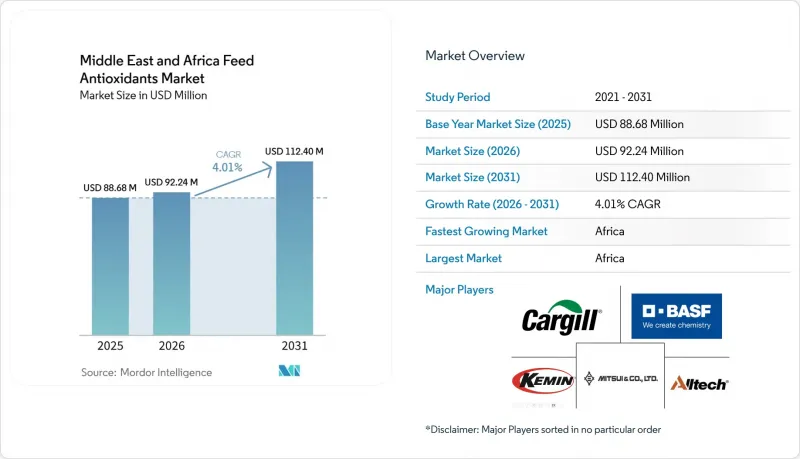
Mordor Intelligence에 의하면, 중동 및 아프리카의 사료용 방부제 시장 규모는 2025년 8,868만 달러로 평가되었습니다. 2026년 9,224만 달러에서 2031년까지 1억 1,240만 달러로 확대되어 2026년부터 2031년에 걸쳐 CAGR 4.01%를 나타낼 것으로 예측됩니다.
본 보고서는 부가제별(BHA, BHT 등), 동물별(반추동물, 가금류 등), 지역별(중동 및 아프리카)로 분류되어 있습니다. 시장 전망은 금액(달러) 및 수량(메트릭 톤)으로 제시되어 있습니다.
중동 및 아프리카의 사료용 방부제 시장 동향 및 인사이트
상업용 가금류 및 육계 생산량 증가
통계청 데이터에 따르면, 사우디아라비아는 2024년에 130만 메트릭톤의 육계 고기를 생산했으며, 이는 해당국의 대규모 상업용 가금류 부문과 이에 따른 막대한 사료 소비 수요를 반영합니다. 미국 농무부(USDA) 보고서에 따르면, 이집트는 여전히 주요 가금류 생산국으로, 2024년에는 약 19억 9,000만 마리가 도축되어 가금류 생산량은 약 250만 메트릭 톤에 달했습니다. 이러한 생산 시스템에서는 대량의 사료 배치, 보다 엄격한 재고 관리, 그리고 완제품 사료의 안정성이 요구되므로, 항산화제 사용은 상업적 규모와 밀접한 관련이 있습니다. 중동 및 아프리카의 사료용 방부제 시장은 이러한 추세의 혜택을 받고 있습니다. 조직적인 양계 산업의 성장으로 인해 산발적인 구매가 아닌 안정적인 첨가제 수요가 발생하고 있기 때문입니다. 정부 주도의 식량 안보 프로그램 또한 이러한 수요를 더욱 부추기고 있습니다. 이는 사료 소비량이 단기적인 소매 수요뿐만 아니라 지원되는 생산 목표에 따라 증가하기 때문입니다. 양계 시스템이 더욱 집약화됨에 따라, 저장 및 운송 중 사료 내 지방을 보호해야 할 필요성이 중동 및 아프리카의 사료용 방부제 시장을 지속적으로 뒷받침할 것입니다.
고온의 보관·운송 환경에서 사료의 유통 기한에 가해지는 압박
이 지역 전체적으로 주변 온도가 높기 때문에 특히 사료가 야외 야적장, 항만 및 온도 관리가 되지 않는 저장 시설을 통과할 때 지방을 함유한 사료 원료의 지질 산화 위험이 높아집니다. 이러한 운영 환경으로 인해, 특히 걸프 지역과 북아프리카에서는 산화 방지가 상업용 사료 공장의 표준 배합 요건이 되었습니다. 이 문제는 사료가 수입 곡물, 유지, 단백질박에 의존하고 있으며, 제분 전에 장기간 운송되는 경우에 더욱 두드러집니다. 이러한 물리적 제약은 취급 방법의 변경만으로는 해결하기 어려우며, 중동 및 아프리카의 사료용 방부제 시장에 대한 안정적인 수요를 지속적으로 뒷받침하고 있습니다. 산화방지제 사용량을 줄인 사료 공장이라 하더라도 산패, 사료 품질 저하 및 유통기한 단축에 따른 상업적 비용 문제에 여전히 직면해 있습니다. 그 결과, 기후 및 물류 여건이 중동 및 아프리카의 사료용 산화방지제 시장 전반에 걸쳐 안정적인 수요 기반을 지속적으로 유지하고 있습니다.
합성 항산화제 사용에 대한 규제상의 불확실성
EU의 에톡시킨 승인 거부는 중동 및 아프리카 전체에 걸쳐 규제가 통일되어 있지는 않더라도, 사료용 방부제 사용에 관한 광범위한 규제 환경에 변화를 가져왔습니다. 나이지리아가 2025년부터 식용 동물사료에 에톡시킨 사용을 금지하는 규제 지침을 발표함에 따라, 시장 특유의 규정 준수 압박이 커지고 있습니다. 또한 모로코도 2024년에 동물사료의 품질, 안전성 및 표시 기준을 공식적으로 제정함으로써, 해당 지역 일부에서 사료 첨가물에 대한 규제가 강화되고 있음을 보여주고 있습니다. 이러한 변화로 인해 중동 및 아프리카의 사료용 방부제 시장에서 합성 항산화제가 완전히 배제되는 것은 아니지만, 공급업체 입장에서는 등록, 배합 변경 및 제품 포트폴리오 계획에 드는 비용이 증가하게 될 것입니다. 수출 관련 판로를 담당하는 바이어들도 규제 변경에 선제적으로 대응하여, 현지 규정이 개정되기 전에 일부 기존 제품에 대한 수요를 다른 제품으로 전환할 가능성이 있습니다. 따라서 중동 및 아프리카의 사료용 방부제 시장이 직면한 제약 요인은 최근의 지역적 금지 조치라기보다는 시장마다 다른 규정 준수 위험에서 기인한 것입니다.
부문 분석
2025년 기준, 구연산은 시장에서 가장 큰 비중을 차지하는 하위 첨가제로 38.4%의 점유율을 기록했습니다. 이러한 위상은 금속 이온을 킬레이트화하여 항산화 성능을 높이고, 사료의 안정성을 향상시키며, 가금류, 반추동물, 수산 양식 및 배합 사료 용도에서 유통 기한을 연장하는 다기능 첨가제로 널리 사용되고 있기 때문입니다. 합성 및 천연 항산화 시스템과의 폭넓은 호환성에 더해, 높은 비용 효율성과 규제 당국의 승인이 결합되어 상업용 사료 제조 분야에서 널리 채택되는 기반이 되고 있습니다. BHA, BHT 및 에톡시퀸은 계속해서 주요 항산화제 부문을 차지하고 있으며, BHT는 비용 효율적인 사료 배합을 유지하면서 산화 안정성을 향상시키기 위해 BHA와 병용되는 경우가 많았습니다. 또한, 에톡시퀸은 수산 사료에 사용되는 고다불포화지방산을 함유한 어분의 보존에서도 계속해서 중요한 역할을 하고 있는 반면, TBHQ(tert-부틸하이드로퀴논) 및 특수 블렌드를 포함한 기타 항산화제는 틈새 시장용 배합 요건을 지속적으로 충족시키고 있습니다.
토코페롤은 첨가제 중 가장 빠르게 성장하는 하위 카테고리로, 2026년부터 2031년까지 연평균 성장률(CAGR) 4.1%로 확대될 것으로 예측됩니다. 이러한 성장은 남아프리카와 이집트의 수출 지향적 생산자들이 유럽연합(EU) 및 GCC(걸프협력회의)의 프리미엄 시장을 겨냥해 에톡시퀸을 사용하지 않는 배합으로 전환함에 따라 발생하는 규제 준수를 배경으로 한 수요에 힘입은 것입니다. 이러한 변화로 인해 일부 사료 프로그램에서 토코페롤은 ‘프리미엄 선택지’에서 보다 일반적인 조달 요건으로 변모하고 있습니다. 프로파일갈레이트는 수산 사료 배합에서의 활용 확대와 아시아 공급업체들공급 개선에 힘입어 성장하고 있습니다. 2025년 『Animal Nutrition』지에 게재된 연구에서는 기본적인 지질 보존 효과를 넘어선 항산화 작용, 항염증 작용 및 성장 촉진 효과를 입증하여 토코페롤의 유용성을 더욱 뒷받침하는 결과를 보여주었습니다.
기타 혜택 :
- 엑셀 형식 시장 예측(ME) 시트
- 3개월간의 애널리스트 지원
자주 묻는 질문
목차
제1장 서론
제2장 개 보고서의 내용
제3장 주요 요약 및 주요 조사 결과
제4장 주요 업계 동향
제5장 시장 규모 및 성장 예측
제6장 경쟁 구도
제7장 CEO가 직면하는 중요 전략적 과제
KTH 26.08.10According to Mordor Intelligence, the Middle East and Africa feed antioxidants market size is projected to grow from USD 88.68 million in 2025 and USD 92.24 million in 2026 to USD 112.40 million by 2031, registering a CAGR of 4.01% between 2026 and 2031.
This report is Segmented by Sub-Additive (BHA, BHT, and More), by Animal Type (Ruminant, Poultry, and More), and by Geography (Middle East and Africa). The Market Forecasts are Provided in Terms of Value (USD) and Volume (Metric Tons).
Middle East and Africa Feed Antioxidants Market Trends and Insights
Rising Commercial Poultry and Broiler Output
According to the Ministry of Statistics data, Saudi Arabia produced 1.3 million metric tons of broiler meat in 2024, reflecting the country's large commercial poultry sector and substantial feed consumption requirements. USDA report said Egypt remained a major poultry producer, with nearly 1.99 billion birds processed and poultry meat output of approximately 2.5 million metric tons in 2024. These production systems require large feed batches, tighter inventory management, and greater finished-feed stability, which keeps antioxidant use closely tied to commercial scale. The Middle East and Africa feed antioxidants market benefits from this pattern, as organized poultry growth generates consistent additive demand rather than sporadic purchasing. Government-backed food security programs further support this demand, since feed consumption rises in line with supported production targets rather than short-term retail demand alone. As poultry systems become more intensive, the need to protect feed fats during storage and transportation will continue to support the Middle East and Africa feed antioxidants market.
Feed Shelf-Life Pressure in Hot Storage and Transport Conditions
High ambient temperatures across the region increase the risk of lipid oxidation in fat-containing feed ingredients, particularly when feed moves through open yards, ports, and non-climate-controlled storage facilities. This operating environment makes oxidation control a standard formulation requirement for commercial mills, especially in the Gulf and North Africa. The problem is more pronounced when feed relies on imported grains, oils, and protein meals that spend extended periods in transit before milling. These physical constraints are difficult to address through handling changes alone, providing consistent support for the Middle East and Africa feed antioxidants market. Mills that reduce antioxidant use still face the commercial costs of rancidity, reduced feed quality, and shorter storage windows. As a result, climate and logistics conditions continue to sustain a steady base of demand across the Middle East and Africa feed antioxidants market.
Regulatory Uncertainty Around Synthetic Antioxidant Usage
The EU's denial of authorization for ethoxyquin has altered the broader regulatory context around feed antioxidant use, even though rules are not uniform across the Middle East and Africa region. Nigeria's regulatory directive banning ethoxyquin in 2025 in feed for food-producing animals adds market-specific compliance pressure. Morocco also formalized animal feed quality, safety, and labeling standards in 2024, indicating that feed additive governance is tightening in parts of the region. These changes do not remove synthetic antioxidants from the Middle East and Africa feed antioxidants market, but they do increase registration, reformulation, and portfolio planning costs for suppliers. Buyers serving export-linked channels may also respond ahead of regulatory changes, shifting demand away from some legacy products before local rules are updated. The restraint facing the Middle East and Africa feed antioxidants market therefore stems less from an immediate regional ban and more from uneven compliance risk across markets.
Other drivers and restraints analyzed in the detailed report include:
- Shift Toward High-Performance Synthetic Antioxidants in Cost-Sensitive Feed Mills
- Expanding Feed Premix Standardization Among Large Integrators
- Price Volatility in Key Feed Additive Inputs
For complete list of drivers and restraints, kindly check the Table Of Contents.
Segment Analysis
Citric acid was the largest sub-additive in the market in 2025, with 38.4% share. Its position is attributed to its widespread use as a multifunctional additive that enhances antioxidant performance by chelating metal ions, improving feed stability, and extending shelf life across poultry, ruminant, aquaculture, and compound feed applications. Its broad compatibility with both synthetic and natural antioxidant systems, coupled with its cost-effectiveness and regulatory acceptance, has supported its extensive adoption across commercial feed manufacturing. BHA, BHT, and ethoxyquin continued to represent the major antioxidant segment, with BHT frequently used alongside BHA to improve oxidative stability while maintaining cost-efficient feed formulations. Ethoxyquin also remained important in preserving high-polyunsaturated fishmeal used in aquaculture feed, while other antioxidants, including TBHQ (tert-butylhydroquinone) and specialty blends, continued to serve niche formulation requirements.
Tocopherols were the fastest-growing sub-additive and are anticipated to expand at a 4.1% CAGR between 2026 and 2031. Growth is being supported by compliance-driven demand as export-oriented producers in South Africa and Egypt shift toward ethoxyquin-free formulations for European Union and premium GCC (Gulf Cooperation Council) channels. This shift is turning tocopherols from a premium choice into a more regular procurement requirement in some feed programs. Propyl gallate, supported by wider use in blended aquafeed formulations and improved availability from Asian suppliers. Research published in Animal Nutrition in 2025 further supported the case for tocopherols by demonstrating antioxidant, anti-inflammatory, and growth-related benefits beyond basic lipid preservation .
Complete Report Scope:
- By Sub-Additive
- Butylated Hydroxyanisole (BHA)
- Butylated Hydroxytoluene (BHT)
- Citric Acid
- Ethoxyquin
- Propyl Gallate
- Tocopherols
- Other Antioxidants
- By Animal
- Ruminants
- Beef Cattle
- Dairy Cattle
- Other Ruminants
- Poultry
- Broiler
- Layer
- Other Poultry Birds
- Swine
- Aquaculture
- Fish
- Shrimp
- Other Aquaculture Species
- Other Animals
- Ruminants
- By Geography
- Middle East
- Saudi Arabia
- United Arab Emirates
- Rest of Middle East
- Africa
- South Africa
- Egypt
- Rest of Africa
- Middle East
List of Companies Covered in this Report:
- BASF SE
- Cargill, Incorporated
- Kemin Industries, Inc.
- Alltech Inc.
- Novus International, Inc. (Mitsui & Co., Ltd. and Nippon Soda Co., Ltd.)
- Impextraco N.V.
- Solvay S.A.
- EW Nutrition GmbH (EW Group)
- Adisseo France S.A.S. (Sinochem Holdings Corporation Ltd.)
- De Heus Animal Nutrition
- Phibro Animal Health Corporation
- Perstorp Holding AB (Publ.) (PETRONAS Chemicals Group Berhad)
- Layn Natural Ingredients Corp (Guilin Layn Natural Ingredients Corp)
- Pancosma SA (Archer-Daniels-Midland)
- Bioiberica S.A.U.
- DSM-Firmenich AG
- Nutreco N.V.
Additional Benefits:
- The market estimate (ME) sheet in Excel format
- 3 months of analyst support
TABLE OF CONTENTS
1 INTRODUCTION
- 1.1 Study Assumptions and Market Definition
- 1.2 Scope of the Study
- 1.3 Research Methodology
2 REPORT OFFERS
3 EXECUTIVE SUMMARY AND KEY FINDINGS
4 KEY INDUSTRY TRENDS
- 4.1 Animal Headcount
- 4.1.1 Poultry
- 4.1.2 Ruminants
- 4.1.3 Swine
- 4.2 Feed Production
- 4.2.1 Aquaculture
- 4.2.2 Poultry
- 4.2.3 Ruminants
- 4.2.4 Swine
- 4.3 Regulatory Framework
- 4.3.1 Saudi Arabia
- 4.3.2 United Arab Emirates
- 4.3.3 South Africa
- 4.3.4 Egypt
- 4.3.5 Rest of Middle East
- 4.3.6 Rest of Africa
- 4.4 Market Drivers
- 4.4.1 Rising commercial poultry and broiler output
- 4.4.2 Feed shelf-life pressure in hot storage and transport conditions
- 4.4.3 Shift toward high-performance synthetic antioxidants in cost-sensitive feed
- 4.4.4 Expanding feed premix standardization among large integrators
- 4.4.5 Mycotoxin risk management increasing oxidation control in compound feed
- 4.4.6 Export-oriented meat supply chains raising feed quality requirements
- 4.5 Market Restraints
- 4.5.1 Regulatory uncertainty around synthetic antioxidant usage
- 4.5.2 Price volatility in key feed additive inputs
- 4.5.3 Fragmented feed mill base limiting premium antioxidant penetration
- 4.5.4 Low technical awareness among smallholder feed users
5 MARKET SIZE AND GROWTH FORECAST(VALUE AND VOLUME)
- 5.1 By Sub-Additive
- 5.1.1 Butylated Hydroxyanisole (BHA)
- 5.1.2 Butylated Hydroxytoluene (BHT)
- 5.1.3 Citric Acid
- 5.1.4 Ethoxyquin
- 5.1.5 Propyl Gallate
- 5.1.6 Tocopherols
- 5.1.7 Other Antioxidants
- 5.2 By Animal
- 5.2.1 Ruminants
- 5.2.1.1 Beef Cattle
- 5.2.1.2 Dairy Cattle
- 5.2.1.3 Other Ruminants
- 5.2.2 Poultry
- 5.2.2.1 Broiler
- 5.2.2.2 Layer
- 5.2.2.3 Other Poultry Birds
- 5.2.3 Swine
- 5.2.4 Aquaculture
- 5.2.4.1 Fish
- 5.2.4.2 Shrimp
- 5.2.4.3 Other Aquaculture Species
- 5.2.5 Other Animals
- 5.2.1 Ruminants
- 5.3 By Geography
- 5.3.1 Middle East
- 5.3.1.1 Saudi Arabia
- 5.3.1.2 United Arab Emirates
- 5.3.1.3 Rest of Middle East
- 5.3.2 Africa
- 5.3.2.1 South Africa
- 5.3.2.2 Egypt
- 5.3.2.3 Rest of Africa
- 5.3.1 Middle East
6 COMPETITIVE LANDSCAPE
- 6.1 Market Concentration
- 6.2 Strategic Moves
- 6.3 Market Share Analysis
- 6.4 Company Profiles (Includes Global Level Overview, Market Level Overview, Core Business Segments, Financials as available, Strategic Information, Market Rank/Share for key companies, Products and Services, and Recent Developments)
- 6.4.1 BASF SE
- 6.4.2 Cargill, Incorporated
- 6.4.3 Kemin Industries, Inc.
- 6.4.4 Alltech Inc.
- 6.4.5 Novus International, Inc. (Mitsui & Co., Ltd. and Nippon Soda Co., Ltd.)
- 6.4.6 Impextraco N.V.
- 6.4.7 Solvay S.A.
- 6.4.8 EW Nutrition GmbH (EW Group)
- 6.4.9 Adisseo France S.A.S. (Sinochem Holdings Corporation Ltd.)
- 6.4.10 De Heus Animal Nutrition
- 6.4.11 Phibro Animal Health Corporation
- 6.4.12 Perstorp Holding AB (Publ.) (PETRONAS Chemicals Group Berhad)
- 6.4.13 Layn Natural Ingredients Corp (Guilin Layn Natural Ingredients Corp)
- 6.4.14 Pancosma SA (Archer-Daniels-Midland)
- 6.4.15 Bioiberica S.A.U.
- 6.4.16 DSM-Firmenich AG
- 6.4.17 Nutreco N.V.


